Books in the Zaragoza Inquisition: Bernardi and Vicente
What can we know about a book that we do not examine directly, but encounter only as it is described in a judicial proceeding? The Zaragoza cases of Pedro Bernardi (1509–1510) and Juan Vicente (1511), studied by Manuel José Pedraza García, can be read only by distinguishing their documentary traces: a material description, names used by an accused person, an account of circulation attributed to a declarant, a witness's recollection, or an entry in a register.17
This article advances a deliberately limited thesis: in these two proceedings, books described in the records as books of nigromancy appear in different documentary forms, and what each trace allows us to infer depends on who speaks, at what procedural stage, and in what kind of record. Comparing those forms helps us study how books were described and entered into case files; it does not by itself identify surviving works or measure how much the descriptions weighed in judicial decisions.
Pedro Bernardi: describing an object without identifying a work
What the confession describes
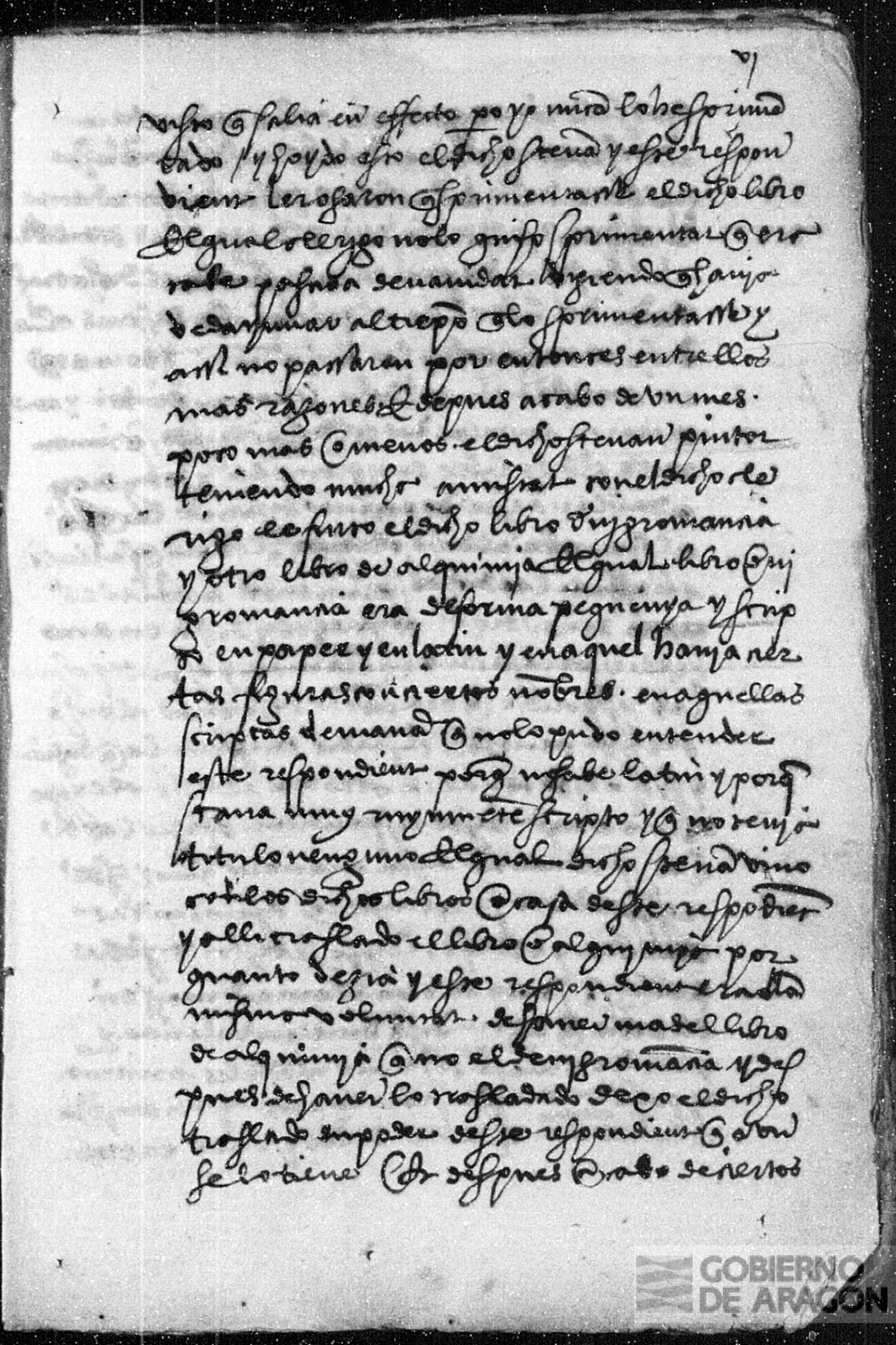
In his confession, Pedro Bernardi distinguished a book of nigromancy from another on alchemy. He said the first was small, written on paper in Latin, contained figures and names, and «no tenia titulo ninguno» (“had no title at all”). He added that he could not understand it because he did not know Latin and because it was badly written.2
These details tell us how Bernardi described the object: its support, size, language and some features of its contents. The absence of a title, and his statement that he could not understand the book, further delimit what the passage can tell us. It offers no author attribution, identifiable work or description sufficient to match the book with a surviving manuscript. This is a characterization made by the accused, not an independent bibliographical record.
The accused person's account and the prosecutor's charge
Bernardi placed the book in an account of lending and a consecration directed by a cleric called mosen Pedro, whom he described as Gascon. In the same confession he recounted an intrusion allegedly arranged by Ramón de Jaunas, who, according to Bernardi, pretended to be an officer of the Inquisition. Pedraza interprets the episode as a deception; the cited file preserves Bernardi's account, not independent confirmation of every scene.34
The prosecutor's charge belongs to a different document and a different voice. One article accused Bernardi of conducting a nine-day experiment with a human skull, candles and fumigations. The confession mentions a consecration and, in a separate passage, objects Bernardi said Jaunas displayed during the intrusion. Partial overlap does not turn the charge into an admission: the passages describe different scenes and different procedural acts.5 The verdict and penance document the judicial outcome, but the passages examined do not establish what weight the book's description carried in it.6
The file also preserves a separate testimony by Miguel Sánchez, cited by Pedraza, conveying what the witness said he had heard from mosen Pedro about the book and an experiment to win at gambling.1 That deposition should not be conflated with Bernardi's later confession or with the prosecutor's charge.
Juan Vicente: titles, circulation and a register entry
An account of circulation attributed to the declarant
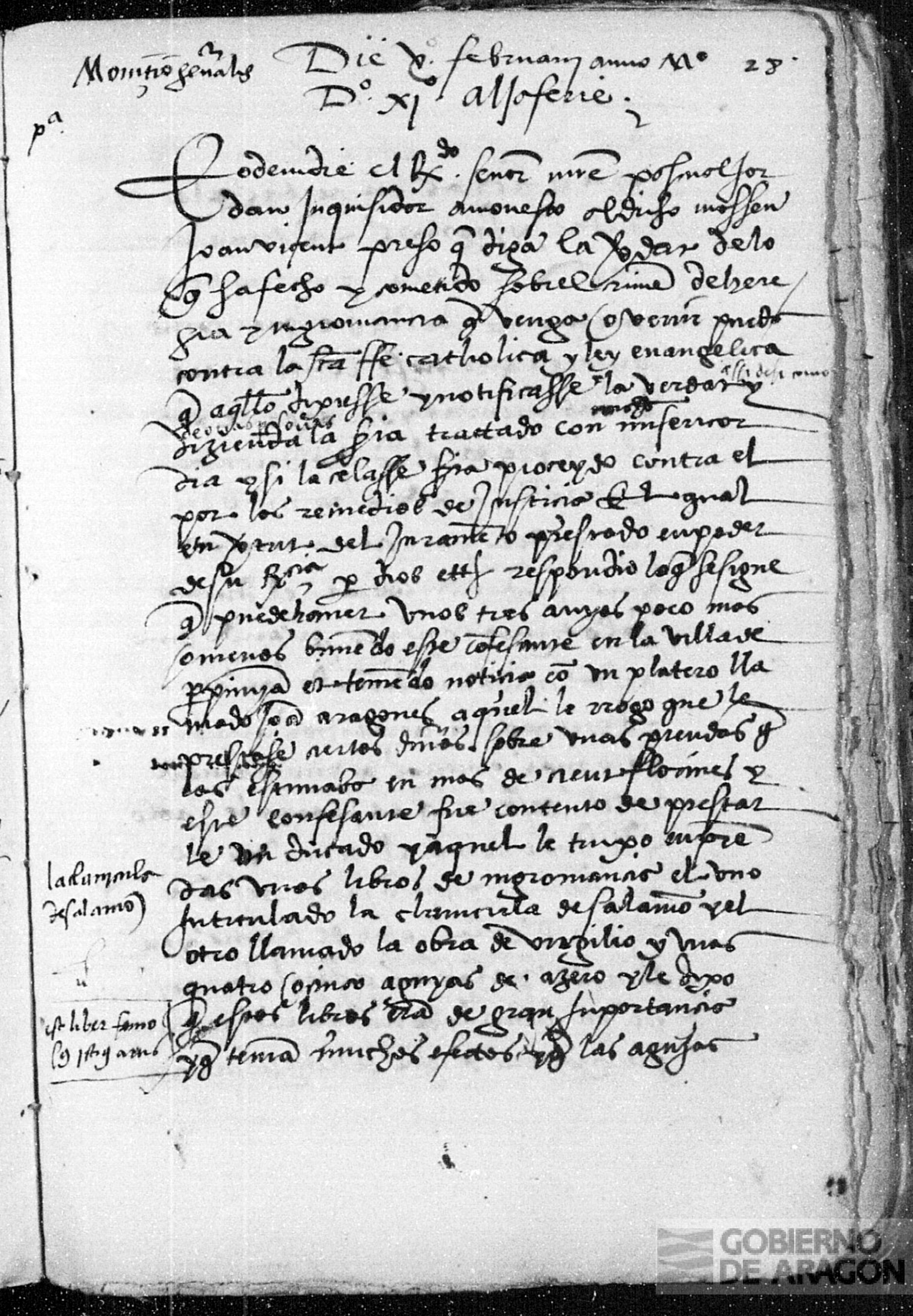
In a statement under oath recorded on 10 February 1511 during a monitio generalis, Juan Vicente said he was living in Perpignan when an Aragonese silversmith asked him for money against certain pledges. According to Vicente's account, he lent a ducat and received, among other objects, two books of nigromancy, which he named «la Clavícula de Salamó» and «la obra de Virgilio» (“the Key of Solomon” and “the work of Virgil”); he said the loan was not repaid and that he kept the pledges.7
This passage provides an account of circulation because the declarant links the books to a loan and a pledge. But the file records his statement: it does not by itself corroborate the transaction or identify original copies. “The Key” and “the work of Virgil” are names used in that voice and context; they are not equivalent to the material identification of two codices.
Answers, testimony and a procedural entry
In a later confession, Vicente returned to the books' passage to Miguel de Soria and recounted episodes related to their burning. In answers to specific articles of the prosecutor, he named «la Clavicula de Salamon y el Virgilio» and said he had given them to Soria; he also located his readings in Perpignan and said he had been «forçado» (“forced”; the passage cited here does not specify to what). These are answers given in an interrogation, not necessarily a spontaneous confession. The prosecutor's initial charge, as cited, refers generally to books of magical art without naming these titles there.8
Two third-party testimonies add descriptions that do not come from the accused person's own voice. A later section distinguishes their contents and attributions without treating them as direct descriptions of manuscripts identified today.9
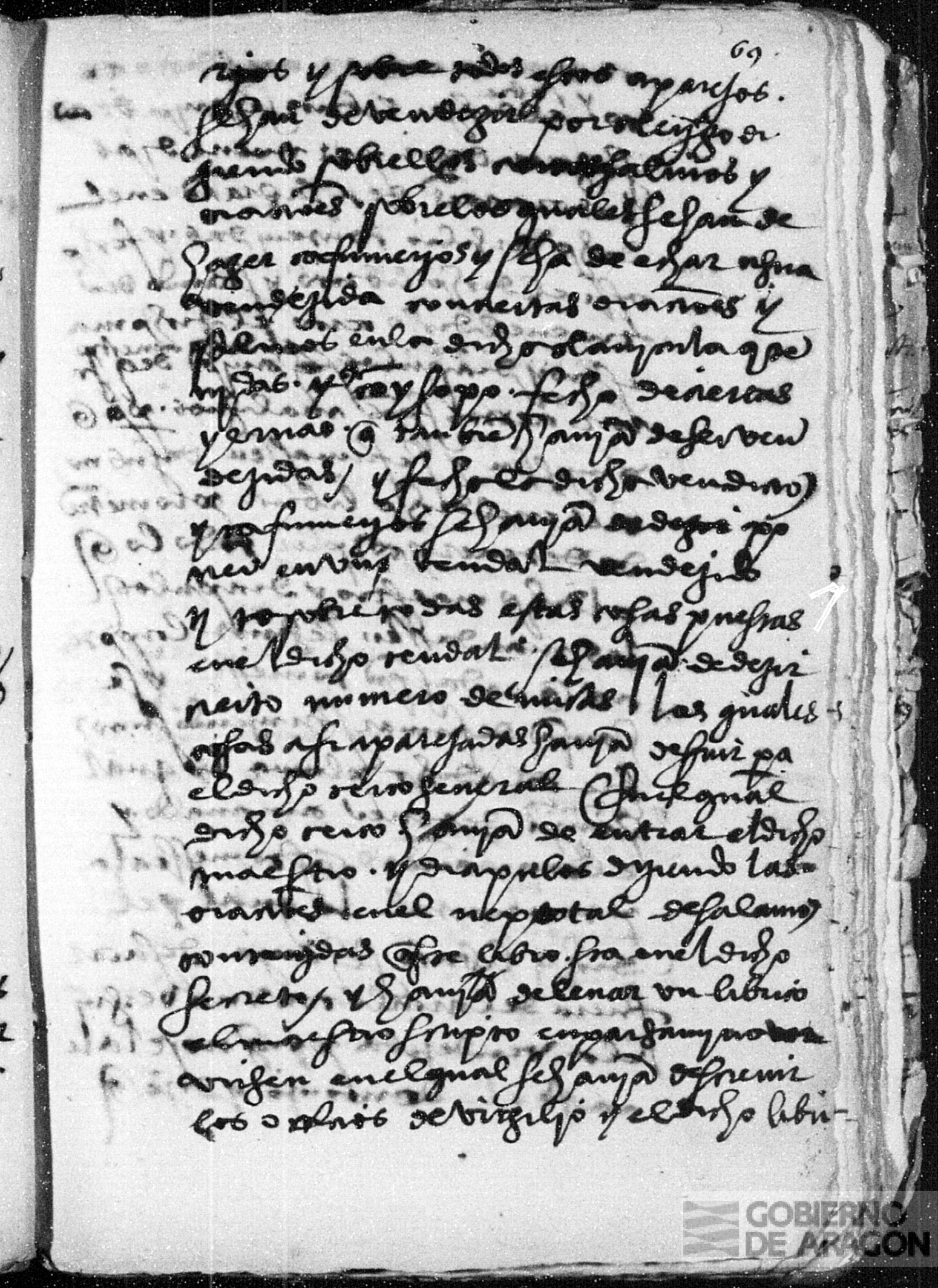
The file also contains an entry for the Key with its principium and finis.10 Unlike a statement, the register documents an act of record-making: a book is entered by reference to these elements. That formal entry does not establish whether it corresponds to any object described by the declarants, nor does it independently verify their accounts of the book's contents.
What magical practices appear in the records?
The sources do not offer a single ritual. They preserve accounts from different voices and procedural moments. This section summarizes what those voices attributed to each practice without treating it as a verified account of efficacy.
The consecration in Bernardi's confession
Bernardi's confession. Bernardi said that mosen Pedro lit two candles, made him kneel, and had him recite seven psalms, the Creed and the Gospel of John. In the same confession, the cleric prayed over the book while transferring a small booklet from a larger volume; the rite included a skull on the table, embers and fumigations, lasted about half an hour and was repeated three times a day.3
The prosecutor's charge, article 7. A separate document describes a “nine-day experiment” involving a skull, candles and fumigations.5 Although the accounts share some elements, they should not be merged into one scene or the charge presented as a confession.
Contents attributed to Vicente's books
In testimony attributed to Miguel de Soria, the Key of Solomon is linked to the equipment for a circle, while the Key of Virgil is associated with one hundred demons, their names and characters, and twenty-eight rings for the soul's twenty-eight mansions.9 In a separate statement, Jerónimo de Valdivielso described a small book of virgin parchment for “the offices of Virgil” and a nine-day consecration. These are claims attributed to the declarants: they do not prove that all these elements belonged to a single volume or that the practices produced the effects assigned to them.
What happened to the accused?
Pedro Bernardi's sentence
The verdict declared Bernardi a heretic and sorcerer; it also recorded his repentance and abjuration and absolved him from excommunication. That ecclesiastical absolution was not an acquittal: the separate penance was perpetual imprisonment. According to Pedraza, further restrictions concerned jewelry, clothing and access to benefices or public office; the decision on confiscating his property was reserved for further deliberation.6
Juan Vicente's escape and proceedings
An act dated 23 February 1511 describes Vicente as “reo y confeso” and records his escape from the Aljafería prison.11 That label belongs to the procedural record; by itself, it does not establish the judicial outcome. The file does preserve a sentence in absentia and in effigy, on fols. 71v–72r.12 The collation confirms that this record exists, but does not establish a specific penalty with sufficient certainty. We therefore do not equate his outcome with Bernardi's or assert a particular punishment.
Compare documentary traces without treating them as equivalent evidence
| Documentary trace | Bernardi | Juan Vicente | Scope and limit |
|---|---|---|---|
| Material description | In the confession: a small book on paper, in Latin, with figures and names, and no title.2 | Testimony attributed to Valdivielso describes a small book of virgin parchment associated with the “offices of Virgil.”9 | Describes an object through a procedural voice; it is not enough to identify a work or surviving copy. |
| Textual designation | The book of nigromancy Bernardi describes has no title in his account.2 | Vicente's statement names “la Clavícula de Salamó” and “la obra de Virgilio”; he repeats the names in his answers to the prosecutor.78 | A title records how a book was named in a passage; it does not, by itself, establish bibliographical identity. |
| Account of circulation | The confession recounts contact with the book and a sequence involving lending and consecration.3 | Vicente attributes receipt of two books to a loan secured by pledges and later speaks of their passage to Soria.78 | These are accounts situated in statements and answers, not transactions corroborated by an independent source. |
| Testimony and register | Miguel Sánchez's separate testimony and the prosecutor's charge are distinct from Bernardi's confession.15 | There are descriptions attributed to witnesses and a register entry for the Key with its principium and finis.910 | Testimony transmits what a declarant said; the register establishes an entry in the proceeding. Neither alone measures the evidentiary weight assigned to it. |
The comparison reveals different kinds of trace, not an automatic scale of reliability. A material description tells us how someone characterized an object; a title records a designation used in the proceeding; an account of circulation narrates a transfer from the declarant's perspective; testimony attributes information to a third party; and a register entry shows that information was incorporated into the file. Each trace answers a different question.
For that reason, adding references does not by itself produce an identification. A title appearing in a statement, recurring in an answer and having a register entry does not prove—without a further documentary link—that all three references describe the same object. Nor can we infer how much each piece influenced the judgment. In Bernardi's case, the untitled book description and the nine-day charge must likewise remain distinct despite their partial overlap in objects.25
What can be known, and what remains open
These two proceedings let us study how books associated with nigromancy entered the language and records of a judicial process: as described objects, titles used in specific contexts, accounts of transfer, witnesses' recollections and procedural entries. Pedraza García's published study provides the framework for bringing these passages into relation.17910
This comparison does not claim to represent all inquisitorial proceedings of the period. It is limited to Bernardi and Vicente, and cannot establish whether the titles refer to particular works, whether different declarants meant the same copy, or how much weight each trace carried in judicial decisions. Mention of the Key of Solomon, a work attributed to Virgil or other titles does not prove that a surviving manuscript has been located.
The useful question, then, is not only “which book was it?” but “what kind of claim about a book does this passage contain, who made it, and how was it recorded?” Keeping documentary presence, bibliographical identification and evidentiary value distinct lets us use what the files preserve without collapsing their different voices into a single narrative.
Questions readers often ask
What do the records say about Bernardi's untitled book?
Bernardi described a small book on paper, written in Latin and containing figures and names, but said it had no title and that he could not understand it. His confession also recounts a consecration; see what practices the sources attribute to each voice. This is the accused's description, not an independent bibliographical identification.2
Which books are named in Juan Vicente's case?
Vicente's statement names «la Clavícula de Salamó» and «la obra de Virgilio». Separate testimonies attribute contents to the Key of Virgil and to the “offices of Virgil”; these references do not identify surviving copies.78910 See the summary of the practices described.
What magical practices do the testimonies describe?
Bernardi recounted a consecration with psalms, prayers and the transfer of a small book; Soria attributed one hundred demons and twenty-eight rings to the Key of Virgil; Valdivielso described the “offices of Virgil” in a book of virgin parchment. Each account belongs to a different voice and does not prove the practice's efficacy.39 Read the details and their attributions.
Does the record identify a surviving Key of Solomon or Virgil manuscript?
No. A title in a statement and a register entry with a principium and finis are documentary traces; they do not by themselves identify a surviving copy or prove that separate references concern the same object.10
Was the prosecutor's nine-day allegation Bernardi's confession?
No. The nine days appear in article 7 of the prosecutor's charge. Bernardi's confession describes a consecration with some overlapping elements, but it is a different document and should not be merged with the charge.35 Read the comparison of the practices.
What sentence did Pedro Bernardi receive?
He was declared a heretic and sorcerer; after repentance and abjuration, he was absolved from excommunication but not acquitted. His penance was perpetual imprisonment, alongside other restrictions recorded by Pedraza.6 Read about the judicial outcome.
What is known about Juan Vicente's outcome?
The file records his escape from the Aljafería on 23 February 1511 and a sentence in absentia and in effigy on fols. 71v–72r. The collation does not establish a specific penalty with sufficient certainty; we do not assume it was the same as Bernardi's.1112 Read what is documented for both accused men.
References and research guide
The PDF pages refer to pagination in the digital files; manuscript folios are listed separately. Pedraza's page numbers refer to the printed article. The numbered citations point to the following documentary locators.
- Pedro Bernardi: prosecutor's complaint, fols. 1v–2r, PDF p. 4; testimony of Miguel Sánchez, fol. 3r, PDF p. 5; confession, fols. 5r–6r, PDF pp. 7–8. Pedraza García (2007), pp. 70–72. Digital record consulted: AHPZ, ES/AHPZ, J/00020/0018. The digitization is a certified notarial copy (PDF p. 37). DARA record 1063432.
- Bernardi, confesión, fols. 5r–6r, PDF pp. 7–8; Pedraza García (2007), p. 72.
- Bernardi, confession, fol. 5v, PDF p. 8 (mosen Pedro, described as Gascon), and fol. 7r, PDF p. 9 (consecration); Pedraza García (2007), pp. 72–73.
- Bernardi, confesión, fols. 7v–9r, PDF pp. 10–11; Pedraza García (2007), pp. 71–72, 78.
- Bernardi, prosecutor's libellus, art. 7, fols. 18v–19r, PDF p. 21; Pedraza García (2007), p. 74. The copy consulted does not interleave the accused's answers in this section.
- Bernardi, verdict and absolution from excommunication, fol. 31r, PDF p. 34; perpetual imprisonment as penance, fol. 32v, PDF p. 35; Pedraza García (2007), pp. 72, 74.
- Juan Vicente: statement in the monitio generalis, fols. 28r–28v, PDF pp. 25–26; Pedraza García (2007), p. 74. Digital record consulted: AHPZ, ES/AHPZ, J/00021/0002. DARA record 229067.
- Juan Vicente, later confession, fols. 32v–33r, PDF p. 30; answers to articles 1–2, fol. 43r, PDF p. 40; prosecutor's libellus, fol. 37r, PDF p. 34 and fols. 37v–38r, PDF p. 35; Pedraza García (2007), pp. 74, 76–77.
- Testimony attributed to Miguel de Soria, fol. 63r, PDF p. 62; statement by Jerónimo de Valdivielso, fols. 69r–69v, PDF pp. 68–69; Pedraza García (2007), p. 78.
- Register of books, fols. 63v–64r, PDF p. 63; Pedraza García (2007), p. 78.
- Juan Vicente, prosecutor's act recording his escape from the Aljafería, fol. 48r, 23 February 1511; Pedraza García (2007), p. 74.
- Juan Vicente, sentence in absentia and in effigy, fols. 71v–72r; the collation confirms the record but does not establish a specific penalty with sufficient certainty.
Secondary reference
Manuel José Pedraza García, «De libros clandestinos y nigromantes: en torno a la posesión y transmisión de grimorios en dos procesos inquisitoriales entre 1509 y 1511», Revista General de Información y Documentación 17, no. 1 (2007), pp. 63–80. Record and text at the Complutense University of Madrid (the institutional record consulted lists no DOI).
The modern identifiers of the digital records consulted are cited; no archival correspondence is asserted with the older shelfmarks 28/5 and 28/7 mentioned by Pedraza. For Grimorium's general approach to reading sources, see its methodology page.
grimorium.lat · Documentary library of ritual magic, demonology and historical grimoires