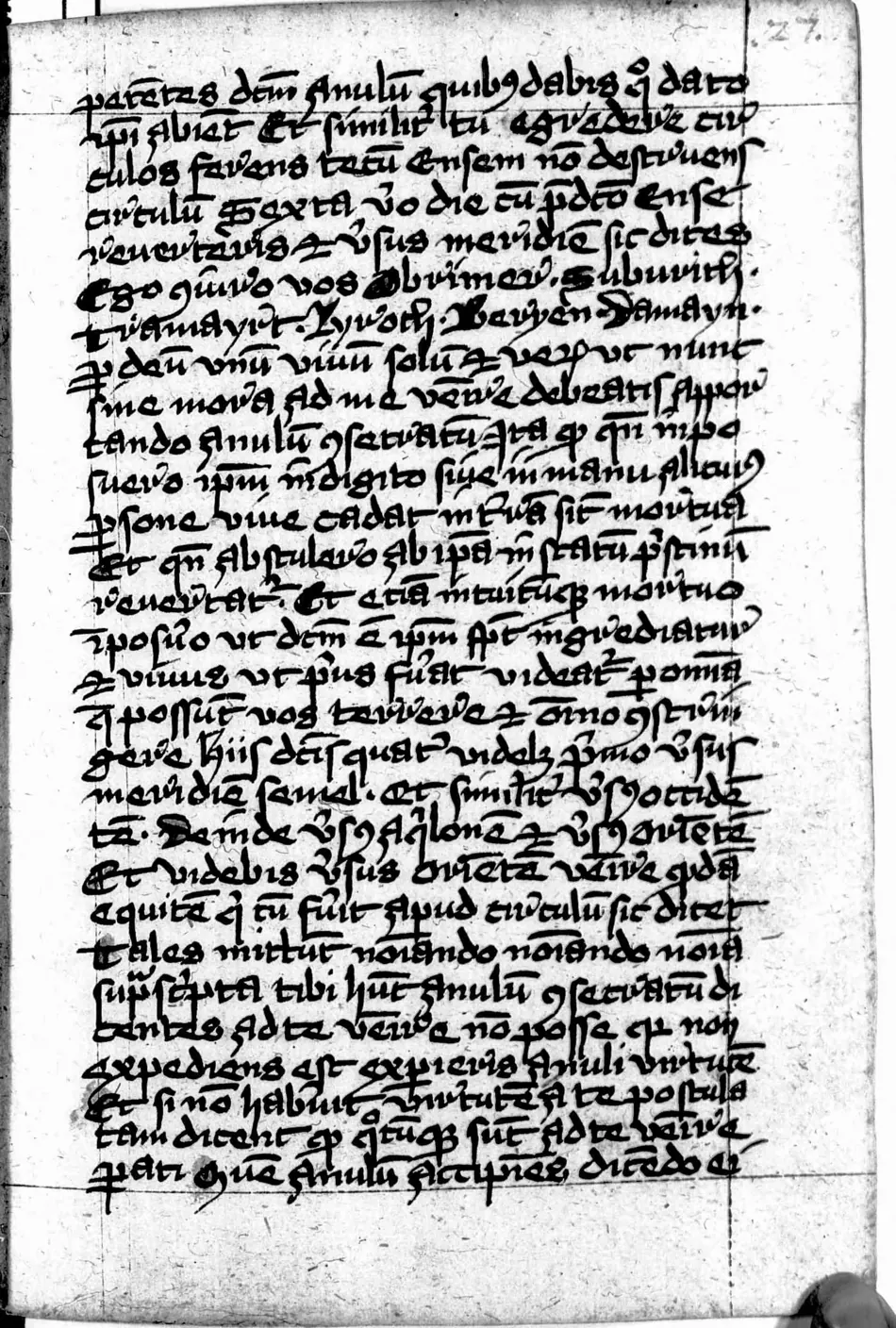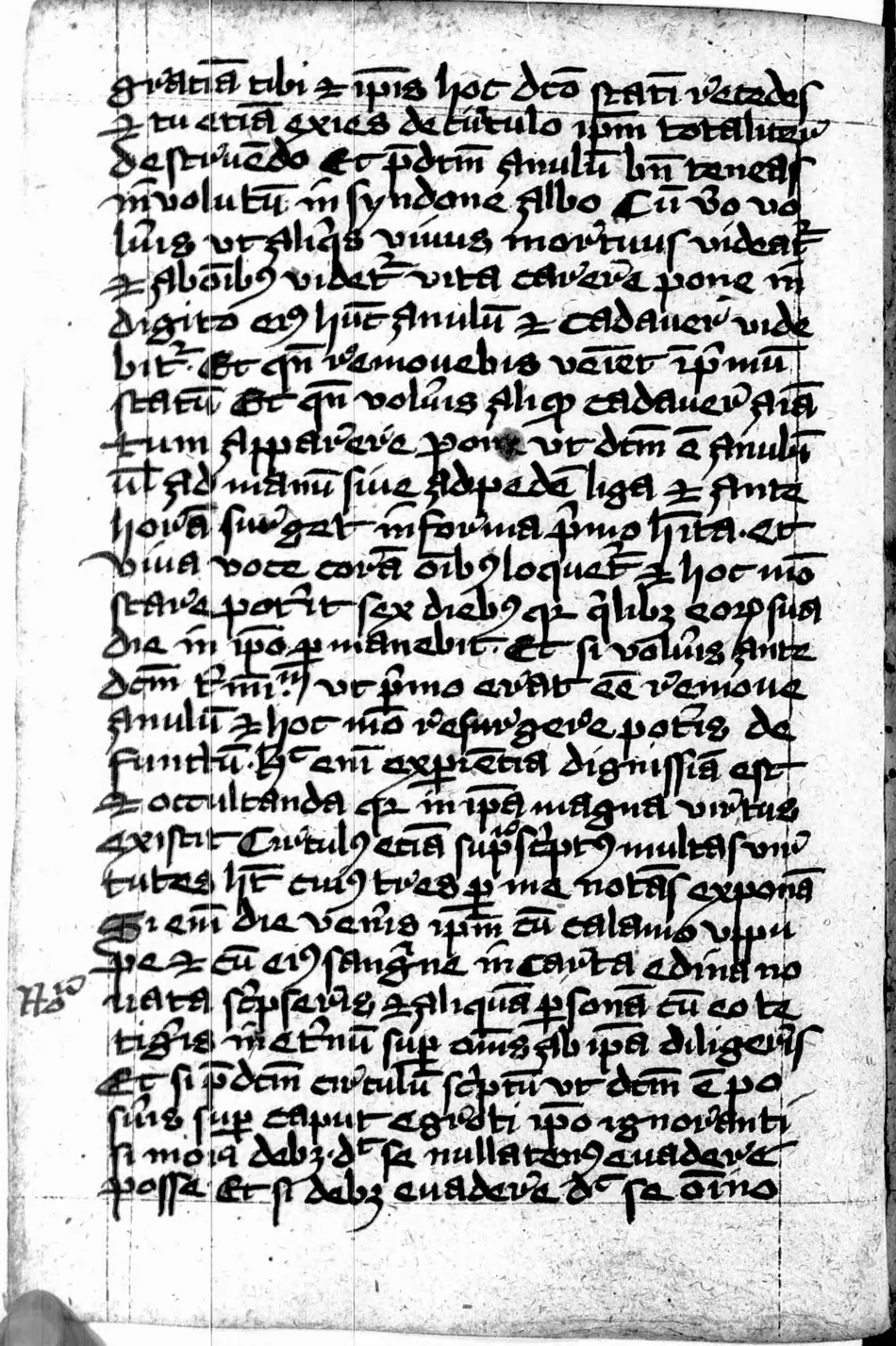
Munich Manual (Clm 849)

Liber incantationum, exorcismorum et fascinationum variarum

BSB Clm 849 (MDZ bsb00037155)
Download PDF ↓
fol. 15v#15v
Munich Manual (Clm 849) — facsimile page (fol. 15v) · public-domain facsimile
BSB Clm 849 (MDZ bsb00037155)
🔍 click to enlarge

TranscriptionLatin

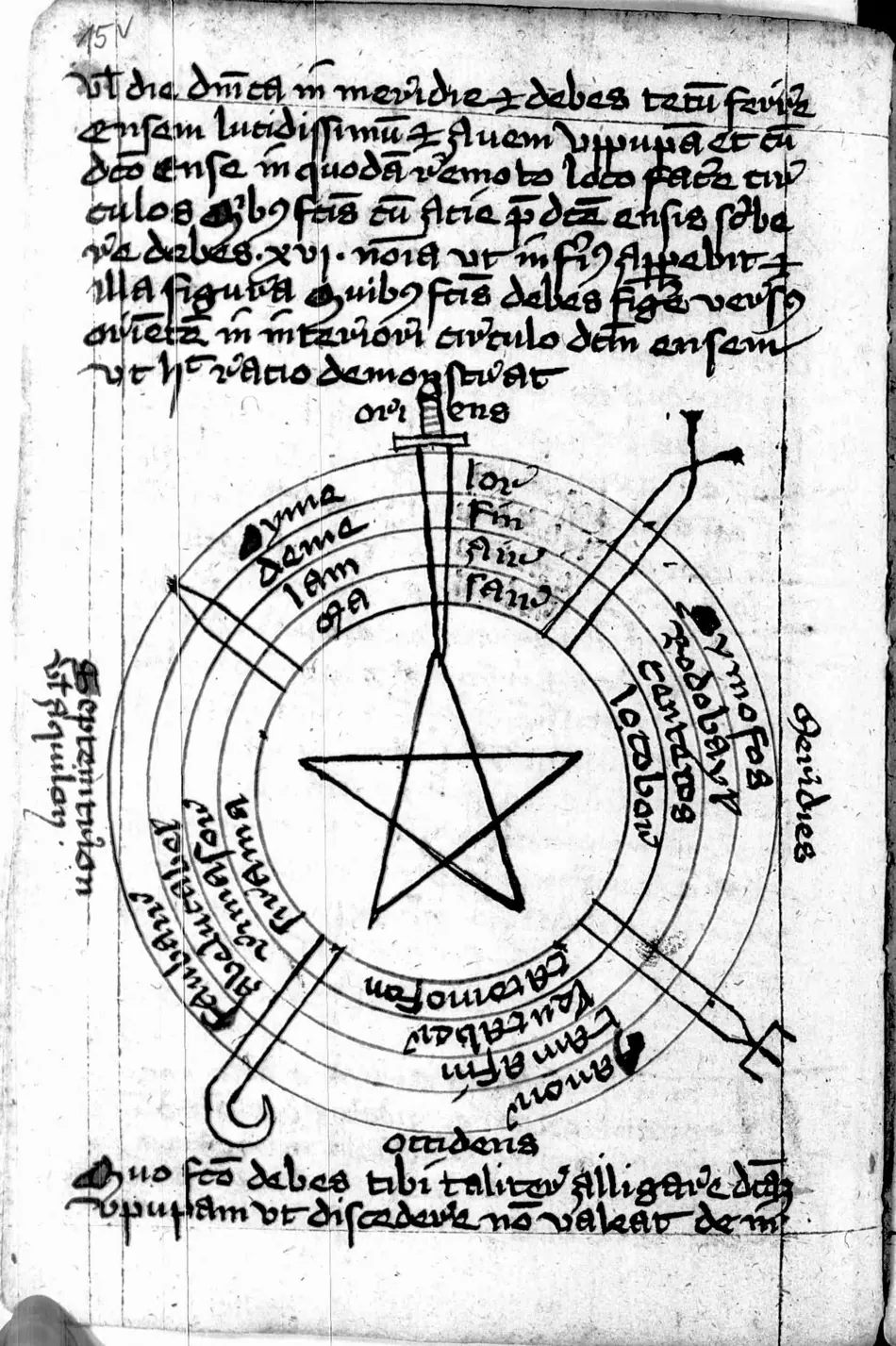
vt die dominica in meridie[?] [et] debes ferru[m] fac[er]e[?] ensem lucidissimu[m] [et] Auem[?] [upupam?] et cu[m] d[i]c[t]o ense in quoda[m] remoto loco facere cir- culos a[m]b[o]s fa[c]tis[?] cu[m] Arte[?] p[er] d[i]c[t]um ense[m] scriba- ve debes . XVI . no[m]i[n]a ut i[n] fig[ur]a[?] Apparebit [et] illa figura quib[us] fa[c]tis debes fige[re] versus oriente[m] in i[n]t[er]iori circulo d[i]c[t]um ense[m] vt h[i]c v[?]ratio demonstrat[?]

above, beside the sword point: ori[ens] . ensis right: Meridies below: occidens left: Septentrio . sit figular[?]

[cuadrante sup. izq.:] yma[?] / dema[?] / lam[?] / ega[?] [cuadrante sup. der.:] lor[?] / fin[?] / Anu[?] / [Sanu?] [cuadrante inf. izq.:] [Alnayn?] / [Nalgabar?] / [Aluciab?] [cuadrante inf. der. exterior:] [Ramos?] / [Rodabayr?] / [cantbos?] / [lodbau?] [cuadrante inf. der. interior:] Amou[r?] / [Lam Anu?] / [Vautabau?] / [Catamofan?]

Quo fa[c]to debes tibi talit[er] Alligare dicta[m] [u]pupam vt discedere no[n] valeat de m[edio?]

TranslationEnglish

...that on Sunday, at noon[?], you must make an iron, a most shining[?] sword, and a bird[?], [a hoopoe?], and with the said sword, in some remote place, make the circles, both[?] made with art; by[?] the said sword you must write the XVI names, as it will appear in the figure, and that figure; which done, you must fix toward the east, in the inner circle, the said sword, as this diagram[?] shows. (Diagram: pentagram with a sword [ensis] pointing to the east; rings bearing the XVI magical names; orientations oriens / meridies / occidens / septentrio.) Which done, you must bind to yourself the said hoopoe in such a way that it cannot depart from the middle[?]...
fol. 16r#16r
Munich Manual (Clm 849) — facsimile page (fol. 16r) · public-domain facsimile
BSB Clm 849 (MDZ bsb00037155)
🔍 click to enlarge

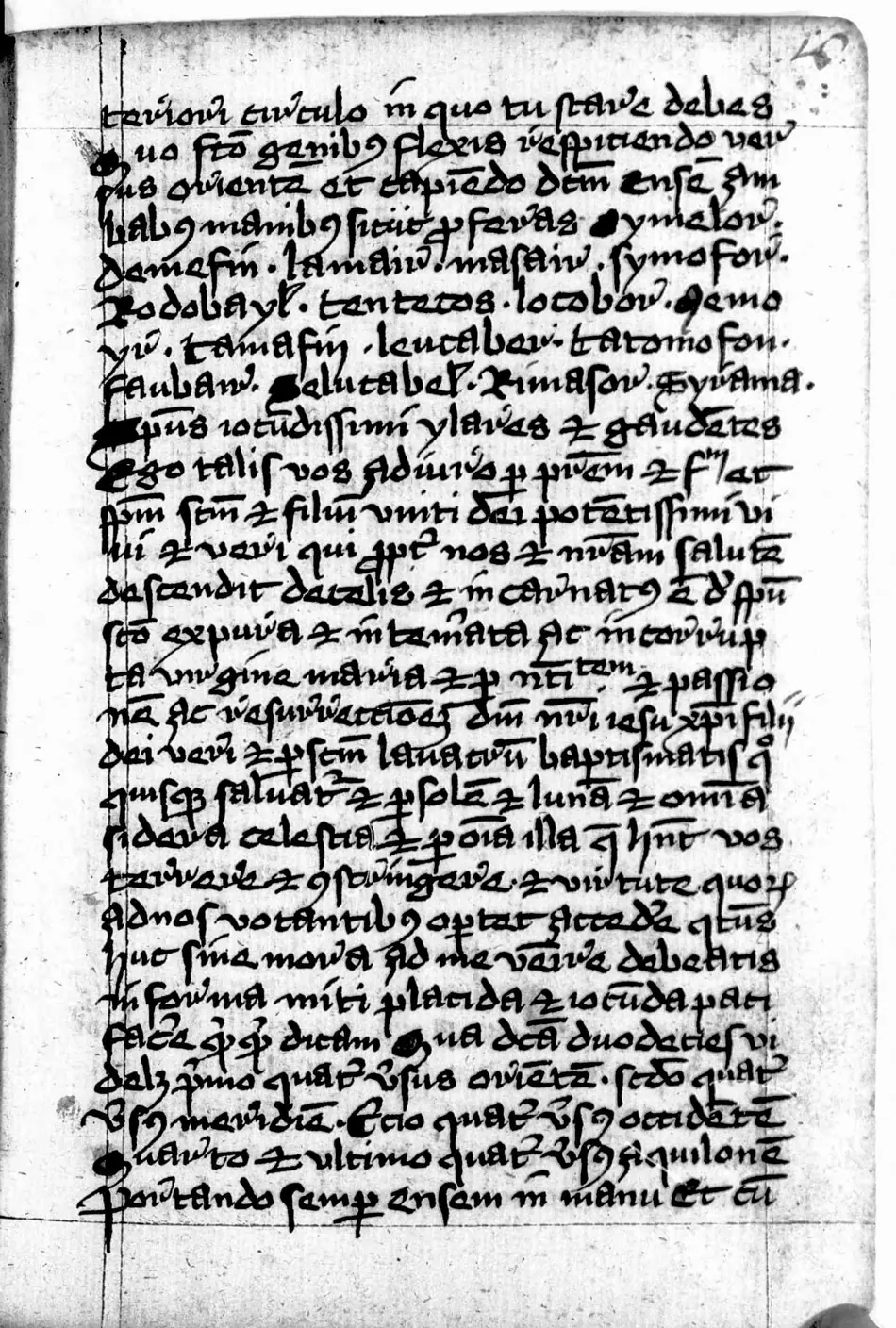
TranscriptionLatin

teriori titulo in quo tu star[e] debes quo st[an]do genib[us] flexis re[s]piciendo ver- sus oriente[m] et capiendo d[i]c[t]um ense[m] cum [am]bab[us] manib[us] scilicet p[er] feras [?]ymelor[um?] damasin . tamain . masain . symoso[u?] . todobayl . tenteros . locobou . [?]emo- y[?] . tamasin . leutabou . t[?]atomosou . faubau . salutabel . rimasou . syrama . [cor]pus rotu[n]dissimi ylar[?]s [et] gaudete[?] ego talis vos ad[iuro] p[er] pat[re]m [et] f[?]- [li]um s[an]c[tu]m [et] filiu[m] uniti dei potentissimi vi- ui [et] veri qui p[ro]p[ter] nos [et] n[ost]ram salut[em] descendit de celis [et] in carne [?] d[e] sp[irit]u s[an]c[t]o [con]cep[tus?] [et] in[car]nat[us] [?] in corp[us?] t[a?] virgine maria [et] p[er] n[a]tivitate[m] [et] passio- ne[m] [et?] resurrectio[n]es d[omi]n[i] n[ost]ri iesu [christ]i fili- [i] dei veri [et] p[er] s[anc]t[u]m lauac[ru]m baptismatis q[uo] quisq[ue] saluat[ur] [et] p[er] sol[em] [et] luna[m] [et] om[n]ia sidera celestia [et] p[er] o[mn]ia illa q[ue] h[abe]nt vos t[er]rere [et] [con]stri[n]gere . [et] vi[r]tute quor[um] ad nos vo[ca]ntib[us] optat[?] atte[n]de[re] q[ua]te[nus] huc s[ine] m[or]a mo[?]a[?] ad me venire debetis in forma miti placida [et] iocu[n]da pati- [en]t[er] p[ro]p[ter] dicta[m] [?]ua d[i]c[t]a duodecies vi- del[ice]t p[ri]mo quat[er] v[er]sus oriente[m] . s[e]c[un]do quat[er] v[er]s[us] meridie[m] . t[er]cio quat[er] v[er]s[us] occidente[m] qua[r]to [et] ultimo quat[er] v[er]s[us] aquilone[m] portando semp[er] ensem in manu et cu[m]

TranslationEnglish

...of the preceding title in which you must stand, standing therein with knees bent, looking to- ward the east and taking the said sword with both hands, that is, by [the beasts/names] [?] of [?]ymelor[?]: damasin, tamain, masain, symoso[u?], todobayl, tenteros, locobou, [?]emo- y[?], tamasin, leutabou, t[?]atomosou, faubau, salutabel, rimasou, syrama. [body] most round [?] joyful [?] and rejoice [?]. I, so-and-so, conjure you by the Father and by the holy Son and the son of the one most powerful God, li- ving and true, who for us and for our salvation came down from heaven and [took] flesh of the Holy Spirit, [conceived] and [incarnate] [?] in the body [?] of the virgin Mary; and by [his] nativity and by [his] passion and resurrection of our Lord Jesus Christ, son of the true God; and by the holy laver of baptism by which everyone is saved; and by the sun and the moon and all the heavenly stars; and by all those things that have [power] to terrify and constrain you; and by the virtue of which [I bid you] attend to us who call [you], as desired, insofar as here, without delay, [?] you must come to me in a gentle, calm and joyful form, patient- ly, on account of the said [?]. This being said twelve times, namely: first four times toward the east; second, four times toward the south; third, four times toward the west; fourth and last, four times toward the north; always carrying the sword in the hand and with...

fol. 16v#16v
Munich Manual (Clm 849) — facsimile page (fol. 16v) · public-domain facsimile
BSB Clm 849 (MDZ bsb00037155)
🔍 click to enlarge

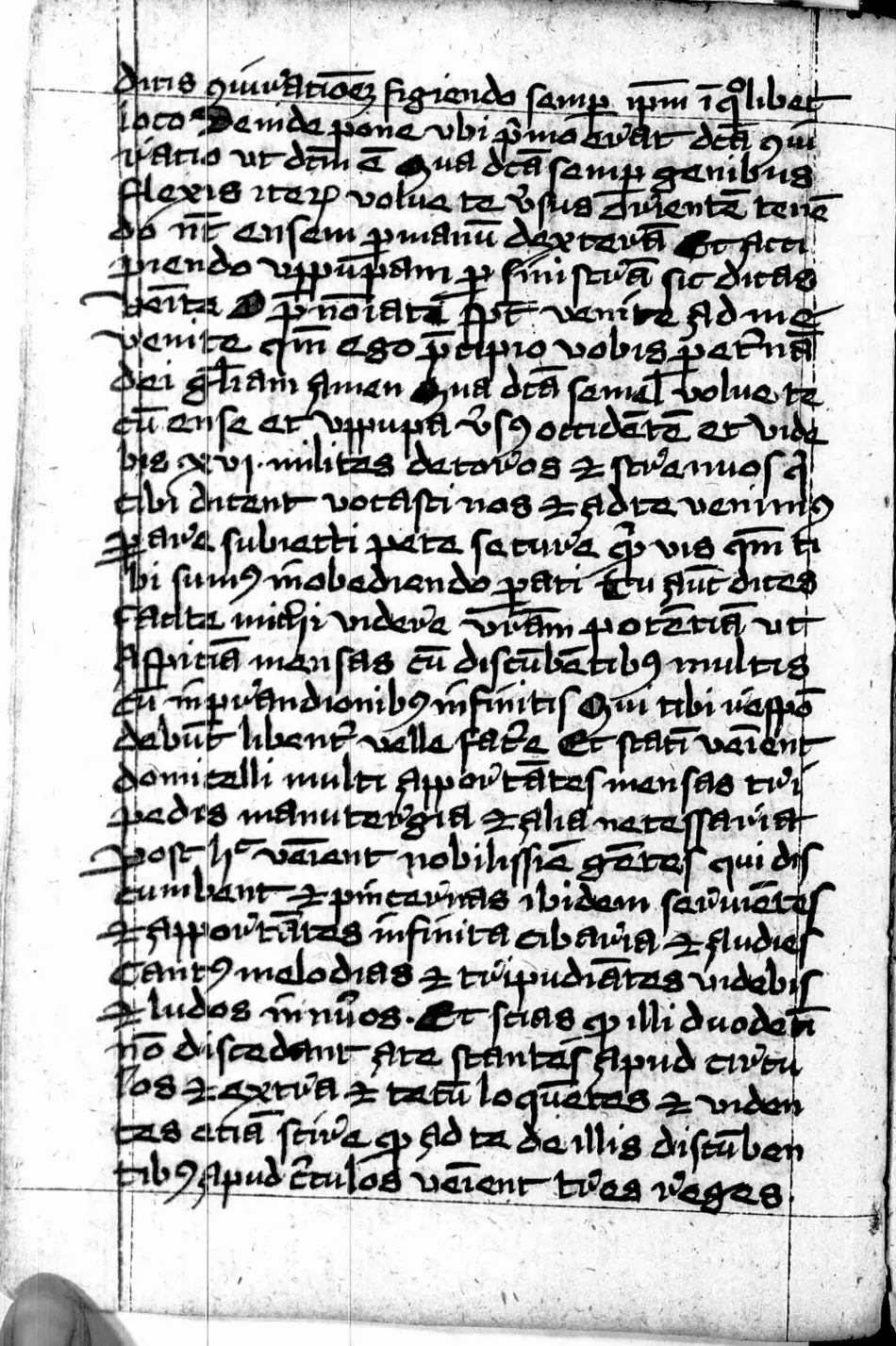
TranscriptionLatin

d[i]c[t]is [con]iurat[i]o[n]es figiendo [?] sem[per] n[ome]n i[n] q[uo]libet loco. Deinde pone vbi p[ri]mo st[et]erat d[i]c[t]a [con]iu- ratio ut d[i]c[tu]m e[st] [et] q[ua] d[i]c[t]a sem[per] g[e]nibus flexis iter[um] volue te v[er]sus oriente[m] tene- do n[?] ensem p[er] manu[m] dextera[m] Et acci- piendo v[er]purp[ur]am p[er] sinistra[m] sic dicas venite [?] p[er] no[m]i[n]ata p[ro]p[ter] venite ad me venite q[uonia]m ego p[re]p[ar]o vobis pat[?]a[?] dei g[ra]t[i]am amen [?]ua d[i]c[t]a semel volue te cu[m] ense et v[er]purp[ur]a v[er]s[us] occidente[m] et vide- bis xvj . milites d[e]coros [et] p[er]uarios [?] tibi d[i]c[e]nt votasti nos [et] adte venim[us] [et] a[?]ua subiacti p[er?]cta sa[?]tut[?] q[uod] vis q[uonia]m ti- bi sum[us] mo[do] obediendo p[ar]ati [et] tu au[tem] dices facita michi vndeue vita[m] p[ro]p[ter]ia[?] ut aparita mensas cu[m] discubantib[us] multis cu[m] mo[?]tendio[n]ib[us] i[n]finitis Qui tibi v[er]p[ur]a debu[?] libent[er] villa fac[er]e Et statim v[er]ient domicelli multi apportantes mensas t[?]- [?]edes manutergia [et] alia necessaria post h[oc] v[er]ient nobiliss[im]a g[e]ntes qui dis- cu[m]bant [et] p[?]cantes ibidem sauuietes[?] [et] apportantes i[n]finita cibaria [et] audies cant[us] melodias [et] tri[um]pudia[n]tas videbis [et] ludos infinitos . Et scias q[uod] illi duode[cim] no[n] discedent s[?] stantes apud circu- los [et] c[?]rua [et] tatu loqueres [et] videli- c[et] eti[am] sciwa[?] q[uod] ad te de illis discu[m]ben- tib[us] apud circulos v[er]ient tres v[e]l q[ui]nq[ue]

TranslationEnglish

These conjurations being said, always fixing [?] the name in whatever place. Then set [it where] the said conjura- tion first stood, as has been said; and this said, always with knees bent, turn yourself again toward the east, hold- ing the sword in the right hand and tak- ing the purple [rod/robe] in the left, thus you shall say: "Come [?] by the named [names], come to me; come, for I prepare for you [?] the grace of God, amen." This said, turn once with the sword and the purple [rod] toward the west, and you shall see sixteen fair knights of various [colors] [?]; they will say to you: "You summoned us and we have come to you, and [?] subject [?] [ask] what you wish, for we are now ready to obey you." And you then shall say: "Make for me [?] the life [?] so that tables may appear with many diners with [?] infinite." He who to you [with] the purple [rod] should [?] gladly do [?]. And at once will come many young servants bringing tables [?], seats [?], towels and other necessary things. After this will come most noble folk who recline [at table] and [?] there [?], and bringing infinite viands; and you will hear songs [and] melodies, and you will see [people] dancing [in triumph] and endless games. And know that those twelve will not depart, but will stand by the circ- les, and [?], and you will speak [?]; and to wit, you will also know [?] that toward you, of those recli- ning by the circles, will come three or five...

fol. 17r#17r
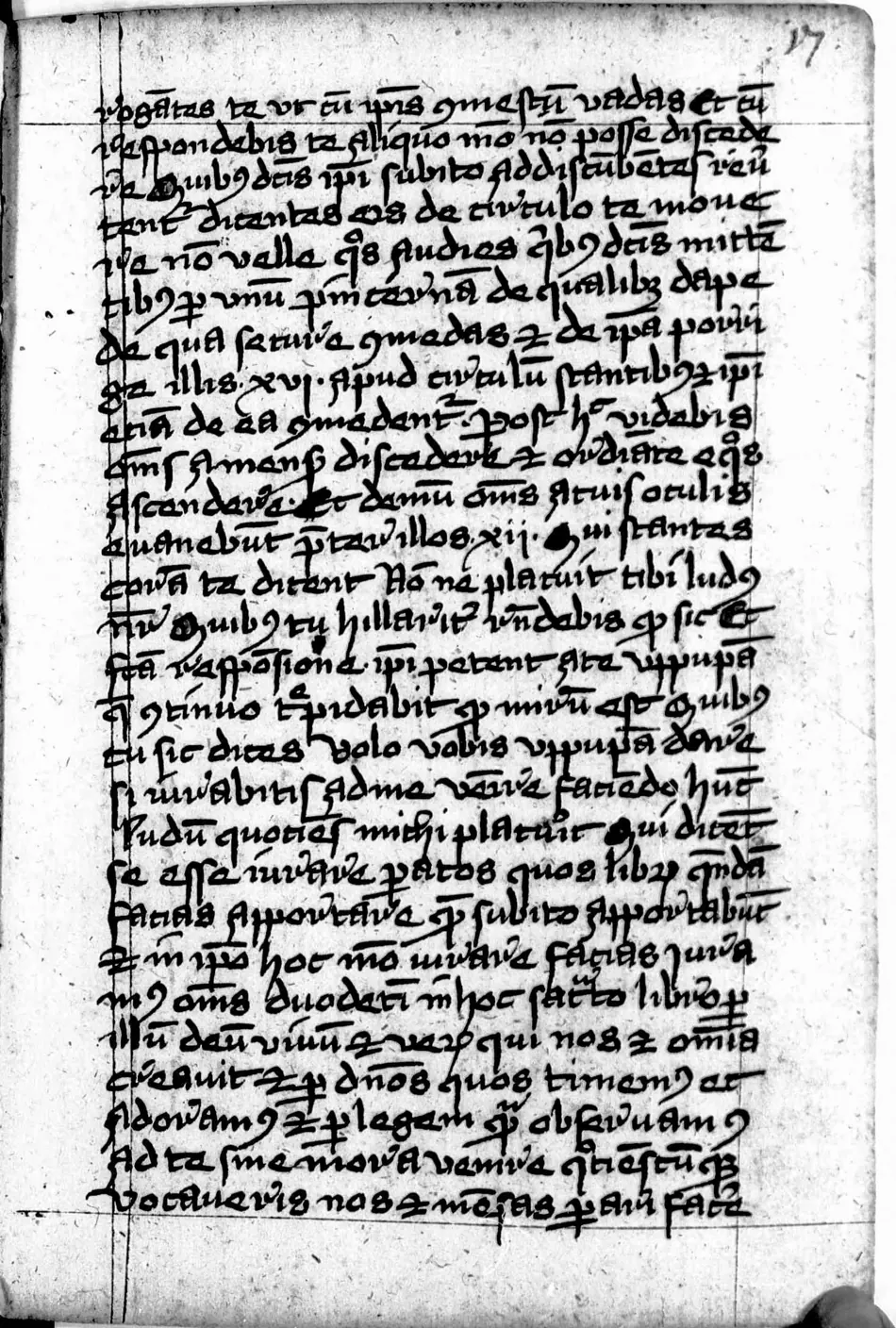
Munich Manual (Clm 849) — facsimile page (fol. 17r) · public-domain facsimile
BSB Clm 849 (MDZ bsb00037155)
🔍 click to enlarge

TranscriptionLatin

rogatas te vt cu[m] ip[s]is q[uo]meat[?] vadas et cu[m] respondebis te aliquo mo[do] no[n] posse discede- re Quib[us] d[i]c[t]is ip[s]i subito ad discub[an]tes reu[er]- tent dicentes eos de titulo te move- re no[n] velle q[ui]bus audies q[ui]b[us] d[i]c[t]is mitte- tib[?] p[er] vnu[m] p[er] mensa[m] de qualib[et] dape de qua se[r]uir[e] q[uo]meatas [et] de ip[s]a potu[?] g[usta?] illis xvj . apud circulu[m] stantib[us] [et] ip[s]i et[iam] de ea q[uo]medent . Post h[oc] videbis eos amans[?] discedere [et] ordiare eos- ascendere . Et d[e]mu[m] o[mn]es At[?]uis oculis auferet[?] p[er] ta[?] villos xij . Qui stantes cora[m] te dicent Ho[?] no[nne] placuit tibi lud[us] [?] Quib[us] tu hillari[t]er r[esp]ondebis q[uod] sic Et s[?]a rasp[?]sione ip[s]i petent [a?]te v[er]purp[ur]a[m] [et] [con]tinuo t[ibi] r[esp]ondabit q[uod] mitu[?] q[uae?] Quib[us] tu sic dicas volo vobis v[er]purp[ur]a[m] d[o]n[are] si iuuabitis ad me venire faciendo huc ludu[m] quoties michi placuit Qui dice[n]t se esse iuraue[runt?] p[ar]atos quos libu[er]it q[uan]d[o?] facias apportare q[uod] subito apportabu[n]t [et] in ip[s]is hoc mo[do] iuuare facias iura- m[us] o[mn]es duodeci[m] in hoc sa[n]c[t]o libro [et] illu[m] deu[m] viuu[m] [et] veru[m] qui nos [et] o[mn]ia creauit [et] p[er] d[omi]nos quos timem[us] et adoram[us] [et] p[er] legem q[uam] obs[er]uam[us] Ad te sine mora venire q[uo]t[iens]cu[m]q[ue] vocaueris nos [et] mensas p[ar]atas fac[er]e

TranslationEnglish

...begging you to go with them to [eat/where they go] [?]; and you shall answer that in no way can you with- draw. This said, they will at once turn back to the diners, saying that you of the title do not wish to move yourself; which you will hear. This said, [they] will send to you, by one [of them], along the table, of every dish of which is served to eat, and of the same [drink?] you [shall taste?] for those sixteen standing by the circle; and they also will eat of it. After this you will see the [diners] withdraw amicably [?], and you will begin [to see] them ascend. And at last all, with [?] eyes [?], [will withdraw] by [?] those twelve, who, standing before you, will say: "Well then [?], has the game not pleased you [?]?". To whom you will answer merrily that yes. And [this] answer [given], they will ask you for the purple [rod], and straightway [they] will answer you that [?]. To whom you shall say thus: "I wish to give you the purple [rod] if you help me, coming to make here the game as often as it pleases me." Who will say [that] they swore to be ready [whenever] he might wish, when you make [them] bring [whatever], at once they will bring it; and upon them [the tables], in this manner, [that] you make [them] help: "We swe- ar, all twelve, upon this holy book and by that living and true God who created us and all things, and by the lords whom we fear and adore, and by the law which we observe, to come to you without delay whenever you shall call us, and to make tables prepared...".

fol. 17v#17v
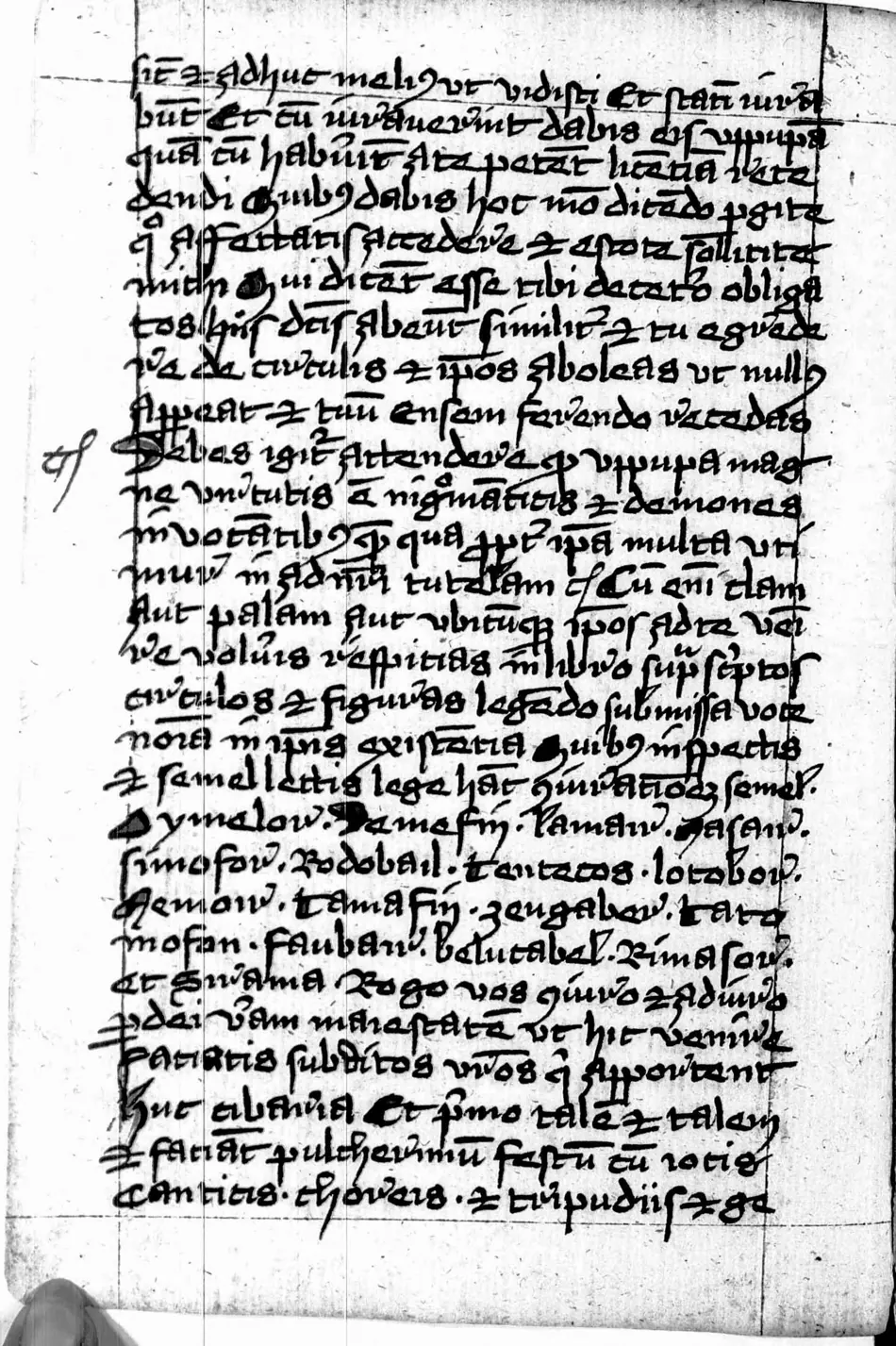
Munich Manual (Clm 849) — facsimile page (fol. 17v) · public-domain facsimile
BSB Clm 849 (MDZ bsb00037155)
🔍 click to enlarge

TranscriptionLatin

sit [?] et adhuc meli[us][?] ut vidisti. Et statim iura- b[u]it. Et cum iuraverint dabis eis [pecuniam?] qua[m] tu habuisti. Itaq[ue] petat [licentia[m]] recede- ndi q[ui]b[us] dabis. Hoc m[od]o dicendo p[er]g[e][?] q[uo] affectaris accedere et esto te sollicit[a?] michi [?] ut dicat[ur] esse tibi de cetero obliga- tos. His dicas: abeatis simili[ter]. Et tu agredia- ris de [curulis?] et ip[s]os aboleas ut null[us] app[ar]eat. Et tu[n]c ensam[?] [fervendo?] vacadas[?] Debeas ig[itur] attendere q[uod] p[er] [?] mag[ic]e ne[?] virtutis et nig[ro]maticis[?] et demones invocat[i]b[us] q[uod][?] q[u]a p[er] ip[s]a multa vi- mus[?] in [admiratutelam?] et cu[m] aut clam aut palam fiu[n]t virtute ip[s]os adire vel recedere volu[er]is respicias in libro sup[ra]sc[ri]ptos [curulos?] et figuras legendo submissa voce no[m]i[n]a in eius existentia q[ui]b[us] invocatis et semel lectis lege has invocationes semel. Symalow · Sames[?] · Yamaw[?] · Sasan[?] · Simosow[?] · Rodobail · Tantatos[?] · lotabow[?] · Gemow[?] · Tamasyn[?] · Zengabow[?] · Tara- mosan · Faubaw[?] · Belutabel · Rimasow[?] · Et sup[ra][?] no[m]i[n]a[?]. Rogo vos [con]iuro et adiuro p[er] dei vestram maiestate[m] ut hic venire faciatis subditos v[est]ros q[u]i apportent huc [abavia?] et p[ri]mo tales et tale[m] et faciat pulcherimu[m] festu[m] cu[m] rosis canticis · choreis · et tripudiis · et[cetera]

TranslationEnglish

...let it be[?] and even better, as you saw. And at once he will swear[?]. And when they have sworn, you shall give them [money?] that which you had[?]. And so let them ask [licence] to depart, which you shall give, saying thus: «Go[?] where you desire to go, and be careful[?]... for me [?] that they be said to remain bound to you henceforth». To these say: «Depart likewise». And you shall set to work[?] with the [seats?/curule stools?] and blot them out so that none may appear. And then [?] [...]. You must therefore attend that by [?] magical[?] art and by necromantic[?] powers and by the demons invoked[?] [...] many things [...] whether secretly or openly are done by [their] power; to make them come or depart, look in the book at the aforesaid [seats?/signs?] and figures, reading in a low voice the names that are there; these being invoked and once read, read these invocations a single time: Symalow · Sames[?] · Yamaw[?] · Sasan[?] · Simosow[?] · Rodobail · Tantatos[?] · lotabow[?] · Gemow[?] · Tamasyn[?] · Zengabow[?] · Taramosan · Faubaw[?] · Belutabel · Rimasow[?]. And [upon?] the names[?]: «I beg you, I conjure and adjure you by the majesty of your[?] god, that you make come here your subjects, who may bring here [?] and first such a one and such a one, and let there be made a most beautiful feast with roses, songs, choruses and dances, etc.».

fol. 18r#18r
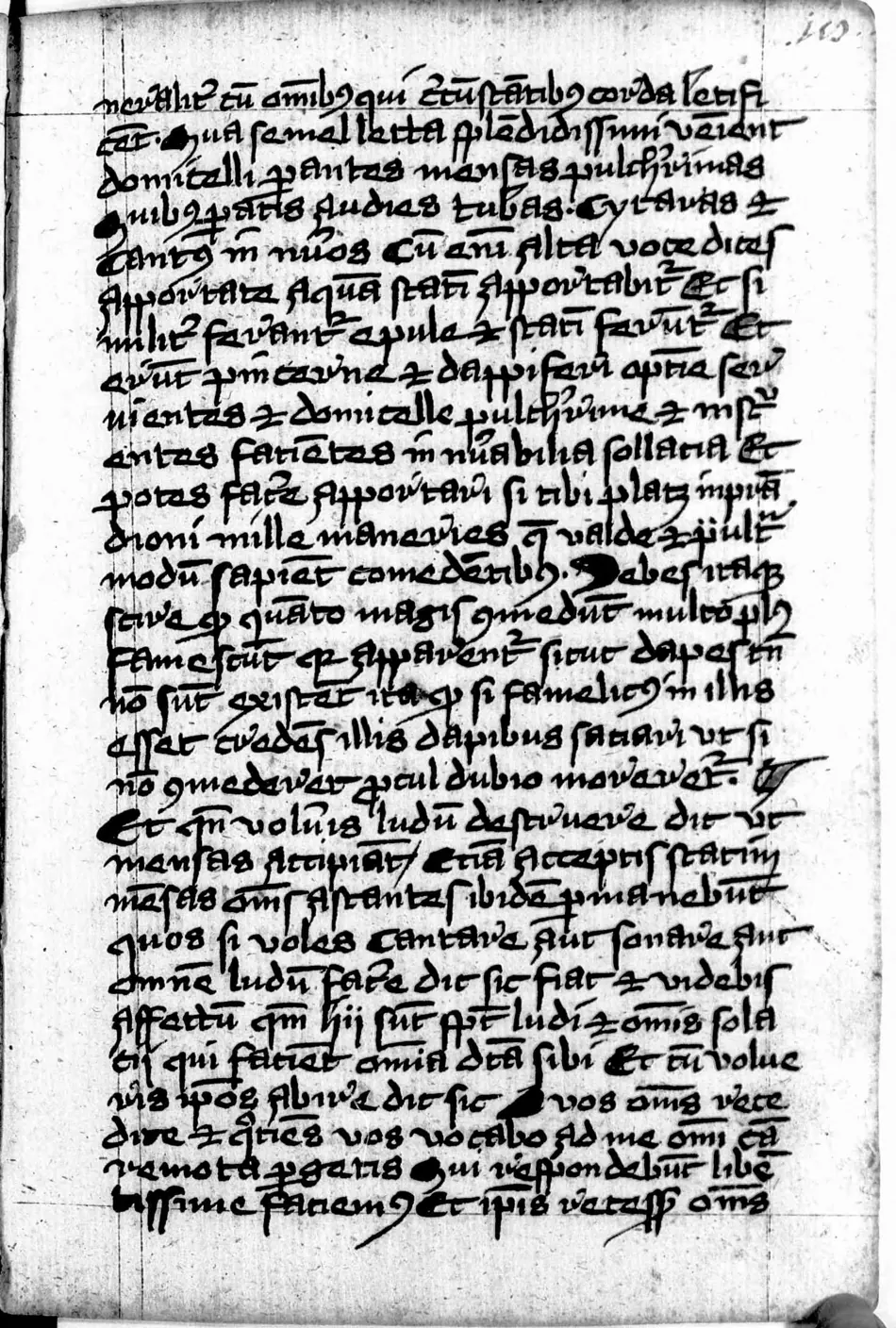
Munich Manual (Clm 849) — facsimile page (fol. 18r) · public-domain facsimile
BSB Clm 849 (MDZ bsb00037155)
🔍 click to enlarge

TranscriptionLatin

[nc]tibit[?] cu[m] om[n]ib[us] qui [circum]stantib[us] corda letifi- cet. Qua semel lecta splendidissimi venient[?] domicelli portantes mensas pulch[er]rimas sub q[ui]b[us] paratis audies tubas · cytharas et cantus in nubes[?]. Cu[m] a[u]t[em] alta voce dicas: apportate aqua[m], stati[m] apportab[it]. Et si- milit[er] facient[?] epulas et stati[m] facient[?]. Et erunt p[ri]mo carne[?] et dapiferi[?] apt[a] ser- vientes et domicelle pulch[er]rime et minist- rantes[?] facietes[?] in[n]u[mer]abilia solatia. Et potes facere apportari si tibi placet imp[er]an- [dominor]um[?] mille maneries[?] q[uod] valde et ultra modu[m] sapiet[?] comedentib[us]. Debes itaq[ue] scire q[uod] q[ua]nto magis [com]edunt multo pl[us] famescunt[?] q[ui]a apparent[?] sicut dapes tam[en] no[n] su[n]t · existet[?] ita q[uod] si famelicus[?] in illis esses cibaces[?] illis dapib[us] saciari[?] ut si no[n] [com]ederet p[ro]cul dubio moriaris[?] Et cu[m] volu[er]is ludu[m] destruere dic ut mensas accipiant, stati[m] accipies[?] · stati[m] mensas om[ne]s astantes ibide[m] p[er]manebu[n]t[?] quos si voles cantare aut sonare aut om[n]e ludu[m] facere dic sic fiat et videbis affectu[?] cu[m] hii su[n]t[?] ars ludi et om[n]is sola- tii q[u]i faciet om[n]ia dicta sibi. Et tu volue- ris ip[s]os abire dic sic: [Re?]vos om[ne]s recede- re et [quies?] vos vocabo ad me om[n]i [causa?] remota p[er] gr[ati]am[?] q[u]i respondebit libe- rissime facie[n]s. Et ip[s]is recedentib[us] om[ne]s

TranslationEnglish

...[?] gladden[?] the hearts of all the bystanders. This [invocation] once read, most splendid young men will come[?] carrying most beautiful tables; these being set, you will hear trumpets, citharas and songs in the clouds[?]. And when you say aloud: «bring water», at once they will bring it. And likewise they will make[?] the dishes, and at once they will make them. And there will be first meat[?] and stewards[?] serving what is fitting, and most beautiful maidens and attendants[?] making[?] countless delights. And you can have brought, if it pleases you, by commanding [it], a thousand kinds[?] [of dishes] that will taste[?] exceedingly and beyond measure to those who eat. You must therefore know that the more they eat, the much more hungry they grow[?], because they appear[?] like dishes but are not; [it happens?] thus that, if you were hungry[?] among them [and wished?] to be sated[?] with those dishes, so that if you did not eat[?] you would without doubt die[?]. And when you wish to break up the show, say that they take away the tables, and at once they will take [them] away[?]; at once the tables [and] all the bystanders will remain[?] there. Whom, if you wish them to sing or play or perform the whole show, say «let it be so» and you will see[?]. With[?] these [spirits?] is the art of the play and of all delight; they will do everything told to them. And [if] you wish them to go, say thus: «[?] withdraw all of you, and [rest?]; I will call you to me, every [cause?] set aside, by [grace?]». Who[ever] will answer[?] most freely, obeying[?]. And as they withdraw, all...

fol. 18v#18v
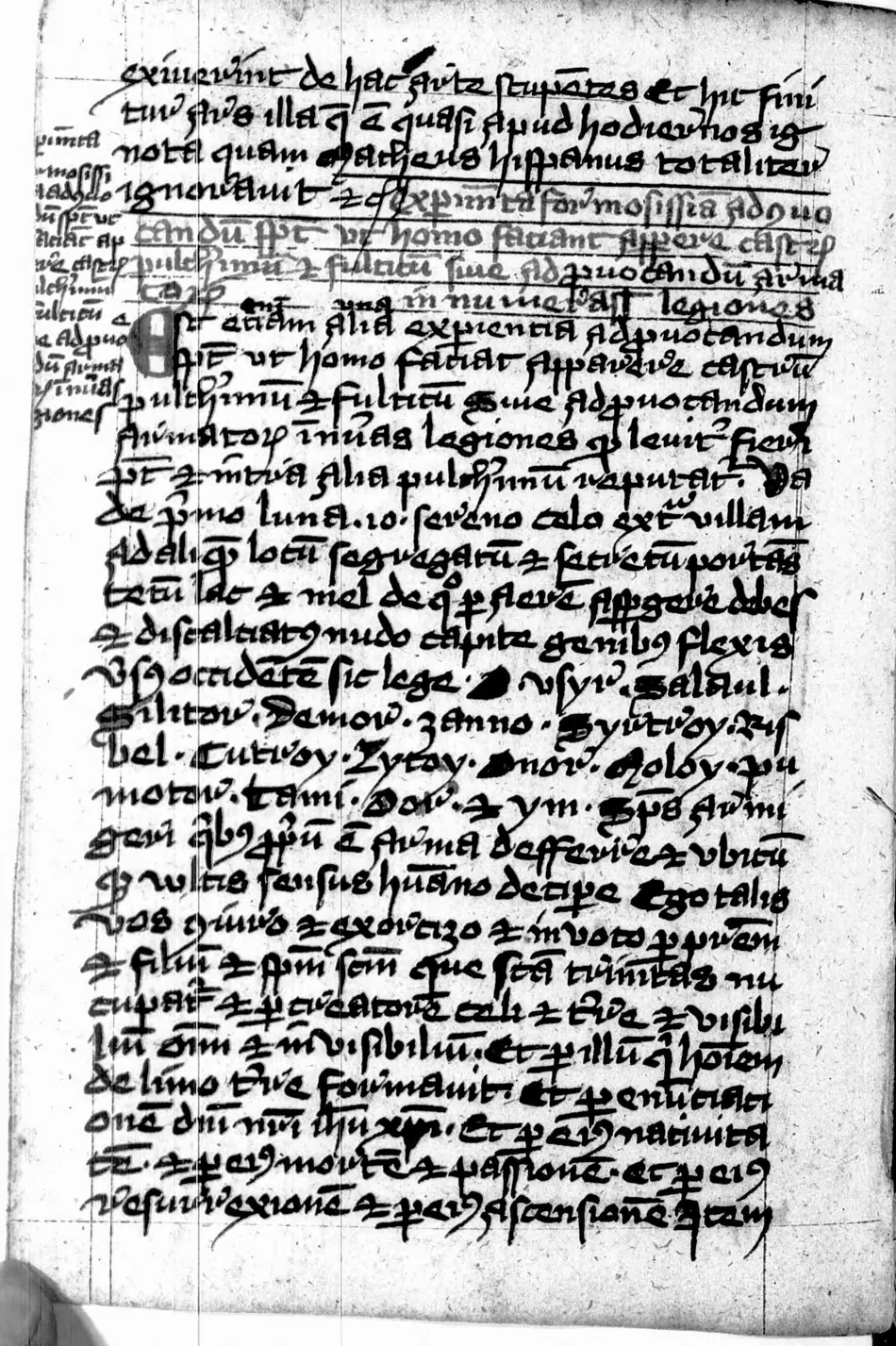
Munich Manual (Clm 849) — facsimile page (fol. 18v) · public-domain facsimile
BSB Clm 849 (MDZ bsb00037155)
🔍 click to enlarge

TranscriptionLatin

exiuerunt de hac arte stupores[?]. Et hic fini- t[ur] q[ui]d[em] illa q[ue] a[?] quasi apud hodiernos ig- nota, quam Matheus Hispanus totalit[er] ignorauit. ~~et exp[er]imenta formosissima ad p[ro]uo~~ ~~[ca]ndu[m] [est] ut homo faciat app[ar]ere castru[m]~~ ~~pulch[er]rimu[m] et fultitu[m] sive ad p[ro]uocandu[m] arma~~ [cro?] ... una i[n] nu[mer]o[?] a[u]t legions ← (partly crossed-out line) [E]st etiam alia experientia ad p[ro]uocandum a[?] ut homo faciat apparere castru[m] pulch[er]rimu[m] et fultitu[m] sive ad p[ro]uocandum arm[at]or[um] turmas legiones q[uod] levit[er] fieri[?] et[?] multa alia pulch[er]rima reparat[?]. Da[?] de p[ri]mo luna · 10 · sereno celo extra villam ad ali[quem] locu[m] segregatu[m] et fac[?] circu[?] portas[?] tenta loco[?] et mel de q[uo][?] p[er][?] flere[?] app[er]ire debes[?] et discalciato nudo capite genib[us] flexis versus occidente[m] sic lege: [?] · Vsyr · Salaul · Silitow[?] · Damow[?] · Zenno · Zyttwoy[?] · Ras- bel · Cuttoy[?] · Zytoy[?] · Snow[?] · Choloy[?] · Ru- motow[?] · Tami[?] · Dow[?] · et ym[?]. [Spiritus?] arma- geri[?] q[ui]b[us][?] app[ar]etis[?] et arma differetis[?] et virtu- [tem?] q[uod] ultra sensum huma[n]um decipe. Ego talis vos [con]iuro et exorcizo et invoco p[er] p[at]rem et filiu[m] et sp[iritu]m s[an]c[tu]m que s[an]c[t]a t[ri]nitas nu- cupat[ur] et p[er] c[re]atore[m] celi et t[er]re et visibi- liu[m] om[n]iu[m] et invisibiliu[m]. Et p[er] illu[m] q[u]i ho[m]i[n]em de limo t[er]re formauit. Et p[er] eius annunciaci- one[m] d[omi]ni n[ost]ri Jh[es]u [Christ]i. Et p[er] eius nativita- te[m] · et p[er] eius morte[m] et passione[m] · et p[er] eius resur[r]ectione[m] et p[er] eius ascensione[m]. Ite[m][?]

TranslationEnglish

...they went out from this art, amazed[?]. And here ends that which is almost unknown among people of today, which Matthew the Spaniard was wholly ignorant of. ~~and most beautiful experiments for provoking[/making appear], namely that a man may~~ ~~make a most beautiful and fortified castle appear, or to provoke armed [hosts]...~~ (lines struck out by the copyist) There is also another experiment for provoking[/making appear], namely that a man may make a most beautiful and fortified castle appear, or to summon squadrons of armed men, legions, which is done easily[?]; and many other most beautiful things [are achieved?]. Give[?]: first, on the 10th [day of the] moon, with a clear sky, outside the town, in some secluded place, and make a circle[?] [with?] gates[?] [...] and honey of which[?] [...] you must open[?]; and, barefoot, with bare head, with knees bent, facing west, read thus: [?] · Vsyr · Salaul · Silitow[?] · Damow[?] · Zenno · Zyttwoy[?] · Rasbel · Cuttoy[?] · Zytoy[?] · Snow[?] · Choloy[?] · Rumotow[?] · Tami[?] · Dow[?] · et ym[?]. [Spirits?] bearers of arms[?], by whom you appear[?] and bring[?] arms and power[?], who [deceive] beyond human sense. I, such a one, conjure and exorcise and invoke you by the Father and the Son and the Holy Spirit, which is called the holy Trinity, and by the Creator of heaven and earth and of all things visible and invisible. And by Him who formed man from the mud of the earth. And by the annunciation of our Lord Jesus Christ. And by his nativity; and by his death and passion; and by his resurrection and by his ascension. Likewise[?]...

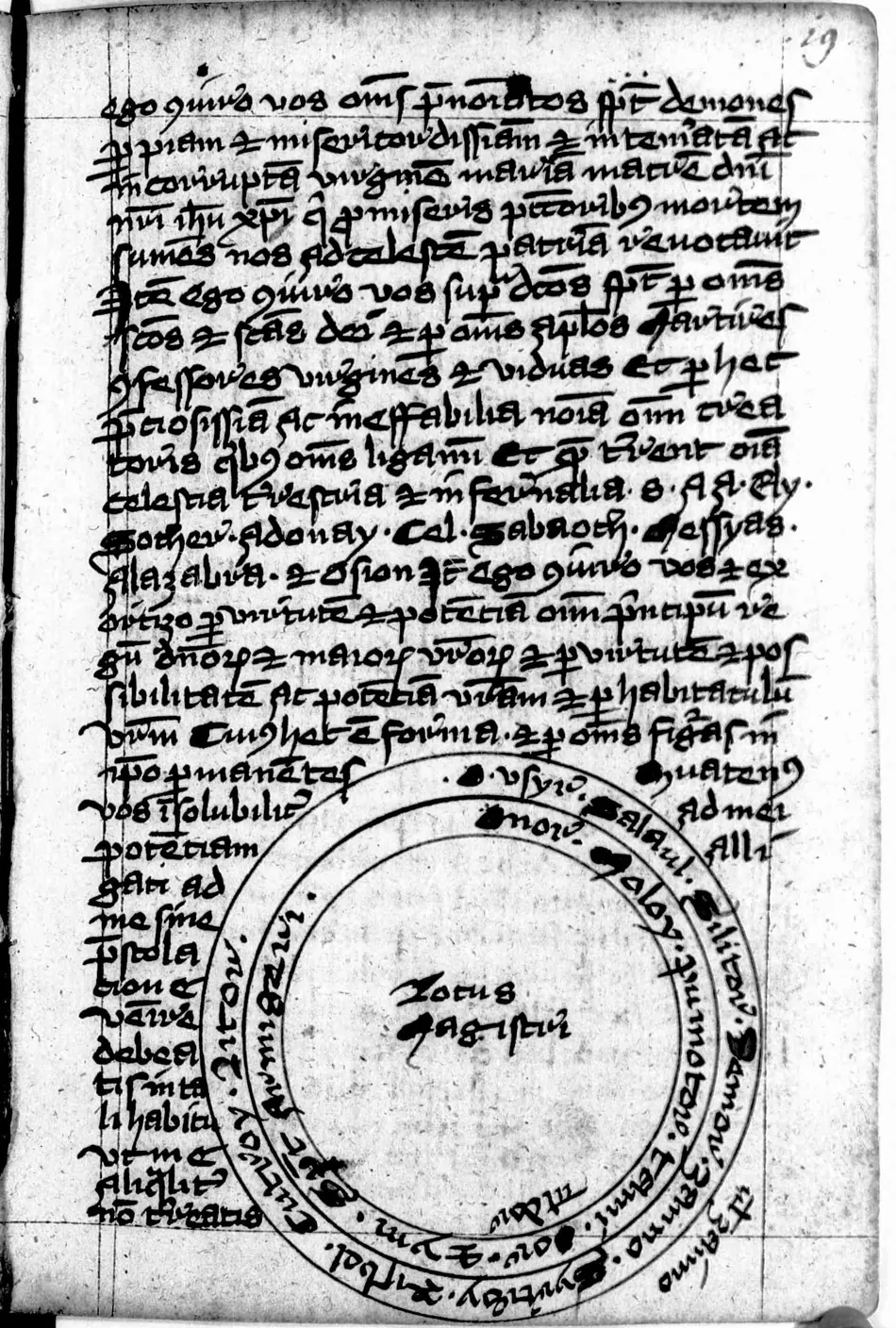
fol. 19r#19r
Munich Manual (Clm 849) — engraved plate (fol. 19r) · public-domain facsimile
BSB Clm 849 (MDZ bsb00037155)
🔍 click to enlarge

TranscriptionLatin

ego co[n]iuro vos om[ne]s p[ri]ncipatus [?] p[ri]ncipes demones [per] p[ie]tatem et misericord[iam] et in[te]merata[m] Ac i[n]corrupta[m] virgi[n]e[m] maria[m] matre[m] d[omi]ni n[ost]ri ih[es]u xp[ist]i qui p[ro] miseris peccatorib[us] morte[m] s[?]m[?] nos ad celeste[m] patria[m] revocavit Item ego co[n]iuro vos sup[er] d[e]os s[an]c[t]os [?] Et p[er] om[ne]s s[an]c[t]os et s[an]c[t]e[?] dei et p[er] om[ne]s [s]c[t]os martires co[n]fessores virgines et viduas Et p[er] hec gloriosissima Ac ineffabilia no[m]i[n]a om[n]iu[m] c[re]a- toris q[ui]b[us] om[n]e ligat[ur] Et q[ui] trem[un]t om[n]ia celestia t[er]restria et in[fer]nalia · O · A · A · Ely · Sother · Adonay · Cel[?] · Sabaoth · Messyas · Alazabra[?] · et Osion[?] Item ego co[n]iuro vos et ex- orzizo [exorcizo] p[er] virtute[m] et pote[n]tia[m] om[n]iu[m] p[ri]ncipu[m] ve- s[t]r[or]u[m] d[omi]noru[m] maioru[m] v[est]roru[m] et p[er] virtute[m] et pos- sibilitate[m] Ac pote[n]tia[m] v[est]ram et p[er] habitac[u]lu[m] v[est]r[u]m Cu[m] hec et forma et p[er] om[ne]s figas [figuras?] in [?]o p[er]manetes [permanentes?] quaten[us] left column beside the circle: vos i[n]solubili[ter] potentiam gari [ligari?] ad me sine [con]sola- tione et vana[?] debea- tis i[n] ta- li habi[tu?] vt me Adhuc[?] no[n] tediat[?] right column beside the circle: quaten[us] / Ad me / Alli-[gari?]

TranslationEnglish

I conjure you all, principalities[?], princes, demons, [by] the piety and the mercy and by the undefiled and incorrupt Virgin Mary, mother of our Lord Jesus Christ, who for wretched sinners [took?] death [and] called us back to the heavenly homeland. Likewise I conjure you by the holy gods[?], and by all the holy men and women of God, and by all the holy martyrs, confessors, virgins and widows, and by these most glorious and ineffable names of the creator of all things, by which everything is bound and before whom tremble all heavenly, earthly and infernal things: O, A · A · Ely · Sother · Adonay · Cel[?] · Sabaoth · Messyas · Alazabra[?] · and Osion[?]. Likewise I conjure and exorcize you by the virtue and power of all your princes, of your greater lords, and by the virtue and possibility and power of you, and by your dwelling, with this [and this?] form, and by all the figures that remain in [?], insofar [left col.:] you… indissolubly / the power / to bind[?] to me, without / consolation / and … / vain[?] / you must / [remain] in such habit[?] / until I / yet[?] / grow not weary[?]. [right col.:] insofar / to me / to bind[?].

fol. 19v#19v
Munich Manual (Clm 849) — facsimile page (fol. 19v) · public-domain facsimile
BSB Clm 849 (MDZ bsb00037155)
🔍 click to enlarge

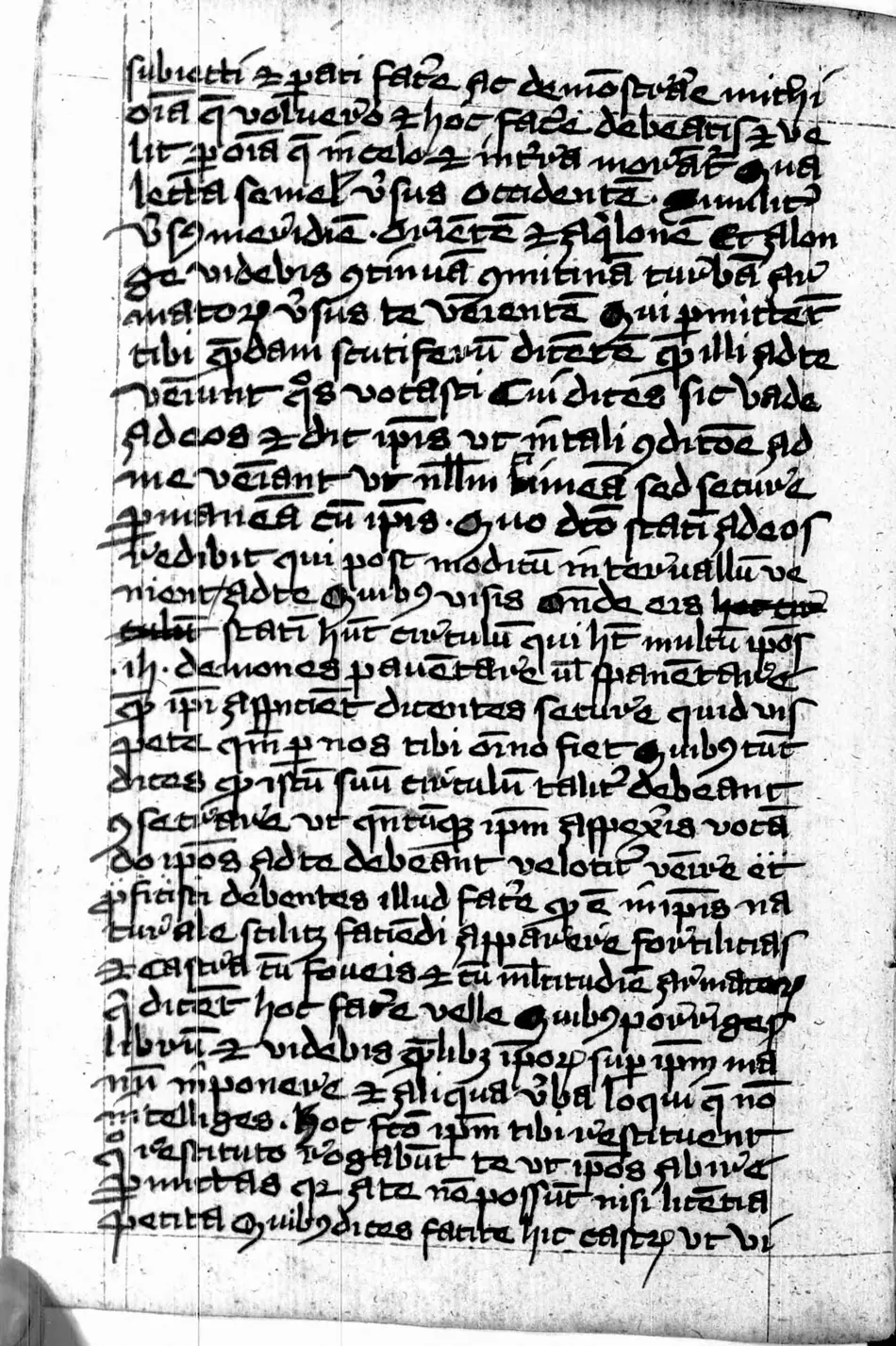
TranscriptionLatin

subiecti et p[ar]ere faciet[?] q[uo]d demo[n]strabile[?] michi om[n]ia q[ue] volue[ro] Et hoc facere debeatis Et va- let[?] p[er] om[n]ia q[ui] i[n] celo[?] et i[n] t[er]ra mora[n]t[ur] q[ui]a l[e]cta[?] samel[?] v[er]sus occidente[m] q[ui] alu[d?] v[er]sus[?] meridie[m] · dicere et Aquilone[m] Et Alon- ga videbis co[n]tinuo[?] em[m]i[n]e[n]te[?] turba[m] Ar- matoru[m] v[er]sus te venienti[um] q[ui] p[ro]mittet[?] tibi q[uo]dam scutifar[um][?] dicere[?] q[uod] illi Ad te venerunt q[uo]s vocasti Cu[m] dices sic vade Ad eos et dic ip[s]is v[e]l[?] i[n] tali co[n]dic[t]o[?] Ad me venia[n]t v[e]l n[u]ll[u]m timea[n]t[?] s[ed] secur[us] p[er]maneat cu[m] ip[s]is · q[u]o d[i]c[t]o statim Ad eos redibit qui post modicu[m] i[n]t[er]vallu[m] ve- nient Ad te q[ui]b[us] visis onda[?] eras[?] crossed out statim[?] hu[n]c circulu[m] qui h[ab]et multu[m] ip[s]or[um] ·ii· demones pave[n]t[?] [?] ut p[er]maneat[?] q[uod?] q[uod] ip[s]i appareat[?] dicentes satur[us][?] quid vis fieri q[uo]d[?] p[er] nos tibi o[mn]i[n]o fiet[?] q[ui]b[us] tu[?] dices q[uod] i[st]u[m] suu[m] circulu[m] valit[?] debea[n]t[?] et satur[us][?] v[t] q[ua]ntu[m]q[ue] ip[su]m appropi[n]q[u]a[?] vota[?] do ip[s]os Ad te debeant velo[?]t[?] venire et [?]si[?] debentes illud facere q[uod] e[?] i[n] ip[s]is n[?] et castru[m] tu foueis[?] et tu m[ul]titudi[n]e[?] armator[um] q[ui] diceret[?] hoc facere velle q[ui]b[us] p[?]rig[?] [?] videbis q[uod] lib[et] ip[s]or[um] sup[er] ip[su]m mu- [?] i[m]pone[re] et Aliqua v[er]ba loqui q[ue] no[n] i[n]telliges Hoc facto ip[s]um tibi restituent[?] [?]stituto[?] rogabu[n]t te v[t] ip[s]os Ab i[?] [?][?]s q[uod] facere no[n] possu[nt] nisi lice[n]tia[?] [?]arita q[ui]b[us] dices facere hic castr[um] v[t] v[?]

TranslationEnglish

…subdued, and will make[?] [them] obey, so that there be shown to me[?] all that I want. And this you must do. And it avails[?] by all who dwell in heaven[?] and on earth, because[?] [?] "Samel[?]" toward the west, [and] another[?] toward the south —to say— and the north. And afar[?] you will see at once, drawing near[?], a troop of armed men coming toward you; one[?] will promise[?] —a certain squire[?]— to say[?] that they have come to you, whom you summoned. When you shall say thus: "Go to them and tell them[?] or[?] that by such a pact[?] they come to me, or let them fear nothing[?], but let [him] remain secure with them." Which said, at once to them he will return; who, after a short interval, will come to you; and seeing them, [?] then[?] [struck out] at once[?] this circle, which holds much of them. The ·ii· [two] demons fear[?] […] that it may remain[?], that they appear saying: "[Lord?/Saturus?], what do you wish to be done, which by us shall be wholly done for you?" To whom you will say that their circle[?] must avail[?] … and [Saturus?], that however much he approaches[?], … [vowing?] that they must come to you swiftly[?], and [?] having to do that which is in them[?] … and a castle with moats[?] and with a multitude[?] of armed men, whoever shall say[?] he wishes to do this; to whom [?] [?] you will see that each of them upon him [?] [?] to impose[?] and to speak certain words that you will not understand. This done, they will restore him to you[?]; restored[?], they will beg you that [you release?] them from [?] [?] which they cannot do except by license[?] [?] to whom you will say: to make here a castle, that [?].

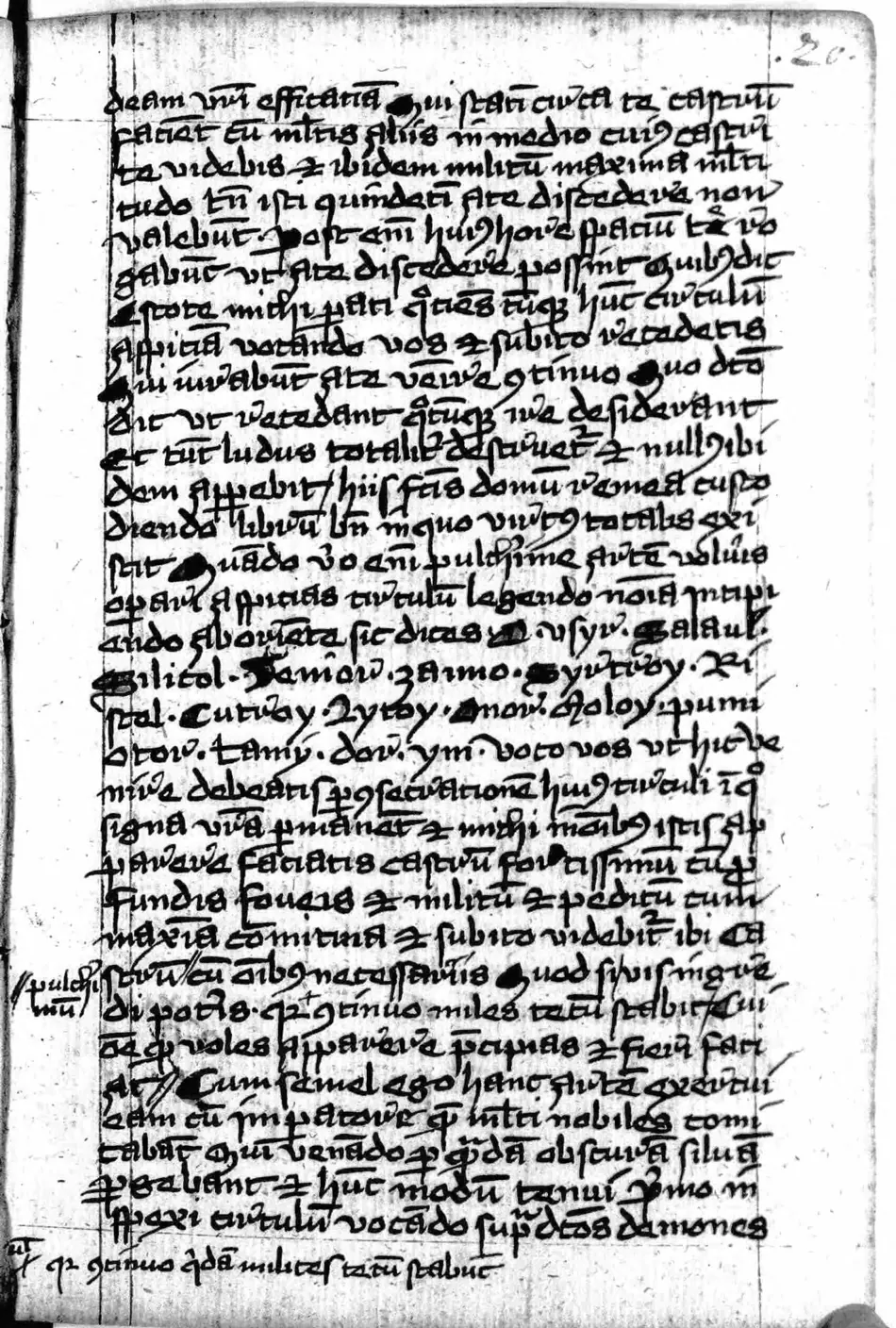
fol. 20r#20r
Munich Manual (Clm 849) — facsimile page (fol. 20r) · public-domain facsimile
BSB Clm 849 (MDZ bsb00037155)
🔍 click to enlarge

TranscriptionLatin

deam[?] v[est]r[am] efficatia[m][?] qui statim circa te circulu[m] faciat cu[m] militib[us] aliis in medio cui[us] circu- l[i] [?] videbis et ibidem militu[m] maxima[m] multi- tudo t[ame]n isti q[ui]nda[m][?] Ar[?] discedere non valebu[n]t post e[t]am[?] hu[i]us hore[?] spatiu[m][?] te ro- gabu[n]t v[t] Ab te discedere possint q[ui]b[us] dic- es p[ro]pter[?] michi p[ar]ati[?] q[ua]tes[?] tu[n]c[que] hu[n]c circulu[m] Ap[er]iat[?] volando vos et subito v[er]cade[n]s[?] [?] iuvabu[n]t Ar[?] v[er]e co[n]tinuo q[u]o d[i]c[t]o d[i]c v[t] v[er]cedant[?] q[uo]t[?]q[ue] me desiderant et t[un]c ludus totalit[er] desi[n]et[?] et null[us] ibi- dem apparebit hii[s] fac[t]is domu[m] v[e]nias custo- diendo libru[m] v[b]i[?] i[n] q[u]o v[?] totalis[?] exi- sit[?] Q[ua]ndo v[er]o a[n]i[m]a[?] pulc[er]rime[?] Arte[m] volueris op[er]ari Ap[er]ias[?] circulu[m] legendo no[m]i[n]a i[n]uo- cando Ab o[r]ie[n]te[?] sic dicas [?] vsyr[?] Salaul[?] Silitor[?] Samior[?] zarmo[?] Byrtiray[?] Ri- pcal[?] Cutray[?] Lyrsy[?] Amor[?] Aoloy[?] p[?]mi- otor[?] Lamy[?] dor[?] ym[?] voco vos vt hic ve- mi[re][?] debeatis p[er] co[n]servatione[m] hu[ius] circuli i[n] q[uo] signa vestra p[er]manent et michi maio[?] ip[s]is Ap- pareatis facientes castru[m] fortissimu[m] cu[m] fundis[?] foueis et militu[m] et peditu[m] cu[m] maxima comitiua et subito videbit[ur] ibi ca- [marg. izq.: pulc[er]rimu[m]] stru[m] cu[m] o[mn]ib[us] necessariis Quod si vis i[n]uenre[?]- di potis[?] q[uo]d[?] co[n]tinuo miles tec[um] stabit Cui ad[?] q[uo]d voles Apparere pug[n]as[?] et ficta[?] fari- gat[?] Cum s[em]el ego hanc Arte[m] exercui eam cu[m] i[m]p[er]atore q[ui] i[n]t[er] nobiles comi- tabat q[ui] venado[?] p[er] q[uo]da[m] obscura[m] silua[m] [am]bulaba[n]t et hu[n]c modu[m] tenui q[ua]n[?]do i[n]- [f]raxi[?] circulu[m] vocando sup[er] deos demones [marg. inf.: v[t] q[uod] co[n]tinuo q[ue]da[m] milites tecu[m] stabu[n]t]

TranslationEnglish

…your[?] efficacy[?], who at once shall make around you a circle with other knights, in the midst of which circle you will see[?]; and right there [will be] a very great multitude of knights; yet these [?] will not be able to depart, and afterward, even[?] after the space[?] of this hour, they will beg you that they may depart from you; to whom you will say[?] that[?] "for [?] I am ready[?]"… and then this circle[?] let [them] open[?], you flying[?], and suddenly withdrawing[?] [?] they will help[?] [?] truly at once. Which said, say that as many as desire me[?] withdraw[?], and then the game [ludus] will wholly cease[?], and no one there will appear. This done, return home, keeping the book where[?] it may be[?] [?] entirely[?]. And when you truly wish[?] to work this most beautiful[?] art, open[?] the circle by reading the names, invoking from the east[?]; say thus[?]: "Vsyr[?], Salaul[?], Silitor[?], Samior[?], Zarmo[?], Byrtiray[?], Ri- pcal[?], Cutray[?], Lyrsy[?], Amor[?], Aoloy[?], [?]mi- otor[?], Lamy[?], dor[?], ym[?]: I call you that here you must come, by the preservation of this circle in which your signs remain, and to me… greater[?]… appear to them[?], making a most strong castle with slings[?/moats], moats, and knights and foot-soldiers with a very great retinue"; and suddenly there will be seen a [marg.: most beautiful] castle with all that is needed. And if you wish to find[?] [?], that at once a knight will stand with you, to whom [?] whatever you wish to appear: battles[?] and feigned[?] toils[?]. Once I myself practiced this art, [I did it] with an emperor who among nobles was riding, who, hunting[?], through a certain dark forest were walking; and I kept this method[?] when [?] I traced[?] the circle, invoking over the gods[?] demons, [lower marg.: so that at once certain knights will stand with you].

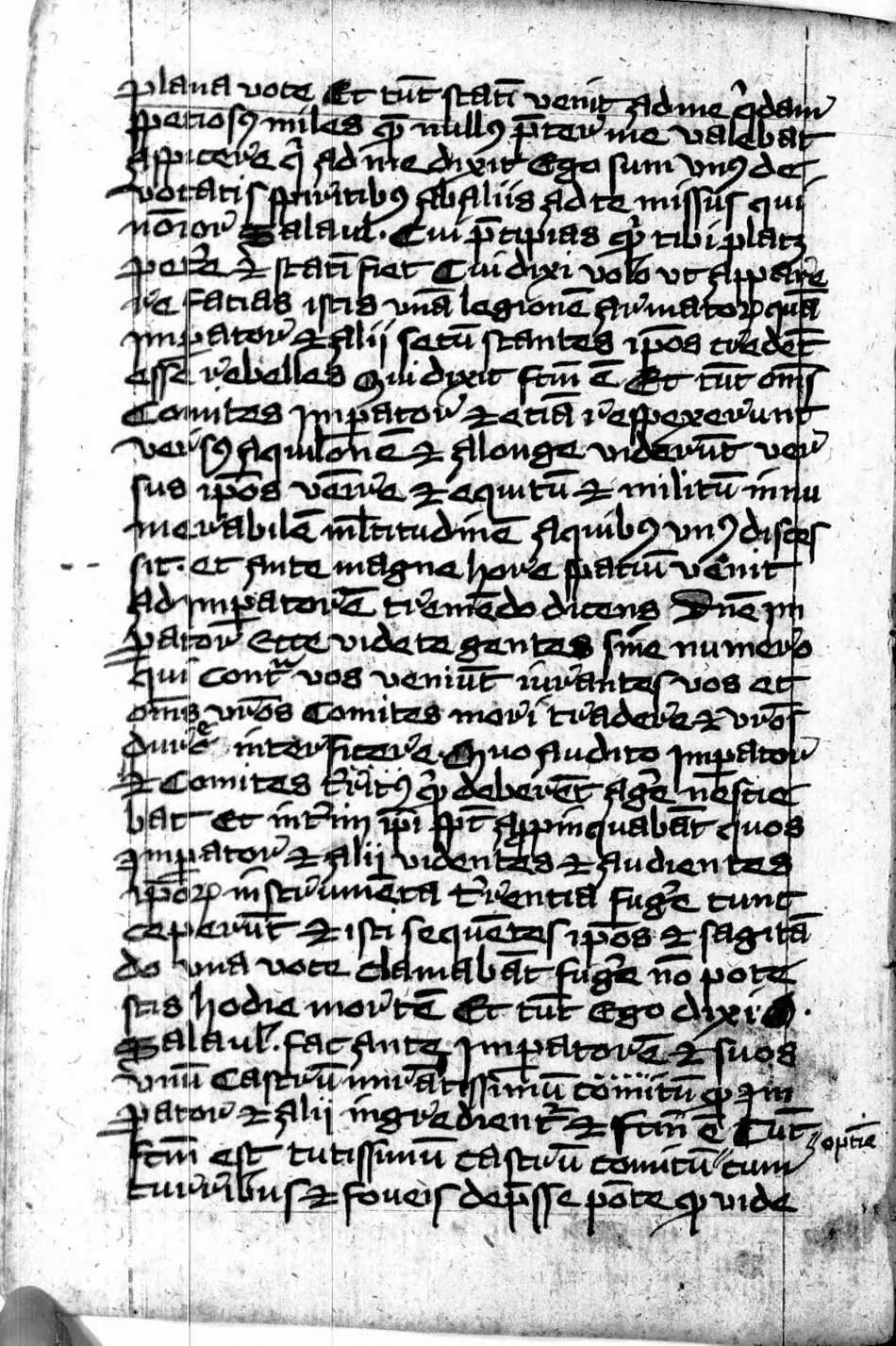
fol. 20v#20v
Munich Manual (Clm 849) — facsimile page (fol. 20v) · public-domain facsimile
BSB Clm 849 (MDZ bsb00037155)
🔍 click to enlarge

TranscriptionLatin

plana voce, et tunc statim venit ad me quidam [armatus?] miles, quod nullus p[re]ter me valebat apparere. Qui ad me dixit: ego sum un[us] de vocatis a milit[ibus][?], ab aliis ad te missus, qui vocor Salaul. Cui p[re]cipias q[uod] tibi i[n]placet[?] [voca?] et statim fiat. Cui dixi: volo vos apparere [et?] facias ip[s]e una[m] legione[m] armator[um], qua[m] imp[er]ator[?] et alii satis st[antes?] ip[s]os [tradere?][?] esse[?] rebelles. Q[u]i dixit: fiat. Et ego tu[n]c om[ne]s[?] comites imp[er]ator[um] et alia [p]er[r]exeru[n]t[?] v[er]sus aquilone[m], et a longe videru[n]t v[er]- sus ip[s]os [venire?] et equitu[m] et militu[m] i[n]nu- merabile[m] m[u]ltitudine[m], a q[ui]b[us] [?] [?] et ante magna[m] hora[m] statim venit ad imp[er]ator[em] tremendo dicens: domine im- p[er]ator, ecce videte gentes sine numero qui contra vos veniu[n]t, iuva[n]tes vos et om[ne]s v[est]ros comites mori t[ra]dere et v[est]ros [?] int[er]ficere. Quo audito, imp[er]ator[e] et comites t[er]riti, q[uo]d deber[en]t age[re] nescie- bat. Et int[er]im ip[s]i [hostes?] app[ro]pi[n]quaba[n]t. Duos[?] imp[er]ator[em] et alii, videntes et audientes ip[s]oru[m] i[n][?] t[er]rentia, fug[er]e tunc cep[er]unt, et isti seq[ue]ntes ip[s]os et sagita[n]- do una voce clamabat: fug[er]e no[n] pote- stis hodie morte[m]. Et tu[n]c ego dixi [?] Salaul: faciant imp[er]ator[em][?] et suos unu[m] captu[m][?] mir[abilissimu]m[?] comitu[m], q[uod?] imp[er]ator et alii ingredient[ur][?] et [?], et tu[n]c [?] est tutissimu[m] castru[m] comitu[m], cum turrib[us] et fove[is] defe[nsari?] pot[est], q[u]i vide- catchword lower right marg.: «[et?] optie» ≈ et optima]

TranslationEnglish

...in a plain voice, and then at once there came to me a certain [armed?] knight, whom none but me could make appear. Who said to me: I am one of those summoned by the soldiers[?], sent to you by the others, who am called Salaul. Command him whatever pleases you[?] and it will at once be done. To whom I said: I wish you to appear, and that you yourself make one legion of armed men, whom the emperor[?] and others, standing by[?], [hand over?] to them as though they were rebels. Who said: let it be done. And I then [saw] all[?] the counts of the emperors and the rest advance[?] toward the north, and from afar they saw coming against them[?] an innumerable multitude of horsemen and of soldiers, from whom [?] [?]. And before a great hour, at once there came to the emperor, trembling, one saying: lord emperor, behold, see peoples without number who come against you, ready to aid you[?] and to hand over to death all your counts, and to kill yours[?]. Hearing this, the emperor and the counts, terrified, knew not what they ought to do. And meanwhile they, the [enemies?], drew near. To the two[?]: the emperor and the rest, seeing and hearing what terrified them, then began to flee; and these, pursuing them and shooting arrows, cried with one voice: you cannot flee death today. And then I said [to?] Salaul: let them make[?] the emperor and his men [enter?] one most wondrous [castle?] of the counts, so that[?] the emperor and the rest may enter[?], and [?]; and then [?] it is a most secure castle of the counts, which with towers and moats can be defended[?], which sees/saw-...

fol. 21r#21r
Munich Manual (Clm 849) — facsimile page (fol. 21r) · public-domain facsimile
BSB Clm 849 (MDZ bsb00037155)
🔍 click to enlarge

TranscriptionLatin

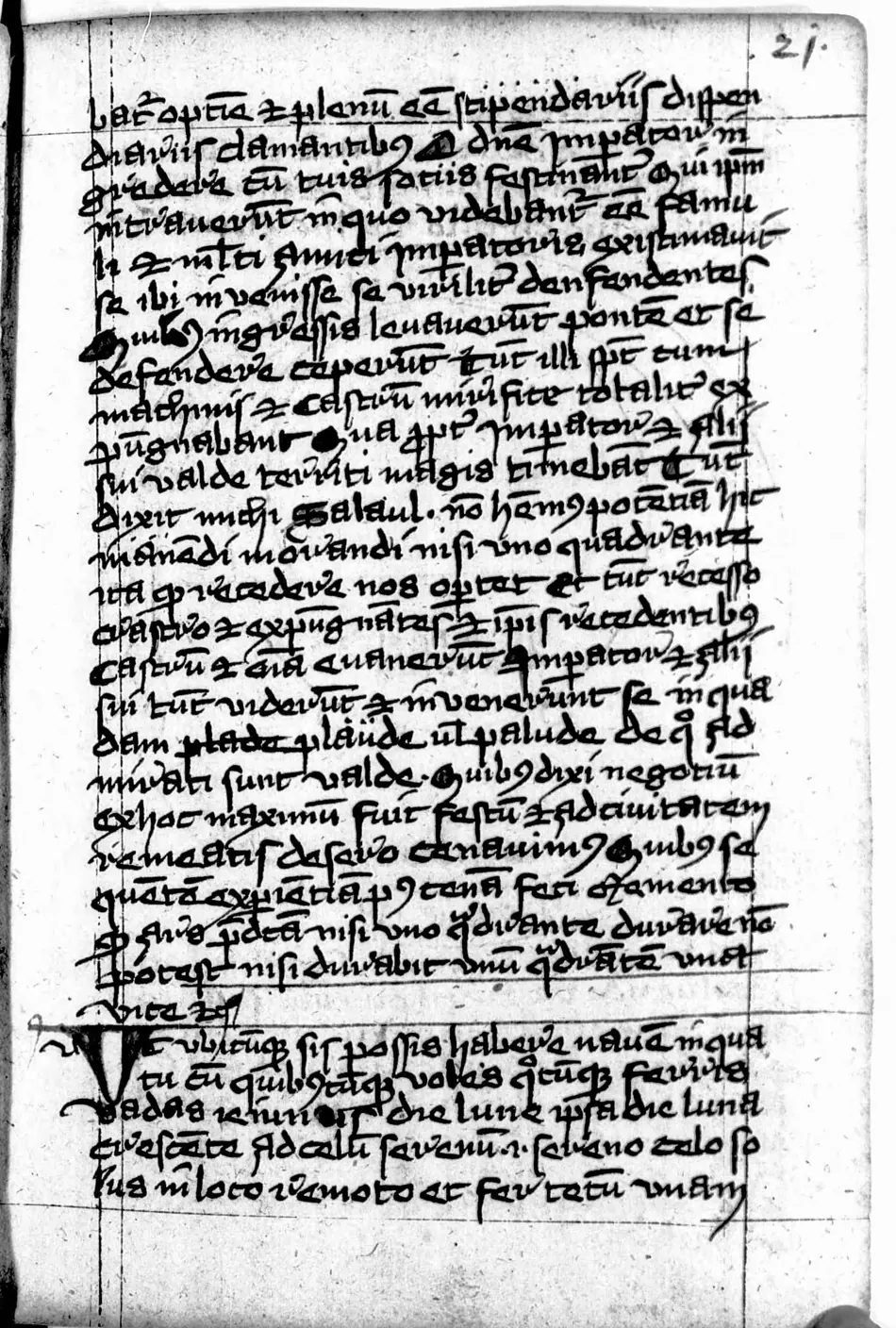
[hec?] optima et plenu[m], et stipendariis dispen- [san?]d[is][?] clamantib[us]. Et domine imp[er]ator, i[n]- gredere cu[m] tuis sociis festina[n]t[er], q[u]i ip[s]i int[ra]verunt in quo videbant. Et famu- li et milit[es], amici imp[er]atori[s], existimavi[t] se ibi i[n]venisse, se virilit[er] defende[n]tes Quib[us] i[n]gressis leuaveru[n]t ponte[m] et se defendere cep[er]unt. Tunc illi q[u]i [erant?] cu[m] machinis et castru[m], muru[m] [?], totalit[er] ex- pugnaba[n]t. Qua aut[em] imp[er]ator et alii sui valde t[er]riti, magis timebat. Et tu[n]c dixit michi Salaul: no[n] habem[us] pot[enti]a[m] hu- [c][?] manendi [nec] movendi nisi uno quadra[n]te, it[a] q[uod] p[ro]cedere nos op[or]tet. Et tu[n]c, recesso castro et expugnatores et ip[s]i recede[n]tib[us], castru[m] et alia euanueru[n]t. Imp[er]ator et alii sui tu[n]c viderunt et i[n]veneru[n]t se i[n] qua- dam palude [p[ro] laude ut palude][?] de q[ua] ad- mirati su[n]t valde. Quib[us] dixi: negotiu[m] ex hoc maximu[m] fuit factu[m] et ad utilitatem [?] de sabbato [con]auim[us][?]. Quib[us] se- quarta[m] experie[n]cia[m] p[er][?] certa[m] fieri [?] [?] h[ec] p[re]d[i]c[t]a nisi uno quadrante durare no[n] potest, nisi durabit unu[m] quadrante[m] una[?] [vice?][?] (V) Ut ubicu[m]q[ue] sis, possis h[ab]ere nave[m] i[n] qua tu et quib[us]cu[m]q[ue] volueris, quantu[m]cu[m]q[ue] festina[nter?] vadas[?] [?]. Die lune, ip[s]a die luna crescente, ad casu[m] [solis?], id est sereno celo, so- lus in loco remoto, et fac tibi una[m]

TranslationEnglish

...best [provisions] and in plenty, and to be dealt out to the stipendiaries[?], while they shouted[?]. «And you, lord emperor, enter with your companions in haste!»; and they themselves entered into [the place] they saw. And the servants and soldiers, friends of the emperor, he thought[?] he had found there, defending themselves manfully. When these had entered, they raised the bridge and began to defend themselves. Then those who [were?] with the siege-engines assaulted the castle, the wall[?], utterly. And since the emperor and his other men were greatly terrified, he feared the more. And then Salaul said to me: we have no power to remain here[?] [nor] to move except for one quarter [of an hour], so that we must depart. And then, once the castle and the besiegers had withdrawn, and as they withdrew, the castle and the rest vanished. The emperor and his other men then saw and found themselves in a certain marsh [reading «palude» for «laude»][?], at which they marveled greatly. To whom I said: from this a very great matter was made, and to advantage[?] [?] of the sabbath we wrought[?]. To whom [there followed?] a fourth experiment, that certain things be made[?], [?] [?] these aforesaid things cannot last but one quarter [of an hour], for it will last one quarter, one[?] [time?][?]. (V) That wherever you are, you may have a ship in which you and whomever you wish, however far, in haste[?] may go[?]. On the day of Monday, on that same day, with the moon waxing, at the setting [of the sun?], that is, under a clear sky, alone, in a remote place, and make for yourself a...

fol. 21v#21v
Munich Manual (Clm 849) — facsimile page (fol. 21v) · public-domain facsimile
BSB Clm 849 (MDZ bsb00037155)
🔍 click to enlarge

TranscriptionLatin

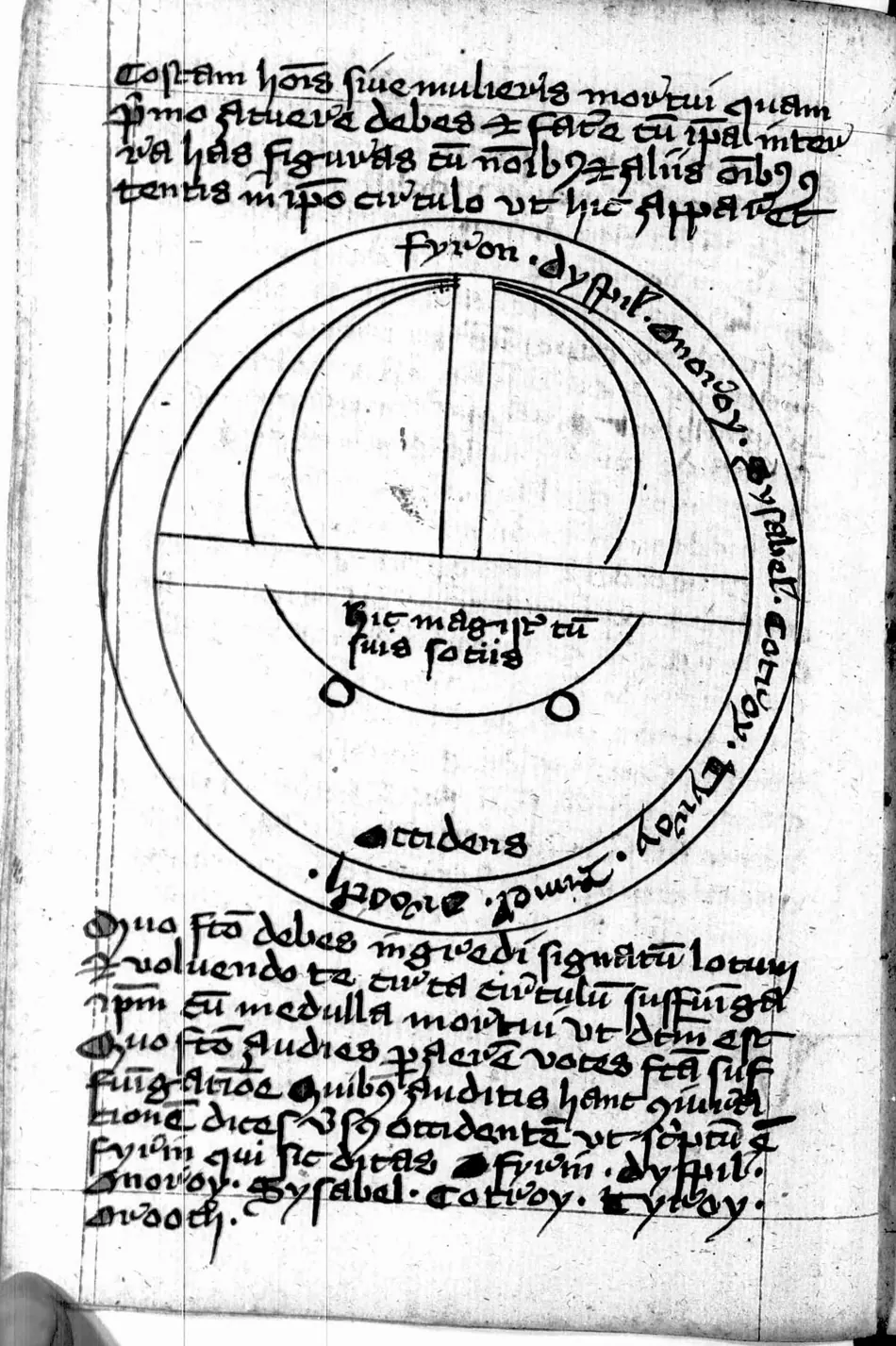
[costam?] ho[m]i[ni]s sive mulieris mortui, quam p[ri]mo adunare debes, et fac[?] cu[m] ip[s]a[?] [?] [?] has figuras cu[m] no[m]i[ni]b[us] et aliis [con]- tentis in ip[s]o circulo, ut hic apparet.

— on the upper edge / outer ring (right → below): fyron · dyabol[?] · amoymon · Sysabel · cotroy · loathy[?] — en el lower arc: attidens · [hproogie?] · [amanth?] — en el centro dthe circle: hic magi[s]t[er] cu[m] suis sociis — (two small circles/knots drawn on the lower edge)

Quo facto, debes ingredi signatu[m] locu[m], et volvendo te circa circulu[m], suffumiga ip[su]m cum medulla mortui, ut dictum est. Quo facto, audies plures voces facta suf- fumigatione. Quib[us] auditis, hanc [con]iura- tione[m] dices v[er]sus occidente[m], ut sequitur: [con]iuro[?] [te?] fyron. Q[u]i sic dicas: fyron · dyabol[?] · amoymon[?] · Sysabel · cotroy · [t]ytroy · amooth ·

TranslationEnglish

...the [rib?] of a dead man or woman, which first you must gather/obtain, and make[?] with it[?] [?] [?] these figures with the names and the other things contained in the circle itself, as here appears.

(Circle labels: fyron · dyabol[?] · amoymon · Sysabel · cotroy · loathy[?] · attidens · [hproogie?] · [amanth?]; at the center: «here the master with his companions».)

This done, you must enter the marked place, and, turning yourself about the circle, suffumigate it with the marrow of a dead man, as has been said. This done, you will hear many voices once the suffumigation is made. Having heard these, you shall say this conjuration toward the west, as follows: [I conjure you?] fyron. So that you say thus: fyron · dyabol[?] · amoymon[?] · Sysabel · cotroy · [t]ytroy · amooth ·

fol. 22r#22r
Munich Manual (Clm 849) — facsimile page (fol. 22r) · public-domain facsimile
BSB Clm 849 (MDZ bsb00037155)
🔍 click to enlarge

TranscriptionLatin

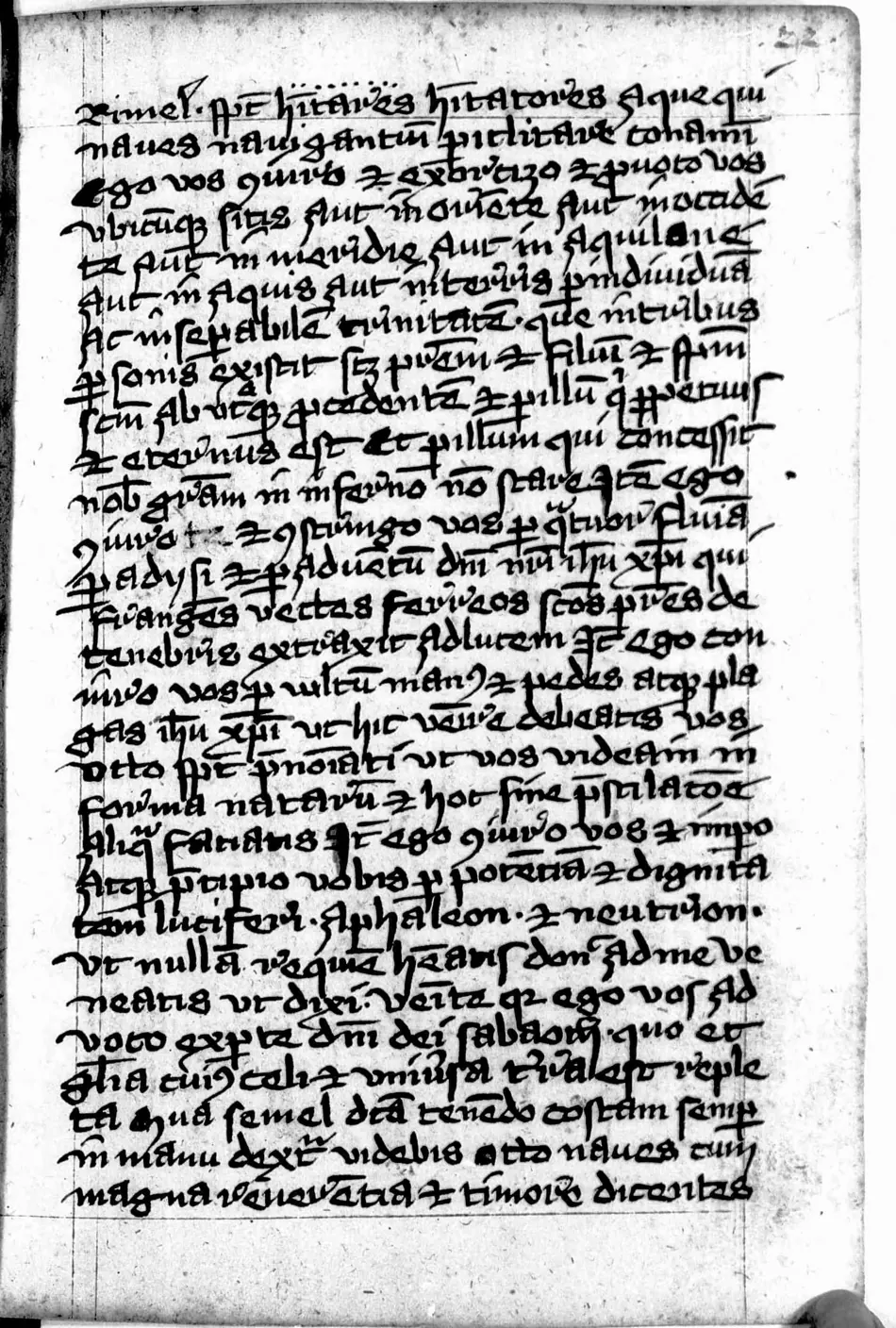
...imel · A[?]t h[abitat]ores h[abitat]ores Aque q[u]i [in] n[avi]b[us] navigant[ur][?] p[er]cip[iti]s co[n]iuram[?] ego vos co[n]iuro [et] exorcizo [et] p[re]cepto[?] vos vbicu[m]q[ue] sit[i]s Aut in oriente Aut in occide[n]- te Aut in meridie Aut in Aquilone Aut in Aquis Aut n[?] i[n]t[er]uis[?] p[er] i[n]diuidua[m] Ac i[n]sep[ar]abile[m] trinitate[m] · q[ue] i[n] trib[us] [et][?] p[er]sonis existit s[ed] p[er] p[at]rem [et] filiu[m] [et] s[an]c- t[u]m [spiritum?] Ab v[traque] p[ro]cedente[m] [et] p[er] illu[m] q[ui] p[re]t[er]nus[?] [et] et[er]nus est [et] p[er] illum qui co[n]cessit nob[is] gr[ati]am in i[n]f[er]no no[n] stare q[ue][?] te[?] ego co[n]iuro te[?] [et] co[n]stringo vos [et] q[ua]t[er?]b[?] p[er] fluuia[?] [et] Adysi[?] [et] p[er] Adue[n]tu[m] d[omi]ni n[ost]ri ih[es]u xp[ist]i qui [con]f[r]ange[n]s[?] v[er]itas[?] farin[e]os[?] s[an]c[t]os p[at]res de tenebris extraxit Ad luce[m] [con]iuro[?] ego con- iuro vos p[er] vultu[m] man[us][?] [et] pedes atq[ue] pla- gas ih[es]u xp[ist]i vt hic ven[ire][?] adieatis[?] vos otto[?] p[er?] p[ro]miatti[?] vt vos videa[m] in forma nat[ur]ali[?] [et] hoc s[i]ne p[er]s[on?]latoe[?] Alicu[i][?] f[?]a[?]ans[?] [con]iuro vos [et] i[m]p[er]o atq[ue] p[re]cipio vobis p[er] pote[n]tia[m] [et] dignita- te[m] luciferi · Apha Leon · [et] neutrilon · vt nulla req[ui]e[m] h[abe]atis do[n]ec Ad me ve- niatis vt dixi. Venite q[ui]a[?] ego vos Ad- voco exp[ec]t[a]te[?] d[omi]ni dei sabaoth quo et[?] gl[or]ia[?] cuius c[a]el[um] [et] vniu[er]sa t[er]ra[?] est reple- ta q[u]a[?] uel[?] semel d[i]c[t]a t[en]e[n]do co[?]sta[m][?] s[em]p[er] in manu dext[er]a[?] videbis otto[?] n[avi]b[us][?] cu[m] magna reue[re]ntia [et] timore dice[n]tes

TranslationEnglish

...imel · [O?] dwellers, dwellers of the water who are borne[?] in ships, receive[?] the conjuration: I conjure you and exorcise you and command[?] you, wherever you may be —whether in the east, or in the wes- t, or in the south, or in the north, or in the waters, or in[?]...[?]— by the undivided and inseparable Trinity, which exists in three persons[?], that is, by the Father and the Son and the Holy Spirit[?] proceeding from both, and by Him who [is] eternal[?] and everlasting, and by Him who granted us the grace of not remaining in hell; [so] that[?] I[?] conjure you[?] and constrain you, and...[?] by the rivers[?] and ...[?] and by the Advent of our Lord Jesus Christ, who shattering[?]...[?] brought the holy fathers out of darkness to the light; I conjure[?], I con- jure you by the face, the hands[?] and the feet, and by the wounds of Jesus Christ, that you come here[?]... you eight[?]... promised[?], that I may see you in natural[?] form, and this without...[?] to anyone[?]...[?]; I conjure you and command you and order you, by the power and dignity of Lucifer · Apha Leon · and Neutrilon · that you have no rest until you come to me as I have said. Come, for[?] I summon you by the awaiting[?] of the Lord God Sabaoth, whose glory[?], of which heaven and all the earth[?] is fil- led, which[?] once[?] said, holding...[?] ever in the right hand[?], you shall see eight[?] ships[?] with great reverence and fear, saying:

fol. 22v#22v
Munich Manual (Clm 849) — facsimile page (fol. 22v) · public-domain facsimile
BSB Clm 849 (MDZ bsb00037155)
🔍 click to enlarge

TranscriptionLatin

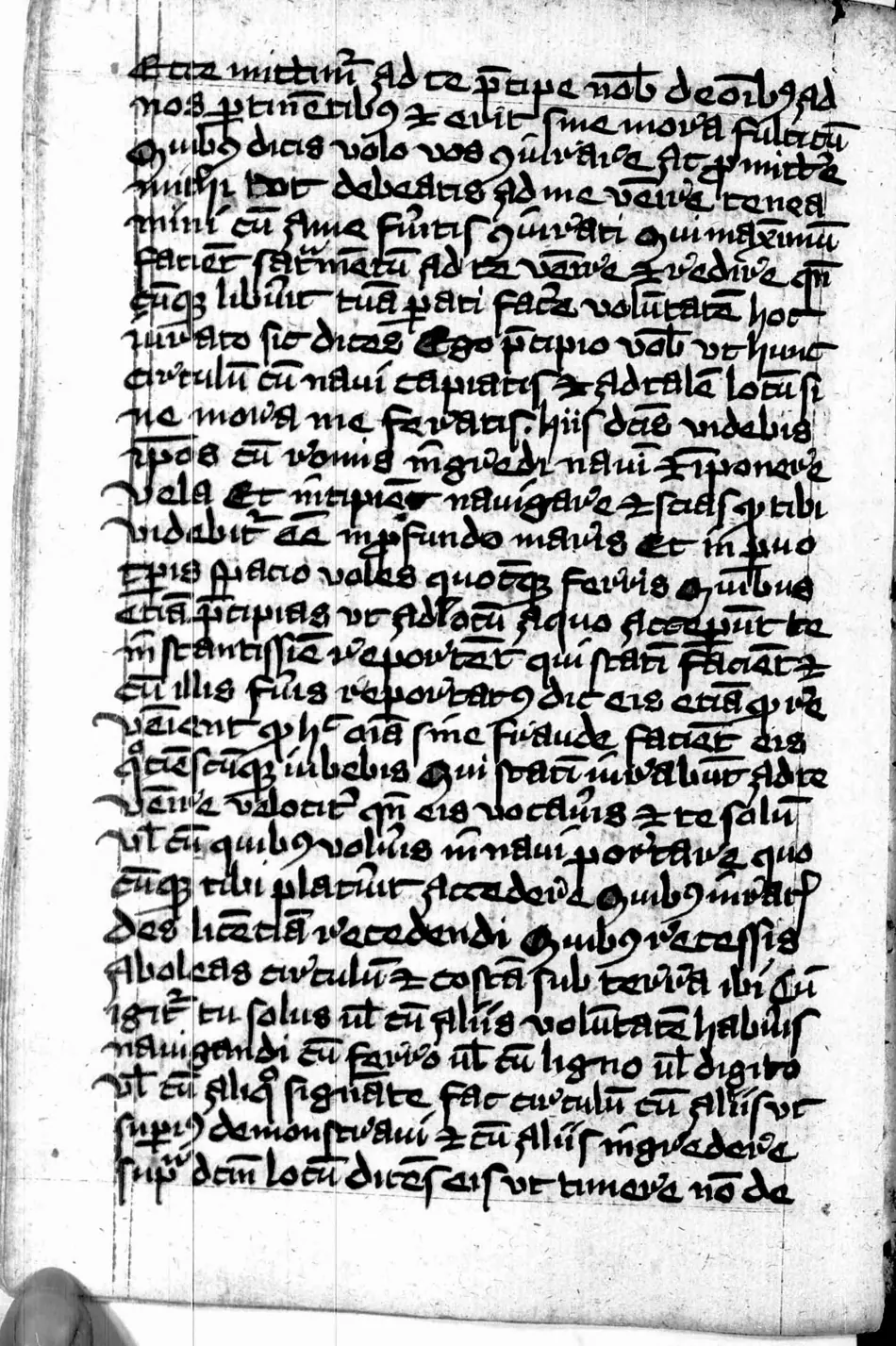
Et[?] mitta[m][?] Ad te p[ro]p[er]e[?] n[ave]s[?] de o[mn]ib[us] Ad nos p[er]tinentib[us] [et] a[?]lit[er][?] s[i]ne mora[?] Sub[?] Q[ui]b[us] dictis volo vos co[n]iurare Atq[ue] mitt[er]e[?] mu[?]p[?] tot[?] debeatis Ad me venire tenea- mini cu[m] s[i]ne fin[i]tis[?] co[n]iurati q[ui] maximu[m] faciet sacr[a]m[en]tu[m] Ad te venire [et] redire cu[m] cu[m]q[ue] libuit[?] tua[m] p[er?] i[?] fac[er]e[?] volu[n]tate[m] hoc iurato sic dicas Ego p[re]cipio vob[is] vt hunc circulu[m][?] cu[m] naui capiatis [et] Ad tale[m] locu[m] si- ne mora me feratis. hiis dictis videbis ip[s]os cu[m] v[er]bum[?] ingredi naui[m] [et] i[?]p[ro]nare[?] vela[?] et itiu[er?]n[?] nauigare [et] fac[i]es q[uod] tibi vndabit[?] a[?] i[n] p[ro]fundo maris et in suo[?] t[er?]ris[?] fi[?]acio[?] vales[?] q[uo]t[?]q[ue] farib[us][?] q[ui]b[us] eti[am] [p]capias[?] vt Ad locu[m] [a]q[uo][?] Acce[?]uit[?] te[?] i[n]stantissie[?] u[e]portat[?] qui st[at]i[m] facie[?]t[?] cu[m] illis fuis[?] reportare[?] dic eis eti[am] q[uod] re[?] valent[?] q[uod] h[?] eis s[i]ne fraude faciet eis q[ua]esc[um]q[ue][?] iubel[?]is[?] qui v[er?]a[m][?] i[?]ualiu[?] Ad te venire velocit[er] cu[m] eis vocatis [et] te salu- vit[?] cu[m] q[ui]b[us] voluis[?] i[n] naui portare[?] q[ua]s- cu[m]q[ue] tibi placuit[?] Accedens[?] q[ui]b[us] iurat[us][?] des[?] licenc[iam][?] recedendi q[ui]b[us] recessis[?] Aboleas circulu[m][?] [et] co[n]sta[?] sub t[er]ra[?] ibi cu[m] ig[itur][?] tu solus vt cu[m] Aliis volu[n]tate[m] habuis[?]- nauigandi cu[m] farib[us][?] vt cu[m] ligno vt digito vt cu[m] Alia[?] signate f[a]c circulu[m] cu[m] Aliis vt sup[er]i[us] demo[n]straui [et] cu[m] Aliis ingredere[?] sup[er] d[i]c[tu]m locu[m] dic[?] eis vt timore[m][?] no[n] de-

TranslationEnglish

And[?] I will send[?] to you speedily[?] ships[?] of all that be- longs to us, and otherwise[?] without delay[?]...[?] This said, I wish you to conjure them and to send[?] ...[?] you must come to me, hold[?] yourselves with[?]... conjured[?], that the greatest[?] shall make[?] an oath[?] to come to you and to return, and whensoever[?] it pleases[?] to do[?] your will, this being conjured you shall say thus: "I command you that this circle[?] with the ship you take, and to such a place with- out delay carry me." This said, you shall see them, with the word[?], enter the ship[?] and...[?] the sails[?], and sail the passage[?] and you shall do what suits[?] you... in the deep of the sea and in its[?] land[?]...[?] you can[?]... with as many...[?] whom also[?] you take[?], so that to the place from[?] where[?]... you[?] at once[?]... carry you[?], which straightway shall[?] make[?] with those his own[?] to return; tell them also that they...[?] can[?], that...[?] to them without fraud he shall do them whatever[?] you command[?], that truly[?]... to you come swiftly with them, [being] called[?], and greeted[?] you; with whom you wish[?] to carry in the ship whatso- ever pleases[?] you. Approaching[?], to those [you have] conjured[?] give[?] leave[?] to depart; and when they have withdrawn[?], erase[?] the circle[?] and...[?] under the earth[?] there, with you[?] alone; and when with others you have[?] the will[?] to sail with...[?], whether with wood, or with a finger, or with another[?] sign[?], make the circle with others as above I have shown, and with others enter[?] upon the said place; tell[?] them that they should not [have] fe-[ar]

fol. 23r#23r
Munich Manual (Clm 849) — facsimile page (fol. 23r) · public-domain facsimile
BSB Clm 849 (MDZ bsb00037155)
🔍 click to enlarge

TranscriptionLatin

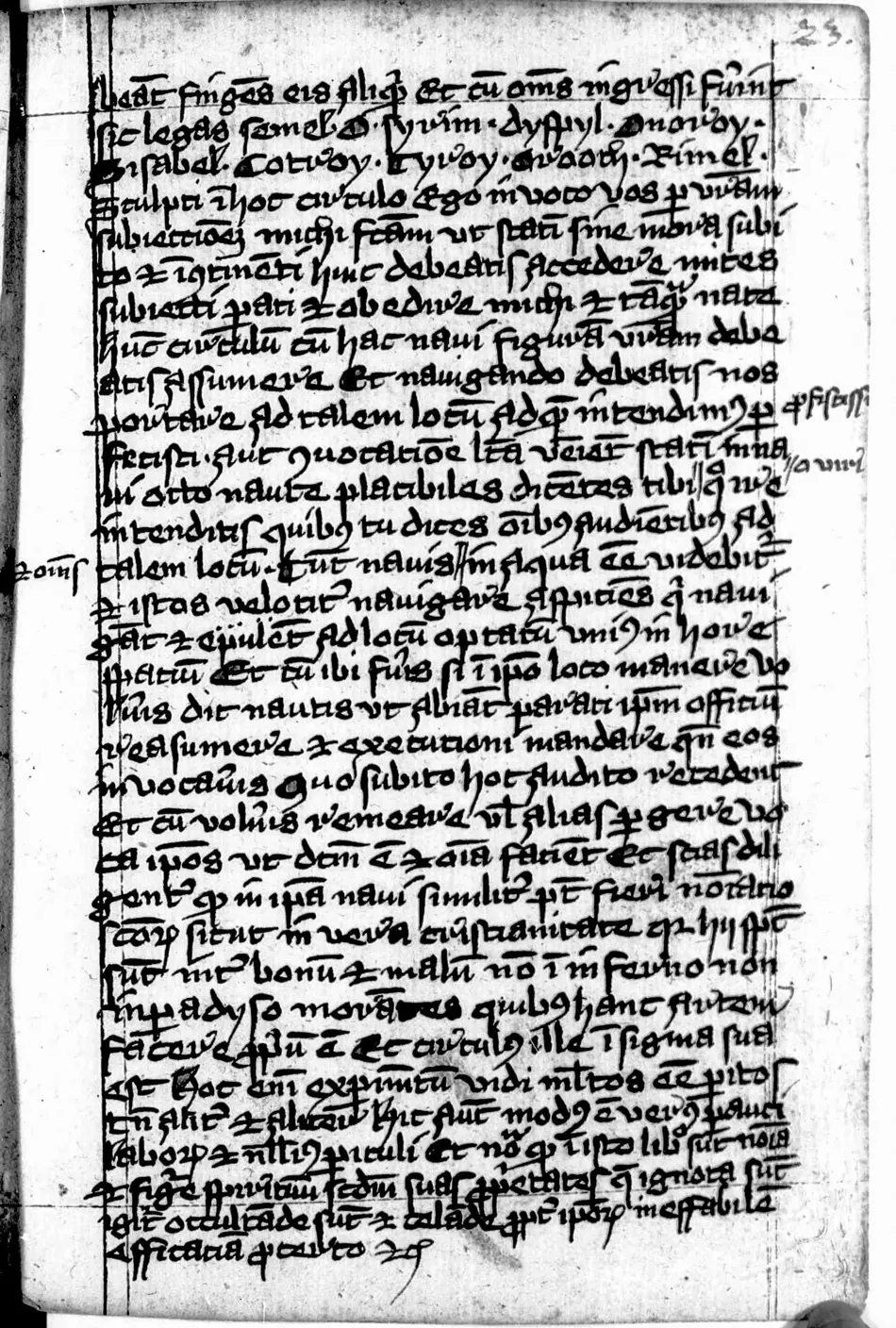
[ha]beat[?] fugie[n]s[?] eis Alicq[?] Et cu[m] om[ne]s ingressi fu[er]int sic legas samel · syrim · dyftryl · onordy · syzabal[?] · cotudy[?] · tyudy[?] · anaocy[?] · ximel · sculpti[?] in hoc circulo Ego i[n]uoco vos p[er] v[ir]tute[m] subiettioq[ue][?] michi f[a]c[t]a[m] vt st[at]i[m] s[i]ne mor[a] subi- to [et] i[n]tincti[?] huc debeatis Accede[re] mites subietti p[ar?]ti[?] [et] obedire[?] michi [et] tag[?] naui[?] huc[?] circulu[m] cu[m] hac naui figura[m] v[?]am dab- atis Assumere Et nauigando debeatis nos portare Ad tale[m] locu[m] Ad q[ue]m i[n]tendim[us][?] [et][?] q[?] feci[?]ti[?] Aut q[uo]tac[i]o[n]e[?] i[t]a v[er?]it[?] st[at]i[m] mira[?]- ni[?] octo[?] nauta[?] plac[a]bilas[?] dic[er]etis[?] tibi[?] q[ue][?] ve[?] intenditis[?] q[ui]b[us] tu dices o[mn]ib[us] audientib[us] Ad talem locu[m] · [et][?] nauis[?] i[n] Aqua[m] ea videbit[?] [et] istos velocit[er] nauigare [et] p[ar?]t[ice]s[?] q[ui] naui- gat[?] [et] cu[?]ulet[?] Ad locu[m] optatu[m] uni[?] in hor[a?] p[re?]atu[?] Et tu ibi fuis[?] si i[n] ip[s]o loco manere vo- luuis[?] dic nautis vt Aliat[?] p[ar?]ati ip[su]m officiu[m] reasumere[?] [et] execuc[i]oni mandare[?] q[u]i[?] eos invocaui[?] q[uo] subito hoc audito recedent Et cu[m] volu[er]is remeare[?] vt Alias[?] p[er?] ge[?]e[?] vo- ca ip[s]os vt d[i]c[tu]m [est] [et] gr[ati]a[?] faciet [et] s[ecundu]m[?] dili- gente[?] q[uod] i[n] ip[s]a naui simulit[er?] p[?]t[?] fi[er]i not[ur]o[?] co[?] situ[?] i[n] uera cui[?]uanicate[?] q[uo][?] hii f[?]t[?] s[e]c[un]do m[?] bonu[m] [et] malu[m] no[?] i[?] i[n] fauore[?] no[n] i[m]p[er]adyso[?] mou[er]e[?] q[ui]b[us] h[?]anc[?] Autem facere[?] q[?]u[?] [et] Et circulu[s][?] ille i[n] sig[n]a[?] sua[?] est Hoc en[im] exp[ri]mitu[r][?] vndi[?] mittos[?] de p[er?]itos[?] cu[m] alie[?] [et] Aliata[?] hic Aut modo[?] c[on][?]u[er?]s p[er?]uu[?] valdop[?] [et] i[n] t[?]t[i][?] circuli et no[?] q[uod] i[n] isto libro[?] su[n]t nota[?] [et] figure p[ri]uatam[?] s[e]c[un]d[um] sua[?] p[ro]pietates[?] q[ui]a ignota[?] su[n]t ig[itur][?] occulta[?] de[?] sunt [et] cel[at]a[?] p[ro]p[ter] ip[s]o[rum] i[n]effabile[m][?] efficacia[m] q[uo] c[?]to[?] [et] c[?]

TranslationEnglish

...let there be[?] fleeing[?] from them something[?]. And when all have entered, read thus: samel · syrim · dyftryl · onordy · syzabal[?] · cotudy[?] · tyudy[?] · anaocy[?] · ximel · carved[?] in this circle. "I invoke you by the virtue and by the subjection[?] made[?] to me, that at once, without delay, sud- denly[?] and...[?], here you must approach, meek, subject...[?] and obedient[?] to me, and...[?] the ship[?] this[?] circle with this ship [as] figure...[?] you must take[?], and by sailing you must carry us to such a place to which we are bound[?], and which[?] ...[?]". Or by [such] an invocation[?], thus...[?], at once...[?] ...[?] eight[?] gentle[?] sailors[?], you shall say[?]...[?] ...[?], to whom you shall say, all hearing: "To such a place"; and the ship[?] in the water you shall see[?] and these to sail swiftly and...[?] those who sa- il[?] and...[?] to the desired place, in one[?]... in the hour[?] ...[?]. And you, [when] you are[?] there, if in that place you wish to re- main[?], tell the sailors that...[?] ready [they] the same office resume[?] and put it into execution[?], for[?] them I invoked[?]; whereupon, suddenly, this heard, they will withdraw. And when you wish to return[?], to come back[?]...[?] call them as has been said, and with grace[?] [he] will do [it], and according to[?] the dili- gence[?]... that in the same ship likewise[?] can[?] be done...[?] ...[?] placed[?] in true...[?], whereby[?] these...[?] according to[?]... good and evil, not[?]... in favor[?], not in paradise[?] to move[?]... to whom[?]... this[?] however[?] to do[?]...[?] And that circle[?] in its signs[?] is[?]. For this is expressed[?]...[?] sent[?] of[?] the skilled[?] with another[?]... here, or in a manner[?]...[?] ...[?] and in...[?] of the circle, and not[?] [is] what in this book[?] are noted the figures[?] privately[?] according to their properties[?], because they are unknown[?]; therefore[?] hidden[?]... they are, and concealed because of their ineffable[?] efficacy, whereby[?]...[?] and...[?]

fol. 23v#23v
Munich Manual (Clm 849) — facsimile page (fol. 23v) · public-domain facsimile
BSB Clm 849 (MDZ bsb00037155)
🔍 click to enlarge

TranscriptionLatin

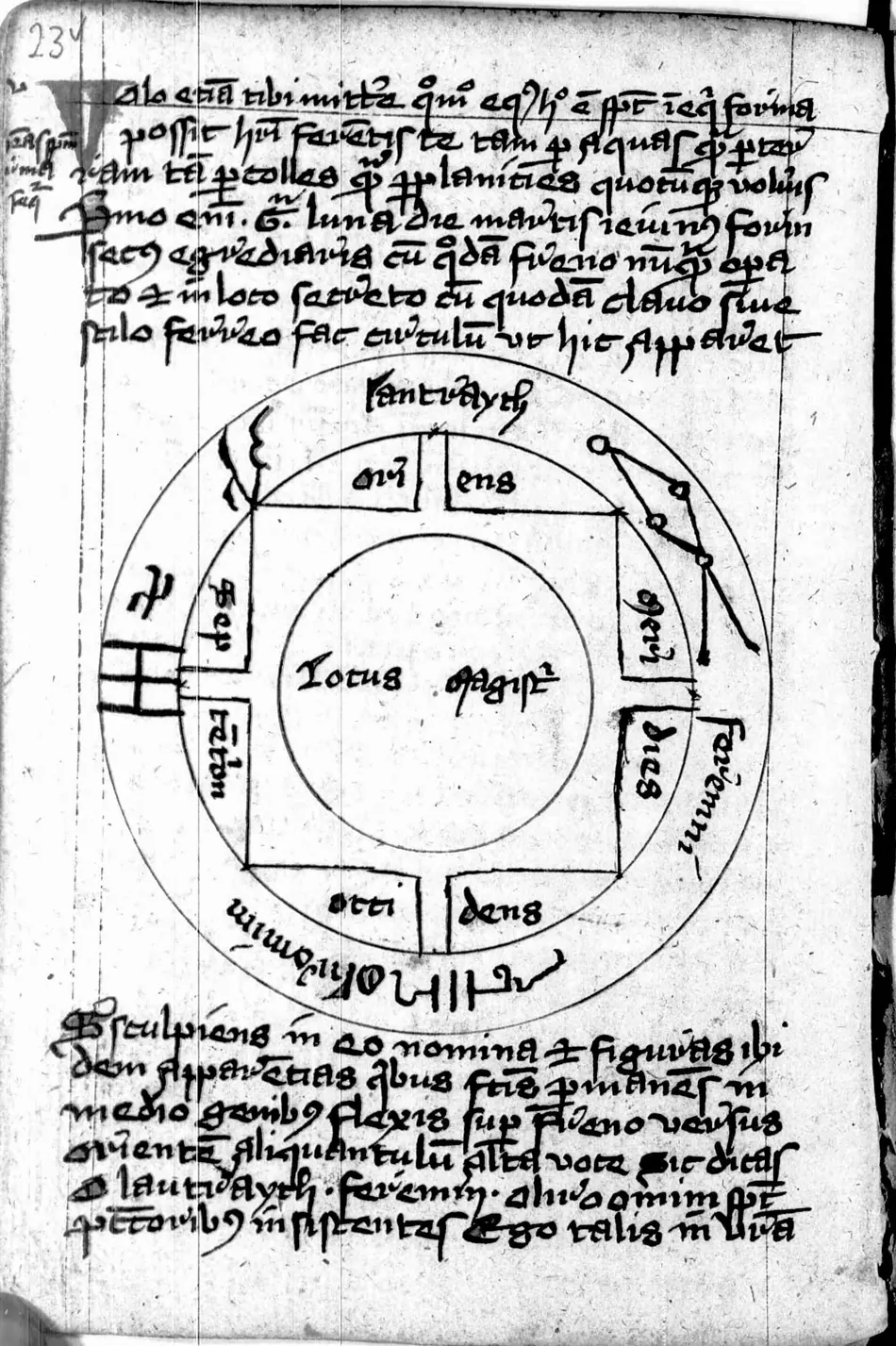
[?]o eciam tibi mitta[m] q[ue]m eq[ue]s h[abe]re [?] a[?] [?] [?] forma[m] possit h[?] facieris[?] te ta[m] [?] [?]q[ue] [?] [?][?] [?]iam t[ame]n p[er]tolles q[uod] [?] planicies quotu[m]q[ue] volueris P[ri]mo eni[m] [?] luna die m[er]curis ieiun[us] [?]o[?]i[n] [?]ac[?] egrediaris cu[m] q[uo]da[m] [?]iano nu[n]c op[er]a- to [?] in loco secreto cu[m] quoda[m] clauo siue stilo ferreo fac circulu[m] ut hic app[ar]et [DIAGRAM: double circle with inscriptions] — outside above (name): [G?]antrayth — interior, cuadrantes: ori·ens (oriens) | meri·dies (meridies) | occi·dens (occidens) | sep·tentrio (septentrio) — centro: Totus[?] magist[er?] — outside right (vertical): faciemini — outside: characters and seals illegible; lower curved word illegible [S?]culpiens in eo nomina [et] figuras ibi den[?] apparent[es][?] [?]b[us] [?] p[er]manes[?] in medio genib[us] flexis sup[er] [?]iano versus orient[em] aliquantulu[m] alta voce sic dicas O [G?]antrayth faciemini ali[us] om[ne]s[?] [?] [?]toribus in [?]tenta[?] ego talis in [?]ra[?]

TranslationEnglish

[?] I will also send to you the one whom the horseman[?] may have[?] [?] to[?] [?] the form[?] [?] may be able[?] [?] you shall make[?] yourself so[?] [?] and[?] [?] [?] [?] yet you shall bring it[?] to a level place[?], as much[?] as you wish[?] First, then, [in the waning?] moon, on Wednesday, fasting [?] [?] you shall go out with a certain [?]iano now wrought, and in a secret place, with a certain nail or iron stylus draw the circle, as it appears here [DIAGRAM: double circle with inscriptions] — top name: [G?]antrayth — inner quadrants: east | south (midday) | west | north (septentrion) — center: All[?] master[?] — right side: "faciemini" (you shall be made) — seals and characters [illegible] Carving[?] in it the names and figures that appear[?] there, [with which?] [?] remaining[?] in the middle, on [bent] knees[?], upon the [?]iano, toward the east, a little, in a loud voice say thus: «O [G?]antrayth, you shall be made[?] [and] all the rest[?] [?] [?] attentive[?]; I, so-and-so, in [?]

fol. 24r#24r
Munich Manual (Clm 849) — facsimile page (fol. 24r) · public-domain facsimile
BSB Clm 849 (MDZ bsb00037155)
🔍 click to enlarge

TranscriptionLatin

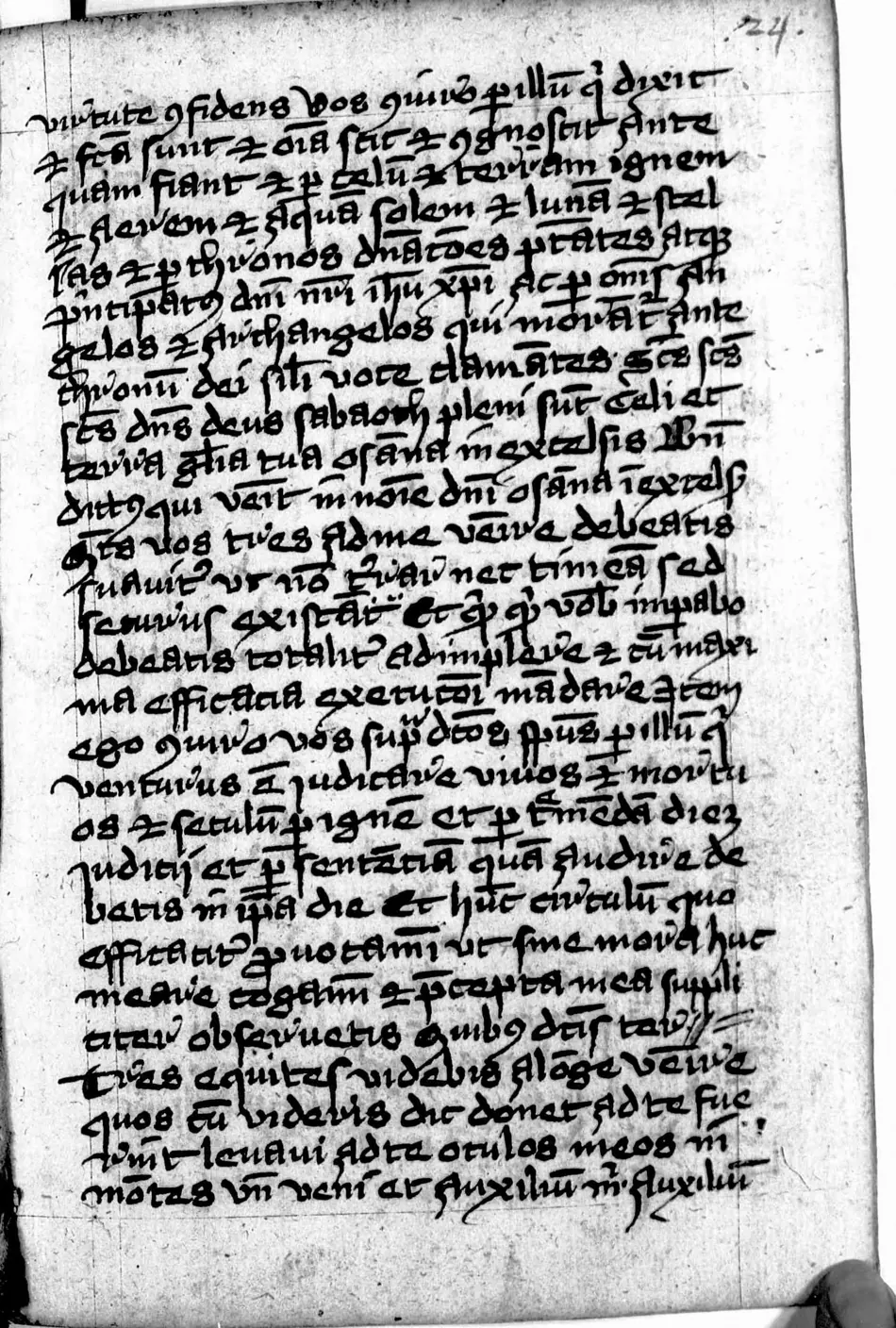
virtute co[n]fidens vos co[n]iuro p[er] illu[m] q[ui] dixit [et] f[a]c[t]a sunt [et] o[mn]ia sc[it] [et] cognosc[it] ante qua[m] fiant [et] p[er] celu[m] [et] terra[m] igne[m] [et] aere[m] [et] aqua[m] solem [et] luna[m] [et] stel- las [et] p[er] th[r]onos d[omi]naciones p[otes]tates atq[ue] [pri]ncipat[us][?] d[omi]ni n[ost]ri ih[es]u [christ]i ac p[er] om[ne]s an- gelos [et] archangelos qui movent[?] ante thronu[m] dei siti[?] voce clama[n]tes s[an]c[t]e s[an]c[t]e s[an]c[t]e d[omi]n[u]s deus sabaoth pleni su[n]t celi et terra[m] gl[or]ia tua osa[n]na in excelsis be[n]e- dictus qui venit in no[m]i[n]e d[omi]ni osa[n]na in excelsis [con]iuro[?] vos t[r]es ad me venire debeatis [?]ruai[?] ut no[n] [?] nec timea[?] sed securius exista[n]t [et] q[uod] q[ui]d volo[?] iniu[n]go[?] debeatis totalit[er] adimplere [et] cu[m] maxi- ma efficacia executo[r]i[?] ma[n]dare [et] ta[m]e[n] ego co[n]iuro vos su[?]d[i]c[t]os sp[irit]us p[er] illu[m] q[ui] venturus e[st] iudicare vivos [et] mortu- os [et] s[e]c[u]l[u]m p[er] igne[m] et p[er] t[re]meda[m][?] die[m] iudicii et p[er] sentencia[m] qua[m] audire de- beatis in i[psa] die et hu[n]c[?] circulu[m] quo efficat[ur][?] co[n]uocami[ni] ut sine mora huc me a[n]te cogi[?] [et] p[re]cepta mea suppli- cat[er][?] observetis quib[us] d[i]c[t]is t[er][?] t[r]es equites videbis a longe venire quos cu[m] videris dic donec ad te fue- rint [?]leuaui ad t[er]ra[?] oculos meos in montes u[n]de veniet auxiliu[m] m[ihi] Auxiliu[m]

TranslationEnglish

trusting in [His] power, I conjure you by Him who spoke and [things] were made, and who knows and recognizes all things before they come to be; and by heaven and earth, fire and air and water, the sun and the moon and the stars, and by the thrones, dominations, powers and also the principalities[?] of our Lord Jesu[s Christ], and by all the an- gels and archangels who move[?] before the throne of God, [standing?] crying out with a voice: «Holy, Holy, Holy is the Lord God of hosts; full are the heavens and the earth of your glory. Hosanna in the highest. Bles- sed is he who comes in the name of the Lord. Hosanna in the highest». I conjure[?] you three to come to me, [?] so that you may not [?] nor fear[?], but may be the more secure; and whatever I will[?] I enjoin[?] upon you, you must totally fulfill, and with the utmost efficacy carry into execution[?] what is commanded[?]; and yet, I conjure you, aforesaid spirits, by Him who is to come to judge the living and the dead and the world by fire, and by the dreadful[?] day of judgment, and by the sentence you shall have to hear on that day; and [by] this[?] circle by which it is effected[?]: be summoned[?] that, without delay, here, before me, [you may be compelled?], and my precepts suppliantly[?] you may observe. When these things are said, [?] you will see three horsemen coming from afar; when you see them, say, until they have come to you: «I lifted[?] to the earth[?] my eyes unto the mountains, whence shall come help for me. The help [...]»

fol. 24v#24v
Munich Manual (Clm 849) — facsimile page (fol. 24v) · public-domain facsimile
BSB Clm 849 (MDZ bsb00037155)
🔍 click to enlarge

TranscriptionLatin

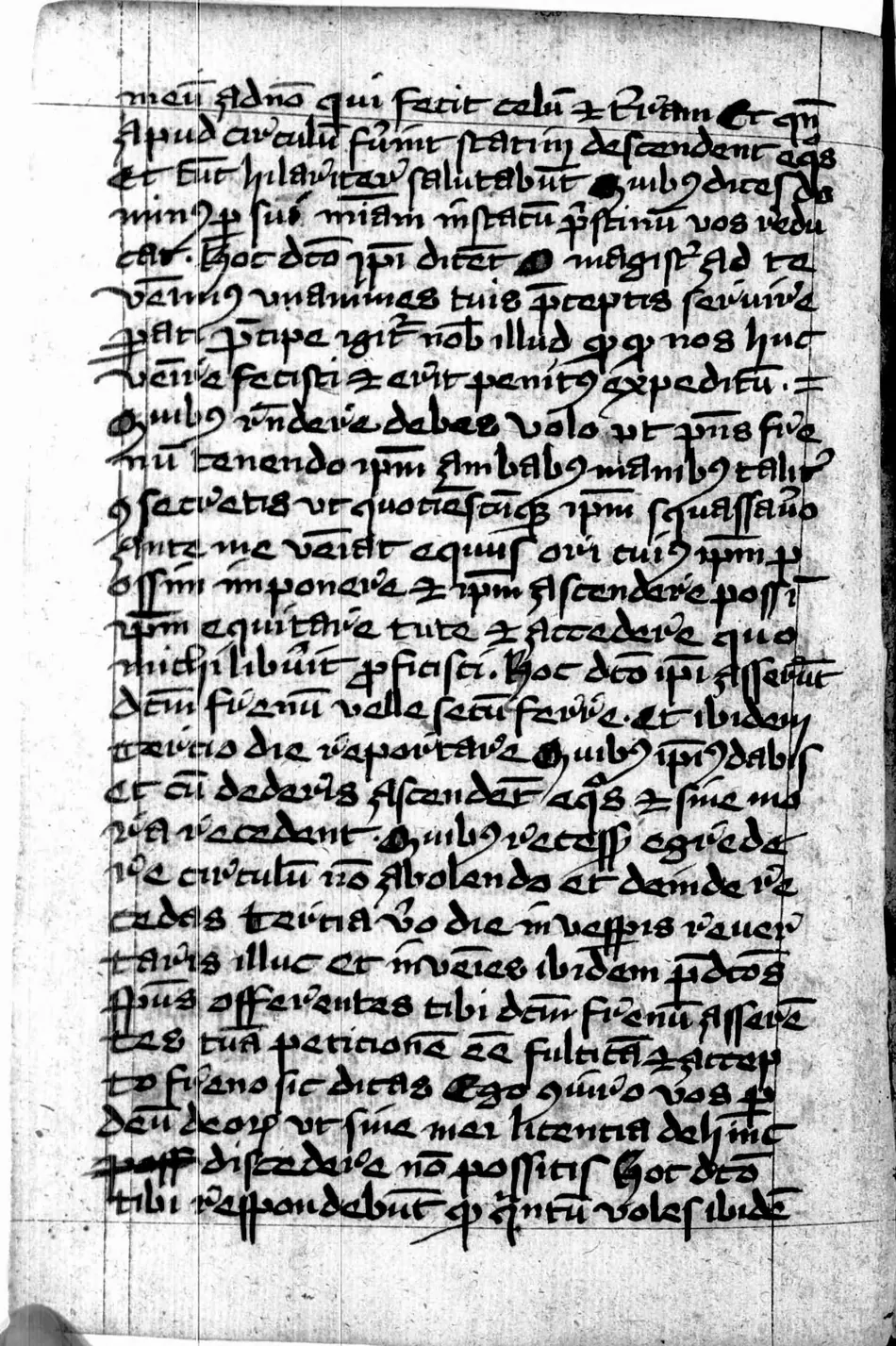
meu[m] a d[omi]no qui fecit celu[m] [et] t[er]ra[m] Et cu[m] apud circulu[m] fu[er]int stati[m] descendent aq[ue]s[?] et te hilarit[er] salutabu[n]t quib[us] dices do- min[us][?] p[er] su[a]m mi[sericordi]am in statu[m] p[ri]stinu[m] vos redu- cat Hoc d[i]c[t]o ip[s]i dicet [?] magist[er] Ad te venim[us] ut a[n]i[m]as[?] tuis p[re]ceptis serviue- r[?]t p[ro]pe igit[ur] nob[?] illud q[uo]q[ue] q[uo] nos huc venire fecisti [et] a[?]t penit[us][?] expeditu[m] quib[us] r[e]sp[on]dere[?] debes volo ut p[ri]us siue nu[m][?] tenendo ip[su]m [Am]bab[us] ma[nib]us tali- q[ue] servetis ut quotiescu[m]q[ue] ip[su]m [?]uassau[er]o[?] [a]nte me v[e]niet equus [?] cui[?] ip[su]m p[er] os m[ihi] imponere [et] ip[su]m ascendere possi[m] ip[su]m equitare tute[?] [et] accedere quo michi libuit q[uod] fiat sci[licet] Hoc d[i]c[t]o ip[s]i asseru[n]t[?] d[i]c[t]u[m] fienu[m] velle sc[?] fac[er]e Et ibidem tercio die reportare quib[us] ip[s]i[?] dabis et cu[m] dederis ascendet aq[ue]s[?] [et] siue mo- ra recedant quib[us] recede[n]t[?] egrede- re circulu[m] no[n] abolendo et deinde re- cedas t[er]cia v[er]o die in vesp[er]is reuer- taris illuc et invenies ibidem p[re]d[i]c[t]os [?]sus offerentes tibi d[i]c[t]u[m] fienu[m] assere[n]- tes tua peticione[?] ea fulti[?] [et] accep- to fieno sic dicas Ego co[n]iuro vos p[er] deu[m] deor[um] ut sine mei licentia dehinc [?] discedere no[n] possitis Hoc d[i]c[t]o tibi respondebu[n]t q[uod] q[ua]ntu[m] voles ibide[m]

TranslationEnglish

[my help comes] from the Lord, who made heaven and earth. And when they are beside the circle, at once the horsemen[?] will descend and will greet you joyfully; to whom you shall say: «May the Lord[?], by his mercy, restore you to your former state». When this is said, the master[?] himself will say: «To you we come, that we may serve with[?] your precepts[?]; draw near, then, [?] that [thing] for which you made us come hither, and [it is] wholly[?] made ready[?]». To whom you must reply[?]: «I will that first [?] [?] holding it with both hands, and such [a horse?] you shall keep, that as often as I [shake/brandish?] it, before me the horse may come [?] upon which[?] I may set upon it by the mouth the [bridle], and I may mount it, ride it safely[?] and go wherever it pleases me; let it be done, namely». When this is said, they affirm[?] that they will make the said hay[?], and there, on the third day, bring it back; to whom you shall give it[?]. And when you have given [it], the horsemen[?] will mount and without de- lay let them withdraw; when they withdraw[?], go out of the circle without erasing it, and then with- draw; and on the third day, at evening, re- turn there and you will find in that same place the aforesaid [horsemen?] offering you the said hay, affirm- ing that your petition[?] is fulfilled[?]; and, the hay being taken, say thus: «I conjure you by the God of gods that, without my leave, from here [?] you may not depart». When this is said, they will answer you that [they will stay] as long as you wish, there.

fol. 25r#25r
Munich Manual (Clm 849) — facsimile page (fol. 25r) · public-domain facsimile
BSB Clm 849 (MDZ bsb00037155)
🔍 click to enlarge

TranscriptionLatin

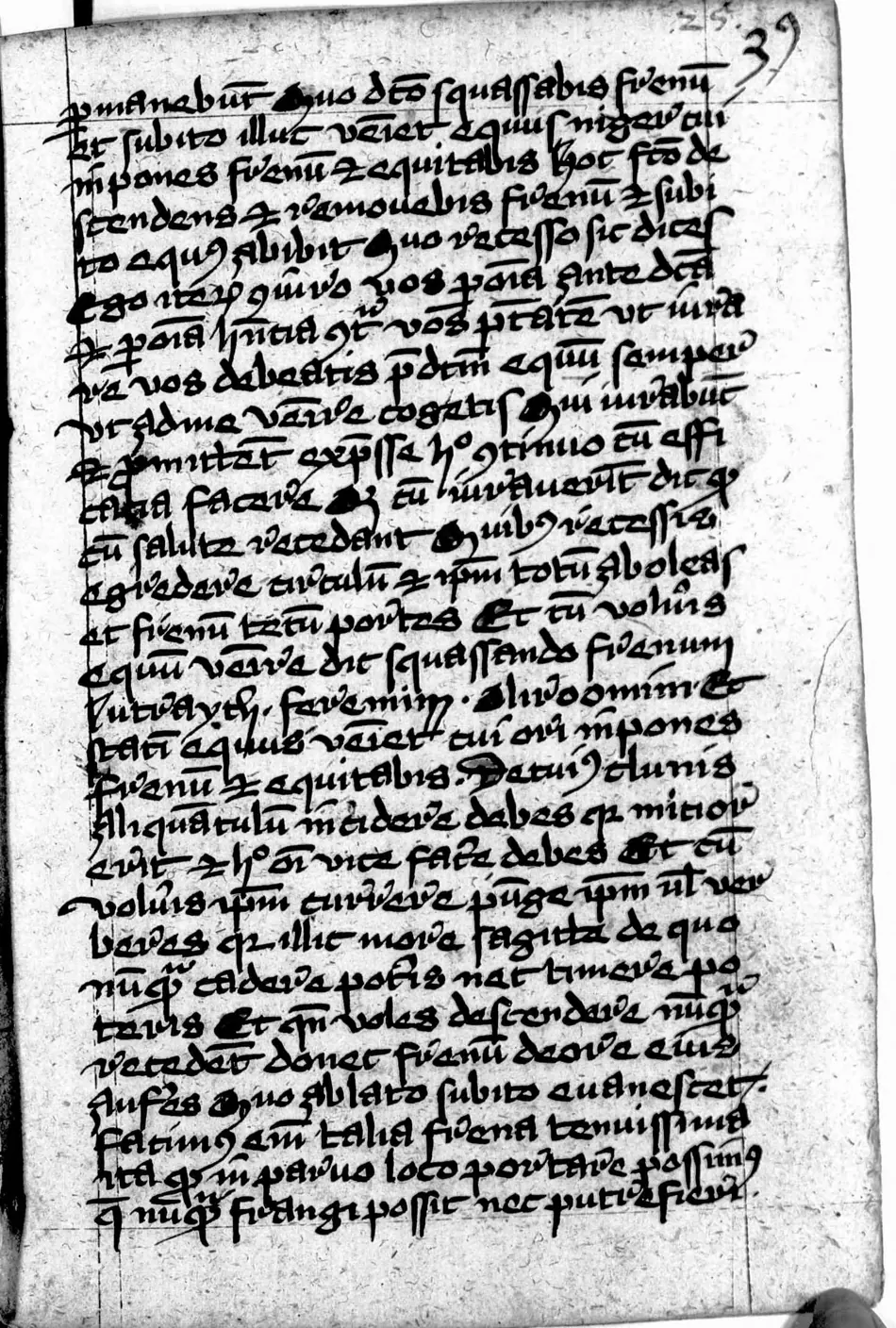
[per]manebit[?]. Quo d[i]c[t]o quassabis frenu[m] et subito illuc veniet equ[us] niger cu[m][?] [im]pones frenu[m] [et] equitabis. Hoc f[ac]to de- scendens [et] ramouebis [removebis] frenu[m] [et] subi- to equus abibit. Quo recesso[?] sic dices ego iter[um] co[n]iuro vos p[er] om[n]ia ante d[i]c[t]a [et] p[er] om[n]ia s[an]c[t]a[?] q[uod] vos p[re]fat[us][?] ... u[est]ra[?] ... vos debeatis p[re]d[i]c[tu]m equ[um] semp[er][?] ut ad me venire cogatis[?]. Qui[?] mirabit[ur][?] [et] remittat[ur][?] exp[re]ssa[?] h[or]a[?] co[n]tinuo tu effi- cacia[?] facere[?] [et] cu[m] iuuauerit[?] dic q[uod] cu[m] salute recedant. Quib[us] recessis[?] egrediere[?] circulu[m] [et] ip[su]m totu[m] aboleas et frenu[m] tecu[m] portes. Et tu volens equu[m] venire dic quassando frenum [Nutwalyth?] (vox magica) feremini[?]. Aliud[?] om[n]iu[m][?] ... equus veniet cui ori impones frenu[m] [et] equitabis. [Notandum?] ... illegible Aliqua[n]tulu[m] [?] debes q[uia][?] minor[?] erit[?] [et] h[oc][?] vice[?] face[re] debes. Et cu[m] volueris ip[su]m currere p[un]ge[?] ip[su]m ut uer- b[er]es[?] q[uod] illuc mora[?] sagitta[?] de quo nu[m]q[uam] cadere possis nec[?] timere po- teris. Et cu[m] uoles descendere nu[m]q[uam] recedet donec frenu[m] de ore eius aufers. Quo ablato subito euanescet. Sciendu[m][?] [quod] talia frena tenuissima[?] [su]nt q[uod] in paruo loco portare possint[?] [et] nu[m]q[uam] frangi possit nec putrefieri.

TranslationEnglish

...it will remain[?]. Having said this, you shall shake the bridle, and at once a black horse will come there with[?]... you shall put on the bridle and ride. This done, dismounting, you shall remove the bridle, and suddenly the horse will depart. When it has withdrawn, you shall say thus: «I again conjure you by all the aforesaid things and by all holy things[?], that you [aforesaid?]... your[?]... must [make?] the said horse always[?] compel[?] to come to me». Which[?] will be marvelous[?]; and let it be dismissed[?] at the stated[?] hour, straightway, to act with efficacy[?]; and when it has helped[?], say that they depart in peace. When they have withdrawn[?], leave[?] the circle and blot it all out entirely, and carry the bridle with you. And you, wishing the horse to come, say while shaking the bridle: «[Nutwalyth?] (magic word), you shall be brought[?]». Another[?] of all[?]... ...the horse will come, on whose mouth you shall put the bridle, and you shall ride. [Note that?]... [illegible] A little[?] you must [eat/cut?], because[?] it will be smaller[?], and this[?] at once[?] you must do[?]. And when you wish it to run, prick[?] it so that you lash[?] it, for[?] it will go there [like an] arrow[?], so that you can never fall nor will you have to fear[?]. And when you wish to dismount, it will never leave until you take the bridle from its mouth. Once that is removed, it will at once vanish. It should be known[?] that such bridles are very fine[?], so that they can be carried in a small place, and can never be broken nor rot.

fol. 25v#25v
Munich Manual (Clm 849) — facsimile page (fol. 25v) · public-domain facsimile
BSB Clm 849 (MDZ bsb00037155)
🔍 click to enlarge

TranscriptionLatin

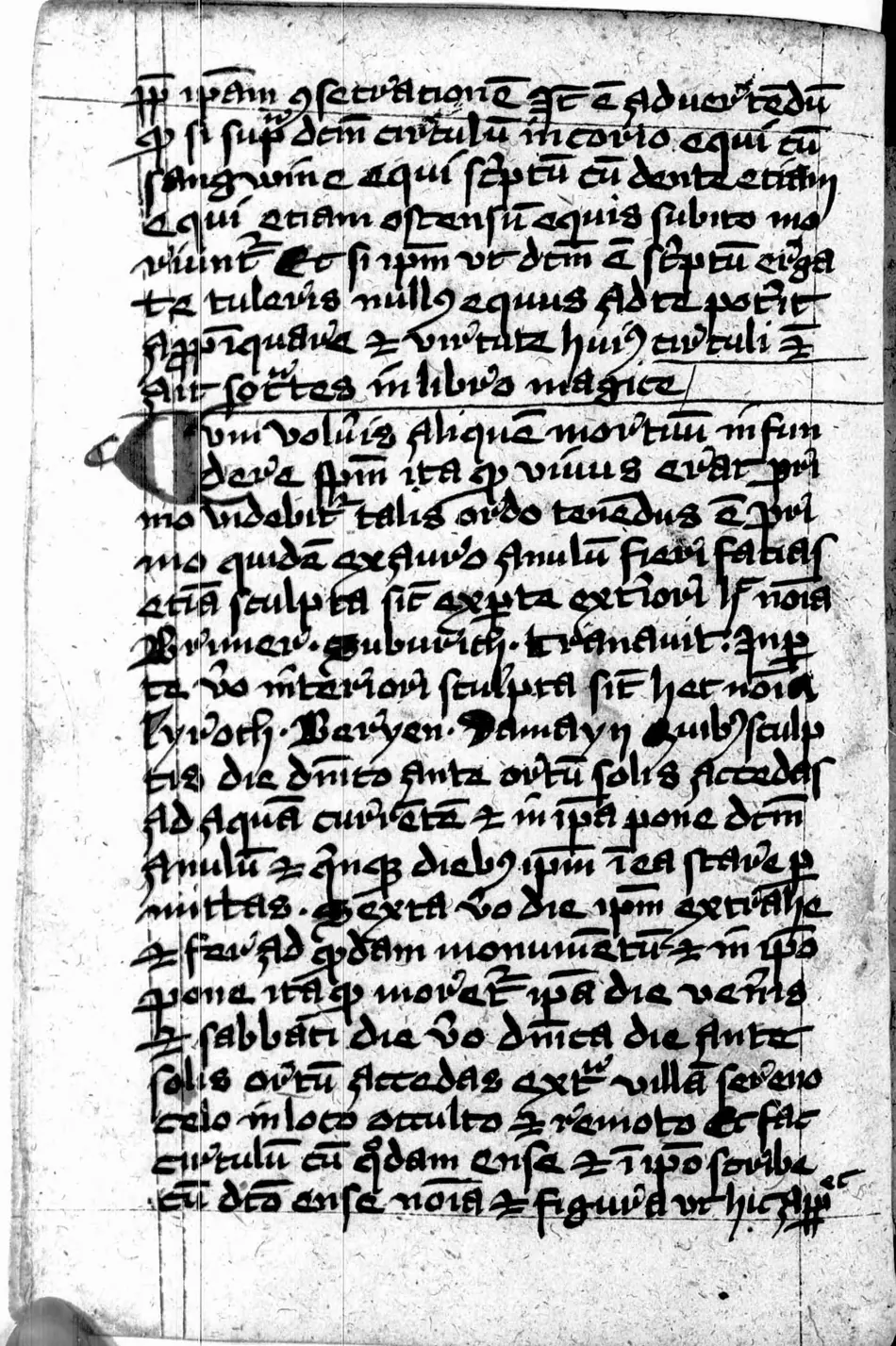
... in ip[s]am co[n]s[er]uatione[m][?] ... e[st] aduoca[n]du[m][?] q[uod] si sup[er] d[i]c[tu]m circulu[m] in corio[?] equi cu[m] sanguine [et] equi[?] s[cri]ptu[m] cu[m] dente et tibia[?] equi etiam ost[en]su[m] equis subito mo- riu[n]t[ur]. Et si ip[su]m ut d[i]c[tu]m e[st] s[cri]ptu[m] cir- ca te tuleris nullus equus ad te pot[er]it app[ro]pi[n]quare. Et virtut[es] hui[us] circuli [et][?] ait [Aristo]t[e]les[?] in libro magice. C[um] volueris aliquem mortuu[m][?] in fun- dere[?] s[?] ita q[uod] uiu[us] euad[er]e[?] p[ri]- mo [videbit?] talis ordo tene[n]dus e[st]. P[ri]- mo quida[m][?] ex auro[?] anulu[m] fieri facias etia[m] sculptu[m] sit ex[?]p[ar]te exteriori[?] no[m]i[n]a Brimen[?] Suburich [et] Tra[n]siuit[?]. Ex par- te vo[?] interiori sculpta sit hec no[m]i[n]a Lyroth Beryen Damayn quib[us] sculp- tis die d[omi]nico ante ortu[m] solis accedas ad aqua[m] curre[n]te[m] [et] in ip[s]a pone d[i]c[tu]m anulu[m] [et] q[ui]nq[ue] dieb[us] ip[su]m ibi stare p[er]- mittas. Sexta vo[?] die ip[su]m extrahe [et] f[er]as[?] ad q[uon]dam monume[n]tu[m] [et] in ip[s]o p[o]ne ita q[uod] moret[ur][?] ip[s]a die ven[er]is[?] ... sabbati. Die vo[?] d[omi]nica die ante solis ortu[m] accedas ext[ra] villa[m] sereno celo in loco occulto [et] remoto et fac circulu[m] cu[m] q[uon]dam ense [et] in ip[s]o s[cri]be cu[m] d[i]c[t]o ense no[m]i[n]a [et] figura[m] ut hic app[aret]

TranslationEnglish

...for its very preservation[?]... is to be invoked[?]: that if, upon the said circle, on the horse's hide[?], with horse's blood[?], written with the tooth and shin-bone[?] of a horse, and also shown to horses, they suddenly die. And if you carry it written, as has been said, about you, no horse will be able to approach you. And [these are] the virtues of this circle[?], and [Aristo]tle[?] says [so] in the book of magic. When you wish to make some dead man[?] fall[?]... so that he escapes alive[?], first [it will appear?] that such an order must be kept. First, indeed, you shall have[?] a ring made of gold[?]; and let there be engraved, on the outer part[?], the names Brimen[?] Suburich and Transiuit[?]. On the inner part, however[?], let these names be engraved: Lyroth, Beryen, Damayn. These being engraved, on a Sunday before sunrise, approach running water and place the said ring in it, and let it remain there five days. On the sixth day[?] take it out and carry it[?] to a certain tomb (monumentum) and place it therein, so that it stay[?] that Friday[?]... [until the] Sabbath. And on the Sunday[?], before sunrise, go outside the town, under a clear sky, to a hidden and remote place, and make a circle with a sword, and in it write with the said sword the names and the figure, as appears here [in 26r].

fol. 26r#26r
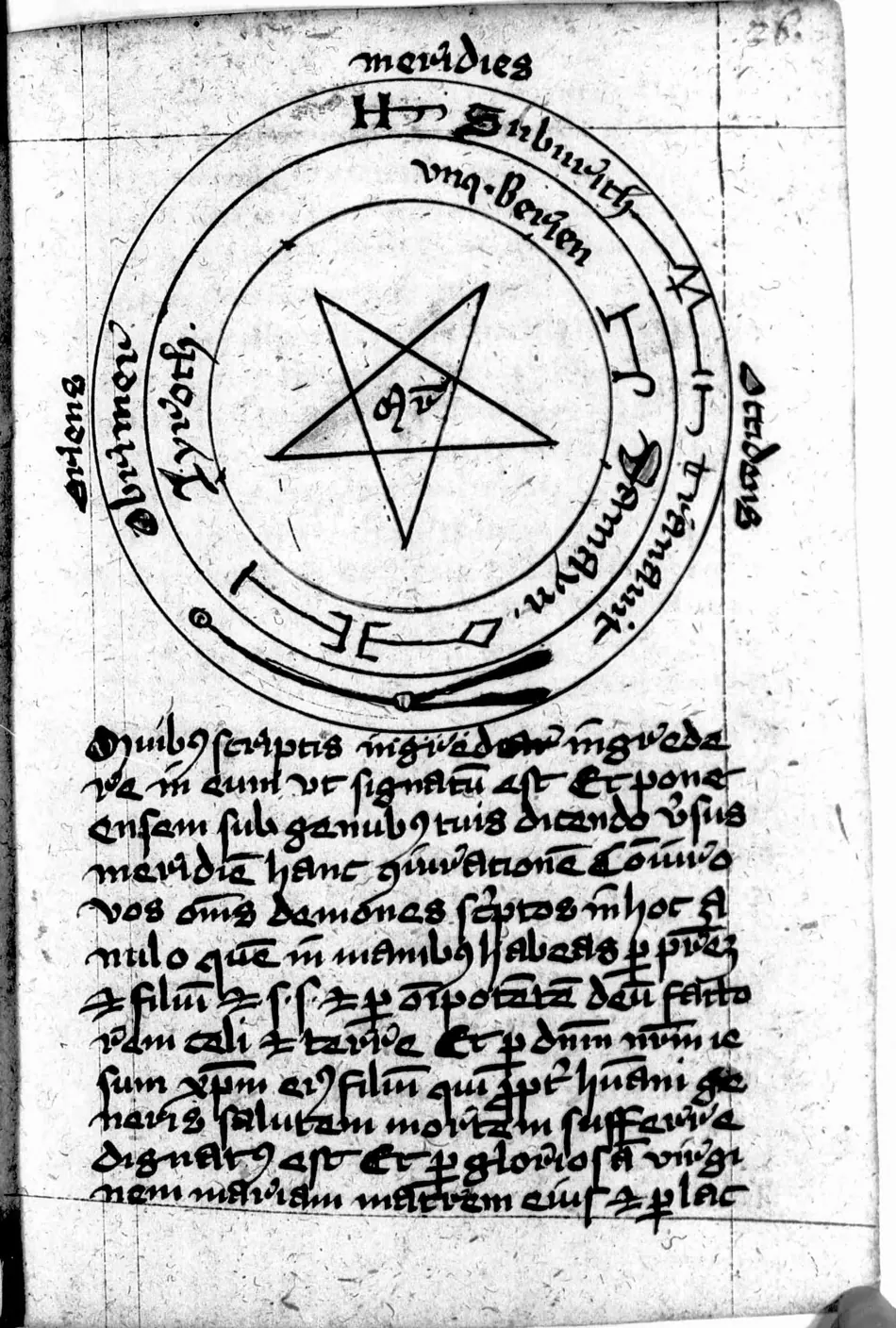
Munich Manual (Clm 849) — facsimile page (fol. 26r) · public-domain facsimile
BSB Clm 849 (MDZ bsb00037155)
🔍 click to enlarge

TranscriptionLatin

Quib[us] s[cri]ptis ingrediar[?] [ingredi] ingreda- re[?] in eu[m][?] ut signatu[m] est. Et pone ensem sub genub[us] tuis dicendo v[er]sus meridie[m] hanc co[n]iuratione[m]. Co[n]iuro vos om[ne]s demones s[cri]ptos in hoc a- nulo que[m] in manib[us] habeas[?] p[er] p[at]re[m] [et] filiu[m] [et] sp[iritu]m s[an]c[tu]m [et] p[er] pote[n]tia[m] dei facto- re[m] celi [et] t[er]re. Et p[er] d[omi]n[u]m no[st]r[u]m Ie- sum [Christ]um ei[us] filiu[m] qui p[ro] h[um]ani ge- neris salute[m][?] morte[m] suff[er]re dignat[us] e[st]. Et p[er] gloriosa[m] virgi- nem maria[m] matrem eius [et] p[er][?]... [et] plac[?]

TranslationEnglish

These [names and figure] being written, enter[?] into it [the circle] as is marked. And place the sword beneath your knees, saying, turned toward the south, this conjuration: «I conjure you, all demons written in this ring, which you hold[?] in [your] hands, by the Father and the Son and the Holy Spirit, and by the power of God, maker of heaven and earth; and by our Lord Jesus Christ, his Son, who for the salvation[?] of the human race deigned to suffer death; and by the glorious virgin Mary, his mother, and by[?]... and [may it please / and gentle?]...» [the text continues on the following folio].

fol. 26v#26v
Munich Manual (Clm 849) — facsimile page (fol. 26v) · public-domain facsimile
BSB Clm 849 (MDZ bsb00037155)
🔍 click to enlarge

TranscriptionLatin

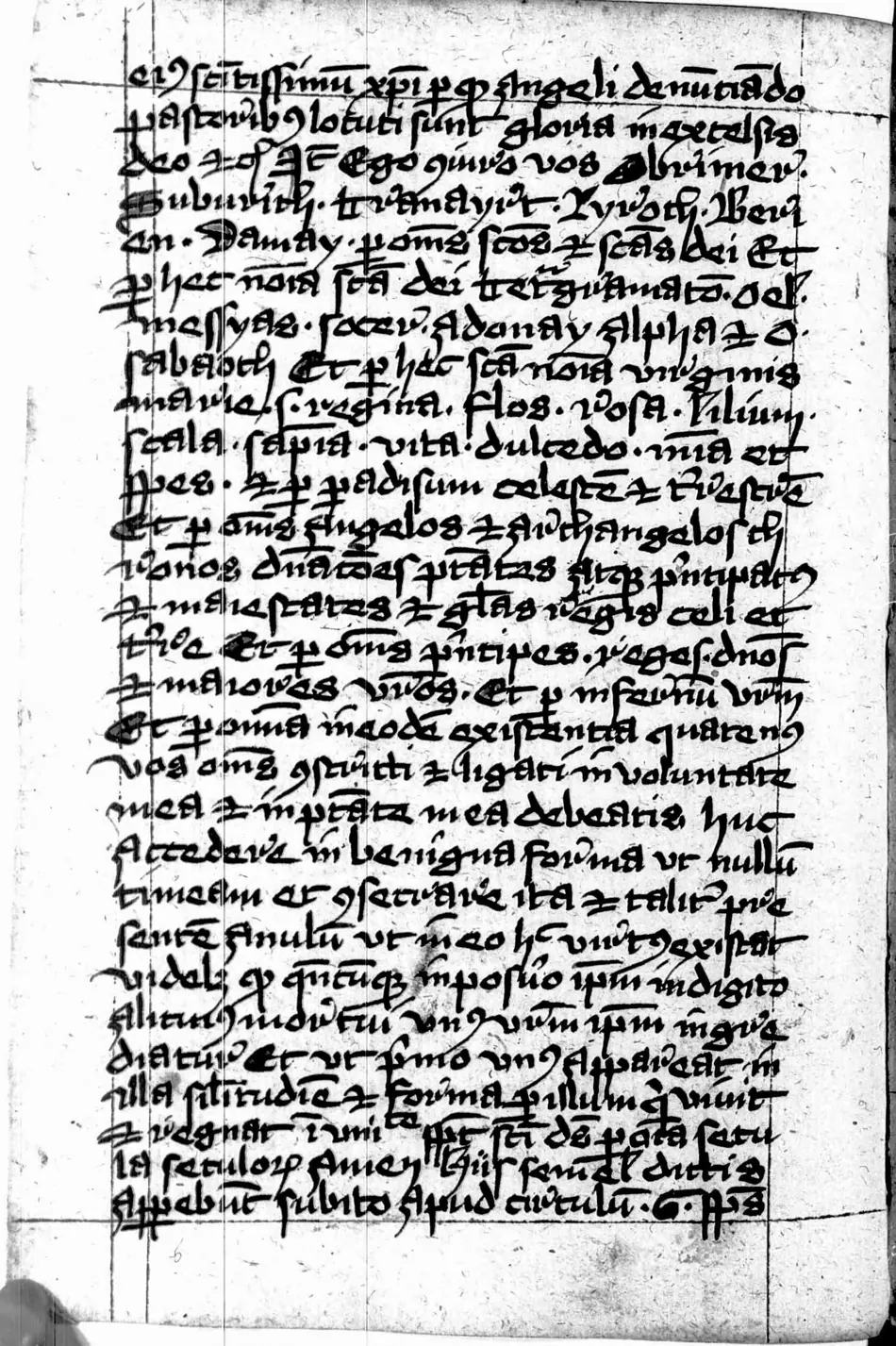
[e]ius s[an]c[t]issimu[m] [Christi] p[ro] q[uo] angeli den[un]ciando pastorib[us] locuti sunt Gloria in excelsis deo &c[etera]. Et Ego [con]iuro vos Obrimeu[?]. Suburith. tiramayrt[?]. Iyroth[?]. Beri- an[?]. Damay. p[er] om[n]es s[an]c[t]os & s[an]c[t]as dei Et p[er] hec no[m]i[n]a s[an]c[t]a dei tetragra[m]mato[n]. odel[?]. Messyas. So[the]r[?]. Adonay Alpha & o[mega?] Sabaoth Et p[er] hec s[an]c[t]a no[m]i[n]a virginis marie s[cilicet]. regina. flos. rosa. lilium. scala. sapi[enti]a. vita. dulcedo. m[isericordi]a et spes. & p[er] paradisum celeste[m] & t[er]restre[m] Et p[er] om[n]es angelos & archangelos th[r]o- nos d[omi]naci[on]es p[o]t[est]ates atq[ue] p[ri]ncipatus & mai[ores?] p[o]t[est]ates & illegible regis celi et t[er]re Et p[er] om[n]es p[ri]ncipes. reges. d[omi]nos & maiores v[est]ros. Et p[er] i[n]f[er]nu[m] v[est]r[u]m[?] Et p[er] om[n]ia i[n] eo[dem] existan[t]ia[?] q[ua]tenus vos om[n]es [con]stricti & ligati i[n] voluntate mea & i[m]p[er]ata mea debeatis huc att[end]ere[?] in benigna forma ut nullu[m] timea[m] et [con]s[er]uare[?] ita & talit[er] p[re]- sente anulu[m] ut i[n] eo hec virt[us] existat vt dat[?] q[uod] q[ui]cu[m]q[ue] i[m]posic[i]o[n]e ip[su]m i[n] digito alicui[us] mortu[i] viu[us?] u[t] ip[su]m i[n]g[re]- diat[ur] Et ut p[ri]mo viu[us] Appareat i[n] illa si[mi]litudi[n]e & forma p[ri]stina[?] qua[m] habuit[?] & veniat[?] illegible. Et s[an]c[t]i de[?] p[er] o[mn]ia s[e]c[u]- la s[e]c[u]lo[rum] Amen. Hiis[?] semel dictis Appareb[it] subito Apud circulu[m]. illegible

TranslationEnglish

…his most holy [name of Christ], for whom the angels, announcing to the shepherds, said "Glory to God in the highest," etc. And I conjure you, Obrimeu[?], Suburith, Tiramayrt[?], Iyroth[?], Beri-/an[?], Damay, by all the saints of God, male and female, and by these holy names of God: Tetragrammaton, odel[?], Messiah, Soter[?], Adonay, Alpha and O[mega?], Sabaoth; and by these holy names of the Virgin Mary, namely: queen, flower, rose, lily, ladder, wisdom, life, sweetness, mercy and hope; and by the celestial and terrestrial paradise; and by all the angels and archangels, thrones, dominions, powers and principalities, and the [greater?] powers and [illegible] of the king of heaven and earth; and by all princes, kings, lords and your uppers; and by your hell[?]; and by all that exists in it[?]: that all of you, bound and tied to my will and my commands, must attend[?] here in a benign form, so that I fear nothing, and conserve[?] so and in such a way this present ring that in it this virtue may exist, so that[?] whoever, by placing it[?], sets it on the finger of some dead man — alive[?] — may enter into him[?], and that at once he may appear alive in that likeness and first[?] form which he had[?]; and may he live[?] [illegible]. And the saints [of God?] for all ages of ages. Amen. These things said once[?], he will appear suddenly beside the circle. [illegible]

fol. 27r#27r
Munich Manual (Clm 849) — facsimile page (fol. 27r) · public-domain facsimile
BSB Clm 849 (MDZ bsb00037155)
🔍 click to enlarge

TranscriptionLatin

pateres[?] d[i]c[tu]m Anulu[m] quib[us] dabis q[uod] dato ip[s]i abiet[?] Et similit[er] tu i[n]gredere[?] cir- culos ferens tecu[m] ensem no[n] destruens circulu[m]. Sexta v[er]o die cu[m] p[re]d[i]c[t]o ense reuertaris & v[er]sus meridie[m] sic dices Ego [con]iuro vos Obrimeu. Suburith. triamayrt[?]. Iyroth[?]. Berien. Damayn. p[er] deu[m] unu[m] viuu[m] solu[m] & veru[m] ut nunc sine[?] mora ad me venire debeatis Appor- tando Anulu[m] [con]seruatu[m] ita q[uod] cu[m] i[m]posu-[?] [er]o[?] ip[su]m i[n] digito siue i[n] manu alicui[us] p[er]sone viue cadat i[n] t[er]ra[m] sic[ut] mortua Et cu[m] abstuler[o] ab ip[s]a i[n] statu[m] p[ri]stinu[m] reuertat[ur]. Et etia[m] illegibleq[ue] mortuo i[m]posito ut d[i]c[tu]m e[st] ip[su]m ap[?] i[n]grediat[ur] & viuu[m] ut p[ri]us fuit videat[ur] p[er] om[n]ia q[uod] possu[n]t vos t[er]rere & o[mn]i[n]o [con]strin- gere. hiis d[i]c[t]is q[ua]t[er] videl[icet] p[ri]mo v[er]sus meridie[m] semel. Et similit[er] v[er]sus occide[n]- te[m]. Deinde v[er]sus Aquilone[m] & v[er]sus orientem Et videbis v[er]sus orienta[?] venire q[uen]da[m] equite[m] q[ui] tu[nc] fuit apud circulu[m] sic dicet[?] tales mittu[n]t[ur] no[mina]ndo no[mina]ndo no[m]i[n]a[?] sup[er]s[cri]pta tibi hu[n]c Anulu[m] [con]seruatu[m] di- beris[?] ad te venire no[n] posse eu[?] no[n] expediens e[st] experie[n]s[?] Anuli virtute[m] Et si no[n] habuit virtute[m] a te postula- tam dicent q[uod] q[uan]tuc[um]q[ue] su[n]t ad te venire p[ar]ati sine anulu[m] Accip[er]e[?] dicendo e[i]

TranslationEnglish

…you should show[?] him the said ring, to whom[?] you will give [something] which, once given, may leave him[?]. And likewise you, enter[?] the circles, carrying the sword with you, without destroying the circle. On the sixth day[?], with the aforesaid sword, you shall return and, turned toward the south, you shall say thus: "I conjure you, Obrimeu, Suburith, Triamayrt[?], Iyroth[?], Berien, Damayn, by the one, living, sole and true God, that now, without[?] delay, you must come to me, bringing the conserved ring, so that when I have set it[?] on the finger or in the hand of some living person, she may fall to the ground as if dead; and when I remove it from her, she may return to her former state. And also, placed upon a dead man[?] as has been said, may it enter into him[?], and may he appear alive as he formerly was, in everything." For they can terrify you and wholly constrain you. These things said four times —namely: first toward the south once, and likewise toward the west, then toward the north and toward the east— you will see coming from the east[?] a certain horseman who was then beside the circle; thus he will say[?]… such ones are sent, naming, naming the names[?] written above: "to you this conserved ring…"; …not able to come to you[?], it not being fitting to test[?] the virtue of the ring. And if it did not have the virtue asked of it by you, they will say that, however many they are, they are ready to come to you without the ring; receive it[?], saying to him[?]…

fol. 27v#27v
Munich Manual (Clm 849) — facsimile page (fol. 27v) · public-domain facsimile
BSB Clm 849 (MDZ bsb00037155)
🔍 click to enlarge

TranscriptionLatin

gratia[m] tibi & ip[s]is hoc d[i]c[t]o s[t]ati[m][?] recedes & tu etia[m] exies de circulo[?] ip[su]m totalit[er] destruendo Et p[re]d[i]c[tu]m Anulu[m] b[e]n[e] teneas i[n]uolutu[m] i[n] syndone Albo. Cu[m] v[er]o vo- lu[er]is ut aliq[ui]s viuus mortuus videat[ur] & ab o[mn]ib[us] videat[ur]. vita[?] cavea[?] pone i[n] digito eius hu[n]c Anulu[m] & cadauer[?] vide- bit[ur]. Et cu[m] remouebis reuert[etur?] ip[su]m i[n] p[ri]mu[m] statu[m]. Et cu[m] volu[er]is aliq[uo]d cadauer a[n]i[m]a- tum Apparere pone[?] ut d[i]c[tu]m e[st] Anulu[m] ut ad manu[m] siue ad pede[m] liga & Ante hora[m] surget[?] i[n] forma p[ri]mo h[ab]ita. Et viua voce coram om[n]ib[us] loquet[ur] & hoc mo[do] stare pot[er]it sex dieb[us]. q[uia] q[ua]lib[et] corp[us] su[?] die[?] i[n] ip[s]o q[uod?] manebit. Et si volu[er]is ante d[i]c[tu]m t[er]minu[m][?] ut p[ri]mo erat[?] e[u]m[?] remoue Anulu[m] & hoc mo[do] resurgere poteri[t?] de functu[?]. h[ae]c eni[m] experie[nti]a dignissi[m]a e[st] & occultanda q[uia] i[n] ip[s]a magna virtus existit. Circulus[?] etia[m] sup[er]s[cri]pt[us] multas vir- tutes h[abe]t cui[us] tres p[ri]ma[s] notas expona[m] Si eni[m] die veneris ip[su]m cu[m] calamo v[?]u[?] sp[?] & cu[m] eius sangui[n]e i[n] carta e[?]di[n]a[?] no- uiata[?] scripseris & aliqua[m] p[er]sona[m] cu[m] eo te- tigeris[?] i[n] [con]ti[nen]tu[?] sup[er] om[ne]s ab ip[s]a diligeris[?] Et si p[re]d[i]c[tu]m circulu[m] scriptu[m] ut d[i]c[tu]m e[st] po- sueris[?] sup[er] caput egroti ip[s]o ig[n]orante si mori[?] dab[et][?] d[?] s[?] nullat[enus] euadere possit[?]. Et si dab[et][?] euadere d[icet?] s[e?] o[mn]i[n]o

TranslationEnglish

…[giving] thanks to you and to them, this said you will withdraw at once[?]; and you too will go out of the circle[?], destroying it entirely. And keep the said ring well, wrapped in a white cloth. When you truly wish some living person to seem dead and to be held by all for [dead], take care[?]: place this ring on his finger, and he will seem a corpse[?]. And when you remove it, he will return to his first state. And when you wish some corpse to appear animated, place the ring as has been said, so that you tie it to the hand or to the foot, and before an hour it will rise in the form it first had; and with living voice it will speak before all, and in this way it can remain [so] for six days, because any body of his[?] will remain in him[?] [each?] day. And if you wish, before the said term[?], that he be as he first was, remove the ring from him, and in this way he will be able[?] to rise again[?] from the dead[?]. For this experience is most worthy and must be concealed, because in it great virtue exists. The circle[?] written above also has many virtues, of which I will set forth the first three. For if on a Friday you write it with a pen [of vulture?][?] and with its blood, on [skin?][?] parchment, new[?], and touch some person with it, at once[?] you will be[?] loved by her above all. And if the said written circle, as has been said, you place[?] over the head of a sick person, he not knowing it: if he must die[?], [it will say that?] he could in no way escape[?]; and if he must escape [recover], it will say[?] that he entirely…

Grimorium · grimorium.lat · CC BY 4.0 · Details