Munich Manual (Clm 849)

Liber incantationum, exorcismorum et fascinationum variarum

BSB Clm 849 (MDZ bsb00037155)
Download PDF ↓
fol. 3r#3r
Munich Manual (Clm 849) — facsimile page (fol. 3r) · public-domain facsimile
BSB Clm 849 (MDZ bsb00037155)
🔍 click to enlarge

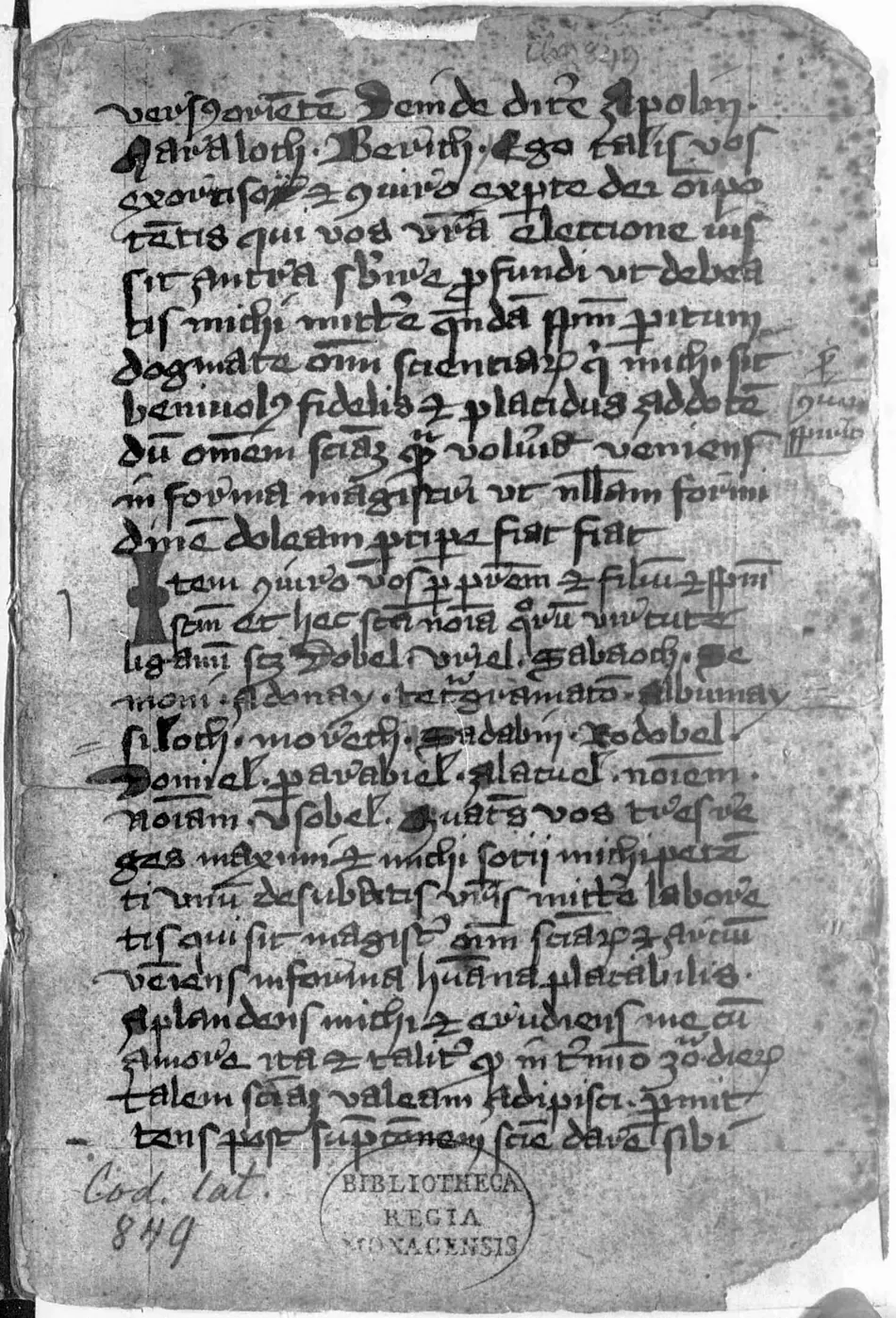
TranscriptionLatin

...versus orientem. Deinde dicite: Apolin, Maraloth, Berith. Ego talis vos exoro sciens et coniuro ex parte Dei omnipo- tentis, qui vos vestra electione ins[tituit?] [pos]sit contra servientibus profundi, ut debea- tis michi mittere quendam spiritum peritum dogmata omnium scientiarum, qui michi sit benevolus, fidelis et placidus ad d[oc]te[ndum?] Deum[?] omnem sciam quas voluit[?] veniens in forma magistri, ut nullam formi- dinem doleam per ipse. Fiat, fiat. Item coniuro vos per Patrem et Filium et Spiritum Sanctum et hec sancta nomina, quorum virtute lig[amini?]: scilicet Sobel, Vriel, Sabaoth, He- moni, Adonay, Tetragramaton, Albumay[?], Siloth, Moveth[?], Elohym, Sadobel[?], Sonriel[?], Pavabiel, Alatuel, noiem[?] noiam[?], Isobel. Coniuro vos t[er]res[?] vel[?] gas[?] maxime[?] michi socii michi para- ti, unum de subditis vestris mittere labora- tis, qui sit magister omnium scientiarum, veniens in forma humana peramabilis, applaudens michi et adiuvans me cum amore, ita et taliter quod in termino 30 dierum talem sciam valeam adipisci. Amit- tan[?]s per... supra[?]... sciens dare tibi...

TranslationEnglish

...toward the east. Then say: Apolin, Maraloth, Berith. I, so-and-so, beseech you knowingly and conjure you on the part of God almigh- ty, who instituted you by your own election [so that you may] [prevail] against those who serve the abyss, that you must send me a certain spirit skilled [in] the doctrines of all the sciences, one who may be to me benevolent, faithful and gentle, to teach [me]; that I may know all he willed[?], coming in the form of a master, so that I may suffer no dread through him. Be it done, be it done. Likewise I conjure you by the Father and the Son and the Holy Spirit and these holy names, by whose virtue [you are bound], namely: Sobel, Vriel, Sabaoth, He- moni, Adonay, Tetragramaton, Albumay[?], Siloth, Moveth[?], Elohym, Sadobel[?], Sonriel[?], Pavabiel, Alatuel, [name?] [name?], Isobel. I conjure you, [spirits?] most [ready?] to me, my companions, prepa- red for me, that you strive to send one of your subjects, one who may be master of all the sciences, coming in a most amiable human form, favoring me and helping me with love, in such wise that within the term of 30 days I may be able to attain such knowledge. [And let him not dismiss it?]... ...knowing how to give it to you...
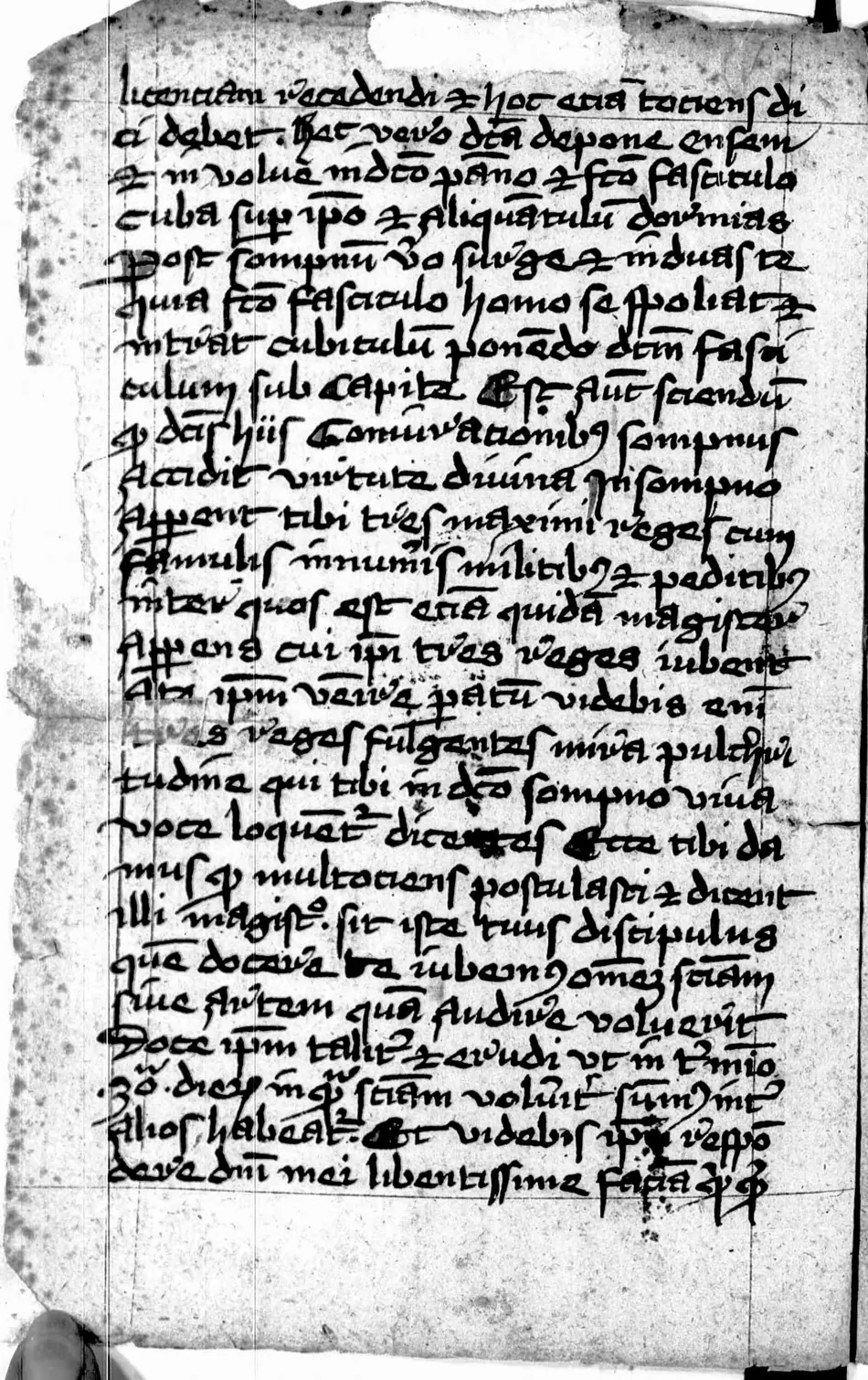
fol. 3v#3v
Munich Manual (Clm 849) — facsimile page (fol. 3v) · public-domain facsimile
BSB Clm 849 (MDZ bsb00037155)
🔍 click to enlarge

TranscriptionLatin

licenciam recedendi, et hoc etiam tociens di- ci debet. Hac vero dicta, depone ensem et invol[v]e mundo panno, et facto fasciculo cuba super ipso, et aliquantulum dormias. Post sompnum vero surge, et induas te [?] facto fasciculo homo se spoliat et[?] intrat cubiculum, ponendo dictum fasci- culum sub capite. Est autem sciendum quod dictis hiis coniurationibus sompnus accidit virtute divina. In sompno apparent tibi tres maximi reges cum famulis innumeris, militibus et peditibus, inter quos est etiam quidam magister apparens, cui ipsi tres reges iubent. Dicta ipsum vero peractum videbis: enim et reges fulgentes mira pulchri- tudine, qui tibi in dicto sompno viva voce loquentur, dicentes: «ecce tibi da- mus quod multociens postulasti», et dicent illi magistro: «sit ipse tuus discipulus, quem docere iubemus omnem scienciam sive artem quam audire voluerit; doce ipsum taliter et erudi, ut in termino 30 dierum in quacumque scientia voluerit su[m]m[am?] [prae] alios habeat». Et videbis ipsum respondentem: «dicentem: domini mei libentissime faciam». [etc.]

TranslationEnglish

...license to withdraw; and this too must be said just as many times. And when this has been said, lay aside the sword, wrap it in a clean cloth, and once the bundle [amulet] is made, lie down upon it and sleep a little. After the sleep, rise and clothe yourself... once the bundle is made, the man strips himself and enters the bedchamber, placing said bundle beneath his head. And it must be known that, when these conjurations have been said, sleep comes upon [one] by divine virtue. In the sleep there appear to you three greatest kings with innumerable servants, horsemen and footmen, among whom there also appears a certain master, whom the three kings command. This being accomplished, you will indeed see the three kings resplendent with wondrous beauty, who in said sleep will speak to you with living voice, saying: «behold, we give you what you have often asked for», and they will say to that master: «let this be your disciple, whom we command you to teach every science or art he wishes to hear; teach him thus and instruct him, so that within the term of 30 days he may have, in whatever science he wishes, the highest [rank] above the others». And you will see him answering the king: «saying: my lords, most gladly will I do it». [etc.]

fol. 4r#4r
Munich Manual (Clm 849) — facsimile page (fol. 4r) · public-domain facsimile
BSB Clm 849 (MDZ bsb00037155)
🔍 click to enlarge

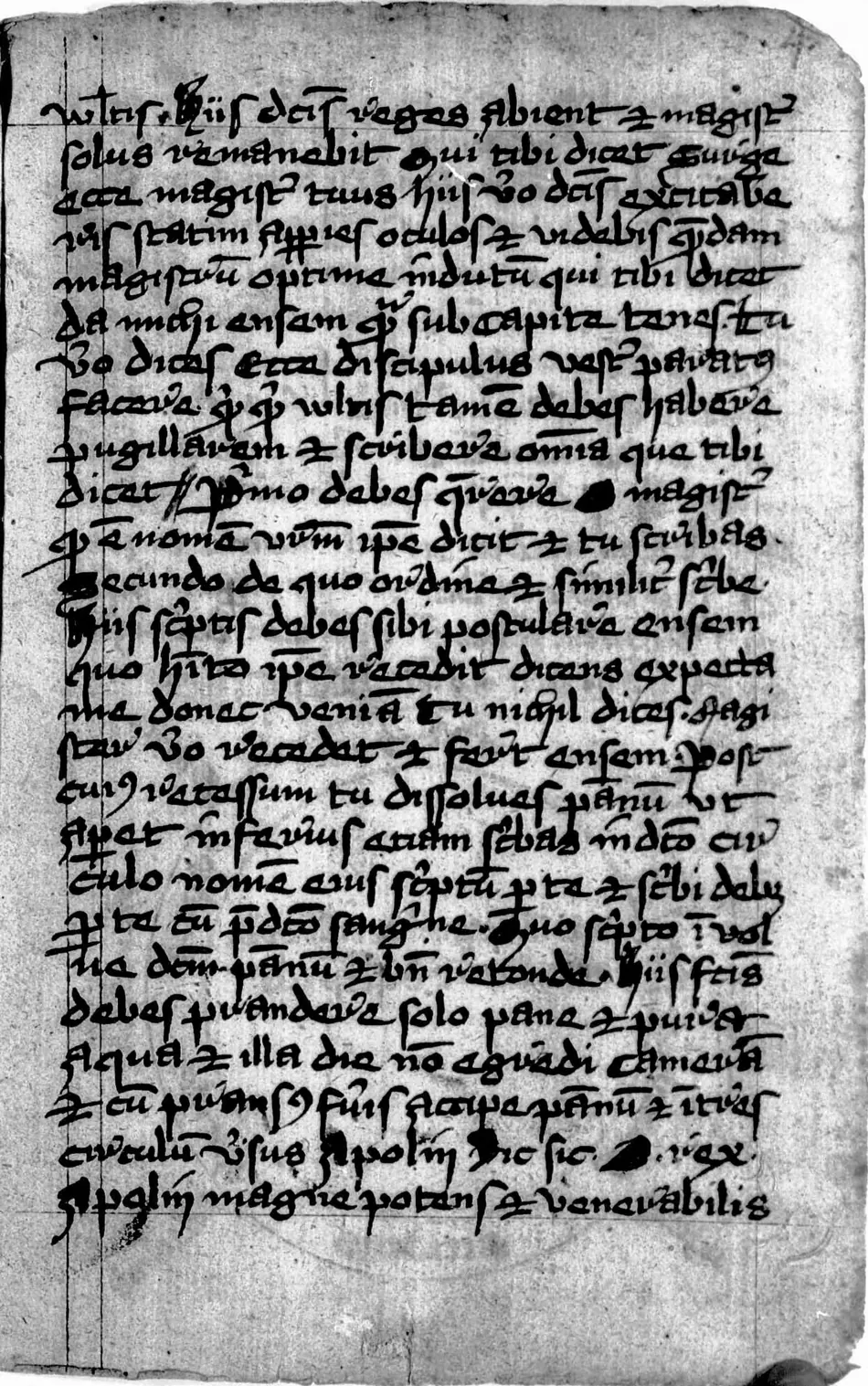
TranscriptionLatin

ulterius. Hiis dictis, reges abient, et magister solus remanebit, qui tibi dicet: «surge, [ecce] magister tuus». Hiis vero dictis excitabe- ris statim, aperies oculos et videbis quendam magistrum optime indutum, qui tibi dicet: «da michi ensem quem sub capite tenes». Tu vero dices: «ecce discipulus vester paratus facere quicquid vultis». Tamen debes habere pugillarem et scribere omnia que tibi dicet. Primo debes quaerere a magistro [nomen suum?] et nomina virtutum, [que] ipse dicit, et tu scribas. Secundo, de quo ordine [sit], et similiter scribe. Hiis scriptis debes sibi postulare ensem, quo habito ipse recedit dicens: «expecta me donec veniam». Tu nichil dices. Magi- ster vero recedet et feret ensem. Post- quam recesserit, tu dissolvas pannum, ut apparet inferius; etiam scribas in dicto cir- culo nomina eius scripta per te et sibi [?] [?] cum predicto sanguine. Quo scripto, in vol- [v]a [pannum?] per manum et bene reconde. Hiis factis debes ieiunare solo pane et pura aqua, et illa die non egredi cameram. Et cum pertransierit [?] statim per manum et iterum coniurabis versus Apolin pro sic: «O rex Apolin magne, potens et venerabilis...»

TranslationEnglish

...further. When this has been said, the kings will depart, and the master will remain alone, who will say to you: «rise, [behold] your master». And when this has been said you will wake at once, you will open your eyes and see a certain master excellently attired, who will say to you: «give me the sword which you keep beneath your head». And you will say: «behold your disciple, ready to do whatever you wish». Yet you must have a writing-tablet and write down everything he tells you. First you must ask the master [his name] and the names of the powers, [which] he speaks, and you shall write them. Second, of which order [he is], and likewise write it. When these have been written you must ask him for the sword, and once he has it he withdraws saying: «await me until I come». You shall say nothing. But the mas- ter will withdraw and carry off the sword. After he has withdrawn, you shall untie the cloth, as appears below; also write in said cir- cle his names, written by you, and to him [?] [?] with the aforesaid blood. This written, wrap [the cloth?] by hand and store it well away. When this is done you must fast on bread alone and pure water, and that day not leave the chamber. And when it has passed [?] at once by hand and again you shall conjure toward Apolin thus: «O king Apolin great, mighty and venerable...»

fol. 4v#4v
Munich Manual (Clm 849) — facsimile page (fol. 4v) · public-domain facsimile
BSB Clm 849 (MDZ bsb00037155)
🔍 click to enlarge

TranscriptionLatin

[—]

TranslationEnglish

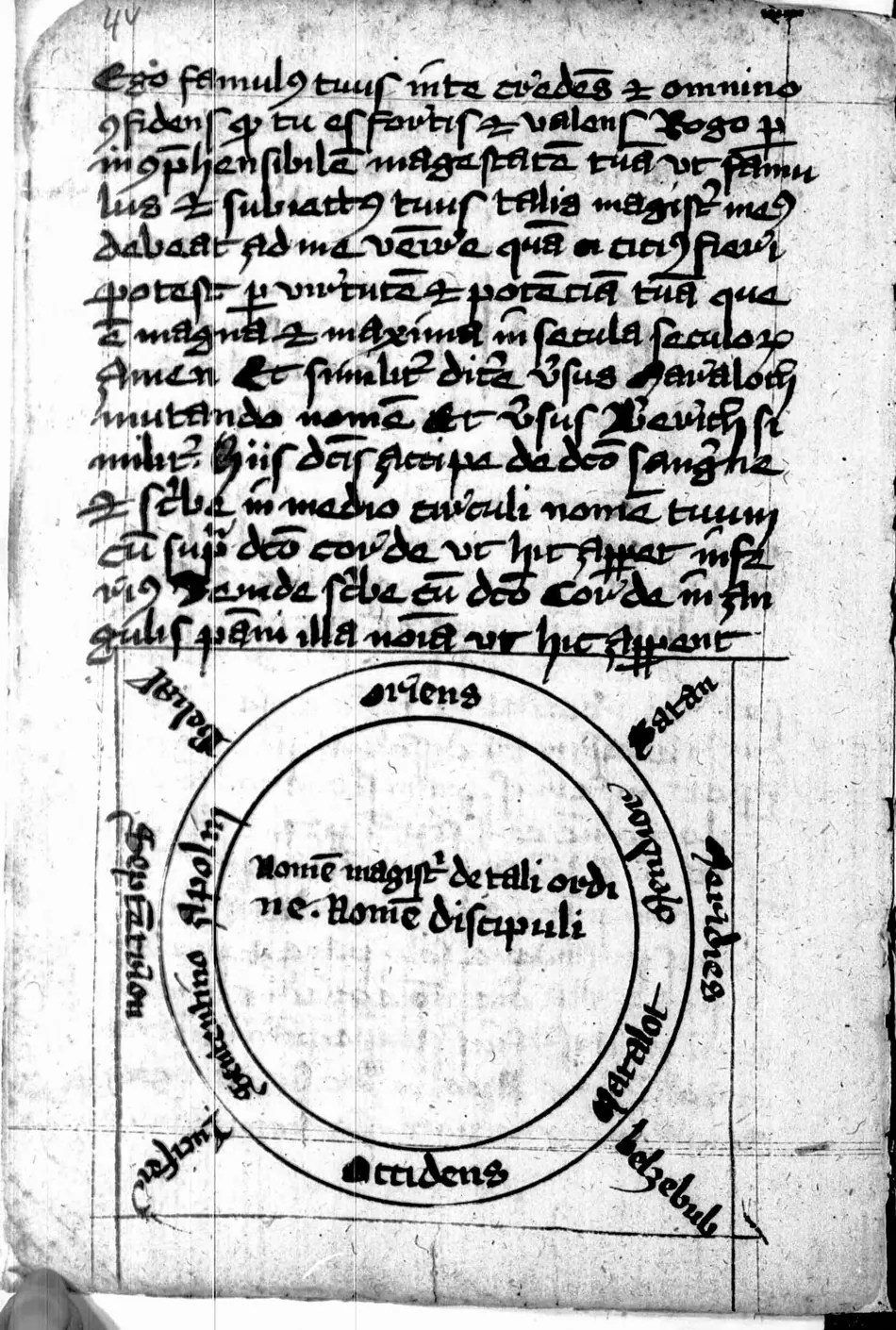
...I, your servant, believing in you and wholly trusting that you are strong and mighty. I ask by your incomprehensible majesty, that your servant and subject, such a master of mine, must come to me —which by you can be commanded to be done—, by your virtue and power, which is great and greatest unto the ages of ages, Amen. And let the same be said toward Maraloth, changing the names. And toward Berith like- wise. When this has been said, take of the said blood and write in the midst of the circle your name with its [order], with your whole heart, as here appears below. Then write with the said blood in the four angles those names, as here they appear. (the figure of the circle follows)

fol. 5r#5r
Munich Manual (Clm 849) — facsimile page (fol. 5r) · public-domain facsimile
BSB Clm 849 (MDZ bsb00037155)
🔍 click to enlarge

TranscriptionLatin

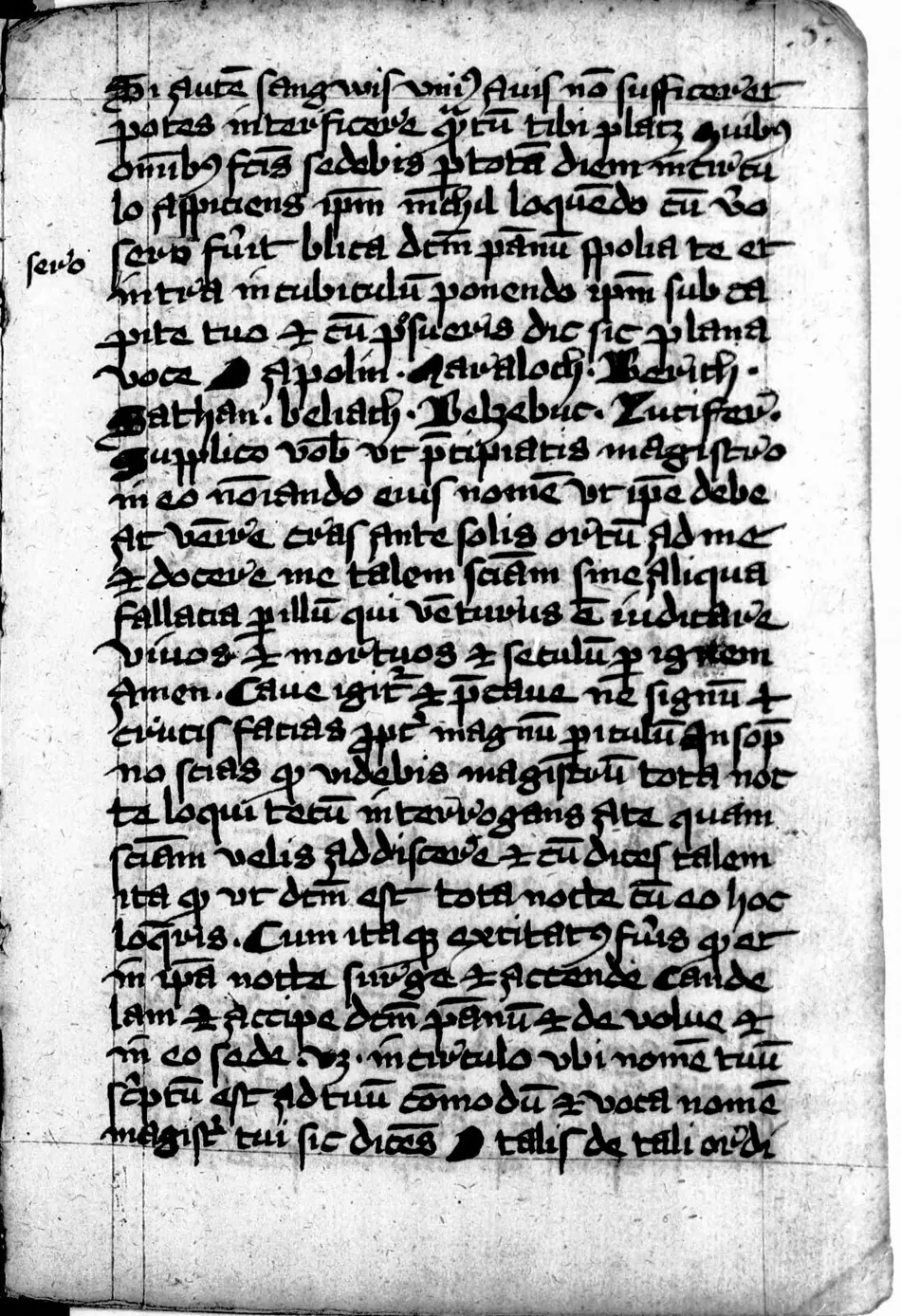
Si autem sanguis unius avis non suffecerit, potes interficere quot tibi placet. Quibus omnibus factis, sedebis per totam diem in circu- lo, aspiciens ipsum, nichil loquendo. Cum vero sero fuerit, plica dictum pannum, spolia te et ‹deepseek: plica, no «publica» — cf. «plica pannum» infra› intra in cubiculo, ponendo ipsum sub ca- pite tuo, et cum posueris dic sic, plana voce: «Apolin, Maraloth, Berith, Sathan, Beliath, Belzebub, Lucifer: Supplico vobis ut praecipiatis magistro meo (notando eius nomen) ut ipse debe- at venire cras ante solis ortum ad me et docere me talem scientiam sine aliqua fallacia, per illum qui venturus [est] iudicare vivos et mortuos et seculum per ignem. Amen». Cave igitur et percave ne signum crucis facias ante magnum periculum. In som- no scias quod videbis magistrum tota noc- te loqui tecum, interrogans [de] illa quam scientiam velis addiscere; et cum dices talem, ita quod, ut dictum est, tota nocte tecum de hoc loqueris. Cum itaque excitatus fueris, quia et in ipsa nocte surge et accende cande- lam, et accipe dictum pannum et devolue, et in eo sede, scilicet in circulo ubi nomen tuum scriptum est, ad tuum comodum, et voca nomen ‹deepseek: voca (invocar), no «vota»› magistri tui; sic dices: «O talis de tali ordine...»

TranslationEnglish

And if the blood of a single bird does not suffice, you may kill as many as you please. When all these things are done, you shall sit the whole day in the circle, gazing at it, speaking nothing. And when evening has come, fold the said cloth, strip yourself and enter the bedchamber, placing it beneath your head; and when you have placed it, say thus, in a plain voice: «Apolin, Maraloth, Berith, Sathan, Beliath, Belzebub, Lucifer: I beseech you that you command my master (noting his name) that he must come tomorrow before sunrise to me and teach me such science without any deceit, by Him who is to come to judge the living and the dead and the world by fire. Amen». Beware therefore, and take great care not to make the sign of the cross before the great peril. In the sleep know that you will see the master speak with you the whole night, asking [about] which science you wish to learn; and when you say which one, so that, as has been said, the whole night you will speak with him of this. And so when you have awakened —for even in that very night— rise and light a can- dle, and take the said cloth and unfold it, and sit upon it, that is, in the circle where your name is written, at your ease, and call the name of your master; thus you shall say: «O so-and-so, of such an order...»

fol. 5v#5v
Munich Manual (Clm 849) — facsimile page (fol. 5v) · public-domain facsimile
BSB Clm 849 (MDZ bsb00037155)
🔍 click to enlarge

TranscriptionLatin

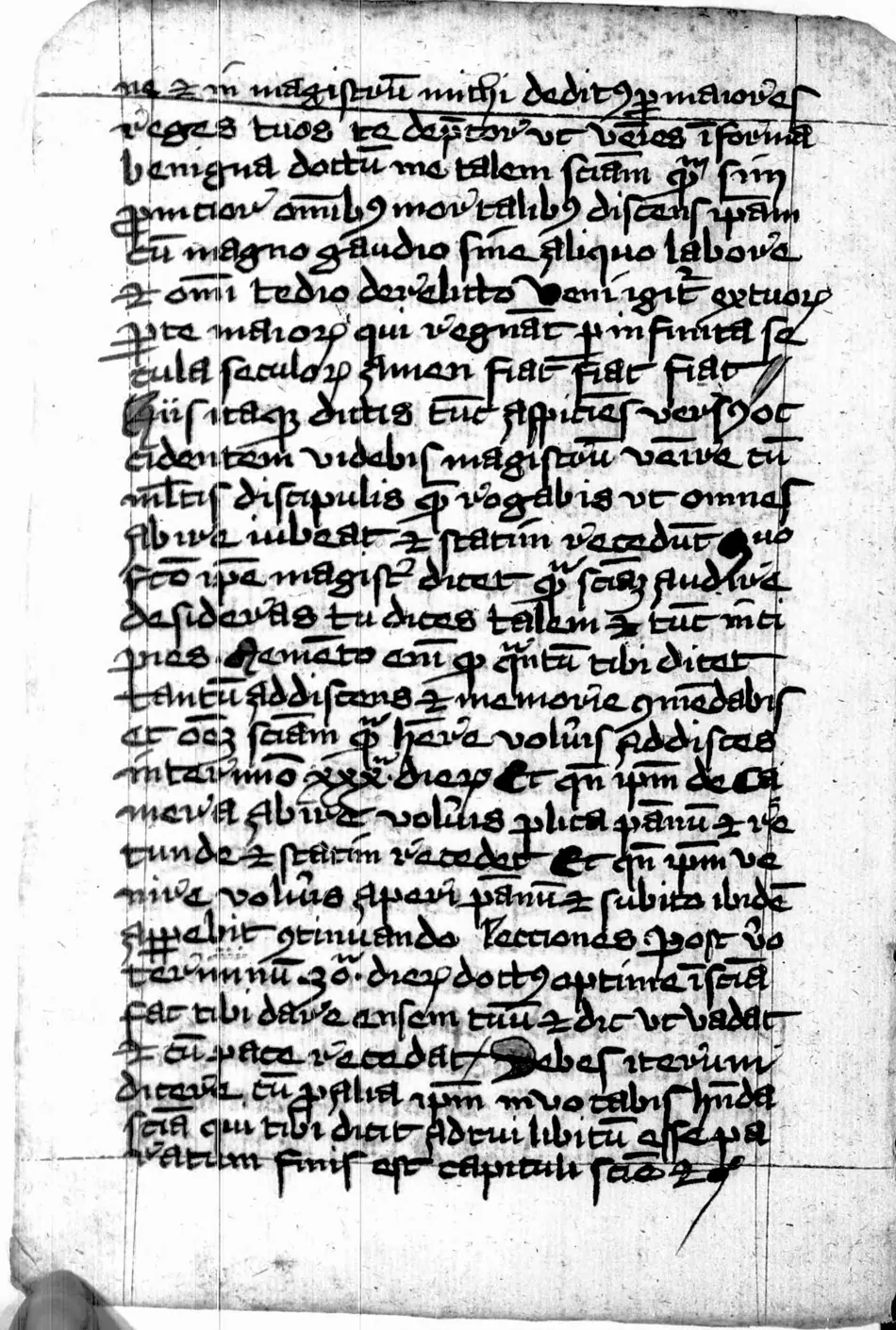
...[in mag]istrum michi dedit, quod maiores reges tuos te deputaverunt, ut velles in forma benigna docere me talem scientiam, quam scire concupio [pre] omnibus mortalibus, dicens ipsam cum magno gaudio, sine aliquo labore et omni tedio derelicto. Veni igitur ex tuorum parte maiorum, qui regnat per infinita se- cula seculorum, amen. Fiat, fiat, fiat. Hiis itaque dictis, tunc aspicies versus oc- cidentem: videbis magistrum, ut ante, cum multis discipulis, quos vocabis, ut omnes abire iubeat, et statim recedunt. Quo facto ipse magister dicet: «quam scientiam desideras?» Tu dices «talem». Et tunc inci- pies exclamato animo, quod quantum tibi dicet tantum addiscere et memorie commendabis; et docebit scientiam quam habere volueris; addisces in termino 30 dierum. Et cum ipsum de ca- mera abire volueris, plica pannum et re- conde, et statim recedet. Et cum ipsum ve- nire volueris, aperi pannum et subito ibidem apparebit, continuando lectiones. Post vero terminum 30 dierum, doctus optime in scientia, fac tibi dare ensem tuum, et dic ut vadat, et cum pace recedat. Debes iterum dicere [...] scientiam qui tibi dicet ad tui libitum. Explicit [finis] capituli secundi. Etc.

TranslationEnglish

...gave [him] to me as master, [saying] that your greater kings charged you to be willing to teach me in a benign form such science, which I desire to know above all mortals, dictating it to me with great joy, without any labor and with all tedium laid aside. Come, therefore, on the part of your greater ones, [by Him] who reigns through the infinite ages of ages, amen. Be it done, be it done, be it done. This being said, you shall then look toward the west: you will see the master, as before, with many disciples, whom you shall call so that he may command them all to depart, and at once they withdraw. This being done, the master will say: «what science do you desire?» You shall say «such». And then you will begin, with resolute spirit, to learn as much as he tells you and commit it to memory; and he will teach the science you wish to have: you will learn it within the term of 30 days. And when you wish him to leave the cham- ber, fold the cloth and store it away, and at once he will withdraw; and when you wish him to come, open the cloth and instantly there in the same place he will appear, continuing the lessons. And after the term of 30 days, most excellently instructed in the science, have your sword given back to you, and tell him to go, and to withdraw in peace. You must again say [...] the science which he will tell you at your pleasure. Here ends the second chapter. Etc.

fol. 6r#6r
Munich Manual (Clm 849) — facsimile page (fol. 6r) · public-domain facsimile
BSB Clm 849 (MDZ bsb00037155)
🔍 click to enlarge

TranscriptionLatin

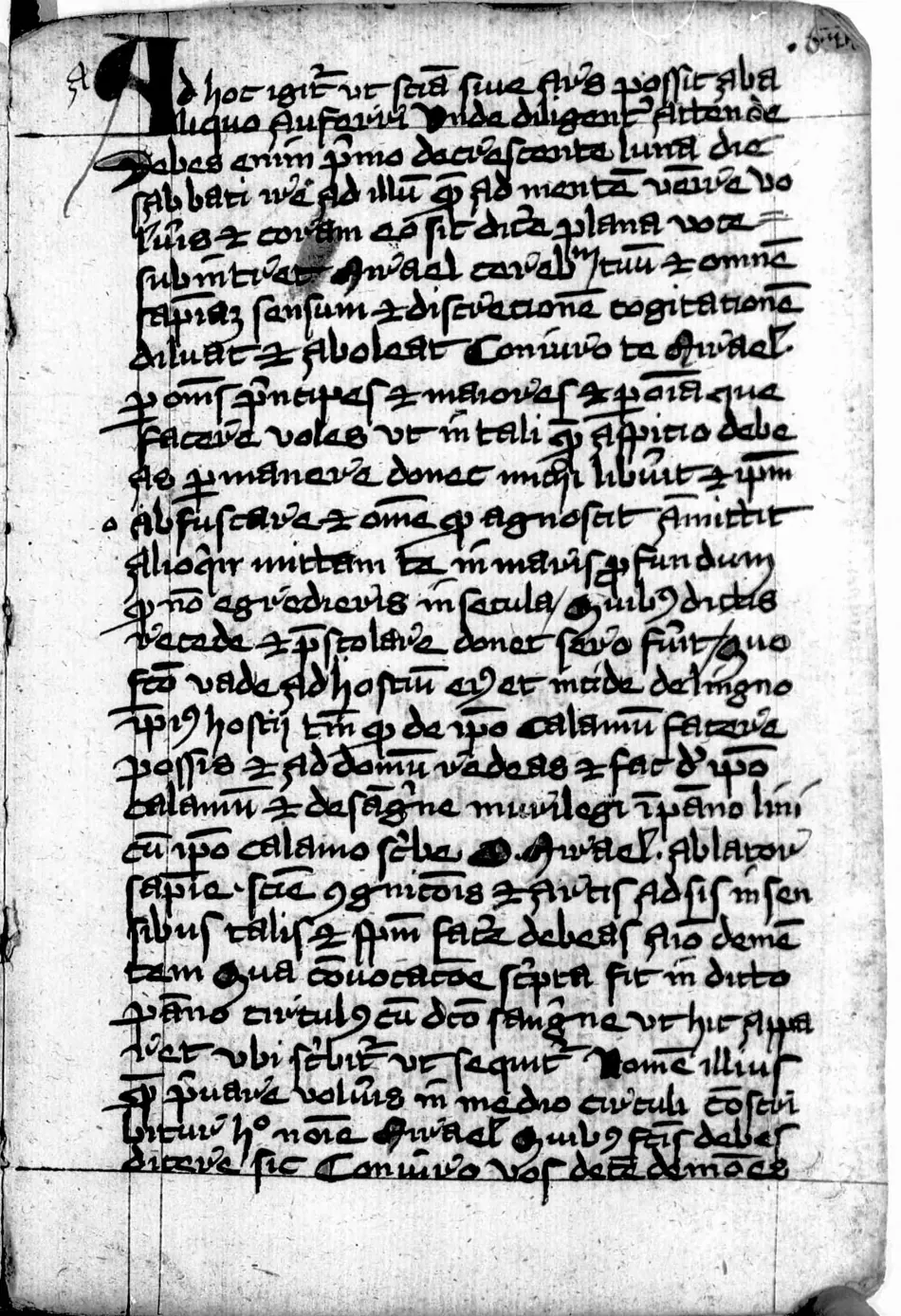
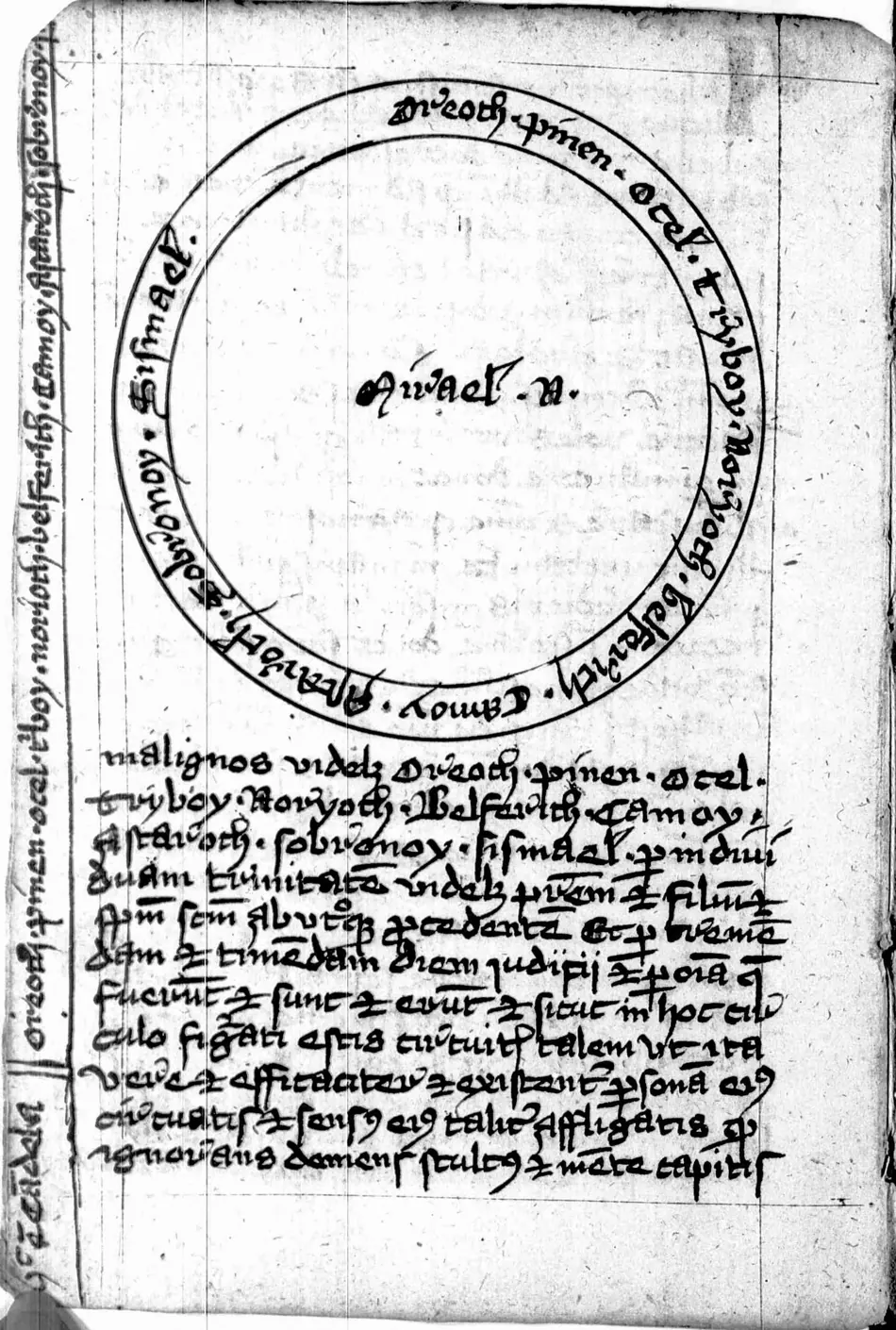
Ad hoc igitur ut scientiam sive artem possit ab a- liquo auferri, unde diligenter attende. Debes enim primo, decrescente luna, die sabbati, ire ad illum quem ad mentem venire vo- lueris, et coram eo, sic dicta plana voce, submitte: «Anael, [Caruelytuum?] (vox magica) et omnem sapientiam, sensum et discretionem, cogitationem diluat et aboleat». Coniuro te, Anael, et omnes principes et maiores et potestates, que facere voles, ut in tali [quo] officio debe- as permanere, donec michi libuerit, et ipsum obfuscare et omne quod agnoscit amittere. Alioquin mittam te in maris profundum, quod non egredieris in secula. Quibus dictis recede et [epistolare?] donec sero fuerit; quo facto vade ad hostium eius, et [mitte?] de ligno ipsius hostii tantum quod de ipso calamum facere possis, et ad domum vadeas et fac de ipso calamum; et de sanguine murilegi, in panno lini, cum ipso calamo scribe: «O Anael, ablator[?] sapientiae, scientiae cognitionis et artis, adsis in ser- vientibus talis, et artem facere debes». [...] ... qua convocacione scripta sit in dicto panno, circulus cum dicto sanguine, ut hic appa- ret, ubi scribitur ut sequitur. Nomen illius quem privare volueris in medio circuli conscri- bitur, hoc nomine [Anael]; quibus factis debes dicere sic: «Coniuro vos deleatis mox...»

TranslationEnglish

To this end, then —that a science or art may be taken away from someone—, attend carefully. You must first, at the waning of the moon, on a Saturday, go toward the one whom you wish to bring to mind, and before him, saying thus in a plain voice, whisper low: «Anael, [Caruelytuum?] (magical word) and let it dissolve and abolish all his wisdom, sense, discernment and thought». I conjure you, Anael, and all the princes and greater ones and powers, [whom] you will to do [it], that in such an office you must remain, until it pleases me, and that you obfuscate him and make him lose all that he knows. Otherwise, I shall send you into the deep of the sea, from which you will not come forth for the ages. When this has been said, withdraw and [wait?] until it is evening; and this done, go to his door, and [take?] of the wood of his very door as much as you can make from it a pen, and go to your house and make from it a pen; and with the blood of a cat, on a linen cloth, with that pen write: «O Anael, remover[?] of wisdom, knower of science and of art, be present against the ser- vants of so-and-so, and you must take away the art». [...] ...with which invocation being written there is made in the said cloth a circle with the said blood, as here appears, where is written what follows. The name of him whom you wish to deprive is written in the midst of the circle, with this name [Anael]; when this is done you must say thus: «I conjure you that you soon efface...»

fol. 6v#6v
Munich Manual (Clm 849) — facsimile page (fol. 6v) · public-domain facsimile
BSB Clm 849 (MDZ bsb00037155)
🔍 click to enlarge

TranscriptionLatin

malignos videl[icet] Drecoth · P[ri]men[?] · Ocel · Truboy[?] · Noryoth[?] · Belfarith · Camoy · Astaroth · Sobronoy[?] · Fismael · p[er] indiui- duam trinitatem videl[icet] p[at]rem [et] filium [et] s[anctu]m s[piritu]m ab utrisq[ue] p[ro]cedent[em] Et p[er] uenie[n]- dam [et] timenda[m] diem iudicij [et] p[er] o[mn]ia q[ue] fueru[n]t [et] sunt [et] eru[n]t [et] sicut in hoc cir- culo figati estis co[n]iuro[?] talem [ut] ita vad[atis?] efficaciter [et] co[n]stant[er] p[er]sona[m] eius cruciatis [et] sensu[m] eius talit[er] affligatis q[uod] ignoua[n]s[?] amens[?] stultus [et] mente capiat[ur][?]

TranslationEnglish

...[the] malign ones, namely: Drecoth, Primen[?], Ocel, Truboy[?], Noryoth[?], Belfarith, Camoy, Astaroth, Sobronoy[?], Fismael — by the undivided Trinity, that is, the Father and the Son and the Holy Spirit proceeding from both, and by the coming and dreadful day of judgment, and by all that was and is and shall be; and as in this circle you are fixed[/bound], I conjure[?] [you that] such a [person] you may thus effectively and constantly torment in his person, and so afflict his sense[/mind], that ignorant[?], mad[?], foolish and out of his mind he be taken[?].

fol. 7r#7r
Munich Manual (Clm 849) — facsimile page (fol. 7r) · public-domain facsimile
BSB Clm 849 (MDZ bsb00037155)
🔍 click to enlarge

TranscriptionLatin

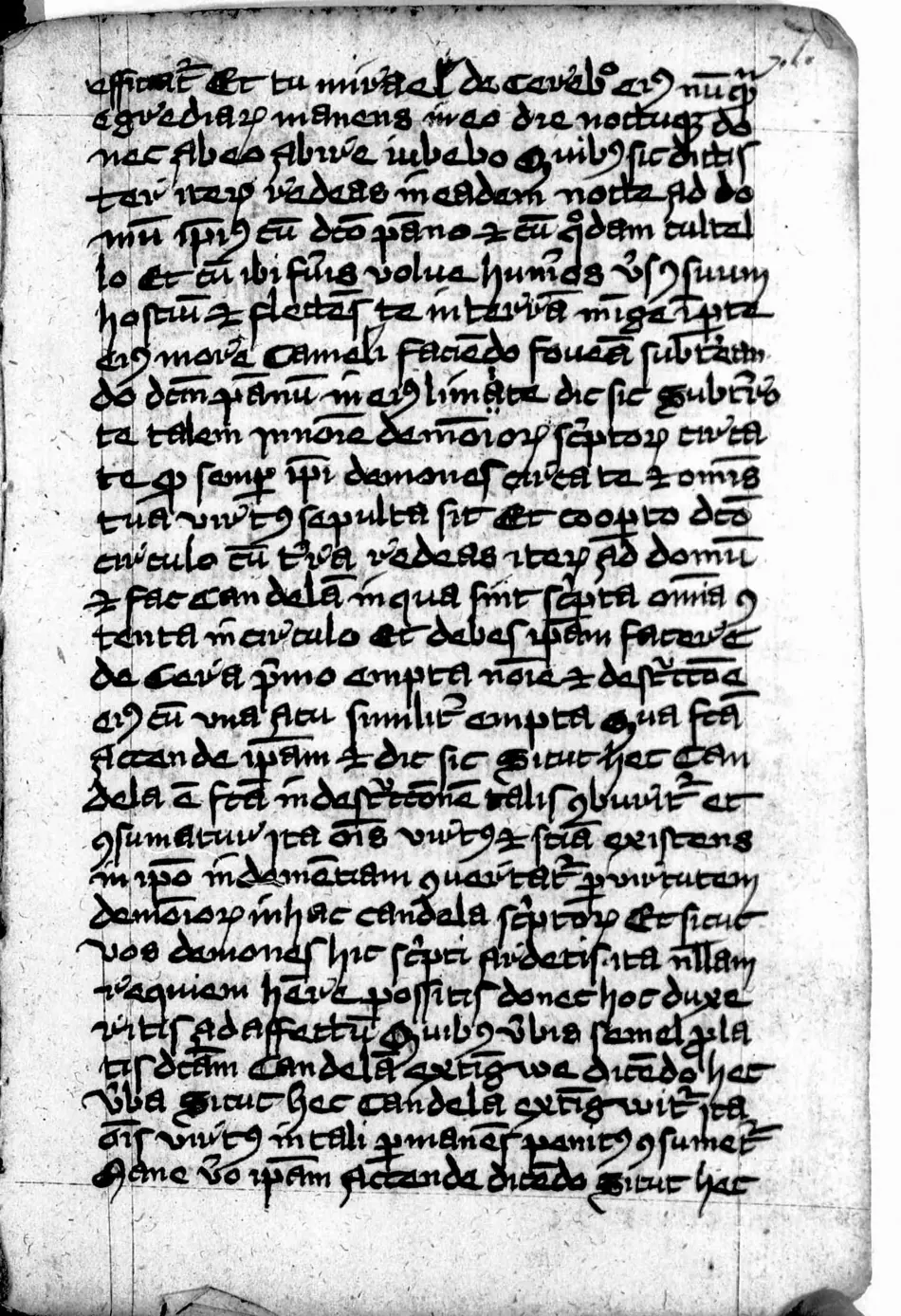
efficiat[ur] Et tu [Mirtael?/Anael?] de caelo[?] eius nu[n]q[uam] egredia[r]is manens meo d[i]c[t]o noctu[rno?] q[uia?] nec ab eo abire iubebo Quib[us] sic dictis iter[um] recedas[?] in eadem nocte ad do- mu[m] [propriam?] cu[m] d[i]c[t]o panno [et] cu[m] q[uo]dam cultel- lo Et cu[m] ibi fueris volue[ris][?] humid[us?] u[er]sus[?] suum hostiu[m] [et] flectas te in terra[m] mi[n]ga[?] ip[su]m[?] p[ro?]- co[n]iuro[?] mortale[?] cam[?]ali facie[n]do fouea[m] subt[er]- ra[n]do d[i]c[t]o[?] p[er] manu[m] i[n] ar[?] limata[?] dic sic subt[er]- ra talem p[re]no[m]i[n]e[?] demonior[um] scriptor[um] cir[ca?] te te q[uod] semp[er] ip[s]i demones cir[ca] te [et] o[mn]is tua v[ir]tus sepulta sit Et coop[er]to d[i]c[t]o circulo cu[m] terra recedas iter[um] ad domu[m] [et] fac candela[m] in qua si[n]t scr[ipt]a om[n]ia [con]- tenta in circulo Et debes ip[s]am facere de cera p[ri]mo empta no[m]i[n]e[?] [et] des[ig]nata[?] d[i]c[t]o[?] cu[m] una statu[?] simul[iter?] empta q[ue] s[an]c[t]a[?] Accende ip[s]am [et] dic sic sicut hec can- dela [et] scr[ipt]a in destructione[?] tali[?] q[uod] uritur[?] Et co[n]sumitur ita om[n]is v[ir]tus [et] scie[n]tia[?] existens in ip[s]o in[?] amentia[m][?] q[ua]r[?] tali[?] p[er] v[ir]tutem demonior[um] in hac candela scriptor[um] Et sicut[?] vos demones hic scripti ardetis ita nullam req[ui]em h[ab]ere possitis donec hoc duxe- ritis ad affectu[m] Quib[us] dictis[?] Illa[m] candela[m] ex- ti[n]guas d[i]c[t]am candela[m] extingua[s?] dicendo hec v[er]ba sicut hec candela extinguit[ur] ita d[i]c[t]o[?] v[ir]tus in tali p[er]maneat vanit[as?]... sumet[?] dei[n]de uero ip[s]am Accendas dicendo sicut hec

TranslationEnglish

...let it be done. And you, [Mirtael?/Anael?], from his [mind?] never depart, remaining by my command [by night?], [for?] I shall not bid you leave him. This being said, again withdraw[?] that same night to [your?] house with the said cloth and with a certain knife. And when you are there [...][?] toward his door, and bow yourself to the ground [...][?]; making a pit and burying [...] with the hand [...] say thus: "Bury such a one under the name[?] of the demons written [around?] you[...], so that always those demons [be] around you and all your power be buried." And the said circle being covered with earth, withdraw again to the house and make a candle on which are written all the things contained in the circle. And you must make it of wax bought first [in the name of?] and marked[?] [...], with a [figure?] likewise bought [...]. Light it and say thus: "As this candle [...] in such[?] destruction[?] is burned and consumed, so let all the power and the knowledge[?] existing in him [fall?] into madness[?], by the power of the demons written on this candle. And as you demons here written burn, so may you have no rest until you have brought this to effect." This said, extinguish that candle, quenching the said candle and saying these words: "As this candle is extinguished, so let [...] the power in such a one remain [as nothing?]." Then indeed light it again saying: "As this...".

fol. 7v#7v
Munich Manual (Clm 849) — facsimile page (fol. 7v) · public-domain facsimile
BSB Clm 849 (MDZ bsb00037155)
🔍 click to enlarge

TranscriptionLatin

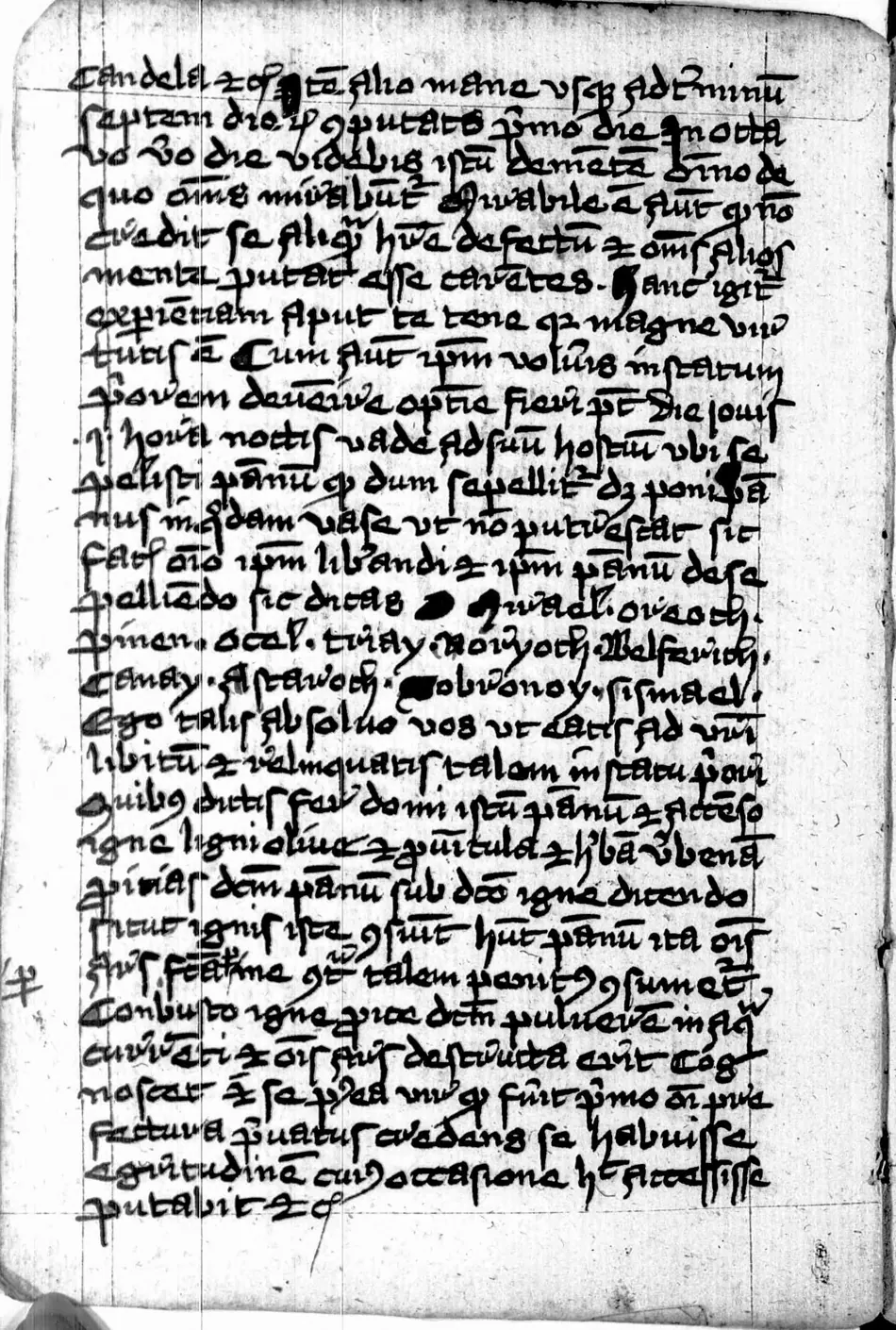
candela[m] [et]c[etera] Alio mane[?] usq[ue] ad t[er]minu[m] [scriptu?] die[m] [et] q[uod] putabis[?] p[ri]mo die[?] i[n] octa- uo[?] uero die[?] videbis istu[m] dementem d[omi]no de[?] quo ante mirabit[ur]. Mirabile[?] a[utem] fuit q[uod] no[n] [con]uadit[?] se aliq[u]i[?] h[ab]ere defectu[m] [et] om[ne]s alios[?] mentem[?] putat[?] e[ss]e[?] curatos. Hanc igit[ur] experie[n]tiam aput te tene q[uia] magne vir- tutis e[st] Cum aut[em] ip[su]m volueris in statu[m] p[ri]orem deduc[er]e o[mn]ia[?] fieri [debent?] die iouis[?] i[n] hora noctis vade ad suu[m] hostiu[m] ubi sa[?]- [se]pelisti[?] panu[m] q[uod] dum sepellit[ur][?] d[ebe]s poni[?] [et] a- nus[?] i[n] q[uo]dam vase ut no[n] putuescat[?] sic facto[?] d[i]c[t]o[?] ip[su]m libandi[?] [et] ip[su]m panu[m] de se- pelie[n]do[?] sic dicas [nomina?] Drecoth[?] · Oreoth[?] · P[ri]men · Ocel · Truday[?] · Noryoth · Belfarith · Camay · Astaroth · Sobronoy · Fismael · Ego talis Absoluo vos ut eatis ad u[est]ru[m][?] libitu[m] [et] relinquatis talem i[n] statu p[ri]o[re] quib[us] d[i]c[t]is fac[?] domi istu[m] panu[m] [et] accenso igne ligni oliue [et] p[ro]iectula[?] [et] h[er]ba v[er]bena[?] co[n]uras[?] d[i]c[t]u[m] panu[m] sub d[i]c[t]o igne dicendo sicut ignis iste [con]surit[?] hu[n]c panu[m] ita om[n]is[?] [furor?] festine[?] q[ui]a[?] talem panit[?] [con]sumet[?] Co[n]busto igne p[er] dicto[?] puluere[m][?] i[n] flu- [men?] curua[?]... [et] om[n]is furor[?] destructa erit cog- nos[c]at [et] sa[nus?] p[ro?]... uir[?] q[ui] fuit p[ri]mo di[e] p[er?]- factura[?] p[ro]uat[ur?] credens se habuisse egritudine[m] cu[m] occasione[?] h[oc][?] Accessisse[?] putabit [et]c[etera]

TranslationEnglish

...the candle, etc. On the next morning[?], up to the term of the appointed day[?]; and what you will think[?] on the first day[?], on the eighth day[?] indeed you will see that man mad, [lord?] at whom before he wondered[?]. And it was remarkable[?] that he does not [acknowledge?] having any defect[?], and holds all others to be sound of mind[?]. Keep, therefore, this experiment with you, for it is of great virtue. And when you wish to restore him to his former state, everything must be done[?] on a Thursday[?], at the hour of night: go to his door, where you buried[?] the cloth —which, while it is buried[?], must be placed[?] [...] in a certain vessel so that it does not rot[?]—; this done[?], [said thus?], libating it[?] and un-burying that cloth, say thus [the names]: Drecoth[?], Oreoth[?], Primen, Ocel, Truday[?], Noryoth, Belfarith, Camay, Astaroth, Sobronoy, Fismael: "I, so-and-so, absolve you, that you may go to your[?] pleasure and leave such a one in his former state." This said, at home [take?] that cloth and, a fire of olive wood being kindled, and [...][?] and herb vervain[?], burn[?] the said cloth under the said fire, saying: "As this fire consumes this cloth, so all[?] [the fury?] soon[?] [...] shall consume such a one[?]." The fire being burnt out, [scatter?] the said[?] powder[?] into a river[?] [...] and all the fury[?] will be destroyed; and let him know[?] and, sound[?] [...] the man[?] who was on the first day[...], believing that he had had a sickness that by some occasion[?] befell him[?], he will think, etc.

fol. 8r#8r
Munich Manual (Clm 849) — facsimile page (fol. 8r) · public-domain facsimile
BSB Clm 849 (MDZ bsb00037155)
🔍 click to enlarge

TranscriptionLatin

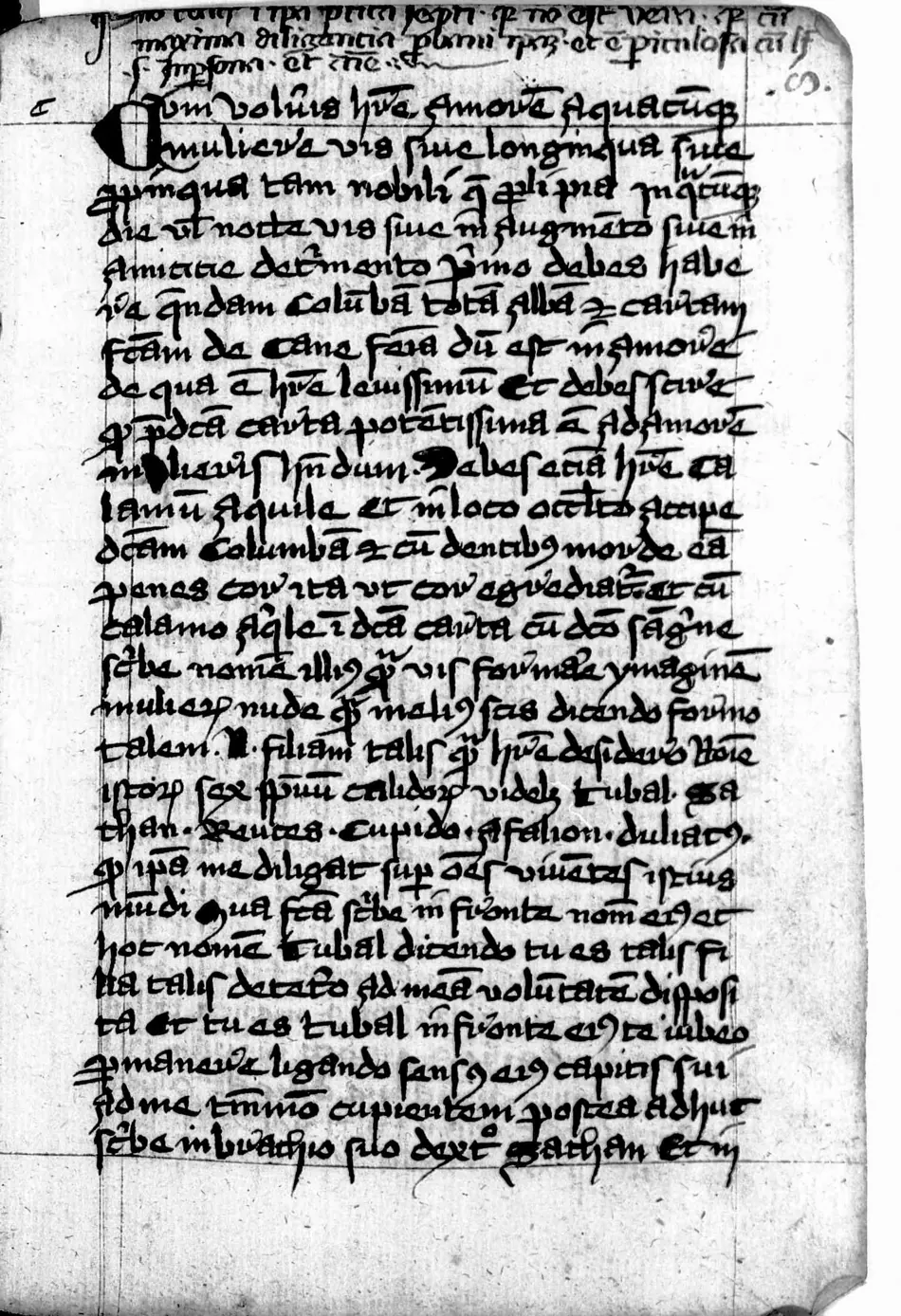
Cum volueris h[abe]re amorem alicuius mulieris, vis sive longinqua sive propinqua, tam nobili quam alia, pro quacumque die — ut nota — vis sive in augmento sive in amittere[/amittere] detrimento: primo debes habere quandam columbam totam albam, et cartam factam de carne [virginea?] dum est in amore, de qua [debes] habere levissimum; et debes scire quod predicta carta [est] potentissima ad amorem mulierum secundum [artem]. Debes etiam habere calamum aquile, et in loco occulto accipe dictam columbam et cum dentibus morde eam [in] venas, concita ut consequeris; et cum calamo aquile in dicta carta cum dicto sanguine scribe nomina illius quem[/quam] vis, forma[n]s imaginem mulieris nude quas [malignitas?]... dicendo: «formo talem [R.] filiam talis quam habere desidero, per nomen istorum sex spirituum calidorum, videlicet Tubal, Sathan, Reuces, Cupido, Afalion, Duliato, quod ipsa me diligat super omnes [homines?] istius mundi». Quam facta scribe in fronte nomen eius et hoc nomen Tubal, dicendo: «tu es talis filia talis, de tali ad meam voluntatem disposita, et tu es Tubal in fronte eius». Ita iubeo quam[?]... ligando sanguis eius capitis sui ad me [continuo?] cupientem. Postea adhuc scribe in brachio ipso dextro Sathan, et in... continues on following fol.

TranslationEnglish

When you wish to obtain the love of some woman —whether far or near, noble or otherwise, for whatever day, as noted—, be it to increase it or to [prevent] its loss: first you must have a certain wholly white dove, and a carta (parchment) made from [virgin?] flesh while it is in heat, of which you must take the lightest part; and you must know that the said carta is most powerful for the love of women, according to the art. You must also have an eagle's quill, and in a hidden place take the said dove and bite it with your teeth on the veins, rouse it until you succeed; and with the eagle's quill, upon the said carta and with the said blood, write the names of her whom you want, forming the image of a naked woman... saying: "I form so-and-so, daughter of so-and-so, whom I desire to have, by the name of these six warm spirits, namely Tubal, Sathan, Reuces, Cupido, Afalion, Duliato, that she may love me above all [men] of this world." This done, write on her forehead her name and this name, Tubal, saying: "you are so-and-so, daughter of so-and-so, disposed to my will, and you are Tubal upon her forehead." So I command... binding the blood of her head to me, desiring. Then further write on her right arm "Sathan", and on... (continues on the next folio)

fol. 8v#8v
Munich Manual (Clm 849) — facsimile page (fol. 8v) · public-domain facsimile
BSB Clm 849 (MDZ bsb00037155)
🔍 click to enlarge

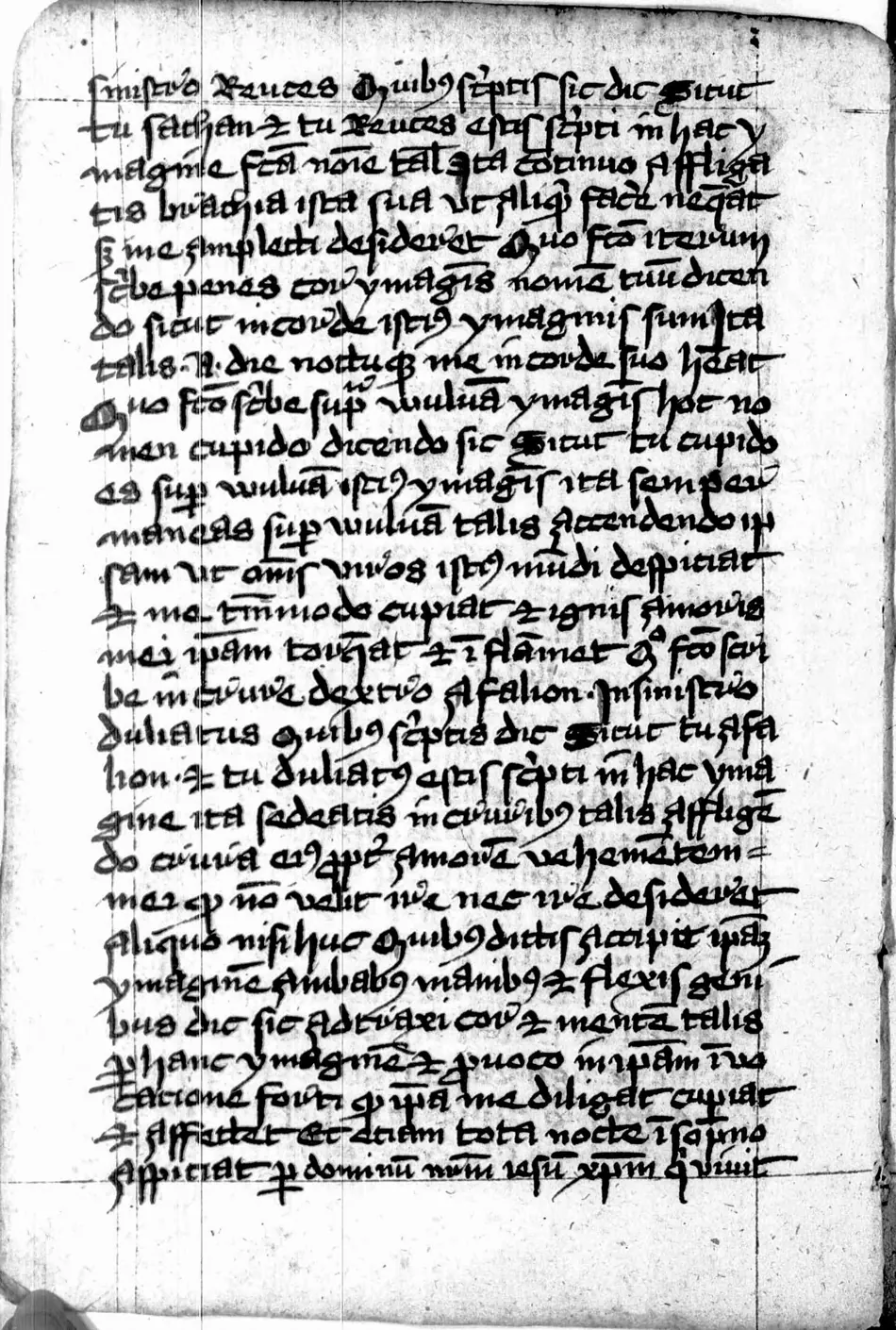
TranscriptionLatin

ministro Reuces, quibus scriptis sic dic: sicut tu Sathan et tu Reuces estis scripti in hac y- magine sub nomine talis, et continuo affliga- tis brachia ista sua ut aliqui[d] facere neq[ue]at[?] nisi me [com]plecti desideret. Quo f[a]c[t]o iterum scribe penes cor ymaginis nomen tuum dicen- do: sicut in corde istius ymaginis sum ita talis. Et die noctu[que] me in corde suo h[abe]at. Quo f[a]c[t]o scribe sup[er] vulvam ymaginis hoc no- men Cupido, dicendo sic: sicut tu Cupido es super vulvam istius ymaginis ita semp[er] maneas super vulvam talis, attendendo ip- sam ut om[ne]s viros istius mundi despiciat et me t[antu]mmodo cupiat, et ignis amoris mei ipsam torqueat et in[?]flammet. Q[u]o f[a]c[t]o scri- be in crure[?] dextro Afalion, in sinistro Duliatus[?], quibus scriptis dic: sicut tu Afa- lion et tu Duliato estis scripti in hac yma- gine ita sedeatis in cruribus[?] talis affligen- do crura[?] eius ad ip[su]m amorem vehementem[?] mei[?], q[uod] non velit ire nec ire desideret[?] aliquo nisi huc. Quibus dictis accipiat ip[sa]m[?] ymaginem ambabus manibus et flexis geni- bus dic sic: adtraxi cor et mentem talis [in?] hanc ymaginem et [in]voco in ip[sa]m [in]uo- cacione forti quod ipsa me diligat, cupiat et affectet, et etiam tota nocte in so[m]pno[?] afficiat, p[er] d[omi]n[u]m n[ost]r[u]m Jesum [Christ]um qui vivit

TranslationEnglish

...servant Reuces; these [names] written, say thus: "Just as you, Sathan, and you, Reuces, are written in this image under the name of so-and-so, so afflict continually these her arms, that she may do nothing except desire to embrace me." This done, write again beside the heart of the image your name, saying: "Just as I am in the heart of this image, so [may] so-and-so [be]. And day and night let her hold me in her heart." This done, write upon the vulva of the image this name, Cupido, saying thus: "Just as you, Cupido, are upon the vulva of this image, so may you ever remain upon the vulva of so-and-so, watching her that she may despise all the men of this world and desire me alone, and that the fire of my love may torment and inflame her." This done, write on the right leg[?] "Afalion", on the left "Duliato"; these written, say: "Just as you, Afalion, and you, Duliato, are written in this image, so may you settle in the legs[?] of so-and-so, afflicting her legs[?] toward that vehement love of me, so that she may not wish to go nor desire to go anywhere but here." This said, let him take the image with both hands and, on bent knees, say thus: "I have drawn the heart and mind of so-and-so [into?] this image, and I invoke [her] with a strong invocation that she may love, desire and long for me, and even all night in sleep[?] be moved [with passion], through our Lord Jesus Christ, who lives..."

fol. 9r#9r
Munich Manual (Clm 849) — facsimile page (fol. 9r) · public-domain facsimile
BSB Clm 849 (MDZ bsb00037155)
🔍 click to enlarge

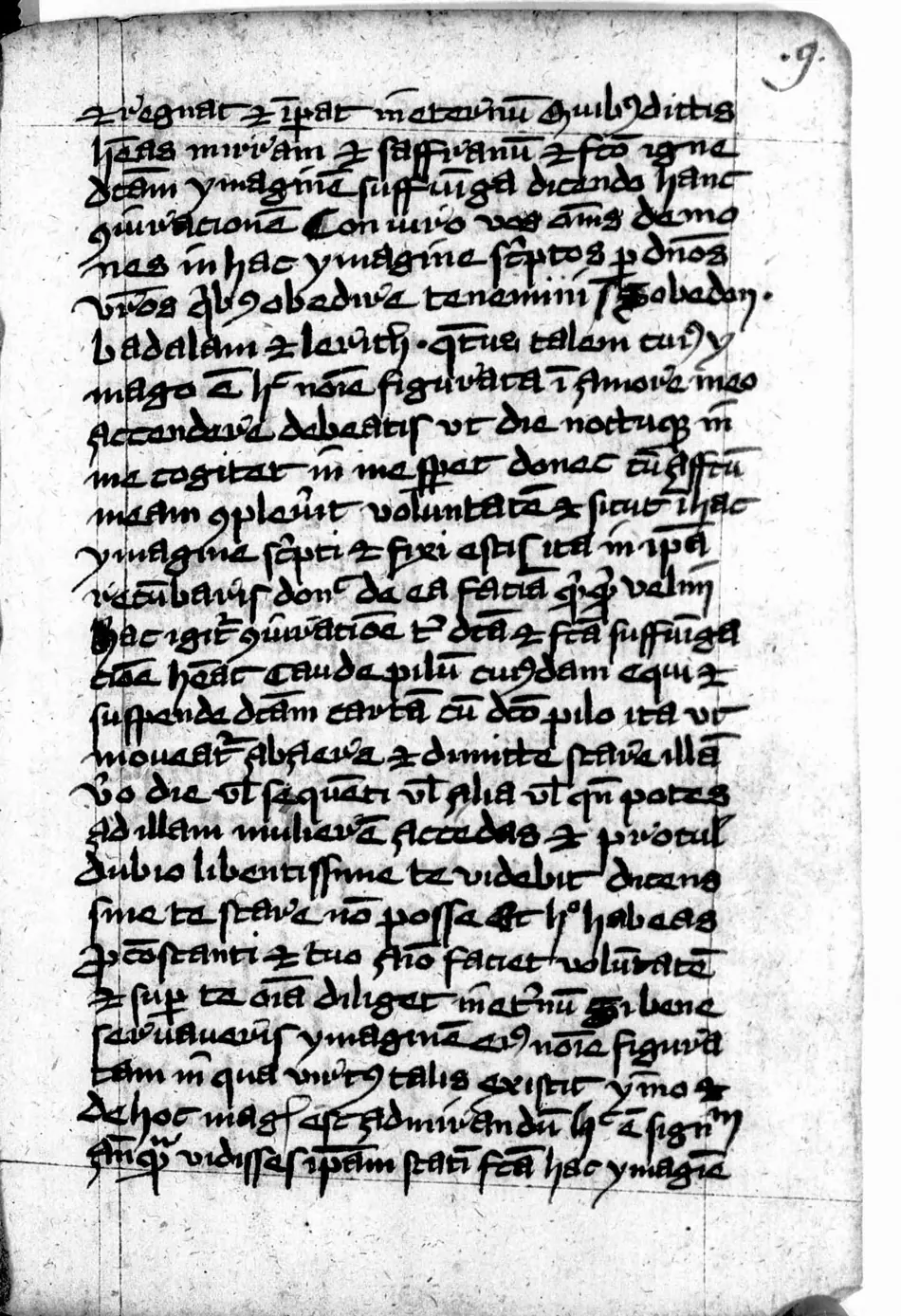
TranscriptionLatin

et regnat et i[m]p[er]at in eternum. Quibus dictis h[abe]as mirram et saffranum[?] et f[a]c[t]o igne d[i]c[t]am ymagine[m] suffumiga dicendo hanc [con]iurationem: Coniuro vos om[ne]s[?] demo- nes in hac ymagine scriptos p[er] d[omi]nos v[est]ros quibus obedire tenemini [+] Sobedon[?] Badalam[?] et Berith, q[ua]re[?] talem cui[us][?] y- mago et hoc nomine figurata[est], in amore meo accendere debeatis, ut die noctu[que] in me cogitet, in me speret, donec tuam[?] et meam[?] compleverit voluntatem. Et sicut in hac ymagine scripti et figurati[?] estis ita in ip[s]a [re]cumbatis[?] donec d[i]c[t]a f[a]c[t]a q[ue][?] velim. Hac ig[itur] [con]iuratione et[?] dicta et f[a]c[t]a suffumiga- tione [h]abeas[?] [de] cauda pilum cuiusdam equi et suspende d[i]c[t]am cartam cum d[i]c[t]o pilo ita ut moveat[ur] ab aura, et dimitte stare illam uno die[?] et sequenti ut alia[?], et cum potes[?] ad illam mulierem accedas, et pro[cul] dubio libentissime te videbit, dicens: sine te stare non possem[?]. Et h[abe]as[?] [con]stant[er][?] et[?] tuo iure[?] faciet voluntatem et super [omnes?][?] te diliget illegible si bene servaveris ymaginem cum nomine figura- tam, in qua virtus talis existit, ymo et ad hoc magis est admirandum q[uod][?] illegible signu[m][?] a[m]ico[?] vidisses ip[sa]m statim f[a]c[t]a hac ymagine

TranslationEnglish

...and reigns and rules forever. These words said, have myrrh and saffron[?] and, the fire lit, fumigate the said image saying this conjuration: "I conjure you, all[?] the demons written in this image, by your lords whom you are bound to obey, [+] Sobedon[?], Badalam[?] and Berith, that[?] you must kindle into love of me such [a woman], whose[?] image and [who is] figured with this name, so that day and night she may think on me, hope in me, until she has fulfilled your[?] and my[?] will. And just as you are written and figured in this image, so may you lie[?] upon her until the said things be done which I wish." Then, this conjuration having been spoken and the fumigation made, have[?] from the tail a hair of a certain horse, and suspend the said carta by the said hair so that it moves in the breeze; and let it hang thus one day[?] and the next, or[?] more, and when you can, approach that woman, and without doubt she will see you most gladly, saying: "I could[?] not bear to be without you." And you shall have[?]... constantly[?] she will do your will and love you above [all?] [illegible], if you have well kept the image figured with the name, in which such power exists; nay more, and what is the more to be wondered at, that[?]... [illegible] sign[?]... friend[?]... you had seen her: at once, this image being made...

fol. 9v#9v
Munich Manual (Clm 849) — facsimile page (fol. 9v) · public-domain facsimile
BSB Clm 849 (MDZ bsb00037155)
🔍 click to enlarge

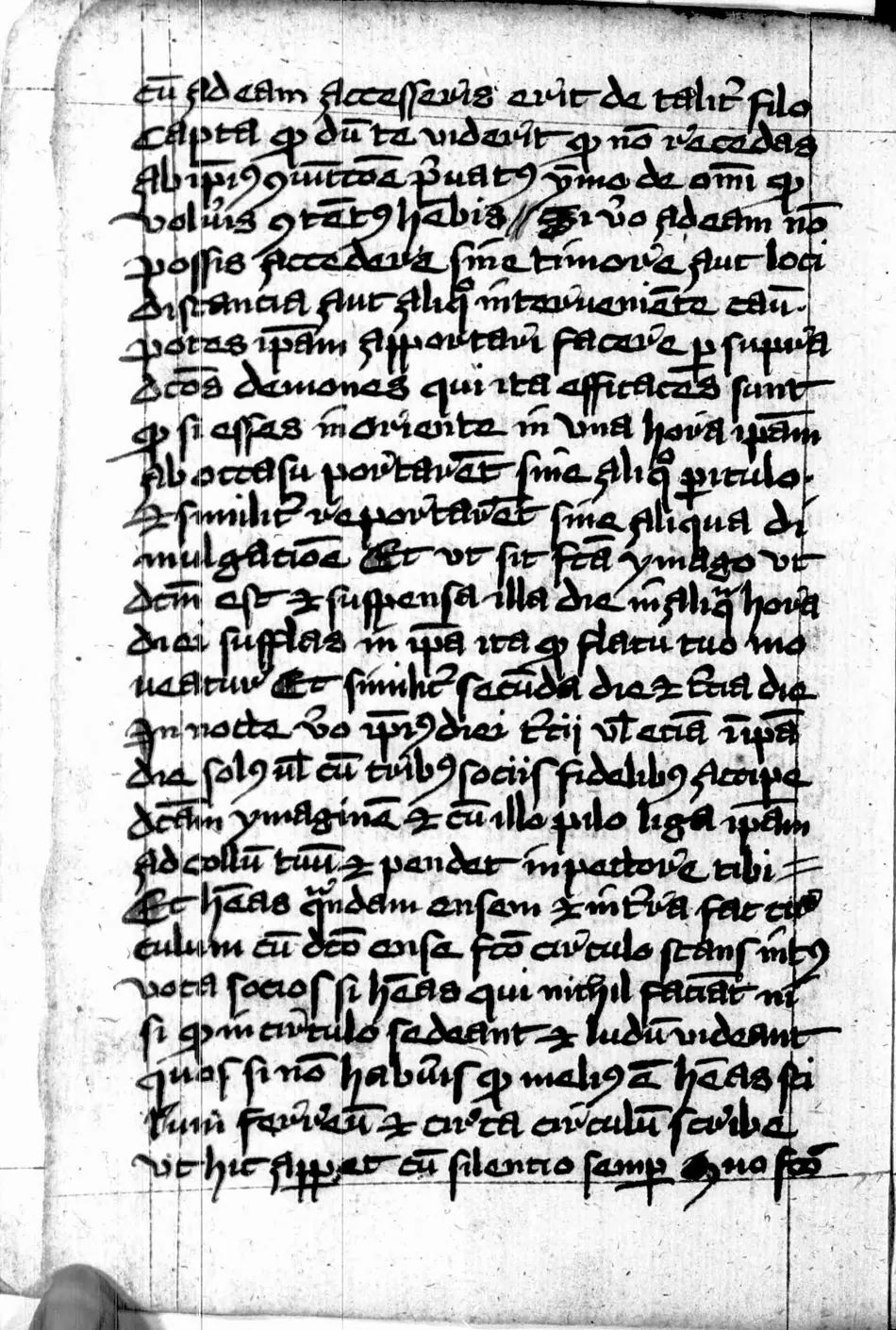
TranscriptionLatin

cum ad eam accesseris erit[?] de tali filo capta, q[uod] dum te viderit q[uod] non r[e]cedas ab ip[s]a[?] quietus[?]... ymo de om[n]i q[uod][?] volueris[?] gratis[?] habebis. Si v[er]o ad eam non possis accedere sine timore aut loci distancia aut aliqua interveniente cau- sa, potes[?] ip[sa]m apportari facere p[er] supra- d[i]c[t]os demones, qui ita efficaces sunt q[uod] si esses in oriente in una hora ip[sa]m ab occasu portarent sine aliquo periculo et similit[er] reportarent sine aliqua di- vulgatione. Et ut sit f[a]c[t]a ymago ut d[i]c[t]um est et suspensa, illa die in aliqua hora diei suffles in ip[s]a ita q[uod] flatu tuo mo- ueatur. Et similit[er] secunda die et tertia die. In nocte v[er]o [tercii?] diei tercii[?], ut etiam ip[s]a[?] die solus[?] ut cum tribus sociis fidelib[us] accipe d[i]c[t]am ymaginem, et cum illo pilo liga ip[sa]m ad collum tuum et pendeat in pectore tibi. Et h[abe]as q[u]andam ensem et in terra fac cir- culum cum d[i]c[t]o ense; f[a]c[t]o circulo stans intra[?] voca[?] socios si h[abe]s qui nichil faciat ni- si q[uod] in circulo sedeant et ludum videant, quos si non habueris q[uod] melius; et h[abe]as si[?] tum[?] fecerint[?] et circa[?] circulum scribe ut hic apparet, cum silentio semp[er]. Quo f[a]c[t]o

TranslationEnglish

...when you approach her, she will be[?] caught by such a thread, so that as soon as she sees you, you may not withdraw[?] from her at ease[?]... nay more, you will have for free[?] everything you wish[?]. But if you cannot approach her, out of fear, or the distance of the place, or some other intervening cause, you can[?] have her brought by the aforesaid demons, who are so effective that, were you in the east, in one hour they would carry her from the west without any danger, and likewise carry her back without any divulging. And, the image being made as said and suspended, that day, at some hour of the day, blow upon it so that it moves with your breath. And likewise the second day and the third day. But on the night of the[?] third day, that she too[?]... that day, alone[?] or with three faithful companions, take the said image, and with that hair tie it to your neck and let it hang on your breast. And have a sword and trace on the ground a circle with the said sword; the circle made, standing within[?], call[?] the companions if you have any, who do nothing except sit within the circle and watch the play; whom if you have not, [it is] better[?]; and have[?] if[?]... they have done[?], and around the[?] circle write as here appears, always in silence. Which done...

fol. 10r#10r
Munich Manual (Clm 849) — facsimile page (fol. 10r) · public-domain facsimile
BSB Clm 849 (MDZ bsb00037155)
🔍 click to enlarge

TranscriptionLatin

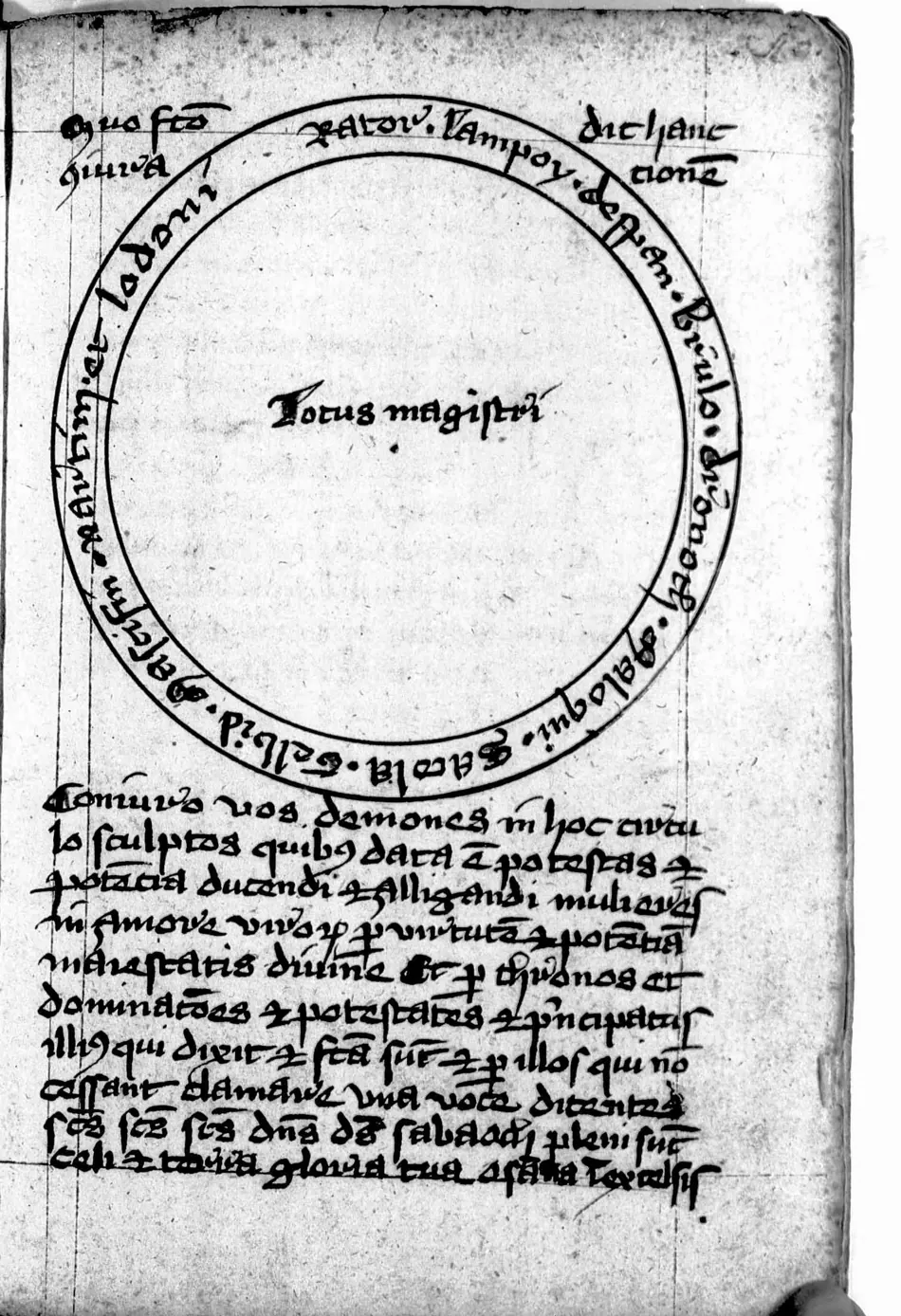
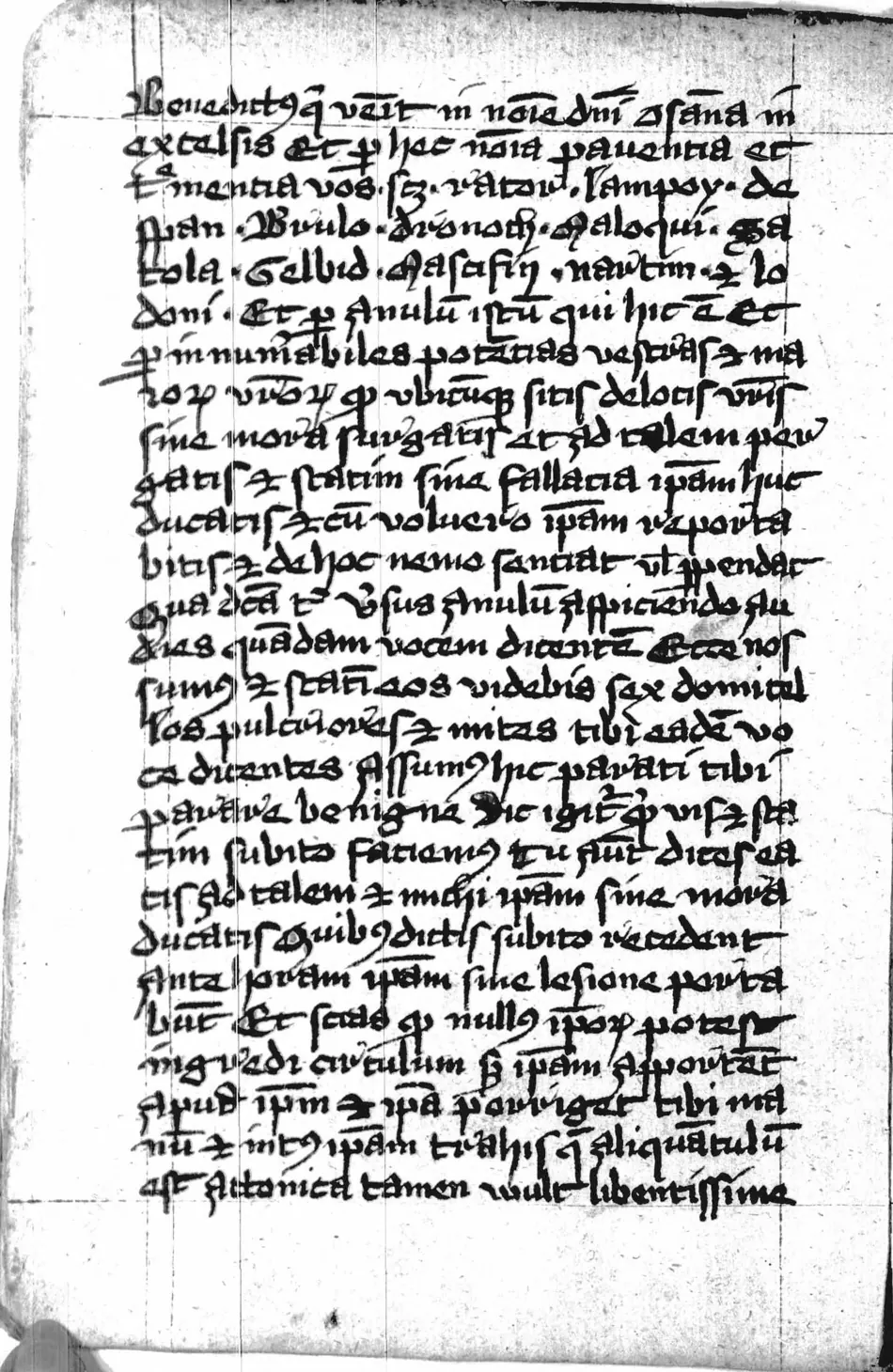
outside, upper left: Quo f[a]c[t]o co[n]iura outside, upper right: dic hanc [ora]c[i]one[m] band, clockwise from above: [·V?]rator[?] · Lampoy · deffren[?] · Brulo[?] · dronoth · Galoqui · Satola[?] · Belid[?] · Pasafyn[?] · [n]authm[?] et lodoni · [B?]arich[?] uauthm[?] et[?] illegible [centro:] Locus magistri

[C]oniuro vos demones in hoc circu- lo sculptos quib[us] data e[st] potestas et pote[n]cia ducendi et alligandi mulieres in amore[m] viro[rum] p[er] virtute[m] et pote[n]cia[m] maiestatis divine et p[er] thronos et dominac[i]ones et potestates et p[ri]ncipatus illi[us] qui dixit et facta su[n]t et p[er] illos qui no[n] cessant clamare una voce dicentes S[an]c[tu]s S[an]c[tu]s S[an]c[tu]s d[omi]n[u]s d[eu]s sabaoth pleni su[n]t celi et t[er]ra gloria tua osanna [i]n excelsis

TranslationEnglish

[figure rubrics: “This done, conjure” / “say this prayer”] [circle band: spirit-names — Vrator[?], Lampoy, Destan[?], Brulo[?], Dronoth, Galoqui, Satola[?], Gelbid/Belid[?], Sasafyn[?], Nauthin[?] and Lodoni…; centre: “Place of the master”]

I conjure you, demons carved in this circle, to whom is given the power and might of leading and binding women unto the love of men, by the virtue and might of the divine majesty, and by the thrones and dominions and powers and principalities of Him who spoke and [the things] were made, and by those who cease not to cry with one voice, saying: “Holy, Holy, Holy, Lord God of hosts; the heavens and the earth are full of thy glory; hosanna in the highest.”

fol. 10v#10v
Munich Manual (Clm 849) — facsimile page (fol. 10v) · public-domain facsimile
BSB Clm 849 (MDZ bsb00037155)
🔍 click to enlarge

TranscriptionLatin

Benedictus q[ui] ve[n]it in no[m]i[n]e d[omi]ni osana in excelsis et p[er] hec no[m]i[n]a pac[ien]cia[?] et [cle]mencia[?] vos s[cilicet] [V]rator[?] lampoy de- stan Brulo dronoth Galoqui Sa- tola Gelbid Sasafyn[?] nauthi[n][?] et lo- doni Et p[er] Anulu[m] istu[m] qui hic e[st] et p[er] innum[er]abiles pote[n]cias vestras et ma- ioru[m] vestror[um] q[uod] ubicu[m]q[ue] sitis de locis vestris sine mora surgatis et ad talem per- gatis et statim sine fallacia ipsam huc ducatis et cu[m] voluero ipsam reporta- bitis et de hoc nemo senciat ut p[re]ndat[?] qua d[i]c[t]a[?] tu[?] visus[?] Anuli aspiciendo Au- dias quadam[?] vocem dicente[m] Ecce nos sumus et statim eos videbis sex domi[cel?]- los[?] pulc[r]iores[?] et mitte[n]s[?] tibi ad[?] de[?] vo- ca[?] dicentes Assum[us] hic parati tibi paratura[?] benigna dic igitur q[uod] vis et sta- tim subito faciam[us] tu sic dicas ea- tis ad talem et michi ipsam sine mora ducatis quib[us] dictis subito recedant Ante portam ipsam sine lesione porta- bu[n]t Et scias q[uod] nullus ipsor[um] potest ingredi circulu[m][?] s[ed] ipsam Apporta[n]t[?] Apud ipsu[m] et ipsa porriget tibi ma- nu[m] et mitte[?] ipsam trahis si aliquantulu[m] [sit?] Attonita tamen vult libentissime

TranslationEnglish

Blessed is he that comes in the name of the Lord; hosanna in the highest. And by these names, [by] patience[?] and clemency[?], to you, namely: Vrator[?], Lampoy, Destan, Brulo, Dronoth, Galoqui, Satola, Gelbid, Sasafyn[?], Nauthin[?] and Lodoni; and by this ring that is here, and by your innumerable powers and [those] of your elders: that wherever you may be, from your places you rise without delay, and go unto such a [woman], and at once, without deceit, bring her hither; and when I so will, you shall carry her back; and of this let no one be aware, that [he/one may] take[?] [her]. Which said, you, gazing[?] upon the ring[?], shall hear a certain voice saying: “Behold, here we are”; and at once you shall see them, six[?] very fair maiden[s?], and [sending?]… with a voice[?] saying: “We are here ready for you, disposed[?] kindly; say therefore what you wish and at once, straightway, we shall do it.” You shall say thus: “Go unto such a [woman] and bring her to me without delay.” Which said, they shall at once withdraw, and before her door, without harm, they shall carry her. And know that none of them can enter the circle[?], but they bring her near it; and she will hold out her hand to you, and you[?] draw her[?] in; though she be somewhat startled, yet she comes most willingly.

fol. 11r#11r
Munich Manual (Clm 849) — facsimile page (fol. 11r) · public-domain facsimile
BSB Clm 849 (MDZ bsb00037155)
🔍 click to enlarge

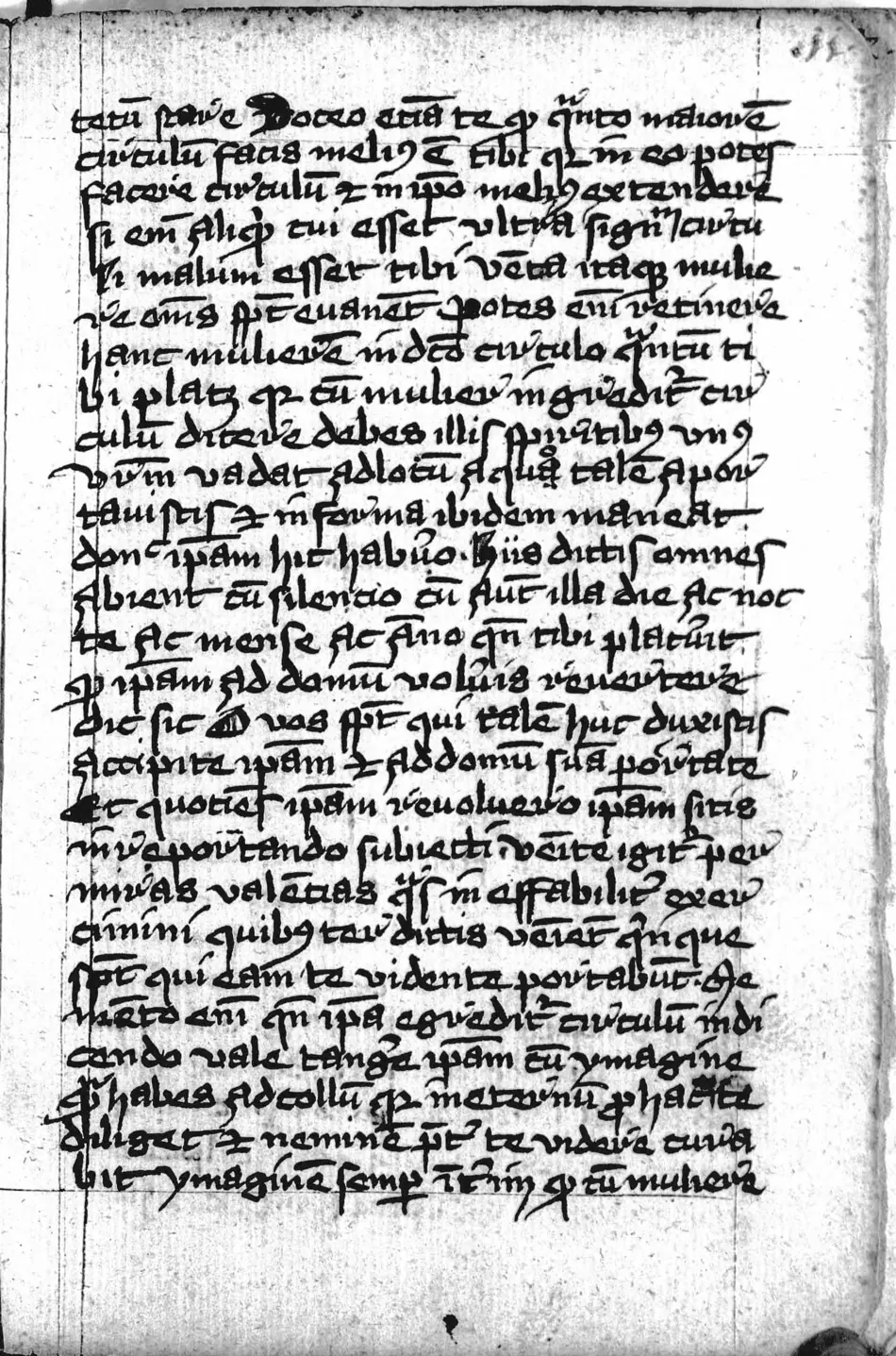
TranscriptionLatin

tetu[?] p[e]t[er]e[?] Doceo etia[m] te q[uod] q[ua]nto meliore[m] circulu[m] facias meli[us] e[st] tibi q[uia] in eo potes facere circulu[m] et in ipso melius extendere si e[n]im aliq[ui]d tui esset ultra signu[m] aut u[?] [v]t malu[m] esset tibi Vera itaq[ue] mulie- re[m] omn[e]s[?] preveniret[?] potes e[n]im retinere hanc muliere[m] in d[i]c[t]o circulo q[ua]ntu[m] ti- bi place[t] q[uod] cu[m] mulier ingreditur cir- culu[m] dicere debes illis spiritib[us] Un[us][?] [e]or[um] vadat ad locu[m] a q[uo][?] tale[m] Apor- tauistis et in forma ibidem maneat don[ec] ipsam hic habu[er]o His dictis omnes Abeant cu[m] silencio Cu[m] Aut[em] illa die Ac noc- te sic mense Ac Anno q[ua]n[do] tibi placuit[?] q[uod] ipsam Ad domu[m] volu[er]is reverti[?] dic sic O vos sp[iritu]s qui tale[m] huc duxistis Accipite ipsam et Ad domu[m] sua[m] portate Et quotie[n]s ipsam revocavero[?] ipsam sitis[?] in reportando subiecti Rec[ed]ite[?] igit[ur] p[er] om- nia valeatis Ite[m][?] affabilit[er] exea[?]- [m]ini quib[us] tandem dictis vadet[?] q[ui]nq[ue][?] sp[iritu]s qui eam te vidente portabit Ac[?]- vertet[?] domu[m][?] cu[m] ipsa egreditur circulu[m] Indi- cando vale tanga[s][?] ipsam cu[m] ymagine q[uam] habes Ad collu[m] q[uod] mox [omnium?] illegible p[er] hac[?] diliget et nemine[m] p[os]t te videre curabit ymagine[m] semp[er] teneas q[uod] tu mulierem[?]

TranslationEnglish

…[to?] ask[?] [you?]. I teach you also that the better you make the circle, the better it is for you, for within it you can make [another] circle and stretch yourself out the better therein. For if anything of yours were beyond the sign, or[?]… it would be evil for you. Therefore, [the] woman[?]… all[?] would reach[?]; you can indeed keep this woman in the said circle as long as it pleases you. And when the woman enters the circle, you must say to those spirits: “Let one[?] of them go to the place from which[?] you brought such a [woman], and let him remain there in [her] form until I have her here.” This said, let them all depart in silence. And when, on whatever day and night, and month and year that pleases you[?], you wish[?] her to return to her house, say thus: “O you spirits who brought such a [woman] hither, take her and carry her to her house; and as often as I recall[?] her, be you bound[?] to bring her back.” Withdraw[?], therefore; may you fare well in all things [= go in peace]; likewise[?] withdraw[?] affably. This said at last, let [a?][?] spirit go who will carry her before your eyes… And when she leaves the circle, signaling farewell, touch[?] her with the image you wear at your neck, so that at once she may love [you above all?]… [illegible]… and will care to see no one after you. Keep the image always, that you [may the?] woman[?]…

fol. 11v#11v
Munich Manual (Clm 849) — facsimile page (fol. 11v) · public-domain facsimile
BSB Clm 849 (MDZ bsb00037155)
🔍 click to enlarge

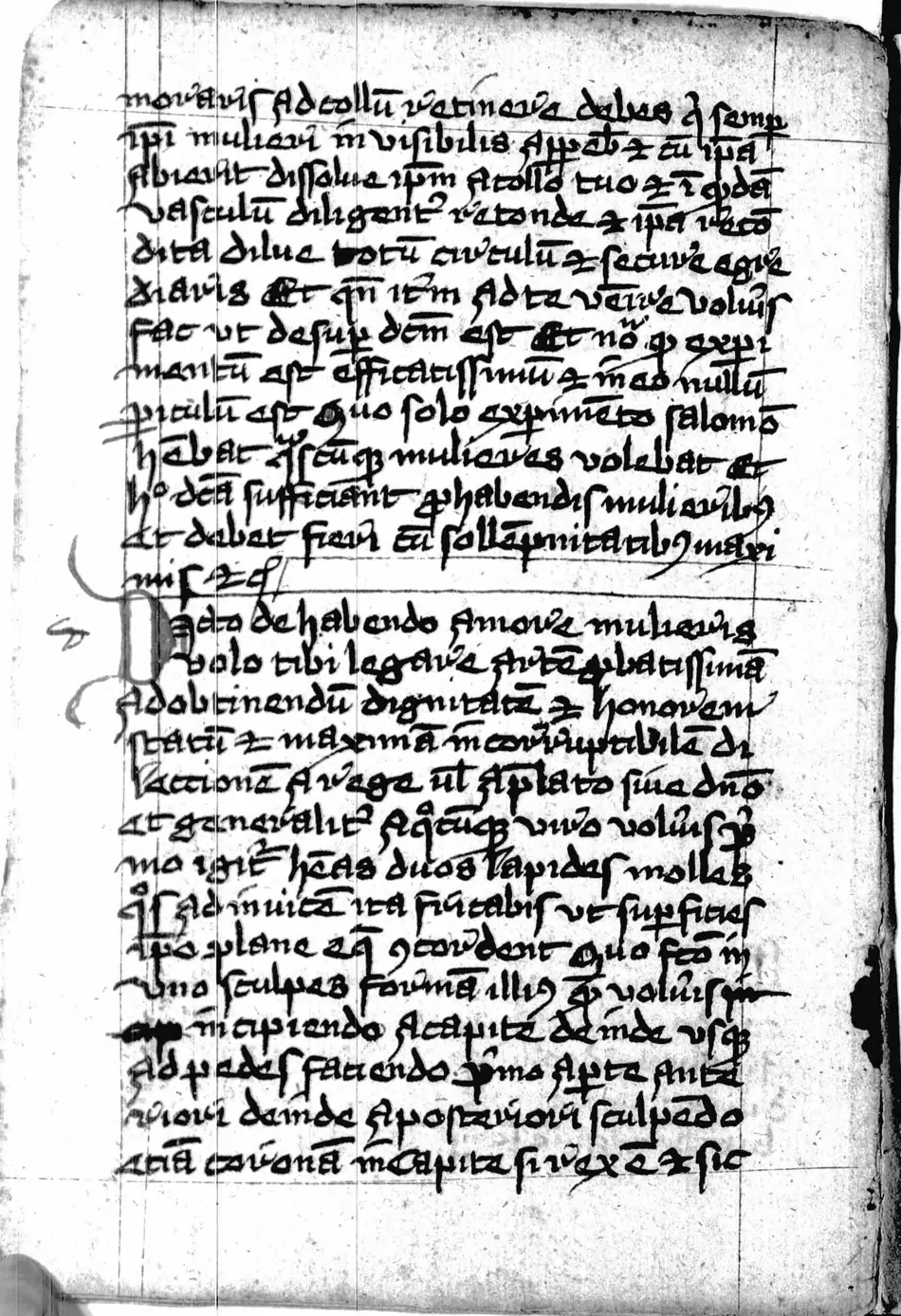
TranscriptionLatin

moraris[?]. Ad collu[m] retineris[?] dolium[?] q[uod] semp[er] ip[s]i mulieri invisibilis appare[a]t. [Et] tu ip[s]a[m] abiuret[?] dissolue ip[su]m. Ad collo[?] tuo[?] [et] rq[uo]da[?] vasculu[m] diligent[er] retonde[?] [et] ip[s]a[m] rev[o]co[?] d[i]c[t]a dilue. Vot[um][?] [?]tulu[m] [et] sequ[er]e[?] agr[?] maris[?]. Et q[?] ite[m] Ad te ver[t]ere volu[er]is fac ut desup[er] d[i]c[tu]m est. Et n[o]n q[uod] ex[peri]- mentu[m] est efficacissimu[m] [et] m[?] nullu[m] p[er]iculu[m] est. quo solo experi[men]to Salomo[n] h[ab]ebat q[uas]cu[m]q[ue] mulieres volebat et ho[c] d[i]c[t]a[?] sufficiant. q[uod] habendis mulierib[us] et debet fieri. Et solle[m]nitatib[us][?] i[?] mari- nis[?] [et] c[?] ---(línea de separación)--- [I]ncipit[?] de habendo Amore mulieris[?] volo tibi legar[e][?] Ante q[uod] [pro]batissima[?] Ad obtinendu[m] dignitate[m] [et] honorem [s]tatu[m][?] [et] maxima[m] in cur[ia][?] [?]tabile[m] d[e] [?]cione[?] A rege ut A p[re]lato suo[?] d[omi]no et generalit[er] A q[uo]cu[m]q[ue] viro volu[er]is p[ri]- mo igit[ur] h[ab]eas duos lapides molles q[uos] ad invice[m] ita [ap]tabis[?] ut sup[er]ficies ip[s]o[rum] plane[?] [con]cordent quo f[a]c[t]o in uno sculpes forma[m] illi[us] q[uam][?] volu[er]is [?] [?] incipiendo A capite deinde us[que] Ad pedes faciendo [pri]mo Apte[?] Ante[?] [?]iori deinde A posteriori sculpe[n]do [?]a[?] cauon[?] in capite si[?] vex[?] [et] sic

TranslationEnglish

...[you delay?]. On the neck you keep[?] a vessel[?], so that it may always appear invisible to the woman herself. And you [conjure?] her; dissolve it. On your neck[?] and [...] carefully [scrape/polish?] the little vessel, and I call her back[?]; the words said, dilute her. The vow[?] [...] and follow[?] [...] of the sea[?]. And [...] if you should again wish to turn her to you, do as has been said above. And [note] that this experi- ment is most effective, and there is no danger whatsoever; by this experiment alone Solomon had whatever women he wished; and let what has been said[?] about the having of women suffice, and so it must be done — and with the [...] marine[?] solemnities[?] and [...] ---(separating line)--- [Here] begins[?] "On obtaining the love of a woman"[?]: I wish to relate to you[?] [something] most tried and proven[?]: to obtain dignity and honor of estate[?], and very great [grace] in court[?] [...] [...] from a king, as from a prelate, from one's lord, and generally from whatever man you wish. First, then, have two soft stones, which you will fit one to the other so that their surfaces meet[?] evenly; and this done, on one you shall carve the form of him[?] whom you wish [...], beginning at the head, then down to the feet, making first the front[?] part, and afterwards the back[?], carving[?] [...] on the head [...] and so

fol. 12r#12r
Munich Manual (Clm 849) — facsimile page (fol. 12r) · public-domain facsimile
BSB Clm 849 (MDZ bsb00037155)
🔍 click to enlarge

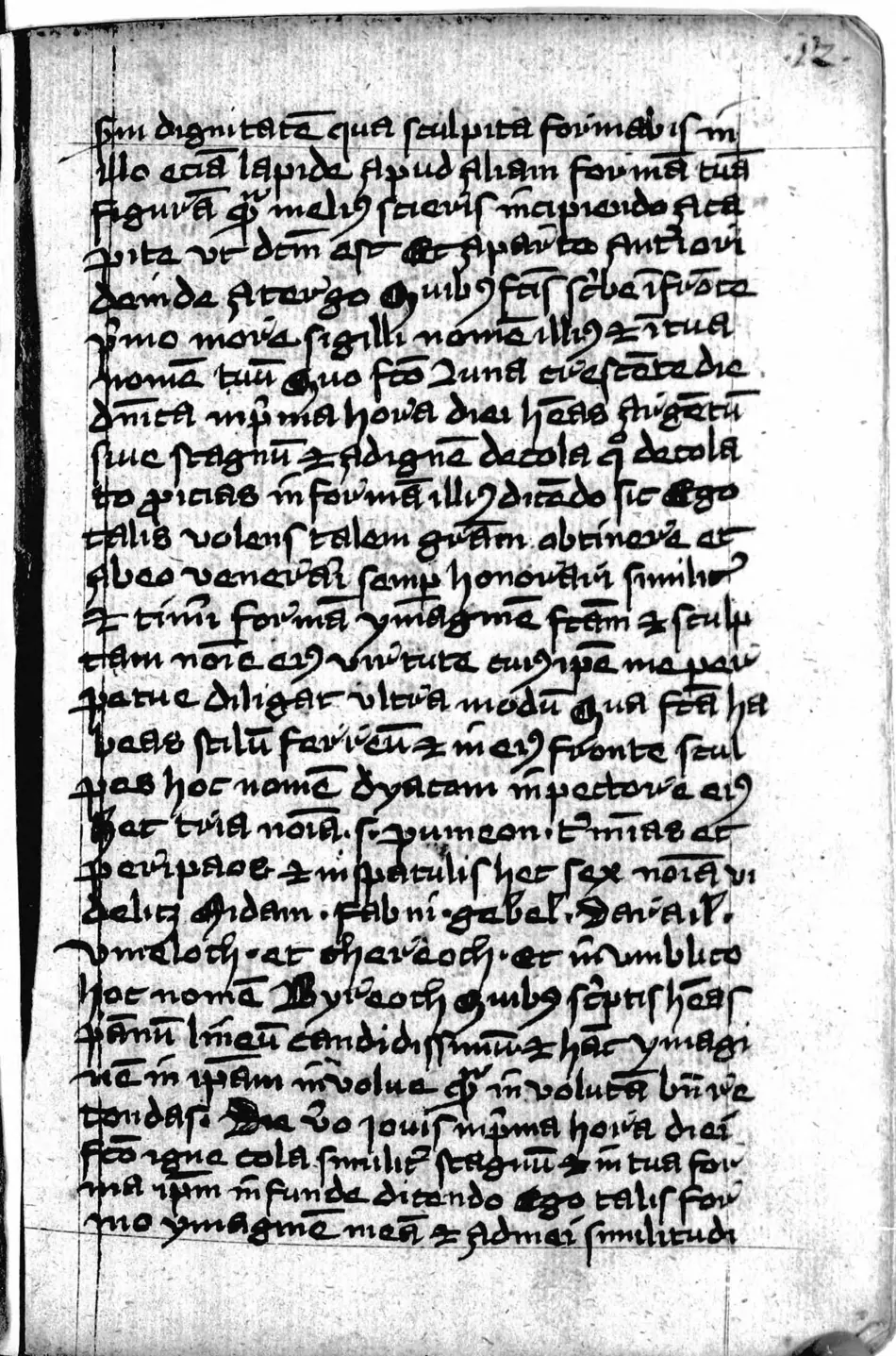
TranscriptionLatin

[?]m dignitate[m] q[uam] sculpsit[?] formab[is] in illo alio lapide Apud alia[m] forma[m] tua[m] figura[m] q[uam] meli[us] scieris incipiendo A ca- pite ut d[i]c[tu]m est [et] A p[ar]te Antiqui[?] deinde A tergo q[ui]b[us] fac[t]is sc[ri]be[?] i[?]p[?] [pri]mo more sigilli nome[n] illi[us] [et] i[?] tua[?] nome[n] tuu[m]. quo f[a]c[t]o Luna crescente die d[omi]nica mi[?]ma hora diei h[ab]eas s[?]ge[?]tu[?] siue stagnu[m] [et] Ad igne[m] de[?]la q[uod] de[?]la- to [?]icias in forma[m] illi[us] dice[n]do sic Ego talis volens talem g[ra]tiam obtinere[?] et Ab eo venerari sic[ut] honorari[?] similit[er] [et] timeri forma ymagine[?] f[a]c[t]am [et] sculp- tam nomine ei[us] virtute cui[us] ip[s]e me [?] [?]atur[?] [et] diligat ultra modu[m] qua f[a]c[t]a ha- beas stilu[m] fer[r]eu[m] [et] in ei[us] fronte scul- pas hoc nome[n] Dyatam in pectore ei[us] [?] tria no[m]i[n]a s[cilicet] Sumeon. Turmias et Peripade[s] [et] in scapulis hec sex no[m]i[n]a vi[delicet] delir[?] Andam. Fabni[?]. Gabal. Danias v[?] [?a]meloth. et Chereoth. et in umbil[i]co hoc nome[n] Byrreoth q[ui]b[us] scriptis h[ab]eas p[ann]u[m] lineu[m] candidissimu[m] [et] hac ymagi- ne[m] in ip[s]am involuas q[uod] involuta bene [?] torqueas[?] Die vero Iouis mi[?]ma hora diei [?]torque[?] c[o]la[?] simili[ter] stagniu[m] [et] in tua for- ma ip[s]am infunde dice[n]do Ego talis for- mo ymagine[m] mea[m] [et] Ad mei similitudi-

TranslationEnglish

...the dignity you carved[?], you shall form it in that other stone: beside the other, your own form and figure, as best you know, beginning at the head as has been said, and at the front part[?], then at the back; and these done, write[?] [...] first, seal-fashion, the name of him, and [...] your[?] your own name. This done, in the waxing moon, on Sunday, at the first[?] hour of the day, have a [...] or a pool [of water], and at the fire [heat it]; the [heated water?] you pour[?] over his form, saying thus: "I so-and-so, wishing to obtain such grace and to be venerated by him, as also honored, likewise and feared, [invoke] the form [and] image made and carved in his name, by whose power he himself may [...] me, [love me?] and cherish me beyond measure." This done, have an iron stylus, and on its forehead carve this name Dyatam; on its breast [write?] three names, namely: Sumeon, Turmias and Peripades; and on the shoulder-blades these six names, namely: [...] Andam, Fabni[?], Gabal, Danias, [...] [Sa]meloth and Chereoth; and on the navel this name Byrreoth. These written, have a most white linen cloth, and wrap this image in it, so that, wrapped, you twist[?] it well. And on the day of Jupiter (Thursday), at the first[?] hour of the day, [...] likewise [heat] a pool, and into your form pour it, saying: "I so-and-so form my image and to my likeness..."

fol. 12v#12v
Munich Manual (Clm 849) — facsimile page (fol. 12v) · public-domain facsimile
BSB Clm 849 (MDZ bsb00037155)
🔍 click to enlarge

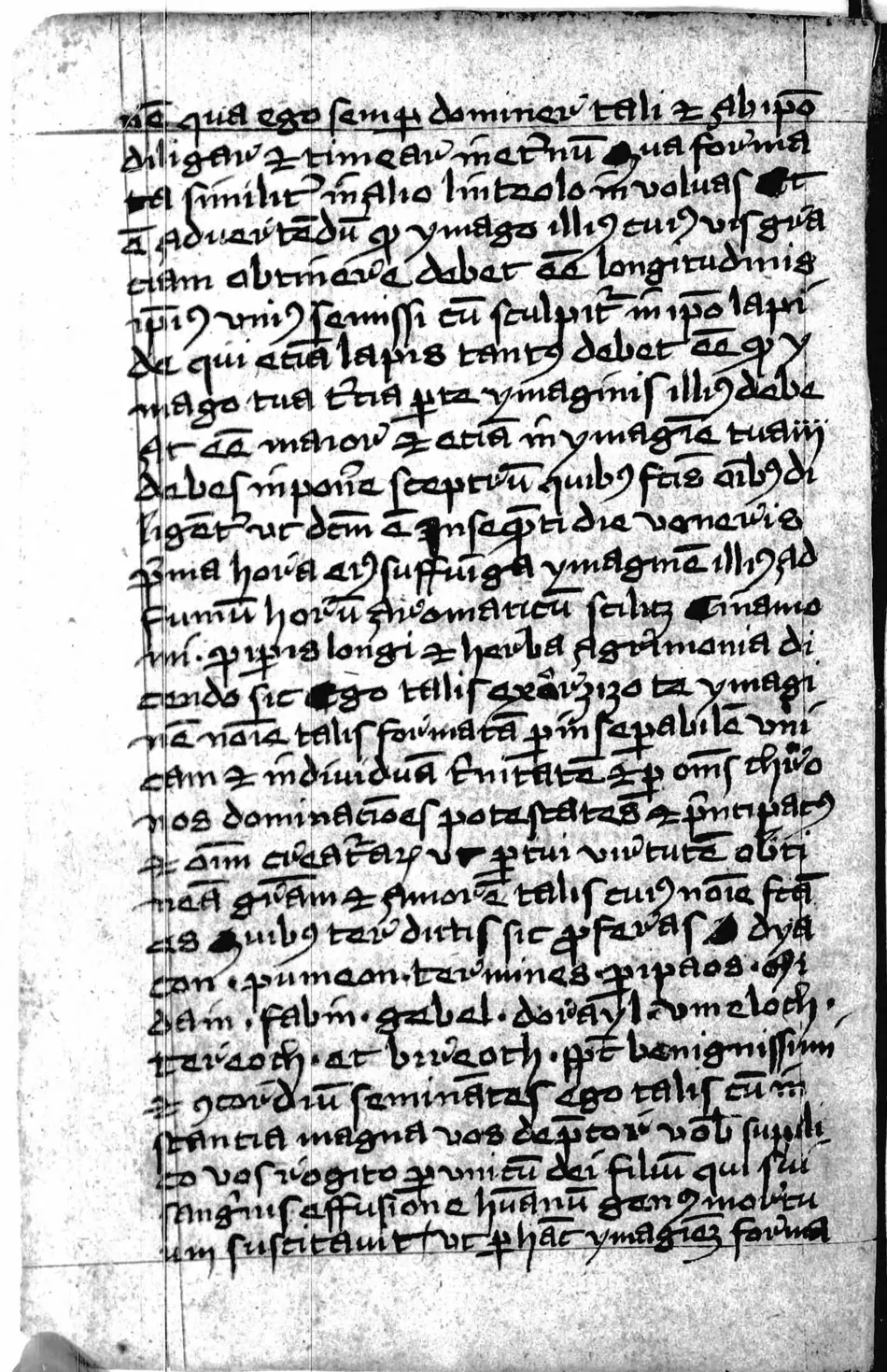
TranscriptionLatin

ne[m] qua[m] ego semp[er] dominer[?] tali [et] Ab ip[s]o diligar [et] timear [et] metua[m][?] q[uod] qua[m] forma[m] [?] similit[er] in alio lintheolo[?] involuas Et [est] Aduertendu[m] q[uod] ymago illi[us] cui[us] gr[ati]am obtinere[?] debet e[ss]e longitudinis [?]ni[us] [et] semissi cu[m] sculpsit[?] in ip[s]o lapi- de qui etia[m] lapis tant[us] debet e[ss]e q[uod] y- mago tua tria p[ar]te[m][?] ymaginis illi[us] debe- at e[ss]e maior[?] [et] etia[m] in ymagine tua i[?] debes in ponere sceptru[m] q[ui]b[us] factis Ali[?] di- ligat[ur] ut d[i]c[tu]m [et] in sequenti die veneris p[ri]ma hora ei[us] suffumiga ymagine[m] illi[us] Ad fumu[m] hor[um] aromaticu[m] scilicet cinamo- mi. piperis longi [et] herba Agrimonia di- cendo sic Ego talis exorizo te ymagi- ne[m] nomine talis formata[m] p[er] i[n]separabile[m] uni- cam [et] individua[m] trinitate[m] [et] p[er] om[ne]s th[ro]- nos dominac[i]o[n]es potestates [et] p[ri]ncipa[tus] [et] om[n]iu[m] cr[e]atura[rum] [?] p[er] tui virtute[m] obti- nea[m] g[ra]tia[m] [et] amore[m] talis cui[us] no[m]i[n]e f[a]c[t]a es quib[us] ter[minatis] dicti[s][?] sic q[uod] fa[?]as. Dya- con. Sumeon. termines[?]. Peripades. [An]- dam. Fabin. Gabal. Doray[?] [et] Sameloth. Chereoth. et Birreoth. p[er] benignissim[um] [et] gaudiu[m][?] semin[a]tas[?] Ego talis cu[m] in- stantia magna vos dep[re]cor v[el] vob[is] suppli- co vos rogito p[er] u[ni]cu[m] dei filiu[m] qui sui[?] [sa]nguinis affusione hu[m]anu[m] gen[us] i[n] mortu[?] um suscitatur[?] ut p[er] hac ymaginem[?] forma[m]

TranslationEnglish

...[the image] by which I may always rule[?] so-and-so, and by him be loved and feared and [held in awe?]." Which form [...] you shall likewise wrap in another linen cloth[?]. And it must be noted that the image of him whose grace is to be obtained[?] must be of the length of [a palm?] and a half, with which you carved[?] it in the same stone; which stone also must be so [large] that your image must be larger by a third part than the image of him; and also on your image [...] you must place a scepter. These things done [and] bound[?] as was said, on the following day of Venus (Friday), at its first hour, fumigate that image with the smoke of these aromatics, namely: cinnamon, long pepper and the herb agrimony, say- ing thus: "I so-and-so exorcize you, ima- ge formed in the name of so-and-so, by the inseparable, sole and undivided Trinity, and by all the thro- nes, dominations, powers and principalities and of all creatures[?], by your power, may I obtain the grace and love of so-and-so in whose name you were made." These ended, said[?] thus, [...]. Dya- con, Sumeon, termines[?], Peripades, [An]- dam, Fabin, Gabal, Doray[?] and Sameloth, Chereoth and Birreoth: by the most benign and [joyful?] [...], I so-and-so with great insistence beseech you and suppli- cate you, I entreat you by the only Son of God, who by the shedding of his[?] blood raised[?] the human race from the dead[?], that by this image [and] form...

fol. 13r#13r
Munich Manual (Clm 849) — facsimile page (fol. 13r) · public-domain facsimile
BSB Clm 849 (MDZ bsb00037155)
🔍 click to enlarge

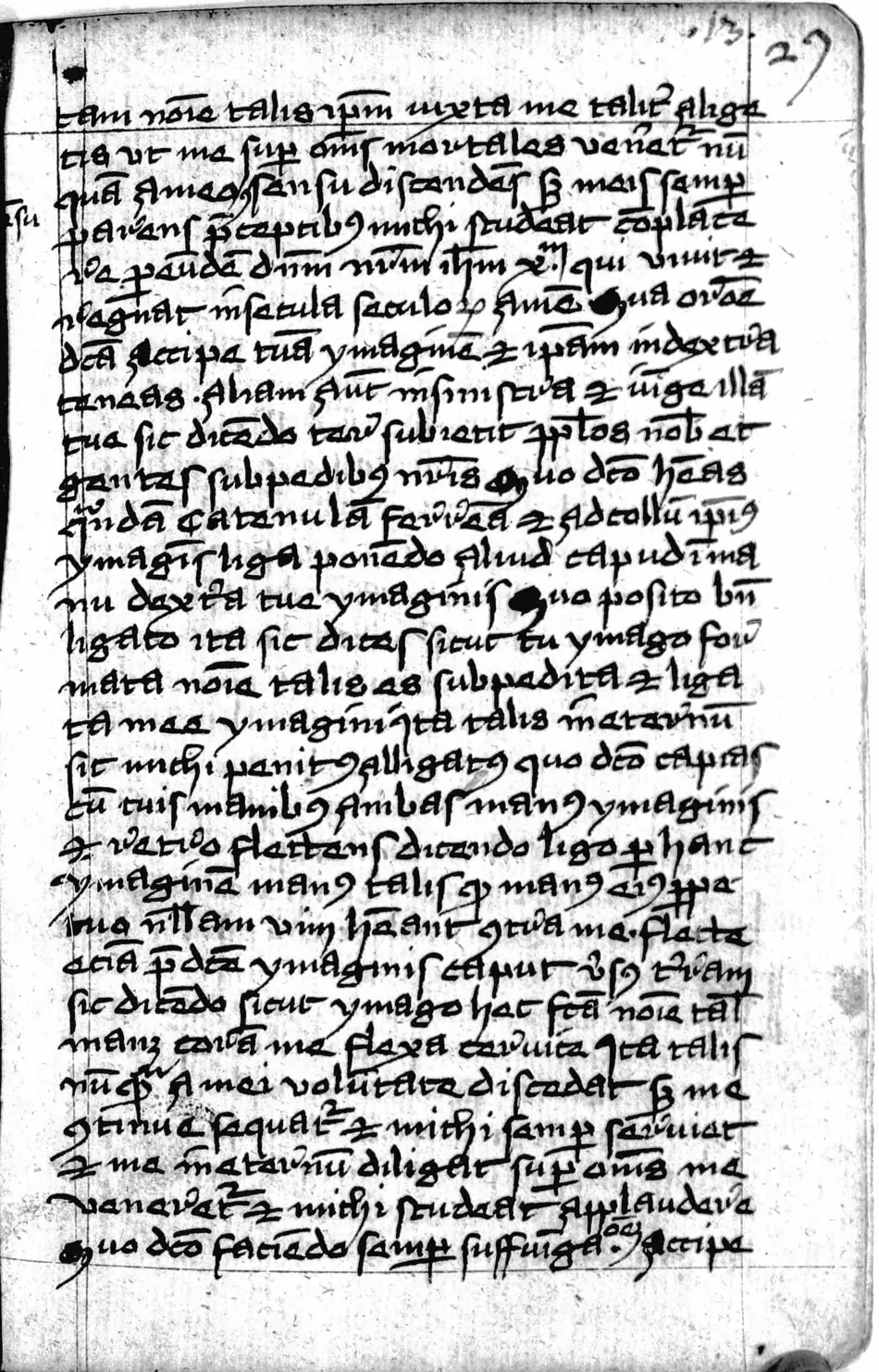
TranscriptionLatin

tam nomine talis eorum iuxta me talis allig[a]- tis ut me super om[ne]s mortales venere[n]t[?] nu[m]- quam a me[o] sensu discedat, s[ed] meis semp[er] parens p[re]ceptib[us] michi studeat co[m]place- re [?] pauca[?] d[omi]n[u]m n[ost]r[u]m Ih[esu]m [Christum?] qui vivit et regnat in secula seculo[rum]. Amen. Qua or[ati]o[n]e d[i]c[t]a accipias tuam ymagine[m] et ip[s]am in dextra teneas. Aliam aut[em] in sinistra et [uirga[m]?] illa[m] tua[m] sic dicendo tange: «subicia[n]t[?] [protos?] nob[iles?] et[?] gigantes sub pedib[us] n[ost]ris», quo dicto habeas [in] una catenula ferrea et ad collu[m] ip[s]ius ymagi[ni]s liga ponendo. Aliud caput in ma- nu dext[r]a tue ymaginis, quo posito b[e]n[e] ligato ita sic dicas: «sicut tu ymago for- mata nomine talis es subpedita et liga- ta mee ymagini, ita talis in ea illegible nu[m?]- [sit?] michi [panit[us]?] alligat[us]», quo dicto capias tu tuis manib[us] ambas manus ymaginis et [uerte[n]s?] flectens dicendo: «ligo + hanc ymagine[m] manus talis, q[uod] manus ei[us] ip[s]a[?] [uro?] nullam vim habeant contra me». Flecte etia[m] p[r]ima[m] ymaginis caput usq[ue] [terram?] sic dicendo: «sicut ymago habet [flexa[m]?] nomine tal[is] manu[m][?] [certa[m]?] mea[?] flexa cervice, ita talis nu[m]q[uam] a mei[?] volu[n]tate discedat, s[ed] me [con]tinue sequatur et michi semp[er] serviat et me in eternu[m] diligat, super om[ne]s me venere[n]t[ur][?] et michi studeat applaudere», quo dicto faciendo semp[er] suffragia. Accipe

TranslationEnglish

...thus, in the name of so-and-so, bind their [hands?] beside me, so that he/she may venerate me[?] above all mortals, [and] never depart from my mind[?], but, obeying my precepts, strive to please me... [few/short?] ... through our Lord Jesus [Christ?], who lives and reigns for ever and ever. Amen. Once this prayer is said, take your image and hold it in the right [hand]. The other, however, in the left, and that [rod?] of yours, say while touching thus: «let them subject[?] the [first?] nobles[?] and[?] giants beneath our feet»; this said, have [on] an iron chain and tie it, placing it around the neck of that image. The other end, in the right hand of your image; this set and well tied, say thus: «as you, image formed in the name of so-and-so, are subjected and bound to my image, so let so-and-so in it [illegible]... [wholly?] bound to me». This said, take with your hands both hands of the image and, [turning?] bending them, say: «I bind + this image of the hands of so-and-so, so that his hands [illegible] have no power against me». Bend also the head of the first image down to [the earth?], saying thus: «as the image has [bent?] in the name of so-and-so my hand[?] [firm?] with the neck bent, so let so-and-so never depart from my[?] will, but follow me continually and always serve me and love me for eternity, venerate[?] me above all and strive to applaud me»; in doing which, [you will have] favours[?] always. Take

fol. 13v#13v
Munich Manual (Clm 849) — facsimile page (fol. 13v) · public-domain facsimile
BSB Clm 849 (MDZ bsb00037155)
🔍 click to enlarge

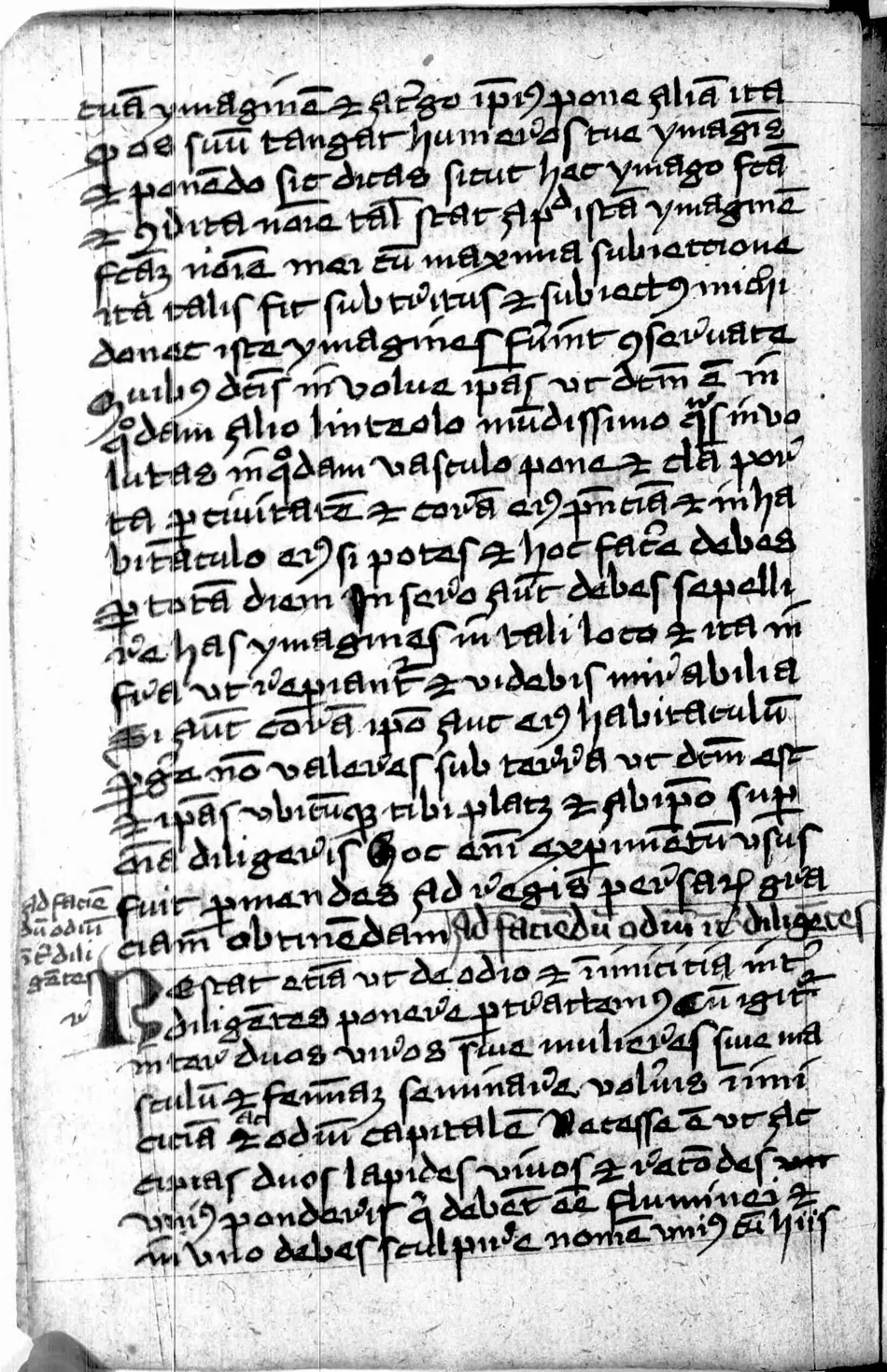
TranscriptionLatin

tua[m] ymagine[m] et ergo ip[s]i[us] pone alia[m] ita q[uod] de suo tangat humero[?] stue[?] ymagi[n]e[m] et ponendo sic dicas: «sicut hec ymago fc[t]a[?] et ligata nomine tal[is] stat apud ista[m] ymagine[m] f[a]ct[am] nomine mea[?] cu[m] maxima subiectione, ita talis fit sub[?][uictus?] et subiect[us] michi» donec ista ymagines fuerint conservate. Quib[us] d[i]c[t]is in[?]volua ip[s]as ut d[i]c[tu]m est, et in quodam alio linteolo mu[n]dissimo, et involutas in quodam vasculo pone, et illud pon- [t]a[?] p[er?] [ci]uitate[m][?] et corda[?] ei[us] p[rese]ntia[?] et in ha- bitaculo ei[us] si potes; et hoc fact[um] debes [servare?] tota[m] die[m]. In s[er]o aut[em] debes sepelli- re has ymagines in tali loco, et ita in- [?]ue ut remaneant, et videbis mirabilia. Si aut[em] corda[?] ip[s]o[?] aut ei[us] habitaculu[m] [hga?] no[n] valeas sub tarra[?], ut d[i]c[tu]m est, [ip]sas ubicu[m]q[ue] tibi placet, et ab ip[s]o super- ne diligeris. Hoc aut[em] experimentu[m] usus fuit p[ro] mandato ad regis[?] perse[?] gra- cia[m] obtinenda[m]. crossed rubric, marginal hand: Ad facie[n]du[m] odiu[m] v[e]l diligeres[?] Restat etia[m] ut de odio et inimicicia[?] [sive?] diligeres[?] pone[?] p[er] arte[m] q[ua]ndam. Igit[ur][?] [recipe?] duos [uiuos?] tue mulieres[?] sive ma- sculu[m] et [femina[m]?] s[e]c[un]d[u]m volu[n]tate[m] inimi- cicia[?] et odiu[m] capitale[?] [uacassa?] et ut ac- cipias duos lapides vivos et [uacatos?] uir- gineos ponderis[?], q[ui] debet e[ss]e fluminei, et in uno debes sculpere nome[n] uni[us] et huius[?]

TranslationEnglish

...your image, and therefore set the other, his/hers, so that with what is its own it may touch[?] the shoulder[?] of your[?] image; and, setting it, say thus: «as this image, made[?] and bound in the name of so-and-so, stands beside this image made in my[?] name with utmost subjection, so let so-and-so be subdued[?] and subject to me» — until these images have been kept. This said, wrap them as said, and in another very clean cloth, and once wrapped set them in a small vessel, and place it... through[?] the city[?] and with[?] his presence[?], and in his dwelling if you can; and this done you must [keep it?] the whole day. At evening, however, you must bury these images in such a place, and so [disposed?] that they remain, and you will see wonders. But if his dwelling[?] or [where he is?] you cannot [have?] underground, as said, [set them?] wherever you please, and by him/her you will be loved from on high[?]. This experiment was used by command to obtain the favour of a Persian[?] king[?]. [Marginal rubric:] To cause hatred or [love?]. It remains also [to treat] of hatred and enmity[?] or[?] love[?], to work it by a certain art. Therefore[?], [take?] two [living?]... your[?] woman/women?, whether male or [female?], according to the will of enmity[?] and mortal hatred[?] [illegible]; and take two living[?] stones, [hollow?/smooth?] and virgin, of [a certain] weight, which must be river-stones, and on one you must carve the name of one, and of this[?]...

fol. 14r#14r
Munich Manual (Clm 849) — facsimile page (fol. 14r) · public-domain facsimile
BSB Clm 849 (MDZ bsb00037155)
🔍 click to enlarge

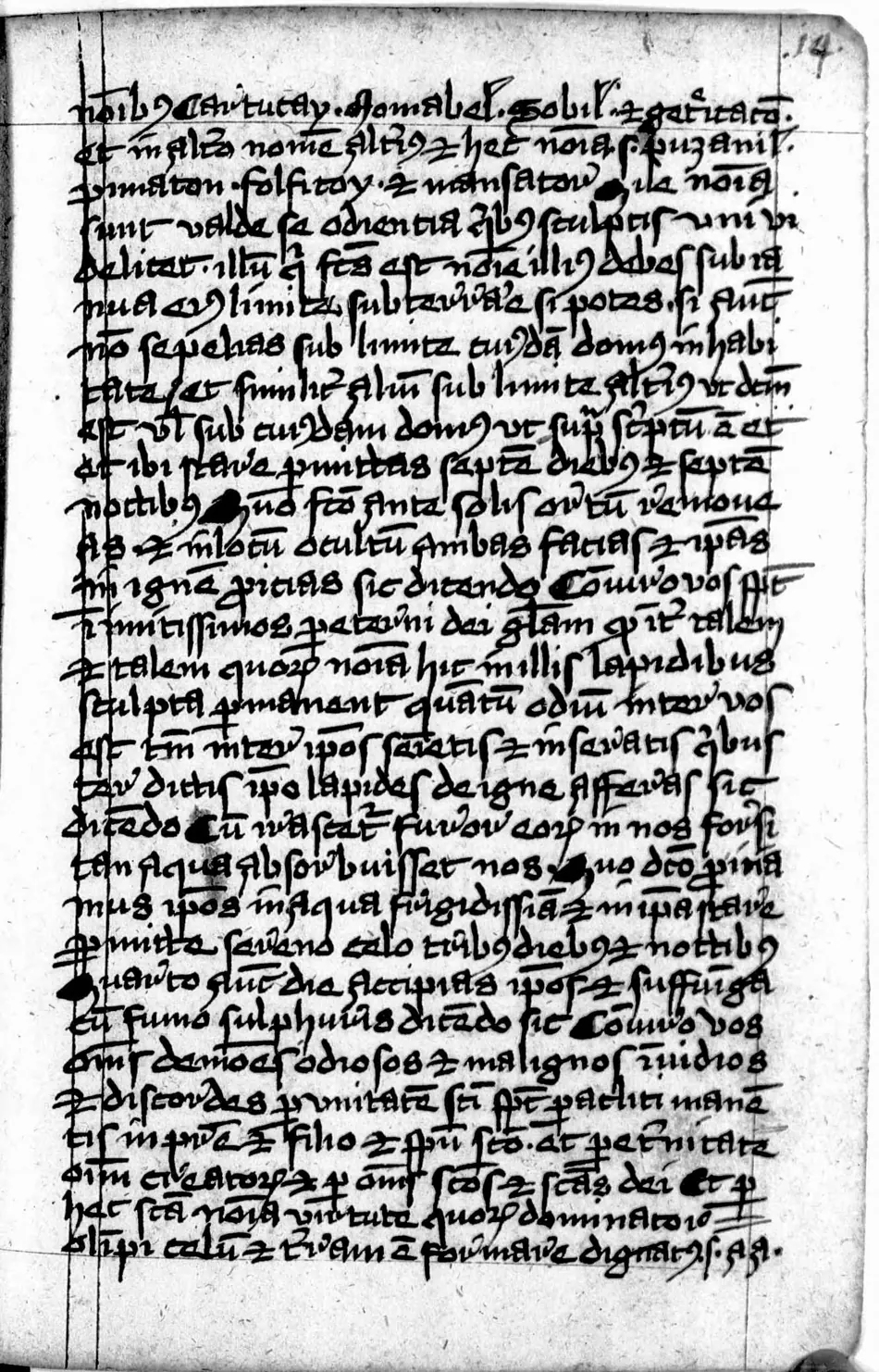
TranscriptionLatin

nominib[us] et virtutu[m][?]. [Homabel?]. Sobib[?] et [garicaro?]. et in alto nomine altius[?] et hec nomi[n]a s[unt]: Luzani[s][?] [ymaton?] solfiroy[?] et [mansatoy?]. Ista nomi[n]a sunt valde [obedientia?] quib[us] sculptis uni vi- delit[er][?] illu[m] qui sculpt[us] est nomi[n]e illi[us] debes sub ta[?]- [nuar?] ei[us] limita[?] subterra[n]d[e][?] si potes. Si aut[em] no[n] [sequebras?] sub limita[?] cuiusda[m] domus inhabi- tata, et similit[er] aliu[m] sub limita[?] alteri[us], ut d[i]c[tu]m est, vel sub ea[n]dem domu[m], ut sup[ra] scriptu[m] e[st]. Et et ibi relinq[ue] p[er] mult[as][?] septe[m] dieb[us] et septe[m] noctib[us]. Quo facto ante solis ortu[m] remove- as, et in loco oculto ambas facias, et ip[s]as in igne [piritas?/proicias?] sic dicendo: «Coniuro vos [fit?] inimicissimos [patroni?] dei glo[ri]am, q[uod] ut talem[?] et talem, quor[um] nomi[n]a hic [in] illis[?] lapidib[us] sculpta [per]manent[?], quantu[m] odiu[m] inter vos sit, tam inter ip[s]os [saeuatis?] et [inseuatis?], quib[us] [tar?] d[i]c[t]is ip[s]os lapides de igne [afferas?]» sic dicendo: «cu[m] [uultis?][?]scat furor[?] eor[um] in nos, forsi- tan aqua absorbuisset nos». Quo d[i]c[t]o proicia- mus ip[s]os in aqua frigidissi[m]a, et in ip[s]a relin- que[?] seveno[?] calo[re?] trib[us] dieb[us] et noctib[us]. Quinto aut[em] die accipias ip[s]os et suffumiga cu[m] fumo sulphuris dicendo sic: «Coniuro vos om[ne]s demones odiosos et malignos [inuidos?] et discordas[?] p[er] unitatem s[an]c[t]i[?] p[atris] paracliti[?] mane[n]- tis in patre et filio et sp[irit]u s[an]c[t]o, et p[er] unitatem om[n]iu[m] creatoru[m][?], et p[er] om[ne]s s[an]c[t]os et s[an]c[t]as dei, et p[er] hec sancta nomi[n]a, virtute quor[um] dominat[i]o[?] [slipi?] celu[m] et terra[m] et formare dignat[us] e[st]. A[men].

TranslationEnglish

...with the names and of the virtues[?]: [Homabel?], Sobib[?] and [garicaro?]; and on high, the highest name[?]; and these names are: Luzanis[?], [Ymaton?], Solfiroy[?] and [Mansatoy?]. These names are very [obedient?]. Once these are carved, one of them[?] — namely[?], the one carved with that person's name — you must [bury?] under his threshold[?], sinking it underground[?] if you can. But if you cannot[?], [set it] under the threshold[?] of some inhabited house, and likewise the other under the threshold[?] of another, as said, or under the same house, as written above. And leave them there for[?] seven days and seven nights. This done, before sunrise remove them, and in a hidden place [take out?] both, and [cast?] them into fire, saying thus: «I conjure you, be[?] utmost enemies... [by?] the glory of God, [patron?], that as such and such, whose names remain here carved [on] those stones[?], however much hatred there be between you, so much between them [illegible] and [illegible]»; this said, [draw?] those stones from the fire, saying thus: «when[?]... their fury[?] may blaze[?] against us, perhaps[?] the water would have swallowed us». This said, let us cast them into iciest water, and leave them[?] in it [seven?/lukewarm?]... for three days and nights. On the fifth day, however, take them and fumigate them with sulphur smoke, saying thus: «I conjure you, all hateful and malignant [envious?] demons and discords[?], by the unity of the holy[?] Father Paraclete[?] abiding in the Father and the Son and the Holy Spirit, and by the unity of all creatures[?], and by all the saints, male and female, of God, and by these holy names, by whose virtue [he deigned?] ...to [create?] heaven and earth and to form [them]. Amen.

fol. 14v#14v
Munich Manual (Clm 849) — facsimile page (fol. 14v) · public-domain facsimile
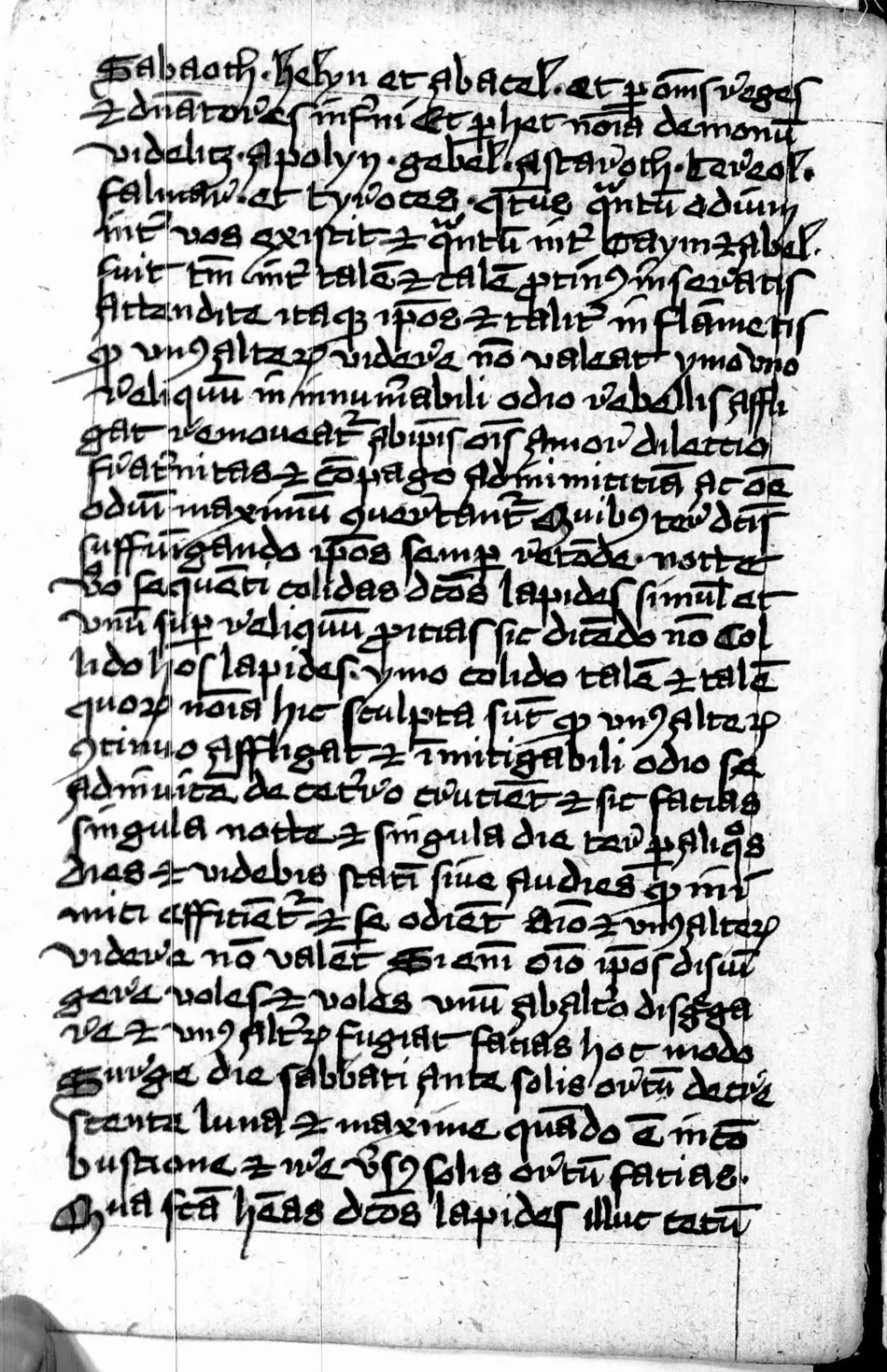
BSB Clm 849 (MDZ bsb00037155)
🔍 click to enlarge

TranscriptionLatin

Sabaoth . Hely[n?] et Abaeal[?] . et p[er] om[ne]s reges [et] demones inferni . et p[er] hec no[m]i[n]a demonu[m] videlic[et] . Apolyn . gabel[?] . Astaroth . [Zaveol?] . [Salinaon?] . et [Tyroces?] . [con]iuro [con]iurat[i]o[n]e adiur[?] [inte?] vos exurgit[?] [et] [con]iur[o] mi[hi?] [Baym?] zabel[?] . fuit t[ame]n [con]t[ra] talem [et] talem p[er]ting[ens?] i[n] serva[n?]t[?] Attendite ita[que] ipsos [et] talit[er] i[n] flame[?]tis[?] q[uod] un[us] alt[eru]m videre no[n] valeat ymo un[us?] [et?] aliqui[?] i[n] i[n]nu[mer]abili odio [et] bello[?] affli[?] affli- gat[?] [et] amoveat abipsis om[n]is amor[?] dilat[i]o[?] illegible Admittas[?] [et] [con]iurago[?] Ad[m]i[?]micia[?] Ac de[?] oditu[?] maximu[?] [q?]uertent[?] quib[us] taw[?]d[?] suffurgendo[?] ipsos [sam?]p[?] illegible . nott[e?] illegible [saquati?] calidas de[?]os lapides simul et un[um?] su[per] [v?]aliqui[?] p[ro?]ttat[?] sic dictando no[n] col- lido h[?]os lapides . ymo colido tale[m] [et] tale[m] quo[rum] no[m]i[n]a hic sculpta su[nt] q[uod] un[us] alt[er?] [con]tinuo affligat[?] [et] i[n]mitigabili odio s[?] Ad[m]uita[?] de catuo[?] [con?]uciet[?] [et] sic facias si[n]gula nott[e?] [et] si[n]gula die taw[?] p[er?] aliq[u]os[?] dies[?] [et] videbis stati[m] siue Audies q[uod] mi[?] mici[?] afficiet[?] [et] se odiet[?] alio[?] [et] un[us] alt[er?] videre no[n] valet[?] illegible om[?] ipsos disiu[n?] gere volas[?] [et] volas[?] un[us] ab alt[er]o dissga[?] vt [et] un[us] alt[er] fugiat facias hoc modo[?] [con]iurga[?] die sabbati Ante solis ortu[m] de[?] [s?]crescente luna[?] [et] maxime qua[n]do [et] i[n?] [com?] bustione[?] [et] u[?] u[?][?] solis ortu[m] facias . Qu[?]a s[?]a h[abe]as duos lapides illu[?] tatu[?]

TranslationEnglish

Sabaoth, Hely[n], and Abaeal[?], and by all the kings and demons of hell, and by these names of demons, namely: Apolyn, gabel[?], Astaroth, [Zaveol?], [Salinaon?] and [Tyroces?] — I conjure you with a conjuration [and] I adjure[?]... that you rise[?] and I conjure for me[?] [Baym?]zabel[?]... yet it was against such a one and such a one... Attend, then, to them and in such a way in [illegible], that one may not see the other, but rather [that] someone[?] with numberless hatred and war[?] may afflict[?] him and remove from them all love... Admit[?] and I conjure[?]... the greatest hatred[?]... with which... [placing?] the hot[?] [stones?], two stones together, one upon another[?] [set them], saying thus: "I do not strike[?] these stones, but rather I strike such a one and such a one, whose names are here carved, that one may continually afflict[?] the other with unmitigable hatred..." And so you shall do it every night[?] and every day... for some[?] days, and you will see at once or hear that they are made enemies[?] and hate one another[?] and one cannot[?] see the other... [if] you wish[?] to separate them so that one flees the other, do it thus: conjure[?] on the sabbath day, before sunrise, in the waning moon[?], and especially when... in the [burning?]... [and do it] toward[?] sunrise. [When?]... you have two stones... [illegible].

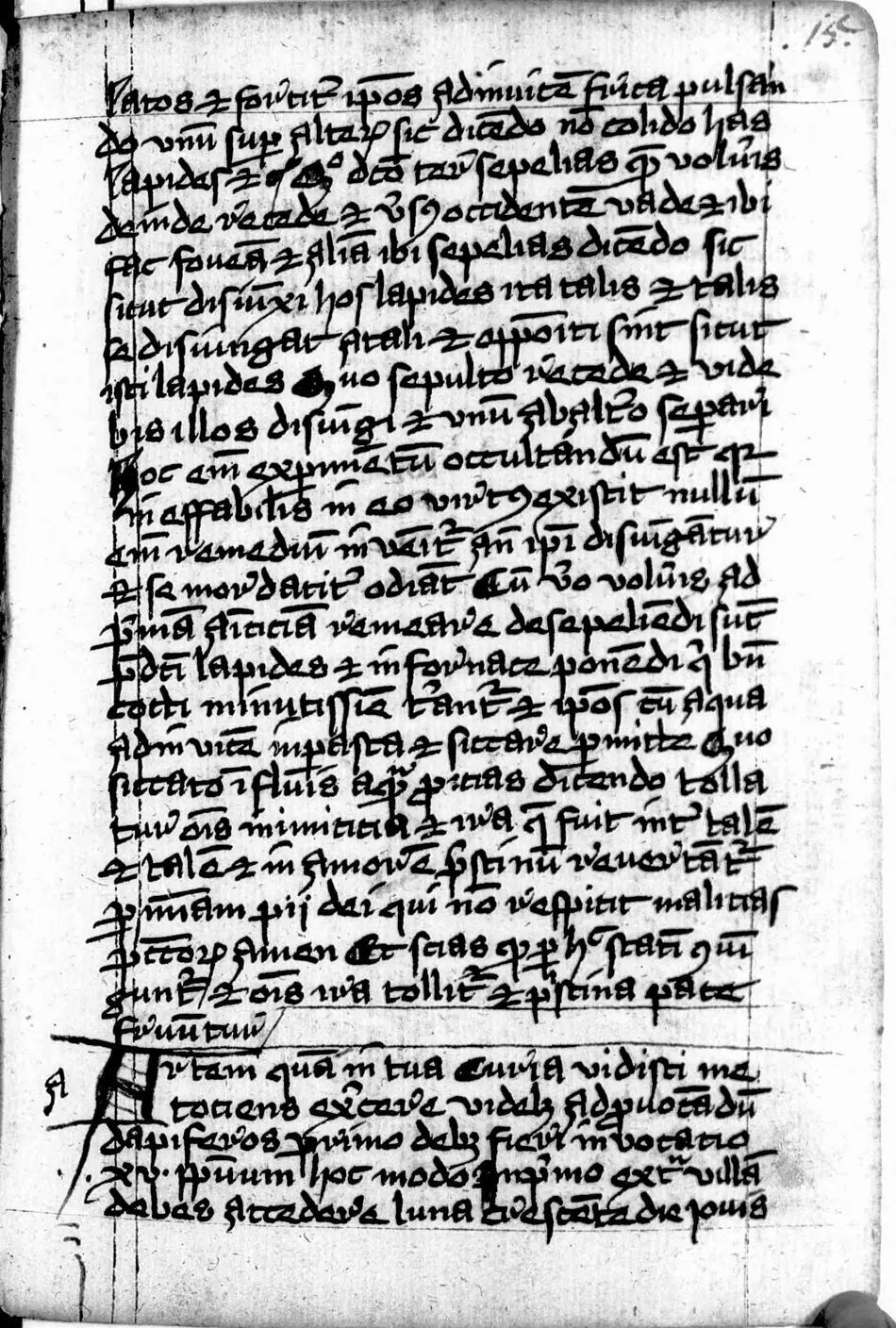
fol. 15r#15r
Munich Manual (Clm 849) — facsimile page (fol. 15r) · public-domain facsimile
BSB Clm 849 (MDZ bsb00037155)
🔍 click to enlarge

TranscriptionLatin

[v?]aros[?] [et] sortit[?] ipsos Ad[m]uica[?] [con?]nica[?] pulsan- do un[um] su[per] Altar[e] sic dicta[n]do no[n] colido has lapides [et] [i]o[?] q[uod] d[i]c[t]os taw[?] sepelias q[uod] volu[er]is de[in]de vacade[?] [et] [ver]s[us] occidente[m] vadeas ibi [et] sic fouea[m] [et] Alia[m] ibi sepelias dicta[n]do sic sicut disiu[n]xi hos lapides ita talis [et] talis [et] disiu[n]ga[n]t[ur] Atali[?] [et] app[ro]xi[m?]i sint sicut isti lapides [Q?]uo sepulto vacade[?] [et] vide- bis illos disiu[n]gi[?] [et] un[us] ab alt[er]o [separari?] hoc au[tem] experime[n]tu[m] occulta[n]du[m] est q[uod?] [con?]affabilis in eo virtus[?] existit nullu[m] cu[m?] remediu[m] i[n]uenit[ur?] an ipsi disiu[n]gat[ur] [et] se mo[r]d[e]at[ur?] odiat[ur?] Cu[m] v[er]o volu[er]is Ad [pri?]ma[m] Amicicia[m] rememat[?] desepeliedi su[nt] [pre]d[i]c[t]i lapides [et] i[n] fornace[m] ponedi q[uod] b[e]n[e] cocti minutissi[m]e[?] [con]ant[?] ipsos cu[m] Aqua Ad[m]uica[?] i[m]pasta[?] [et] siccav[er?]e p[er]mitte q[u]o siccato i[n] fluis[?] asp[er]git[ur?] dicendo talia[?] tuo[?] o[mne]s i[n]imiciti[a] [et] i[?]ra q[uod] fuit [in]t[er] tale[m] [et] tale[m] [et] i[n] Amor[em] [con?]tinu[m] [con?]uertat[ur] vt[?] iam p[er] dei[?] qui no[n] [d?]esp[i]cit malicias[?] [pec]cato[rum] Amen Et scias q[uod] p[er] h[oc?] stati[m] [con]iu[n]- gunt[ur] [et] om[n]is i[?]ra tollit[ur] [et] p[r]istina p[ax] i[nt]er [con?]uu[n?]t[ur?] Artem qua[m] in tua Curia vidisti me totiens exercere videlic[et] Ad p[ro]uoca[n]du[m] Aviferos[?] p[r]imo deb[es] fac[er]e i[n]uocatio- ne[m] [avium?] hoc modo [pr]i[m]o ext[ra] villa[m] debes Attedere[?] luna [cre]sca[n]te die Jouis

TranslationEnglish

...[striking?] them mutually[?], hitting[?] them, striking one upon the altar, saying thus: "I do not strike these stones...", and then bury the said [stones] where you wish; afterward withdraw[?] and go toward the west; there make a pit, and bury there the other [stone], saying thus: "As I separated these stones, so let such a one and such a one [be] separated[?]... and be as [far apart?] as these stones." Once [the stone] is buried, withdraw[?] and you will see that they separate[?] and one [parts?] from the other. But this experiment must be hidden, because[?]... there is [great?] virtue in it; no[?] remedy is found[?] for them [to stop] being separated and to bite[?] one another [and] to hate. But when you wish to bring [them] back to their former friendship, the said stones must be dug up and placed in a furnace, so that, well cooked, they be ground[?] very finely, [kneaded] with water mutually[?], and let them dry; once dry, they are scattered in [running water?], saying such [things?]: "...let all enmity and anger that was between such a one and such a one be turned into continual love, that now, by God[?], who does not despise the wickednesses of sinners, Amen." And know that by this they are at once joined and all anger removed and the former peace between [them restored?]. [Initial "A"] The art which you saw me perform so often in your court, namely to attract[?] birds[?]: first you must make an invocation of [the birds?] in this way; first, outside the town, you must wait[?] in the waxing moon, on Thursday...

Grimorium · grimorium.lat · CC BY 4.0 · Details