The Grand Grimoire · Red Dragon

The great grimoire of the pact — Le Véritable Dragon Rouge (1873 ed.)

French print — 1873 (Gallica, BnF)
Download PDF ↓
The Grand Grimoire · Red Dragon — facsimile page (page 086) · public-domain facsimile
French print — 1873 (Gallica, BnF)
🔍 click to enlarge

TranscriptionFrench (1873)

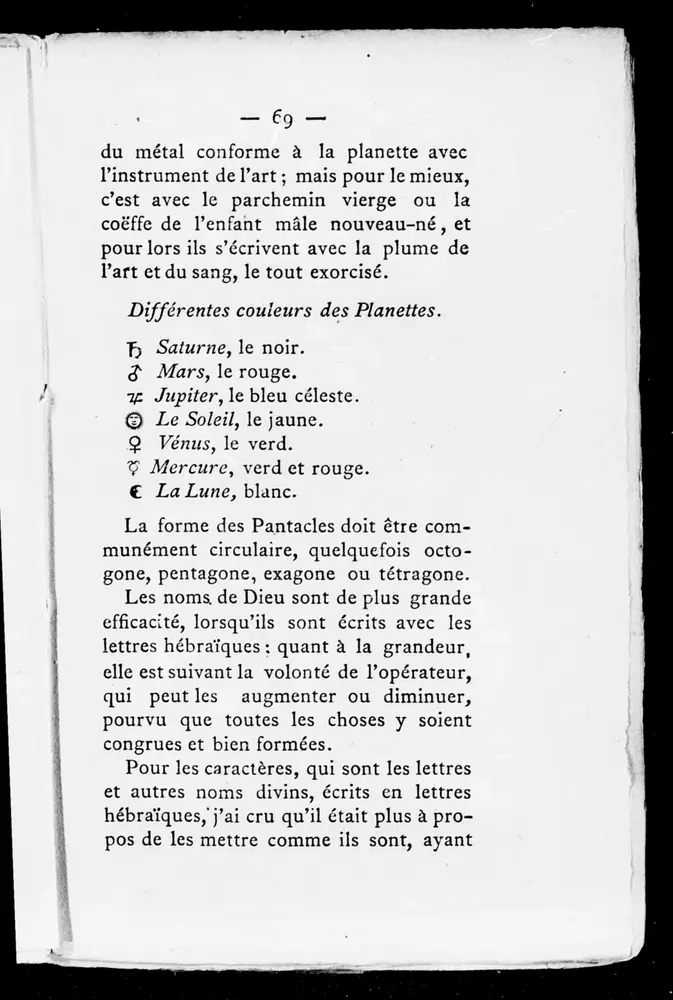
du métal conforme à la planette avec l’instrument de l’art ; mais pour le mieux, c’est avec le parchemin vierge ou la coëffe de l’enfant mâle nouveau-né, et pour lors ils s’écrivent avec la plume de l’art et du sang, le tout exorcisé.

Différentes couleurs des Planettes.

b Saturne, le noir.
J Mars, le rouge.
le bleu céleste.
7E Jupiter, [?]
© Le Soleil, le jaune.
$ Vénus, le verd.
Ç Mercure, verd et rouge.
€ La Lune, blanc.

La forme des Pantacles doit être communément circulaire, quelquefois octogone, pentagone, exagone ou tétragone. Les noms de Dieu sont de plus grande efficacité, lorsqu’ils sont écrits avec les lettres hébraïques : quant à la grandeur, elle est suivant la volonté de l’opérateur, qui peut les augmenter ou diminuer, pourvu que toutes les choses y soient congrues et bien formées.

Pour les caractères, qui sont les lettres et autres noms divins, écrits en lettres hébraïques, j’ai cru qu’il était plus à propos de les mettre comme ils sont, ayant [...]

TranslationEnglish

of the metal conformable to the planet with the instrument of the art; but for the better, it is with the virgin parchment or the caul of the new-born male child, and then they are written with the pen of the art and of the blood, the whole exorcised.

Different colours of the Planets.

b Saturn, the black.
J Mars, the red.
the celestial blue.
7E Jupiter, [?]
© The Sun, the yellow.
$ Venus, the green.
Ç Mercury, green and red.
€ The Moon, white.

The form of the Pantacles must be commonly circular, sometimes octagonal, pentagonal, hexagonal or tetragonal. The names of God are of greater efficacy when they are written with the Hebrew letters: as for the size, it is according to the will of the operator, who can increase or diminish them, provided that all things therein be congruous and well formed.

As for the characters, which are the letters and other divine names, written in Hebrew letters, I have thought it more appropriate to set them down as they are, having [...]
The Grand Grimoire · Red Dragon — facsimile page (page 087) · public-domain facsimile
French print — 1873 (Gallica, BnF)
🔍 click to enlarge

TranscriptionFrench (1873)

— 7° —

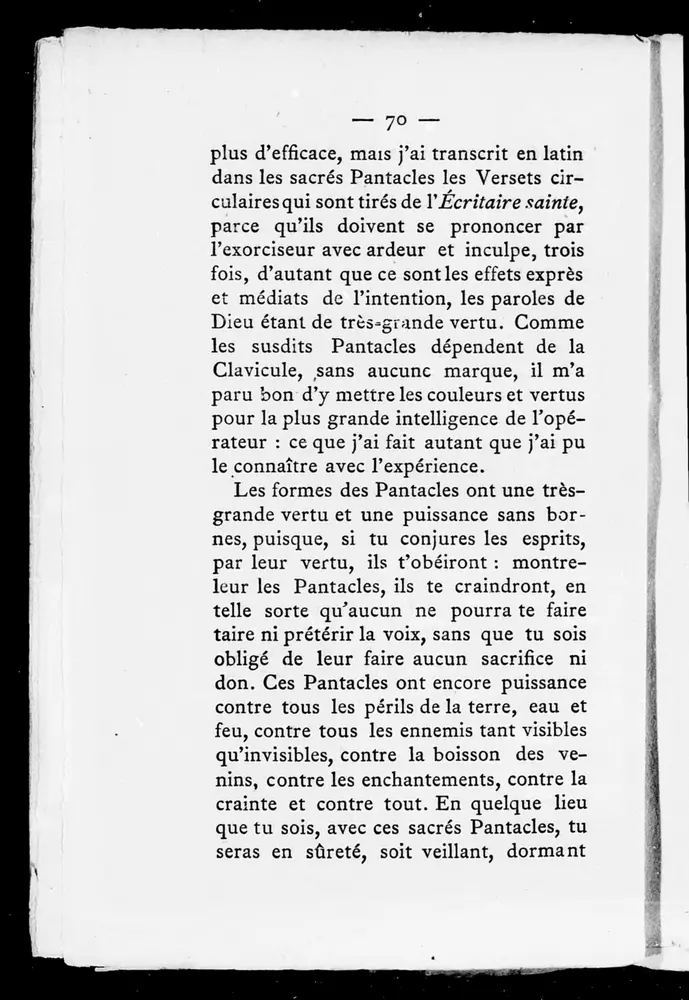
plus d’efficace, mais j’ai transcrit en latin dans les sacrés Pantacles les Versets circulaires qui sont tirés de l’Écriture sainte, parce qu’ils doivent se prononcer par l’exorciseur avec ardeur et inculpe, trois fois, d’autant que ce sont les effets exprès et médiats de l’intention, les paroles de Dieu étant de très-grande vertu. Comme les susdits Pantacles dépendent de la Clavicule, sans aucune marque, il m’a paru bon d’y mettre les couleurs et vertus pour la plus grande intelligence de l’opérateur : ce que j’ai fait autant que j’ai pu le connaître avec l’expérience.

Les formes des Pantacles ont une très-grande vertu et une puissance sans bornes, puisque, si tu conjures les esprits, par leur vertu, ils t’obéiront : montre-leur les Pantacles, ils te craindront, en telle sorte qu’aucun ne pourra te faire taire ni prétérir la voix, sans que tu sois obligé de leur faire aucun sacrifice ni don. Ces Pantacles ont encore puissance contre tous les périls de la terre, eau et feu, contre tous les ennemis tant visibles qu’invisibles, contre la boisson des venins, contre les enchantements, contre la crainte et contre tout. En quelque lieu que tu sois, avec ces sacrés Pantacles, tu seras en sûreté, soit veillant, dormant

TranslationEnglish

— 7° —

more efficacious, but I have transcribed in Latin into the sacred Pantacles the circular Verses that are drawn from Holy Scripture, because they must be pronounced by the exorcist with ardour and inculpe, three times, inasmuch as they are the express and mediate effects of the intention, the words of God being of very great virtue. As the aforesaid Pantacles depend on the Clavicle, without any mark, it seemed good to me to put in them the colours and virtues for the greater understanding of the operator: which I have done as far as I could know it through experience.

The forms of the Pantacles have a very great virtue and a power without bounds, since, if thou conjurest the spirits, by their virtue, they will obey thee: show them the Pantacles, they will fear thee, in such wise that none will be able to silence thee nor pass over the voice, without thy being obliged to make them any sacrifice or gift. These Pantacles have also power against all the perils of earth, water and fire, against all enemies both visible and invisible, against the drink of venoms, against enchantments, against fear and against all. In whatever place thou mayest be, with these sacred Pantacles, thou shalt be in safety, whether waking or sleeping

The Grand Grimoire · Red Dragon — facsimile page (page 088) · public-domain facsimile
French print — 1873 (Gallica, BnF)
🔍 click to enlarge

TranscriptionFrench (1873)

— 71 —

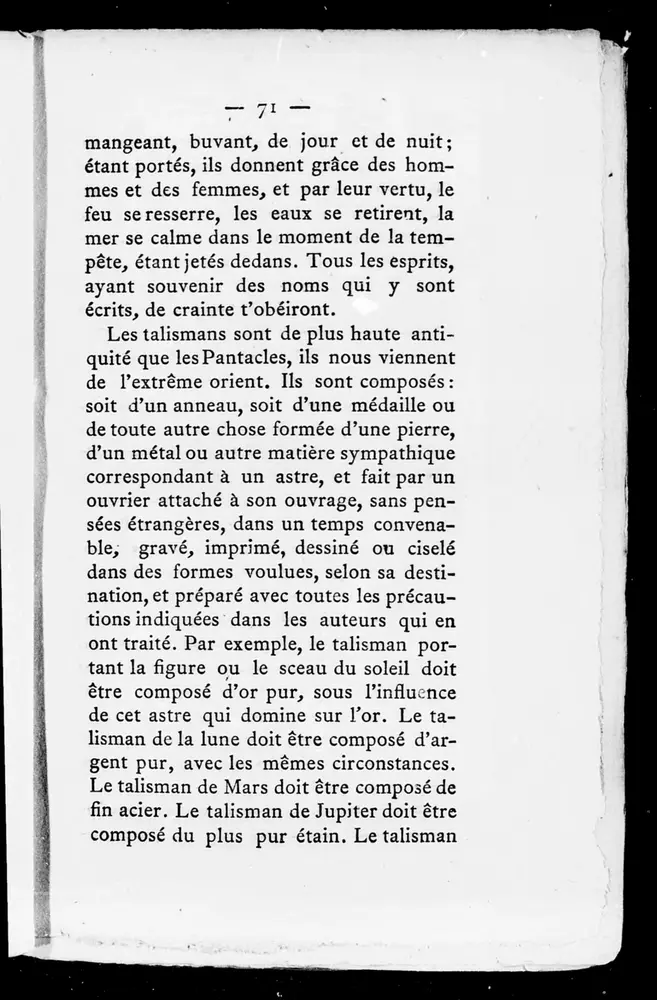
mangeant, buvant, de jour et de nuit ; étant portés, ils donnent grâce des hommes et des femmes, et par leur vertu, le feu se resserre, les eaux se retirent, la mer se calme dans le moment de la tempête, étant jetés dedans. Tous les esprits, ayant souvenir des noms qui y sont écrits, de crainte t’obéiront.

Les talismans sont de plus haute antiquité que les Pantacles, ils nous viennent de l’extrême orient. Ils sont composés : soit d’un anneau, soit d’une médaille ou de toute autre chose formée d’une pierre, d’un métal ou autre matière sympathique correspondant à un astre, et fait par un ouvrier attaché à son ouvrage, sans pensées étrangères, dans un temps convenable, gravé, imprimé, dessiné ou ciselé dans des formes voulues, selon sa destination, et préparé avec toutes les précautions indiquées dans les auteurs qui en ont traité. Par exemple, le talisman portant la figure ou le sceau du soleil doit être composé d’or pur, sous l’influence de cet astre qui domine sur l’or. Le talisman de la lune doit être composé d’argent pur, avec les mêmes circonstances. Le talisman de Mars doit être composé de fin acier. Le talisman de Jupiter doit être composé du plus pur étain. Le talisman [...]

TranslationEnglish

— 71 —

eating, drinking, by day and by night; being carried, they grant grace over men and women, and by their virtue, the fire is held back, the waters withdraw, the sea grows calm in the moment of the storm, being cast into it. All the spirits, having remembrance of the names written therein, will out of fear obey thee.

The talismans are of higher antiquity than the Pantacles; they come to us from the extreme orient. They are composed: either of a ring, or of a medal or of any other thing formed of a stone, a metal or other sympathetic matter corresponding to a star, and made by a workman devoted to his work, without foreign thoughts, in a convenient time, engraved, printed, drawn or chiseled in the desired forms, according to its destination, and prepared with all the precautions indicated in the authors who have treated of it. For example, the talisman bearing the figure or the seal of the sun must be composed of pure gold, under the influence of that star which dominates over gold. The talisman of the moon must be composed of pure silver, with the same circumstances. The talisman of Mars must be composed of fine steel. The talisman of Jupiter must be composed of the purest tin. The talisman [...]

The Grand Grimoire · Red Dragon — facsimile page (page 089) · public-domain facsimile
French print — 1873 (Gallica, BnF)
🔍 click to enlarge

TranscriptionFrench (1873)

— 72 —

de Vénus doit être formé de cuivre poli et bien purifié. Le talisman de Saturne doit être composé de vif-argent fixé.

Quant aux pierres, la hyacinthe et la pierre d’aigle sont de nature solaire. L’émeraude est lunaire. L’aimant et l’améthyste sont propres à Mars. La bérile est propre à Jupiter. La cornaline convient à Vénus. La chalcédoine et le jaspe conviennent à Saturne. La topaze et le porphyre conviennent à Mercure.

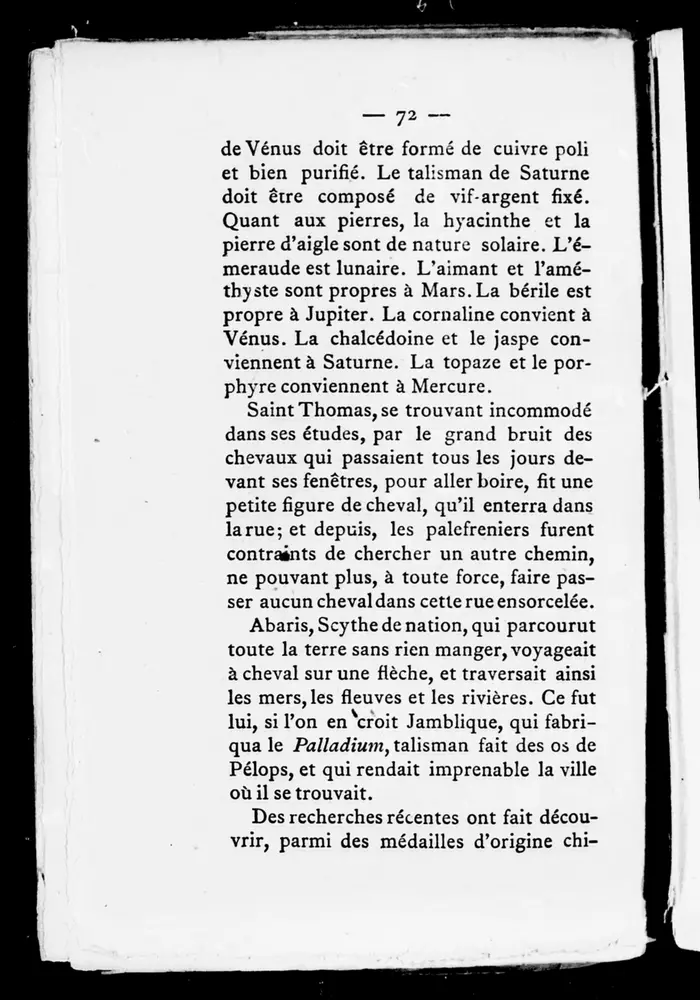
Saint Thomas, se trouvant incommodé dans ses études, par le grand bruit des chevaux qui passaient tous les jours devant ses fenêtres, pour aller boire, fit une petite figure de cheval, qu’il enterra dans la rue; et depuis, les palefreniers furent contraints de chercher un autre chemin, ne pouvant plus, à toute force, faire passer aucun cheval dans cette rue ensorcelée.

Abaris, Scythe de nation, qui parcourut toute la terre sans rien manger, voyageait à cheval sur une flèche, et traversait ainsi les mers, les fleuves et les rivières. Ce fut lui, si l’on en croit Jamblique, qui fabriqua le Palladium, talisman fait des os de Pélops, et qui rendait imprenable la ville où il se trouvait.

Des recherches récentes ont fait découvrir, parmi des médailles d’origine chi[...]

TranslationEnglish

— 72 —

of Venus must be formed of polished copper and well purified. The talisman of Saturn must be composed of fixed quicksilver.

As for stones, the hyacinth and the eagle-stone are of a solar nature. The emerald is lunar. The lodestone and the amethyst are proper to Mars. The beryl is proper to Jupiter. The cornelian befits Venus. The chalcedony and the jasper befit Saturn. The topaz and the porphyry befit Mercury.

Saint Thomas, finding himself incommoded in his studies by the great noise of the horses that passed every day before his windows, on their way to drink, made a small figure of a horse, which he buried in the street; and thereafter, the grooms were constrained to seek another path, being no longer able, by any means, to make any horse pass through that enchanted street.

Abaris, a Scythian by nation, who travelled over the whole earth without eating anything, rode on an arrow, and thus crossed the seas, the rivers and the streams. It was he, if Jamblichus is to be believed, who fashioned the Palladium, a talisman made from the bones of Pelops, and which rendered impregnable the city where it was found.

Recent researches have led to the discovery, among medals of Chinese origin[...]

The Grand Grimoire · Red Dragon — facsimile page (page 090) · public-domain facsimile
French print — 1873 (Gallica, BnF)
🔍 click to enlarge

TranscriptionFrench (1873)

— 73 —

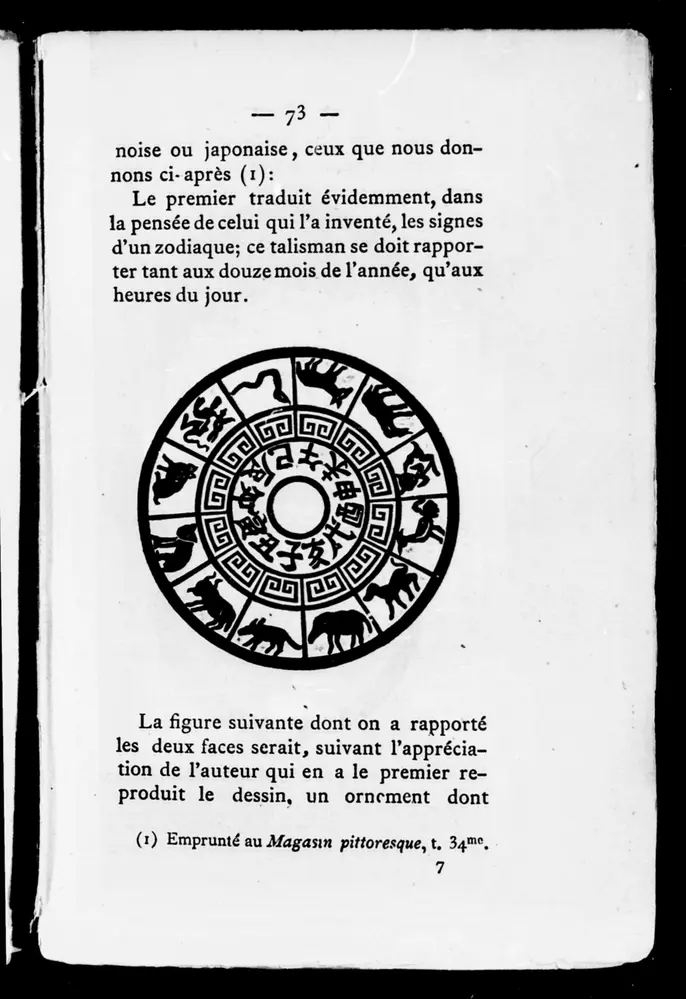
[...] chinoise ou japonaise, ceux que nous donnons ci-après (1) :

Le premier traduit évidemment, dans la pensée de celui qui l’a inventé, les signes d’un zodiaque ; ce talisman se doit rapporter tant aux douze mois de l’année, qu’aux heures du jour.

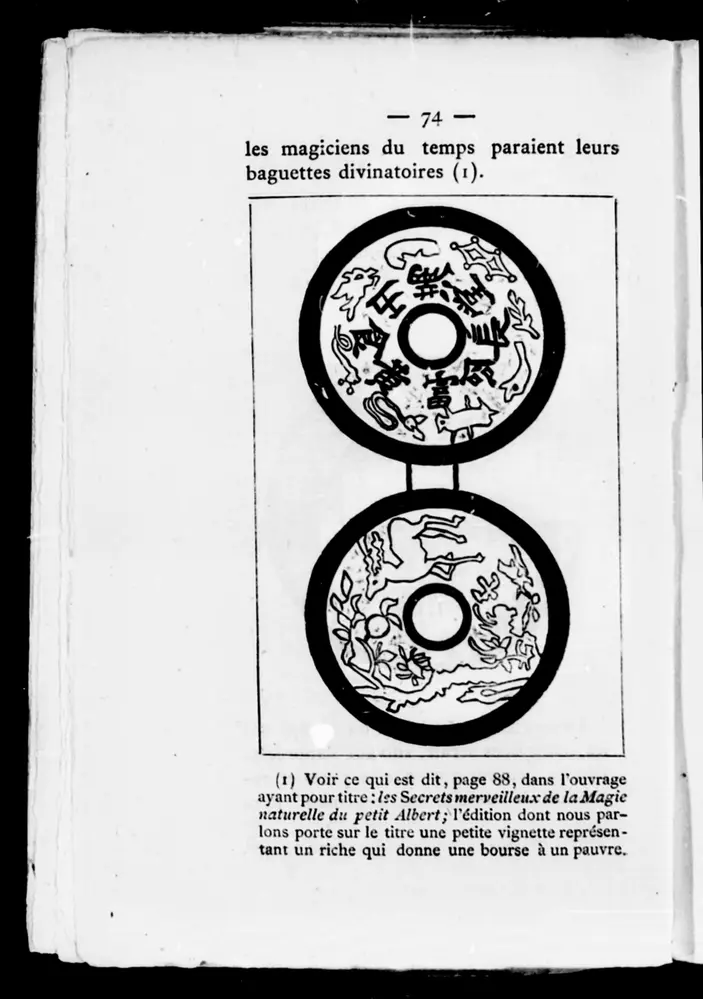
La figure suivante dont on a rapporté les deux faces serait, suivant l’appréciation de l’auteur qui en a le premier reproduit le dessin, un ornement dont

(1) Emprunté au Magasin pittoresque, 34me. 7.

TranslationEnglish

— 73 —

[...] of Chinese or Japanese origin, those that we give below (1):

The first evidently translates, in the mind of the one who invented it, the signs of a zodiac; this talisman should relate as much to the twelve months of the year as to the hours of the day.

The following figure, of which both faces have been reproduced, would be, according to the assessment of the author who first reproduced the drawing, an ornament whose

(1) Borrowed from Le Magasin pittoresque, 34th. 7.

The Grand Grimoire · Red Dragon — facsimile page (page 091) · public-domain facsimile
French print — 1873 (Gallica, BnF)
🔍 click to enlarge

TranscriptionFrench (1873)

les magiciens du temps paraient leurs baguettes divinatoires (1).

(1) Voir ce qui est dit, page 88, dans l'ouvrage ayant pour titre : les Secrets merveilleux de la Magie naturelle du petit Albert; l'édition dont nous parlons porte sur le titre une petite vignette représentant un riche qui donne une bourse à un pauvre.

TranslationEnglish

The magicians of the time adorned their divining rods (1).

(1) See what is said, page 88, in the work entitled: The Marvellous Secrets of Natural Magic of the Petit Albert; the edition of which we speak bears on its title page a small vignette representing a rich man giving a purse to a poor man.

The Grand Grimoire · Red Dragon — facsimile page (page 092) · public-domain facsimile
French print — 1873 (Gallica, BnF)
🔍 click to enlarge

TranscriptionFrench (1873)

CHAPITRE VIII

SECRETS

TOUCHANT LA PHYSIONOMIE SUIVANT UN AUTEUR ITALIEN TRES-ANCIEN ET FORT SAVANT.

L’homme probe. Sa figure est belle, ses épaules grandes; sa poitrine large, sa respiration aisée et tranquille; le nez assez grand, bien proportionné au reste du visage; les yeux sont grands et un peu enfoncés, ou bien ouverts, portant l’expression de la douceur; il arrive quelquefois que les yeux ont quelque chose d’un peu triste, et qu’ils sont rapprochés des sourcils, tandis que le front, dans ce cas même, est un peu sévère; mais tout cela, c’est avec ménagement.

TranslationEnglish

CHAPTER VIII

SECRETS

CONCERNING PHYSIOGNOMY, ACCORDING TO A VERY ANCIENT AND VERY LEARNED ITALIAN AUTHOR.

The upright man. His face is handsome, his shoulders large; his chest broad, his breathing easy and calm; his nose rather large, well proportioned to the rest of his face; his eyes are large and somewhat sunken, or else wide open, bearing an expression of gentleness; it sometimes happens that the eyes have something slightly sad, and that they are close to the eyebrows, while the forehead, even in this case, is somewhat severe; but all this is with moderation.

The Grand Grimoire · Red Dragon — facsimile page (page 093) · public-domain facsimile
French print — 1873 (Gallica, BnF)
🔍 click to enlarge

TranscriptionFrench (1873)

— 76 —

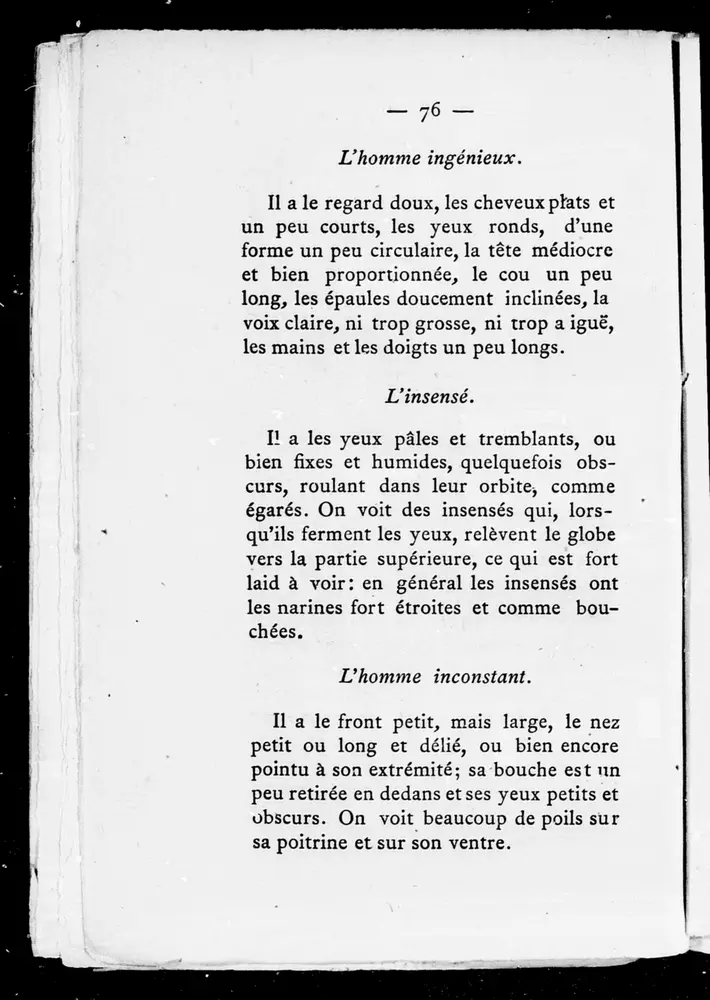
L'homme ingénieux.

Il a le regard doux, les cheveux plats et un peu courts, les yeux ronds, d'une forme un peu circulaire, la tête médiocre et bien proportionnée, le cou un peu long, les épaules doucement inclinées, la voix claire, ni trop grosse, ni trop aiguë, les mains et les doigts un peu longs.

L'insensé.

Il a les yeux pâles et tremblants, ou bien fixes et humides, quelquefois obscurs, roulant dans leur orbite, comme égarés. On voit des insensés qui, lorsqu'ils ferment les yeux, relèvent le globe vers la partie supérieure, ce qui est fort laid à voir : en général les insensés ont les narines fort étroites et comme bouchées.

L'homme inconstant.

Il a le front petit, mais large, le nez petit ou long et délié, ou bien encore pointu à son extrémité ; sa bouche est un peu retirée en dedans et ses yeux petits et obscurs. On voit beaucoup de poils sur sa poitrine et sur son ventre.

TranslationEnglish

— 76 —

The ingenious man.

He has a gentle gaze, flat and somewhat short hair, round eyes of a somewhat circular shape, a medium and well-proportioned head, a slightly long neck, gently sloping shoulders, a clear voice, neither too deep nor too shrill, and somewhat long hands and fingers.

The madman.

He has pale and trembling eyes, or else fixed and moist, sometimes dark, rolling in their orbit, as if straying. One sees madmen who, when they close their eyes, raise the eyeball toward the upper part, which is very ugly to see: in general madmen have very narrow nostrils, as if blocked.

The inconstant man.

He has a small but broad forehead, a small or long and slender nose, or else pointed at its tip; his mouth is somewhat drawn inward and his eyes small and dark. One sees many hairs on his chest and on his belly.

The Grand Grimoire · Red Dragon — facsimile page (page 094) · public-domain facsimile
French print — 1873 (Gallica, BnF)
🔍 click to enlarge

TranscriptionFrench (1873)

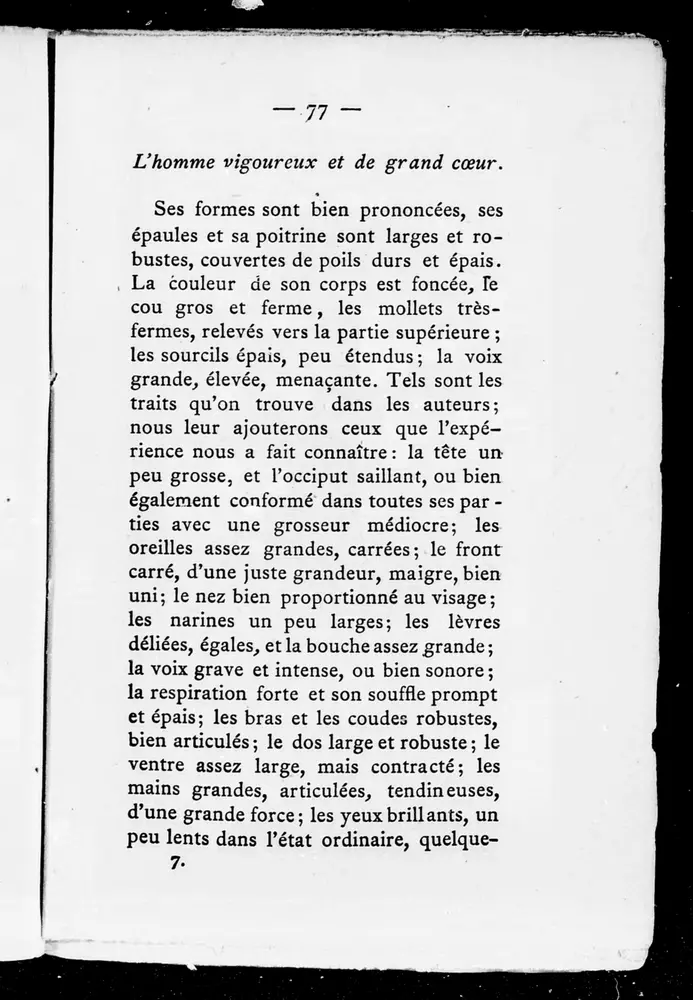
L'homme vigoureux et de grand cœur. Ses formes sont bien prononcées, ses épaules et sa poitrine sont larges et robustes, couvertes de poils durs et épais. La couleur de son corps est foncée ; le cou gros et ferme, les mollets très fermes, relevés vers la partie supérieure ; les sourcils épais, peu étendus ; la voix grande, élevée, menaçante.

Tels sont les traits qu'on trouve dans les auteurs ; nous leur ajouterons ceux que l'expérience nous a fait connaître : la tête un peu grosse, et l'occiput saillant, ou bien également conformé dans toutes ses parties avec une grosseur médiocre ; les oreilles assez grandes, carrées ; le front carré, d'une juste grandeur, maigre, bien uni ; le nez bien proportionné au visage ; les narines un peu larges ; les lèvres déliées, égales, et la bouche assez grande ; la voix grave et intense, ou bien sonore ; la respiration forte et son souffle prompt et épais ; les bras et les coudes robustes, bien articulés ; le dos large et robuste ; le ventre assez large, mais contracté ; les mains grandes, articulées, tendineuses, d'une grande force ; les yeux brillants, un peu lents dans l'état ordinaire, quelque[...]

TranslationEnglish

The vigorous man and of great heart. His forms are well pronounced, his shoulders and his chest are broad and robust, covered with hard and thick hair. The colour of his body is dark; the neck thick and firm, the calves very firm, raised toward the upper part; the eyebrows thick, little extended; the voice large, high, threatening.

Such are the traits that are found in the authors; we shall add to them those that experience has made known to us: the head a little large, and the occiput protruding, or else equally conformed in all its parts with a mediocre size; the ears rather large, square; the forehead square, of a just size, lean, well smooth; the nose well proportioned to the face; the nostrils a little broad; the lips loose, even, and the mouth rather large; the voice grave and intense, or else sonorous; the respiration strong and its breath prompt and thick; the arms and the elbows robust, well articulated; the back broad and robust; the belly rather broad, but contracted; the hands large, articulated, tendinous, of great strength; the eyes brilliant, a little slow in the ordinary state, some[...]

The Grand Grimoire · Red Dragon — facsimile page (page 095) · public-domain facsimile
French print — 1873 (Gallica, BnF)
🔍 click to enlarge

TranscriptionFrench (1873)

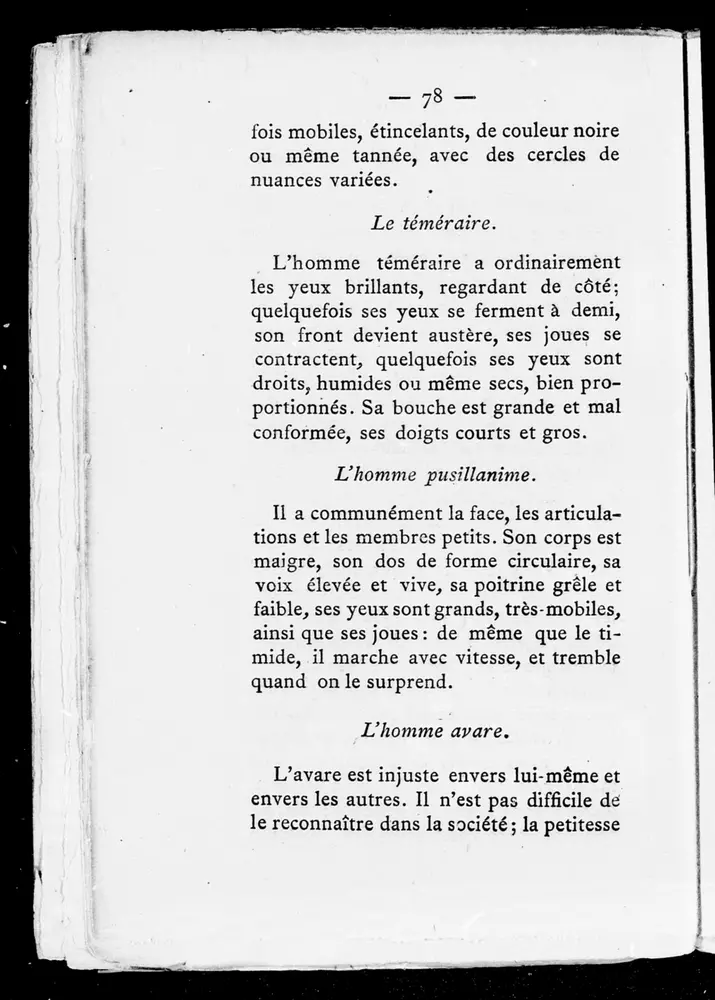
fois mobiles, étincelants, de couleur noire ou même tannée, avec des cercles de nuances variées.

Le téméraire.

L'homme téméraire a ordinairement les yeux brillants, regardant de côté ; quelquefois ses yeux se ferment à demi, son front devient austère, ses joues se contractent, quelquefois ses yeux sont droits, humides ou même secs, bien proportionnés. Sa bouche est grande et mal conformée, ses doigts courts et gros.

L'homme pusillanime.

Il a communément la face, les articulations et les membres petits. Son corps est maigre, son dos de forme circulaire, sa voix élevée et vive, sa poitrine grêle et faible, ses yeux sont grands, très-mobiles, ainsi que ses joues : de même que le timide, il marche avec vitesse, et tremble quand on le surprend.

L'homme avare

L'avare est injuste envers lui-même et envers les autres. Il n'est pas difficile de le reconnaître dans la société ; la petitesse

TranslationEnglish

times mobile, sparkling, of a black or even tawny colour, with circles of varied shades.

The rash man.

The rash man ordinarily has bright eyes, looking sideways; sometimes his eyes half close, his brow becomes austere, his cheeks contract; sometimes his eyes are straight, moist or even dry, well proportioned. His mouth is large and ill-formed, his fingers short and thick.

The pusillanimous man.

He commonly has a small face, joints and limbs. His body is lean, his back of a circular form, his voice high and lively, his chest slender and weak, his eyes are large, very mobile, as are his cheeks: like the timid man, he walks swiftly, and trembles when he is taken by surprise.

The avaricious man

The miser is unjust towards himself and towards others. It is not difficult to recognise him in society; the pettiness

The Grand Grimoire · Red Dragon — facsimile page (page 096) · public-domain facsimile
French print — 1873 (Gallica, BnF)
🔍 click to enlarge

TranscriptionFrench (1873)

— 79 —

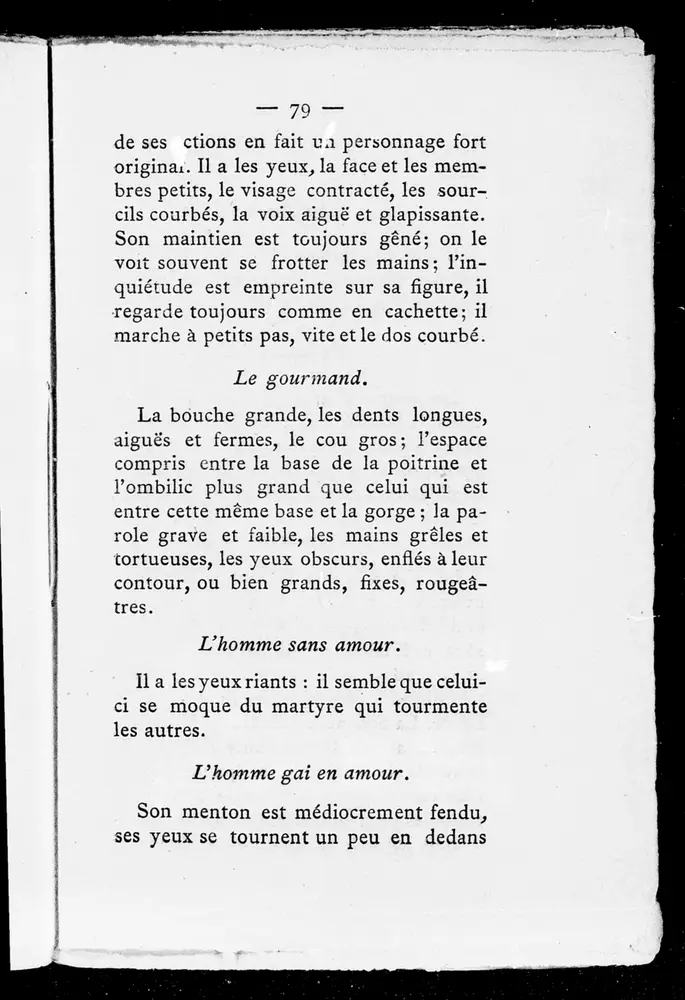
de ses [?] en fait un personnage fort original. Il a les yeux, la face et les membres petits, le visage contracté, les sourcils courbés, la voix aiguë et glapissante. Son maintien est toujours gêné ; on le voit souvent se frotter les mains ; l’inquiétude est empreinte sur sa figure, il regarde toujours comme en cachette ; il marche à petits pas, vite et le dos courbé.

Le gourmand.

La bouche grande, les dents longues, aigues et fermes, le cou gros ; l’espace compris entre la base de la poitrine et l’ombilic plus grand que celui qui est entre cette même base et la gorge ; la parole grave et faible, les mains grêles et tortueuses, les yeux obscurs, enflés à leur contour, ou bien grands, fixes, rougeâtres.

L’homme sans amour.

Il a les yeux riants : il semble que celui-ci se moque du martyre qui tourmente les autres.

L’homme gai en amour.

Son menton est médiocrement fendu, ses yeux se tournent un peu en dedans

TranslationEnglish

— 79 —

of his [?] makes him a very original character. He has small eyes, face and limbs, a contracted face, curved eyebrows, a sharp and screeching voice. His bearing is always constrained ; he is often seen rubbing his hands ; unease is imprinted on his face, he always looks as if in secret ; he walks with small steps, quickly, and with his back bent.

The glutton.

The mouth large, the teeth long, sharp and firm, the neck thick ; the space between the base of the chest and the navel larger than that which is between this same base and the throat ; the speech grave and weak, the hands slender and twisted, the eyes dark, swollen around their contour, or else large, fixed, reddish.

The man without love.

He has laughing eyes : it seems that this one mocks the martyrdom that torments others.

The man cheerful in love.

His chin is mediocrely cleft, his eyes turn a little inward

The Grand Grimoire · Red Dragon — facsimile page (page 097) · public-domain facsimile
French print — 1873 (Gallica, BnF)
🔍 click to enlarge

TranscriptionFrench (1873)

— 80 —
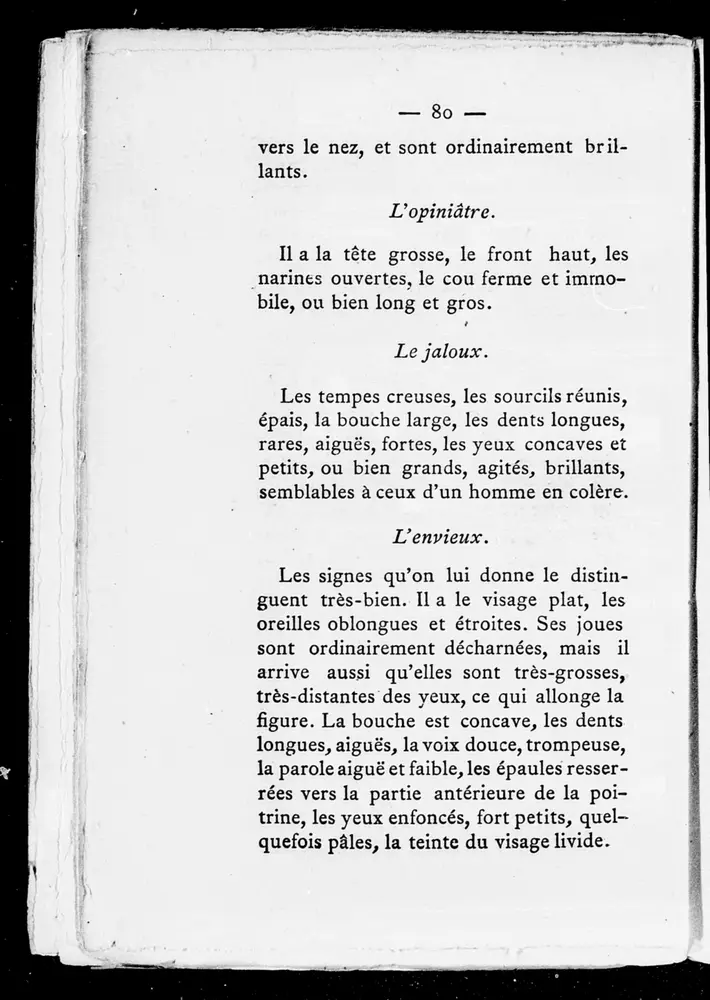
vers le nez, et sont ordinairement brillants.

L'opiniâtre.
Il a la tête grosse, le front haut, les narines ouvertes, le cou ferme et immobile, ou bien long et gros.

[?]

Le jaloux.
Les tempes creuses, les sourcils réunis, épais, la bouche large, les dents longues, rares, aiguës, fortes, les yeux concaves et petits, ou bien grands, agités, brillants, semblables à ceux d'un homme en colère.

L'envieux.
Les signes qu'on lui donne le distinguent très-bien. Il a le visage plat, les oreilles oblongues et étroites. Ses joues sont ordinairement décharnées, mais il arrive aussi qu'elles sont très-grosses, très-distantes des yeux, ce qui allonge la figure. La bouche est concave, les dents longues, aiguës, la voix douce, trompeuse, la parole aiguë et faible, les épaules resserrées vers la partie antérieure de la poitrine, les yeux enfoncés, fort petits, quelquefois pâles, la teinte du visage livide.

TranslationEnglish

— 80 —
toward the nose, and are ordinarily glittering.

The obstinate one.
He has a large head, a high forehead, open nostrils, a firm and motionless neck, or else long and thick.

[?]

The jealous one.
Hollow temples, eyebrows drawn together, thick, a wide mouth, long, sparse, sharp, strong teeth, sunken and small eyes, or else large, restless, glittering, like those of a man in anger.

The envious one.
The signs given for him distinguish him very well. He has a flat face, oblong and narrow ears. His cheeks are ordinarily gaunt, but it also happens that they are very large, very far from the eyes, which lengthens the face. The mouth is concave, the teeth long, sharp, the voice soft, deceitful, the speech sharp and faint, the shoulders drawn together toward the front of the chest, the eyes sunken, very small, sometimes pale, the complexion of the face livid.

The Grand Grimoire · Red Dragon — facsimile page (page 098) · public-domain facsimile
French print — 1873 (Gallica, BnF)
🔍 click to enlarge

TranscriptionFrench (1873)

CHAPITRE IX

LES SECRETS DE LA REINE CLEOPATRE

[L]es secrets de la reine Cléopâtre ont été conservés et transmis précieusement au rapport de certains écrivains ; ne devrait-il pas plutôt être admis que lesdits secrets, attribués à cette reine, ont été ainsi désignés à cause de sa beauté, et si ceux ici reproduits ne pouvaient avoir authenticité, ils pourraient, autant que leur efficacité serait incontestable, être estimés à leur juste valeur.

Pour qu’une femme conserve sa beauté.

Prenez tous les matins du maigre de [...]

TranslationEnglish

CHAPTER IX

THE SECRETS OF QUEEN CLEOPATRA

[L]es secrets of Queen Cléopâtre have been preserved and jealously handed down according to the account of certain writers; should it not rather be admitted that the said secrets, attributed to this queen, were thus designated because of her beauty, and that if those reproduced here could not be authentic, they might, in so far as their efficacy would be incontestable, be esteemed at their just value?

For a woman to preserve her beauty.

Take every morning of the lean [meat] [...]

The Grand Grimoire · Red Dragon — facsimile page (page 099) · public-domain facsimile
French print — 1873 (Gallica, BnF)
🔍 click to enlarge

TranscriptionFrench (1873)

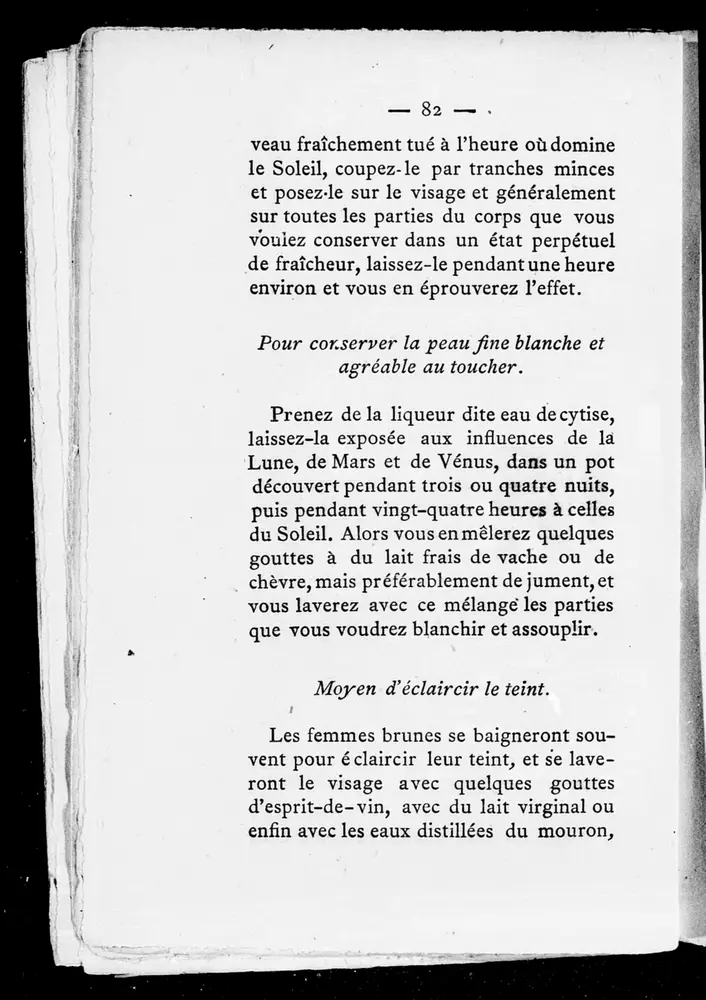
veau fraîchement tué à l’heure où domine le Soleil, coupez-le par tranches minces et posez-le sur le visage et généralement sur toutes les parties du corps que vous voulez conserver dans un état perpétuel de fraîcheur, laissez-le pendant une heure environ et vous en éprouverez l’effet.

Pour conserver la peau fine blanche et agréable au toucher.

Prenez de la liqueur dite eau de cytise, laissez-la exposée aux influences de la Lune, de Mars et de Vénus, dans un pot découvert pendant trois ou quatre nuits, puis pendant vingt-quatre heures à celles du Soleil. Alors vous en mêlerez quelques gouttes à du lait frais de vache ou de chèvre, mais préférablement de jument, et vous laverez avec ce mélange les parties que vous voudrez blanchir et assouplir.

Moyen d’éclaircir le teint,

Les femmes brunes se baigneront souvent pour éclaircir leur teint, et se laveront le visage avec quelques gouttes d’esprit-de-vin, avec du lait virginal ou enfin avec les eaux distillées du mouron.

TranslationEnglish

calf freshly killed at the hour when the Sun predominates; cut it into thin slices and lay it on the face and generally on all the parts of the body that you wish to keep in a perpetual state of freshness; leave it there for about an hour and you will feel its effect.

To preserve a fine skin, white and pleasant to the touch.

Take the liquor called eau de cytise, leave it exposed to the influences of the Moon, of Mars and of Venus, in an uncovered pot for three or four nights, then for twenty-four hours to those of the Sun. Then you shall mix a few drops of it with fresh milk of cow or goat, but preferably of mare, and with this mixture you shall wash the parts that you wish to whiten and soften.

A means of clearing the complexion,

Brunette women shall bathe often to clear their complexion, and shall wash their faces with a few drops of spirit of wine, with lait virginal, or lastly with the distilled waters of pimpernel.

The Grand Grimoire · Red Dragon — facsimile page (page 100) · public-domain facsimile
French print — 1873 (Gallica, BnF)
🔍 click to enlarge

TranscriptionFrench (1873)

— 83 —

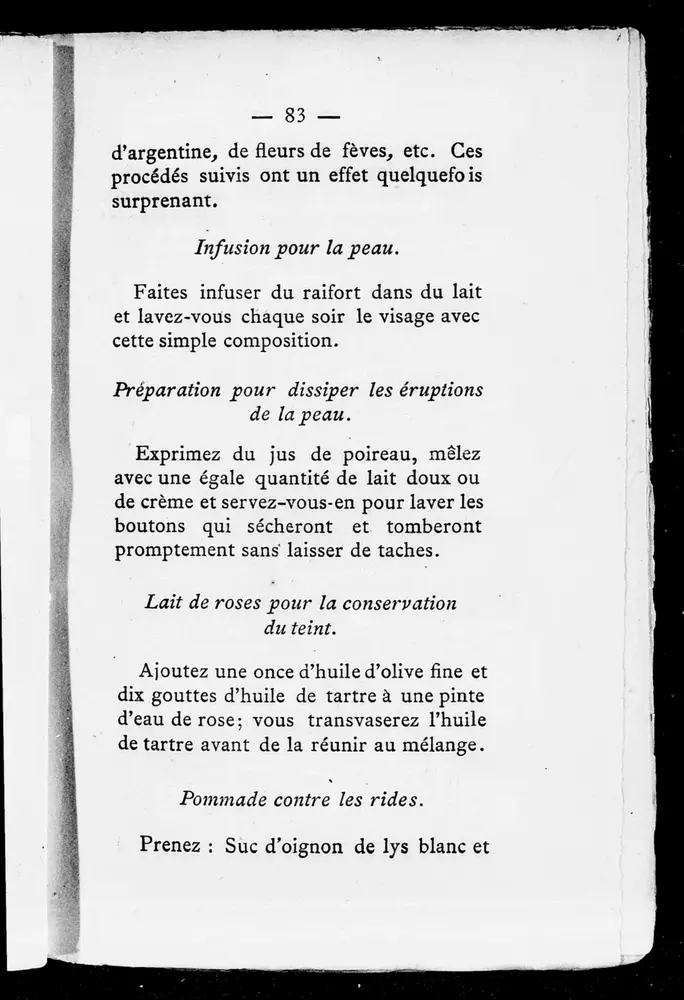
d’argentine, de fleurs de fèves, etc. Ces procédés suivis ont un effet quelquefois surprenant.

Infusion pour la peau.

Faites infuser du raifort dans du lait et lavez-vous chaque soir le visage avec cette simple composition.

Préparation pour dissiper les éruptions de la peau.

Exprimez du jus de poireau, mêlez avec une égale quantité de lait doux ou de crème et servez-vous-en pour laver les boutons qui sécheront et tomberont promptement sans laisser de taches.

Lait de roses pour la conservation du teint.

Ajoutez une once d’huile d’olive fine et dix gouttes d’huile de tartre à une pinte d’eau de rose; vous transvaserez l’huile de tartre avant de la réunir au mélange.

Pommade contre les rides.

Prenez : Suc d’oignon de lys blanc et

TranslationEnglish

— 83 —

of argentine, of bean flowers, etc. These procedures, when followed, sometimes have a surprising effect.

Infusion for the skin.

Infuse horseradish in milk and wash your face each evening with this simple composition.

Preparation to dispel eruptions of the skin.

Express the juice of leek, mix it with an equal quantity of sweet milk or cream, and use it to wash the pimples, which will dry up and fall off promptly without leaving any spots.

Rose milk for the preservation of the complexion.

Add one ounce of fine olive oil and ten drops of oil of tartar to a pint of rose water; you will decant the oil of tartar before uniting it with the mixture.

Pomade against wrinkles.

Take: Juice of white lily bulb and

The Grand Grimoire · Red Dragon — facsimile page (page 101) · public-domain facsimile
French print — 1873 (Gallica, BnF)
🔍 click to enlarge

TranscriptionFrench (1873)

— 84 —

[...] miel blanc, de chacun deux onces ; cire blanche fondue, une once ; incorporez le tout ensemble et faites-en une pommade dont vous vous frotterez le visage tous les soirs en vous couchant, et que vous n’essuierez que le lendemain.

Bain de beauté.

Prenez deux livres d’orge mondé, une livre de riz, trois livres de lupin pulvérisé, huit livres de son et dix poignées de bourrache et de violier ; faites bouillir le tout dans une suffisante quantité d’eau de rivière, et passez la liqueur par un tamis. Ce bain est parfait pour nettoyer et adoucir la peau.

TranslationEnglish

— 84 —

[...] white honey, of each two ounces; melted white wax, one ounce; incorporate the whole together and make of it a pomade with which you will rub your face every evening on going to bed, and which you will not wipe off until the next day.

Beauty bath.

Take two pounds of hulled barley, one pound of rice, three pounds of pulverized lupin, eight pounds of bran and ten handfuls of borage and of wallflower; boil the whole in a sufficient quantity of river water, and pass the liquid through a sieve. This bath is perfect for cleansing and softening the skin.

The Grand Grimoire · Red Dragon — facsimile page (page 102) · public-domain facsimile
French print — 1873 (Gallica, BnF)
🔍 click to enlarge

TranscriptionFrench (1873)

SECRET POUR SE RENDRE INVISIBLE

[...] plus grand de tous les secrets, chose pour laquelle nous ne saurions trouver de contradicteur, serait le Secret pour se rendre invisible; quel que soit donc celui que l’on pourrait nous enseigner, il ne s’en trouverait pas au-dessus de l’anneau de Gygès, si la fable rapportée par Platon pouvait être admise comme vérité, chose également reproduite par Cicéron dans le livre De officiis, et si l’anneau de Gygès pouvait être reproduit.

Gygès, roi de Lydie, était l’ami et le favori du roi Candaule, lequel voulant faire admirer à Gygès la beauté de sa femme, la lui fit voir toute nue. La reine outragée menaça Gygès de le faire périr s’il ne consentait à tuer le roi, ce qu’il fit et pour prix obtint d’épouser la reine et devint roi.

e [?]

TranslationEnglish

SECRET TO MAKE ONESELF INVISIBLE

[...] the greatest of all secrets, a thing for which we could find no one to contradict us, would be the Secret for making oneself invisible; whatever, then, might be the one that could be taught to us, it would not be found above the ring of Gyges, if the fable related by Plato could be admitted as truth, a thing likewise reproduced by Cicero in the book De officiis, and if the ring of Gyges could be reproduced.

Gyges, king of Lydia, was the friend and favourite of King Candaules, who, wishing to make Gyges admire the beauty of his wife, made him see her quite naked. The outraged queen threatened to put Gyges to death if he did not consent to kill the king, which he did, and as a reward he obtained the hand of the queen and became king.

e [?]

The Grand Grimoire · Red Dragon — facsimile page (page 103) · public-domain facsimile
French print — 1873 (Gallica, BnF)
🔍 click to enlarge

TranscriptionFrench (1873)

— 86 —

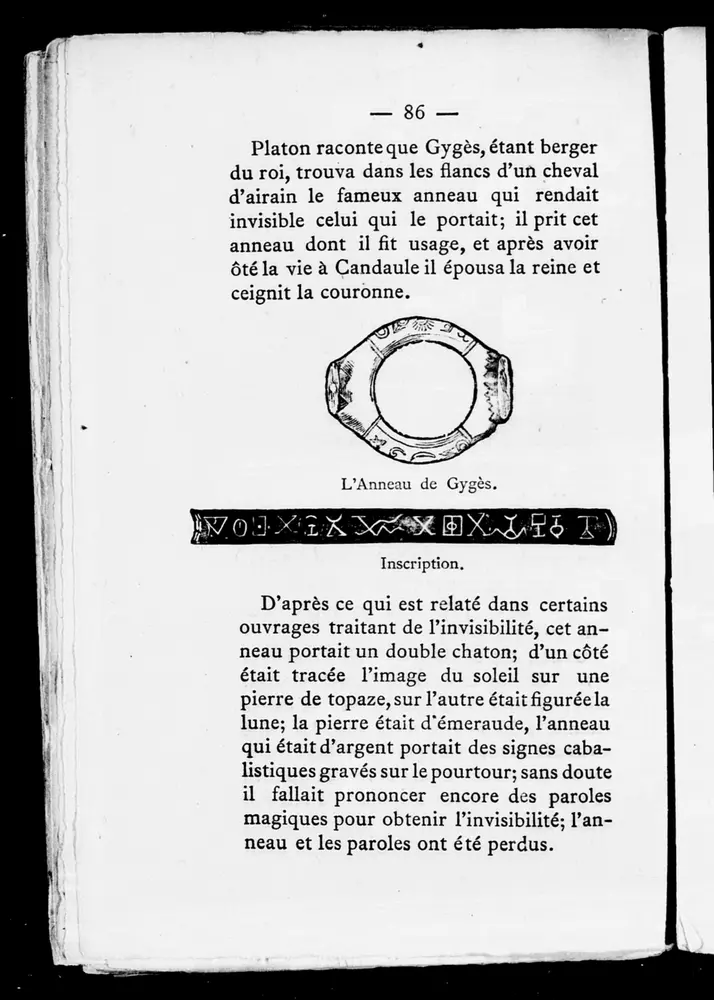
Platon raconte que Gygès, étant berger du roi, trouva dans les flancs d’un cheval d’airain le fameux anneau qui rendait invisible celui qui le portait; il prit cet anneau dont il fit usage, et après avoir ôté la vie à Candaule il épousa la reine et ceignit la couronne.

L’Anneau de Gygès.

[?]

Inscription.

D’après ce qui est relaté dans certains ouvrages traitant de l’invisibilité, cet anneau portait un double chaton; d’un côté était tracée l’image du soleil sur une pierre de topaze, sur l’autre était figurée la lune; la pierre était d’émeraude, l’anneau qui était d’argent portait des signes cabalistiques gravés sur le pourtour; sans doute il fallait prononcer encore des paroles magiques pour obtenir l’invisibilité; l’anneau et les paroles ont été perdus.

TranslationEnglish

— 86 —

Platon recounts that Gygès, being a shepherd of the king, found in the flanks of a bronze horse the famous ring that made invisible whoever wore it; he took this ring and made use of it, and after taking the life of Candaule he married the queen and assumed the crown.

The Ring of Gygès.

[?]

Inscription.

According to what is related in certain works dealing with invisibility, this ring had a double bezel; on one side was traced the image of the sun on a topaz stone, on the other was figured the moon; the stone was emerald, the ring, which was silver, bore cabalistic signs engraved around its rim; no doubt one still had to pronounce magic words to obtain invisibility; the ring and the words have been lost.

The Grand Grimoire · Red Dragon — facsimile page (page 104) · public-domain facsimile
French print — 1873 (Gallica, BnF)
🔍 click to enlarge

TranscriptionFrench (1873)

— 87 —

CHAPITRE X
LES SECRETS
DU SAVANT ARTÉPHIUS.

Artéphius qui, au dire des historiens, existait au xiie siècle, possédait, suivant lesdits narrateurs, une foule de sciences les plus précieuses à savoir : l’alchimie, qui est, comme nous l’avons dit en plusieurs endroits de cette humble compilation, l’art de faire de l’or, puis l’astrologie et aussi avait ce grand secret, lequel ne pourrait être trop grandement estimé, qui était l’art de prolonger la vie, lequel secret lui aurait permis de fournir une carrière qui aurait excédé mille ans.

Les écrits d’Artéphius touchant la pierre philosophale ont été perdus, et l’on doit supposer que son savoir touchant la manière de faire de l’or dont quelques écrivains ont parlé, est bien autant probléma-

TranslationEnglish

— 87 —

CHAPTER X
THE SECRETS
OF THE LEARNED ARTÉPHIUS.

Artéphius, who, according to historians, existed in the twelfth century, possessed, according to the aforesaid narrators, a host of the most precious sciences, namely: alchemy, which is, as we have said in several places in this humble compilation, the art of making gold, then astrology; and he also had this great secret, which could not be too highly esteemed, which was the art of prolonging life, a secret that would have allowed him to pursue a career that would have exceeded a thousand years.

The writings of Artéphius concerning the philosopher's stone have been lost, and one must suppose that his knowledge concerning the manner of making gold, of which some writers have spoken, is just as problema-

The Grand Grimoire · Red Dragon — facsimile page (page 105) · public-domain facsimile
French print — 1873 (Gallica, BnF)
🔍 click to enlarge

TranscriptionFrench (1873)

[...]tique que les mille ans et plus d’existence que lui octroyent certains historiens ou fabricateurs d’histoires extraordinaires.

Jérôme Cardan, qui, lui aussi, a écrit sur ces sciences et fut compté au nombre des astrologues, aurait avancé dans son livre De la variété des choses[?] que le livre d’Artéphius serait l’œuvre d’un mystificateur qui voulut se jouer des partisans de l’alchimie.

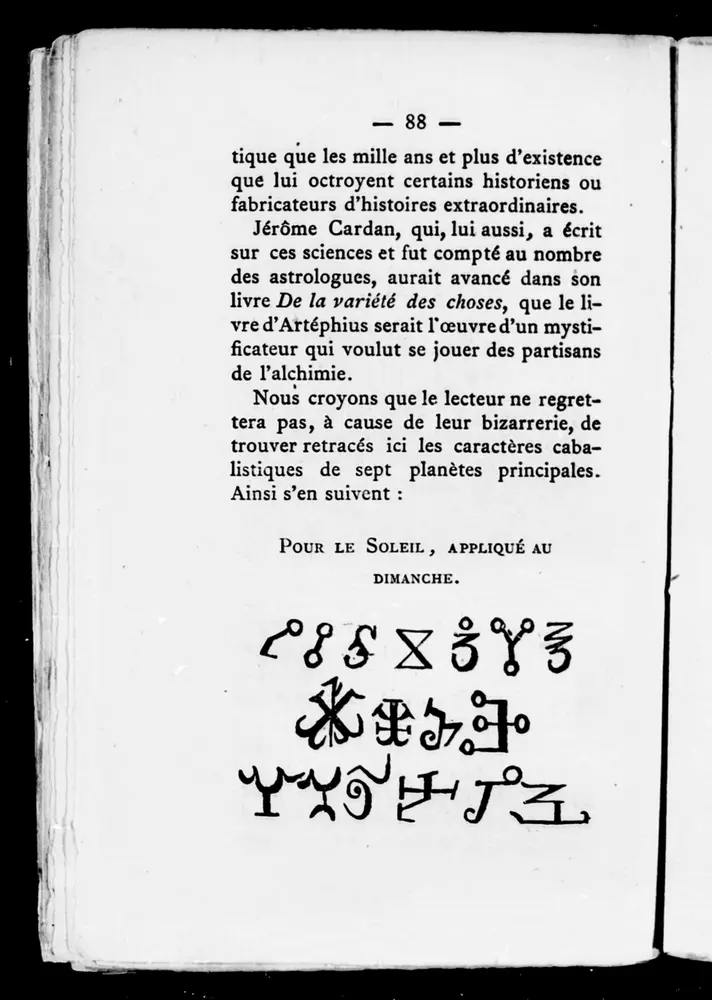
Nous croyons que le lecteur ne regrettera pas, à cause de leur bizarrerie, de trouver retracés ici les caractères cabalistiques de sept planètes principales. Ainsi s’en suivent :

Pour le Soleil, appliqué au DIMANCHE.

[?]

TranslationEnglish

[...]tic that the thousand years and more of existence which certain historians or makers of extraordinary stories grant him.

Jérôme Cardan, who likewise wrote on these sciences and was counted among the astrologers, is said to have advanced in his book De la variété des choses[?] that the book of Artéphius was the work of a mystifier who wished to make sport of the partisans of alchemy.

We believe the reader will not regret, on account of their oddity, to find traced here the cabalistic characters of the seven principal planets. Thus follow:

For the Sun, applied to SUNDAY.

[?]

The Grand Grimoire · Red Dragon — facsimile page (page 106) · public-domain facsimile
French print — 1873 (Gallica, BnF)
🔍 click to enlarge

TranscriptionFrench (1873)

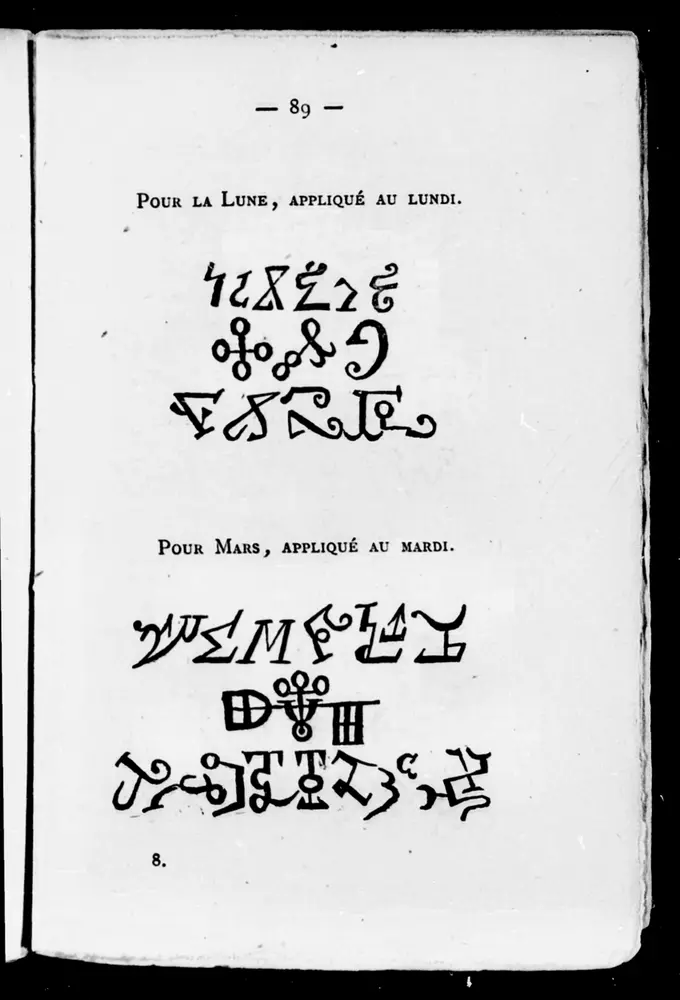
Pour la Lune, appliqué au lundi.

[?]

[?]

[?]

Pour Mars, appliqué au mardi.

[?]

[?]

[?]

[?]

TranslationEnglish

For the Moon, applied on Monday.

[?]

[?]

[?]

For Mars, applied on Tuesday.

[?]

[?]

[?]

[?]

The Grand Grimoire · Red Dragon — engraved plate (page 107) · public-domain facsimile
French print — 1873 (Gallica, BnF)
🔍 click to enlarge

TranscriptionFrench (1873)

— 90 —

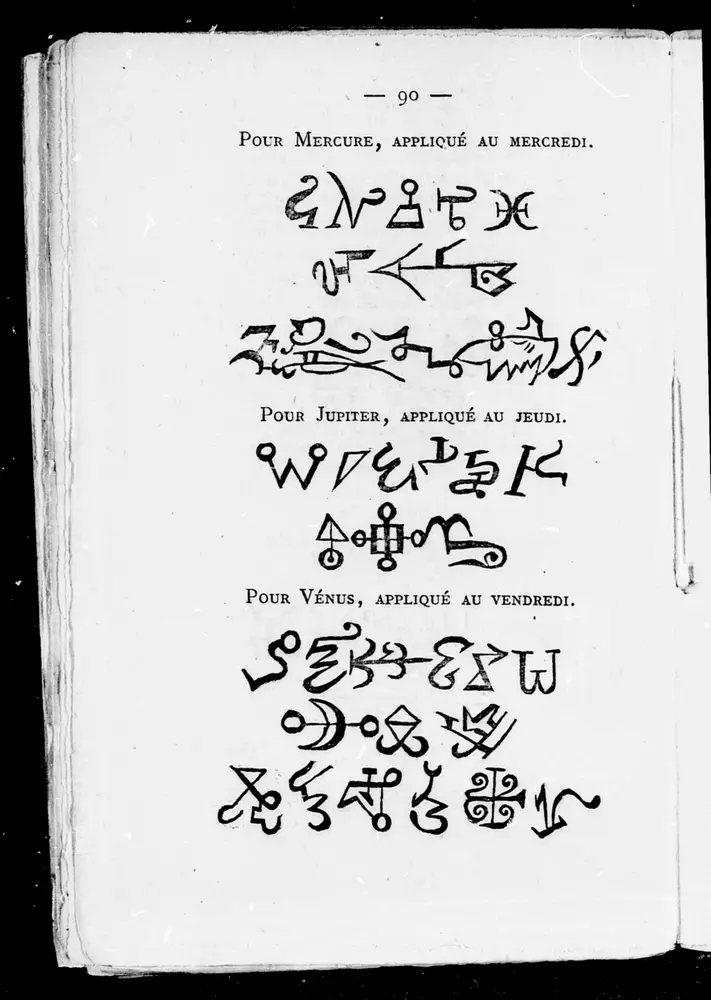
Pour Mercure, appliqué au mercredi.

[figure: caractères planétaires]

Pour Jupiter, appliqué au jeudi.

[figure: caractères planétaires]

Pour Vénus, appliqué au vendredi.

[figure: caractères planétaires]

TranslationEnglish

— 90 —

For Mercury, applied to Wednesday.

[figure: planetary characters]

For Jupiter, applied to Thursday.

[figure: planetary characters]

For Venus, applied to Friday.

[figure: planetary characters]

The Grand Grimoire · Red Dragon — facsimile page (page 108) · public-domain facsimile
French print — 1873 (Gallica, BnF)
🔍 click to enlarge

TranscriptionFrench (1873)

[?] 91,— x5318w35 [?]

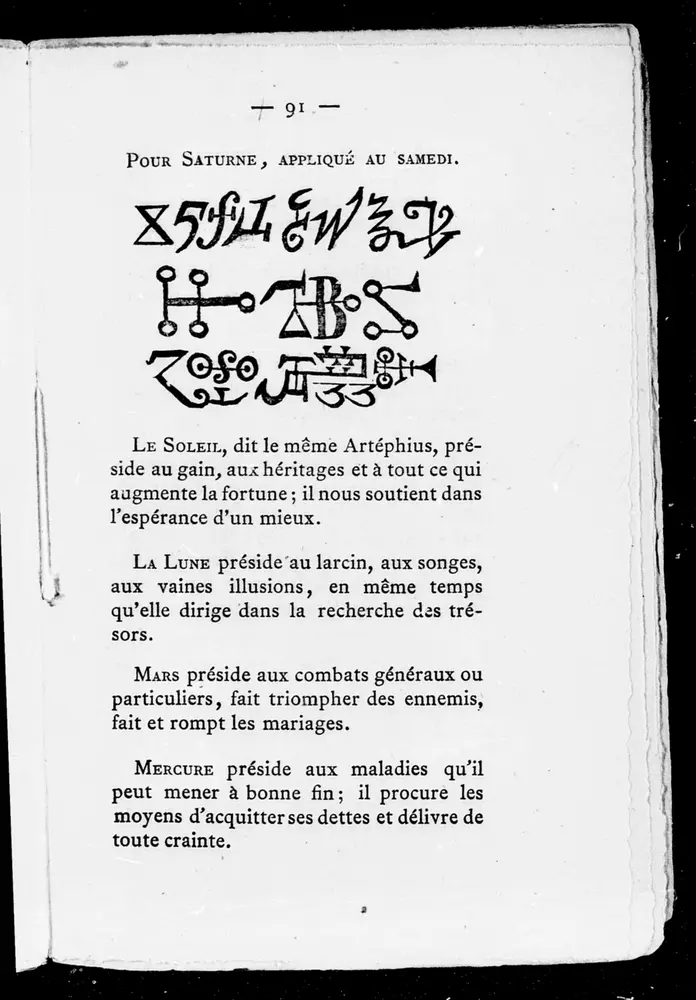
Pour SATURNE, appliqué au samedi.

Le Soleil, dit le même Artéphius, préside au gain, aux héritages et à tout ce qui augmente la fortune ; il nous soutient dans l’espérance d’un mieux.

La Lune préside au larcin, aux songes, aux vaines illusions, en même temps qu’elle dirige dans la recherche des trésors.

Mars préside aux combats généraux ou particuliers, fait triompher des ennemis, fait et rompt les mariages.

Mercure préside aux maladies qu’il peut mener à bonne fin ; il procure les moyens d’acquitter ses dettes et délivre de toute crainte.

TranslationEnglish

[?] 91,— x5318w35 [?]

For SATURN, applied to Saturday.

The Sun, says the same Artéphius, presides over gain, over inheritances and over all that increases fortune; it sustains us in the hope of better things.

The Moon presides over theft, over dreams, over vain illusions, at the same time as she directs in the search for treasures.

Mars presides over general or particular combats, makes one triumph over enemies, makes and breaks marriages.

Mercury presides over the illnesses that he can bring to a good end; he procures the means to pay off one’s debts and delivers from all fear.

The Grand Grimoire · Red Dragon — facsimile page (page 109) · public-domain facsimile
French print — 1873 (Gallica, BnF)
🔍 click to enlarge

TranscriptionFrench (1873)

— 92 —

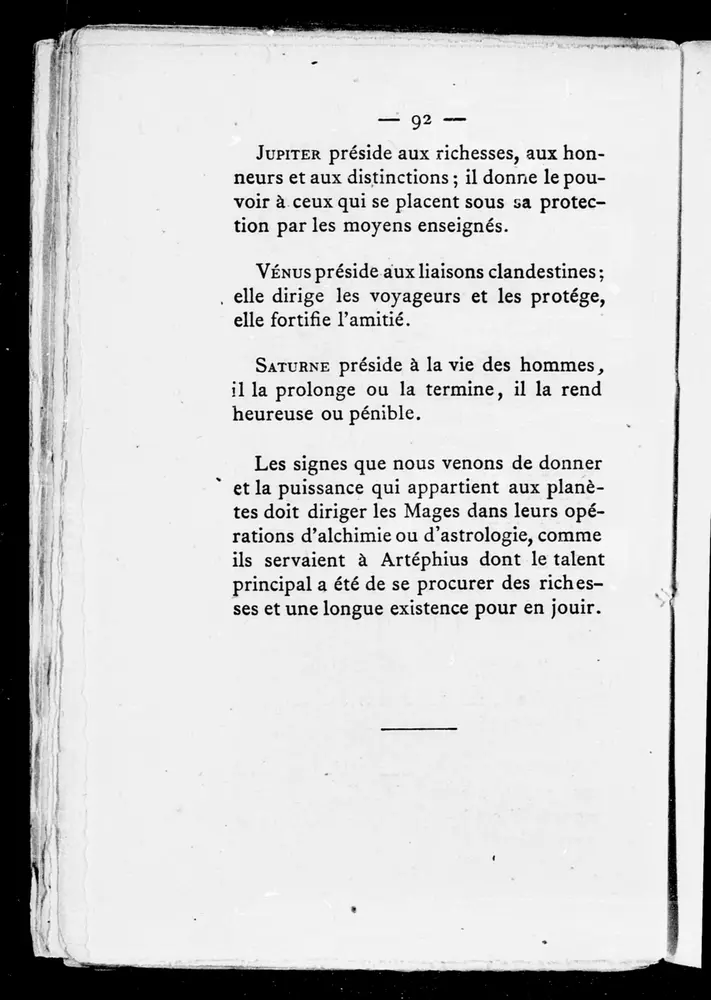
Jupiter préside aux richesses, aux honneurs et aux distinctions ; il donne le pouvoir à ceux qui se placent sous sa protection par les moyens enseignés.

Vénus préside aux liaisons clandestines ; elle dirige les voyageurs et les protège, elle fortifie l'amitié.

Saturne préside à la vie des hommes, il la prolonge ou la termine, il la rend heureuse ou pénible.

Les signes que nous venons de donner et la puissance qui appartient aux planètes doit diriger les Mages dans leurs opérations d'alchimie ou d'astrologie, comme ils servaient à Artéphius dont le talent principal a été de se procurer des richesses et une longue existence pour en jouir.

TranslationEnglish

— 92 —

Jupiter presides over riches, honors and distinctions; he gives power to those who place themselves under his protection by the means taught.

Venus presides over clandestine liaisons; she directs travelers and protects them, she strengthens friendship.

Saturn presides over the life of men, he prolongs or ends it, he makes it happy or painful.

The signs we have just given and the power that belongs to the planets must guide the Magi in their operations of alchemy or astrology, as they served Artéphius, whose principal talent was to procure riches and a long existence in order to enjoy them.

The Grand Grimoire · Red Dragon — facsimile page (page 110) · public-domain facsimile
French print — 1873 (Gallica, BnF)
🔍 click to enlarge

TranscriptionFrench (1873)

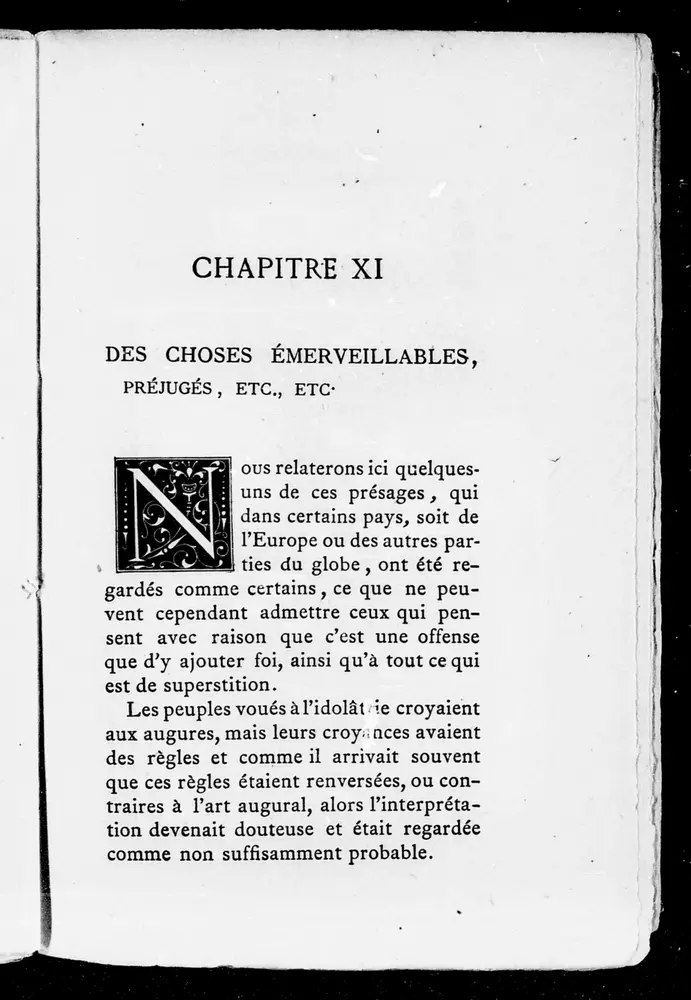
CHAPITRE XI

DES CHOSES ÉMERVEILLABLES, PRÉJUGÉS, ETC., ETC.

[N]ous relaterons ici quelques-uns de ces présages, qui dans certains pays, soit de l'Europe ou des autres parties du globe ont été regardés comme certains, ce que ne peuvent cependant admettre ceux qui pensent avec raison que c'est une offense que d'y ajouter foi, ainsi qu'à tout ce qui est de superstition.

Les peuples voués à l'idolâtrie croyaient aux augures, mais leurs croyances avaient des règles et comme il arrivait souvent que ces règles étaient renversées, ou contraires à l'art augural, alors l'interprétation devenait douteuse et était regardée comme non suffisamment probable.

TranslationEnglish

CHAPTER XI

OF MARVELLOUS THINGS, PREJUDICES, ETC., ETC.

We shall relate here some of those presages which, in certain countries, whether of Europe or of the other parts of the globe, have been regarded as certain, which those who think with reason that it is an offence to give credence to them, as to all that belongs to superstition, cannot however admit.

The peoples devoted to idolatry believed in auguries, but their beliefs had rules, and as it often happened that these rules were overturned, or contrary to the augural art, then the interpretation became doubtful and was regarded as not sufficiently probable.

Grimorium · grimorium.lat · CC BY 4.0 · Details