Cecco d'Ascoli

The nigromantic passages of the commentary on the Sphere

Sphaera mundi, Venice 1499 (BNCF / Internet Archive)
Download PDF ↓
The four kings of the directions#1_reyes
Cecco d'Ascoli — facsimile page (The four kings of the directions) · public-domain facsimile
Sphaera mundi, Venice 1499 (BNCF / Internet Archive)
🔍 click to enlarge

TranscriptionLatin

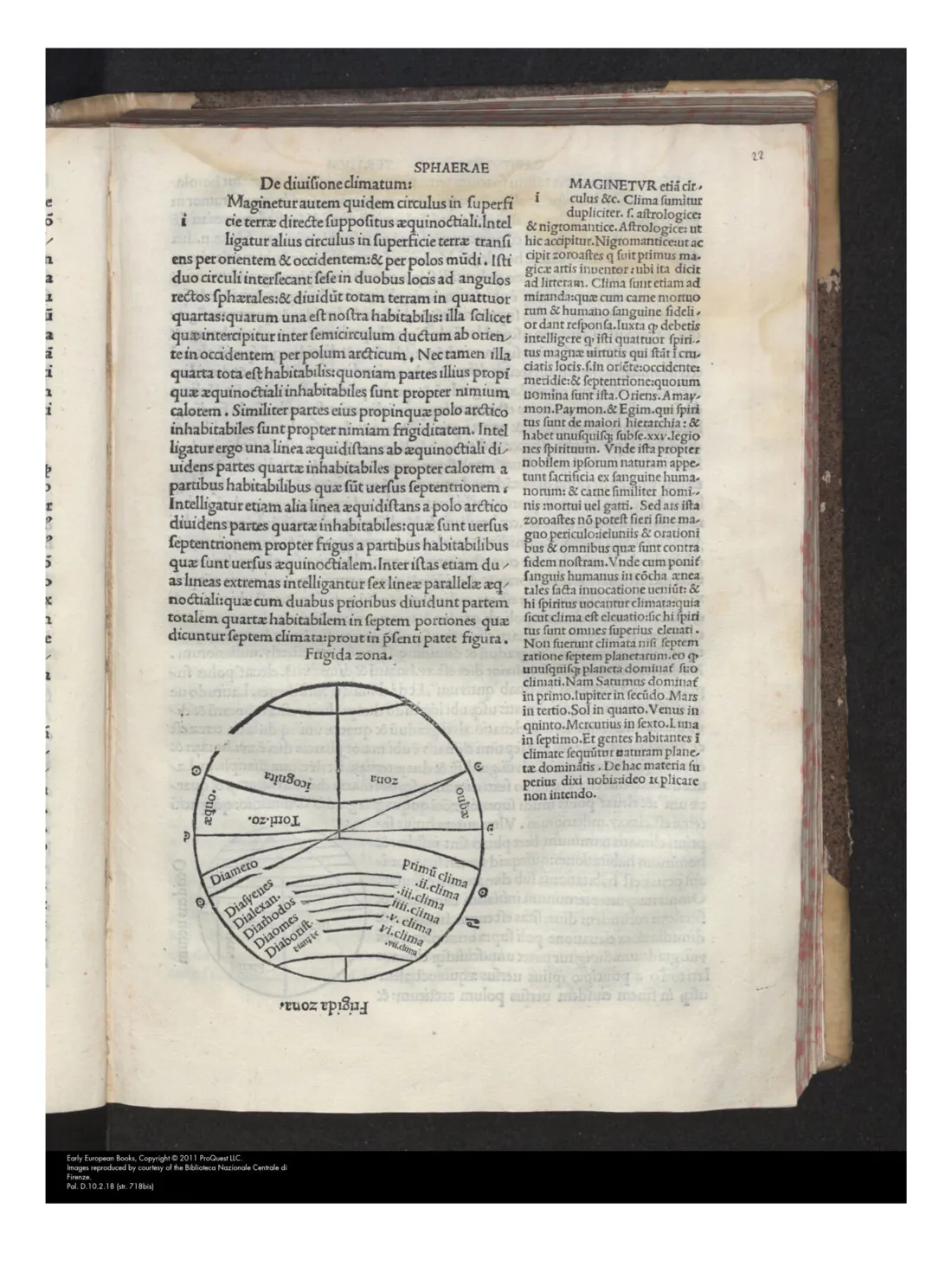
[gloss to «Maginetur etiam circulus…»] Clima sumitur dupliciter, scilicet astrologice et nigromantice. Astrologice, ut hic accipitur. Nigromantice, ut accipit Zoroastes, qui fuit primus magicae artis inventor, ubi ita dicit ad litteram: «Clima sunt etiam admiranda, quae cum carne mortuorum et humano sanguine fideliter dant responsa.» Iuxta quod debetis intelligere quod isti quatuor spiritus magnae virtutis, qui stant in cruciatis locis, scilicet in oriente, occidente, meridie et septentrione, quorum nomina sunt ista: Oriens, Amaymon, Paymon et Egim, qui spiritus sunt de maiori hierarchia, et habet unusquisque sub se XXV legiones spirituum. Unde ista propter nobilem ipsorum naturam appetunt sacrificia ex sanguine humanorum et carne similiter hominis mortui vel gatti[cati]. Sed ars ista Zoroastes non potest fieri sine magno periculo, ieiuniis et orationibus et omnibus quae sunt contra fidem nostram. Unde cum ponitur sanguis humanus in cocha aenea, tales facta invocatione veniunt; et hi spiritus vocantur climata, quia sicut clima est elevatio, sic hi spiritus sunt omnes superius elevati. Non fuerunt climata nisi septem, ratione septem planetarum, eo quod unusquisque planeta dominatur suo climati: nam Saturnus dominatur in primo, Iupiter in secundo, Mars in tertio, Sol in quarto, Venus in quinto, Mercurius in sexto, Luna in septimo. Et gentes habitantes in climate sequuntur naturam planetae dominantis. De hac materia superius dixi vobis, ideo replicare non intendo.

TranslationEnglish

The «clime» is taken in two ways: astrologically and nigromantically. Astrologically, as it is taken here. Nigromantically, as Zoroaster takes it, who was the first inventor of the magic art, where he says thus, to the letter: «The climes are also wondrous things, which with the flesh of the dead and human blood faithfully give answers.» Whereby you must understand that these four spirits of great power, who stand in the crossed places —that is, in the east, west, south and north—, whose names are these: Oriens, Amaymon, Paymon and Egim, who are spirits of the highest hierarchy, and each has under him twenty-five legions of spirits. Wherefore these, on account of their noble nature, crave sacrifices of human blood and likewise of the flesh of a dead man or of a cat. But this art of Zoroaster cannot be performed without great danger, with fasts and prayers and all that is against our faith. Wherefore, when human blood is placed in a bronze vessel, once the invocation is made, such [spirits] come; and these spirits are called «climes», because just as a clime is an elevation, so these spirits are all elevated on high. There were but seven climes, by reason of the seven planets, because each planet rules its clime: for Saturn rules in the first, Jupiter in the second, Mars in the third, the Sun in the fourth, Venus in the fifth, Mercury in the sixth, the Moon in the seventh. And the peoples dwelling in a clime follow the nature of the ruling planet. Of this matter I spoke to you above, so I do not intend to repeat it.
Floron and the steel mirror#2_floron
Cecco d'Ascoli — facsimile page (Floron and the steel mirror) · public-domain facsimile
Sphaera mundi, Venice 1499 (BNCF / Internet Archive)
🔍 click to enlarge

TranscriptionLatin

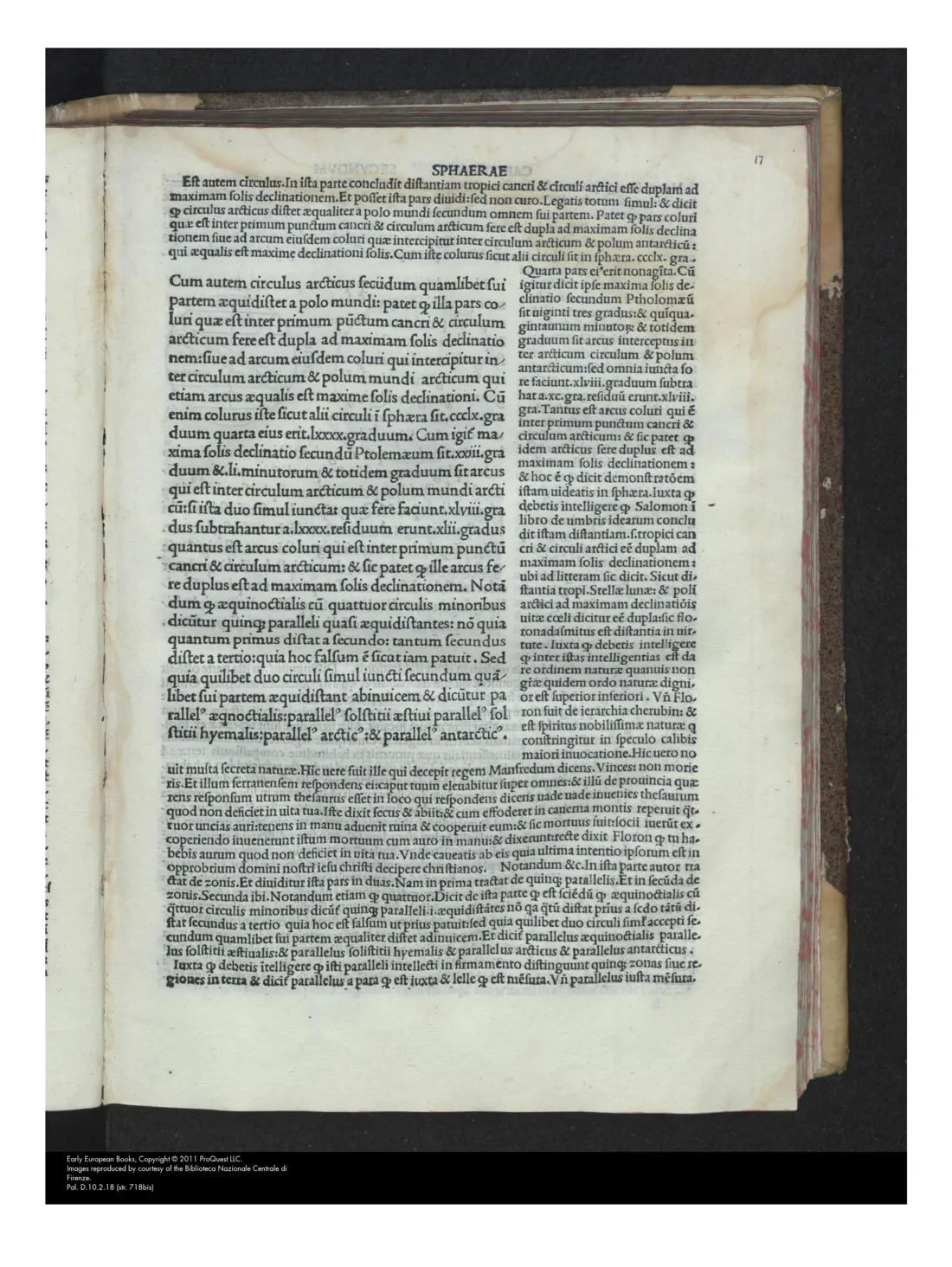
[Hic spiritus] constringitur in speculo chalybe[o] maiori invocatione. Hic vero novit multa secreta [naturae]. Hic vere fuit ille qui decepit regem Manfredum, dicens: «Vinces, non morieris.» Et illum ferrariensem[de Ferrara], respondens ei: «Caput tuum elevabitur super omnes.» Et illum de provincia quaerens responsum utrum thesaurus esset in loco, qui respondens dicens: «Vade, vade, invenies thesaurum quod non deficiet in vita tua.» Iste dixit [gratias?] et abiit; et cum effoderet in caverna montis, reperiit quatuor uncias auri, tenens in manu; advenit ruina et cooperuit eum, et sic mortuus [fuit]. [Illi qui iverunt cum eo], cooperiendo[ aperiendo] invenerunt istum mortuum cum auro in manu, et dixerunt: «Recte dixit Floron, quod habebis aurum quod non deficiet in vita tua.» Unde caveatis ab eis, quia ultima intentio ipsorum est, in opprobrium domini nostri Iesu Christi, decipere christianos.

TranslationEnglish

[This spirit] is constrained in a steel mirror by a greater invocation. He indeed knows many secrets [of nature]. He was truly the one who deceived King Manfred, saying: «You will conquer, you will not die.» And to that man of Ferrara, answering him: «Your head shall be raised above all.» And to that man of the province who asked for an answer whether there was a treasure in a place, answering him: «Go, go, you will find a treasure that will not fail you in your life.» This man [gave thanks] and departed; and while he dug in the cave of a mountain, he found four ounces of gold, holding them in his hand; a collapse came and buried him, and so he died. [Those who went with him], on uncovering him, found this man dead with the gold in his hand, and they said: «Rightly did Floron speak, that you would have gold that would not fail you in your life.» Wherefore beware of them, for their ultimate intention is, to the reproach of our Lord Jesus Christ, to deceive Christians.

The spirits of the poles#3_polos
Cecco d'Ascoli — facsimile page (The spirits of the poles) · public-domain facsimile
Sphaera mundi, Venice 1499 (BNCF / Internet Archive)
🔍 click to enlarge

TranscriptionLatin

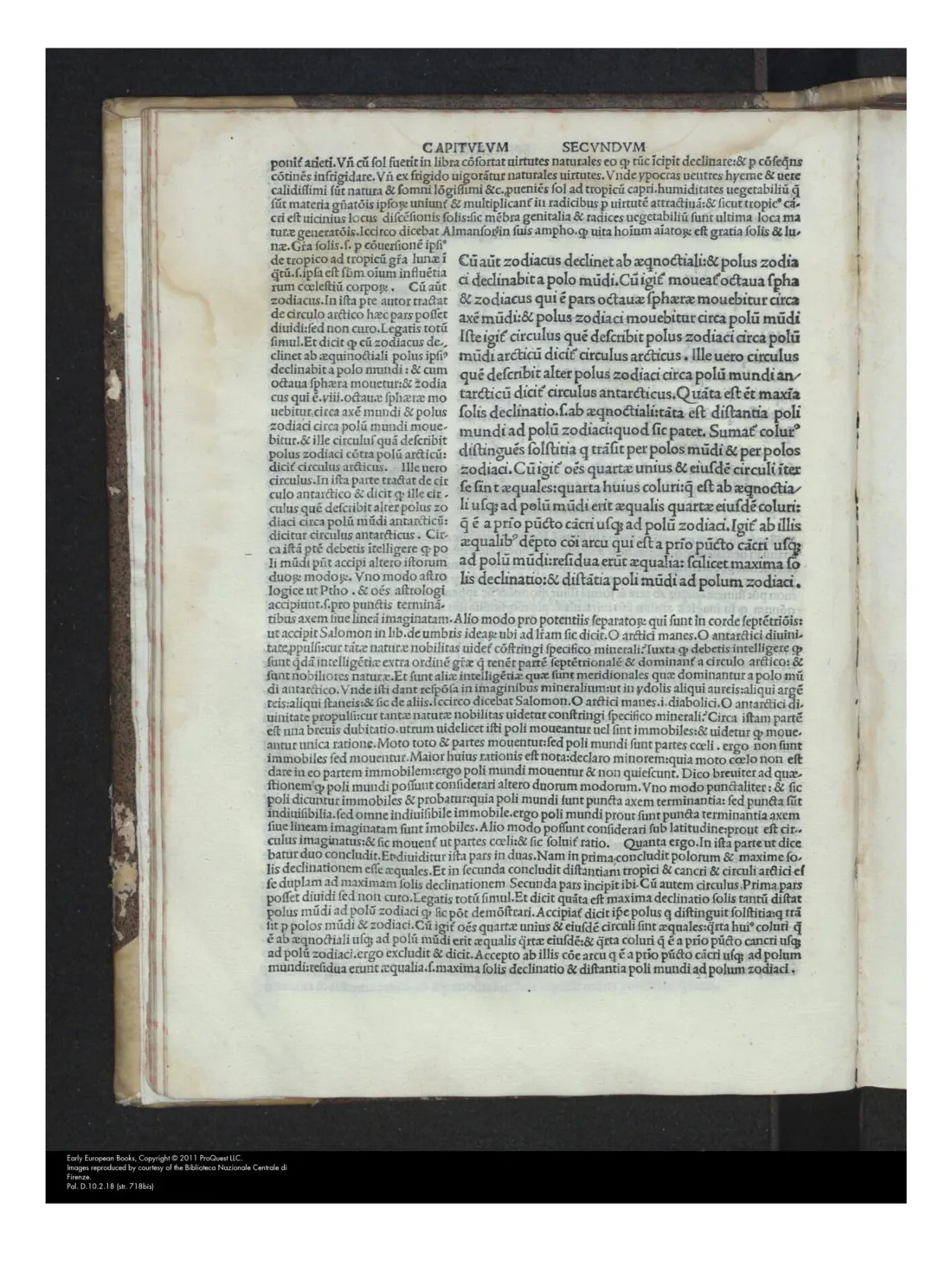
[…] modo pro potentiis separator[um] qui sunt in corde septentrionis; […] ubi ad l[itte]ram sic dicit: «O arctici manes. O antarctici […]». […det]ur constringi specifico minerali. Iuxta quod debetis intelligere quod […] tenet parte[m] septentrionale[m] et dominant[ur] a circulo arctico; et intelligentiae quae sunt meridionales, quae dominantur a polo mundi, […] imaginibus mineralium, ut in ydolis aliqui aureis, aliqui arge[nteis] […] dicebat Salomon: «O arctici manes» .i. diabolici, «O antarctici di[abolici]» […] videtur constringi specifico minerali. Circa istam parte[m]…

TranslationEnglish

[…] in some way, by the separate powers that are in the heart of the north; […] where he says thus, to the letter: «O arctic shades, O antarctic […]». […] it seems to be constrained by a specific mineral. Whereby you must understand that […] holds the northern part and they rule from the arctic circle; and the intelligences that are southern, which rule from the pole of the world, […] by images of minerals, as in idols some of gold, some of silver […] Solomon said: «O arctic shades», that is, diabolical ones, «O antarctic di[abolical]» […] it seems to be constrained by a specific mineral.

Grimorium · grimorium.lat · CC BY 4.0 · Details