Ars Notoria (clásica)

El arte notoria clásico —no la versión abreviada del Lemegeton— · Turner 1657, con las notae iluminadas del Mellon MS 1

Impreso — Turner 1657 · Manuscrito iluminado — Mellon MS 1 (Beinecke)
Descargar PDF ↓
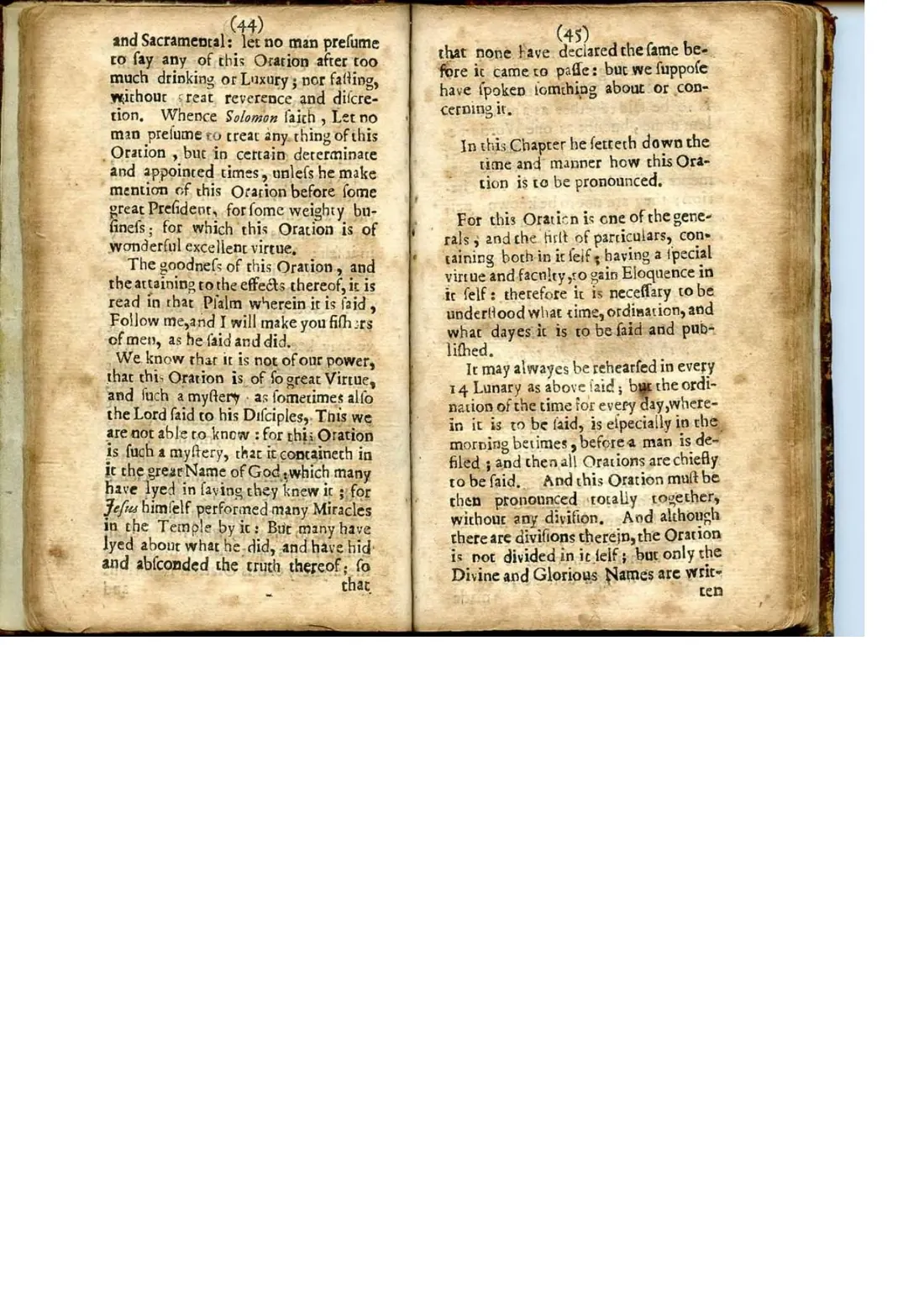
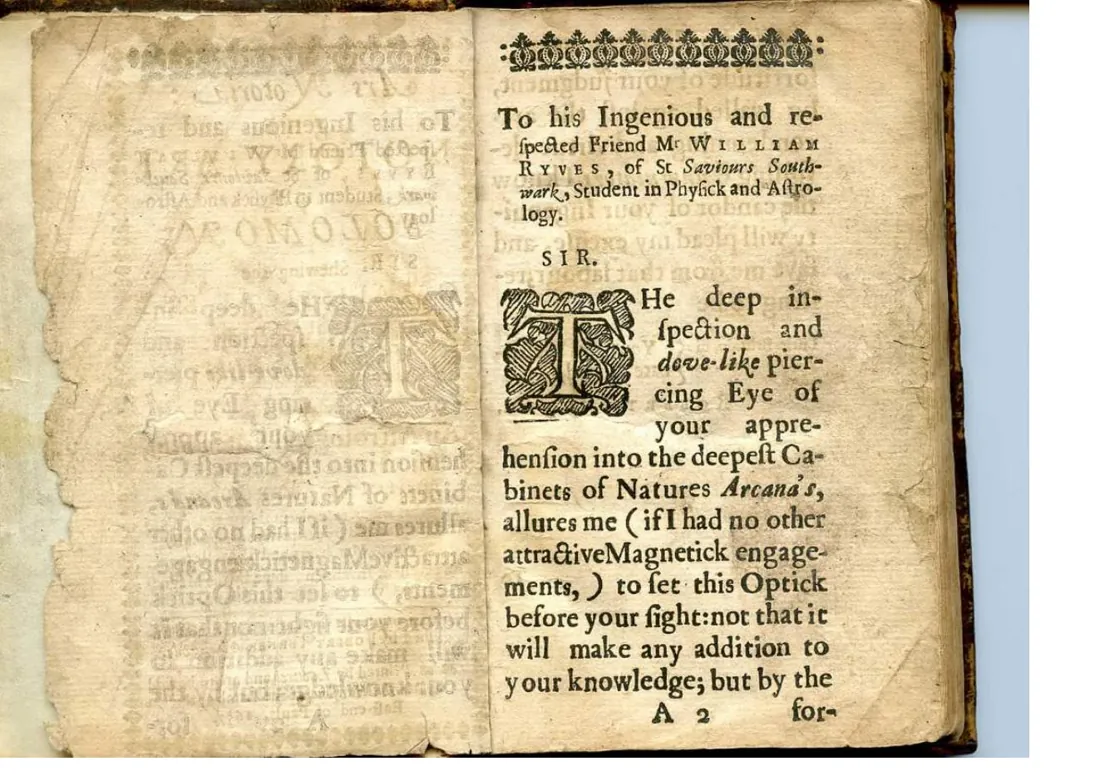
Dedicatoria a William Ryves (inicio)#p003
Ars Notoria (clásica) — facsímil · Dedicatoria a William Ryves (inicio) · dominio público
Impreso — Turner 1657 · Manuscrito iluminado — Mellon MS 1 (Beinecke)
🔍 clic para ampliar

TranscripciónInglés (impreso, 1657)

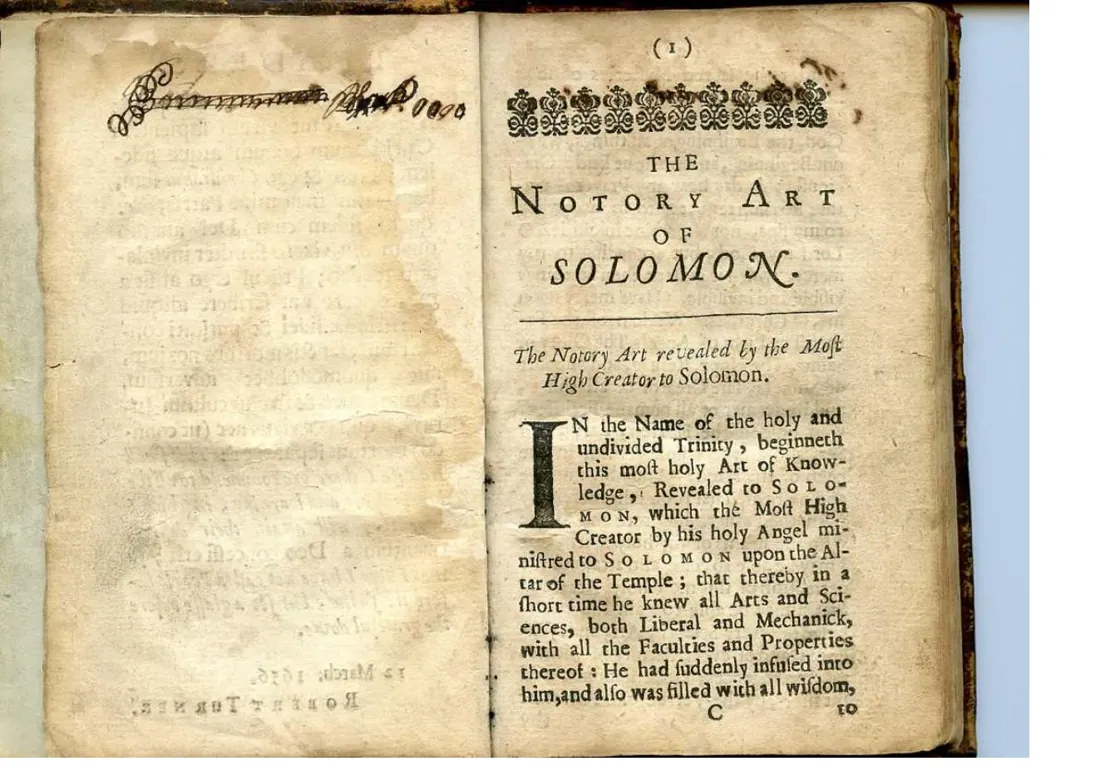
[Página izquierda: verso en blanco de la portada; solo se aprecia la transparencia especular (traspaso) del texto de la portada impreso al otro lado. Sin texto propio.]

To his Ingenious and re- spected Friend Mr WILLIAM RYVES, of St Saviours South- wark, Student in Physick and Astro- logy.

SIR.

THe deep inspection and dove-like piercing Eye of your apprehension into the deepest Cabinets of Natures Arcana's, allures me (if I had no other attractive Magnetick engagements,) to set this Optick before your sight: not that it will make any addition to your knowledge; but by the

A 2    for-

TraducciónEspañol

[Página izquierda: verso en blanco de la portada; solo se percibe la transparencia especular (traspaso) del texto de la portada impresa en la otra cara. Sin texto propio.] A su ingenioso y respetado amigo el Sr. WILLIAM RYVES, de St. Saviour's Southwark, estudiante de física y astrología. Señor. La profunda inspección y el ojo penetrante, semejante al de la paloma, de vuestro entendimiento hacia los más recónditos gabinetes de los arcanos de la naturaleza, me atrae (aun si no tuviera ninguna otra atractiva atadura magnética,) a poner este lente ante vuestra vista: no porque haya de añadir nada a vuestro conocimiento; sino que por la A 2    for-
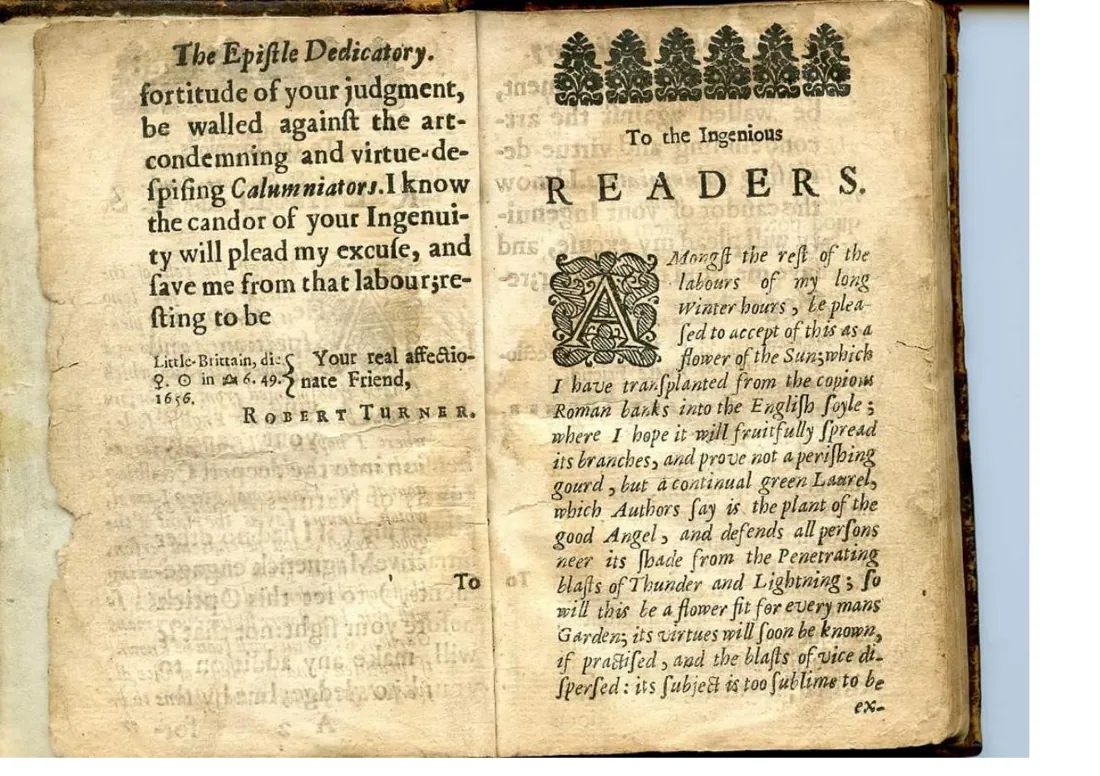
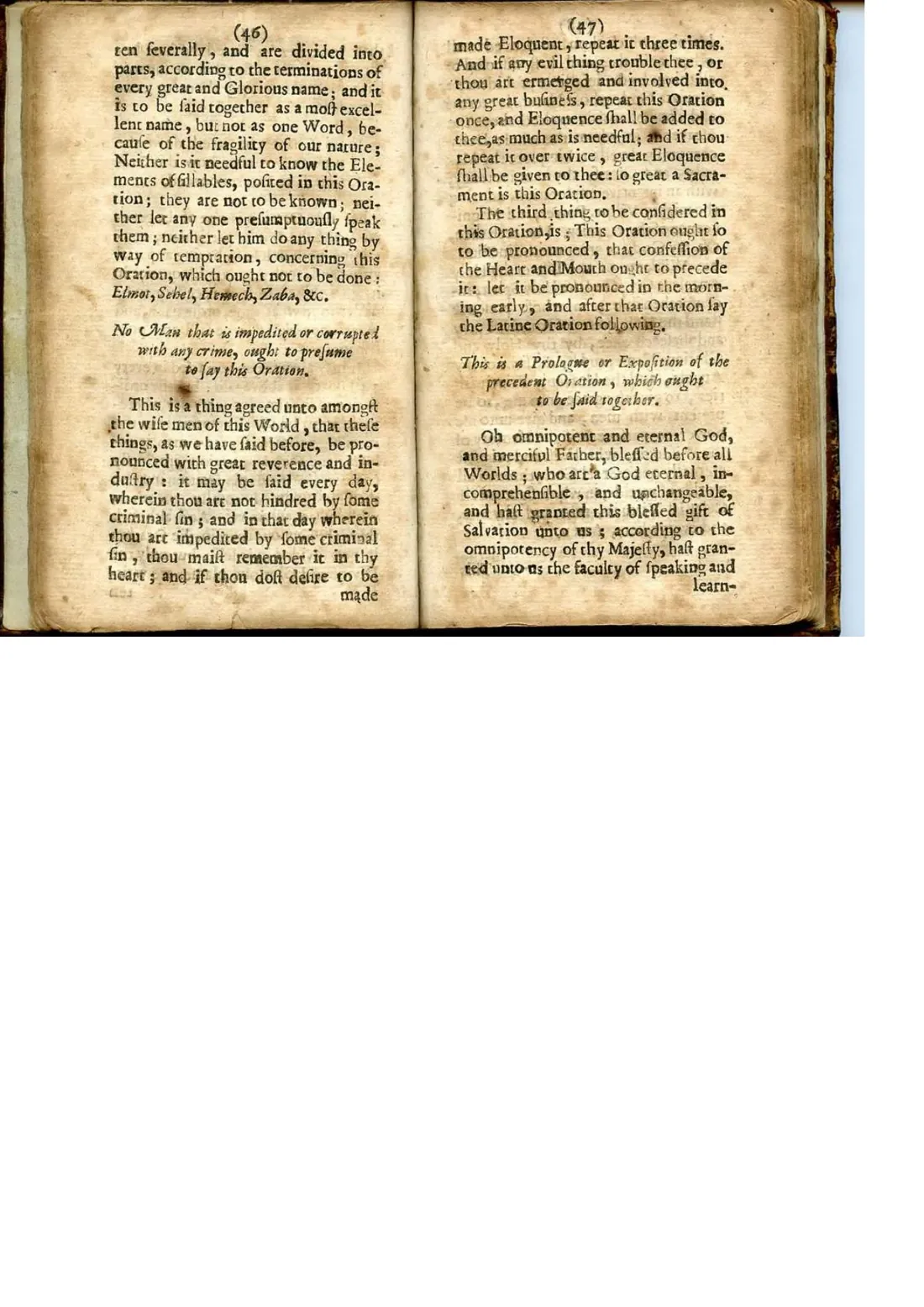
Fin de la Epístola dedicatoria; A los lectores ingeniosos#p005
Ars Notoria (clásica) — facsímil · Fin de la Epístola dedicatoria; A los lectores ingeniosos · dominio público
Impreso — Turner 1657 · Manuscrito iluminado — Mellon MS 1 (Beinecke)
🔍 clic para ampliar

TranscripciónInglés (impreso, 1657)

The Epistle Dedicatory.

fortitude of your judgment, be walled against the art- condemning and virtue-de- spising Calumniators. I know the candor of your Ingenui- ty will plead my excuse, and save me from that labour; re- sting to be

Little-Brittain, die Your real affectio- ♀. ☉ in ♈ 6. 49. nate Friend, 1656.

ROBERT TURNER.

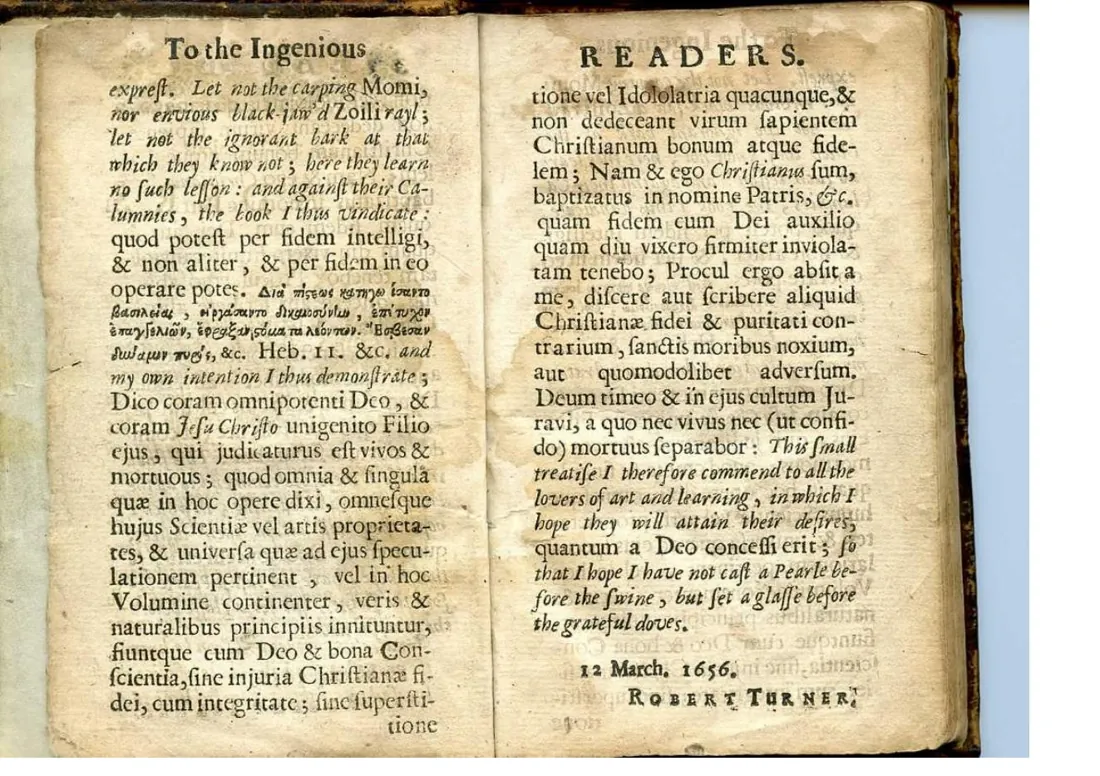
To the Ingenious

READERS.

Amongst the rest of the labours of my long winter hours, be pleased to accept of this as a flower of the Sun; which I have transplanted from the copious Roman banks into the English soyle; where I hope it will fruitfully spread its branches, and prove not a perishing gourd, but a continual green Laurel, which Authors say is the plant of the good Angel, and defends all persons neer its shade from the Penetrating blasts of Thunder and Lightning; so will this be a flower fit for every mans Garden; its virtues will soon be known, if practised, and the blasts of vice dispersed: its subject is too sublime to be ex-

TraducciónEspañol

La Epístola dedicatoria.

La fortaleza de vuestro juicio, quede amurallada contra los calumniadores que condenan el arte y desprecian la virtud. Sé que el candor de vuestro ingenio alegará mi excusa, y me ahorrará ese trabajo; quedando como

Little-Brittain, die Vuestro sincero y afectuoso ♀. ☉ in ♈ 6. 49. amigo, 1656.

ROBERT TURNER. A los ingeniosos

lectores.

Entre las demás labores de mis largas horas de invierno, tened a bien aceptar esta como una flor del Sol; la cual he trasplantado desde las copiosas riberas romanas al suelo inglés; donde espero que extienda fructíferamente sus ramas, y resulte no una calabaza perecedera, sino un laurel siempre verde, que los autores dicen ser la planta del buen Ángel, y defiende a todas las personas que están cerca de su sombra de las penetrantes ráfagas del trueno y el relámpago; así será esta una flor apropiada para el jardín de todo hombre; sus virtudes pronto se conocerán, si se practican, y las ráfagas del vicio se dispersarán: su asunto es demasiado sublime para ser ex-

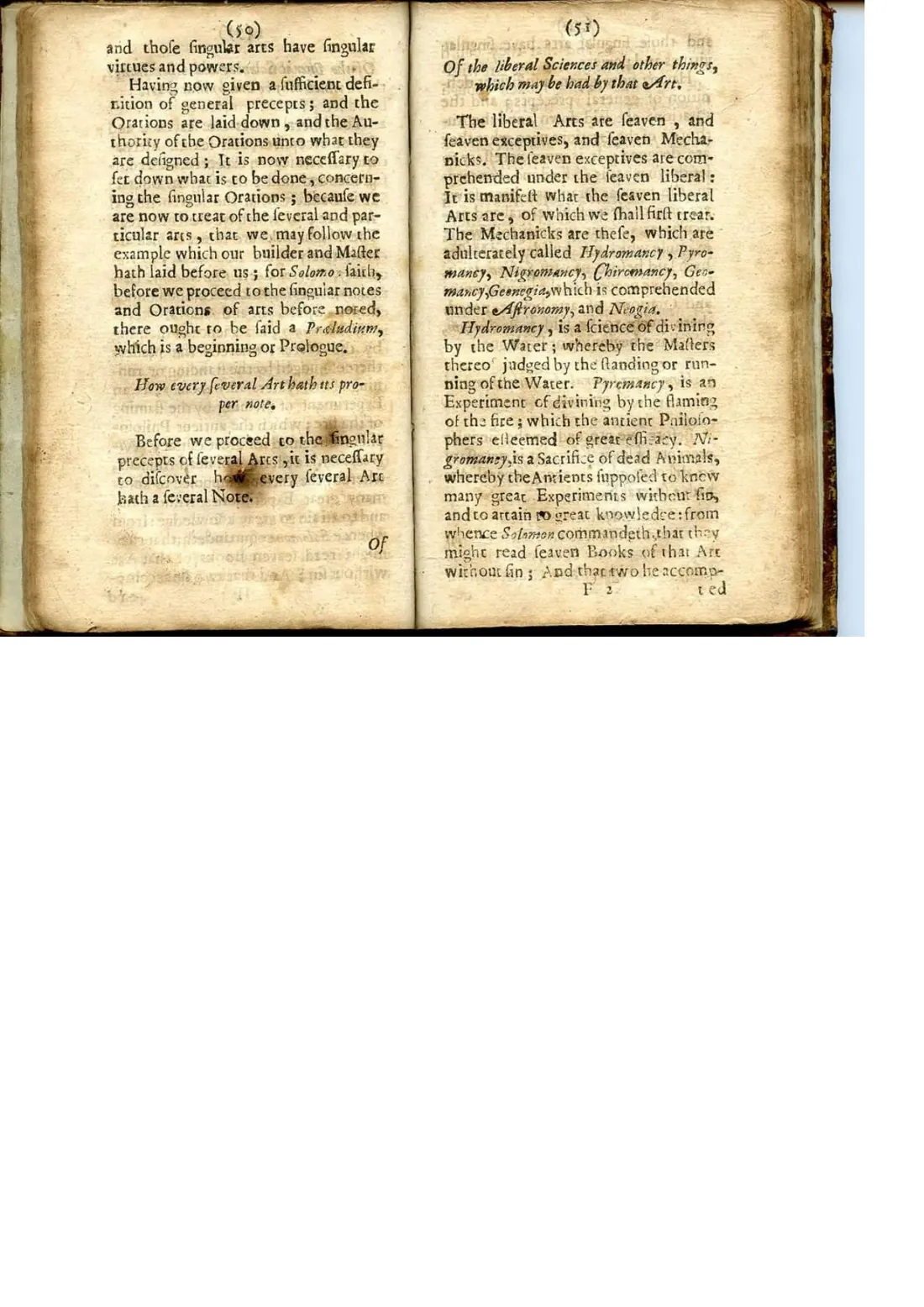
A los lectores ingeniosos (final del prefacio)#p007
Ars Notoria (clásica) — facsímil · A los lectores ingeniosos (final del prefacio) · dominio público
Impreso — Turner 1657 · Manuscrito iluminado — Mellon MS 1 (Beinecke)
🔍 clic para ampliar

TranscripciónInglés (impreso, 1657)

To the Ingenious READERS.

exprest. Let not the carping Momi, nor envious black-jaw'd Zoili rayl; let not the ignorant bark at that which they know not; here they learn no such lesson: and against their Calumnies, the book I thus vindicate: quod potest per fidem intelligi, & non aliter, & per fidem in eo operare potes. Διὰ πίστεως κατηγωνίσαντο βασιλείας, εἰργάσαντο δικαιοσύνην, ἐπέτυχον ἐπαγγελιῶν, ἔφραξαν στόματα λεόντων, ἔσβεσαν δύναμιν πυρός, &c. Heb. 11. &c. and my own intention I thus demonstrate; Dico coram omnipotenti Deo, & coram Jesu Christo unigenito Filio ejus, qui judicaturus est vivos & mortuous; quod omnia & singula quæ in hoc opere dixi, omnesque hujus Scientiæ vel artis proprietates, & universa quæ ad ejus speculationem pertinent, vel in hoc Volumine continenter, veris & naturalibus principiis innituntur, fiuntque cum Deo & bona Conscientia, sine injuria Christianæ fidei, cum integritate; sine superstitione vel Idololatria quacunque, & non dedeceant virum sapientem Christianum bonum atque fidelem; Nam & ego Christianus sum, baptizatus in nomine Patris, &c. quam fidem cum Dei auxilio quam diu vixero firmiter inviolatam tenebo; Procul ergo absit a me, discere aut scribere aliquid Christianæ fidei & puritati contrarium, sanctis moribus noxium, aut quomodolibet adversum. Deum timeo & in ejus cultum Juravi, a quo nec vivus nec (ut confido) mortuus separabor: This small treatise I therefore commend to all the lovers of art and learning, in which I hope they will attain their desires, quantum a Deo concessi erit; so that I hope I have not cast a Pearle before the swine, but set a glasse before the grateful doves.

12 March. 1656. ROBERT TURNER.

TraducciónEspañol

A los lectores ingeniosos.

Expresado. Que no despotriquen los quejumbrosos Momos, ni los envidiosos Zoilos de negra mandíbula; que el ignorante no ladre a aquello que no conoce; aquí no aprenden semejante lección: y contra sus calumnias vindico así el libro: lo que puede entenderse por la fe, y no de otro modo, y por la fe puedes obrar en ello. Διὰ πίστεως κατηγωνίσαντο βασιλείας, εἰργάσαντο δικαιοσύνην, ἐπέτυχον ἐπαγγελιῶν, ἔφραξαν στόματα λεόντων, ἔσβεσαν δύναμιν πυρός, etc. Heb. 11. etc. y mi propia intención la demuestro así; Digo ante Dios omnipotente, y ante Jesucristo su Hijo unigénito, que ha de juzgar a los vivos y a los muertos, que todas y cada una de las cosas que dije en esta obra, y todas las propiedades de esta ciencia o arte, y todo cuanto atañe a su especulación, o se contiene en este volumen, se apoyan en principios verdaderos y naturales, y se hacen con Dios y con buena conciencia, sin injuria de la fe cristiana, con integridad; sin superstición ni idolatría alguna, y que no desdicen de un varón sabio, cristiano, bueno y fiel; pues también yo soy cristiano, bautizado en el nombre del Padre, etc. Cuya fe, con el auxilio de Dios, mientras viva mantendré firme e inviolada; lejos, pues, esté de mí aprender o escribir algo contrario a la fe y a la pureza cristiana, nocivo a las santas costumbres, o de cualquier modo adverso. Temo a Dios y he jurado por su culto, del cual ni vivo ni (según confío) muerto seré separado: This small treatise I therefore commend to all the lovers of art and learning, in which I hope they will attain their desires, quantum a Deo concessi erit; so that I hope I have not cast a Pearle before the swine, but set a glasse before the grateful doves. [este pequeño tratado lo encomiendo, pues, a todos los amantes del arte y del saber, en el cual espero que alcancen sus deseos, en cuanto Dios lo haya concedido; de modo que espero no haber echado una perla ante los cerdos, sino haber puesto un espejo ante las agradecidas palomas.]

12 de marzo. 1656. ROBERT TURNER.

El Arte Notoria de Salomón (comienzo)#p009
Ars Notoria (clásica) — lámina grabada · El Arte Notoria de Salomón (comienzo) · dominio público
Impreso — Turner 1657 · Manuscrito iluminado — Mellon MS 1 (Beinecke)
🔍 clic para ampliar

TranscripciónInglés (impreso, 1657)

(1)

[figura: friso ornamental tipográfico a lo ancho de la caja]

THE NOTORY ART OF SOLOMON.

———

The Notory Art revealed by the Most High Creator to Solomon.

IN the Name of the holy and undivided Trinity, beginneth this most holy Art of Knowledge, Revealed to SOLOMON, which the Most High Creator by his holy Angel ministred to SOLOMON upon the Altar of the Temple; that thereby in a short time he knew all Arts and Sciences, both Liberal and Mechanick, with all the Faculties and Properties thereof: He had suddenly infused into him, and also was filled with all wisdom,

C

TraducciónEspañol

(1)

[figura: friso ornamental tipográfico a lo ancho de la caja]

El arte notoria de SALOMÓN.

———

El arte notoria revelada por el Altísimo Creador a Salomón.

En el nombre de la santa e indivisa Trinidad, comienza este santísimo arte del conocimiento, revelada a SALOMÓN, la cual el Altísimo Creador, por medio de su santo ángel, administró a SALOMÓN sobre el altar del Templo; para que así, en breve tiempo, conociese todas las artes y ciencias, tanto liberales como mecánicas, con todas sus facultades y propiedades: le fueron súbitamente infundidas, y quedó también colmado de toda sabiduría,

Oración para memoria y entendimiento#p011
Ars Notoria (clásica) — facsímil · Oración para memoria y entendimiento · dominio público
Impreso — Turner 1657 · Manuscrito iluminado — Mellon MS 1 (Beinecke)
🔍 clic para ampliar

TranscripciónInglés (impreso, 1657)

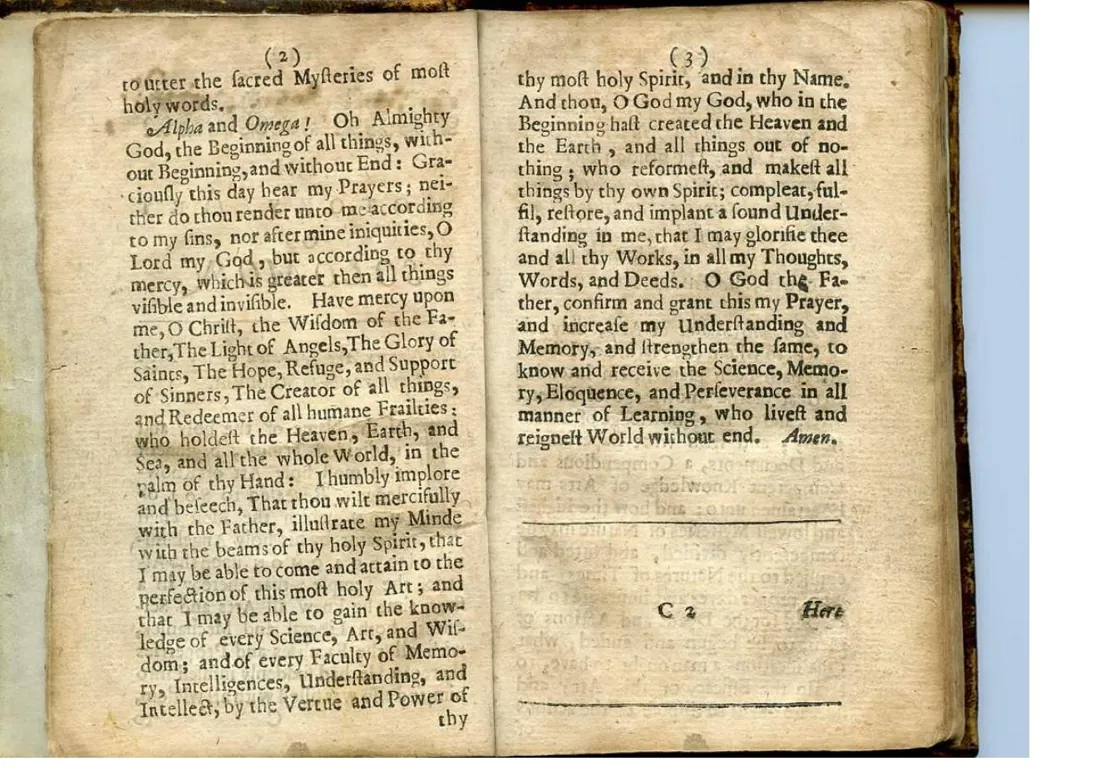
(2)

to utter the sacred Mysteries of most holy words.

Alpha and Omega! Oh Almighty God, the Beginning of all things, without Beginning, and without End : Graciously this day hear my Prayers ; neither do thou render unto me according to my sins, nor after mine iniquities, O Lord my God, but according to thy mercy, which is greater then all things visible and invisible. Have mercy upon me, O Christ, the Wisdom of the Father, The Light of Angels, The Glory of Saints, The Hope, Refuge, and Support of Sinners, The Creator of all things, and Redeemer of all humane Frailties ; who holdest the Heaven, Earth, and Sea, and all the whole World, in the palm of thy Hand: I humbly implore and beseech, That thou wilt mercifully with the Father, illustrate my Minde with the beams of thy holy Spirit, that I may be able to come and attain to the perfection of this most holy Art; and that I may be able to gain the knowledge of every Science, Art, and Wisdom; and of every Faculty of Memory, Intelligence, Understanding, and Intellect, by the Vertue and Power of thy

(3)

thy most holy Spirit, and in thy Name. And thou, O God my God, Who in the Beginning hast created the Heaven and the Earth, and all things out of nothing ; who reformest, and makest all things by thy own Spirit; compleat, fulfil, restore, and implant a sound understanding in me, that I may glorifie thee and all thy Works, in all my Thoughts, Words, and Deeds. O God the Father, confirm and grant this my Prayer, and increase my understanding and Memory, and strengthen the same, to know and receive the Science, Memory, Eloquence, and Perseverance in all manner of Learning, who livest and reignest World without end. Amen.

C 2    Here

TraducciónEspañol

(2)

para proferir los sagrados misterios de palabras santísimas.

Alpha and Omega! Oh Dios Todopoderoso, el principio de todas las cosas, sin principio y sin fin : escucha benignamente en este día mis oraciones ; ni me pagues conforme a mis pecados, ni según mis iniquidades, oh Señor mi Dios, sino conforme a tu misericordia, que es mayor que todas las cosas visibles e invisibles. Ten misericordia de mí, oh Cristo, sabiduría del Padre, luz de los Ángeles, gloria de los Santos, esperanza, refugio y sustento de los Pecadores, creador de todas las cosas y redentor de todas las flaquezas humanas ; tú que sostienes el Cielo, la Tierra y el Mar, y todo el Mundo entero, en la palma de tu mano: humildemente imploro y suplico que tú, misericordiosamente con el Padre, ilumines mi mente con los rayos de tu santo Espíritu, para que pueda llegar y alcanzar la perfección de este santísimo arte; y para que pueda ganar el conocimiento de toda ciencia, arte y sabiduría; y de toda facultad de memoria, inteligencia, entendimiento e intelecto, por la virtud y poder de tu

(3)

santísimo Espíritu, y en tu Nombre. Y tú, oh Dios mi Dios, que en el principio has creado el Cielo y la Tierra, y todas las cosas de la nada ; tú que reformas y haces todas las cosas por tu propio Espíritu; completa, cumple, restaura e implanta en mí un sano entendimiento, para que pueda glorificarte a ti y a todas tus obras, en todos mis pensamientos, palabras y obras. Oh Dios Padre, confirma y concede esta mi oración, y aumenta mi entendimiento y memoria, y fortalece lo mismo, para conocer y recibir la ciencia, memoria, elocuencia y perseverancia en toda manera de aprendizaje, tú que vives y reinas por los siglos de los siglos. Amén.

C 2    Here

Flores doradas y eficacia de las palabras#p013
Ars Notoria (clásica) — facsímil · Flores doradas y eficacia de las palabras · dominio público
Impreso — Turner 1657 · Manuscrito iluminado — Mellon MS 1 (Beinecke)
🔍 clic para ampliar

TranscripciónInglés (impreso, 1657)

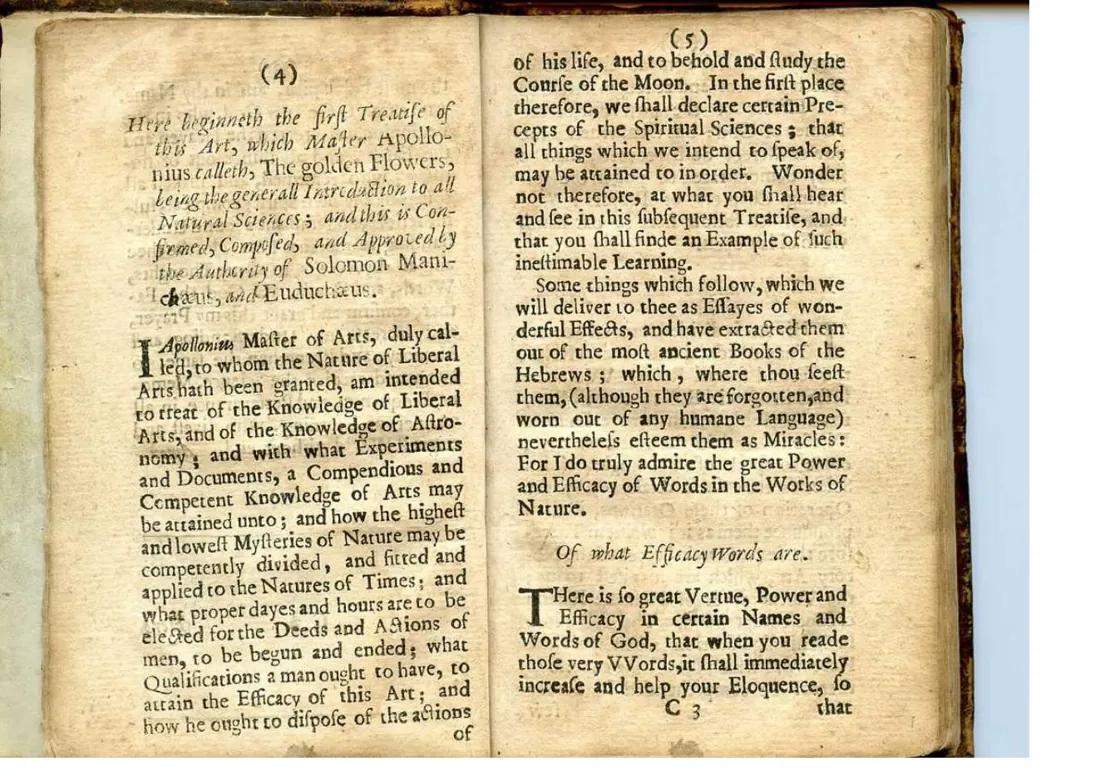
(4)

Here beginneth the first Treatise of this Art, which Master Apollonius calleth, The golden Flowers, being the generall Introduction to all Natural Sciences ; and this is Confirmed, Composed, and Approved by the Authority of Solomon Manicheus, and Euduchæus.

I Apollonius Master of Arts, duly called; to whom the Nature of Liberal Arts hath been granted, am intended to treat of the Knowledge of Liberal Arts, and of the Knowledge of Astronomy ; and with what Experiments and Documents, a Compendious and Competent Knowledge of Arts may be attained unto ; and how the highest and lowest Mysteries of Nature may be competently divided, and fitted and applied to the Natures of Times ; and what proper dayes and hours are to be elected for the Deeds and Actions of men, to be begun and ended; what Qualifications a man ought to have, to attain the Efficacy of this Art; and how he ought to dispose of the actions

(5)

of his life, and to behold and study the Course of the Moon. In the first place therefore, we shall declare certain Precepts of the Spiritual Sciences ; that all things which we intend to speak of, may be attained to in order. Wonder not therefore, at what you shall hear and see in this subsequent Treatise, and that you shall finde an Example of such inestimable Learning.

Some things which follow, which we will deliver to thee as Essayes of wonderful Effects, and have extracted them out of the most ancient Books of the Hebrews ; which, where thou seest them, (although they are forgotten,and worn out of any humane Language) neverthelesse esteem them as Miracles: For I do truly admire the great Power and Efficacy of Words in the Works of Nature.

Of what Efficacy Words are.

THere is so great Vertue, Power and Efficacy in certain Names and Words of God, that when you reade those very VVords,it shall immediately increase and help your Eloquence, so

C 3    that

TraducciónEspañol

(4)

Aquí comienza el primer tratado de este arte, que el maestro Apollonius llama The golden Flowers, siendo la introducción general a todas las ciencias naturales; y esto está confirmado, compuesto y aprobado por la autoridad de Solomon Manicheus, y Euduchæus.

Yo, Apollonius maestro de artes, debidamente llamado; a quien ha sido concedida la naturaleza de las artes liberales, estoy destinado a tratar del conocimiento de las artes liberales, y del conocimiento de la astronomía; y con qué experimentos y documentos puede alcanzarse un conocimiento compendioso y competente de las artes; y cómo los más altos y más bajos misterios de la naturaleza pueden ser competentemente divididos, y ajustados y aplicados a las naturalezas de los tiempos; y qué días y horas propios han de ser elegidos para que los hechos y acciones de los hombres sean comenzados y terminados; qué cualificaciones debe tener un hombre para alcanzar la eficacia de este arte; y cómo debe disponer las acciones

(5)

de su vida, y contemplar y estudiar el curso de la Luna. En primer lugar, por tanto, declararemos ciertos preceptos de las ciencias espirituales; para que todas las cosas de las que intentamos hablar puedan alcanzarse en orden. No te maravilles, por tanto, de lo que oirás y verás en este tratado subsiguiente, y de que encontrarás un ejemplo de tan inestimable aprendizaje.

Algunas cosas que siguen, que te entregaremos como ensayos de efectos maravillosos, y que hemos extraído de los libros más antiguos de los hebreos; las cuales, donde las veas, (aunque estén olvidadas, y desgastadas fuera de cualquier lengua humana) estímalas, no obstante, como milagros: pues verdaderamente admiro el gran poder y eficacia de las palabras en las obras de la naturaleza.

De qué eficacia son las palabras.

Hay tan gran virtud, poder y eficacia en ciertos nombres y palabras de Dios, que cuando leas esas mismas palabras, ello aumentará y ayudará inmediatamente tu elocuencia, de modo que

C 3    that

Una Explicación del Arte Notoria; el primer Precepto#p015
Ars Notoria (clásica) — facsímil · Una Explicación del Arte Notoria; el primer Precepto · dominio público
Impreso — Turner 1657 · Manuscrito iluminado — Mellon MS 1 (Beinecke)
🔍 clic para ampliar

TranscripciónInglés (impreso, 1657)

(6)

that you shall be made eloquent of speech by them, and at length attain to the Effects of the powerful Sacred Names of God: but from whence the power hereof doth proceed, shall be fully demonstrated to you in the following Chapters of Prayers: And those which follow next to our hand, we shall lay open.

An Explanation of the Notory Art.

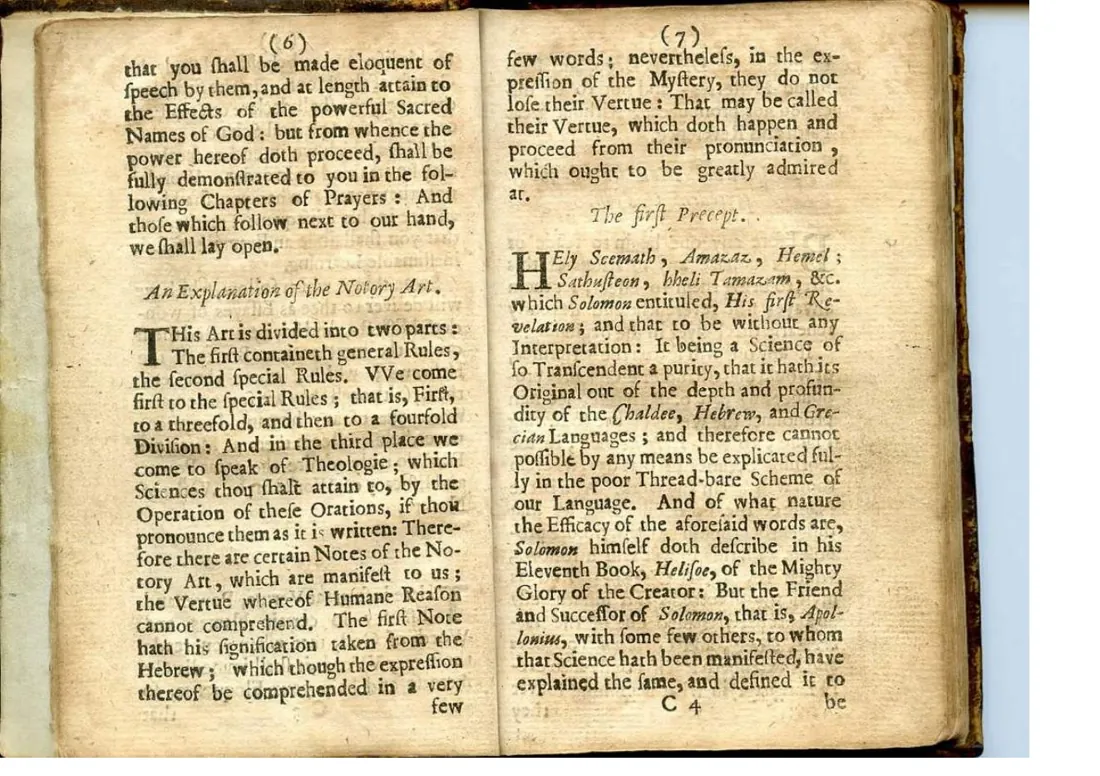
THis Art is divided into two parts: The first containeth general Rules, the second special Rules. VVe come first to the special Rules; that is, First, to a threefold, and then to a fourfold Division: And in the third place we come to speak of Theologie; which Sciences thou shalt attain to, by the Operation of these Orations, if thou pronounce them as it is written: Therefore there are certain Notes of the Notory Art, which are manifest to us; the Vertue whereof Humane Reason cannot comprehend. The first Note hath his signification taken from the Hebrew; which though the expression thereof be comprehended in a very few

(7)

few words; nevertheless, in the expression of the Mystery, they do not lose their Vertue: That may be called their Vertue, which doth happen and proceed from their pronunciation, which ought to be greatly admired at.

The first Precept.

HEly Scemath, Amazaz, Hemel; Sathusteon, bheli Tamazam, &c. which Solomon entituled, His first Revelation; and that to be without any Interpretation: It being a Science of so Transcendent a purity, that it hath its Original out of the depth and profundity of the Chaldee, Hebrew, and Grecian Languages; and therefore cannot possible by any means be explicated fully in the poor Thread-bare Scheme of our Language. And of what nature the Efficacy of the aforesaid words are, Solomon himself doth describe in his Eleventh Book, Helisoe, of the Mighty Glory of the Creator: But the Friend and Successor of Solomon, that is, Apollonius, with some few others, to whom that Science hath been manifested, have explained the same, and defined it to

C 4    be

TraducciónEspañol

(6)

que seréis hechos elocuentes en el habla por ellos, y al fin alcanzaréis los efectos de los poderosos sagrados nombres de Dios: pero de dónde procede este poder, se os demostrará plenamente en los siguientes capítulos de oraciones: y aquellos que siguen a continuación, junto a nuestra mano, los expondremos.

Una explicación del Arte Notoria.

Este Arte se divide en dos partes: la primera contiene reglas generales, la segunda reglas especiales. Llegamos primero a las reglas especiales; esto es, primero, a una división triple, y luego a una cuádruple: y en tercer lugar venimos a hablar de la teología; cuyas ciencias alcanzarás, por la operación de estas oraciones, si las pronuncias tal como están escritas: por tanto hay ciertas notas del Arte Notoria, que nos son manifiestas; cuya virtud la razón humana no puede comprender. La primera nota tiene su significación tomada del hebreo; la cual, aunque su expresión esté comprendida en muy pocas

(7)

pocas palabras; sin embargo, en la expresión del misterio, no pierden su virtud: puede llamarse su virtud aquella que sucede y procede de su pronunciación, la cual debe ser grandemente admirada.

El primer precepto.

Hely Scemath, Amazaz, Hemel; Sathusteon, bheli Tamazam, &c. a lo cual Salomón tituló su primera revelación; y ello sin interpretación alguna: siendo una ciencia de tan trascendente pureza, que tiene su origen en la hondura y profundidad de las lenguas caldea, hebrea y griega; y por tanto no puede de ningún modo ser explicada plenamente en el pobre y raído esquema de nuestra lengua. Y de qué naturaleza es la eficacia de las susodichas palabras, el mismo Salomón lo describe en su undécimo libro, Helisoe, de la poderosa gloria del Creador: pero el amigo y sucesor de Salomón, esto es, Apolonio, con algunos pocos más, a quienes esa ciencia ha sido manifestada, han explicado lo mismo, y lo han definido como

C 4    be

Mandato espiritual y exposición de la Oración#p017
Ars Notoria (clásica) — facsímil · Mandato espiritual y exposición de la Oración · dominio público
Impreso — Turner 1657 · Manuscrito iluminado — Mellon MS 1 (Beinecke)
🔍 clic para ampliar

TranscripciónInglés (impreso, 1657)

(8)

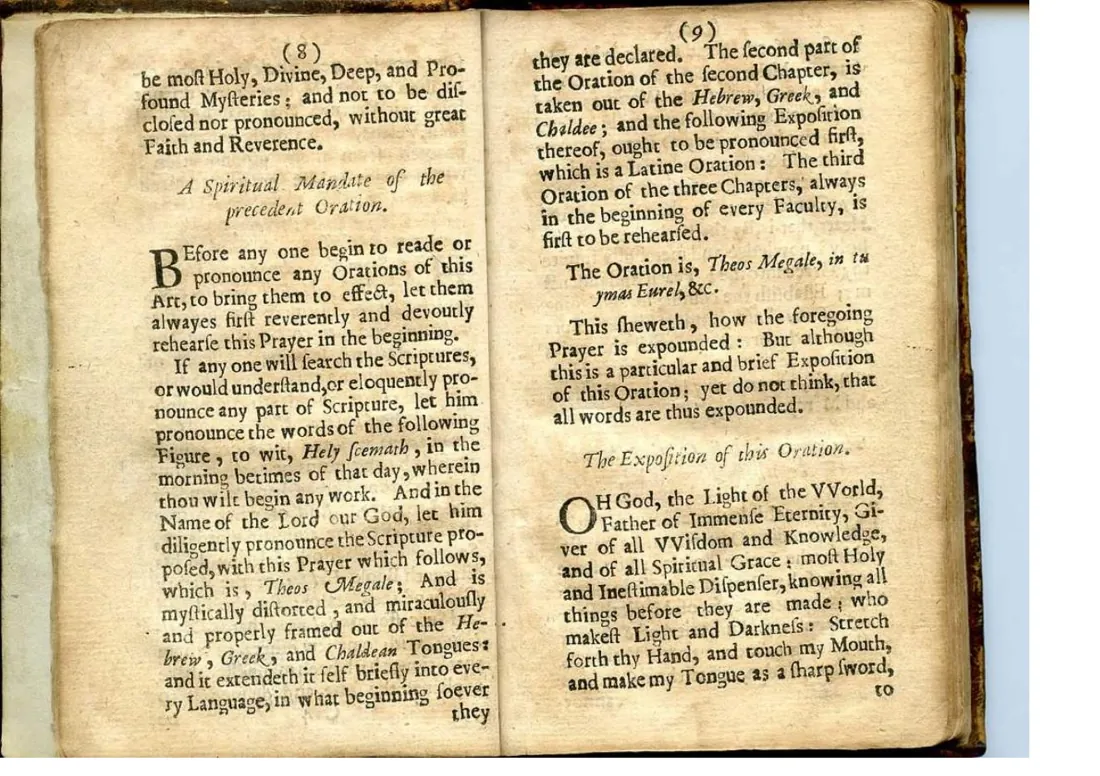
be most Holy, Divine, Deep, and Pro- found Mysteries; and not to be dis- closed nor pronounced, without great Faith and Reverence.

A Spiritual Mandate of the precedent Oration.

BEfore any one begin to reade or pronounce any Orations of this Art, to bring them to effect, let them alwayes first reverently and devoutly rehearse this Prayer in the beginning.

If any one will search the Scriptures, or would understand, or eloquently pro- nounce any part of Scripture, let him pronounce the words of the following Figure, to wit, Hely scemath, in the morning betimes of that day, wherein thou wilt begin any work. And in the Name of the Lord our God, let him diligently pronounce the Scripture pro- posed, with this Prayer which follows, which is, Theos Megale; And is mystically distorted, and miraculously and properly framed out of the He- brew, Greek, and Chaldean Tongues: and it extendeth it self briefly into eve- ry Language, in what beginning soever they

(9)

they are declared. The second part of the Oration of the second Chapter, is taken out of the Hebrew, Greek, and Chaldee; and the following Exposition thereof, ought to be pronounced first, which is a Latine Oration: The third Oration of the three Chapters, always in the beginning of every Faculty, is first to be rehearsed.

The Oration is, Theos Megale, in tu ymas Eurel, &c.

This sheweth, how the foregoing Prayer is expounded: But although this is a particular and brief Exposition of this Oration; yet do not think, that all words are thus expounded.

The Exposition of this Oration.

OH God, the Light of the VVorld, Father of Immense Eternity, Gi- ver of all VVisdom and Knowledge, and of all Spiritual Grace: most Holy and Inestimable Dispenser, knowing all things before they are made; who makest Light and Darkness: Stretch forth thy Hand, and touch my Mouth, and make my Tongue as a sharp sword, to

TraducciónEspañol

(8)

sean los más santos, divinos, profundos y recónditos misterios; y que no han de ser revelados ni pronunciados sin gran fe y reverencia.

Un mandato espiritual de la oración precedente.

Antes de que alguien comience a leer o a pronunciar cualquiera de las oraciones de este arte, para llevarlas a efecto, que siempre primero, reverente y devotamente, recite esta plegaria al comienzo.

Si alguien quiere escudriñar las Escrituras, o desea comprender, o pronunciar con elocuencia cualquier parte de la Escritura, que pronuncie las palabras de la figura siguiente, a saber, Hely scemath, de mañana temprano de aquel día en que hayas de comenzar cualquier obra. Y en el Nombre del Señor nuestro Dios, que pronuncie diligentemente la Escritura propuesta, con esta plegaria que sigue, que es Theos Megale; y está místicamente alterada, y milagrosa y propiamente compuesta de las lenguas hebrea, griega y caldea: y se extiende brevemente a toda lengua, en cualquier comienzo en que

(9)

se declaren. La segunda parte de la oración del segundo capítulo está tomada de la hebrea, griega y caldea; y la exposición siguiente de la misma ha de pronunciarse primero, la cual es una oración latina: la tercera oración de los tres capítulos, siempre al comienzo de cada facultad, ha de recitarse primero.

La oración es Theos Megale, in tu ymas Eurel, etcétera.

Esto muestra cómo se expone la plegaria anterior: pero, aunque esta es una exposición particular y breve de esta oración, no pienses, sin embargo, que todas las palabras se exponen así.

La exposición de esta oración.

Oh Dios, Luz del Mundo, Padre de la Inmensa Eternidad, Dador de toda Sabiduría y Conocimiento, y de toda Gracia Espiritual: Santísimo e Inestimable Dispensador, que conoces todas las cosas antes de que sean hechas; que haces la Luz y las Tinieblas: extiende tu Mano y toca mi Boca, y haz de mi Lengua una espada afilada, para

Lunaciones y primera Figura#p021
Ars Notoria (clásica) — facsímil · Lunaciones y primera Figura · dominio público
Impreso — Turner 1657 · Manuscrito iluminado — Mellon MS 1 (Beinecke)
🔍 clic para ampliar

TranscripciónInglés (impreso, 1657)

(12)

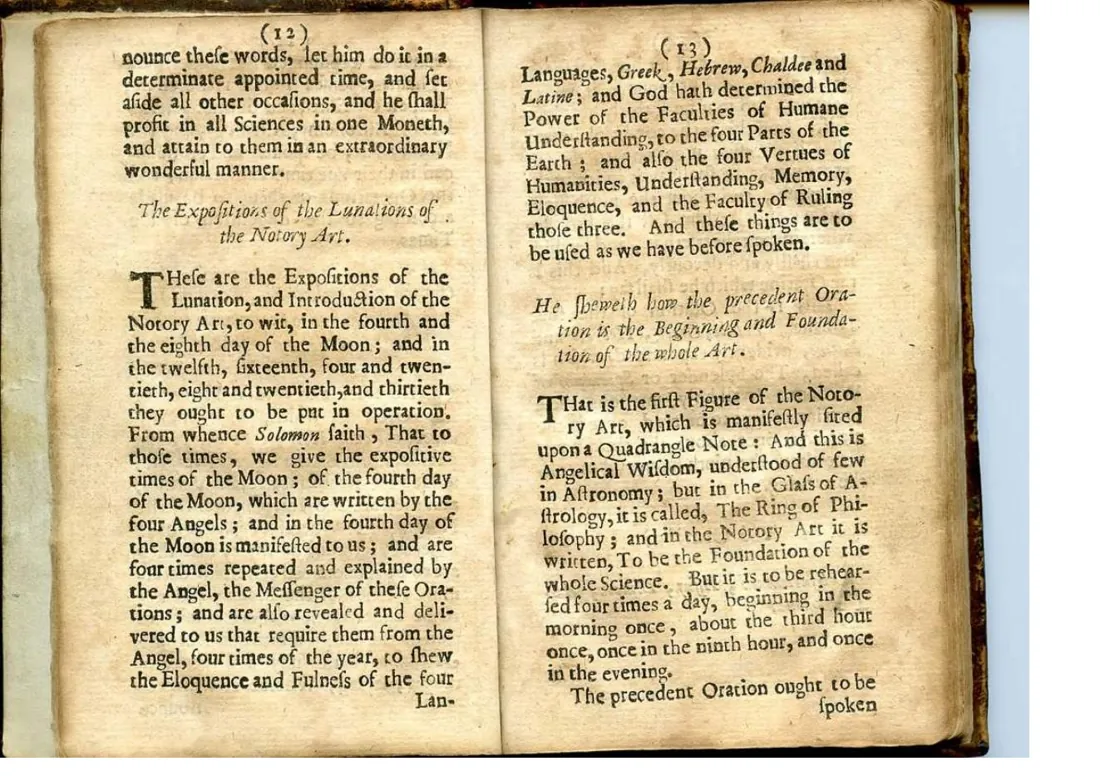
nounce these words, let him do it in a determinate appointed time, and set aside all other occasions, and he shall profit in all Sciences in one Moneth, and attain to them in an extraordinary wonderful manner.

The Expositions of the Lunations of the Notory Art.

THese are the Expositions of the Lunation, and Introduction of the Notory Art, to wit, in the fourth and the eighth day of the Moon; and in the twelfth, sixteenth, four and twen- tieth, eight and twentieth, and thirtieth they ought to be put in operation. From whence Solomon saith, That to those times, we give the expositive times of the Moon; of the fourth day of the Moon, which are written by the four Angels; and in the fourth day of the Moon is manifested to us; and are four times repeated and explained by the Angel, the Messenger of these Ora- tions; and are also revealed and deli- vered to us that require them from the Angel, four times of the year, to shew the Eloquence and Fulness of the four Lan-

(13)

Languages, Greek, Hebrew, Chaldee and Latine; and God hath determined the Power of the Faculties of Humane Understanding, to the four Parts of the Earth; and also the four Vertues of Humanities, Understanding, Memory, Eloquence, and the Faculty of Ruling those three. And these things are to be used as we have before spoken.

He sheweth how the precedent Ora- tion is the Beginning and Founda- tion of the whole Art.

THat is the first Figure of the Noto- ry Art, which is manifestly sited upon a Quadrangle Note: And this is Angelical Wisdom, understood of few in Astronomy; but in the Glass of A- strology, it is called, The Ring of Phi- losophy; and in the Notory Art it is written, To be the Foundation of the whole Science. But it is to be rehear- sed four times a day, beginning in the morning once, about the third hour once, once in the ninth hour, and once in the evening.

The precedent Oration ought to be spoken

TraducciónEspañol

(12)

[pro]nuncie estas palabras, hágalo en un tiempo determinado y señalado, y aparte todas las demás ocasiones, y aprovechará en todas las ciencias en un mes, y las alcanzará de una manera extraordinaria y maravillosa.

Las exposiciones de las lunaciones del Arte Notorio.

Estas son las exposiciones de la lunación, e introducción del Arte Notorio, a saber, en el cuarto y el octavo día de la Luna; y en el duodécimo, decimosexto, vigésimo cuarto, vigésimo octavo, y trigésimo deben ponerse en operación. De donde Salomón dice, que a esos tiempos damos los tiempos expositivos de la Luna; del cuarto día de la Luna, que están escritos por los cuatro Ángeles; y en el cuarto día de la Luna se nos manifiesta; y son cuatro veces repetidos y explicados por el Ángel, el mensajero de estas ora- ciones; y son también revelados y entre- gados a nosotros, que los requerimos del Ángel, cuatro veces al año, para mostrar la elocuencia y plenitud de las cuatro Len-

(13)

Lenguas, griego, hebreo, caldeo y latín; y Dios ha determinado el poder de las facultades del entendimiento humano, a las cuatro partes de la Tierra; y también las cuatro virtudes de las humanidades, entendimiento, memoria, elocuencia, y la facultad de regir aquellas tres. Y estas cosas han de usarse como antes hemos dicho.

Él muestra cómo la oración prece- dente es el principio y funda- mento de todo el Arte.

Esta es la primera figura del Arte Notorio, que está manifiestamente situada sobre una nota cuadrangular: y esta es sabiduría angélica, entendida por pocos en astronomía; pero en el espejo de la astrología se llama el anillo de la filosofía; y en el Arte Notorio está escrito, que es el fundamento de toda la ciencia. Pero ha de recitarse cuatro veces al día, comenzando una vez por la mañana, una vez hacia la hora tercera, una vez en la hora novena, y una vez al atardecer.

La oración precedente debe ser pronunciada

La Oración de las cuatro lenguas#p023
Ars Notoria (clásica) — facsímil · La Oración de las cuatro lenguas · dominio público
Impreso — Turner 1657 · Manuscrito iluminado — Mellon MS 1 (Beinecke)
🔍 clic para ampliar

TranscripciónInglés (impreso, 1657)

(14)

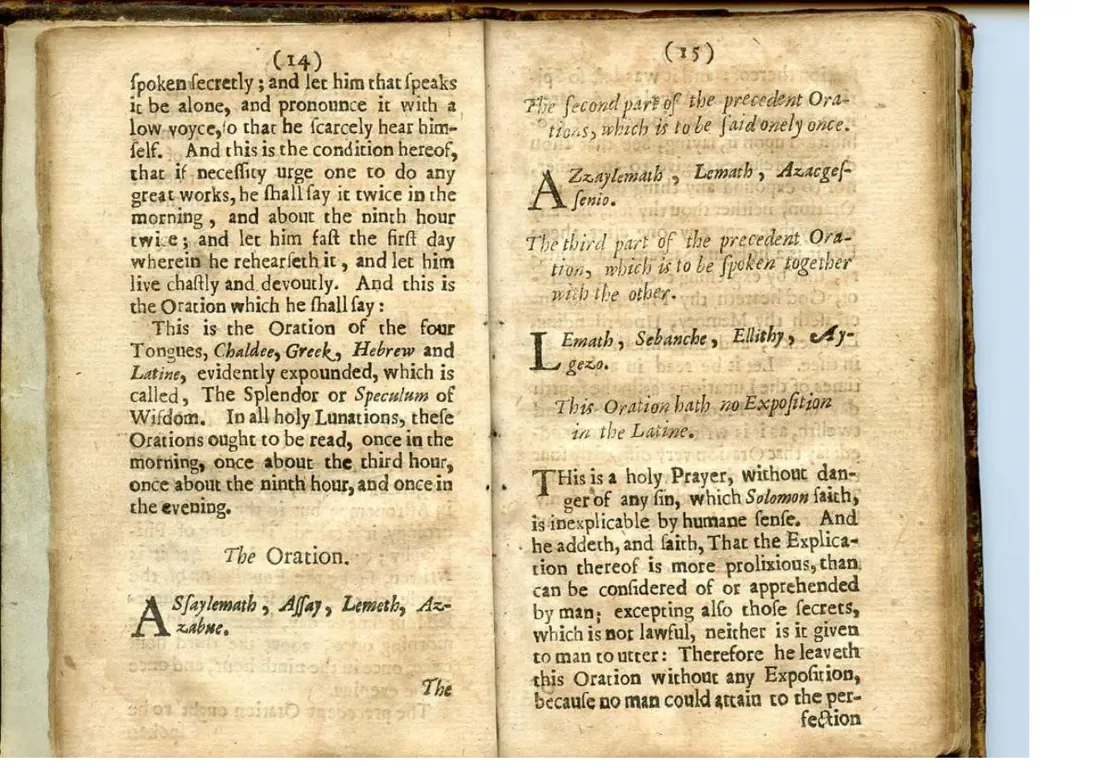
spoken secretly ; and let him that speaks it be alone, and pronounce it with a low voyce, so that he scarcely hear himself. And this is the condition hereof, that if necessity urge one to do any great works, he shall say it twice in the morning, and about the ninth hour twice ; and let him fast the first day wherein he rehearseth it, and let him live chastly and devoutly. And this is the Oration which he shall say :

This is the Oration of the four Tongues, Chaldee, Greek, Hebrew and Latine, evidently expounded, which is called, The Splendor or Speculum of Wisdom. In all holy Lunations, these Orations ought to be read, once in the morning, once about the third hour, once about the ninth hour, and once in the evening.

The Oration.

ASsaylemath, Assay, Lemeth, Az-zabue.

The

(15)

The second part of the precedent Orations, which is to be said onely once.

AZzaylemath, Lemath, Azacgessenio.

The third part of the precedent Oration, which is to be spoken together with the other.

LEmath, Sebanche, Ellithy, Aygezo.

This Oration hath no Exposition in the Latine.

THis is a holy Prayer, without danger of any sin, which Solomon saith, is inexplicable by humane sense. And he addeth, and saith, That the Explication thereof is more prolixious, than can be considered of or apprehended by man ; excepting also those secrets, which is not lawful, neither is it given to man to utter : Therefore he leaveth this Oration without any Exposition, because no man could attain to the perfection

TraducciónEspañol

(14)

[ha de ser] dicha en secreto; y quien la pronuncie esté solo, y la pronuncie con voz baja, de modo que apenas se oiga a sí mismo. Y esta es la condición de ello: que si la necesidad apremia a alguien a realizar alguna gran obra, la dirá dos veces por la mañana, y hacia la hora novena dos veces; y ayune el primer día en que la recite, y viva castamente y con devoción. Y esta es la oración que ha de decir:

Esta es la oración de las cuatro lenguas, caldeo, griego, hebreo y latín, claramente expuesta, la cual se llama el Esplendor o Speculum de la sabiduría. En todas las lunaciones santas, estas oraciones deben leerse una vez por la mañana, una vez hacia la hora tercera, una vez hacia la hora novena, y una vez al atardecer.

La oración.

ASsaylemath, Assay, Lemeth, Az-zabue.

La

(15)

La segunda parte de las oraciones precedentes, que ha de decirse una sola vez.

AZzaylemath, Lemath, Azacgessenio.

La tercera parte de la oración precedente, que ha de pronunciarse junto con la otra.

LEmath, Sebanche, Ellithy, Aygezo.

Esta oración no tiene exposición en el latín.

Esta es una santa plegaria, sin peligro de pecado alguno, la cual —dice Salomón— es inexplicable al sentido humano. Y añade, y dice, que la explicación de ella es más prolija de lo que el hombre puede considerar o comprender; exceptuando también aquellos secretos que no es lícito, ni le es dado al hombre pronunciar: por lo cual él deja esta oración sin exposición alguna, porque ningún hombre podría alcanzar la perfec-[ción]

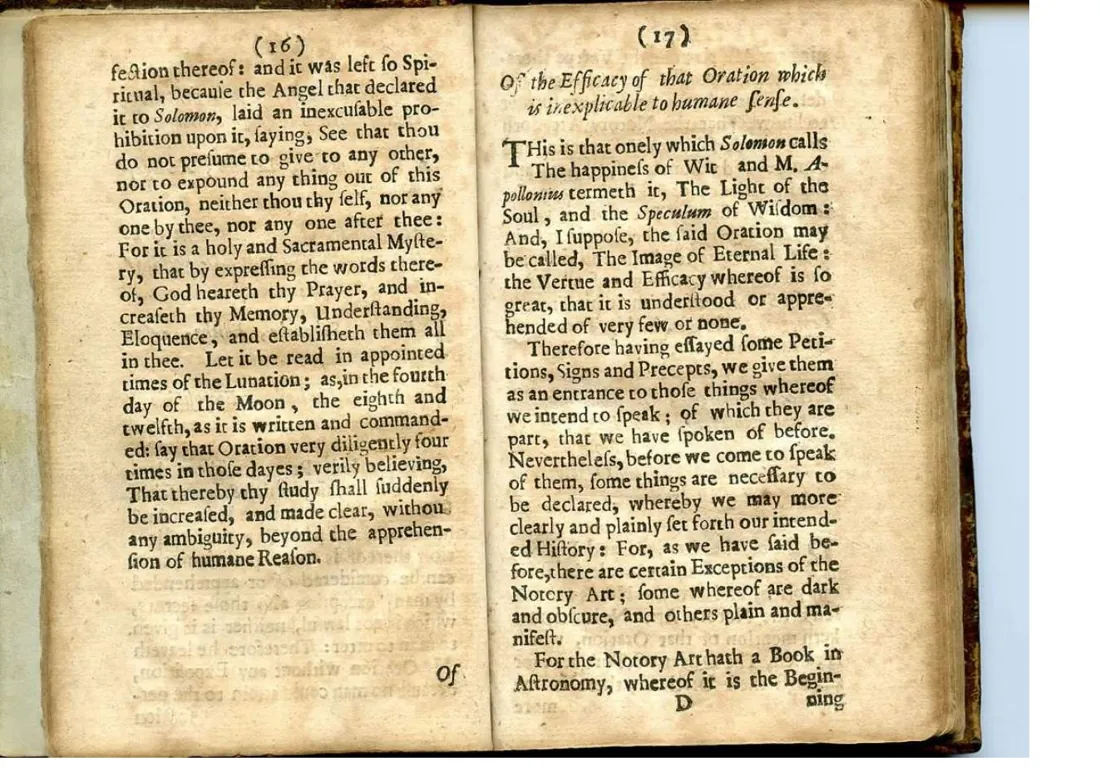
La prohibición del Ángel y la eficacia de la Oración inefable#p025
Ars Notoria (clásica) — facsímil · La prohibición del Ángel y la eficacia de la Oración inefable · dominio público
Impreso — Turner 1657 · Manuscrito iluminado — Mellon MS 1 (Beinecke)
🔍 clic para ampliar

TranscripciónInglés (impreso, 1657)

(16)

fession thereof: and it was left so Spi- ritual, because the Angel that declared it to Solomon, laid an inexcusable pro- hibition upon it, saying, See that thou do not presume to give to any other, nor to expound any thing out of this Oration, neither thou thy self, nor any one by thee, nor any one after thee: For it is a holy and Sacramental Myste- ry, that by expressing the words there- of, God heareth thy Prayer, and in- creaseth thy Memory, Understanding, Eloquence, and establisheth them all in thee. Let it be read in appointed times of the Lunation; as, in the fourth day of the Moon, the eighth and twelfth, as it is written and command- ed: say that Oration very diligently four times in those dayes; verily believing, That thereby thy study shall suddenly be increased, and made clear, without any ambiguity, beyond the apprehen- sion of humane Reason.

Of

(17)

Of the Efficacy of that Oration which is inexplicable to humane sense.

THis is that onely which Solomon calls The happiness of Wit and M. A- pollonius termeth it, The Light of the Soul, and the Speculum of Wisdom: And, I suppose, the said Oration may be called, The Image of Eternal Life: the Vertue and Efficacy whereof is so great, that it is understood or appre- hended of very few, or none.

Therefore having essayed some Peti- tions, Signs and Precepts, we give them as an entrance to those things whereof we intend to speak; of which they are part, that we have spoken of before. Nevertheless, before we come to speak of them, some things are necessary to be declared, whereby we may more clearly and plainly set forth our intend- ed History: For, as we have said be- fore, there are certain Exceptions of the Notory Art; some whereof are dark and obscure, and others plain and ma- nifest.

For the Notory Art hath a Book in Astronomy, whereof it is the Begin- D ning

TraducciónEspañol

(16)

…fesión de ello: y quedó tan espiritual, porque el ángel que la declaró a Salomón puso sobre ella una prohibición inexcusable, diciendo: Mira que no te atrevas a darla a ningún otro, ni a exponer cosa alguna de esta oración, ni tú mismo, ni ninguno por medio de ti, ni ninguno después de ti: pues es un misterio santo y sacramental, que al pronunciar las palabras de ella, Dios oye tu oración, y acrecienta tu memoria, entendimiento y elocuencia, y las afirma todas en ti. Sea leída en los tiempos señalados de la lunación; como en el cuarto día de la Luna, el octavo y el duodécimo, según está escrito y mandado: recita aquella oración muy diligentemente cuatro veces en esos días; creyendo de veras que por ello tu estudio se acrecentará de súbito, y se hará claro, sin ambigüedad alguna, más allá de la comprensión de la razón humana.

De

(17)

De la eficacia de aquella oración que es inexplicable al sentido humano.

Esta es aquella única a la que Salomón llama la felicidad del ingenio, y maestro Apollonius la nombra la Luz del Alma, y el Speculum [Espejo] de la Sabiduría: y, según supongo, dicha oración puede llamarse la Imagen de la Vida Eterna: cuya virtud y eficacia es tan grande que es entendida o comprendida de muy pocos, o de ninguno.

Por tanto, habiendo ensayado algunas peticiones, signos y preceptos, los damos como entrada a aquellas cosas de las que pretendemos hablar; de las cuales son parte, según hemos hablado antes. No obstante, antes de llegar a hablar de ellas, es necesario declarar algunas cosas, por las cuales podamos exponer más clara y llanamente nuestra historia proyectada: pues, como hemos dicho antes, hay ciertas excepciones del Arte Notoria; algunas de las cuales son oscuras y sombrías, y otras claras y manifiestas.

Pues el Arte Notoria tiene un libro en astronomía, del cual es el comien-[zo] D

El Arte Notoria y la Reina de las Lenguas#p027
Ars Notoria (clásica) — facsímil · El Arte Notoria y la Reina de las Lenguas · dominio público
Impreso — Turner 1657 · Manuscrito iluminado — Mellon MS 1 (Beinecke)
🔍 clic para ampliar

TranscripciónInglés (impreso, 1657)

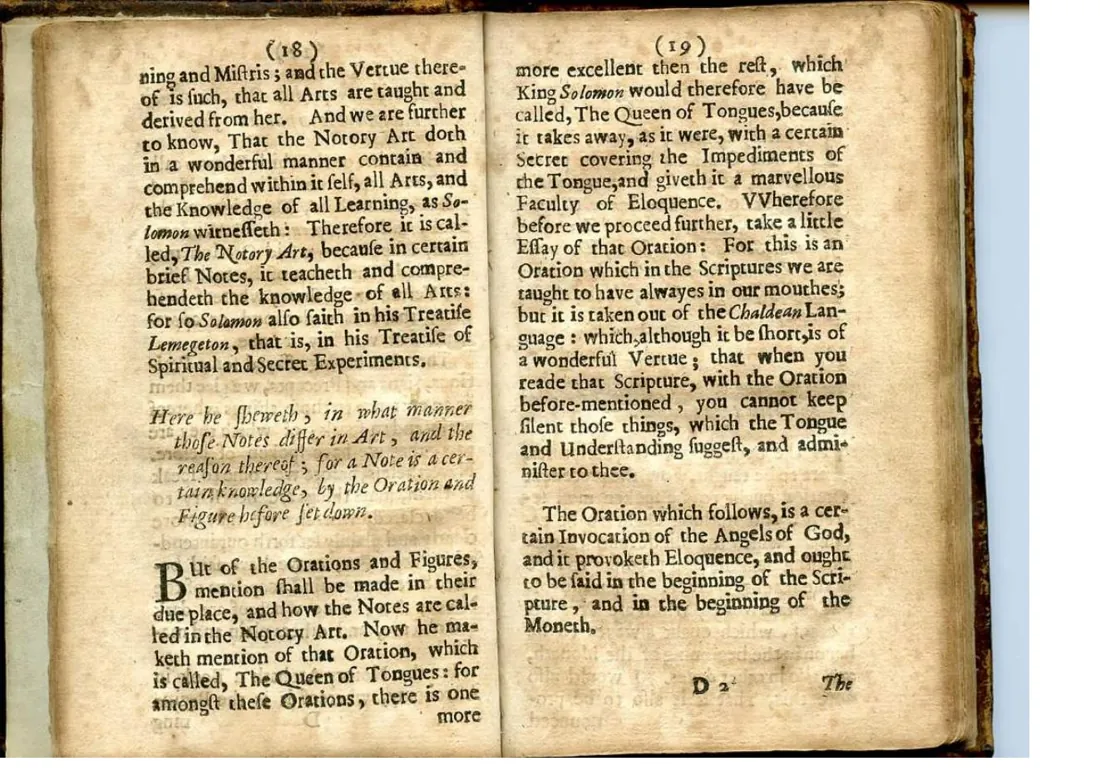
(18)

ning and Miſtris; and the Vertue there- of is ſuch, that all Arts are taught and derived from her. And we are further to know, That the Notory Art doth in a wonderful manner contain and comprehend within it ſelf, all Arts, and the Knowledge of all Learning, as So- lomon witneſſeth: Therefore it is cal- led, The Notory Art, becauſe in certain brief Notes, it teacheth and compre- hendeth the knowledge of all Arts: for ſo Solomon alſo ſaith in his Treatiſe Lemegeton, that is, in his Treatiſe of Spiritual and Secret Experiments.

Here he ſheweth, in what manner thoſe Notes differ in Art, and the reaſon thereof; for a Note is a cer- tain knowledge, by the Oration and Figure before ſet down.

BUt of the Orations and Figures, mention ſhall be made in their due place, and how the Notes are cal- led in the Notory Art. Now he ma- keth mention of that Oration, which is called, The Queen of Tongues: for amongſt theſe Orations, there is one more

(19)

more excellent then the reſt, which King Solomon would therefore have be called, The Queen of Tongues, becauſe it takes away, as it were, with a certain Secret covering the Impediments of the Tongue, and giveth it a marvellous Faculty of Eloquence. VVherefore before we proceed further, take a little Eſſay of that Oration: For this is an Oration which in the Scriptures we are taught to have alwayes in our mouthes; but it is taken out of the Chaldean Lan- guage: which, although it be ſhort, is of a wonderful Vertue; that when you reade that Scripture, with the Oration before-mentioned, you cannot keep ſilent thoſe things, which the Tongue and Underſtanding ſuggeſt, and admi- niſter to thee.

The Oration which follows, is a cer- tain Invocation of the Angels of God, and it provoketh Eloquence, and ought to be ſaid in the beginning of the Scri- pture, and in the beginning of the Moneth.

D 2     The

TraducciónEspañol

(18)

…ción y maestra; y su virtud es tal, que todas las artes se enseñan y derivan de ella. Y aún hemos de saber que el Arte Notoria, de manera admirable, contiene y comprende en sí misma todas las artes y el conocimiento de todo el saber, como atestigua Salomón: por eso se la llama El Arte Notoria, porque en ciertas breves notas enseña y comprende el conocimiento de todas las artes; pues así lo dice también Salomón en su Tratado Lemegeton, esto es, en su Tratado de Experimentos Espirituales y Secretos.

Aquí muestra de qué manera esas notas difieren en arte, y la razón de ello; pues una nota es cierto conocimiento, por la oración y la figura antes expuestas.

Mas de las oraciones y figuras se hará mención en su debido lugar, y de cómo se llaman las notas en el Arte Notoria. Ahora hace mención de aquella oración que se llama la Reina de las Lenguas; pues entre estas oraciones hay una más…

(19)

…más excelente que las demás, a la cual, por ello, el Rey Salomón quiso que se llamase la Reina de las Lenguas, porque quita, por así decir, con cierta cobertura secreta, los impedimentos de la lengua, y le confiere una maravillosa facultad de elocuencia. Por lo cual, antes de proseguir, tómese un pequeño ensayo de aquella oración: pues esta es una oración que en las Escrituras se nos enseña a tener siempre en nuestra boca; pero está tomada de la lengua Caldea: la cual, aunque sea breve, es de una maravillosa virtud; de modo que cuando lees aquella escritura, con la oración antes mencionada, no puedes callar aquellas cosas que la lengua y el entendimiento sugieren y administran a ti.

La oración que sigue es cierta invocación de los Ángeles de Dios, y provoca elocuencia, y ha de decirse al comienzo de la escritura y al comienzo del mes.

D 2     La

Oración para la memoria#p029
Ars Notoria (clásica) — facsímil · Oración para la memoria · dominio público
Impreso — Turner 1657 · Manuscrito iluminado — Mellon MS 1 (Beinecke)
🔍 clic para ampliar

TranscripciónInglés (impreso, 1657)

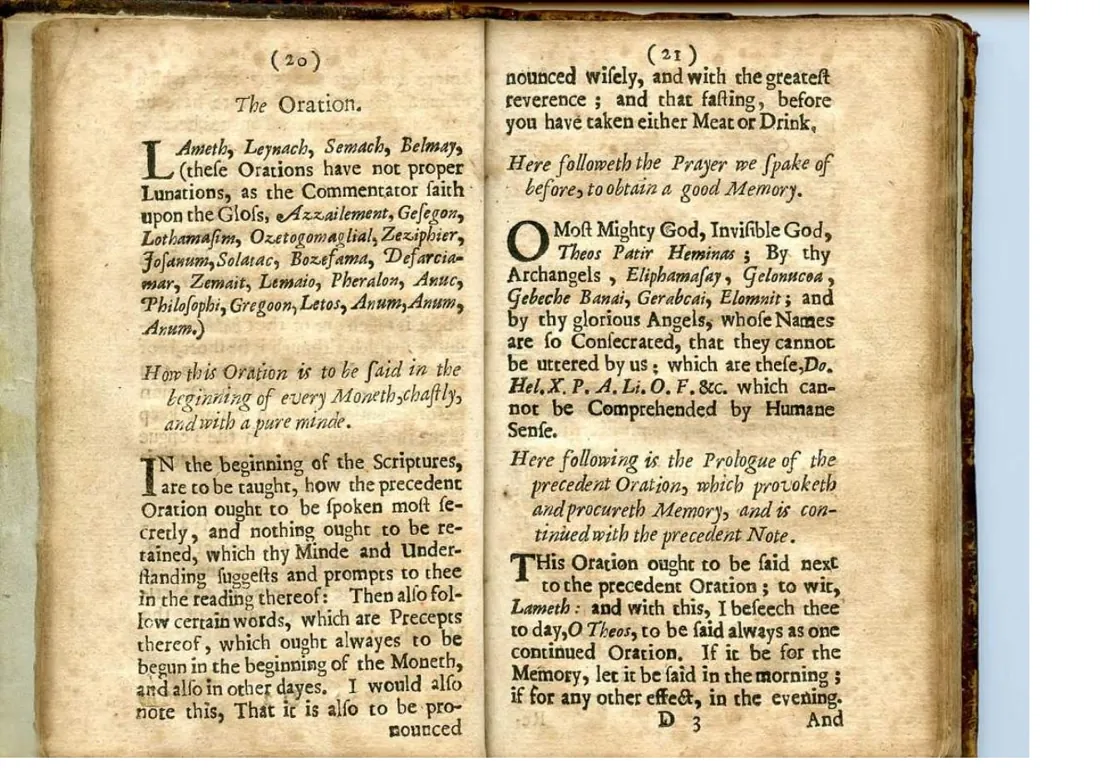
(20)

The Oration.

LAmeth, Leynach, Semach, Belmay, (these Orations have not proper Lunations, as the Commentator saith upon the Gloss, Azzailement, Gesegon, Lothamasim, Ozetogomaglial, Zeziphier, Fosamm, Solarac, Boxefama, Defarcia- mar, Zemait, Lemaios, Pheralon, Anuc, Philosophi, Gregoon, Letos, Anum, Anum, Anum.)

How this Oration is to be said in the beginning of every Moneth,chastly, and with a pure minde.

IN the beginning of the Scriptures, are to be taught, how the precedent Oration ought to be spoken most se- cretly, and nothing ought to be re- tained, which thy Minde and Under- standing suggests and prompts to thee in the reading thereof: Then also fol- low certain words, which are Precepts thereof , which ought alwayes to be begun in the beginning of the Moneth, and also in other dayes. I would also note this, That it is also to be pro- nounced

(21)

nounced wisely, and with the greatest reverence ; and that fasting, before you have taken either Meat or Drink,

Here followeth the Prayer we spake of before, to obtain a good Memory.

O Most Mighty God, Invisible God, Theos Patir Heminas ; By thy Archangels , Eliphamasay, Gelonucoa, Gebeche Banai, Gerabcai, Elomnit ; and by thy glorious Angels, whose Names are so Consecrated, that they cannot be uttered by us; which are these, Do, Hel. X. P. A. Li. O. F. &c. which can- not be Comprehended by Humane Sense.

Here following is the Prologue of the precedent Oration, which provoketh and procureth Memory, and is con- tinued with the precedent Note.

THis Oration ought to be said next to the precedent Oration ; to wit, Lameth : and with this, I beseech thee to day, O Theos, to be said always as one continued Oration. If it be for the Memory, let it be said in the morning ; if for any other effect, in the evening.

D 3     And

TraducciónEspañol

(20)

La oración.

Lameth, Leynach, Semach, Belmay, (estas oraciones no tienen lunaciones propias, como dice el Comentador sobre la Glosa, Azzailement, Gesegon, Lothamasim, Ozetogomaglial, Zeziphier, Fosamm, Solarac, Boxefama, Defarciamar, Zemait, Lemaios, Pheralon, Anuc, Philosophi, Gregoon, Letos, Anum, Anum, Anum.)

Cómo ha de decirse esta oración al comienzo de cada mes, castamente y con mente pura.

Al comienzo de las Escrituras se ha de enseñar cómo la oración precedente debe pronunciarse muy secretamente, y cómo nada debe retenerse de lo que tu mente y entendimiento te sugieren e impulsan en la lectura de ella: luego siguen también ciertas palabras, que son sus preceptos, las cuales deben comenzarse siempre al principio del mes, y también en otros días. También quisiera señalar esto: que asimismo ha de pronunciarse...

(21)

...pronunciarse sabiamente, y con la mayor reverencia; y esto en ayunas, antes de que hayas tomado carne o bebida.

Aquí sigue la plegaria de la que hablamos antes, para obtener una buena memoria.

Oh Dios poderosísimo, Dios invisible, Theos Patir Heminas; por tus arcángeles, Eliphamasay, Gelonucoa, Gebeche Banai, Gerabcai, Elomnit; y por tus gloriosos ángeles, cuyos nombres están tan consagrados que no pueden ser pronunciados por nosotros; que son estos, Do, Hel. X. P. A. Li. O. F. &c., los cuales no pueden ser comprendidos por sentido humano.

Aquí sigue el prólogo de la oración precedente, que provoca y procura memoria, y se continúa con la nota precedente.

Esta oración debe decirse después de la oración precedente; a saber, Lameth: y con esto, te suplico hoy, oh Theos, que sea dicha siempre como una oración continuada. Si es para la memoria, dígase por la mañana; si para cualquier otro efecto, por la tarde.

D 3     Y

Oración del arte físico#p033
Ars Notoria (clásica) — facsímil · Oración del arte físico · dominio público
Impreso — Turner 1657 · Manuscrito iluminado — Mellon MS 1 (Beinecke)
🔍 clic para ampliar

TranscripciónInglés (impreso, 1657)

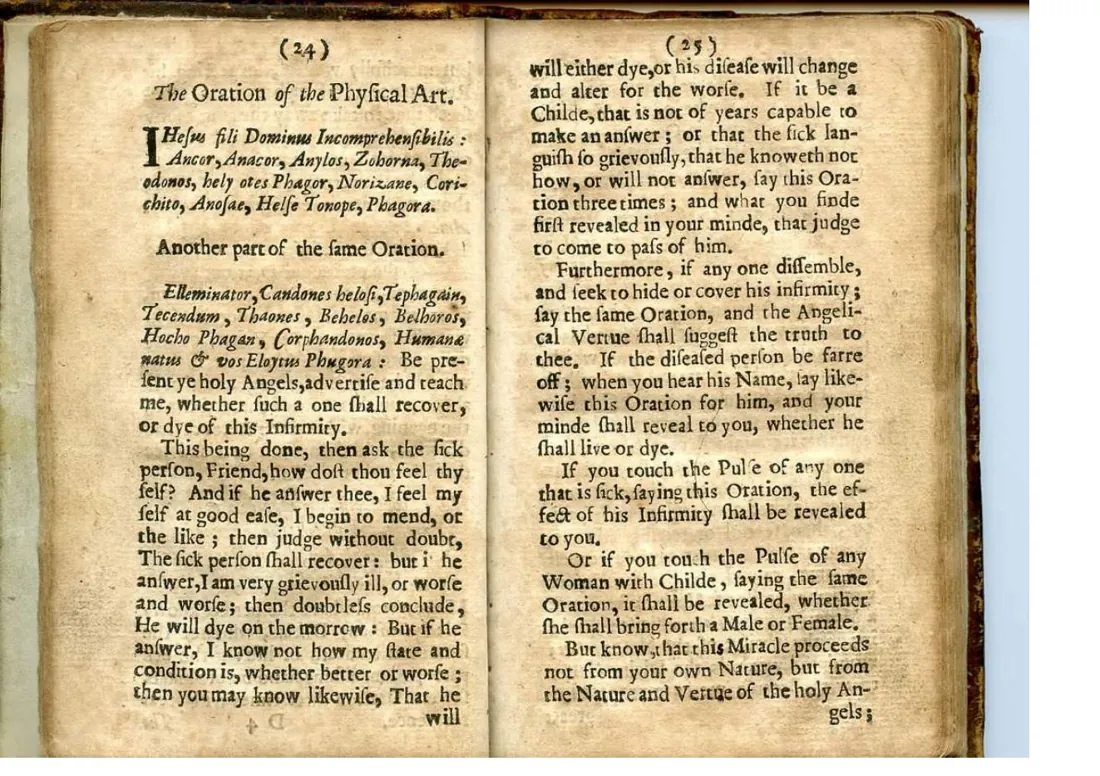
(24)

The Oration of the Physical Art.

IHesus fili Dominus Incomprehensibilis : Ancor, Anacor, Anylos, Zohorna, The- odonos, hely otes Phagor, Norizane, Cori- chito, Anosae, Helse Tonose, Phagora.

Another part of the same Oration.

Elleminator, Candones helos, Tephagain, Tecendum, Thaones, Beheles, Belhoros, Hocho Phagan, Corphandonos, Humane natus & vos Eloytus Phugora : Be pre- sent ye holy Angels, advertise and teach me, whether such a one shall recover, or dye of this Infirmity.

This being done, then ask the sick person, Friend, how dost thou feel thy self? And if he answer thee, I feel my self at good ease, I begin to mend, or the like ; then judge without doubt, The sick person shall recover: but if he answer, I am very grievously ill, or worse and worse; then doubtless conclude, He will dye on the morrow : But if he answer, I know not how my state and condition is, whether better or worse ; then you may know likewise, That he will

(25)

will either dye, or his disease will change and alter for the worse. If it be a Childe, that is not of years capable to make an answer ; or that the sick lan- guish so grievously, that he knoweth not how, or will not answer, say this Ora- tion three times ; and what you finde first revealed in your minde, that judge to come to pass of him.

Furthermore, if any one dissemble, and seek to hide or cover his infirmity ; say the same Oration, and the Angeli- cal Vertue shall suggest the truth to thee. If the diseased person be farre off ; when you hear his Name, say like- wise this Oration for him, and your minde shall reveal to you, whether he shall live or dye.

If you touch the Pulse of any one that is sick, saying this Oration, the ef- fect of his Infirmity shall be revealed to you.

Or if you touch the Pulse of any Woman with Childe, saying the same Oration, it shall be revealed, whether she shall bring forth a Male or Female.

But know, that this Miracle proceeds not from your own Nature, but from the Nature and Vertue of the holy An- gels ;

TraducciónEspañol

(24)

La oración del arte físico.

IHesus fili Dominus Incomprehensibilis : Ancor, Anacor, Anylos, Zohorna, The- odonos, hely otes Phagor, Norizane, Cori- chito, Anosae, Helse Tonose, Phagora.

Otra parte de la misma oración.

Elleminator, Candones helos, Tephagain, Tecendum, Thaones, Beheles, Belhoros, Hocho Phagan, Corphandonos, Humane natus & vos Eloytus Phugora : Estad pre- sentes, santos ángeles, advertidme y enseñad- me si tal persona se recuperará, o morirá de esta enfermedad.

Hecho esto, pregunta entonces a la persona enferma: Amigo, ¿cómo te sientes? Y si te responde: Me siento bien, empiezo a mejorar, o algo semejante; entonces juzga sin duda que la persona enferma se recuperará: pero si responde: Estoy gravemente enfermo, o peor y peor; entonces concluye sin duda que morirá al día siguiente: pero si responde: No sé cómo está mi estado y condición, si mejor o peor; entonces puedes saber asimismo que él

(25)

morirá, o su enfermedad cambiará y se alterará para peor. Si es un niño, que no tiene años suficientes para dar una respuesta; o si el enfermo lan- guidece tan gravemente que no sabe cómo, o no quiere responder, di esta ora- ción tres veces; y lo que halles primero revelado en tu mente, eso juzga que sucederá con él.

Además, si alguien disimula y procura ocultar o cubrir su enfermedad; di la misma oración, y la virtud angéli- ca sugerirá la verdad a ti. Si la persona enferma está lejos; cuando oigas su nombre, di igual- mente esta oración por él, y tu mente te revelará si vivirá o morirá.

Si tocas el pulso de cualquiera que esté enfermo, diciendo esta oración, el ef- ecto de su enfermedad te será revelado.

O si tocas el pulso de alguna mujer encinta, diciendo la misma oración, será revelado si dará a luz un varón o una mujer.

Pero sabe que este milagro procede no de tu propia naturaleza, sino de la naturaleza y virtud de los santos án- geles;

Preludio y precepto#p037
Ars Notoria (clásica) — facsímil · Preludio y precepto · dominio público
Impreso — Turner 1657 · Manuscrito iluminado — Mellon MS 1 (Beinecke)
🔍 clic para ampliar

TranscripciónInglés (impreso, 1657)

(28)

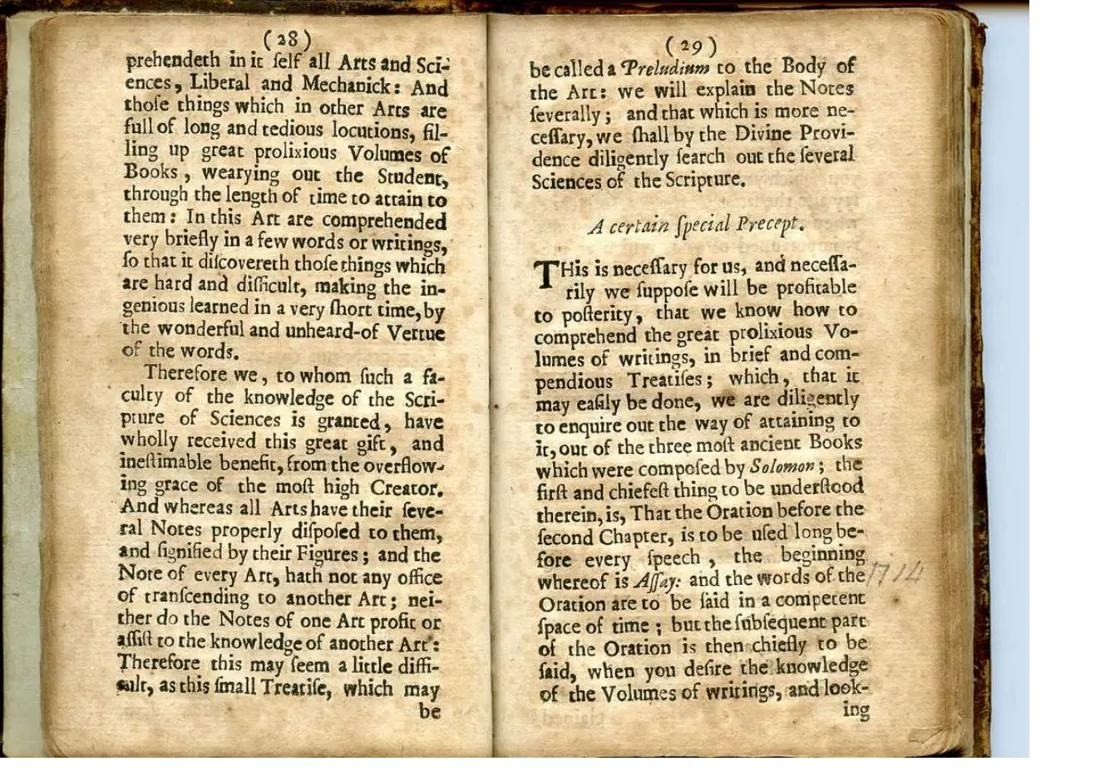
prehendeth in it self all Arts and Sci- ences, Liberal and Mechanick: And those things which in other Arts are full of long and tedious locutions, fil- ling up great prolixious Volumes of Books, wearying out the Student, through the length of time to attain to them: In this Art are comprehended very briefly in a few words or writings, so that it discovereth those things which are hard and difficult, making the in- genious learned in a very short time, by the wonderful and unheard-of Vertue of the words.

Therefore we, to whom such a fa- culty of the knowledge of the Scri- pture of Sciences is granted, have wholly received this great gift, and inestimable benefit, from the overflow- ing grace of the most high Creator. And whereas all Arts have their seve- ral Notes properly disposed to them, and signified by their Figures ; and the Note of every Art, hath not any office of transcending to another Art ; nei- ther do the Notes of one Art profit or assist to the knowledge of another Art: Therefore this may seem a little diffi- cult, as this small Treatise, which may be

(29)

be called a Preludium to the Body of the Art: we will explain the Notes severally; and that which is more ne- cessary, we shall by the Divine Provi- dence diligently search out the several Sciences of the Scripture.

A certain special Precept.

THis is necessary for us, and necessa- rily we suppose will be profitable to posterity, that we know how to comprehend the great prolixious Vo- lumes of writings, in brief and com- pendious Treatises ; which, that it may easily be done, we are diligently to enquire out the way of attaining to it, out of the three most ancient Books which were composed by Solomon; the first and chiefest thing to be understood therein, is, That the Oration before the second Chapter, is to be used long be- fore every speech, the beginning whereof is Assay: and the words of the Oration are to be said in a competent space of time ; but the subsequent part of the Oration is then chiefly to be said, when you desire the knowledge of the Volumes of writings, and look- ing

TraducciónEspañol

(28)

...comprende en sí misma todas las artes y cien- cias, liberales y mecánicas: y aquellas cosas que en otras artes están llenas de largas y tediosas locuciones, que llenan grandes volúmenes prolijos de libros, fatigando al estudiante durante largo tiempo para alcanzarlas: en este arte están comprendidas muy brevemente, en pocas palabras o escritos, de modo que descubre aquellas cosas que son arduas y difíciles, haciendo al in- genioso docto en muy breve tiempo, por la maravillosa e inaudita virtud de las palabras.

Por tanto nosotros, a quienes tal fa- cultad del conocimiento de la escri- tura de las ciencias ha sido concedida, hemos recibido enteramente este gran don y beneficio inestimable, de la sobreabun- dante gracia del altísimo Creador. Y puesto que todas las artes tienen sus varias notas propiamente dispuestas para ellas, y significadas por sus figuras; y la nota de cada arte no tiene oficio alguno de trascender a otro arte; ni aprovechan o asisten las notas de un arte al conocimiento de otro arte: por tanto esto puede parecer un poco difi- cil, pues este pequeño tratado, que puede ser

(29)

ser llamado un Preludium al cuerpo del arte: explicaremos las notas una por una; y aquello que es más ne- cesario, buscaremos diligentemente, por la Divina Provi- dencia, las varias ciencias de la escritura.

Cierto precepto especial.

Esto es necesario para nosotros, y necesa- riamente suponemos que será provechoso para la posteridad: que sepamos cómo comprender los grandes vo- lúmenes prolijos de escritos, en breves y com- pendiosos tratados; lo cual, para que pueda hacerse fácilmente, debemos diligentemente investigar el camino para alcanzarlo, de entre los tres libros más antiguos que fueron compuestos por Solomon; la primera y principal cosa que ha de entenderse allí es que la oración antes del segundo capítulo debe usarse mucho antes de cada discurso, cuyo comienzo es Assay: y las palabras de la oración deben decirse en un competente espacio de tiempo; pero la parte subsiguiente de la oración ha de decirse entonces principalmente cuando deseas el conocimiento de los volúmenes de escritos, y mi- rando

Magnitud del Arte#p039
Ars Notoria (clásica) — facsímil · Magnitud del Arte · dominio público
Impreso — Turner 1657 · Manuscrito iluminado — Mellon MS 1 (Beinecke)
🔍 clic para ampliar

TranscripciónInglés (impreso, 1657)

(30)

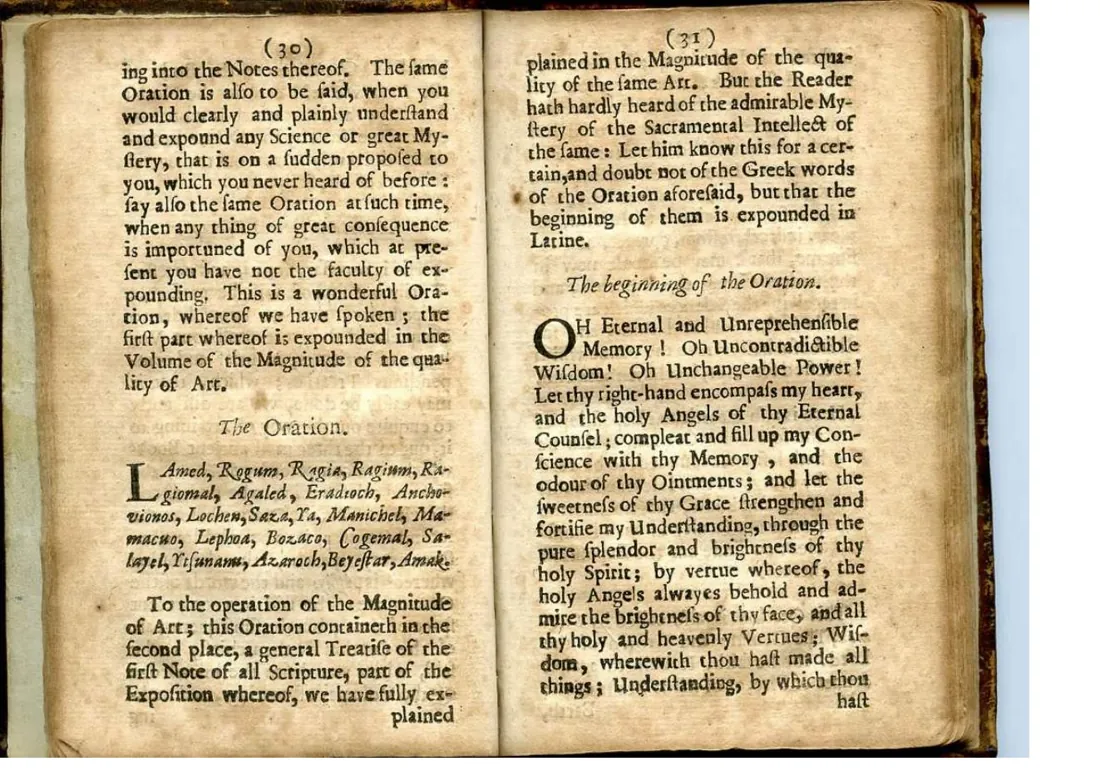
ing into the Notes thereof. The same Oration is also to be said, when you would clearly and plainly understand and expound any Science or great My- stery, that is on a sudden proposed to you, which you never heard of before; say also the same Oration at such time, when any thing of great consequence is importuned of you, which at pre- sent you have not the faculty of ex- pounding. This is a wonderful Ora- tion, whereof we have spoken; the first part whereof is expounded in the Volume of the Magnitude of the qua- lity of Art.

The Oration.

LAmed, Rogum, Ragia, Ragium, Ra- giomal, Agaled, Eradioch, Ancho- vionos, Lochen, Saza, Ya, Manichel, Ma- macuo, Lephoa, Bozaco, Cogemal, Sa- layel, Ytsunanu, Azaroch, Beyestar, Amak.

To the operation of the Magnitude of Art; this Oration containeth in the second place, a general Treatise of the first Note of all Scripture; part of the Exposition whereof, we have fully ex- plained

(31)

plained in the Magnitude of the qua- lity of the same Art. But the Reader hath hardly heard of the admirable My- stery of the Sacramental Intellect of the same: Let him know this for a cer- tain,and doubt not of the Greek words of the Oration aforesaid, but that the beginning of them is expounded in Latine.

The beginning of the Oration.

OH Eternal and Unreprehensible Memory! Oh Uncontradictible Wisdom! Oh Unchangeable Power! Let thy right-hand encompass my heart, and the holy Angels of thy Eternal Counsel; compleat and fill up my Con- science with thy Memory, and the odour of thy Ointments; and let the sweetness of thy Grace strengthen and fortifie my Understanding, through the pure splendor and brightness of thy holy Spirit; by vertue whereof, the holy Angels alwayes behold and ad- mire the brightness of thy face, and all thy holy and heavenly Vertues; Wis- dom, wherewith thou hast made all things: Understanding, by which thou hast

TraducciónEspañol

(30)

…ando en las notas de ello. La misma oración ha de decirse también cuando tú quieras entender clara y llanamente y exponer alguna ciencia o gran mis- terio, que de súbito se te proponga, del cual nunca antes hayas oído; di también la misma oración en tal tiempo, cuando alguna cosa de gran consecuencia te sea requerida con instancia, de la cual al pre- sente no tengas la facultad de ex- poner. Esta es una maravillosa ora- ción, de la cual hemos hablado; la primera parte de la cual se expone en el Volumen de la Magnitud de la cua- lidad del Arte.

La oración.

LAmed, Rogum, Ragia, Ragium, Ra- giomal, Agaled, Eradioch, Ancho- vionos, Lochen, Saza, Ya, Manichel, Ma- macuo, Lephoa, Bozaco, Cogemal, Sa- layel, Ytsunanu, Azaroch, Beyestar, Amak.

Para la operación de la Magnitud del Arte; esta oración contiene en el segundo lugar un tratado general de la primera nota de toda Escritura; parte de la exposición de la cual hemos ex- plicado plenamente

(31)

plicado en la Magnitud de la cua- lidad del mismo Arte. Pero el lector apenas ha oído del admirable mis- terio del intelecto sacramental de lo mismo: sepa esto por cierto, y no dude de las palabras griegas de la oración antedicha, sino que el comienzo de ellas está expuesto en latín.

El comienzo de la oración.

Oh Memoria Eterna e Irreprensible! Oh Sabiduría Incontradictible! Oh Poder Inmutable! Que tu mano derecha rodee mi corazón, y los santos Ángeles de tu Eterno Consejo; completa y llena mi Con- ciencia con tu Memoria, y el olor de tus Ungüentos; y que la dulzura de tu Gracia fortalezca y fortifique mi Entendimiento, mediante el puro esplendor y brillo de tu santo Espíritu; por virtud de lo cual, los santos Ángeles siempre contemplan y ad- miran el brillo de tu rostro, y todas tus santas y celestiales Virtudes; Sabi- duría, con la cual tú has hecho todas las cosas: Entendimiento, por el cual tú has

Exposición de la oración#p041
Ars Notoria (clásica) — facsímil · Exposición de la oración · dominio público
Impreso — Turner 1657 · Manuscrito iluminado — Mellon MS 1 (Beinecke)
🔍 clic para ampliar

TranscripciónInglés (impreso, 1657)

(32)

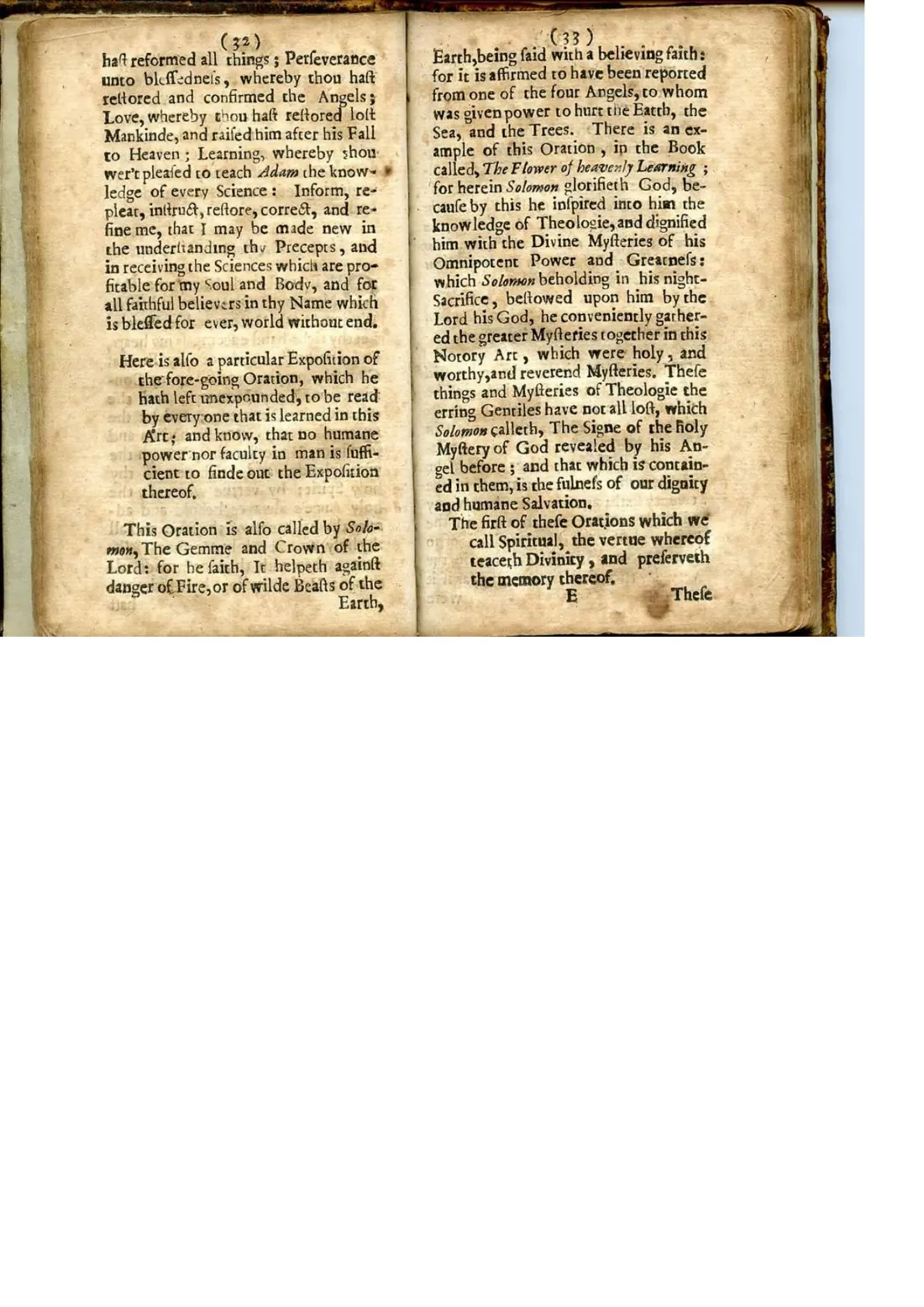
hast reformed all things; Perseverance unto blessedness, whereby thou hast restored and confirmed the Angels; Love, whereby thou hast restored lost Mankinde, and raised him after his Fall to Heaven; Learning, whereby thou wert pleased to teach Adam the know- ledge of every Science: Inform, re- pleat, instruct, restore, correct, and re- fine me, that I may be made new in the understanding thy Precepts, and in receiving the Sciences which are pro- fitable for my Soul and Body, and for all faithful believers in thy Name which is blessed for ever, world without end.

Here is also a particular Exposition of the foregoing Oration, which he hath left unexpounded, to be read by every one that is learned in this Art; and know, that no humane power nor faculty in man is suffi- cient to finde out the Exposition thereof.

This Oration is also called by Solo- mon, The Gemme and Crown of the Lord: for he saith, It helpeth against danger of Fire, or of wilde Beasts of the Earth,

(33)

Earth, being said with a believing faith: for it is affirmed to have been reported from one of the four Angels, to whom was given power to hurt the Earth, the Sea, and the Trees. There is an ex- ample of this Oration, in the Book called, The Flower of heavenly Learning ; for herein Solomon glorifieth God, be- cause by this he inspired into him the knowledge of Theologie, and dignified him with the Divine Mysteries of his Omnipotent Power and Greatness: which Solomon beholding in his night- Sacrifice, bestowed upon him by the Lord his God, he conveniently gather- ed the greater Mysteries together in this Notory Art, which were holy, and worthy,and reverend Mysteries. These things and Mysteries of Theologie the erring Gentiles have not all lost, which Solomon calleth, The Signe of the holy Mystery of God revealed by his An- gel before; and that which is contain- ed in them, is the fulness of our dignity and humane Salvation. The first of these Orations which we call Spiritual, the vertue whereof teacheth Divinity, and preserveth the memory thereof.

E These

TraducciónEspañol

(32)

has reformado todas las cosas; perseverancia hasta la bienaventuranza, por la cual has restaurado y confirmado a los ángeles; amor, por el cual has restaurado a la humanidad perdida, y la has elevado después de su caída al cielo; aprendizaje, por el cual te complaciste en enseñar a Adam el conocimiento de toda ciencia: infórmame, cólmame, instrúyeme, restáurame, corrígeme y refíname, para que sea hecho nuevo en el entendimiento de tus preceptos, y en recibir las ciencias que son provechosas para mi alma y cuerpo, y para todos los creyentes fieles en tu Nombre, que es bendito por siempre, por los siglos de los siglos.

Aquí hay también una exposición particular de la oración precedente, que él dejó sin exponer, para que sea leída por todo aquel que sea docto en este arte; y sabe que ningún poder humano ni facultad en el hombre es suficiente para hallar la exposición de ella.

Esta oración es llamada también por Salomón, La Gema y Corona del Señor: pues él dice que ayuda contra el peligro del fuego, o de las bestias salvajes de la tierra,

(33)

la tierra, siendo dicha con una fe creyente: pues se afirma que fue referida por uno de los cuatro ángeles, a quienes fue dado poder para dañar la tierra, el mar y los árboles. Hay un ejemplo de esta oración en el Libro llamado, La Flor del Aprendizaje celestial; pues en ella Salomón glorifica a Dios, porque por medio de esto inspiró en él el conocimiento de la teología, y lo dignificó con los misterios divinos de su poder omnipotente y grandeza: lo cual, contemplando Salomón en su sacrificio nocturno, otorgado a él por el Señor su Dios, reunió convenientemente los misterios mayores en este Arte Notoria, que eran misterios santos, dignos y reverendos. Estas cosas y misterios de teología no los han perdido todos los gentiles errantes, a lo cual Salomón llama el signo del santo misterio de Dios revelado antes por su Ángel; y aquello que está contenido en ellos es la plenitud de nuestra dignidad y salvación humana.

La primera de estas oraciones que llamamos espirituales, cuya virtud enseña divinidad y preserva la memoria de ella.

E Estas

Elección de tiempos#p043
Ars Notoria (clásica) — facsímil · Elección de tiempos · dominio público
Impreso — Turner 1657 · Manuscrito iluminado — Mellon MS 1 (Beinecke)
🔍 clic para ampliar

TranscripciónInglés (impreso, 1657)

(34)

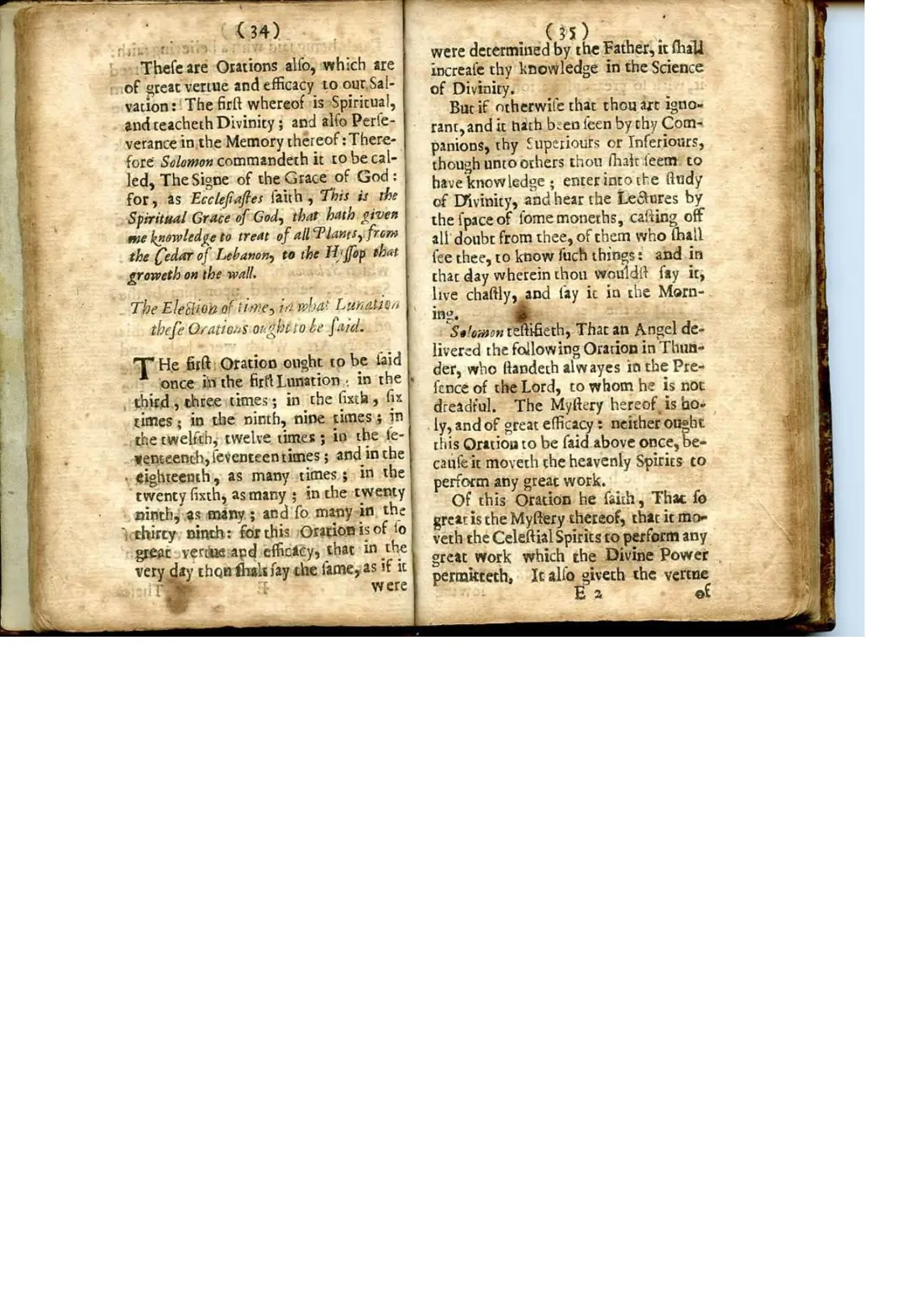
These are Orations also, which are of great vertue and efficacy to our Sal- vation: The first whereof is Spiritual, and teacheth Divinity; and also Perse- verance in the Memory thereof: There- fore Solomon commandeth it to be cal- led, The Signe of the Grace of God: for, as Ecclesiastes saith, This is the Spiritual Grace of God, that hath given me knowledge to treat of all Plants, from the Cedar of Lebanon, to the Hyssop that groweth on the wall.

The Election of time, in what Lunations these Orations ought to be said.

THe first Oration ought to be said once in the first Lunation, in the third, three times; in the sixth, six times; in the ninth, nine times; in the twelfth, twelve times; in the se- venteenth, seventeen times; and in the eighteenth, as many times; in the twenty sixth, as many; in the twenty ninth, as many; and so many in the thirty ninth: for this Oration is of so great vertue and efficacy, that in the very day thou shalt say the same, as if it were

(35)

were determined by the Father, it shall increase thy knowledge in the Science of Divinity.

But if otherwise that thou art igno- rant, and it hath been seen by thy Com- panions, thy Superiours or Inferiours, though unto others thou shalt seem to have knowledge; enter into the study of Divinity, and hear the Lectures by the space of some moneths, casting off all doubt from thee, of them who shall see thee, to know such things: and in that day wherein thou wouldst say it, live chastly, and say it in the Morn- ing.

Solomon testifieth, That an Angel de- livered the following Oration in Thun- der, who standeth alwayes in the Pre- sence of the Lord, to whom he is not dreadful. The Mystery hereof is ho- ly, and of great efficacy: neither ought this Oration to be said above once, be- cause it moveth the heavenly Spirits to perform any great work.

Of this Oration he saith, That so great is the Mystery thereof, that it mo- veth the Celestial Spirits to perform any great work which the Divine Power permitteth. It also giveth the vertue

E 2 of

TraducciónEspañol

(34)

Estas son también oraciones, que son de gran virtud y eficacia para nuestra sal- vación: la primera de ellas es espiritual, y enseña divinidad; y también perse- verancia en la memoria de ella: Por ello Salomón manda que sea lla- mada, El signo de la gracia de Dios: pues, como dice Ecclesiastes, Esta es la gracia espiritual de Dios, que me ha dado conocimiento para tratar de todas las plantas, desde el cedro del Líbano, hasta el hisopo que crece sobre el muro.

La elección del tiempo, en qué lunaciones deben decirse estas oraciones.

La primera oración debe ser dicha una vez en la primera lunación, en la tercera, tres veces; en la sexta, seis veces; en la novena, nueve veces; en la duodécima, doce veces; en la de- cimoséptima, diecisiete veces; y en la decimoctava, otras tantas veces; en la vigésimo sexta, otras tantas; en la vigésimo novena, otras tantas; y otras tantas en la trigésimo novena: pues esta oración es de tan gran virtud y eficacia, que en el mismo día en que digas la misma, como si fuera

(35)

fuera determinada por el Padre, aumentará tu conocimiento en la ciencia de la divinidad.

Pero si de otro modo tú eres igno- rante, y ello ha sido visto por tus com- pañeros, tus superiores o inferiores, aunque ante otros parezca que tienes conocimiento; entra en el estudio de la divinidad, y escucha las lecciones por el espacio de algunos meses, apartando de ti toda duda, de aquellos que te verán, para conocer tales cosas: y en aquel día en que quisieras decirla, vive castamente, y dila por la maña- na.

Salomón testifica, Que un ángel en- tregó la oración siguiente en true- no, el cual está siempre en la pre- sencia del Señor, para quien él no es terrible. El misterio de esto es san- to, y de gran eficacia: tampoco debe decirse esta oración más de una vez, por- que mueve a los espíritus celestiales a realizar cualquier gran obra.

De esta oración dice él, Que tan grande es el misterio de ella, que mueve a los espíritus celestiales a realizar cualquier gran obra que el poder divino permita. También da la virtud

E 2 de

División de la oración#p045
Ars Notoria (clásica) — facsímil · División de la oración · dominio público
Impreso — Turner 1657 · Manuscrito iluminado — Mellon MS 1 (Beinecke)
🔍 clic para ampliar

TranscripciónInglés (impreso, 1657)

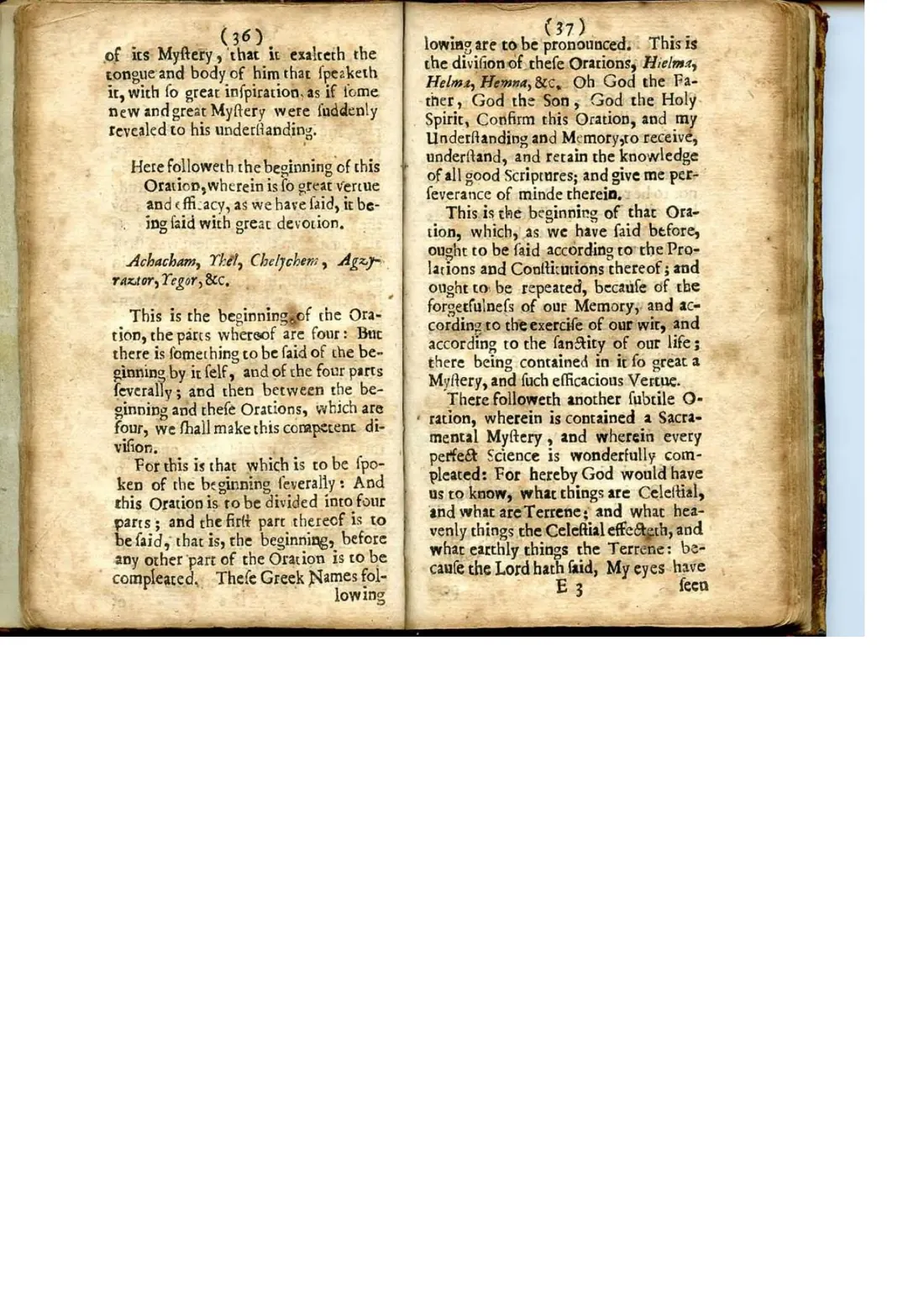
(36)

of its Mystery, that it exalteth the tongue and body of him that speaketh it, with so great inspiration, as if some new and great Mystery were suddenly revealed to his understanding.

Here followeth the beginning of this Oration, wherein is so great vertue and effi-acy, as we have said, it be- ing said with great devotion.

Achacham, Thel, Chelychem, Agzy- raxtor, Yegor, &c.

This is the beginning of the Ora- tion, the parts whereof are four: But there is something to be said of the be- ginning by it self, and of the four parts severally; and then between the be- ginning and these Orations, which are four, we shall make this competent di- vision. For this is that which is to be spo- ken of the beginning severally: And this Oration is to be divided into four parts; and the first part thereof is to be said, that is, the beginning, before any other part of the Oration is to be compleated. These Greek Names fol- lowing

(37)

lowing are to be pronounced: This is the division of these Orations, Hielma, Helma, Hemna, &c. Oh God the Fa- ther, God the Son, God the Holy Spirit, Confirm this Oration, and my Understanding and Memory,to receive, understand, and retain the knowledge of all good Scriptures; and give me per- severance of minde therein.

This is the beginning of that Ora- tion, which, as we have said before, ought to be said according to the Pro- lations and Constitutions thereof; and ought to be repeated, because of the forgetfulness of our Memory; and ac- cording to the exercise of our wit, and according to the sanctity of our life; there being contained in it so great a Mystery, and such efficacious Vertue.

There followeth another subtile O- ration, wherein is contained a Sacra- mental Mystery, and wherein every perfect Science is wonderfully com- pleated: For hereby God would have us to know, what things are Celestial, and what are Terrene; and what hea- venly things the Celestial effecteth, and what earthly things the Terrene: be- cause the Lord hath said, My eyes have

E 3 seen

TraducciónEspañol

(36)

de su misterio, que exalta la lengua y el cuerpo de aquel que la dice, con tan grande inspiración, como si algún nuevo y gran misterio fuera súbitamente revelado a su entendimiento.

Aquí sigue el comienzo de esta oración, en la cual hay tan gran virtud y eficacia, como hemos dicho, siendo dicha con gran devoción.

Achacham, Thel, Chelychem, Agzy- raxtor, Yegor, &c.

Este es el comienzo de la ora- ción, cuyas partes son cuatro: pero hay algo que decir acerca del co- mienzo por sí mismo, y de las cuatro partes separadamente; y luego entre el co- mienzo y estas oraciones, que son cuatro, haremos esta división compe- tente. Pues esto es lo que ha de decirse del comienzo separadamente: y esta oración ha de dividirse en cuatro partes; y la primera parte de ella ha de decirse, es decir, el comienzo, antes de que cualquier otra parte de la oración haya de ser completada. Estos nombres griegos si- guientes

(37)

guientes han de pronunciarse: esta es la división de estas oraciones, Hielma, Helma, Hemna, &c. oh Dios el Pa- dre, Dios el Hijo, Dios el Santo Espíritu, confirma esta oración, y mi entendimiento y memoria, para recibir, entender y retener el conocimiento de todas las buenas Escrituras; y dame per- severancia de mente en ello.

Este es el comienzo de aquella ora- ción, que, como hemos dicho antes, debe decirse según las pro- laciones y constituciones de ella; y debe repetirse, a causa del olvido de nuestra memoria; y de a- cuerdo con el ejercicio de nuestro ingenio, y de acuerdo con la santidad de nuestra vida; estando contenido en ella tan grande misterio, y tan eficaz virtud.

Sigue otra sutil o- ración, en la cual está contenido un mis- terio sacramental, y en la cual toda ciencia perfecta está maravillosamente com- pletada: pues por esto Dios querría que supiéramos qué cosas son celestiales, y cuáles son terrenales; y qué cosas ce- lestiales efectúa lo Celestial, y qué cosas terrenales lo Terrenal: por- que el Señor ha dicho, Mis ojos han

E 3 visto

Preceptos y partes de la oración#p047
Ars Notoria (clásica) — facsímil · Preceptos y partes de la oración · dominio público
Impreso — Turner 1657 · Manuscrito iluminado — Mellon MS 1 (Beinecke)
🔍 clic para ampliar

TranscripciónInglés (impreso, 1657)

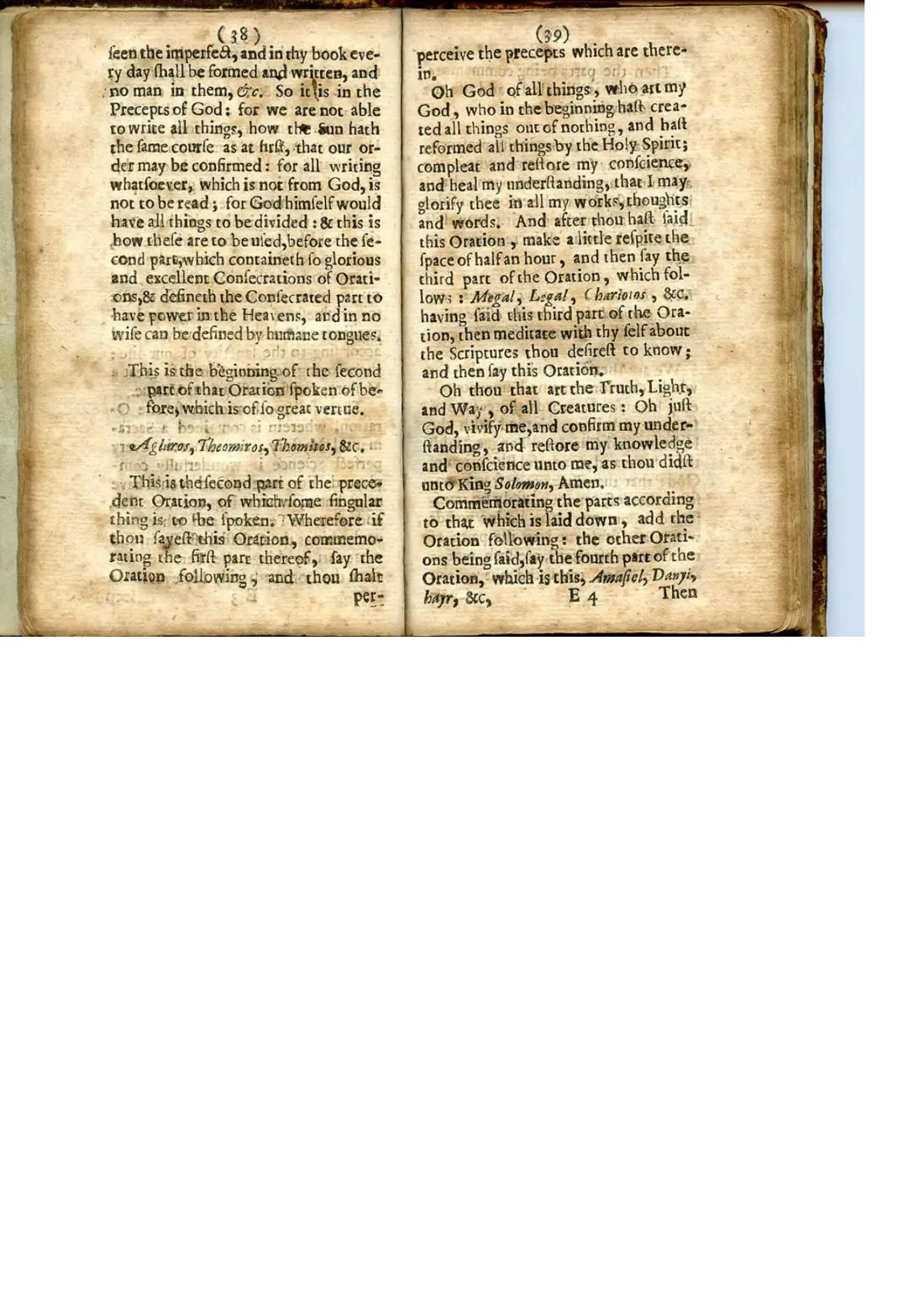
(38)

seen the imperfect, and in thy book eve- ry day shall be formed and written, and no man in them, &c. So it is in the Precepts of God : for we are not able to write all things, how the Sun hath the same course as at first, that our or- der may be confirmed : for all writing whatsoever, which is not from God, is not to be read ; for God himself would have all things to be divided : & this is how these are to be used,before the se- cond part,which containeth so glorious and excellent Consecrations of Orati- ons,& defineth the Consecrated part to have power in the Heavens, and in no wise can be defined by humane tongues.

This is the beginning of the second part of that Oration spoken of be- fore, which is of so great vertue.

Aglaros, Theomiros, Thomitos, &c.

This is the second part of the prece- dent Oration, of which some singular thing is to be spoken. Wherefore if thou sayest this Oration, commemo- rating the first part thereof, say the Oration following ; and thou shalt

per-

(39)

perceive the precepts which are there- in. Oh God of all things, who art my God, who in the beginning hast crea- ted all things out of nothing, and hast reformed all things by the Holy Spirit; compleat and restore my conscience, and heal my understanding, that I may glorify thee in all my works,thoughts and words. And after thou hast said this Oration , make a little respite the space of half an hour , and then say the third part of the Oration , which fol- lows : Megal, Legal, Chariotos , &c. having said this third part of the Ora- tion, then meditate with thy self about the Scriptures thou desirest to know ; and then say this Oration.

Oh thou that art the Truth, Light, and Way, of all Creatures : Oh just God, vivify me,and confirm my under- standing, and restore my knowledge and conscience unto me, as thou didst unto King Solomon, Amen. Commemorating the parts according to that which is laid down, add the Oration following: the other Orati- ons being said,say the fourth part of the Oration, which is this, Amasiel, Danyi- hayr, &c,

E 4 Then

TraducciónEspañol

(38)

visto lo imperfecto, y en tu libro cada día será formado y escrito, y ningún hombre en ellos, &c. Así es en los preceptos de Dios: pues no somos capaces de escribir todas las cosas, cómo el Sol tiene el mismo curso que al principio, para que nuestro or- den sea confirmado: pues toda escritura cualquiera que no sea de Dios, no ha de leerse; pues Dios mismo quiso que todas las cosas fueran divididas: y esta es la manera en que estas han de usarse, antes de la se- gunda parte, que contiene tan gloriosas y excelentes consagraciones de ora- ciones, y define que la parte consagrada tiene poder en los Cielos, y de ningún modo puede ser definida por lenguas humanas.

Este es el comienzo de la segunda parte de aquella oración de la que se habló antes, que es de tan gran virtud.

Aglaros, Theomiros, Thomitos, &c.

Esta es la segunda parte de la prece- dente oración, de la cual alguna cosa singular ha de decirse. Por lo cual si dices esta oración, conmemoran- do la primera parte de ella, di la oración siguiente; y tú habrás de

per-

(39)

percibir los preceptos que están conte- nidos en ella. Oh Dios de todas las cosas, que eres mi Dios, que en el principio has crea- do todas las cosas de la nada, y has reformado todas las cosas por el Espíritu Santo; completa y restaura mi conciencia, y sana mi entendimiento, para que yo pueda glorificarte en todas mis obras, pensamientos y palabras. Y después de que hayas dicho esta oración, haz un pequeño descanso por el espacio de media hora, y entonces di la tercera parte de la oración, que sigue: Megal, Legal, Chariotos, &c. habiendo dicho esta tercera parte de la ora- ción, medita entonces contigo mismo acerca de las Escrituras que deseas conocer; y entonces di esta oración.

Oh tú que eres la Verdad, Luz, y Camino, de todas las Criaturas: Oh justo Dios, vivifícame, y confirma mi enten- dimiento, y restaura mi conocimiento y conciencia en mí, como hiciste con el rey Solomon, Amén. Conmemorando las partes según aquello que está dispuesto, añade la oración siguiente: dichas las otras ora- ciones, di la cuarta parte de la oración, que es esta, Amasiel, Danyi- hayr, &c,

E 4 Entonces

Eficacia de las oraciones#p049
Ars Notoria (clásica) — facsímil · Eficacia de las oraciones · dominio público
Impreso — Turner 1657 · Manuscrito iluminado — Mellon MS 1 (Beinecke)
🔍 clic para ampliar

TranscripciónInglés (impreso, 1657)

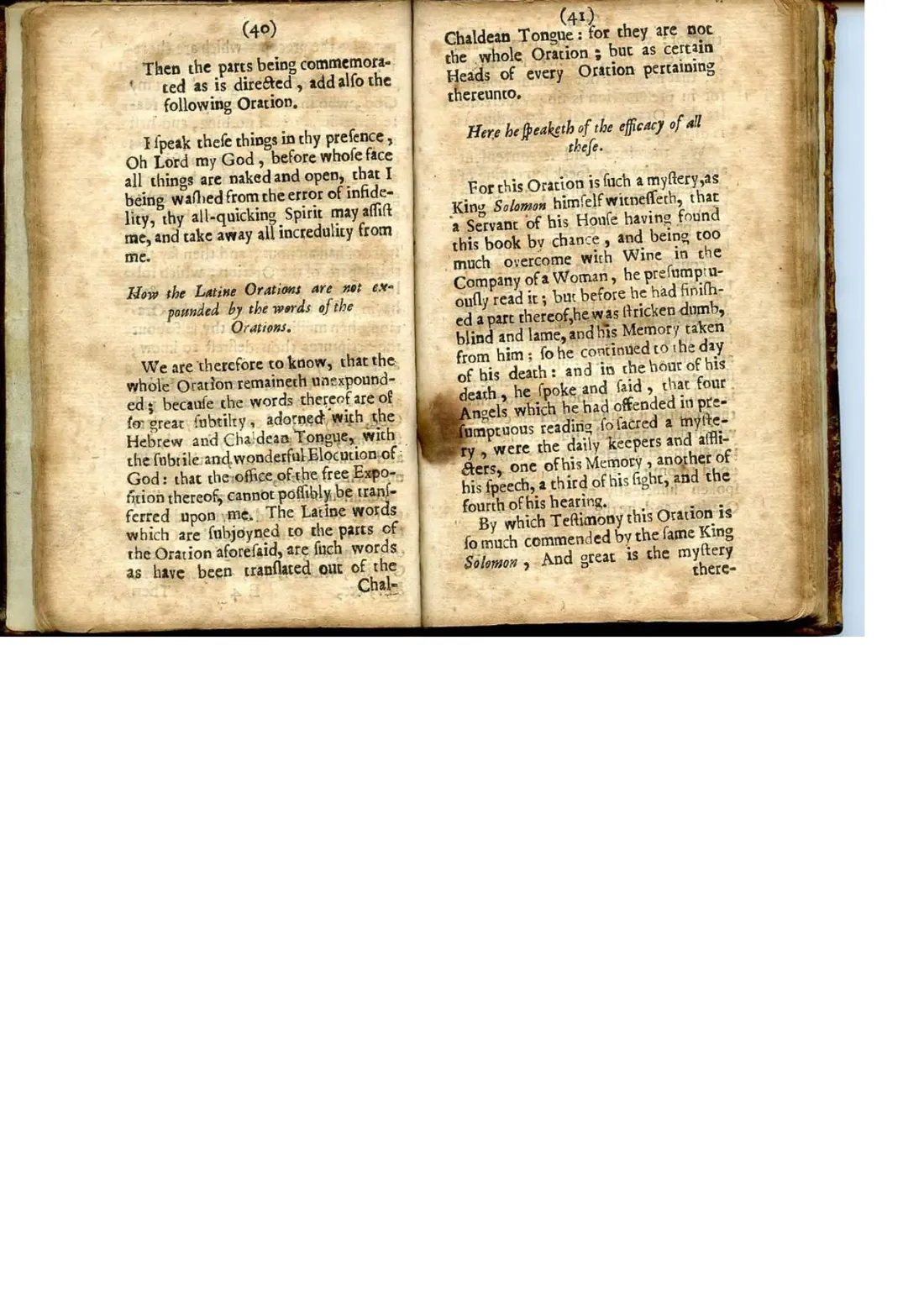
(40)

Then the parts being commemora- ted as is directed, add also the following Oration.

I speak these things in thy presence, Oh Lord my God, before whose face all things are naked and open, that I being washed from the error of infide- lity, thy all-quicking Spirit may assist me, and take away all incredulity from me.

How the Latine Orations are not ex- pounded by the words of the Orations.

We are therefore to know, that the whole Oration remaineth unexpound- ed; because the words thereof are of so great subtilty, adorned with the Hebrew and Chaldean Tongue, with the subtile and wonderful Elocution of God: that the office of the free Expo- sition thereof, cannot possibly be trans- ferred upon me. The Latine words which are subjoyned to the parts of the Oration aforesaid, are such words as have been translated out of the Chal-

(41)

Chaldean Tongue: for they are not the whole Oration ; but as certain Heads of every Oration pertaining thereunto.

Here he speaketh of the efficacy of all these.

For this Oration is such a mystery,as King Solomon himself witnesseth, that a Servant of his House having found this book by chance , and being too much overcome with Wine in the Company of a Woman, he presumptu- ously read it ; but before he had finish- ed a part thereof,he was stricken dumb, blind and lame, and his Memory taken from him ; so he continued to the day of his death : and in the hour of his death, he spoke and said , that four Angels which he had offended in pre- sumptuous reading so sacred a myste- ry , were the daily keepers and affli- cters, one of his Memory , another of his speech, a third of his sight, and the fourth of his hearing. By which Testimony this Oration is so much commended by the same King Solomon , And great is the mystery there-

TraducciónEspañol

(40)

Entonces, conmemoradas las partes como se ha indicado, añade también la oración siguiente.

Hablo estas cosas en tu presencia, oh Señor mi Dios, ante cuyo rostro todas las cosas están desnudas y abiertas, para que yo, lavado del error de la infide- lidad, tu Espíritu que todo vivifica pueda asistirme y quite de mí toda incredulidad.

Cómo las oraciones latinas no son ex- puestas por las palabras de las oraciones.

Por tanto hemos de saber que la oración entera permanece sin exponer; porque las palabras de ella son de tan gran sutileza, adornadas con la lengua hebrea y caldea, con la sutil y maravillosa elocución de Dios: que el oficio de la libre expo- sición de ella no puede posiblemente ser trans- ferido a mí. Las palabras latinas que están unidas a las partes de la oración antedicha son tales palabras como han sido traducidas de la Cal-

(41)

lengua caldea: pues no son la oración entera; sino como ciertas cabezas de cada oración pertenecientes a ella.

Aquí habla de la eficacia de todas estas.

Pues esta oración es tal misterio, que el rey Solomon mismo atestigua que un servidor de su casa, habiendo encontrado este libro por azar, y estando demasiado vencido por el vino en la compañía de una mujer, lo leyó presuntu- osamente; pero antes de haber termi- nado una parte de él, fue herido con mudez, ceguera y cojera, y su memoria le fue quitada; así continuó hasta el día de su muerte: y en la hora de su muerte, habló y dijo que cuatro ángeles a quienes había ofendido en una lectura presuntuosa de tan sagrado miste- rio, eran los guardianes y afli- gidores diarios, uno de su memoria, otro de su habla, un tercero de su vista, y el cuarto de su oído. Por este testimonio esta oración es tan encomiada por el mismo rey Solomon, y grande es el misterio allí-

Preceptos y elocuencia#p051
Ars Notoria (clásica) — facsímil · Preceptos y elocuencia · dominio público
Impreso — Turner 1657 · Manuscrito iluminado — Mellon MS 1 (Beinecke)
🔍 clic para ampliar

TranscripciónInglés (impreso, 1657)

(42)

thereof: we do greatly require and charge every one, that will say or read it , that he do it not presumptuously; for in presumption is sin ; Wherefore let this Oration be said , according as is directed.

We therefore hold it convenient and necessary , to speak something of the general precepts of art , and of the knowledge of all arts ; and of the se- veral precepts of every singular art : but because we have touched somthing of the course of the Moon , it is necessary that we shew what her course signifies. The Moon passeth through 12 signs in one Moneth ; and the Sun through 12 signs in a year ; and in the same term and time,, the Spirit inspireth, fructi- fieth-and illustrateth them ; whence it is said, that the Sun and the Moon run their course: it is understood the course which first they had. But because this is wanting in the Hebrew , we thought good to omit it in the Latine, having spoken sufficiently of the preceding Oration, and the three parts thereof.

In

(43)

In this Chapter he sheweth the effi- cacy of the subsequent Oration, it being special to obtain Elo- quence.

This Holy Oration which followeth, is a certain special Oration, to obtain Eloquence ; whereas all others have virtue and efficacy in other things ; this containeth this certain special mystery in it self: And whereas one of the ge- nerals is shewing in it self, certain ge- neral precepts , common-to all arts ; for so God instituted the Soul in the Body,saying, This I give unto you,that ye may keep and observe the Law of the Lord : And these are they that stand in the presence of God alwayes, and see their Saviour face to face night and day : So of this Oration,I say, This is that most glorious, mystical and in- telligible Oration, containing such my- steries in it, which the mind,conscience and tongue succeedeth. This is such a mystery , that a man shall keep it ac- cording to his will, who foreseeth all things in his sight that are made ; for the mystery of this Oration is glorious

and

TraducciónEspañol

(42)

de ello: requerimos y encargamos grandemente a todo aquel que quiera decirla o leerla, que no lo haga presuntuosamente; pues en la presunción hay pecado; por lo cual dígase esta oración según está dirigido.

Por tanto tenemos por conveniente y necesario hablar algo de los preceptos generales del arte, y del conocimiento de todas las artes; y de los pre- ceptos varios de cada arte singular: pero porque hemos tocado algo del curso de la Luna, es necesario que mostremos qué significa su curso. La Luna pasa por 12 signos en un mes; y el Sol por 12 signos en un año; y en el mismo término y tiempo, el Espíritu inspira, fructi- fica e ilumina estas cosas; de donde se dice que el Sol y la Luna recorren su curso: se entiende el curso que tuvieron primero. Pero porque esto falta en el hebreo, pensamos bien omitirlo en el latín, habiendo hablado suficientemente de la precedente oración, y de sus tres partes.

En

(43)

En este capítulo muestra la efi- cacia de la oración subsiguiente, siendo especial para obtener elo- cuencia.

Esta santa oración que sigue, es una cierta oración especial, para obtener elocuencia; mientras que todas las otras tienen virtud y eficacia en otras cosas; esta contiene este cierto misterio especial en sí misma: y mientras que uno de los ge- nerales se muestra en sí mismo, ciertos pre- ceptos generales, comunes a todas las artes; pues así Dios instituyó el alma en el cuerpo, diciendo, Esto os doy, para que podáis guardar y observar la ley del Señor: y estos son aquellos que están en la presencia de Dios siempre, y ven a su Salvador cara a cara noche y día: así de esta oración, digo, esta es aquella gloriosísima, mística e in- teligible oración, que contiene tales mis- terios en ella, en los cuales la mente, conciencia y lengua tienen éxito. Este es tal misterio, que un hombre lo guardará de a- cuerdo con su voluntad, quien prevé todas las cosas hechas a su vista; pues el misterio de esta oración es glorioso

y

Tiempo de la oración#p053
Ars Notoria (clásica) — facsímil · Tiempo de la oración · dominio público
Impreso — Turner 1657 · Manuscrito iluminado — Mellon MS 1 (Beinecke)
🔍 clic para ampliar

TranscripciónInglés (impreso, 1657)

(44)

and Sacramental : let no man presume to say any of this Oration after too much drinking or Luxury ; nor fasting, without great reverence and discre- tion. Whence Solomon saith , Let no man presume to treat any thing of this Oration , but in certain determinate and appointed times , unless he make mention of this Oration before some great President, for some weighty bu- siness ; for which this Oration is of wonderful excellent virtue. The goodness of this Oration , and the attaining to the effects thereof, it is read in that Psalm wherein it is said , Follow me,and I will make you fishers of men, as he said and did. We know that it is not of our power, that this Oration is of so great Virtue, and such a mystery : as sometimes also the Lord said to his Disciples, This we are not able to know : for this Oration is such a mystery, that it containeth in it the great Name of God, which many have lyed in saying they knew it ; for Jesus himself performed many Miracles in the Temple by it : But many have lyed about what he did, and have hid and absconded the truth thereof; so

that

(45)

that none have declared the same be- fore it came to passe: but we suppose have spoken something about or con- cerning it.

In this Chapter he setteth down the time and manner how this Ora- tion is to be pronounced.

For this Oration is one of the gene- rals ; and the first of particulars, con- taining both in it self ; having a special virtue and faculty,to gain Eloquence in it self : therefore it is necessary to be understood what time,ordination, and what dayes it is to be said and pub- lished. It may alwayes be rehearsed in every 14 Lunary as above said ; but the ordi- nation of the time for every day,where- in it is to be said, is especially in the morning betimes , before a man is de- filed ; and then all Orations are chiefly to be said. And this Oration must be then pronounced totally together, without any division. And although there are divisions therein, the Oration is not divided in it self ; but only the Divine and Glorious Names are writ- ten

TraducciónEspañol

(44)

y sacramental: que ningún hombre presuma decir nada de esta oración después de beber demasiado o de la lujuria; ni ayunando, sin gran reverencia y discre- ción. De donde Solomon dice: Que ningún hombre presuma tratar cosa alguna de esta oración, sino en ciertos tiempos determinados y señalados, a menos que haga mención de esta oración ante algún gran presidente, por algún asunto de peso; por el cual esta oración es de maravillosa y excelente virtud. La bondad de esta oración, y el alcanzar sus efectos, se lee en aquel salmo donde se dice: Seguidme, y os haré pescadores de hombres, como él dijo e hizo. Sabemos que no está en nuestro poder que esta oración sea de tan gran virtud, y de tal misterio: como también a veces el Señor dijo a sus discípulos: Esto no somos capaces de saberlo: pues esta oración es tal misterio, que contiene en sí el gran nombre de Dios, que muchos han mentido diciendo que lo conocían; pues Jesús mismo realizó muchos milagros en el templo por él: Pero muchos han mentido acerca de lo que él hizo, y han ocultado y escondido la verdad de ello; de modo

que

(45)

que ninguno ha declarado lo mismo an- tes de que viniese a pasar: pero suponemos haber dicho algo acerca de ello o con- cerniente a ello.

En este capítulo expone el tiempo y la manera en que esta ora- ción ha de pronunciarse.

Pues esta oración es una de las gene- rales; y la primera de las particulares, con- teniendo ambas en sí misma; teniendo una especial virtud y facultad para obtener elocuencia en sí misma: por tanto es necesario que se entienda qué tiempo, ordenación, y qué días ha de decirse y pub- licarse. Puede ensayarse siempre en cada 14 Lunary como arriba se dijo; pero la orde- nación del tiempo para cada día, en que ha de decirse, es especialmente por la mañana temprano, antes de que el hombre sea man- cillado; y entonces todas las oraciones son principalmente para decirse. Y esta oración debe ser entonces pronunciada totalmente junta, sin división alguna. Y aunque hay divisiones en ella, la oración no está dividida en sí misma; sino que solamente los nombres divinos y gloriosos están escri- tos

Proemio de elocuencia#p055
Ars Notoria (clásica) — facsímil · Proemio de elocuencia · dominio público
Impreso — Turner 1657 · Manuscrito iluminado — Mellon MS 1 (Beinecke)
🔍 clic para ampliar

TranscripciónInglés (impreso, 1657)

(46)

ten severally, and are divided into parts, according to the terminations of every great and Glorious name; and it is to be said together as a most excel- lent name, but not as one Word, be- cause of the fragility of our nature; Neither is it needful to know the Ele- ments of syllables, posited in this Ora- tion; they are not to be known; nei- ther let any one presumptuously speak them; neither let him do any thing by way of temptation, concerning this Oration, which ought not to be done : Eliot, Sehel, Hemech, Zaba, &c.

No Man that is impedited or corrupted with any crime, ought to presume to say this Oration.

This is a thing agreed unto amongst the wise men of this World, that these things, as we have said before, be pro- nounced with great reverence and in- dustry : it may be said every day, wherein thou art not hindred by some criminal sin ; and in that day wherein thou art impedited by some criminal sin, thou maist remember it in thy heart ; and if thou dost desire to be made

(47)

made Eloquent, repeat it three times. And if any evill thing trouble thee, or thou art emerged and involved into any great business, repeat this Oration once, and Eloquence shall be added to thee, as much as is needful; and if thou repeat it over twice, great Eloquence shall be given to thee; so great a Sacra- ment is this Oration. The third thing to be considered in this Oration,is, This Oration ought so to be pronounced, that confession of the Heart and Mouth ought to precede it : let it be pronounced in the morn- ing early, and after that Oration say the Latine Oration following.

This is a Prologue or Exposition of the precedent Oration , which ought to be said together.

Oh omnipotent and eternal God, and merciful Father, blessed before all Worlds ; who art a God eternal, in- comprehensible ; and unchangeable, and hast granted this blessed gift of Salvation unto us ; according to the omnipotency of thy Majesty, hast gran- ted unto us the faculty of speaking, and learn-

TraducciónEspañol

(46)

tos separadamente, y están divididos en partes, según las terminaciones de cada grande y glorioso nombre; y ha de decirse junto como un nombre excel- lentísimo, pero no como una sola palabra, a causa de la fragilidad de nuestra naturaleza; ni es necesario conocer los ele- mentos de las sílabas, puestos en esta ora- ción; no han de ser conocidos; ni deje nadie que presuntuosamente los diga; ni haga cosa alguna por vía de tentación, concerniente a esta oración, lo cual no debe hacerse: Eliot, Sehel, Hemech, Zaba, &c.

Ningún hombre que esté impedido o corrompido por crimen alguno, debe presumir decir esta oración.

Esta es una cosa acordada entre los hombres sabios de este mundo, que estas cosas, como hemos dicho antes, sean pro- nunciadas con gran reverencia e in- dustria: puede decirse cada día, en que no estés impedido por algún pecado criminal; y en aquel día en que estés impedido por algún pecado criminal, puedes recordarla en tu corazón; y si deseas ser hecho

(47)

hecho elocuente, repítela tres veces. Y si alguna cosa mala te turba, o estás emergido e involucrado en algún gran negocio, repite esta oración una vez, y la elocuencia será añadida a ti, tanto como sea necesario; y si la repites de nuevo dos veces, gran elocuencia te será dada; tan gran Sacra- mento es esta oración. La tercera cosa que ha de considerarse en esta oración, es, esta oración debe pronunciarse de tal modo, que la confesión del corazón y de la boca debe precederla: que sea pronunciada por la mañana temprano, y después de aquella oración di la oración latina siguiente.

Este es un prólogo o exposición de la oración precedente, que debe decirse juntamente.

Oh Dios omnipotente y eterno, y Padre misericordioso, bendito antes de todos los mundos; que eres un Dios eterno, in- comprensible; e inmutable, y has concedido este bendito don de salvación a nosotros; según la omnipotencia de tu majestad, has conce- dido a nosotros la facultad de hablar, y apren-

Artes liberales y mecánicas#p059
Ars Notoria (clásica) — facsímil · Artes liberales y mecánicas · dominio público
Impreso — Turner 1657 · Manuscrito iluminado — Mellon MS 1 (Beinecke)
🔍 clic para ampliar

TranscripciónInglés (impreso, 1657)

(50)

and those singular arts have singular virtues and powers. Having now given a sufficient defi- nition of general precepts ; and the Orations are laid down , and the Au- thority of the Orations unto what they are designed ; It is now necessary to set down what is to be done , concern- ing the singular Orations ; because we are now to treat of the several and par- ticular arts , that we may follow the example which our builder and Master hath laid before us ; for Solomon saith, before we proceed to the singular notes and Orations of arts before noted, there ought to be said a Preludium, which is a beginning or Prologue.

How every several Art hath its pro- per note.

Before we proceed to the singular precepts of several Arts , it is necessary to discover how every several Art hath a several Note.

Of

(51)

Of the liberal Sciences,and other things, which may be had by that Art.

The liberal Arts are seaven , and seaven exceptives, and seaven Mecha- nicks. The seaven exceptives are com- prehended under the seaven liberal : It is manifest what the seaven liberal Arts are , of which we shall first treat. The Mechanicks are these, which are adulterately called Hydromancy , Pyro- mancy, Nigromancy, Chiromancy, Geo- mancy,Geomagia,which is comprehended under Astronomy, and Notory. Hydromancy, is a science of divining by the Water ; whereby the Masters thereof judged by the standing or run- ning of the Water. Pyromancy, is an Experiment of divining by the flaming of the fire ; which the antient Philoso- phers esteemed of great efficacy. Ni- gromancy,is a Sacrifice of dead Animals, whereby the Antients supposed to know many great Experiments without sin, and to attain to great knowledge: from whence Solomon commandeth that they might read seaven Books of that Art without sin ; And that two he accomp- ted

TraducciónEspañol

(50)

y aquellas artes singulares tienen singulares virtudes y poderes. Habiendo dado ahora una suficiente defi- nición de los preceptos generales; y estando las oraciones expuestas, y la au- toridad de las oraciones en cuanto a aquello para lo que están destinadas; ahora es necesario exponer lo que ha de hacerse, concern- iente a las oraciones singulares; porque ahora hemos de tratar de las varias y par- ticulares artes, para que podamos seguir el ejemplo que nuestro constructor y Maestro ha puesto ante nosotros; pues Solomon dice, antes de proceder a las notas singulares y oraciones de las artes antes señaladas, debe decirse un Preludium, que es un comienzo o prólogo.

Cómo cada arte particular tiene su pro- pia nota.

Antes de proceder a los singulares preceptos de varias artes, es necesario descubrir cómo cada arte particular tiene una nota particular.

De

(51)

De las ciencias liberales, y otras cosas, que pueden obtenerse por ese arte.

Las artes liberales son siete, y siete exceptivas, y siete Mechá- nicas. Las siete exceptivas están com- prendidas bajo las siete liberales: Es manifiesto cuáles son las siete artes liberales, de las cuales trataremos primero. Las mecánicas son estas, que son adulteradamente llamadas Hydromancy, Pyro- mancy, Nigromancy, Chiromancy, Geo- mancy, Geomagia, que está comprendida bajo Astronomy, y Notory. Hydromancy es una ciencia de adivinar por el agua; por la cual los maestros de ello juzgaban por el estar quieta o cor- rer del agua. Pyromancy es un experimento de adivinar por la llama del fuego; que los antiguos filóso- fos estimaban de gran eficacia. Ni- gromancy, es un sacrificio de animales muertos, por el cual los antiguos suponían conocer muchos grandes experimentos sin pecado, y alcanzar gran conocimiento: de donde Solomon manda que ellos pudieran leer siete libros de aquel arte sin pecado; y que dos él conside- ró

Grimorium · grimorium.lat · CC BY 4.0 · Ficha