Ars Notoria (classical)

The classical Notory Art —not the abbreviated Lemegeton version— · Turner 1657, with the illuminated notae of Mellon MS 1

Printed — Turner 1657 · Illuminated manuscript — Mellon MS 1 (Beinecke)
Download PDF ↓
Dedication to William Ryves (opening)#p003
Ars Notoria (classical) — facsimile page (Dedication to William Ryves (opening)) · public-domain facsimile
Printed — Turner 1657 · Illuminated manuscript — Mellon MS 1 (Beinecke)
🔍 click to enlarge

TranscriptionEnglish (printed, 1657)

Left page: blank verso of the title page; only the mirror show-through of the title-page text printed on the other side is visible. No text of its own.

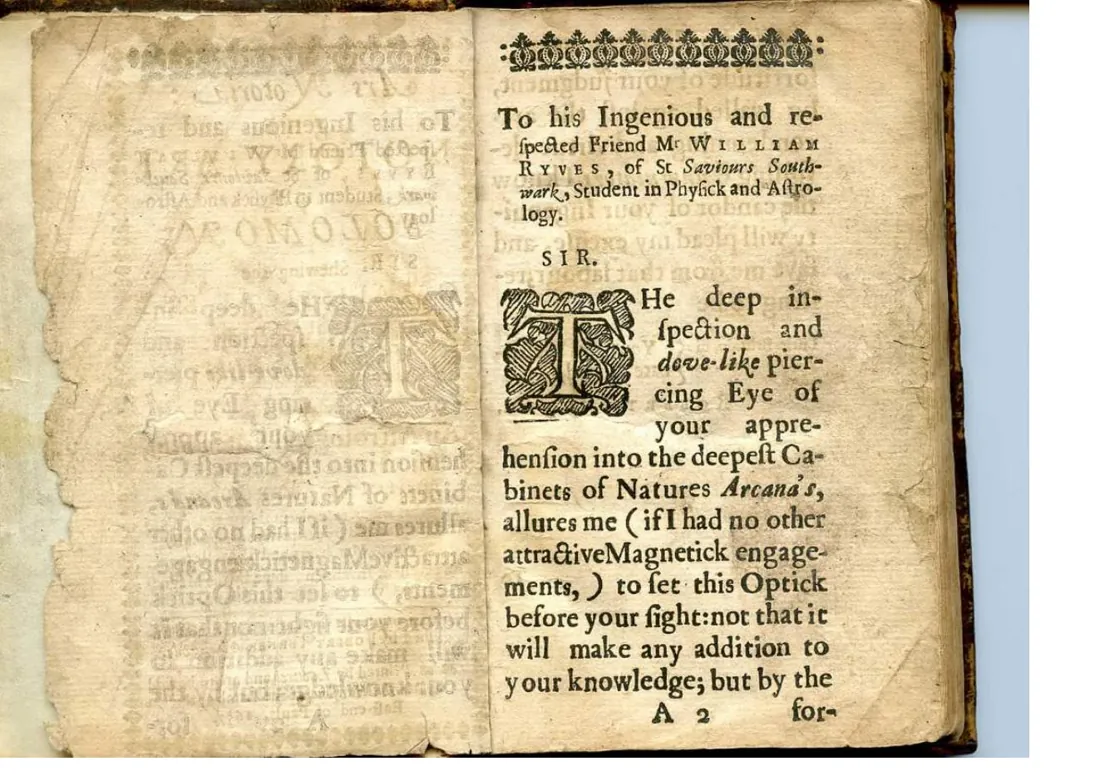
To his Ingenious and re- spected Friend Mr WILLIAM RYVES, of St Saviours South- wark, Student in Physick and Astro- logy.

SIR.

THe deep inspection and dove-like piercing Eye of your apprehension into the deepest Cabinets of Natures Arcana's, allures me (if I had no other attractive Magnetick engagements,) to set this Optick before your sight: not that it will make any addition to your knowledge; but by the

A 2    for-

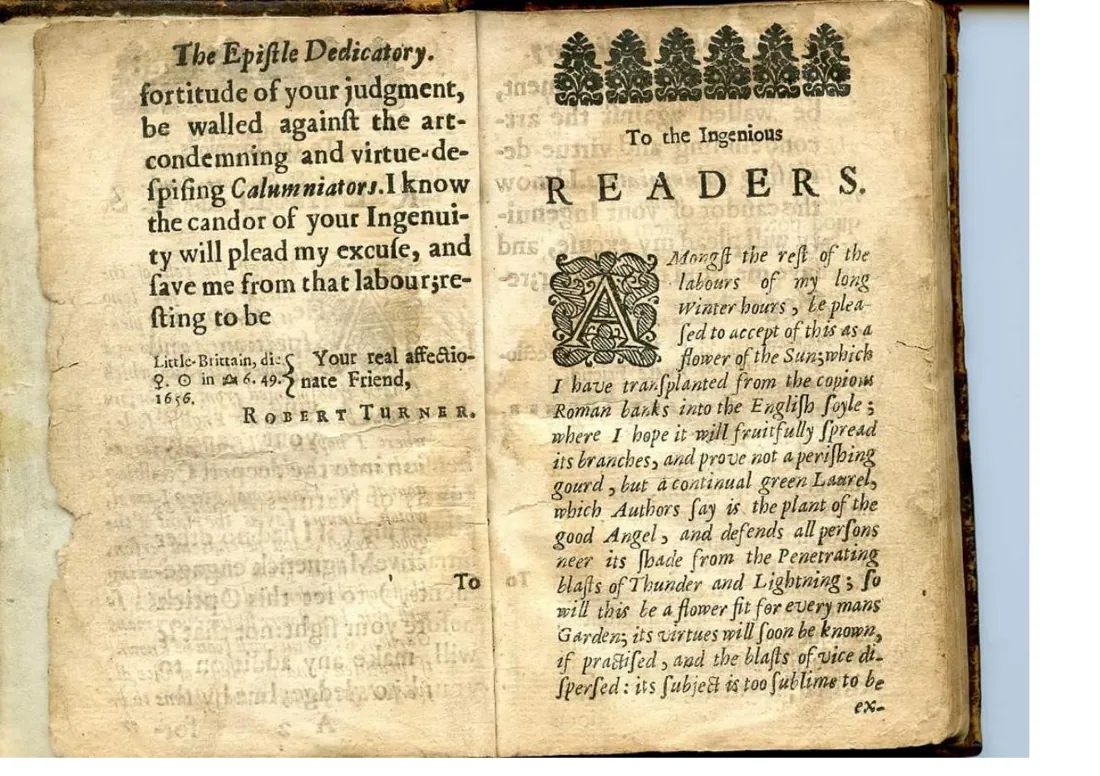
End of the Epistle Dedicatory; To the Ingenious Readers#p005
Ars Notoria (classical) — facsimile page (End of the Epistle Dedicatory; To the Ingenious Readers) · public-domain facsimile
Printed — Turner 1657 · Illuminated manuscript — Mellon MS 1 (Beinecke)
🔍 click to enlarge

TranscriptionEnglish (printed, 1657)

The Epistle Dedicatory.

fortitude of your judgment, be walled against the art- condemning and virtue-de- spising Calumniators. I know the candor of your Ingenui- ty will plead my excuse, and save me from that labour; re- sting to be

Little-Brittain, die Your real affectio- ♀. ☉ in ♈ 6. 49. nate Friend, 1656.

ROBERT TURNER.

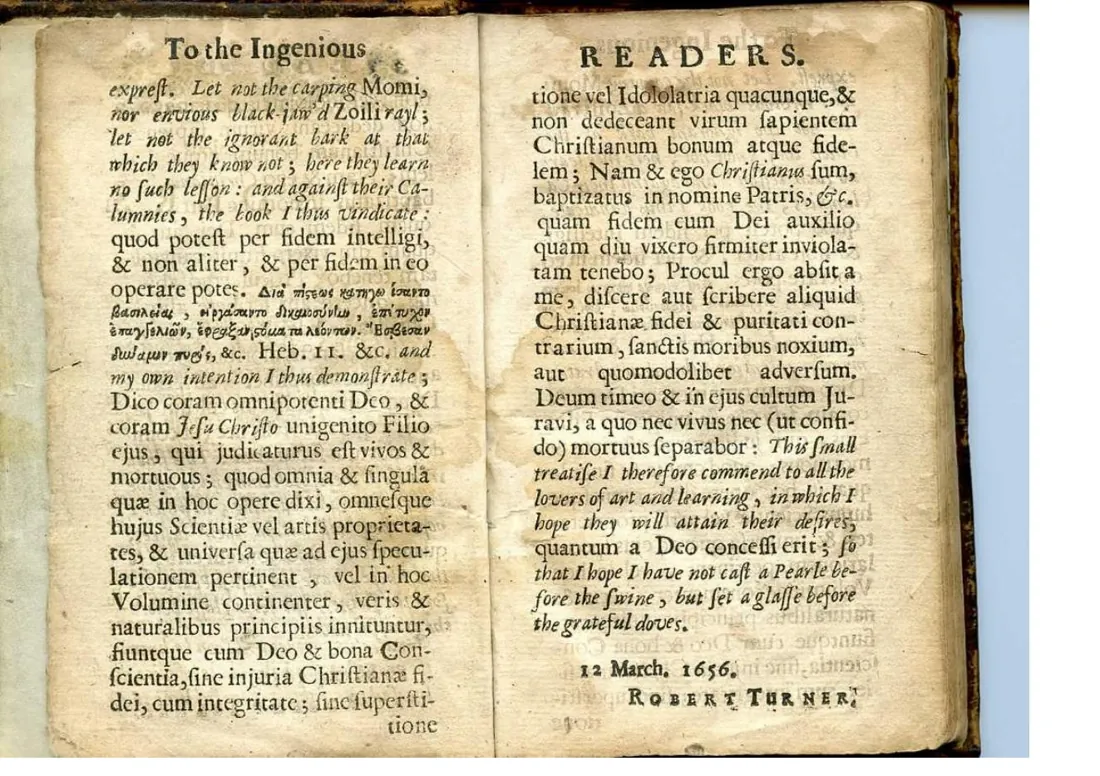
To the Ingenious

READERS.

Amongst the rest of the labours of my long winter hours, be pleased to accept of this as a flower of the Sun; which I have transplanted from the copious Roman banks into the English soyle; where I hope it will fruitfully spread its branches, and prove not a perishing gourd, but a continual green Laurel, which Authors say is the plant of the good Angel, and defends all persons neer its shade from the Penetrating blasts of Thunder and Lightning; so will this be a flower fit for every mans Garden; its virtues will soon be known, if practised, and the blasts of vice dispersed: its subject is too sublime to be ex-

To the Ingenious Readers (end of preface)#p007
Ars Notoria (classical) — facsimile page (To the Ingenious Readers (end of preface)) · public-domain facsimile
Printed — Turner 1657 · Illuminated manuscript — Mellon MS 1 (Beinecke)
🔍 click to enlarge

TranscriptionEnglish (printed, 1657)

To the Ingenious READERS.

exprest. Let not the carping Momi, nor envious black-jaw'd Zoili rayl; let not the ignorant bark at that which they know not; here they learn no such lesson: and against their Calumnies, the book I thus vindicate: quod potest per fidem intelligi, & non aliter, & per fidem in eo operare potes. Διὰ πίστεως κατηγωνίσαντο βασιλείας, εἰργάσαντο δικαιοσύνην, ἐπέτυχον ἐπαγγελιῶν, ἔφραξαν στόματα λεόντων, ἔσβεσαν δύναμιν πυρός, &c. Heb. 11. &c. and my own intention I thus demonstrate; Dico coram omnipotenti Deo, & coram Jesu Christo unigenito Filio ejus, qui judicaturus est vivos & mortuous; quod omnia & singula quæ in hoc opere dixi, omnesque hujus Scientiæ vel artis proprietates, & universa quæ ad ejus speculationem pertinent, vel in hoc Volumine continenter, veris & naturalibus principiis innituntur, fiuntque cum Deo & bona Conscientia, sine injuria Christianæ fidei, cum integritate; sine superstitione vel Idololatria quacunque, & non dedeceant virum sapientem Christianum bonum atque fidelem; Nam & ego Christianus sum, baptizatus in nomine Patris, &c. quam fidem cum Dei auxilio quam diu vixero firmiter inviolatam tenebo; Procul ergo absit a me, discere aut scribere aliquid Christianæ fidei & puritati contrarium, sanctis moribus noxium, aut quomodolibet adversum. Deum timeo & in ejus cultum Juravi, a quo nec vivus nec (ut confido) mortuus separabor: This small treatise I therefore commend to all the lovers of art and learning, in which I hope they will attain their desires, quantum a Deo concessi erit; so that I hope I have not cast a Pearle before the swine, but set a glasse before the grateful doves.

12 March. 1656. ROBERT TURNER.

The Notory Art of Solomon (opening)#p009
Ars Notoria (classical) — engraved plate (The Notory Art of Solomon (opening)) · public-domain facsimile
Printed — Turner 1657 · Illuminated manuscript — Mellon MS 1 (Beinecke)
🔍 click to enlarge

TranscriptionEnglish (printed, 1657)

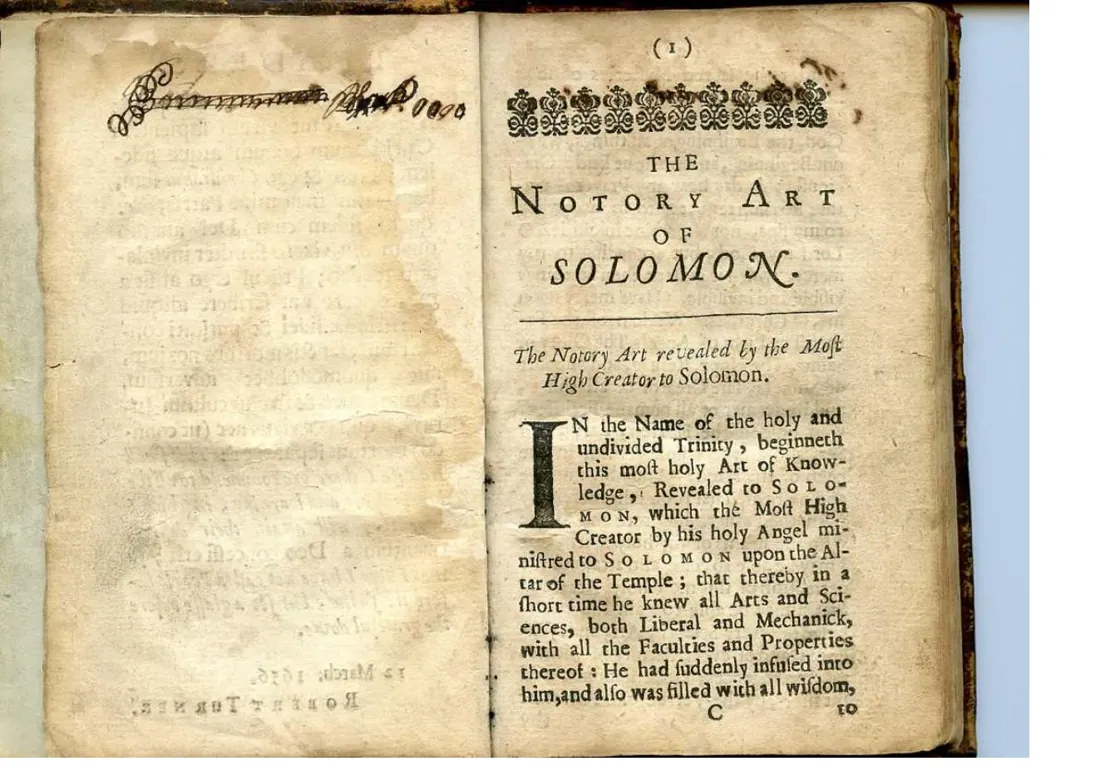
(1)

[figure: typographic ornamental frieze across the width of the text block]

THE NOTORY ART OF SOLOMON.

———

The Notory Art revealed by the Most High Creator to Solomon.

IN the Name of the holy and undivided Trinity, beginneth this most holy Art of Knowledge, Revealed to SOLOMON, which the Most High Creator by his holy Angel ministred to SOLOMON upon the Altar of the Temple; that thereby in a short time he knew all Arts and Sciences, both Liberal and Mechanick, with all the Faculties and Properties thereof: He had suddenly infused into him, and also was filled with all wisdom,

C

Prayer for Memory and Understanding#p011
Ars Notoria (classical) — facsimile page (Prayer for Memory and Understanding) · public-domain facsimile
Printed — Turner 1657 · Illuminated manuscript — Mellon MS 1 (Beinecke)
🔍 click to enlarge

TranscriptionEnglish (printed, 1657)

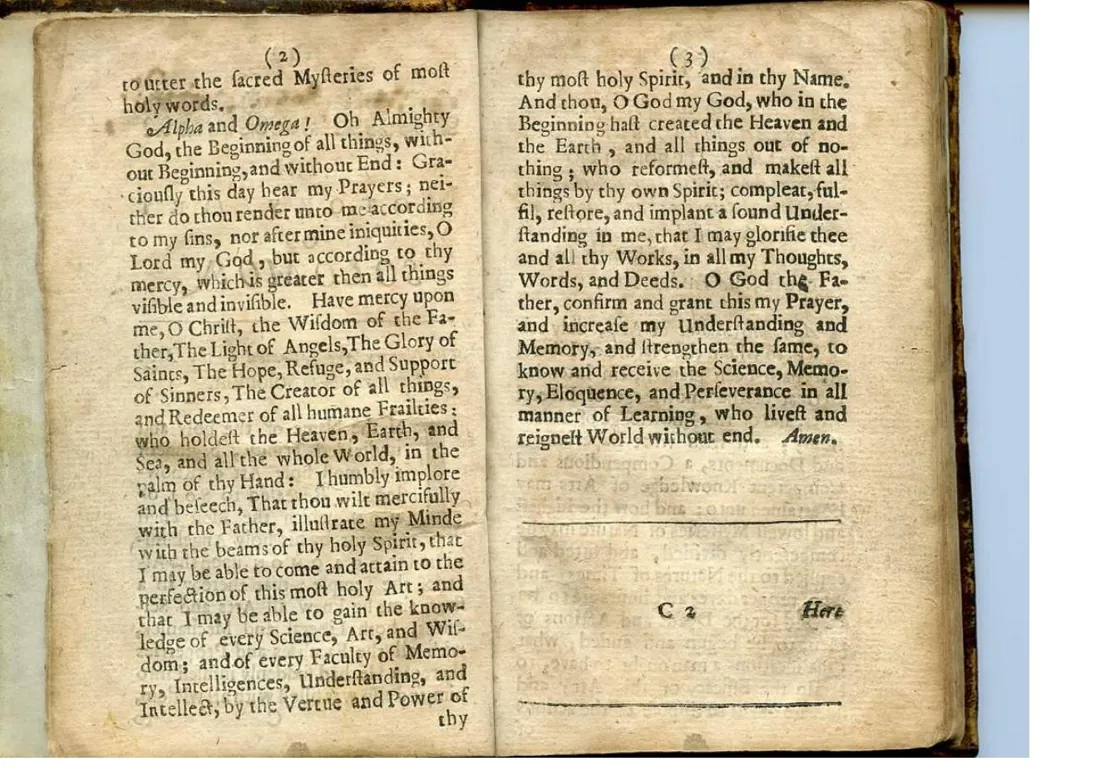
(2)

to utter the sacred Mysteries of most holy words.

Alpha and Omega! Oh Almighty God, the Beginning of all things, without Beginning, and without End : Graciously this day hear my Prayers ; neither do thou render unto me according to my sins, nor after mine iniquities, O Lord my God, but according to thy mercy, which is greater then all things visible and invisible. Have mercy upon me, O Christ, the Wisdom of the Father, The Light of Angels, The Glory of Saints, The Hope, Refuge, and Support of Sinners, The Creator of all things, and Redeemer of all humane Frailties ; who holdest the Heaven, Earth, and Sea, and all the whole World, in the palm of thy Hand: I humbly implore and beseech, That thou wilt mercifully with the Father, illustrate my Minde with the beams of thy holy Spirit, that I may be able to come and attain to the perfection of this most holy Art; and that I may be able to gain the knowledge of every Science, Art, and Wisdom; and of every Faculty of Memory, Intelligence, Understanding, and Intellect, by the Vertue and Power of thy

(3)

thy most holy Spirit, and in thy Name. And thou, O God my God, Who in the Beginning hast created the Heaven and the Earth, and all things out of nothing ; who reformest, and makest all things by thy own Spirit; compleat, fulfil, restore, and implant a sound understanding in me, that I may glorifie thee and all thy Works, in all my Thoughts, Words, and Deeds. O God the Father, confirm and grant this my Prayer, and increase my understanding and Memory, and strengthen the same, to know and receive the Science, Memory, Eloquence, and Perseverance in all manner of Learning, who livest and reignest World without end. Amen.

C 2    Here

Golden Flowers and Efficacy of Words#p013
Ars Notoria (classical) — facsimile page (Golden Flowers and Efficacy of Words) · public-domain facsimile
Printed — Turner 1657 · Illuminated manuscript — Mellon MS 1 (Beinecke)
🔍 click to enlarge

TranscriptionEnglish (printed, 1657)

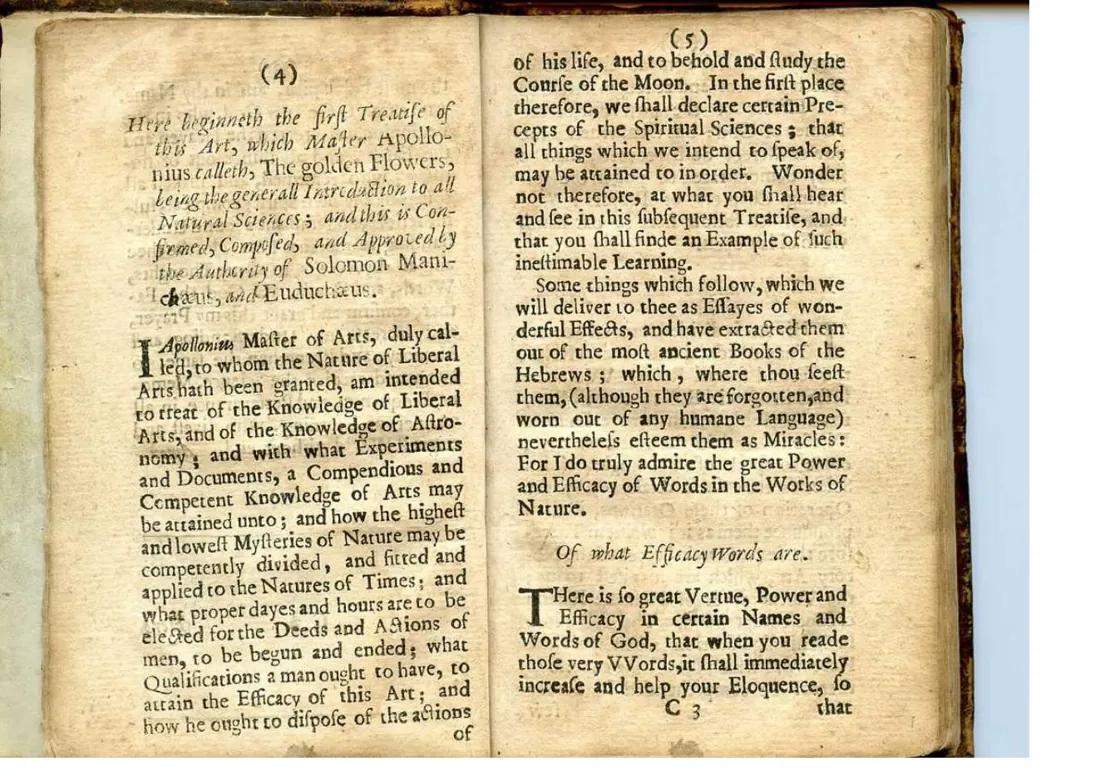
(4)

Here beginneth the first Treatise of this Art, which Master Apollonius calleth, The golden Flowers, being the generall Introduction to all Natural Sciences ; and this is Confirmed, Composed, and Approved by the Authority of Solomon Manicheus, and Euduchæus.

I Apollonius Master of Arts, duly called; to whom the Nature of Liberal Arts hath been granted, am intended to treat of the Knowledge of Liberal Arts, and of the Knowledge of Astronomy ; and with what Experiments and Documents, a Compendious and Competent Knowledge of Arts may be attained unto ; and how the highest and lowest Mysteries of Nature may be competently divided, and fitted and applied to the Natures of Times ; and what proper dayes and hours are to be elected for the Deeds and Actions of men, to be begun and ended; what Qualifications a man ought to have, to attain the Efficacy of this Art; and how he ought to dispose of the actions

(5)

of his life, and to behold and study the Course of the Moon. In the first place therefore, we shall declare certain Precepts of the Spiritual Sciences ; that all things which we intend to speak of, may be attained to in order. Wonder not therefore, at what you shall hear and see in this subsequent Treatise, and that you shall finde an Example of such inestimable Learning.

Some things which follow, which we will deliver to thee as Essayes of wonderful Effects, and have extracted them out of the most ancient Books of the Hebrews ; which, where thou seest them, (although they are forgotten,and worn out of any humane Language) neverthelesse esteem them as Miracles: For I do truly admire the great Power and Efficacy of Words in the Works of Nature.

Of what Efficacy Words are.

THere is so great Vertue, Power and Efficacy in certain Names and Words of God, that when you reade those very VVords,it shall immediately increase and help your Eloquence, so

C 3    that

An Explanation of the Notory Art; The first Precept#p015
Ars Notoria (classical) — facsimile page (An Explanation of the Notory Art; The first Precept) · public-domain facsimile
Printed — Turner 1657 · Illuminated manuscript — Mellon MS 1 (Beinecke)
🔍 click to enlarge

TranscriptionEnglish (printed, 1657)

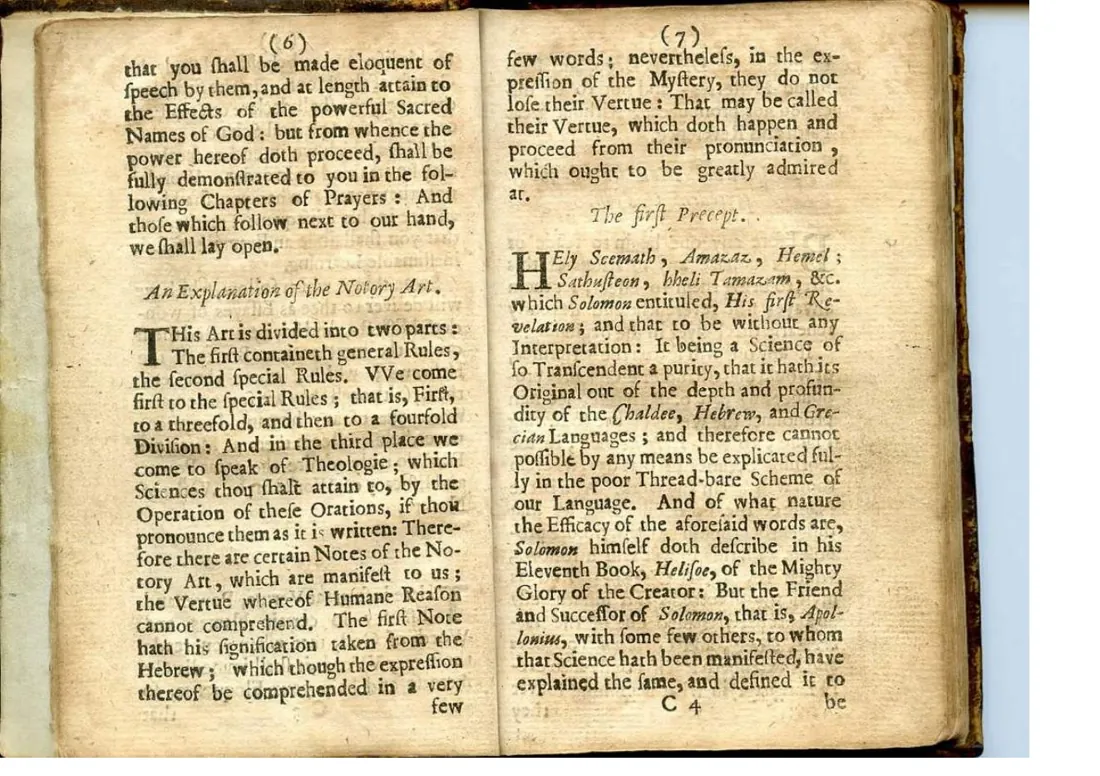
(6)

that you shall be made eloquent of speech by them, and at length attain to the Effects of the powerful Sacred Names of God: but from whence the power hereof doth proceed, shall be fully demonstrated to you in the following Chapters of Prayers: And those which follow next to our hand, we shall lay open.

An Explanation of the Notory Art.

THis Art is divided into two parts: The first containeth general Rules, the second special Rules. VVe come first to the special Rules; that is, First, to a threefold, and then to a fourfold Division: And in the third place we come to speak of Theologie; which Sciences thou shalt attain to, by the Operation of these Orations, if thou pronounce them as it is written: Therefore there are certain Notes of the Notory Art, which are manifest to us; the Vertue whereof Humane Reason cannot comprehend. The first Note hath his signification taken from the Hebrew; which though the expression thereof be comprehended in a very few

(7)

few words; nevertheless, in the expression of the Mystery, they do not lose their Vertue: That may be called their Vertue, which doth happen and proceed from their pronunciation, which ought to be greatly admired at.

The first Precept.

HEly Scemath, Amazaz, Hemel; Sathusteon, bheli Tamazam, &c. which Solomon entituled, His first Revelation; and that to be without any Interpretation: It being a Science of so Transcendent a purity, that it hath its Original out of the depth and profundity of the Chaldee, Hebrew, and Grecian Languages; and therefore cannot possible by any means be explicated fully in the poor Thread-bare Scheme of our Language. And of what nature the Efficacy of the aforesaid words are, Solomon himself doth describe in his Eleventh Book, Helisoe, of the Mighty Glory of the Creator: But the Friend and Successor of Solomon, that is, Apollonius, with some few others, to whom that Science hath been manifested, have explained the same, and defined it to

C 4    be

A Spiritual Mandate and The Exposition of this Oration#p017
Ars Notoria (classical) — facsimile page (A Spiritual Mandate and The Exposition of this Oration) · public-domain facsimile
Printed — Turner 1657 · Illuminated manuscript — Mellon MS 1 (Beinecke)
🔍 click to enlarge

TranscriptionEnglish (printed, 1657)

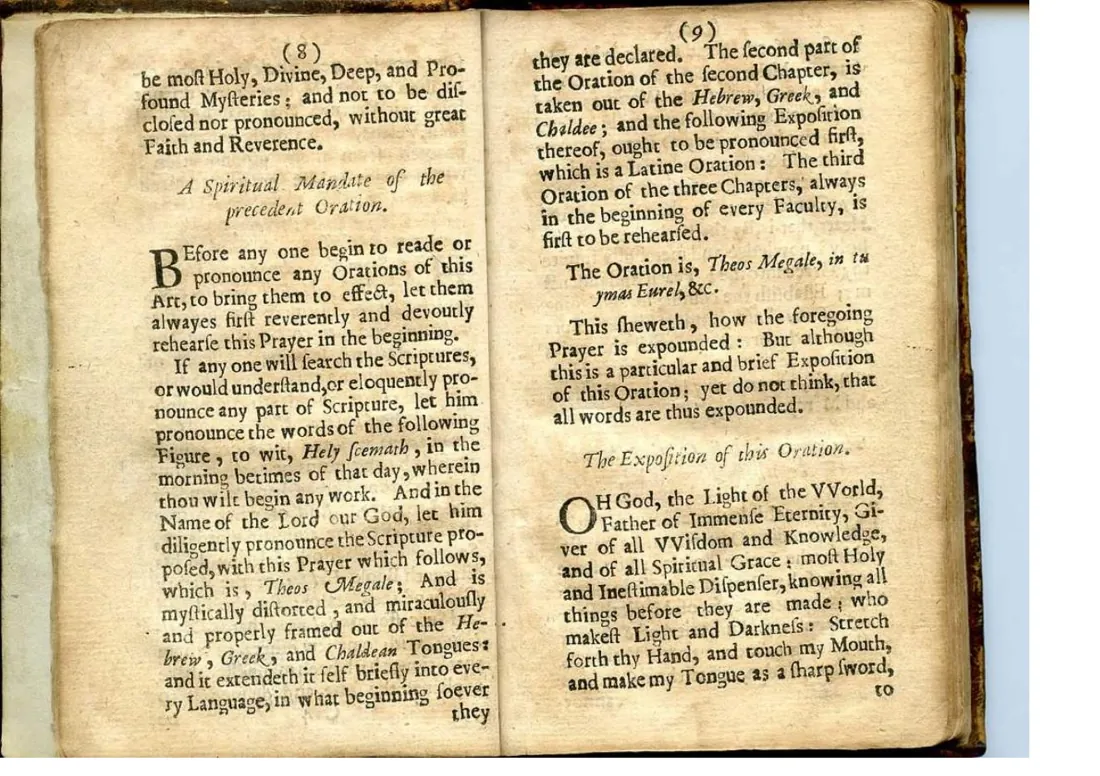
(8)

be most Holy, Divine, Deep, and Pro- found Mysteries; and not to be dis- closed nor pronounced, without great Faith and Reverence.

A Spiritual Mandate of the precedent Oration.

BEfore any one begin to reade or pronounce any Orations of this Art, to bring them to effect, let them alwayes first reverently and devoutly rehearse this Prayer in the beginning.

If any one will search the Scriptures, or would understand, or eloquently pro- nounce any part of Scripture, let him pronounce the words of the following Figure, to wit, Hely scemath, in the morning betimes of that day, wherein thou wilt begin any work. And in the Name of the Lord our God, let him diligently pronounce the Scripture pro- posed, with this Prayer which follows, which is, Theos Megale; And is mystically distorted, and miraculously and properly framed out of the He- brew, Greek, and Chaldean Tongues: and it extendeth it self briefly into eve- ry Language, in what beginning soever they

(9)

they are declared. The second part of the Oration of the second Chapter, is taken out of the Hebrew, Greek, and Chaldee; and the following Exposition thereof, ought to be pronounced first, which is a Latine Oration: The third Oration of the three Chapters, always in the beginning of every Faculty, is first to be rehearsed.

The Oration is, Theos Megale, in tu ymas Eurel, &c.

This sheweth, how the foregoing Prayer is expounded: But although this is a particular and brief Exposition of this Oration; yet do not think, that all words are thus expounded.

The Exposition of this Oration.

OH God, the Light of the VVorld, Father of Immense Eternity, Gi- ver of all VVisdom and Knowledge, and of all Spiritual Grace: most Holy and Inestimable Dispenser, knowing all things before they are made; who makest Light and Darkness: Stretch forth thy Hand, and touch my Mouth, and make my Tongue as a sharp sword, to

Lunations and the First Figure#p021
Ars Notoria (classical) — facsimile page (Lunations and the First Figure) · public-domain facsimile
Printed — Turner 1657 · Illuminated manuscript — Mellon MS 1 (Beinecke)
🔍 click to enlarge

TranscriptionEnglish (printed, 1657)

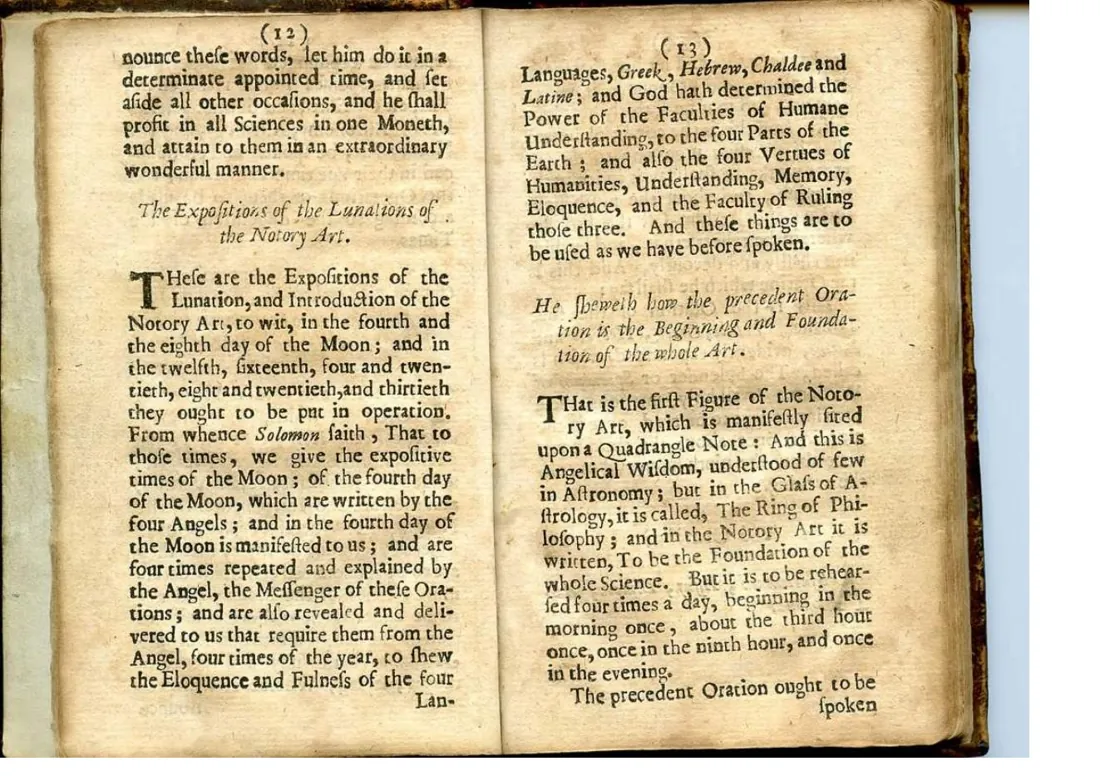
(12)

nounce these words, let him do it in a determinate appointed time, and set aside all other occasions, and he shall profit in all Sciences in one Moneth, and attain to them in an extraordinary wonderful manner.

The Expositions of the Lunations of the Notory Art.

THese are the Expositions of the Lunation, and Introduction of the Notory Art, to wit, in the fourth and the eighth day of the Moon; and in the twelfth, sixteenth, four and twen- tieth, eight and twentieth, and thirtieth they ought to be put in operation. From whence Solomon saith, That to those times, we give the expositive times of the Moon; of the fourth day of the Moon, which are written by the four Angels; and in the fourth day of the Moon is manifested to us; and are four times repeated and explained by the Angel, the Messenger of these Ora- tions; and are also revealed and deli- vered to us that require them from the Angel, four times of the year, to shew the Eloquence and Fulness of the four Lan-

(13)

Languages, Greek, Hebrew, Chaldee and Latine; and God hath determined the Power of the Faculties of Humane Understanding, to the four Parts of the Earth; and also the four Vertues of Humanities, Understanding, Memory, Eloquence, and the Faculty of Ruling those three. And these things are to be used as we have before spoken.

He sheweth how the precedent Ora- tion is the Beginning and Founda- tion of the whole Art.

THat is the first Figure of the Noto- ry Art, which is manifestly sited upon a Quadrangle Note: And this is Angelical Wisdom, understood of few in Astronomy; but in the Glass of A- strology, it is called, The Ring of Phi- losophy; and in the Notory Art it is written, To be the Foundation of the whole Science. But it is to be rehear- sed four times a day, beginning in the morning once, about the third hour once, once in the ninth hour, and once in the evening.

The precedent Oration ought to be spoken

The Oration of the Four Tongues#p023
Ars Notoria (classical) — facsimile page (The Oration of the Four Tongues) · public-domain facsimile
Printed — Turner 1657 · Illuminated manuscript — Mellon MS 1 (Beinecke)
🔍 click to enlarge

TranscriptionEnglish (printed, 1657)

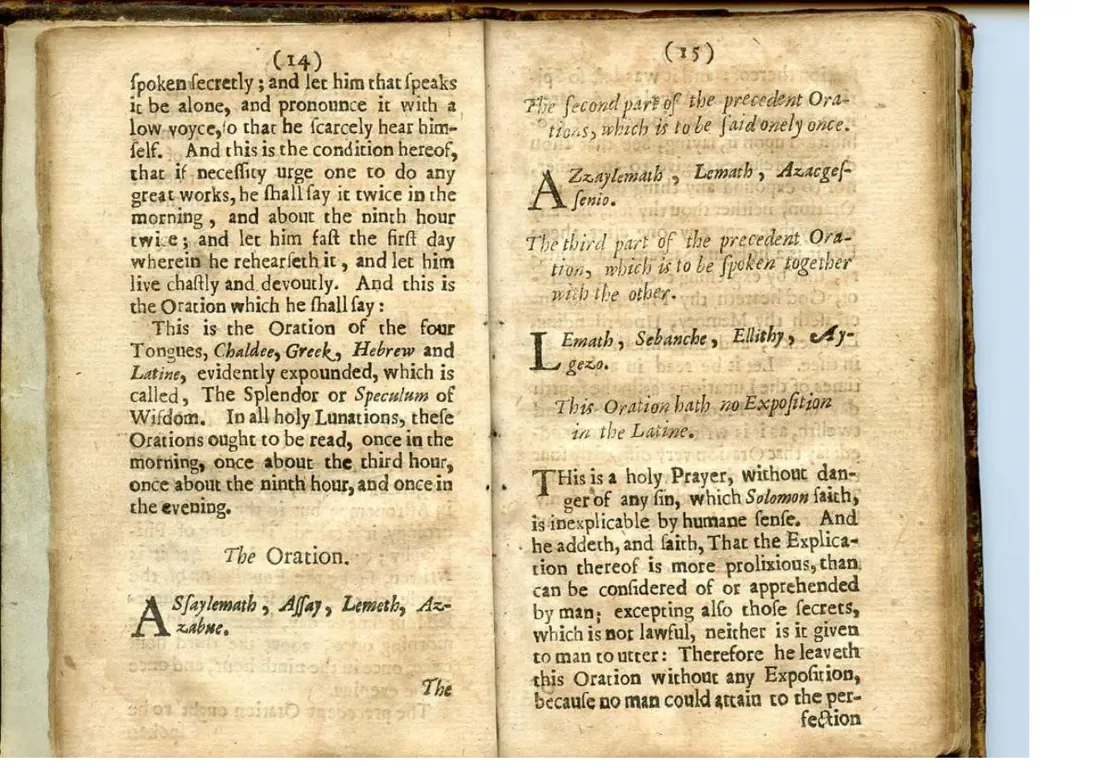
(14)

spoken secretly ; and let him that speaks it be alone, and pronounce it with a low voyce, so that he scarcely hear himself. And this is the condition hereof, that if necessity urge one to do any great works, he shall say it twice in the morning, and about the ninth hour twice ; and let him fast the first day wherein he rehearseth it, and let him live chastly and devoutly. And this is the Oration which he shall say :

This is the Oration of the four Tongues, Chaldee, Greek, Hebrew and Latine, evidently expounded, which is called, The Splendor or Speculum of Wisdom. In all holy Lunations, these Orations ought to be read, once in the morning, once about the third hour, once about the ninth hour, and once in the evening.

The Oration.

ASsaylemath, Assay, Lemeth, Az-zabue.

The

(15)

The second part of the precedent Orations, which is to be said onely once.

AZzaylemath, Lemath, Azacgessenio.

The third part of the precedent Oration, which is to be spoken together with the other.

LEmath, Sebanche, Ellithy, Aygezo.

This Oration hath no Exposition in the Latine.

THis is a holy Prayer, without danger of any sin, which Solomon saith, is inexplicable by humane sense. And he addeth, and saith, That the Explication thereof is more prolixious, than can be considered of or apprehended by man ; excepting also those secrets, which is not lawful, neither is it given to man to utter : Therefore he leaveth this Oration without any Exposition, because no man could attain to the perfection

The Angel's prohibition and the efficacy of the inexpressible Oration#p025
Ars Notoria (classical) — facsimile page (The Angel's prohibition and the efficacy of the inexpressible Oration) · public-domain facsimile
Printed — Turner 1657 · Illuminated manuscript — Mellon MS 1 (Beinecke)
🔍 click to enlarge

TranscriptionEnglish (printed, 1657)

(16)

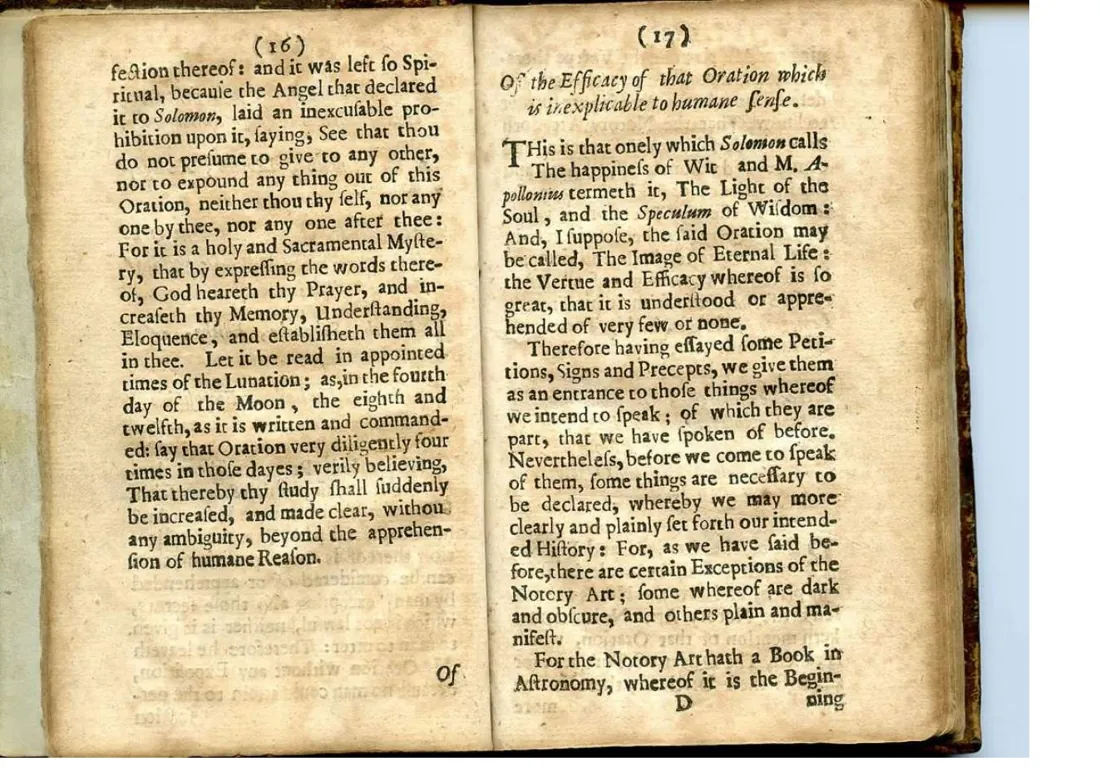
fession thereof: and it was left so Spi- ritual, because the Angel that declared it to Solomon, laid an inexcusable pro- hibition upon it, saying, See that thou do not presume to give to any other, nor to expound any thing out of this Oration, neither thou thy self, nor any one by thee, nor any one after thee: For it is a holy and Sacramental Myste- ry, that by expressing the words there- of, God heareth thy Prayer, and in- creaseth thy Memory, Understanding, Eloquence, and establisheth them all in thee. Let it be read in appointed times of the Lunation; as, in the fourth day of the Moon, the eighth and twelfth, as it is written and command- ed: say that Oration very diligently four times in those dayes; verily believing, That thereby thy study shall suddenly be increased, and made clear, without any ambiguity, beyond the apprehen- sion of humane Reason.

Of

(17)

Of the Efficacy of that Oration which is inexplicable to humane sense.

THis is that onely which Solomon calls The happiness of Wit and M. A- pollonius termeth it, The Light of the Soul, and the Speculum of Wisdom: And, I suppose, the said Oration may be called, The Image of Eternal Life: the Vertue and Efficacy whereof is so great, that it is understood or appre- hended of very few, or none.

Therefore having essayed some Peti- tions, Signs and Precepts, we give them as an entrance to those things whereof we intend to speak; of which they are part, that we have spoken of before. Nevertheless, before we come to speak of them, some things are necessary to be declared, whereby we may more clearly and plainly set forth our intend- ed History: For, as we have said be- fore, there are certain Exceptions of the Notory Art; some whereof are dark and obscure, and others plain and ma- nifest.

For the Notory Art hath a Book in Astronomy, whereof it is the Begin- D ning

The Notory Art and the Queen of Tongues#p027
Ars Notoria (classical) — facsimile page (The Notory Art and the Queen of Tongues) · public-domain facsimile
Printed — Turner 1657 · Illuminated manuscript — Mellon MS 1 (Beinecke)
🔍 click to enlarge

TranscriptionEnglish (printed, 1657)

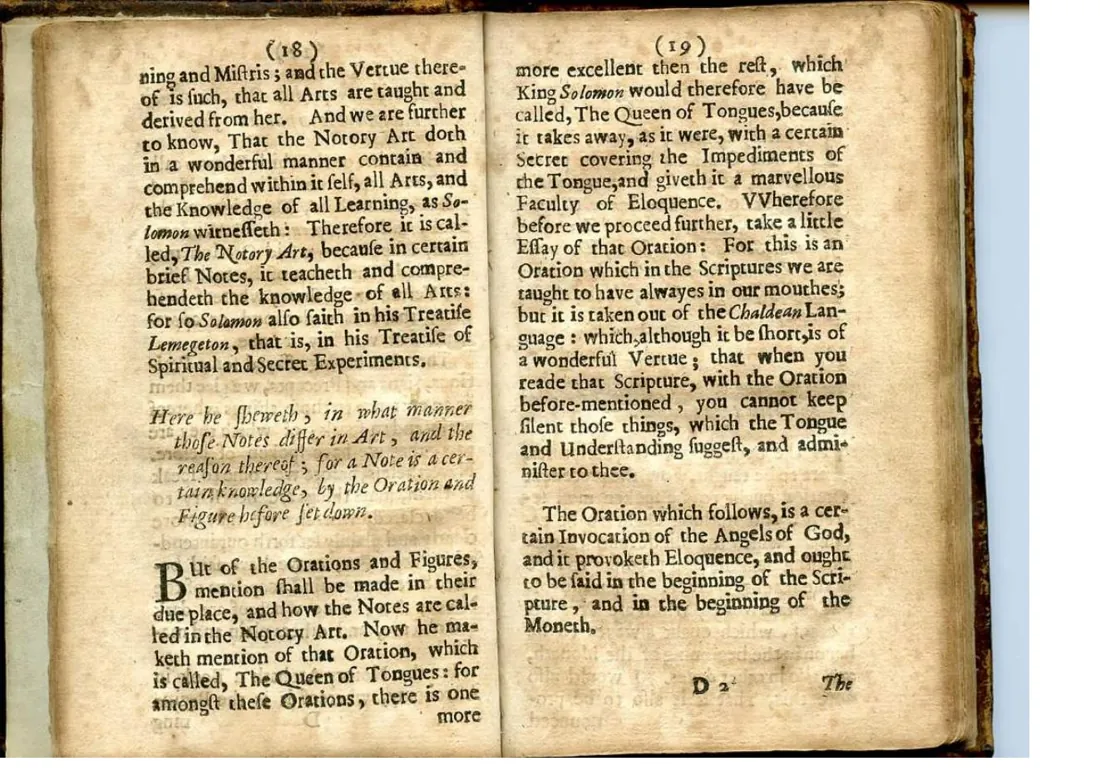
(18)

ning and Miſtris; and the Vertue there- of is ſuch, that all Arts are taught and derived from her. And we are further to know, That the Notory Art doth in a wonderful manner contain and comprehend within it ſelf, all Arts, and the Knowledge of all Learning, as So- lomon witneſſeth: Therefore it is cal- led, The Notory Art, becauſe in certain brief Notes, it teacheth and compre- hendeth the knowledge of all Arts: for ſo Solomon alſo ſaith in his Treatiſe Lemegeton, that is, in his Treatiſe of Spiritual and Secret Experiments.

Here he ſheweth, in what manner thoſe Notes differ in Art, and the reaſon thereof; for a Note is a cer- tain knowledge, by the Oration and Figure before ſet down.

BUt of the Orations and Figures, mention ſhall be made in their due place, and how the Notes are cal- led in the Notory Art. Now he ma- keth mention of that Oration, which is called, The Queen of Tongues: for amongſt theſe Orations, there is one more

(19)

more excellent then the reſt, which King Solomon would therefore have be called, The Queen of Tongues, becauſe it takes away, as it were, with a certain Secret covering the Impediments of the Tongue, and giveth it a marvellous Faculty of Eloquence. VVherefore before we proceed further, take a little Eſſay of that Oration: For this is an Oration which in the Scriptures we are taught to have alwayes in our mouthes; but it is taken out of the Chaldean Lan- guage: which, although it be ſhort, is of a wonderful Vertue; that when you reade that Scripture, with the Oration before-mentioned, you cannot keep ſilent thoſe things, which the Tongue and Underſtanding ſuggeſt, and admi- niſter to thee.

The Oration which follows, is a cer- tain Invocation of the Angels of God, and it provoketh Eloquence, and ought to be ſaid in the beginning of the Scri- pture, and in the beginning of the Moneth.

D 2     The

Prayer for Memory#p029
Ars Notoria (classical) — facsimile page (Prayer for Memory) · public-domain facsimile
Printed — Turner 1657 · Illuminated manuscript — Mellon MS 1 (Beinecke)
🔍 click to enlarge

TranscriptionEnglish (printed, 1657)

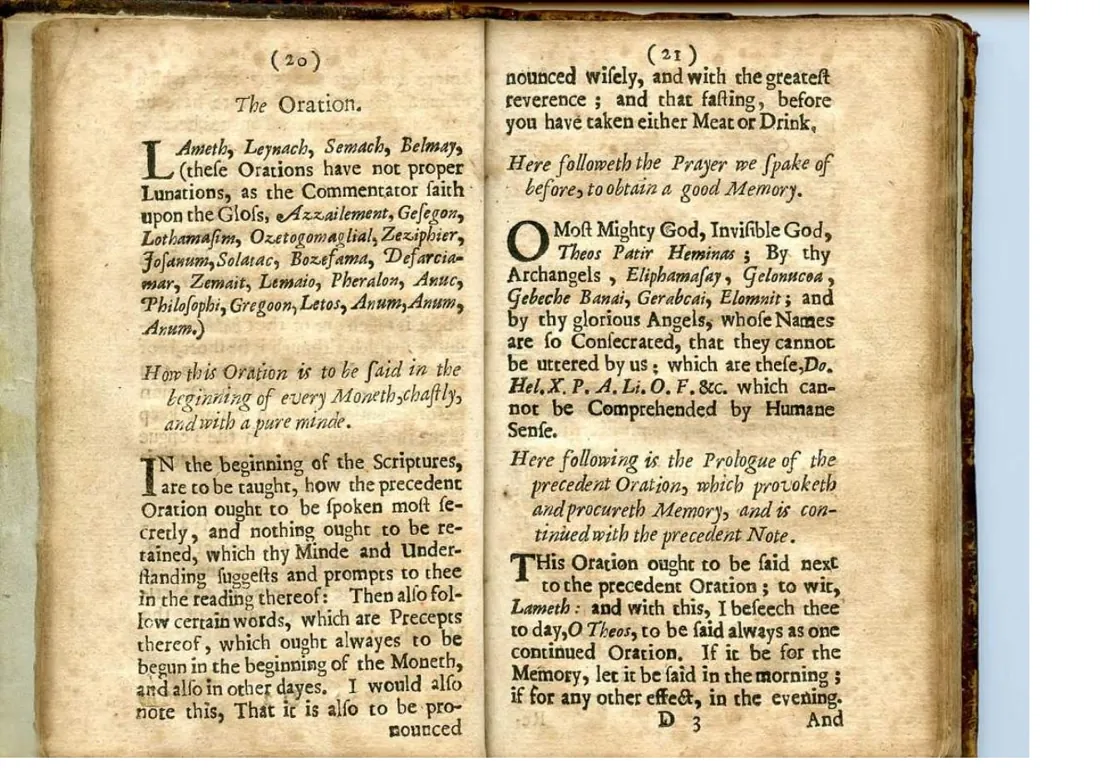
(20)

The Oration.

LAmeth, Leynach, Semach, Belmay, (these Orations have not proper Lunations, as the Commentator saith upon the Gloss, Azzailement, Gesegon, Lothamasim, Ozetogomaglial, Zeziphier, Fosamm, Solarac, Boxefama, Defarcia- mar, Zemait, Lemaios, Pheralon, Anuc, Philosophi, Gregoon, Letos, Anum, Anum, Anum.)

How this Oration is to be said in the beginning of every Moneth,chastly, and with a pure minde.

IN the beginning of the Scriptures, are to be taught, how the precedent Oration ought to be spoken most se- cretly, and nothing ought to be re- tained, which thy Minde and Under- standing suggests and prompts to thee in the reading thereof: Then also fol- low certain words, which are Precepts thereof , which ought alwayes to be begun in the beginning of the Moneth, and also in other dayes. I would also note this, That it is also to be pro- nounced

(21)

nounced wisely, and with the greatest reverence ; and that fasting, before you have taken either Meat or Drink,

Here followeth the Prayer we spake of before, to obtain a good Memory.

O Most Mighty God, Invisible God, Theos Patir Heminas ; By thy Archangels , Eliphamasay, Gelonucoa, Gebeche Banai, Gerabcai, Elomnit ; and by thy glorious Angels, whose Names are so Consecrated, that they cannot be uttered by us; which are these, Do, Hel. X. P. A. Li. O. F. &c. which can- not be Comprehended by Humane Sense.

Here following is the Prologue of the precedent Oration, which provoketh and procureth Memory, and is con- tinued with the precedent Note.

THis Oration ought to be said next to the precedent Oration ; to wit, Lameth : and with this, I beseech thee to day, O Theos, to be said always as one continued Oration. If it be for the Memory, let it be said in the morning ; if for any other effect, in the evening.

D 3     And

Oration of the Physical Art#p033
Ars Notoria (classical) — facsimile page (Oration of the Physical Art) · public-domain facsimile
Printed — Turner 1657 · Illuminated manuscript — Mellon MS 1 (Beinecke)
🔍 click to enlarge

TranscriptionEnglish (printed, 1657)

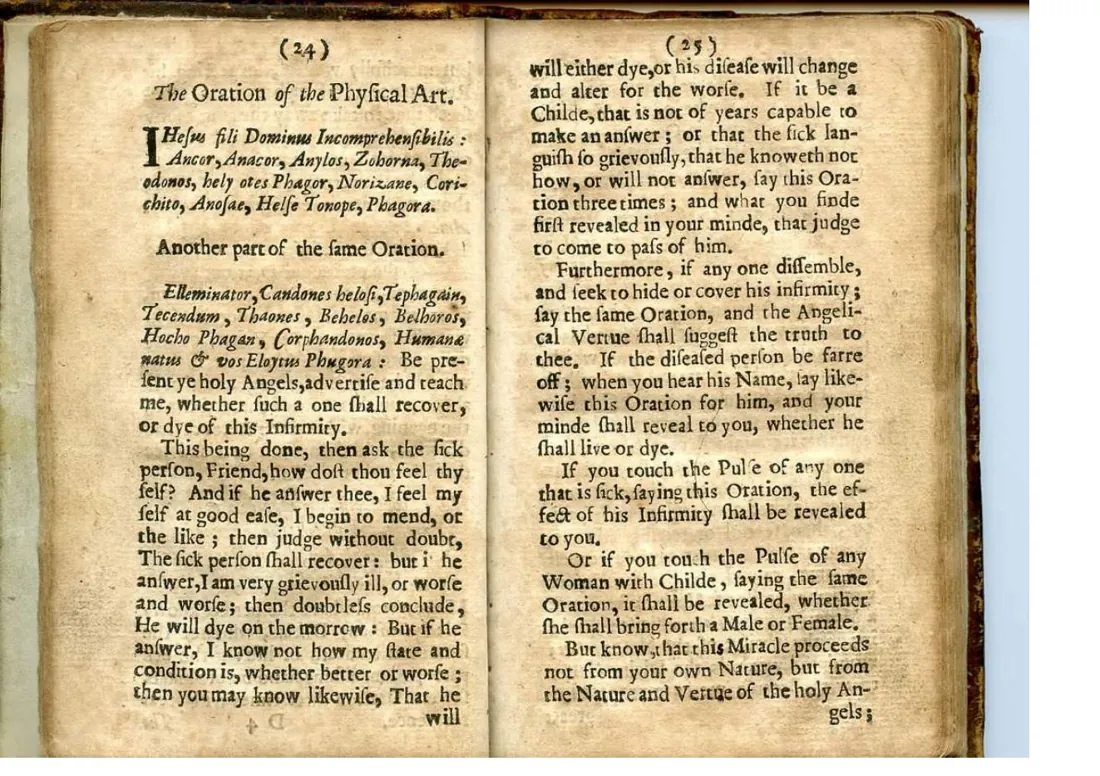
(24)

The Oration of the Physical Art.

IHesus fili Dominus Incomprehensibilis : Ancor, Anacor, Anylos, Zohorna, The- odonos, hely otes Phagor, Norizane, Cori- chito, Anosae, Helse Tonose, Phagora.

Another part of the same Oration.

Elleminator, Candones helos, Tephagain, Tecendum, Thaones, Beheles, Belhoros, Hocho Phagan, Corphandonos, Humane natus & vos Eloytus Phugora : Be pre- sent ye holy Angels, advertise and teach me, whether such a one shall recover, or dye of this Infirmity.

This being done, then ask the sick person, Friend, how dost thou feel thy self? And if he answer thee, I feel my self at good ease, I begin to mend, or the like ; then judge without doubt, The sick person shall recover: but if he answer, I am very grievously ill, or worse and worse; then doubtless conclude, He will dye on the morrow : But if he answer, I know not how my state and condition is, whether better or worse ; then you may know likewise, That he will

(25)

will either dye, or his disease will change and alter for the worse. If it be a Childe, that is not of years capable to make an answer ; or that the sick lan- guish so grievously, that he knoweth not how, or will not answer, say this Ora- tion three times ; and what you finde first revealed in your minde, that judge to come to pass of him.

Furthermore, if any one dissemble, and seek to hide or cover his infirmity ; say the same Oration, and the Angeli- cal Vertue shall suggest the truth to thee. If the diseased person be farre off ; when you hear his Name, say like- wise this Oration for him, and your minde shall reveal to you, whether he shall live or dye.

If you touch the Pulse of any one that is sick, saying this Oration, the ef- fect of his Infirmity shall be revealed to you.

Or if you touch the Pulse of any Woman with Childe, saying the same Oration, it shall be revealed, whether she shall bring forth a Male or Female.

But know, that this Miracle proceeds not from your own Nature, but from the Nature and Vertue of the holy An- gels ;
Prelude and Precept#p037
Ars Notoria (classical) — facsimile page (Prelude and Precept) · public-domain facsimile
Printed — Turner 1657 · Illuminated manuscript — Mellon MS 1 (Beinecke)
🔍 click to enlarge

TranscriptionEnglish (printed, 1657)

(28)

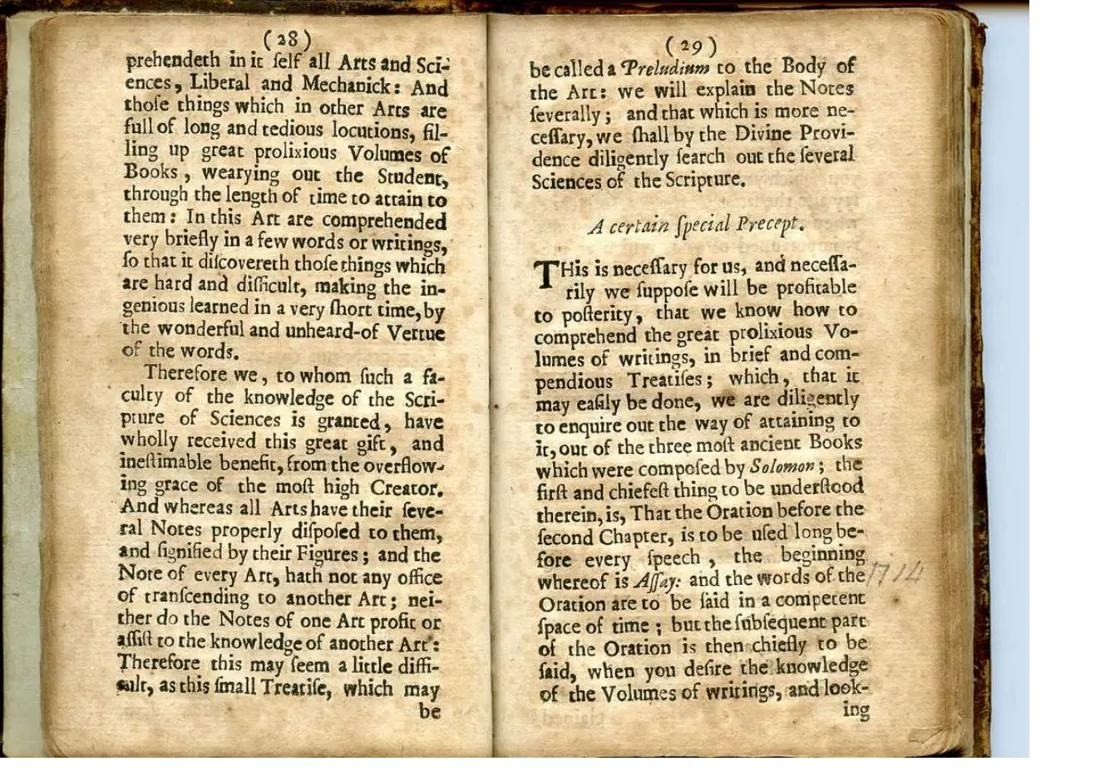
prehendeth in it self all Arts and Sci- ences, Liberal and Mechanick: And those things which in other Arts are full of long and tedious locutions, fil- ling up great prolixious Volumes of Books, wearying out the Student, through the length of time to attain to them: In this Art are comprehended very briefly in a few words or writings, so that it discovereth those things which are hard and difficult, making the in- genious learned in a very short time, by the wonderful and unheard-of Vertue of the words.

Therefore we, to whom such a fa- culty of the knowledge of the Scri- pture of Sciences is granted, have wholly received this great gift, and inestimable benefit, from the overflow- ing grace of the most high Creator. And whereas all Arts have their seve- ral Notes properly disposed to them, and signified by their Figures ; and the Note of every Art, hath not any office of transcending to another Art ; nei- ther do the Notes of one Art profit or assist to the knowledge of another Art: Therefore this may seem a little diffi- cult, as this small Treatise, which may be

(29)

be called a Preludium to the Body of the Art: we will explain the Notes severally; and that which is more ne- cessary, we shall by the Divine Provi- dence diligently search out the several Sciences of the Scripture.

A certain special Precept.

THis is necessary for us, and necessa- rily we suppose will be profitable to posterity, that we know how to comprehend the great prolixious Vo- lumes of writings, in brief and com- pendious Treatises ; which, that it may easily be done, we are diligently to enquire out the way of attaining to it, out of the three most ancient Books which were composed by Solomon; the first and chiefest thing to be understood therein, is, That the Oration before the second Chapter, is to be used long be- fore every speech, the beginning whereof is Assay: and the words of the Oration are to be said in a competent space of time ; but the subsequent part of the Oration is then chiefly to be said, when you desire the knowledge of the Volumes of writings, and look- ing

Magnitude of Art#p039
Ars Notoria (classical) — facsimile page (Magnitude of Art) · public-domain facsimile
Printed — Turner 1657 · Illuminated manuscript — Mellon MS 1 (Beinecke)
🔍 click to enlarge

TranscriptionEnglish (printed, 1657)

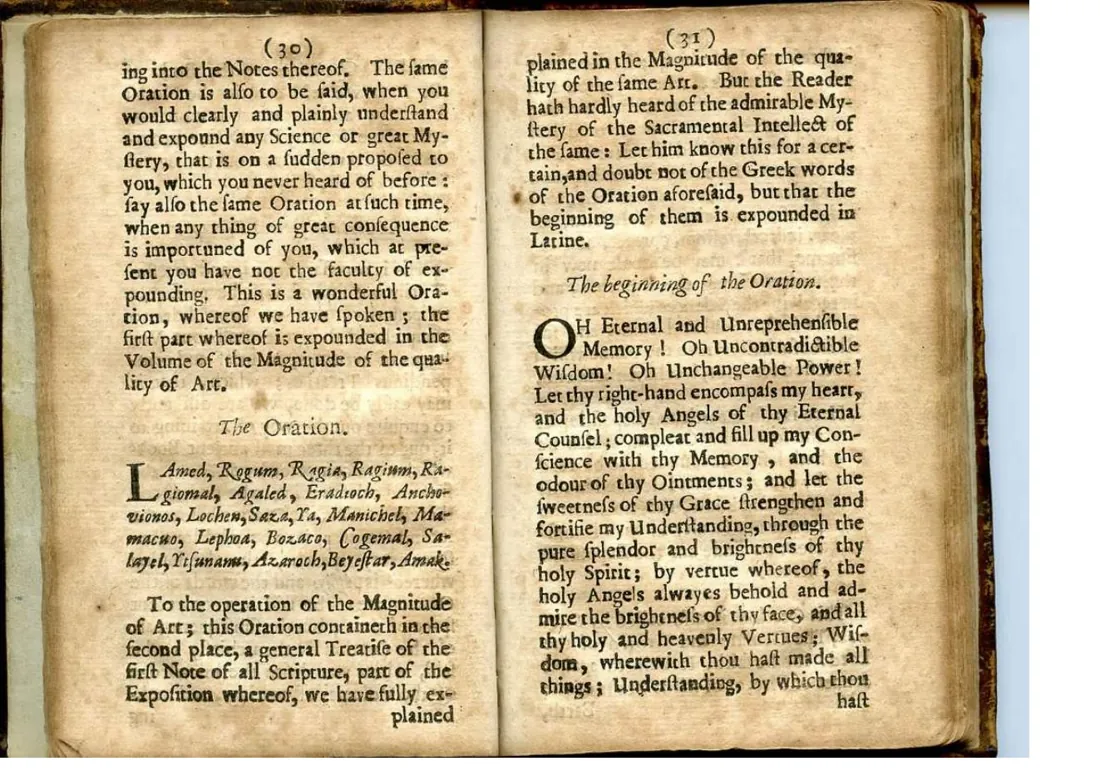
(30)

ing into the Notes thereof. The same Oration is also to be said, when you would clearly and plainly understand and expound any Science or great My- stery, that is on a sudden proposed to you, which you never heard of before; say also the same Oration at such time, when any thing of great consequence is importuned of you, which at pre- sent you have not the faculty of ex- pounding. This is a wonderful Ora- tion, whereof we have spoken; the first part whereof is expounded in the Volume of the Magnitude of the qua- lity of Art.

The Oration.

LAmed, Rogum, Ragia, Ragium, Ra- giomal, Agaled, Eradioch, Ancho- vionos, Lochen, Saza, Ya, Manichel, Ma- macuo, Lephoa, Bozaco, Cogemal, Sa- layel, Ytsunanu, Azaroch, Beyestar, Amak.

To the operation of the Magnitude of Art; this Oration containeth in the second place, a general Treatise of the first Note of all Scripture; part of the Exposition whereof, we have fully ex- plained

(31)

plained in the Magnitude of the qua- lity of the same Art. But the Reader hath hardly heard of the admirable My- stery of the Sacramental Intellect of the same: Let him know this for a cer- tain,and doubt not of the Greek words of the Oration aforesaid, but that the beginning of them is expounded in Latine.

The beginning of the Oration.

OH Eternal and Unreprehensible Memory! Oh Uncontradictible Wisdom! Oh Unchangeable Power! Let thy right-hand encompass my heart, and the holy Angels of thy Eternal Counsel; compleat and fill up my Con- science with thy Memory, and the odour of thy Ointments; and let the sweetness of thy Grace strengthen and fortifie my Understanding, through the pure splendor and brightness of thy holy Spirit; by vertue whereof, the holy Angels alwayes behold and ad- mire the brightness of thy face, and all thy holy and heavenly Vertues; Wis- dom, wherewith thou hast made all things: Understanding, by which thou hast

Exposition of the Oration#p041
Ars Notoria (classical) — facsimile page (Exposition of the Oration) · public-domain facsimile
Printed — Turner 1657 · Illuminated manuscript — Mellon MS 1 (Beinecke)
🔍 click to enlarge

TranscriptionEnglish (printed, 1657)

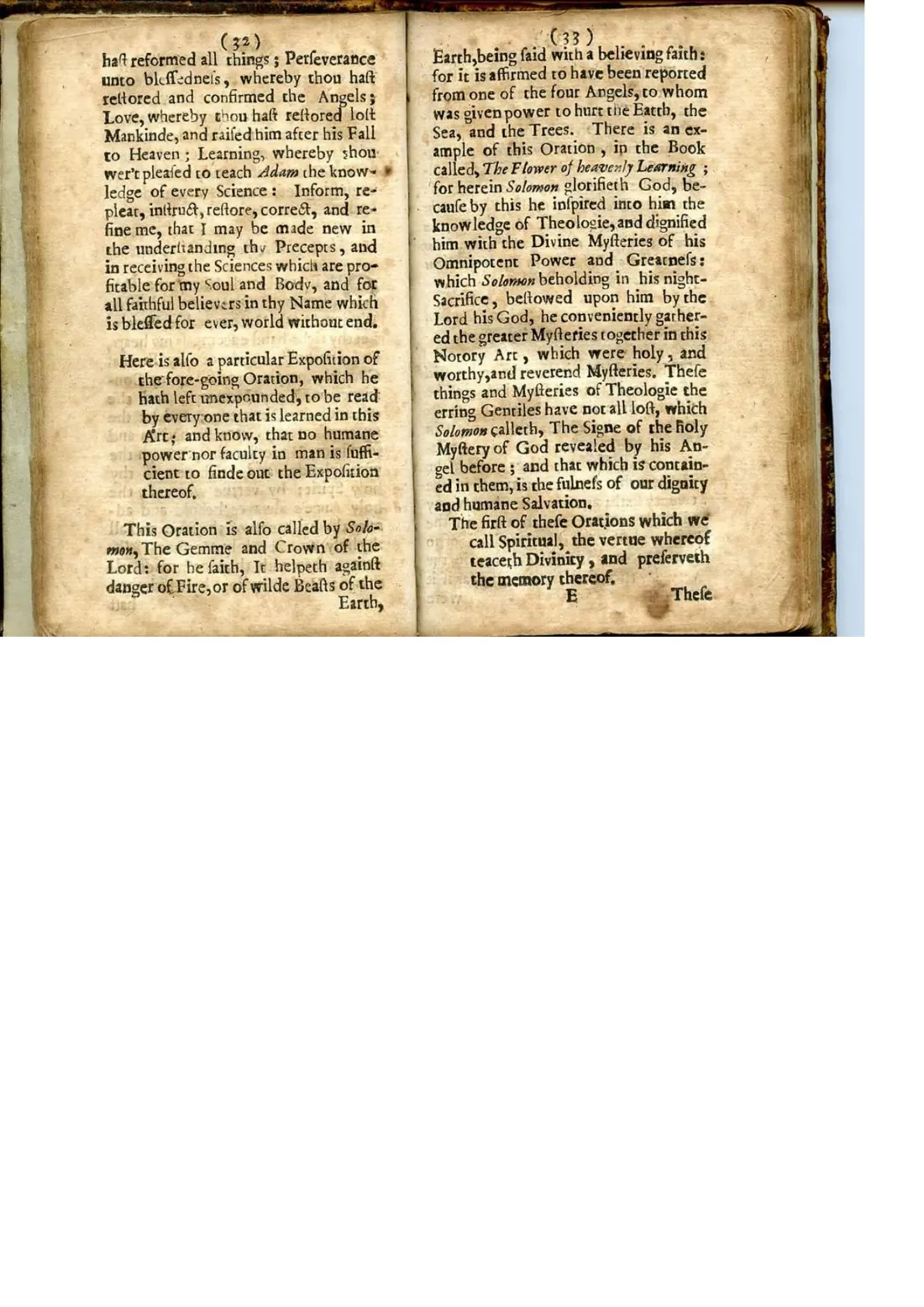
(32)

hast reformed all things; Perseverance unto blessedness, whereby thou hast restored and confirmed the Angels; Love, whereby thou hast restored lost Mankinde, and raised him after his Fall to Heaven; Learning, whereby thou wert pleased to teach Adam the know- ledge of every Science: Inform, re- pleat, instruct, restore, correct, and re- fine me, that I may be made new in the understanding thy Precepts, and in receiving the Sciences which are pro- fitable for my Soul and Body, and for all faithful believers in thy Name which is blessed for ever, world without end.

Here is also a particular Exposition of the foregoing Oration, which he hath left unexpounded, to be read by every one that is learned in this Art; and know, that no humane power nor faculty in man is suffi- cient to finde out the Exposition thereof.

This Oration is also called by Solo- mon, The Gemme and Crown of the Lord: for he saith, It helpeth against danger of Fire, or of wilde Beasts of the Earth,

(33)

Earth, being said with a believing faith: for it is affirmed to have been reported from one of the four Angels, to whom was given power to hurt the Earth, the Sea, and the Trees. There is an ex- ample of this Oration, in the Book called, The Flower of heavenly Learning ; for herein Solomon glorifieth God, be- cause by this he inspired into him the knowledge of Theologie, and dignified him with the Divine Mysteries of his Omnipotent Power and Greatness: which Solomon beholding in his night- Sacrifice, bestowed upon him by the Lord his God, he conveniently gather- ed the greater Mysteries together in this Notory Art, which were holy, and worthy,and reverend Mysteries. These things and Mysteries of Theologie the erring Gentiles have not all lost, which Solomon calleth, The Signe of the holy Mystery of God revealed by his An- gel before; and that which is contain- ed in them, is the fulness of our dignity and humane Salvation. The first of these Orations which we call Spiritual, the vertue whereof teacheth Divinity, and preserveth the memory thereof.

E These

Election of Times#p043
Ars Notoria (classical) — facsimile page (Election of Times) · public-domain facsimile
Printed — Turner 1657 · Illuminated manuscript — Mellon MS 1 (Beinecke)
🔍 click to enlarge

TranscriptionEnglish (printed, 1657)

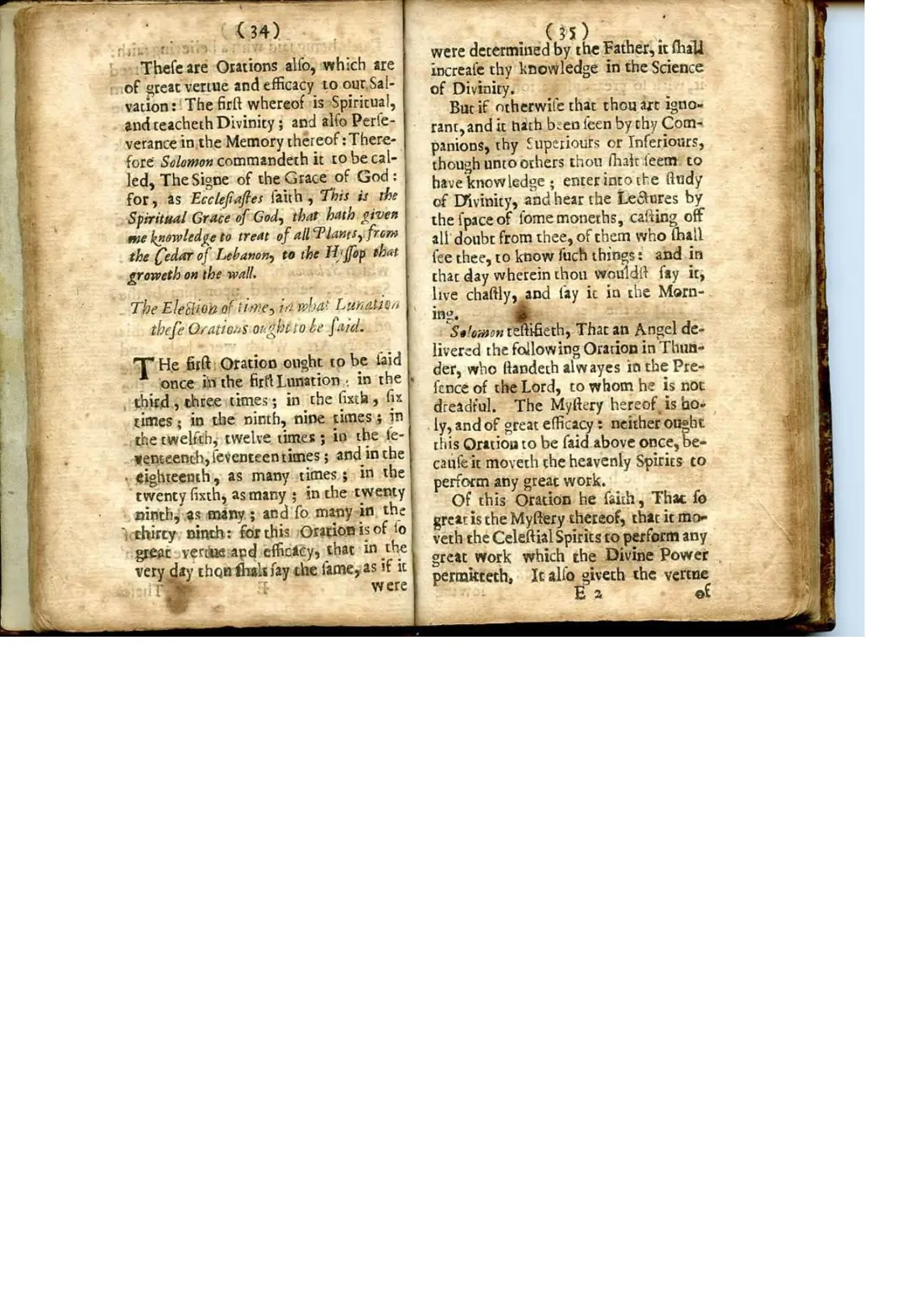
(34)

These are Orations also, which are of great vertue and efficacy to our Sal- vation: The first whereof is Spiritual, and teacheth Divinity; and also Perse- verance in the Memory thereof: There- fore Solomon commandeth it to be cal- led, The Signe of the Grace of God: for, as Ecclesiastes saith, This is the Spiritual Grace of God, that hath given me knowledge to treat of all Plants, from the Cedar of Lebanon, to the Hyssop that groweth on the wall.

The Election of time, in what Lunations these Orations ought to be said.

THe first Oration ought to be said once in the first Lunation, in the third, three times; in the sixth, six times; in the ninth, nine times; in the twelfth, twelve times; in the se- venteenth, seventeen times; and in the eighteenth, as many times; in the twenty sixth, as many; in the twenty ninth, as many; and so many in the thirty ninth: for this Oration is of so great vertue and efficacy, that in the very day thou shalt say the same, as if it were

(35)

were determined by the Father, it shall increase thy knowledge in the Science of Divinity.

But if otherwise that thou art igno- rant, and it hath been seen by thy Com- panions, thy Superiours or Inferiours, though unto others thou shalt seem to have knowledge; enter into the study of Divinity, and hear the Lectures by the space of some moneths, casting off all doubt from thee, of them who shall see thee, to know such things: and in that day wherein thou wouldst say it, live chastly, and say it in the Morn- ing.

Solomon testifieth, That an Angel de- livered the following Oration in Thun- der, who standeth alwayes in the Pre- sence of the Lord, to whom he is not dreadful. The Mystery hereof is ho- ly, and of great efficacy: neither ought this Oration to be said above once, be- cause it moveth the heavenly Spirits to perform any great work.

Of this Oration he saith, That so great is the Mystery thereof, that it mo- veth the Celestial Spirits to perform any great work which the Divine Power permitteth. It also giveth the vertue

E 2 of

Division of the Oration#p045
Ars Notoria (classical) — facsimile page (Division of the Oration) · public-domain facsimile
Printed — Turner 1657 · Illuminated manuscript — Mellon MS 1 (Beinecke)
🔍 click to enlarge

TranscriptionEnglish (printed, 1657)

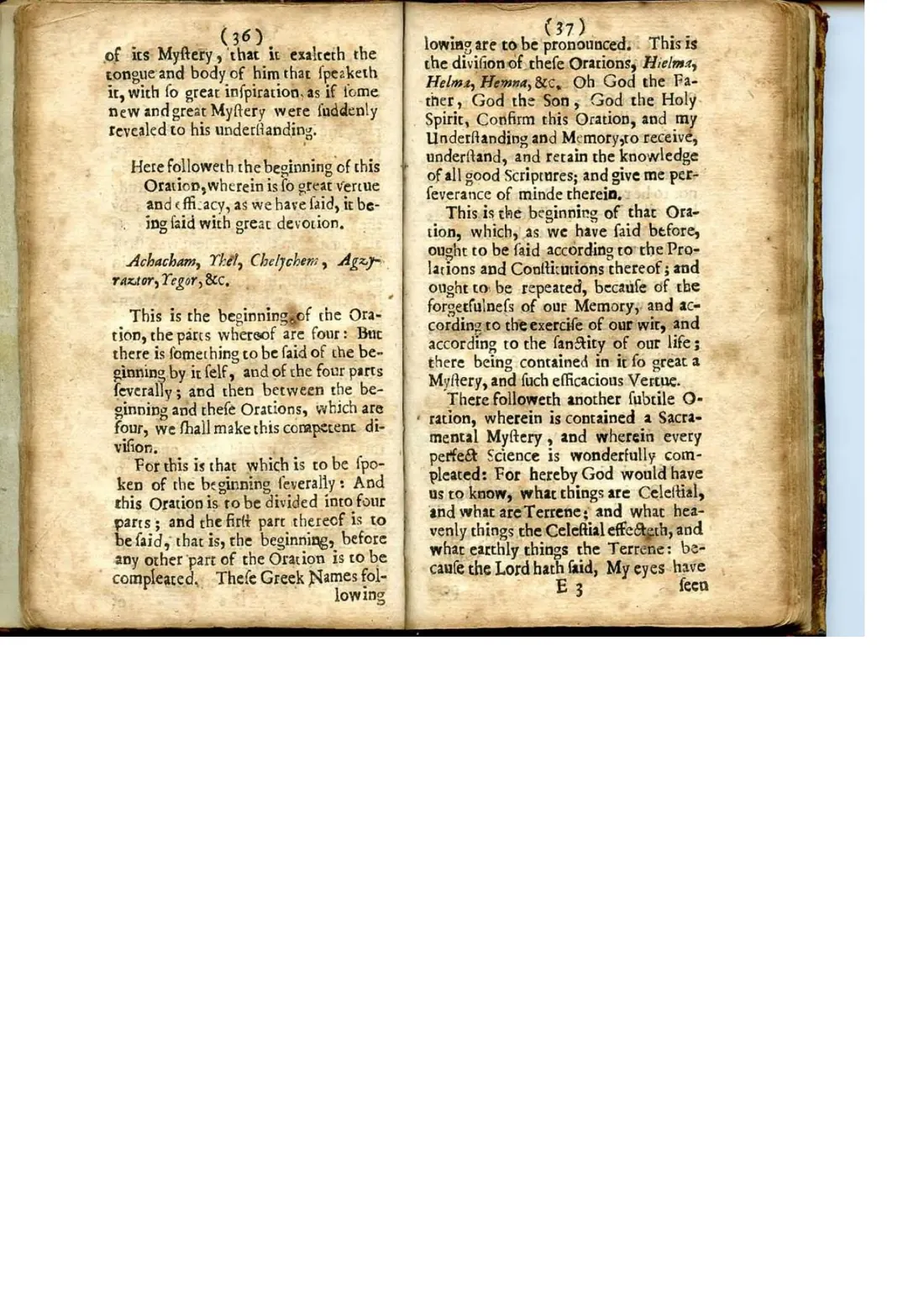
(36)

of its Mystery, that it exalteth the tongue and body of him that speaketh it, with so great inspiration, as if some new and great Mystery were suddenly revealed to his understanding.

Here followeth the beginning of this Oration, wherein is so great vertue and effi-acy, as we have said, it be- ing said with great devotion.

Achacham, Thel, Chelychem, Agzy- raxtor, Yegor, &c.

This is the beginning of the Ora- tion, the parts whereof are four: But there is something to be said of the be- ginning by it self, and of the four parts severally; and then between the be- ginning and these Orations, which are four, we shall make this competent di- vision. For this is that which is to be spo- ken of the beginning severally: And this Oration is to be divided into four parts; and the first part thereof is to be said, that is, the beginning, before any other part of the Oration is to be compleated. These Greek Names fol- lowing

(37)

lowing are to be pronounced: This is the division of these Orations, Hielma, Helma, Hemna, &c. Oh God the Fa- ther, God the Son, God the Holy Spirit, Confirm this Oration, and my Understanding and Memory,to receive, understand, and retain the knowledge of all good Scriptures; and give me per- severance of minde therein.

This is the beginning of that Ora- tion, which, as we have said before, ought to be said according to the Pro- lations and Constitutions thereof; and ought to be repeated, because of the forgetfulness of our Memory; and ac- cording to the exercise of our wit, and according to the sanctity of our life; there being contained in it so great a Mystery, and such efficacious Vertue.

There followeth another subtile O- ration, wherein is contained a Sacra- mental Mystery, and wherein every perfect Science is wonderfully com- pleated: For hereby God would have us to know, what things are Celestial, and what are Terrene; and what hea- venly things the Celestial effecteth, and what earthly things the Terrene: be- cause the Lord hath said, My eyes have

E 3 seen

Precepts and Oration Parts#p047
Ars Notoria (classical) — facsimile page (Precepts and Oration Parts) · public-domain facsimile
Printed — Turner 1657 · Illuminated manuscript — Mellon MS 1 (Beinecke)
🔍 click to enlarge

TranscriptionEnglish (printed, 1657)

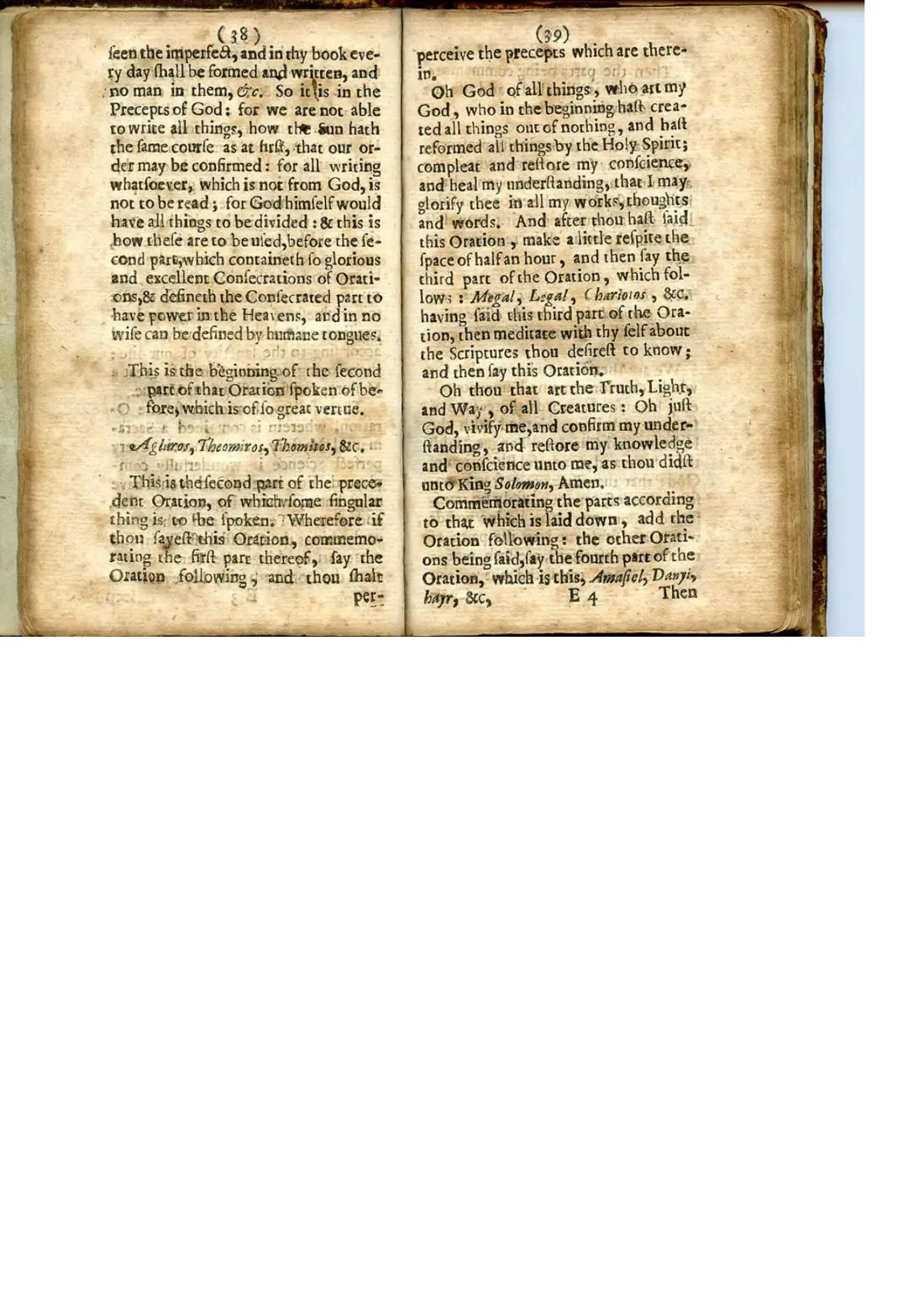
(38)

seen the imperfect, and in thy book eve- ry day shall be formed and written, and no man in them, &c. So it is in the Precepts of God : for we are not able to write all things, how the Sun hath the same course as at first, that our or- der may be confirmed : for all writing whatsoever, which is not from God, is not to be read ; for God himself would have all things to be divided : & this is how these are to be used,before the se- cond part,which containeth so glorious and excellent Consecrations of Orati- ons,& defineth the Consecrated part to have power in the Heavens, and in no wise can be defined by humane tongues.

This is the beginning of the second part of that Oration spoken of be- fore, which is of so great vertue.

Aglaros, Theomiros, Thomitos, &c.

This is the second part of the prece- dent Oration, of which some singular thing is to be spoken. Wherefore if thou sayest this Oration, commemo- rating the first part thereof, say the Oration following ; and thou shalt

per-

(39)

perceive the precepts which are there- in. Oh God of all things, who art my God, who in the beginning hast crea- ted all things out of nothing, and hast reformed all things by the Holy Spirit; compleat and restore my conscience, and heal my understanding, that I may glorify thee in all my works,thoughts and words. And after thou hast said this Oration , make a little respite the space of half an hour , and then say the third part of the Oration , which fol- lows : Megal, Legal, Chariotos , &c. having said this third part of the Ora- tion, then meditate with thy self about the Scriptures thou desirest to know ; and then say this Oration.

Oh thou that art the Truth, Light, and Way, of all Creatures : Oh just God, vivify me,and confirm my under- standing, and restore my knowledge and conscience unto me, as thou didst unto King Solomon, Amen. Commemorating the parts according to that which is laid down, add the Oration following: the other Orati- ons being said,say the fourth part of the Oration, which is this, Amasiel, Danyi- hayr, &c,

E 4 Then

Efficacy of the Orations#p049
Ars Notoria (classical) — facsimile page (Efficacy of the Orations) · public-domain facsimile
Printed — Turner 1657 · Illuminated manuscript — Mellon MS 1 (Beinecke)
🔍 click to enlarge

TranscriptionEnglish (printed, 1657)

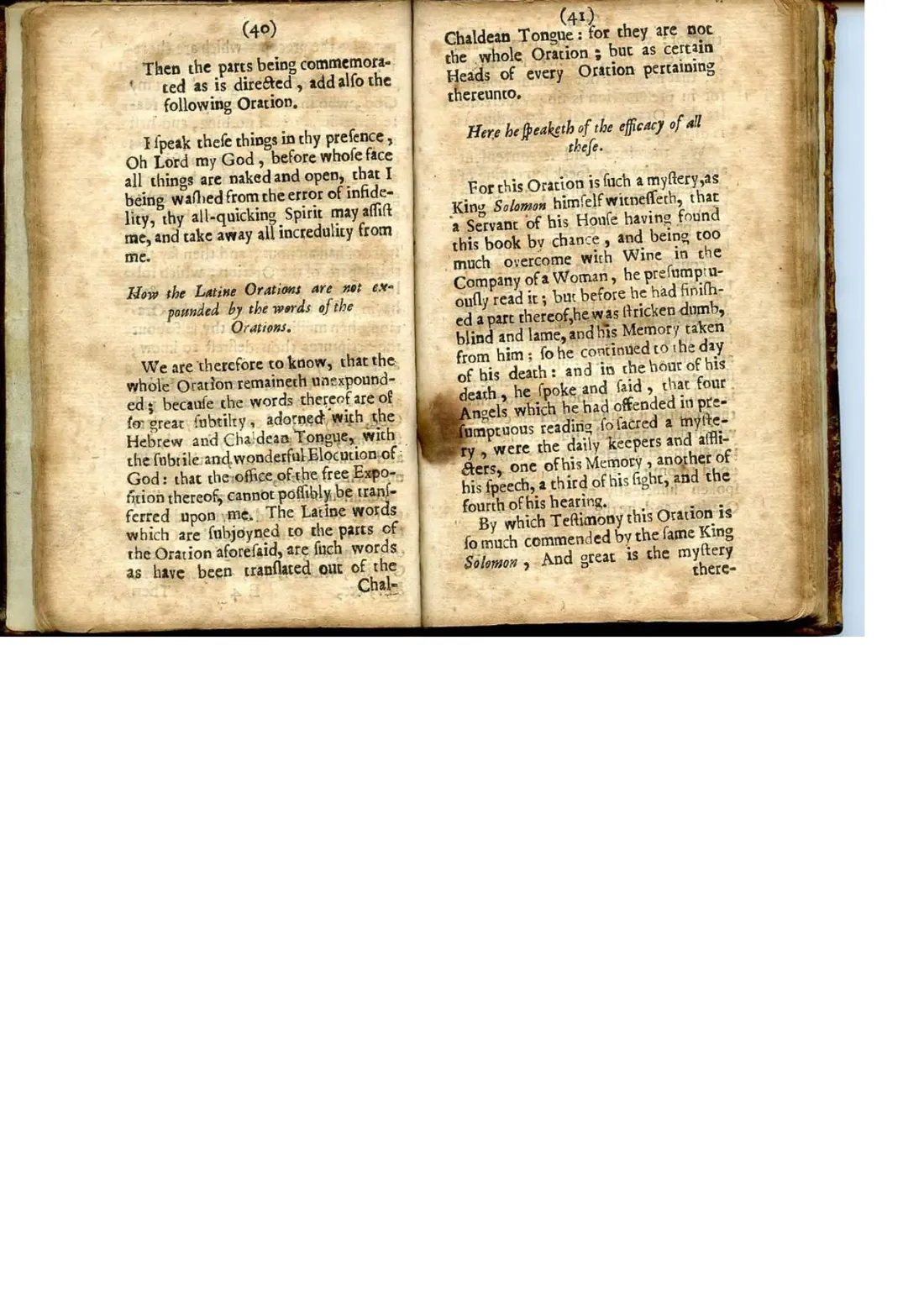
(40)

Then the parts being commemora- ted as is directed, add also the following Oration.

I speak these things in thy presence, Oh Lord my God, before whose face all things are naked and open, that I being washed from the error of infide- lity, thy all-quicking Spirit may assist me, and take away all incredulity from me.

How the Latine Orations are not ex- pounded by the words of the Orations.

We are therefore to know, that the whole Oration remaineth unexpound- ed; because the words thereof are of so great subtilty, adorned with the Hebrew and Chaldean Tongue, with the subtile and wonderful Elocution of God: that the office of the free Expo- sition thereof, cannot possibly be trans- ferred upon me. The Latine words which are subjoyned to the parts of the Oration aforesaid, are such words as have been translated out of the Chal-

(41)

Chaldean Tongue: for they are not the whole Oration ; but as certain Heads of every Oration pertaining thereunto.

Here he speaketh of the efficacy of all these.

For this Oration is such a mystery,as King Solomon himself witnesseth, that a Servant of his House having found this book by chance , and being too much overcome with Wine in the Company of a Woman, he presumptu- ously read it ; but before he had finish- ed a part thereof,he was stricken dumb, blind and lame, and his Memory taken from him ; so he continued to the day of his death : and in the hour of his death, he spoke and said , that four Angels which he had offended in pre- sumptuous reading so sacred a myste- ry , were the daily keepers and affli- cters, one of his Memory , another of his speech, a third of his sight, and the fourth of his hearing. By which Testimony this Oration is so much commended by the same King Solomon , And great is the mystery there-

Precepts and Eloquence#p051
Ars Notoria (classical) — facsimile page (Precepts and Eloquence) · public-domain facsimile
Printed — Turner 1657 · Illuminated manuscript — Mellon MS 1 (Beinecke)
🔍 click to enlarge

TranscriptionEnglish (printed, 1657)

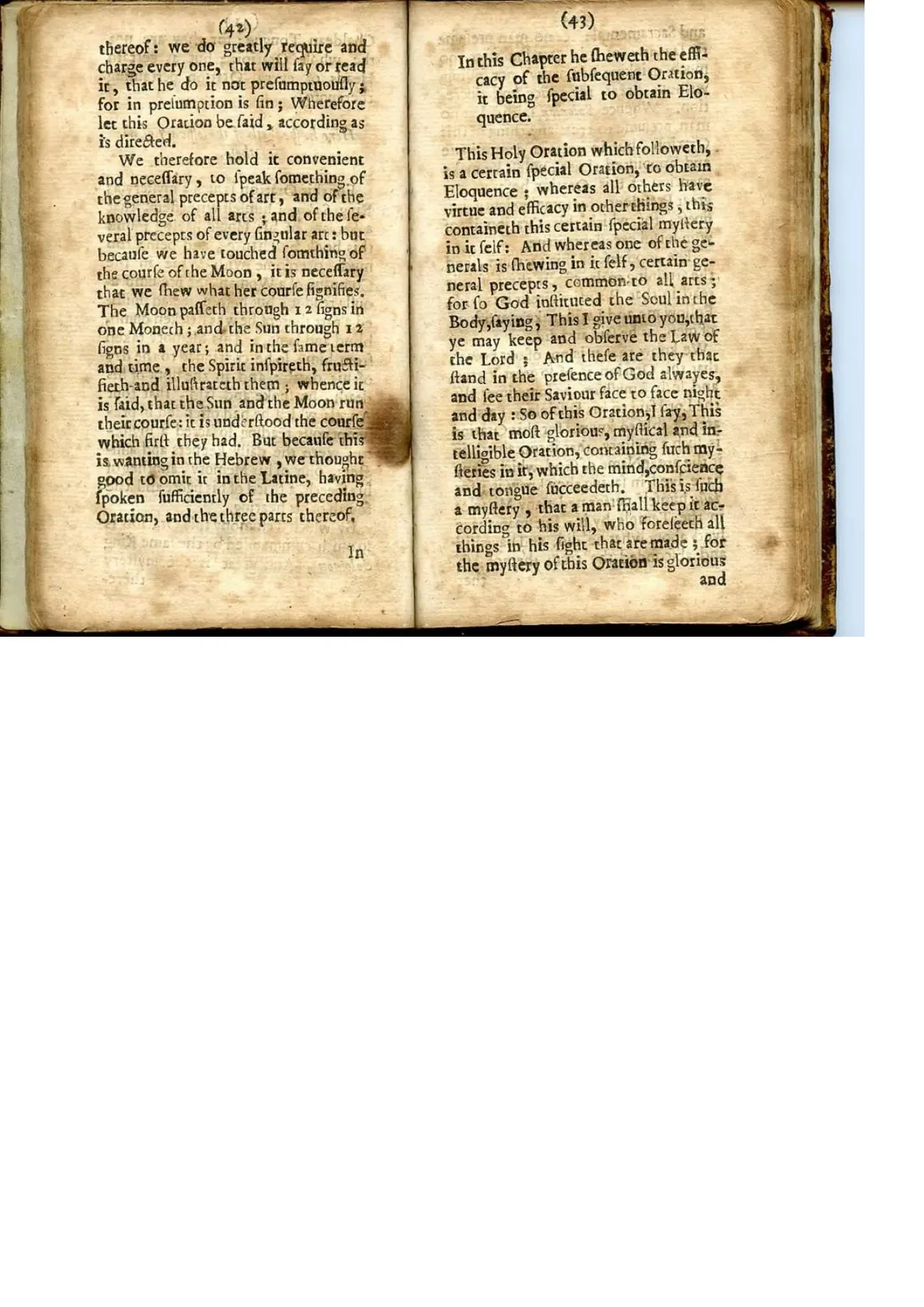
(42)

thereof: we do greatly require and charge every one, that will say or read it , that he do it not presumptuously; for in presumption is sin ; Wherefore let this Oration be said , according as is directed.

We therefore hold it convenient and necessary , to speak something of the general precepts of art , and of the knowledge of all arts ; and of the se- veral precepts of every singular art : but because we have touched somthing of the course of the Moon , it is necessary that we shew what her course signifies. The Moon passeth through 12 signs in one Moneth ; and the Sun through 12 signs in a year ; and in the same term and time,, the Spirit inspireth, fructi- fieth-and illustrateth them ; whence it is said, that the Sun and the Moon run their course: it is understood the course which first they had. But because this is wanting in the Hebrew , we thought good to omit it in the Latine, having spoken sufficiently of the preceding Oration, and the three parts thereof.

In

(43)

In this Chapter he sheweth the effi- cacy of the subsequent Oration, it being special to obtain Elo- quence.

This Holy Oration which followeth, is a certain special Oration, to obtain Eloquence ; whereas all others have virtue and efficacy in other things ; this containeth this certain special mystery in it self: And whereas one of the ge- nerals is shewing in it self, certain ge- neral precepts , common-to all arts ; for so God instituted the Soul in the Body,saying, This I give unto you,that ye may keep and observe the Law of the Lord : And these are they that stand in the presence of God alwayes, and see their Saviour face to face night and day : So of this Oration,I say, This is that most glorious, mystical and in- telligible Oration, containing such my- steries in it, which the mind,conscience and tongue succeedeth. This is such a mystery , that a man shall keep it ac- cording to his will, who foreseeth all things in his sight that are made ; for the mystery of this Oration is glorious

and

Timing of the Oration#p053
Ars Notoria (classical) — facsimile page (Timing of the Oration) · public-domain facsimile
Printed — Turner 1657 · Illuminated manuscript — Mellon MS 1 (Beinecke)
🔍 click to enlarge

TranscriptionEnglish (printed, 1657)

(44)

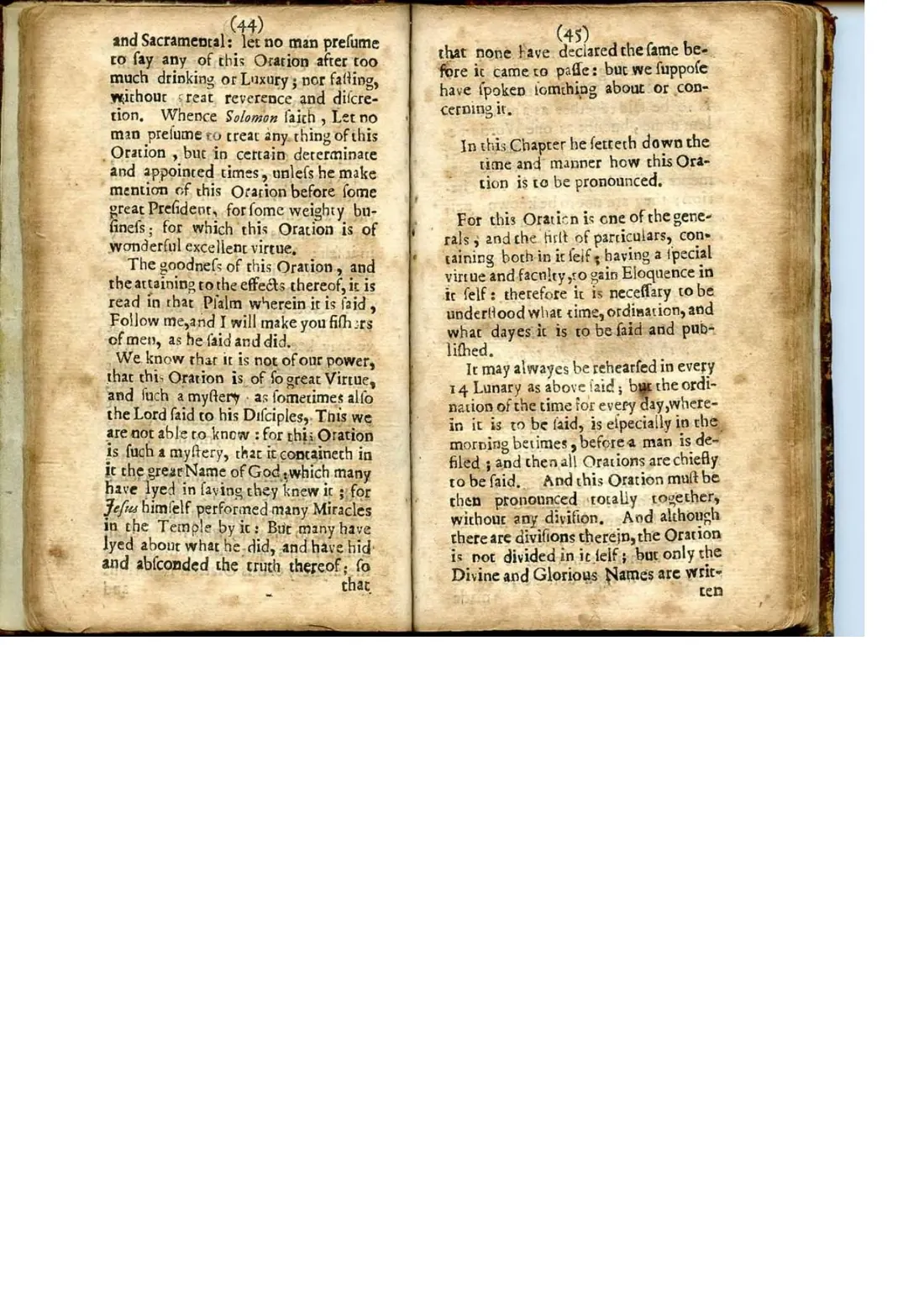
and Sacramental : let no man presume to say any of this Oration after too much drinking or Luxury ; nor fasting, without great reverence and discre- tion. Whence Solomon saith , Let no man presume to treat any thing of this Oration , but in certain determinate and appointed times , unless he make mention of this Oration before some great President, for some weighty bu- siness ; for which this Oration is of wonderful excellent virtue. The goodness of this Oration , and the attaining to the effects thereof, it is read in that Psalm wherein it is said , Follow me,and I will make you fishers of men, as he said and did. We know that it is not of our power, that this Oration is of so great Virtue, and such a mystery : as sometimes also the Lord said to his Disciples, This we are not able to know : for this Oration is such a mystery, that it containeth in it the great Name of God, which many have lyed in saying they knew it ; for Jesus himself performed many Miracles in the Temple by it : But many have lyed about what he did, and have hid and absconded the truth thereof; so

that

(45)

that none have declared the same be- fore it came to passe: but we suppose have spoken something about or con- cerning it.

In this Chapter he setteth down the time and manner how this Ora- tion is to be pronounced.

For this Oration is one of the gene- rals ; and the first of particulars, con- taining both in it self ; having a special virtue and faculty,to gain Eloquence in it self : therefore it is necessary to be understood what time,ordination, and what dayes it is to be said and pub- lished. It may alwayes be rehearsed in every 14 Lunary as above said ; but the ordi- nation of the time for every day,where- in it is to be said, is especially in the morning betimes , before a man is de- filed ; and then all Orations are chiefly to be said. And this Oration must be then pronounced totally together, without any division. And although there are divisions therein, the Oration is not divided in it self ; but only the Divine and Glorious Names are writ- ten

Prologue of Eloquence#p055
Ars Notoria (classical) — facsimile page (Prologue of Eloquence) · public-domain facsimile
Printed — Turner 1657 · Illuminated manuscript — Mellon MS 1 (Beinecke)
🔍 click to enlarge

TranscriptionEnglish (printed, 1657)

(46)

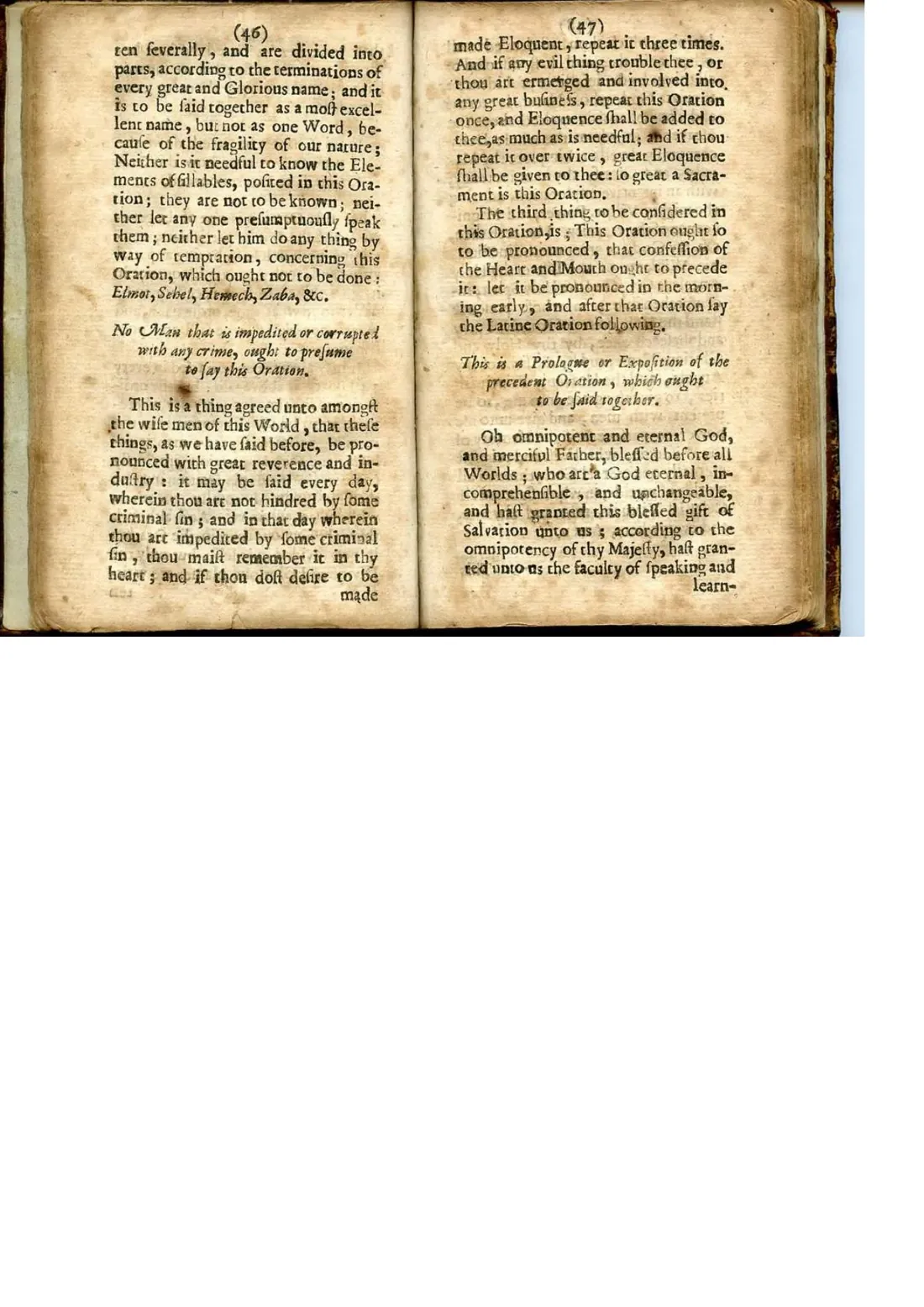
ten severally, and are divided into parts, according to the terminations of every great and Glorious name; and it is to be said together as a most excel- lent name, but not as one Word, be- cause of the fragility of our nature; Neither is it needful to know the Ele- ments of syllables, posited in this Ora- tion; they are not to be known; nei- ther let any one presumptuously speak them; neither let him do any thing by way of temptation, concerning this Oration, which ought not to be done : Eliot, Sehel, Hemech, Zaba, &c.

No Man that is impedited or corrupted with any crime, ought to presume to say this Oration.

This is a thing agreed unto amongst the wise men of this World, that these things, as we have said before, be pro- nounced with great reverence and in- dustry : it may be said every day, wherein thou art not hindred by some criminal sin ; and in that day wherein thou art impedited by some criminal sin, thou maist remember it in thy heart ; and if thou dost desire to be made

(47)

made Eloquent, repeat it three times. And if any evill thing trouble thee, or thou art emerged and involved into any great business, repeat this Oration once, and Eloquence shall be added to thee, as much as is needful; and if thou repeat it over twice, great Eloquence shall be given to thee; so great a Sacra- ment is this Oration. The third thing to be considered in this Oration,is, This Oration ought so to be pronounced, that confession of the Heart and Mouth ought to precede it : let it be pronounced in the morn- ing early, and after that Oration say the Latine Oration following.

This is a Prologue or Exposition of the precedent Oration , which ought to be said together.

Oh omnipotent and eternal God, and merciful Father, blessed before all Worlds ; who art a God eternal, in- comprehensible ; and unchangeable, and hast granted this blessed gift of Salvation unto us ; according to the omnipotency of thy Majesty, hast gran- ted unto us the faculty of speaking, and learn-

Liberal and Mechanical Arts#p059
Ars Notoria (classical) — facsimile page (Liberal and Mechanical Arts) · public-domain facsimile
Printed — Turner 1657 · Illuminated manuscript — Mellon MS 1 (Beinecke)
🔍 click to enlarge

TranscriptionEnglish (printed, 1657)

(50)

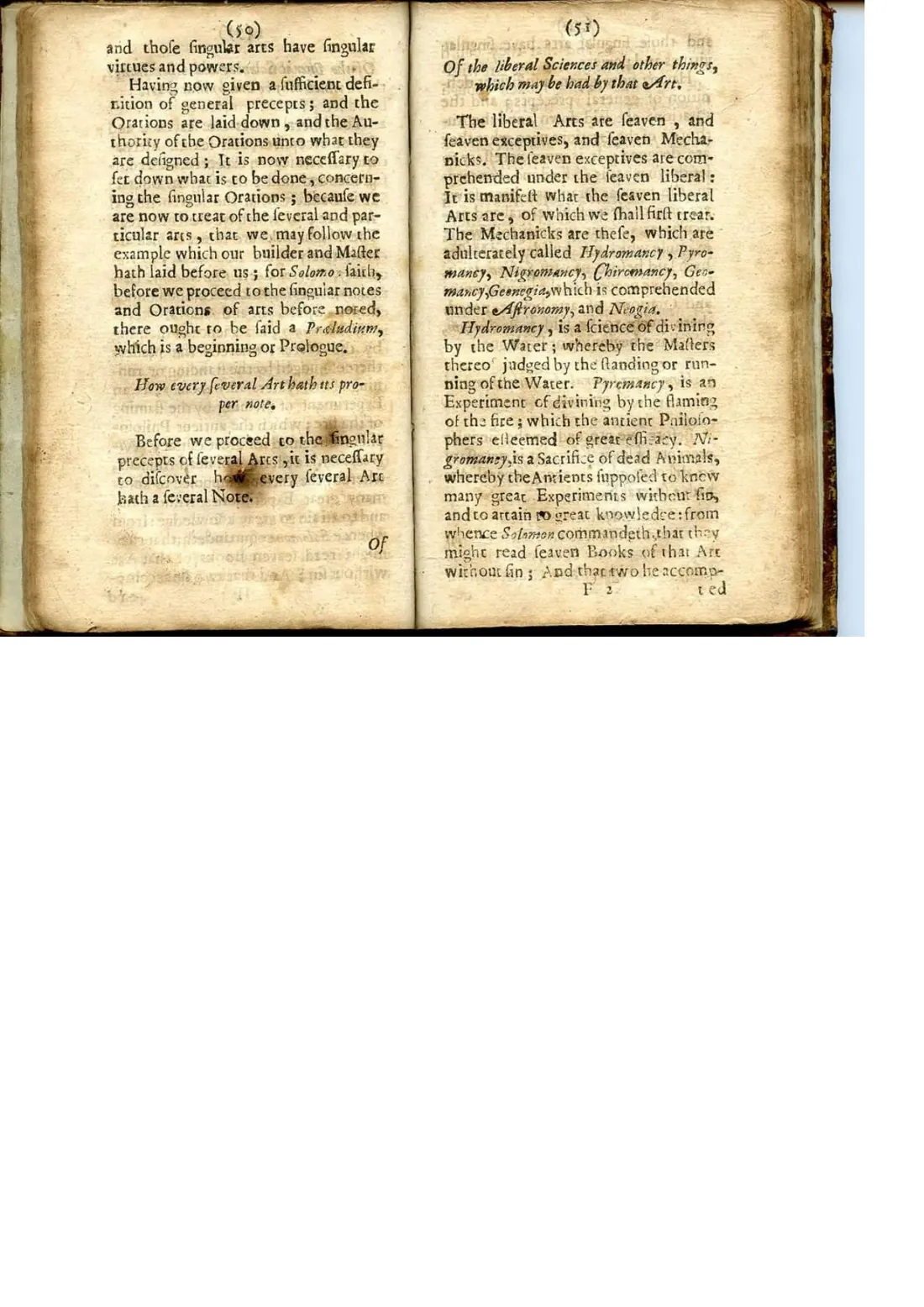
and those singular arts have singular virtues and powers. Having now given a sufficient defi- nition of general precepts ; and the Orations are laid down , and the Au- thority of the Orations unto what they are designed ; It is now necessary to set down what is to be done , concern- ing the singular Orations ; because we are now to treat of the several and par- ticular arts , that we may follow the example which our builder and Master hath laid before us ; for Solomon saith, before we proceed to the singular notes and Orations of arts before noted, there ought to be said a Preludium, which is a beginning or Prologue.

How every several Art hath its pro- per note.

Before we proceed to the singular precepts of several Arts , it is necessary to discover how every several Art hath a several Note.

Of

(51)

Of the liberal Sciences,and other things, which may be had by that Art.

The liberal Arts are seaven , and seaven exceptives, and seaven Mecha- nicks. The seaven exceptives are com- prehended under the seaven liberal : It is manifest what the seaven liberal Arts are , of which we shall first treat. The Mechanicks are these, which are adulterately called Hydromancy , Pyro- mancy, Nigromancy, Chiromancy, Geo- mancy,Geomagia,which is comprehended under Astronomy, and Notory. Hydromancy, is a science of divining by the Water ; whereby the Masters thereof judged by the standing or run- ning of the Water. Pyromancy, is an Experiment of divining by the flaming of the fire ; which the antient Philoso- phers esteemed of great efficacy. Ni- gromancy,is a Sacrifice of dead Animals, whereby the Antients supposed to know many great Experiments without sin, and to attain to great knowledge: from whence Solomon commandeth that they might read seaven Books of that Art without sin ; And that two he accomp- ted

Grimorium · grimorium.lat · CC BY 4.0 · Details