Ars Notoria (classica)

Ars Notoria classica —non versio brevior Lemegeton— · Turner 1657, cum notis illuminatis ex Mellon MS 1

Impressum — Turner 1657 · Codex illuminatus — Mellon MS 1 (Beinecke)
PDF demere ↓
Artes liberales#p061
Ars Notoria (classica) — imago facsimilaris (Artes liberales) · facsimile
Impressum — Turner 1657 · Codex illuminatus — Mellon MS 1 (Beinecke)
🔍 preme ut amplifices

TranscriptioEnglish (printed, 1657)

(52)

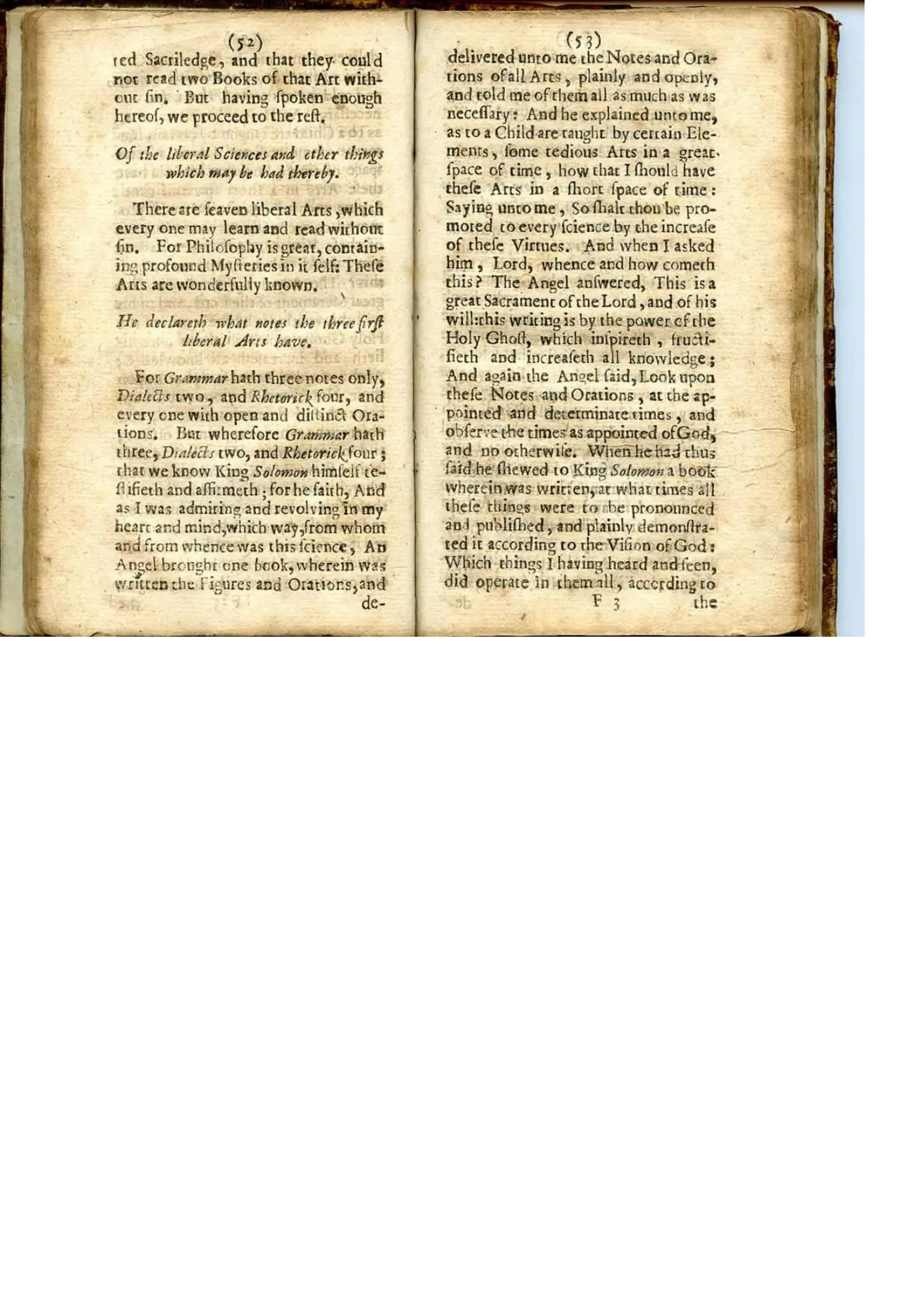
ted Sacriledge,, and that they could not read two Books of that Art with- out sin, But having spoken enough hereof, we proceed to the rest.

Of the liberal Sciences and other things which may be had thereby.

There are seaven liberal Arts ,which every one may learn and read without sin. For Philosophy is great, contain- ing profound Mysteries in it self: These Arts are wonderfully known.

He declareth what notes the three first liberal Arts have.

For Grammar hath three notes only, Dialects two , and Rhetorick four, and every one with open and distinct Ora- tions. But wherefore Grammar hath three, Dialects two, and Rhetorick four ; that we know King Solomon himself te- stifieth and affirmeth ; for he saith, And as I was admiring and revolving in my heart and mind,which way,from whom and from whence was this science, An Angel brought one book, wherein was written the Figures and Orations, and

de-

(53)

delivered unto me the Notes and Ora- tions of all Arts , plainly and openly, and told me of them all as much as was necessary : And he explained unto me, as to a Child are taught by certain Ele- ments , some tedious Arts in a great space of time , how that I should have these Arts in a short space of time : Saying unto me , So shalt thou be pro- moted to every science by the increase of these Virtues. And when I asked him , Lord, whence and how cometh this? The Angel answered, This is a great Sacrament of the Lord, and of his will:this writing is by the power of the Holy Ghost, which inspireth , fructi- fieth and increaseth all knowledge ; And again the Angel said, Look upon these Notes and Orations , at the ap- pointed and determinate times , and observe the times as appointed of God, and no otherwise. When he had thus said he shewed to King Solomon a book wherein was written,at what times all these things were to be pronounced and published , and plainly demonstra- ted it according to the Vision of God : Which things I having heard and seen, did operate in them all, according to

the
Grammatica et dialectica#p063
Ars Notoria (classica) — imago facsimilaris (Grammatica et dialectica) · facsimile
Impressum — Turner 1657 · Codex illuminatus — Mellon MS 1 (Beinecke)
🔍 preme ut amplifices

TranscriptioEnglish (printed, 1657)

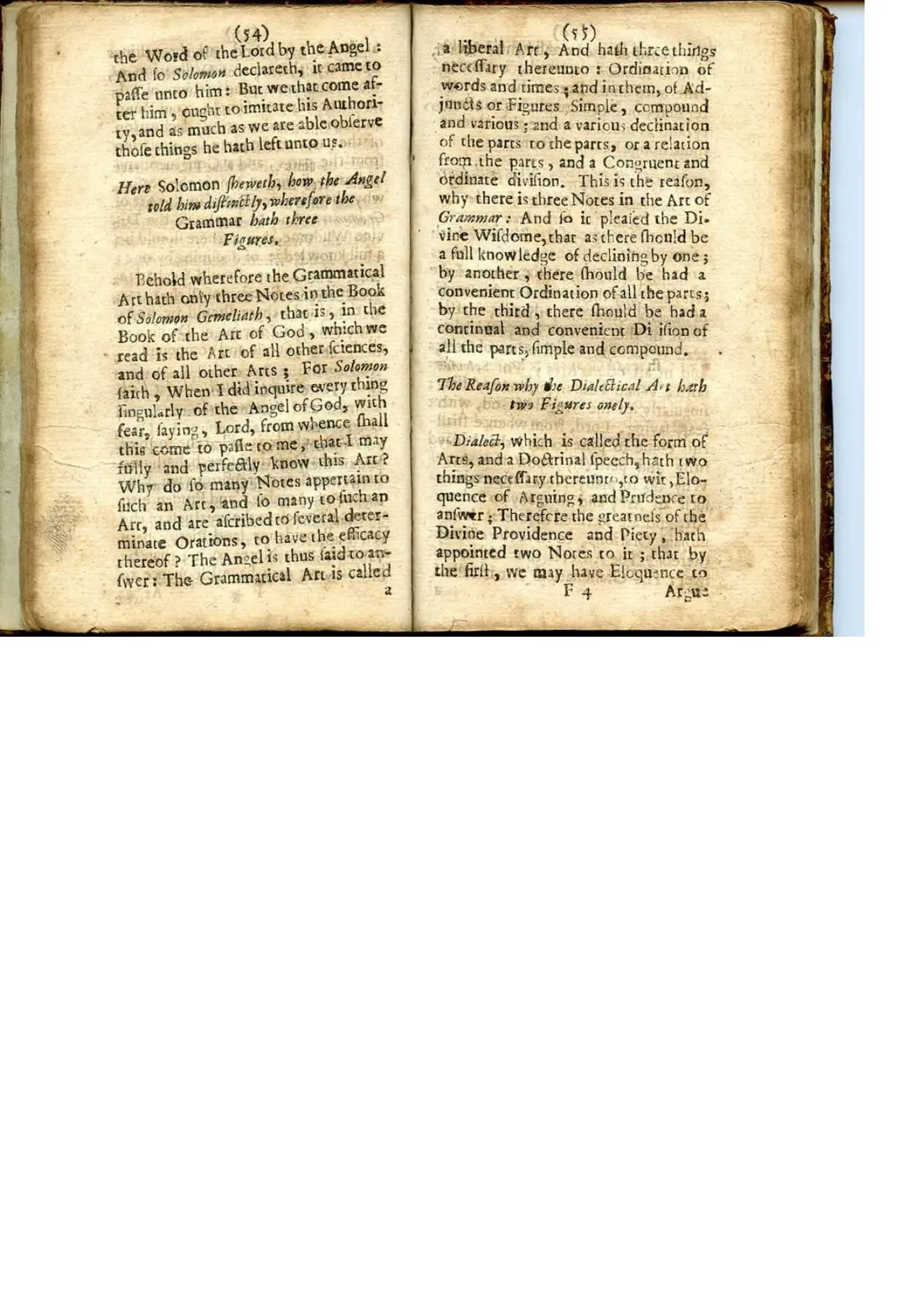
(54)

the Word of the Lord by the Angel: And so Solomon declareth, it came to passe unto him: But we that come af- ter him, ought to imitate his Authori- ty,and as much as we are able observe those things he hath left unto us.

Here Solomon sheweth, how the Angel told him distinctly, wherefore the Grammar hath three Figures.

Behold wherefore the Grammatical Art hath only three Notes in the Book of Solomon Gemeliath , that is , in the Book of the Art of God , which we read is the Art of all other sciences, and of all other Arts ; For Solomon saith , When I did inquire every thing singularly of the Angel of God, with fear, saying, Lord, from whence shall this come to passe to me, that I may fully and perfectly know this Art? Why do so many Notes appertain to such an Art, and so many to such an Art, and are ascribed to several deter- minate Orations, to have the efficacy thereof? The Angel is thus said to an- swer: The Grammatical Art is called

a

(55)

a liberal Art, And hath three things necessary thereunto : Ordination of words and times , and in them, of Ad- juncts or Figures Simple , compound and various ; and a various declination of the parts to the parts, or a relation from the parts, and a Congruent and ordinate division. This is the reason, why there is three Notes in the Art of Grammar : And so it pleased the Di- vine Wisdome, that as there should be a full knowledge of declining by one ; by another , there should be had a convenient Ordination of all the parts; by the third , there should be had a continual and convenient Division of all the parts, simple and compound.

The Reason why the Dialectical Art hath two Figures onely.

Dialect, which is called the form of Arts, and a Doctrinal speech,hath two things necessary thereunto, to wit , Elo- quence of Arguing ; and Prudence to answer ; Therefore the greatness of the Divine Providence and Piety , hath appointed two Notes to it ; that by the first , we may have Eloquence to

F 4

Argu-

Rhetorica et notae#p065
Ars Notoria (classica) — imago facsimilaris (Rhetorica et notae) · facsimile
Impressum — Turner 1657 · Codex illuminatus — Mellon MS 1 (Beinecke)
🔍 preme ut amplifices

TranscriptioEnglish (printed, 1657)

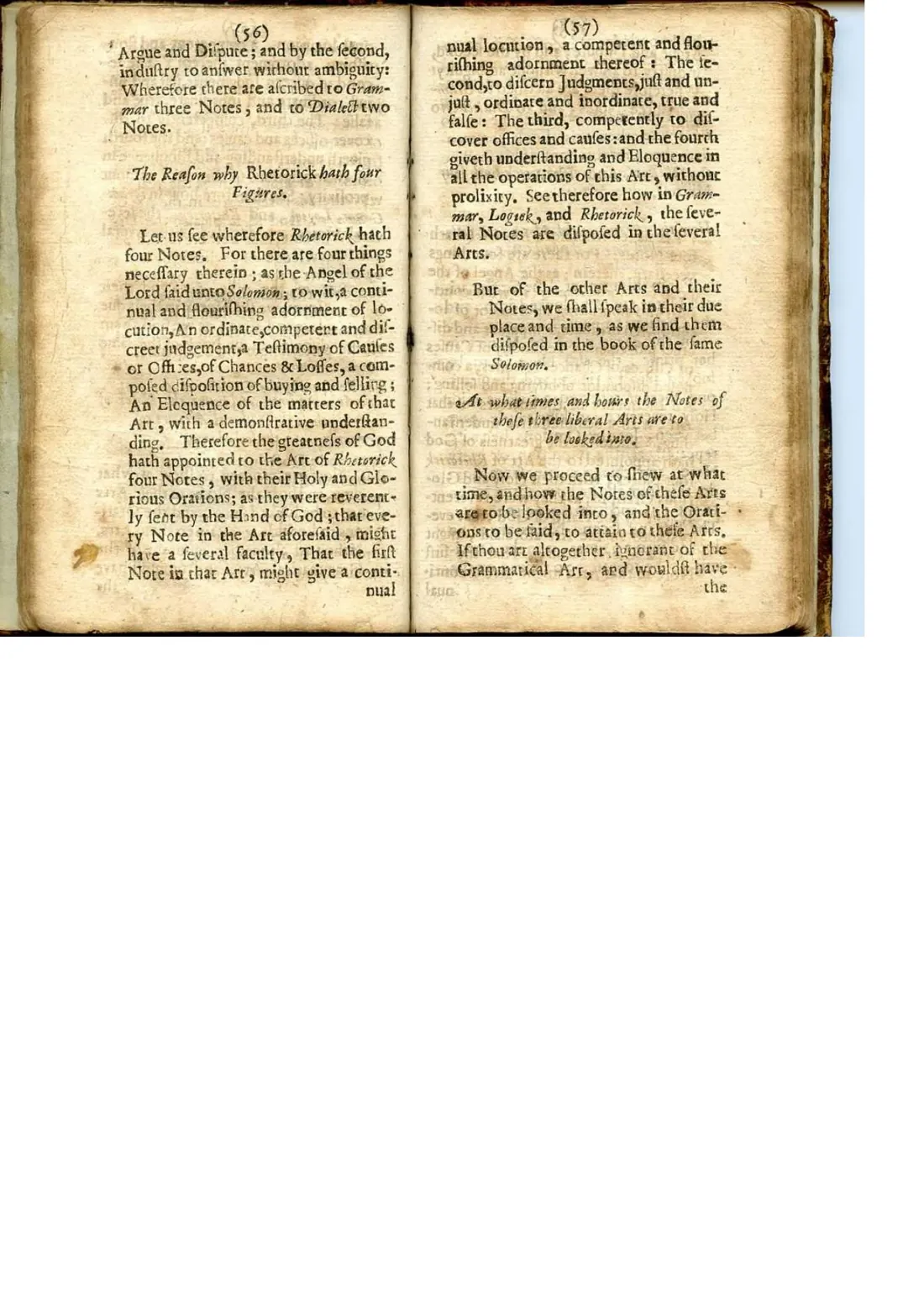
(56) Argue and Dispute; and by the second, industry to answer without ambiguity: Wherefore there are ascribed to Gram- mar three Notes, and to Dialect two Notes.

The Reason why Rhetorick hath four Figures.

Let us see wherefore Rhetorick hath four Notes. For there are four things necessary therein; as the Angel of the Lord said unto Solomon; to wit, a conti- nual and flourishing adornment of lo- cution, An ordinate, competent and dis- creet judgement, a Testimony of Causes or Offices, of Chances & Losses, a com- posed disposition of buying and selling; An Eloquence of the matters of that Art, with a demonstrative understan- ding. Therefore the greatness of God hath appointed to the Art of Rhetorick four Notes, with their Holy and Glo- rious Orations; as they were reverent- ly sent by the Hand of God; that eve- ry Note in the Art aforesaid, might have a several faculty. That the first Note in that Art, might give a conti- nual

(57) nual locution, a competent and flou- rishing adornment thereof: The se- cond, to discern Judgements, just and un- just, ordinate and inordinate, true and false: The third, competently to dis- cover offices and causes: and the fourth giveth understanding and Eloquence in all the operations of this Art, without prolixity. See therefore how in Gram- mar, Logick, and Rhetorick, the seve- ral Notes are disposed in the several Arts.

But of the other Arts and their Notes, we shall speak in their due place and time, as we find them disposed in the book of the same Solomon.

At what times and how, the Notes of these three liberal Arts are to be looked into.

Now we proceed to shew at what time, and how the Notes of these Arts are to be looked into, and the Orati- ons to be said, to attain to these Arts. If thou art altogether ignorant of the Grammatical Art, and wouldst have the

Notae grammaticales#p067
Ars Notoria (classica) — imago facsimilaris (Notae grammaticales) · facsimile
Impressum — Turner 1657 · Codex illuminatus — Mellon MS 1 (Beinecke)
🔍 preme ut amplifices

TranscriptioEnglish (printed, 1657)

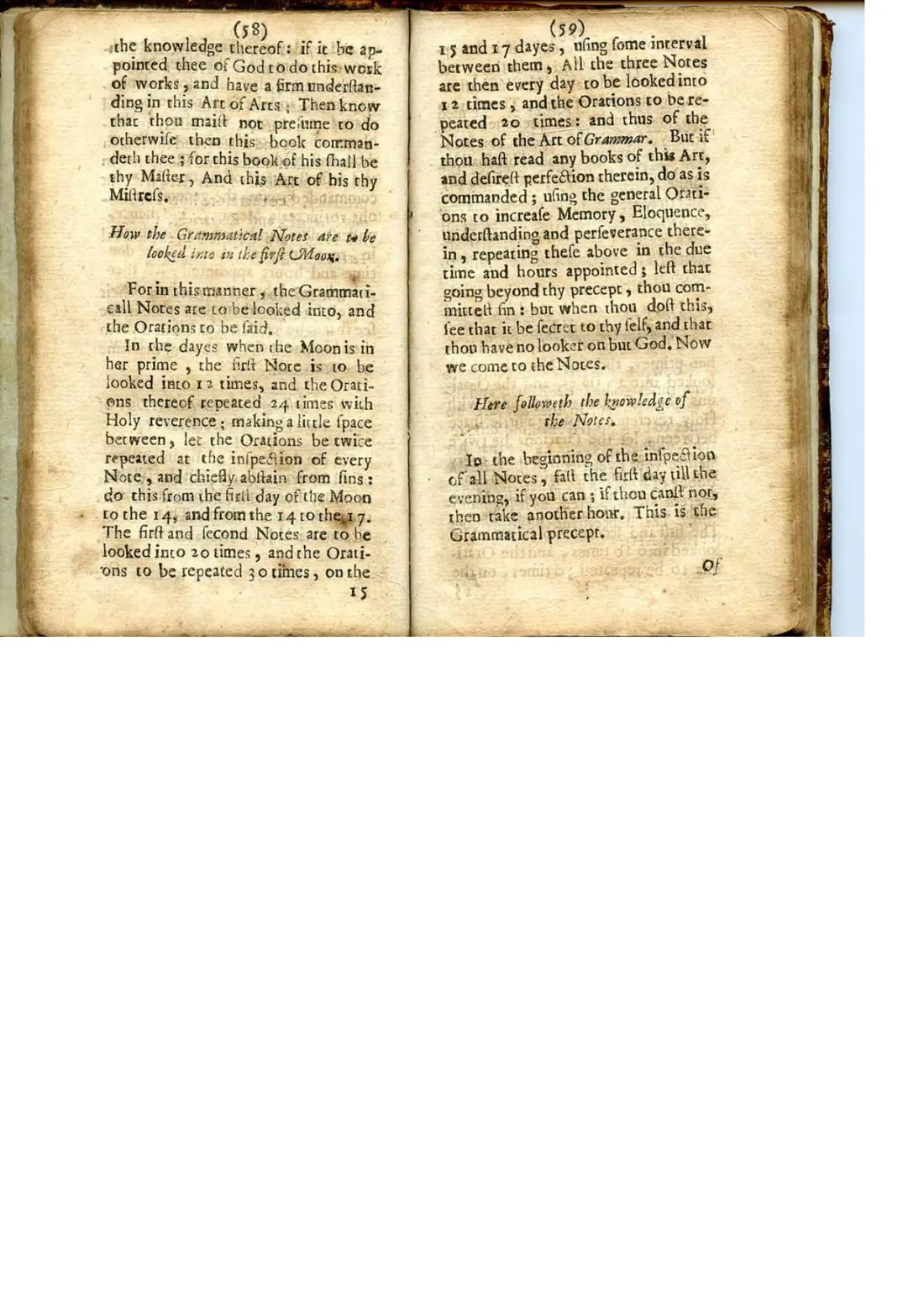
(58)

the knowledge thereof: if it be ap- pointed thee of God to do this work of works, and have a firm understan- ding in this Art of Arts ; Then know that thou maist not presume to do otherwise then this book comman- deth thee ; for this book of his shall be thy Master, And this Art of his thy Mistress.

How the Grammatical Notes are to be looked into in the first Moon.

For in this manner, the Grammati- call Notes are to be looked into, and the Orations to be said. In the dayes when the Moon is in her prime, the first Note is to be looked into 12 times, and the Orati- ons thereof repeated 24 times with Holy reverence , making a little space between , let the Orations be twice repeated at the inspection of every Note , and chiefly abstain from sins : do this from the first day of the Moon to the 14, and from the 14 to the 17. The first and second Notes are to be looked into 20 times , and the Orati- ons to be repeated 30 times , on the 15

(59)

15 and 17 dayes , using some interval between them ; All the three Notes are then every day to be looked into 12 times, and the Orations to be re- peated 20 times : and thus of the Notes of the Art of Grammar. But if thou hast read any books of this Art, and desirest perfection therein, do as is commanded ; using the general Orati- ons to increase Memory , Eloquence, understanding and perseverance there- in , repeating these above in the due time and hours appointed ; lest that going beyond thy precept , thou com- mittest sin : but when thou dost this, see that it be secret to thy self, and that thou have no looker on but God. Now we come to the Notes.

Here followeth the knowledge of the Notes.

In the beginning of the inspection of all Notes, fast the first day till the evening, if you can ; If thou canst not, then take another hour. This is the Grammatical precept.

Of

Notae logicales#p069
Ars Notoria (classica) — imago facsimilaris (Notae logicales) · facsimile
Impressum — Turner 1657 · Codex illuminatus — Mellon MS 1 (Beinecke)
🔍 preme ut amplifices

TranscriptioEnglish (printed, 1657)

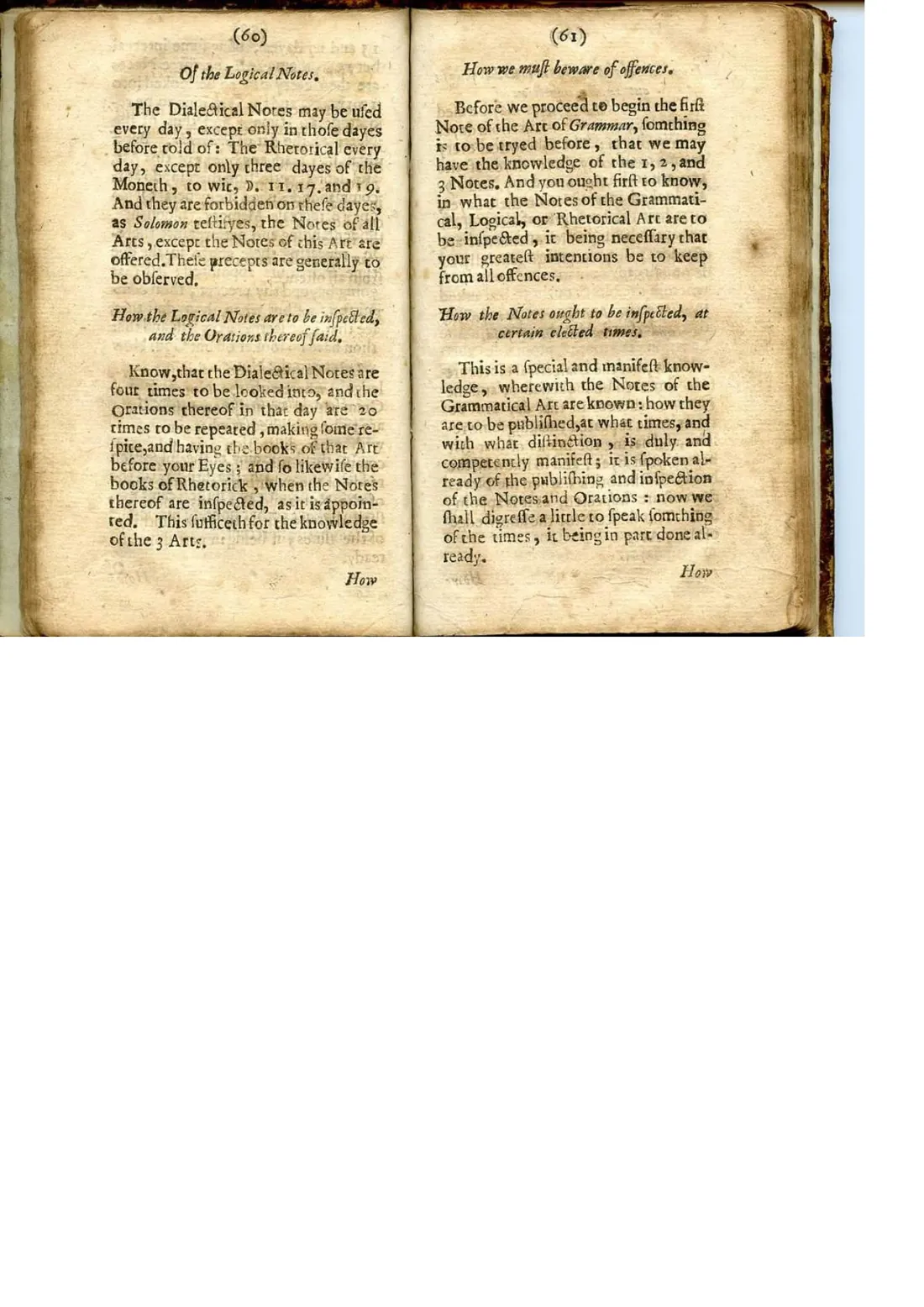
(60)

Of the Logical Notes.

The Dialectical Notes may be used every day , except only in those dayes before told of : The Rhetorical every day, except only three dayes of the Moneth, to wit, D. 11. 17. and 19. And they are forbidden on these dayes, as Solomon testifyes, the Notes of all Arts, except the Notes of this Art are offered. These precepts are generally to be observed.

How the Logical Notes are to be inspected, and the Orations thereof said.

Know,that the Dialectical Notes are four times to be looked into, and the Orations thereof in that day are 20 times to be repeated, making some re- spite,and having the books of that Art before your Eyes ; and so likewise the books of Rhetorick , when the Notes thereof are inspected, as it is appoin- ted. This sufficeth for the knowledge of the 3 Arts.

How

(61)

How we must beware of offences.

Before we proceed to begin the first Note of the Art of Grammar, somthing is to be tryed before , that we may have the knowledge of the 1, 2, and 3 Notes. And you ought first to know, in what the Notes of the Grammati- cal, Logical, or Rhetorical Art are to be inspected, it being necessary that your greatest intentions be to keep from all offences.

How the Notes ought to be inspected, at certain elected times.

This is a special and manifest know- ledge , wherewith the Notes of the Grammatical Art are known : how they are to be published, at what times, and with what distinction, is duly and competently manifest ; it is spoken al- ready of the publishing and inspection of the Notes and Orations : now we shall digresse a little to speak somthing of the times , it being in part done al- ready.

How

Menses et notae#p071
Ars Notoria (classica) — imago facsimilaris (Menses et notae) · facsimile
Impressum — Turner 1657 · Codex illuminatus — Mellon MS 1 (Beinecke)
🔍 preme ut amplifices

TranscriptioEnglish (printed, 1657)

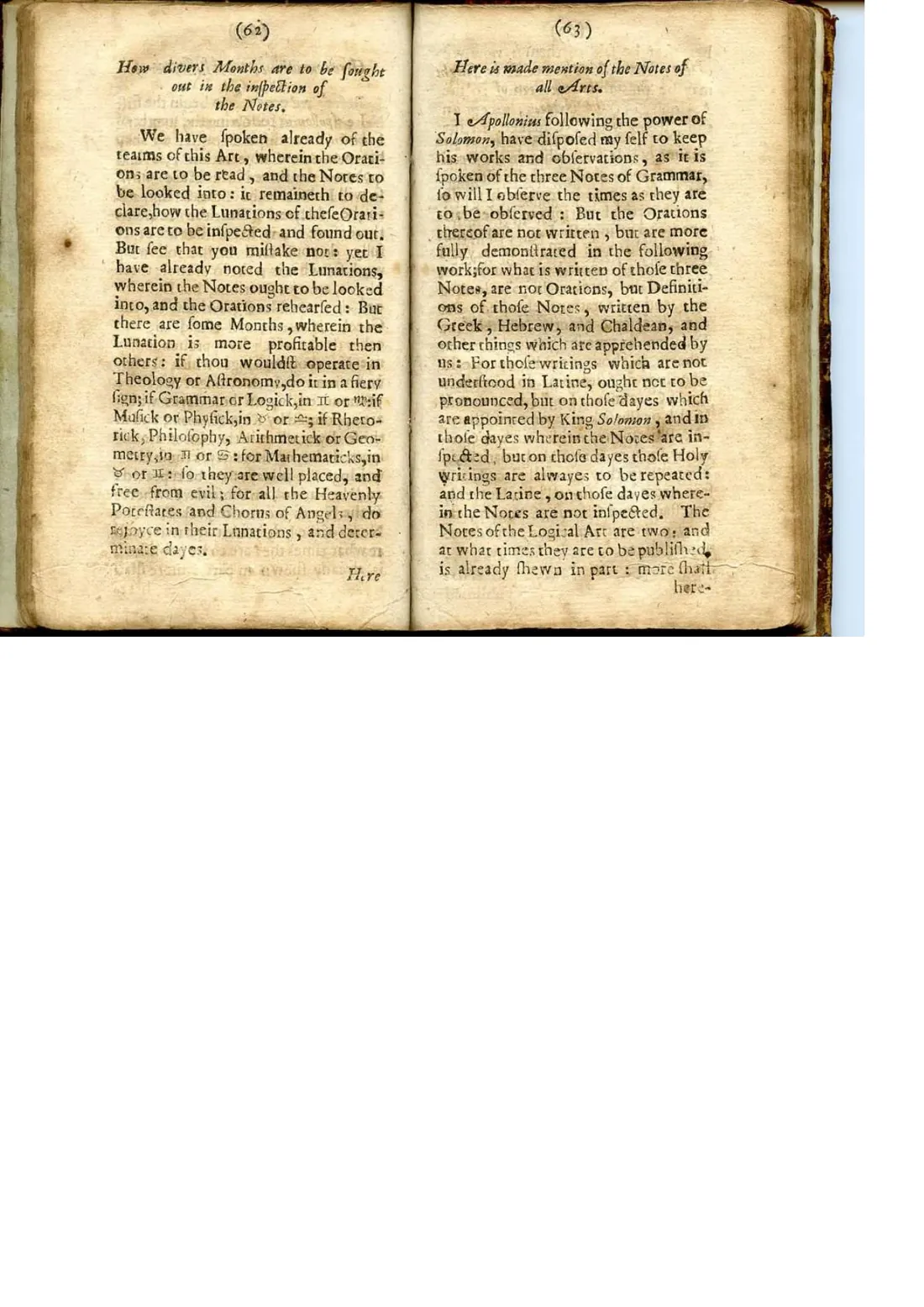
(62)

How divers Months are to be sought out in the inspection of the Notes.

We have spoken already of the terms of this Art, wherein the Orati- ons are to be read, and the Notes to be looked into: it remaineth to de- clare,how the Lunations of these Orati- ons are to be inspected and found out. But see that you mistake not: yet I have already noted the Lunations, wherein the Notes ought to be looked into, and the Orations rehearsed: But there are some Months ,wherein the Lunation is more profitable then others: if thou wouldst operate in Theology or Astronomy,do it in a fiery sign;if Grammar or Logick,in ♊ or ♍;if Musick or Physick,in ♉ or ♎;if Rheto- rick, Philosophy, Arithmetick or Geo- metry,in ♌ or ♋: for Mathematicks,in ♉ or ♊: so they are well placed, and free from evil ; for all the Heavenly Potestates and Chorus of Angels, do rejoyce in their Lunations, and deter- minate dayes.

Here

(63)

Here is made mention of the Notes of all Arts.

I Apollonius following the power of Solomon, have disposed my self to keep his works and observations, as it is spoken of the three Notes of Grammar, so will I observe the times as they are to be observed : But the Orations thereof are not written , but are more fully demonstrated in the following work;for what is written of those three Notes, are not Orations, but Definiti- ons of those Notes, written by the Greek , Hebrew, and Chaldean, and other things which are apprehended by us : For these writings which are not understood in Latine, ought not to be pronounced, but on those dayes which are appointed by King Solomon, and in those dayes wherein the Notes are in- spected, but on those dayes those Holy writings are alwayes to be repeated: and the Latine , on those dayes where- in the Notes are not inspected. The Notes of the Logical Art are two; and at what times they are to be published, is already shewn in part : more shall here-

Definitiones artium#p073
Ars Notoria (classica) — imago facsimilaris (Definitiones artium) · facsimile
Impressum — Turner 1657 · Codex illuminatus — Mellon MS 1 (Beinecke)
🔍 preme ut amplifices

TranscriptioEnglish (printed, 1657)

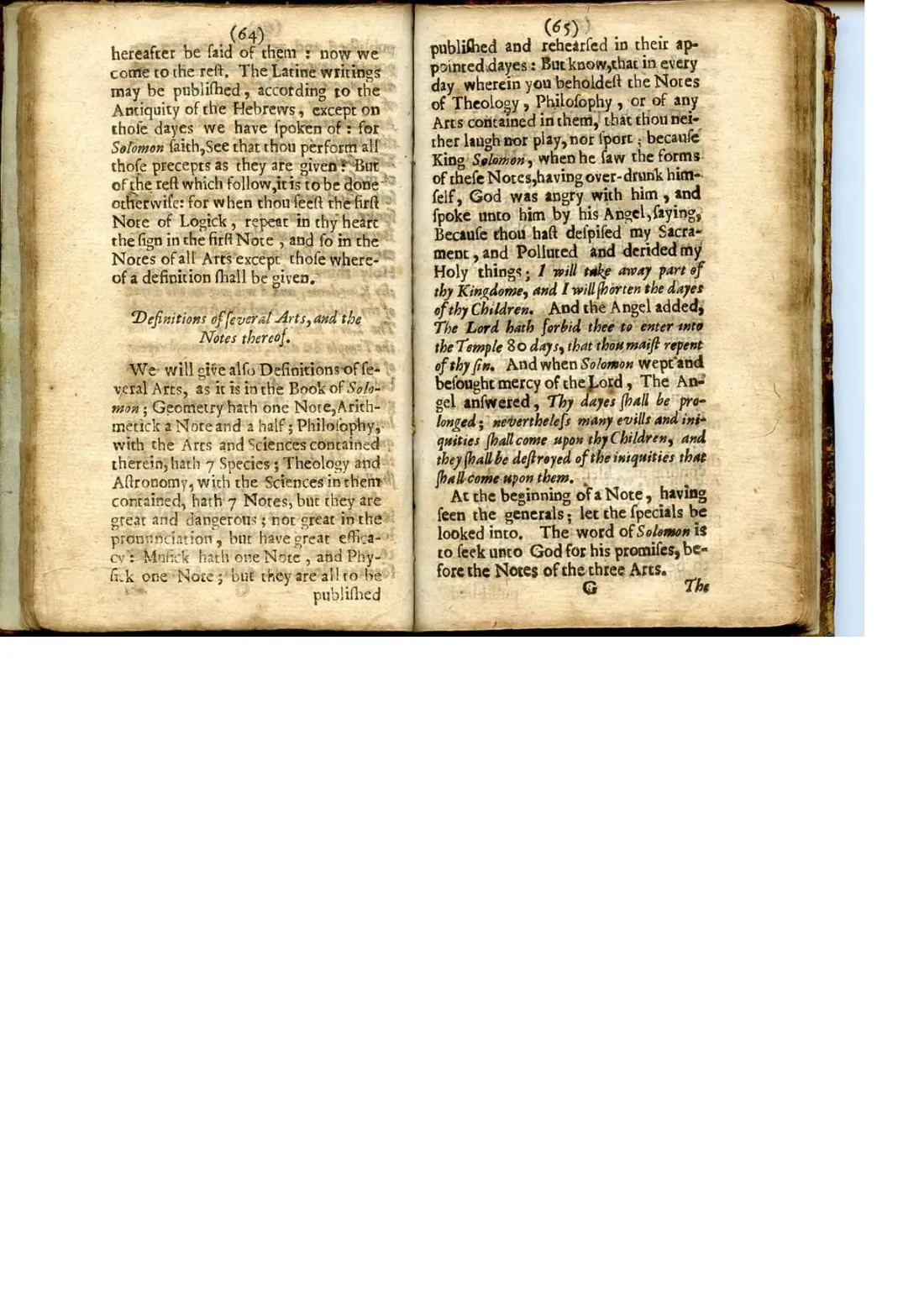
(64)

hereafter be said of them : now we come to the rest. The Latine writings may be published , according to the Antiquity of the Hebrews , except on those dayes we have spoken of : for Solomon saith, See that thou perform all those precepts as they are given : But of the rest which follow, it is to be done otherwise: for when thou seest the first Note of Logick , repeat in thy heart the sign in the first Note , and so in the Notes of all Arts except those where- of a definition shall be given.

Definitions of several Arts, and the Notes thereof.

We will give also Definitions of se- veral Arts, as it is in the Book of Solo- mon ; Geometry hath one Note, Arith- metick a Note and a half ; Philosophy, with the Arts and Sciences contained therein, hath 7 Species ; Theology and Astronomy, with the Sciences in them contained, hath 7 Notes, but they are great and dangerous ; not great in the pronunciation , but have great effica- cy : Musick hath one Note , and Phy- sick one Note ; but they are all to be published

(65)

published and rehearsed in their ap- pointed dayes: But know, that in every day wherein you beholdest the Notes of Theology , Philosophy , or of any Arts contained in them, that thou nei- ther laugh nor play, nor sport , because King Solomon , when he saw the forms of these Notes, having over-drunk him- self, God was angry with him , and spoke unto him by his Angel, saying, Because thou hast despised my Sacra- ment , and Polluted and derided my Holy things ; I will take away part of thy Kingdome, and I will shorten the dayes of thy Children. And the Angel added, The Lord hath forbid thee to enter into the Temple 80 dayes, that thou maist repent of thy sin. And when Solomon wept and besought mercy of the Lord , The An- gel answered , Thy dayes shall be pro- longed ; nevertheless many evills and ini- quities shall come upon thy Children, and they shall be destroyed of the iniquities that shall come upon them.

At the beginning of a Note , having seen the generals ; let the specials be looked into. The word of Solomon is to seek unto God for his promises, be- fore the Notes of the three Arts.

G

The

Orationes grammaticales#p075
Ars Notoria (classica) — imago facsimilaris (Orationes grammaticales) · facsimile
Impressum — Turner 1657 · Codex illuminatus — Mellon MS 1 (Beinecke)
🔍 preme ut amplifices

TranscriptioEnglish (printed, 1657)

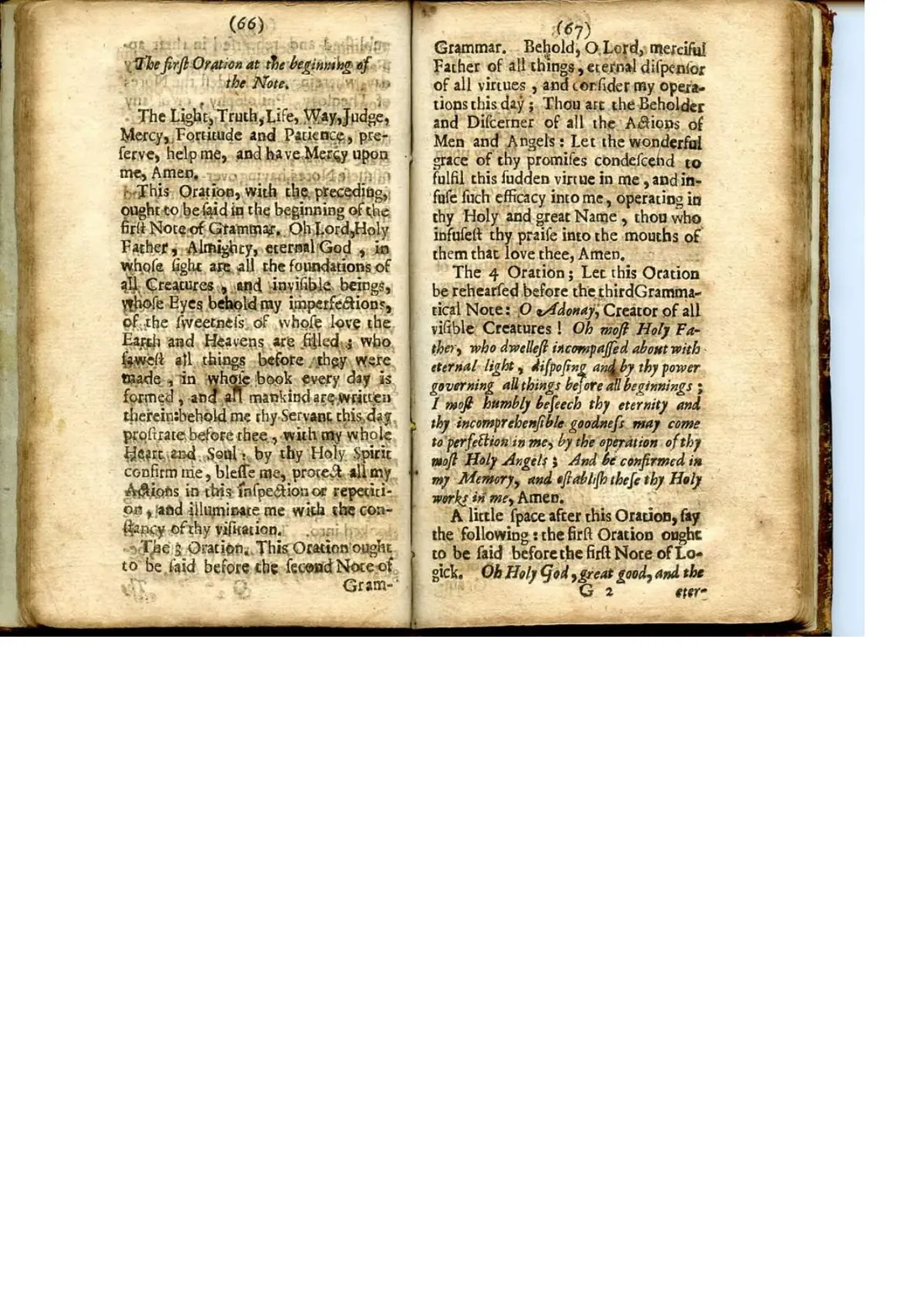
(66)

The first Oration at the beginning of the Note.

The Light, Truth, Life, Way, Judge, Mercy, Fortitude and Patience, pre- serve, help me, and have Mercy upon me, Amen.

This Oration, with the preceding, ought to be said in the beginning of the first Note of Grammar. Oh Lord, Holy Father, Almighty, eternal God ; in whose sight are all the foundations of all Creatures, and invisible beings, whose Eyes behold my imperfections, of the sweetness of whose love the Earth and Heavens are filled ; who sawest all things before they were made ; in whose book every day is formed, and all mankind are written therein:behold me thy Servant this day, prostrate before thee, with my whole Heart and Soul : by thy Holy Spirit confirm me, blesse me, protect all my Actions in this inspection or repeti- tion, and illuminate me with the con- stancy of thy visitation.

The 3 Oration. This Oration ought to be said before the second Note of Gram-

(67)

Grammar. Behold, O Lord, merciful Father of all things, eternal dispenser of all virtues ; and consider my opera- tions this day ; Thou art the Beholder and Discerner of all the Actions of Men and Angels : Let the wonderful grace of thy promises condescend to fulfill this sudden virtue in me, and in- fuse such efficacy into me, Operating in thy Holy and great Name , thou who infusest thy praise into the mouths of them that love thee, Amen.

The 4 Oration; Let this Oration be rehearsed before the third Gramma- rical Note: O Adonay, Creator of all visible Creatures ! Oh most Holy Fa- ther, who dwellest encompassed about with eternal light, disposing and by thy power governing all things before all beginnings ; I most humbly beseech thy eternity and thy incomprehensible goodness may come to perfection in me, by the operation of thy most Holy Angels ; And be confirmed in my Memory, and establish these thy Holy works in me, Amen.

A little space after this Oration, say the following ; the first Oration ought to be said before the first Note of Lo- gick. Oh Holy God, great good, and the eter-

Orationes rhetoricae#p079
Ars Notoria (classica) — imago facsimilaris (Orationes rhetoricae) · facsimile
Impressum — Turner 1657 · Codex illuminatus — Mellon MS 1 (Beinecke)
🔍 preme ut amplifices

TranscriptioEnglish (printed, 1657)

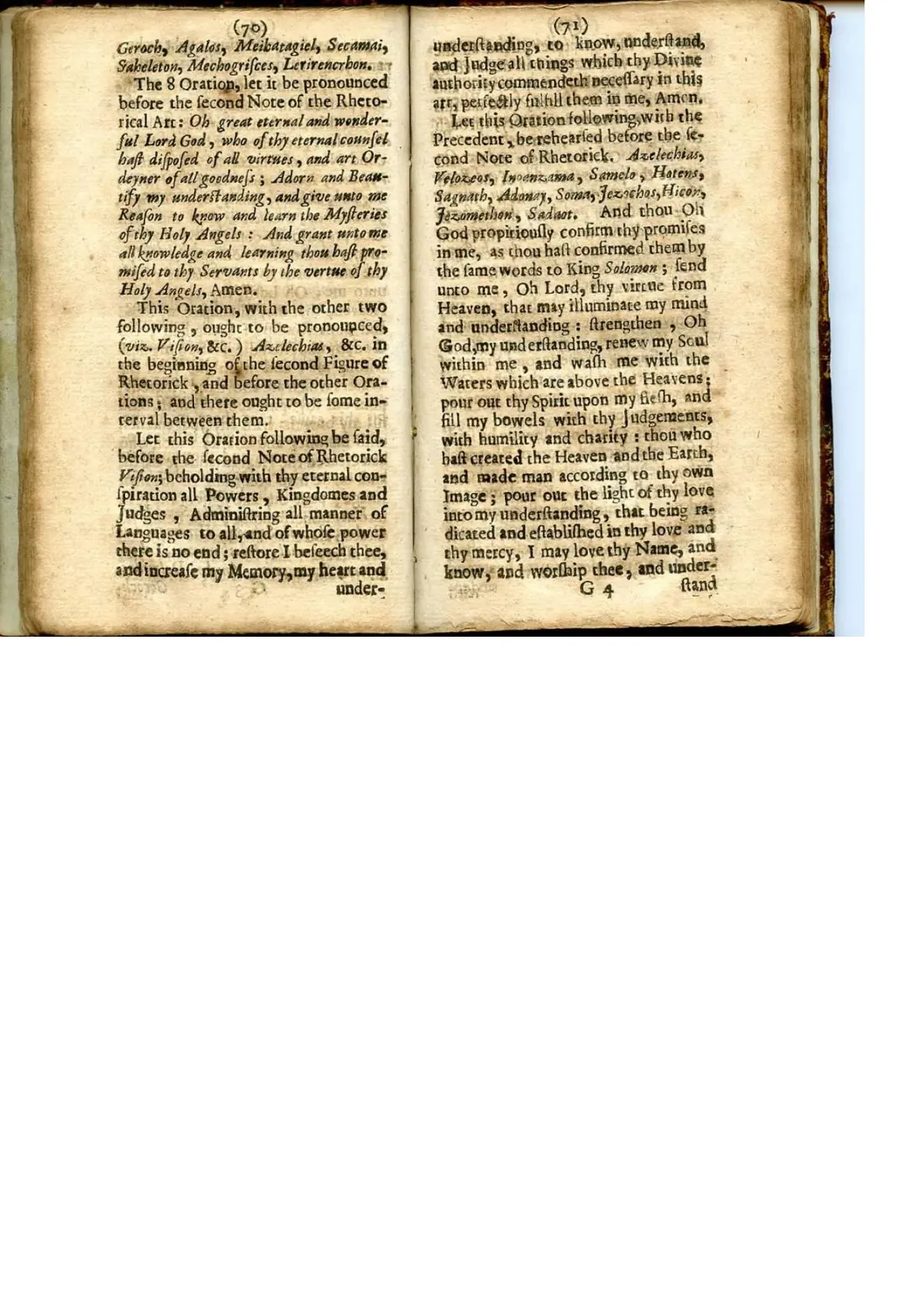
(70)

Gerboch, Agalos, Meibatagiel, Secamai, Sabeleton, Mechogrifces, Lerirencrhon.

The 8 Oration, let it be pronounced before the second Note of the Rheto- rical Art: Oh great eternal and wonder- ful Lord God, who of thy eternal counsel, hast disposed of all virtues, and art Or- deyner of all goodness ; Adorn and Beau- tify my understanding, and give unto me Reason to know and learn the Mysteries of thy Holy Angels : And grant unto me all knowledge and learning thou hast pro- mised to thy Servants by the vertue of thy Holy Angels, Amen.

This Oration, with the other two following, ought to be pronounced, (viz. Visons, &c.) Azelechias, &c. in the beginning of the second Figure of Rhetorick , and before the other Ora- tions ; and there ought to be some in- terval between them.

Let this Oration following be said, before the second Note of Rhetorick Visons beholding with thy eternal con- spiration all Powers , Kingdomes and Judges , Administring all manner of Languages to all,and of whose power there is no end ; restore I beseech thee, and increase my Memory,my heart and under-

(71)

understanding, to know, understand, and Judge all things which thy Divine authority commendeth necessary in this art; perfectly fulfill them in me, Amen.

Let this Oration following, with the Precedent , be rehearsed before the se- cond Note of Rhetorick. Azelechias, Veloxeos, Inoenzama, Samelo , Hatens, Sagnath, Adonay, Soma, Jezrehos,Hicon, Jezomethon, Sadaot. And thou Oh God propitiously confirm thy promises in me, as thou hast confirmed them by the same words to King Solomon ; send unto me , Oh Lord, thy virtue from Heaven, that may illuminate my mind and understanding : strengthen , Oh God,my understanding, renew my Soul within me , and wash me with the Waters which are above the Heavens ; pour out thy Spirit upon my flesh, and fill my bowels with thy Judgements, with humility and charity : thou who hast created the Heaven and the Earth, and made man according to thy own Image ; pour out the light of thy love into my understanding, that being ra- dicated and established in thy love and thy mercy, I may love thy Name, and know, and worship thee, and under-

G 4

stand

Orationes Arithmeticae et Geometriae#p083
Ars Notoria (classica) — imago facsimilaris (Orationes Arithmeticae et Geometriae) · facsimile
Impressum — Turner 1657 · Codex illuminatus — Mellon MS 1 (Beinecke)
🔍 preme ut amplifices

TranscriptioEnglish (printed, 1657)

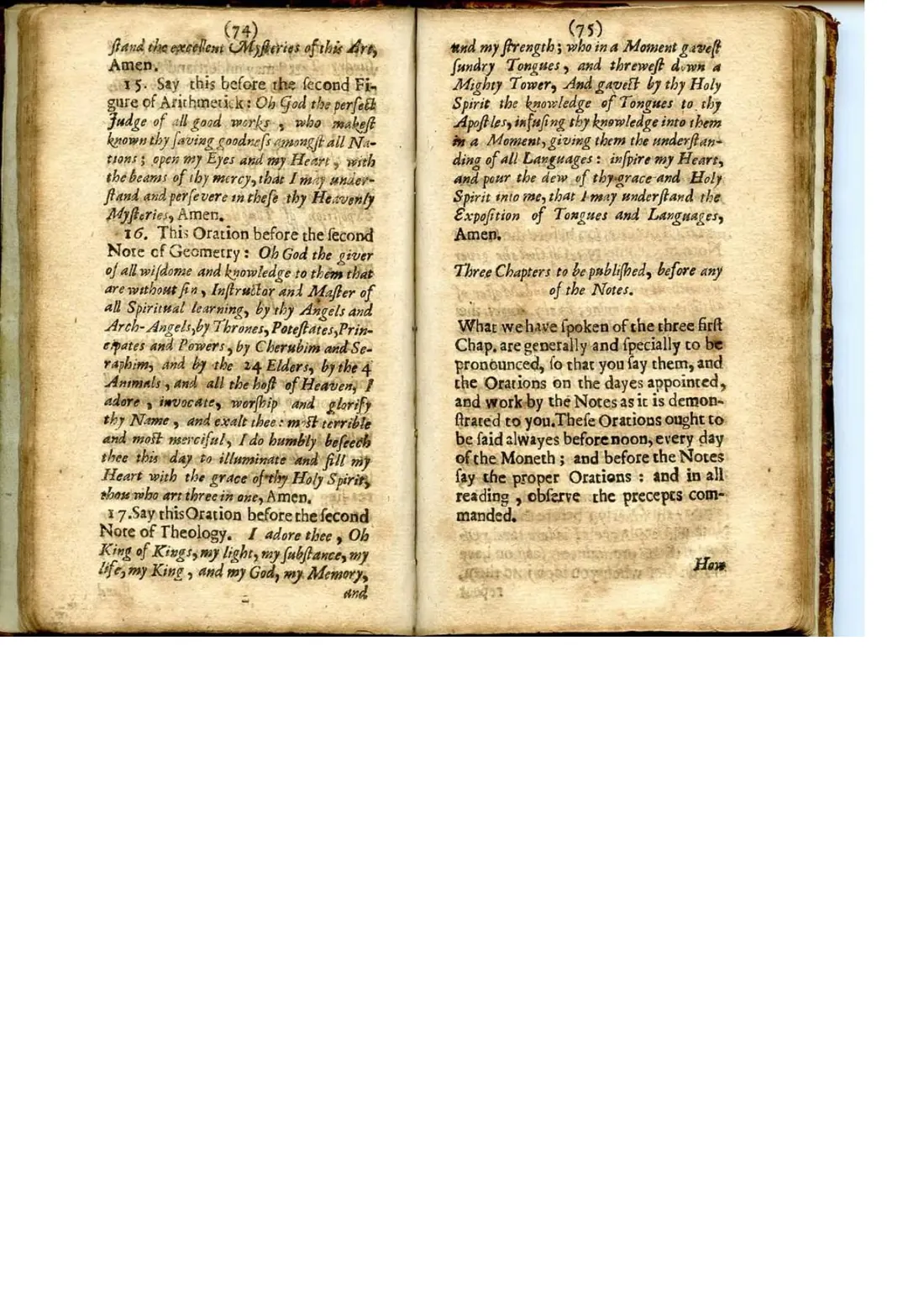
(74)

stand the excellent Mysteries of this Art, Amen.

15. Say this before the second Fi- gure of Arithmetick : Oh God the perfect Judge of all good works, who makest known thy saving goodness amongst all Na- tions ; open my Eyes and my Heart , with the beams of thy mercy, that I may under- stand and persevere in these thy Heavenly Mysteries, Amen.

16. This Oration before the second Note of Geometry : Oh God the giver of all wisdome and knowledge to them that are without sin , Instructor and Master of all Spiritual learning, by thy Angels and Arch-Angels,by Thrones, Potestates, Prin- cipates and Powers, by Cherubim and Se- raphims, and by the 24 Elders, by the 4 Animals, and all the host of Heaven, I adore, invocate, worship and glorify thy Name, and exalt thee: most terrible and most merciful, I do humbly beseech thee this day to illuminate and fill my Heart with the grace of thy Holy Spirit, thou who art three in one, Amen.

17. Say this Oration before the second Note of Theology. I adore thee, Oh King of Kings,my light, my substance, my life,my King, and my God, my Memory, and

(75)

and my strength; who in a Moment gavest sundry Tongues , and threwest down a Mighty Tower, And gavest by thy Holy Spirit the knowledge of Tongues to thy Apostles, infusing thy knowledge into them in a Moment, giving them the understand- ing of all Languages : inspire my Heart, and pour the dew of thy grace and Holy Spirit into me, that I may understand the Exposition of Tongues and Languages, Amen.

Three Chapters to be published, before any of the Notes.

What we have spoken of the three first Chap. are generally and specially to be pronounced, so that you say them, and the Orations on the dayes appointed, and work by the Notes as it is demon- strated to you. These Orations ought to be said alwayes beforenoon, every day of the Moneth ; and before the Notes say the proper Orations : and in all reading , observe the precepts com- manded.

How

Inspectio notarum#p085
Ars Notoria (classica) — imago facsimilaris (Inspectio notarum) · facsimile
Impressum — Turner 1657 · Codex illuminatus — Mellon MS 1 (Beinecke)
🔍 preme ut amplifices

TranscriptioEnglish (printed, 1657)

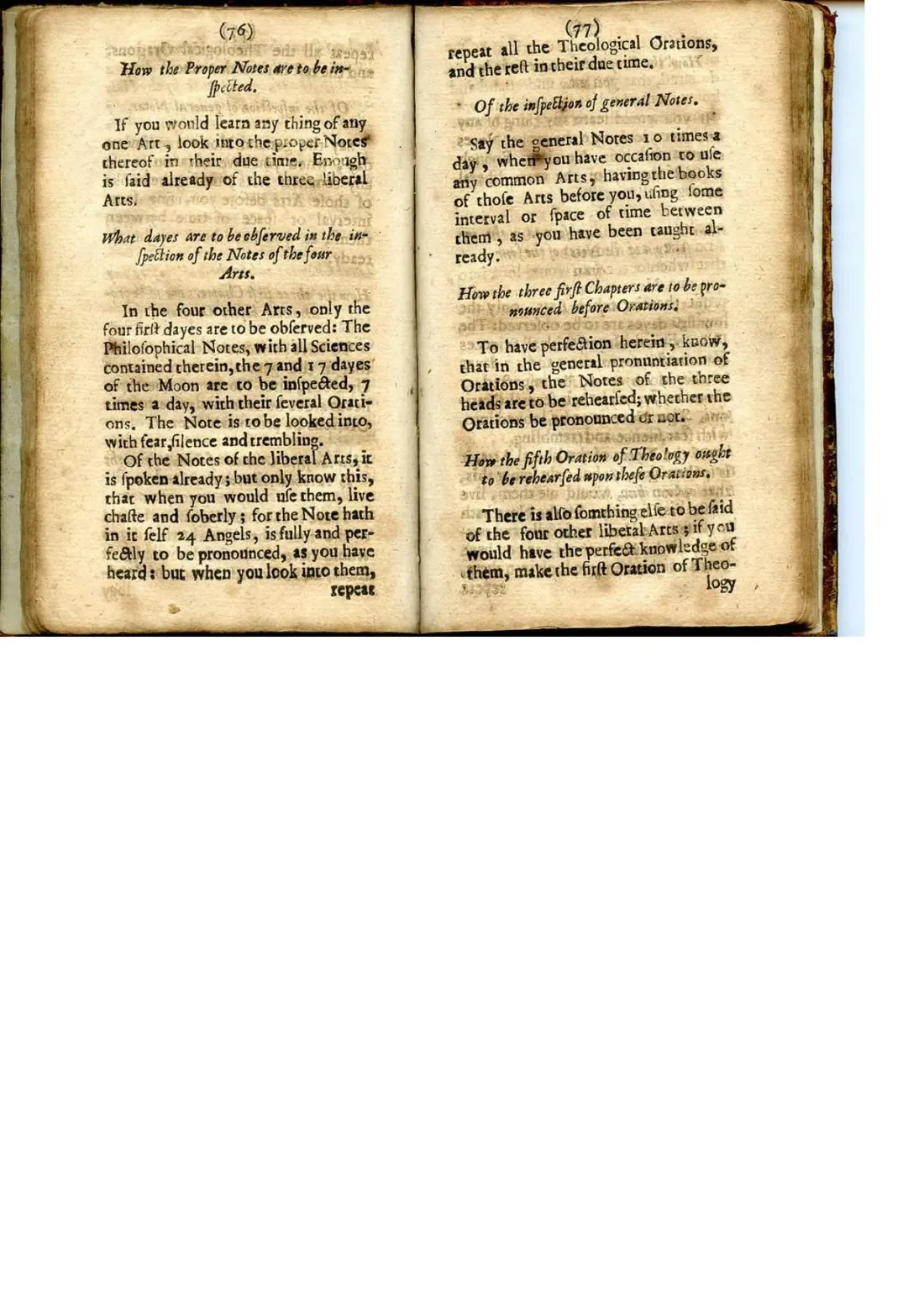
(76)

How the Proper Notes are to be in- spected.

If you would learn any thing of any one Art , look into the proper Notes thereof in their due time, Enough is said already of the three liberal Arts.

What dayes are to be observed in the in- spection of the Notes of the four Arts.

In the four other Arts, only the four first dayes are to be observed: The Philosophical Notes, with all Sciences contained therein,the 7 and 17 dayes of the Moon are to be inspected, 7 times a day, with their several Orati- ons. The Note is to be looked into, with fear,silence and trembling. Of the Notes of the liberal Arts, it is spoken already; but only know this, that when you would use them, live chaste and soberly ; for the Note hath in it self 24 Angels, is fully and per- fectly to be pronounced, as you have heard: but when you look into them, repeat

(77)

repeat all the Theological Orations, and the rest in their due time.

Of the inspection of general Notes.

Say the general Notes 10 times a day , when you have occasion to use any common Arts, having the books of those Arts before you, using some interval or space of time between them, as you have been taught al- ready.

How the three first Chapters are to be pro- nounced before Orations.

To have perfection herein, know, that in the general pronunciation of Orations, the Notes of the three heads are to be rehearsed; whether the Orations be pronounced or not.

How the fifth Oration of Theology ought to be rehearsed upon these Orations.

There is also somthing else to be said of the four other liberal Arts ; if you would have the perfect knowledge of them, make the first Oration of Theo- logy

Augmentationes philosophicae#p087
Ars Notoria (classica) — imago facsimilaris (Augmentationes philosophicae) · facsimile
Impressum — Turner 1657 · Codex illuminatus — Mellon MS 1 (Beinecke)
🔍 preme ut amplifices

TranscriptioEnglish (printed, 1657)

(78)

logy before you say the Orations of the other Notes. These are sufficiently declared, that you may understand and know them ; And let the capitular Ora- tions be pronounced before the seve- ral Notes of every Art , and kept as is determined, &c. These are the Aug- mentations of the Orations , which belong to all Arts liberal and exceptive, except Mechanick, and are especially ascribed to the Notes of Theology. And they are thus to be pronounced, that whensoever you would look into any one Note of any Art , and would profit therein, say these Orations fol- lowing.

1. Ezomamos, Hazalat, Exityne, Hezemechel, Czemomechel Zamay, Za- ton, Ziamy Nayzaton, Hyzemogoy, Jec- comantha, Jaraphy, Phalezaton, Sacram- phal, Sagamazaim, Secranale, Sacrama- than ; Jezennalaton Hacheriatos, Jete- lemathon, Zaymazay, Zamaibay, Gigu- theio [Gemrlagon?], Garyos. Megalon Hera Crubic, Craribuc, Amen.

Let this Oration with the following be pronounced before the first Note of Philosophy : Oh Lord God, Holy Fa- ther, Almighty and incomprehensible ;

hear

(79)

hear my Prayers, thou that art invisi- ble, immortal and intelligible, whose face the Angels and Arch-angels, and all the powers of Heaven , do so much desire to see ; whose Majesty I desire eternally to adore, and honour the on- ly one God for ever and ever, Amen.

2. Say this before the second Note of Philosophy : Oh Lord God, Holy and Almighty Father, hear my Prayers this day , and incline thy ears to my Orations ; Gezomelion Samach, Semath, Cemon, Gezagam, Gezarrhim, Zbeamoth, Zeze Hator Sexeator Samay Samin- da, Gezyel, Iezel, Gaziety, Hel, Gazaye- thyhel, Amen.

Say this following with the former : Oh God eternal, the way , the truth, and the life; give thy light and the flower of thy Holy Spirit into my mind and understanding, and grant that the gift of thy grace may shine forth in my heart , and into my Soul, now and for ever, Amen.

Pronounce the Oration following before the third Note of Philosophy ; Lemogethom, Hegemochom, Hazachay Hazatha, Azamachar, Azacham, Go- bathay, Geomothay Logomothay, Zathana, [Lachanna?],

Orationes philosophiae et usus cotidiani#p089
Ars Notoria (classica) — imago facsimilaris (Orationes philosophiae et usus cotidiani) · facsimile
Impressum — Turner 1657 · Codex illuminatus — Mellon MS 1 (Beinecke)
🔍 preme ut amplifices

TranscriptioEnglish (printed, 1657)

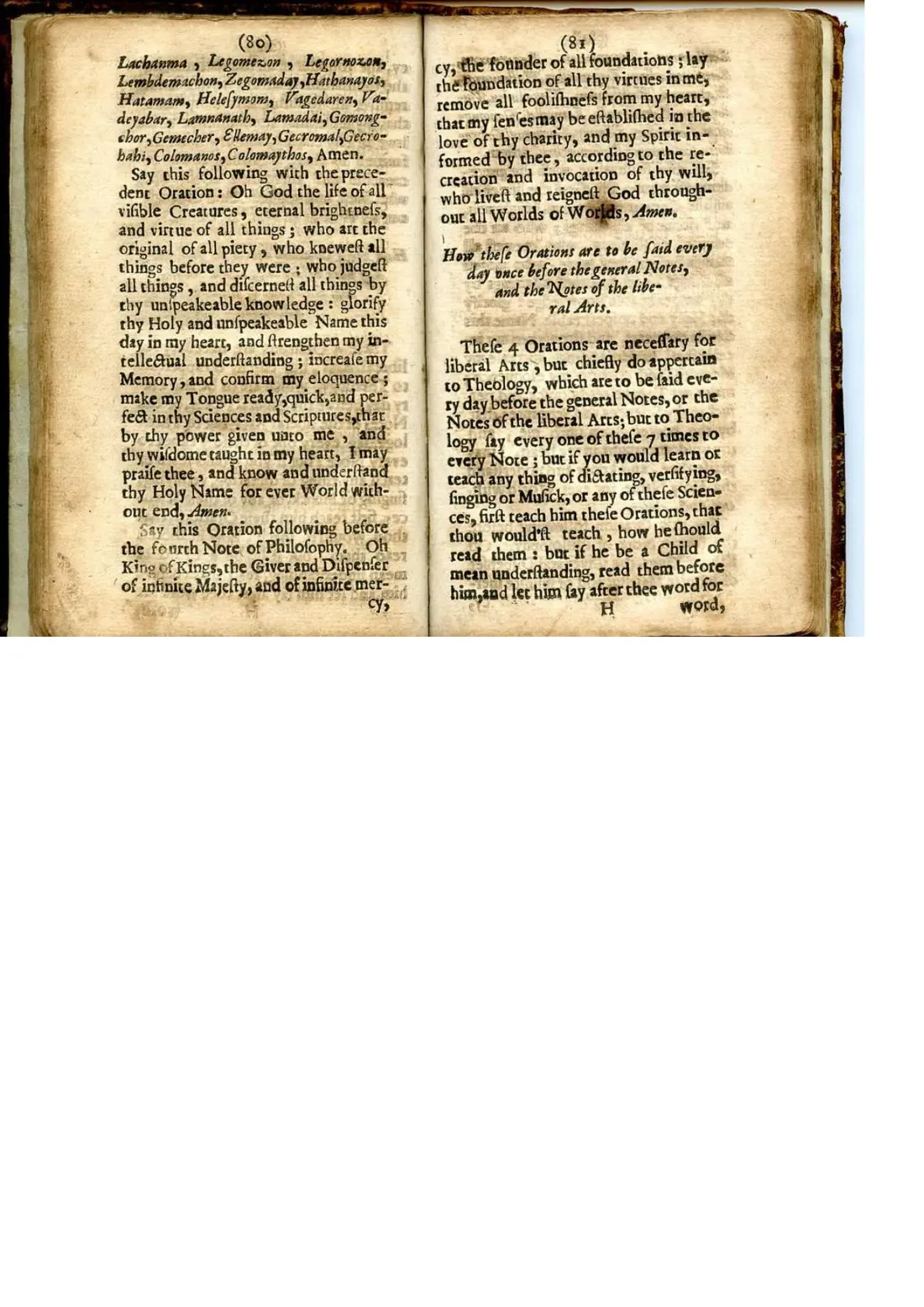
(80)

Lachayma , Legomezon , Legornozon, Lembdemachon,Zegomaday,Hathanayos, Hatamam, Helesymom, Vagedaren, Va- deyabar, Lamnanath, Lamadai, Gomong- chor,Gemecher, Elemay,Gecromal,Gecro- habi, Colomanos, Colomaythos, Amen.

Say this following with the prece- dent Oration : Oh God the life of all visible Creatures , eternal brightness, and virtue of all things ; who art the original of all piety , who knewest all things before they were ; who judgest all things , and discernest all things by thy unspeakeable knowledge : glorify thy Holy and unspeakeable Name this day in my heart, and strengthen my in- tellectual understanding ; increase my Memory, and confirm my eloquence ; make my Tongue ready,quick,and per- fect in thy Sciences and Scriptures,that by thy power given unto me , and thy wisdome taught in my heart, I may praise thee , and know and understand thy Holy Name for ever World with- out end, Amen.

Say this Oration following before the fourth Note of Philosophy. Oh King of Kings,the Giver and Dispenser of infinite Majesty, and of infinite mer-

(81)

cy, the founder of all foundations ; lay the foundation of all thy virtues in me; remove all foolishness from my heart, that my senses may be established in the love of thy charity, and my Spirit in- formed by thee , according to the re- creation and invocation of thy will, who livest and reignest God through- out all Worlds of Worlds, Amen.
How these Orations are to be said every day once before the general Notes, and the Notes of the libe- ral Arts.

These 4 Orations are necessary for liberal Arts , but chiefly do appertain to Theology, which are to be said eve- ry day before the general Notes, or the Notes of the liberal Arts; but to Theo- logy say every one of these 7 times to every Note ; but if you would learn or teach any thing of dictating, versifying, singing or Musick, or any of these Scien- ces, first teach him these Orations, that thou would'st teach , how he should read them : but if he be a Child of mean understanding, read them before him,and let him say after thee word for

H word,

Sexta nota philosophiae#p091
Ars Notoria (classica) — imago facsimilaris (Sexta nota philosophiae) · facsimile
Impressum — Turner 1657 · Codex illuminatus — Mellon MS 1 (Beinecke)
🔍 preme ut amplifices

TranscriptioEnglish (printed, 1657)

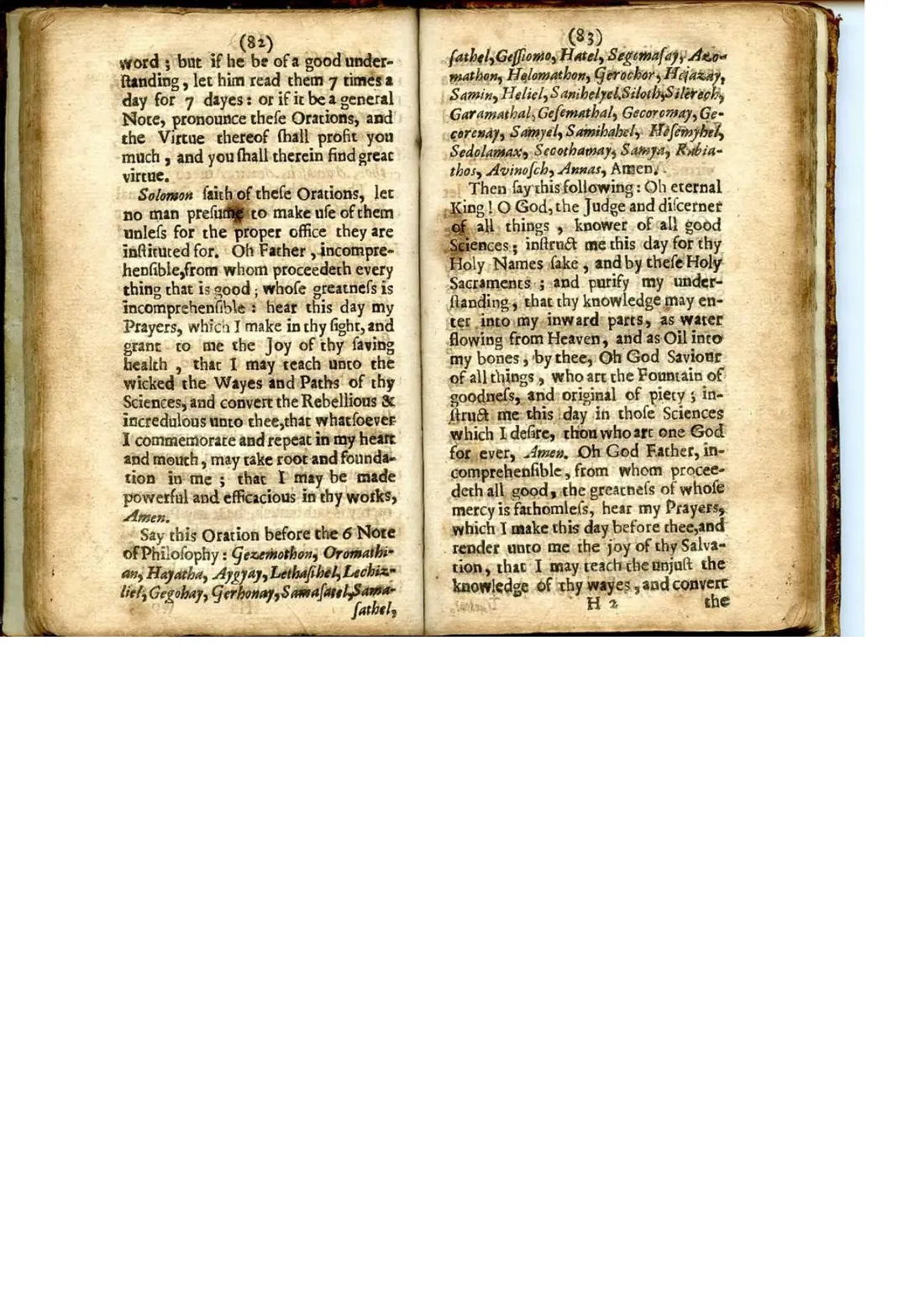
(82)

word : but if he be of a good under- standing , let him read them 7 times a day for 7 dayes : or if it be a general Note, pronounce these Orations, and the Virtue thereof shall profit you much , and you shall therein find great virtue.

Solomon saith of these Orations, let no man presume to make use of them unless for the proper office they are instituted for. Oh Father , incompre- hensible,from whom proceedeth every thing that is good , whose greatness is incomprehensible ; hear this day my Prayers, which I make in thy sight, and grant to me the Joy of thy saving health , that I may teach unto the wicked the Wayes and Paths of thy Sciences,and convert the Rebellious & incredulous unto thee,that whatsoever I commemorate and repeat in my heart and mouth , may take root and founda- tion in me ; that I may be made powerful and efficacious in thy works, Amen.

Say this Oration before the 6 Note of Philosophy : Gezemothon, Oromathi- an, Hayatha, Aygyay, Lethasihel, Lechiz- liel, Gegohay, Gerhonay, Samasatel,Sama-

sathel,

(83)

sathel,Gessiomo,Hatel,Segomasay,Azo- mathon, Helomathon, Gerochor, Hejazay, Samin, Heliel, Sanihelyel,Siloth,Silerech, Garamathal,Gesemathal, Gecoromay, Ge- corenay, Samyel, Samihahel, Hesemyhel, Sedolamax, Secothamay, Samya, Rabia- thos, Avinosch, Annas, Amen.

Then say this following: Oh eternal King ! O God, the Judge and discerner of all things , knower of all good Sciences; instruct me this day for thy Holy Names sake , and by these Holy Sacraments ; and purify my under- standing, that thy knowledge may en- ter into my inward parts, as water flowing from Heaven, and as Oil into my bones , by thee, Oh God Saviour of all things , who art the Fountain of goodness, and original of piety ; in- struct me this day in those Sciences which I desire, thou who art one God for ever, Amen. Oh God Father, in- comprehensible, from whom procee- deth all good, the greatness of whose mercy is fathomless, hear my Prayers, which I make this day before thee,and render unto me the joy of thy Salva- tion, that I may teach the unjust the knowledge of thy wayes, and convert

H 2 the

Septima oratio theologica#p093
Ars Notoria (classica) — imago facsimilaris (Septima oratio theologica) · facsimile
Impressum — Turner 1657 · Codex illuminatus — Mellon MS 1 (Beinecke)
🔍 preme ut amplifices

TranscriptioEnglish (printed, 1657)

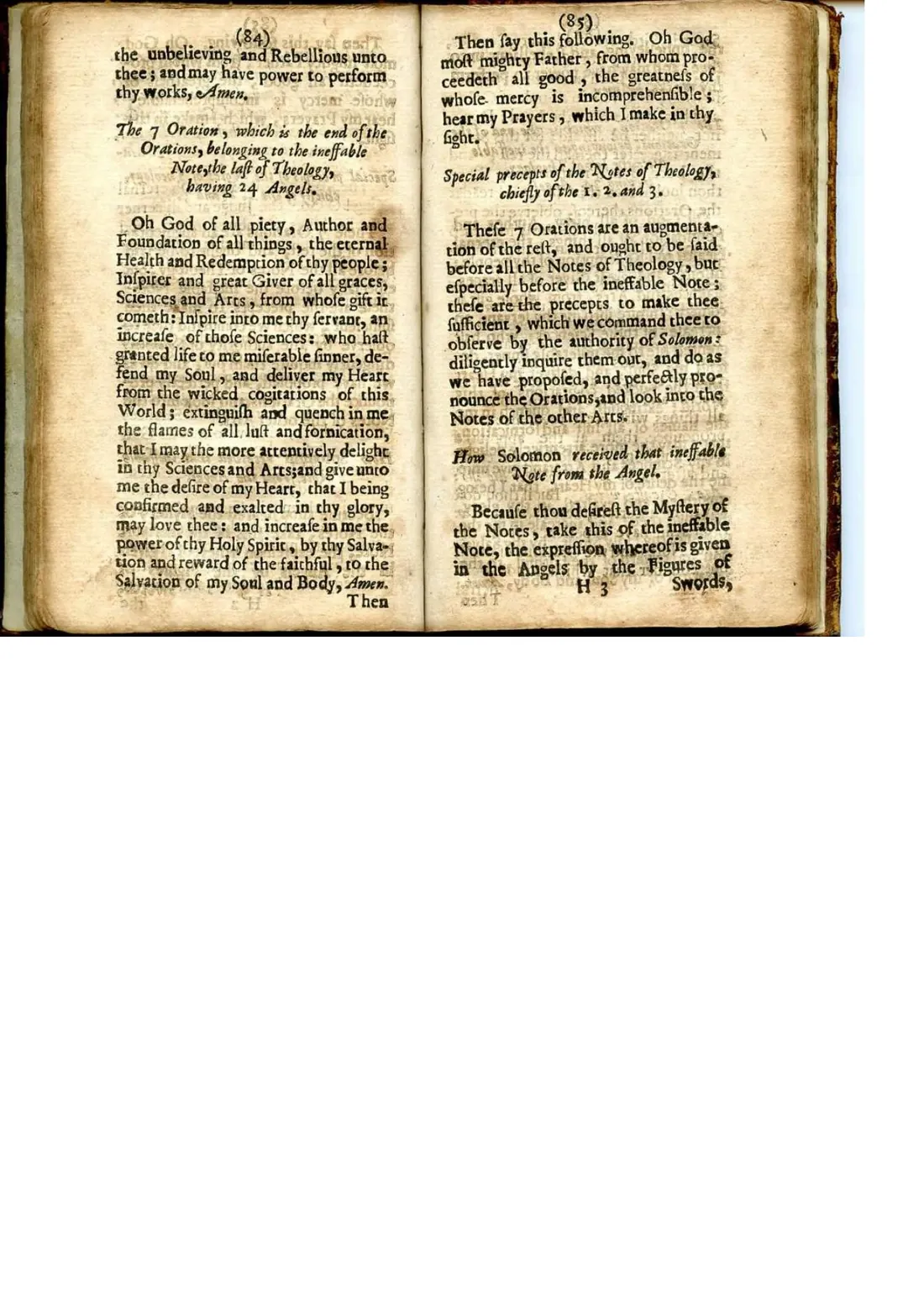
(84)

the unbelieving and Rebellious unto thee; and may have power to perform thy works, Amen.

The 7 Oration, which is the end of the Orations, belonging to the ineffable Note,the last of Theology, having 24 Angels.

Oh God of all piety, Author and Foundation of all things, the eternal Health and Redemption of thy people; Inspirer and great Giver of all graces, Sciences and Arts, from whose gift it cometh: Inspire into me thy servant, an increase of those Sciences: who hast granted life to me miserable sinner, de- fend my Soul, and deliver my Heart from the wicked cogitations of this World; extinguish and quench in me the flames of all lust and fornication, that I may the more attentively delight in thy Sciences and Arts;and give unto me the desire of my Heart, that I being confirmed and exalted in thy glory, may love thee : and increase in me the power of thy Holy Spirit, by thy Salva- tion and reward of the faithful, to the Salvation of my Soul and Body, Amen.

Then

(85)

Then say this following, Oh God most mighty Father, from whom pro- ceedeth all good, the greatness of whose mercy is incomprehensible; hear my Prayers, which I make in thy sight.

Special precepts of the Notes of Theology, chiefly of the 1. 2. and 3.

These 7 Orations are an augmenta- tion of the rest, and ought to be said before all the Notes of Theology, but especially before the ineffable Note; these are the precepts to make thee sufficient, which we command thee to observe by the authority of Solomon: diligently inquire them out, and do as we have proposed, and perfectly pro- nounce the Orations and look into the Notes of the other Arts.

How Solomon received that ineffable Note from the Angel.

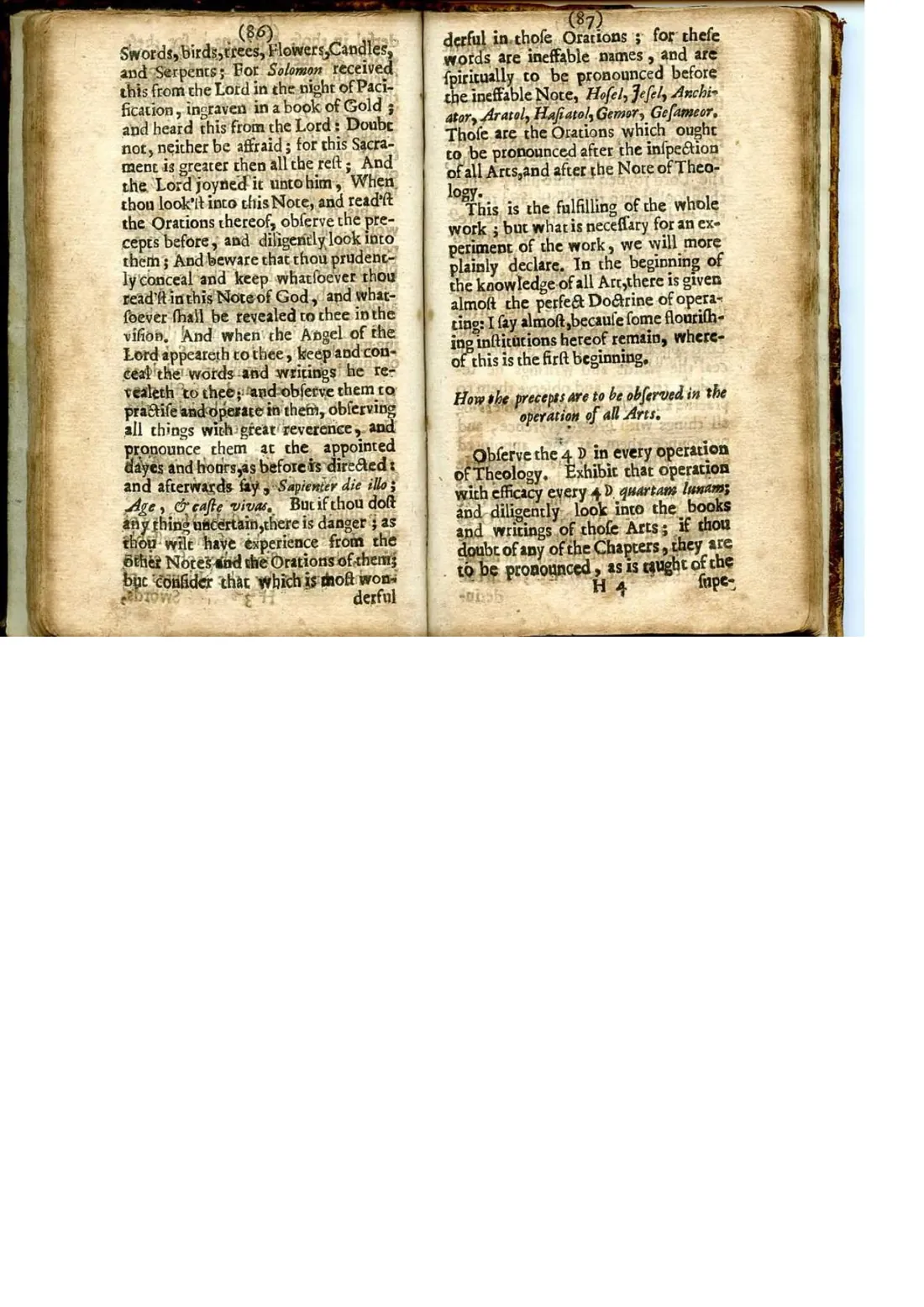
Because thou desirest the Mystery of the Notes , take this of the ineffable Note, the expression whereof is given in the Angels by the Figures of H 3 Swords,

Praecepta operationis#p095
Ars Notoria (classica) — imago facsimilaris (Praecepta operationis) · facsimile
Impressum — Turner 1657 · Codex illuminatus — Mellon MS 1 (Beinecke)
🔍 preme ut amplifices

TranscriptioEnglish (printed, 1657)

(86)

Swords, birds, trees, Flowers, Candles, and Serpents; For Solomon received this from the Lord in the night of Paci- fication, ingraven in a book of Gold; and heard this from the Lord : Doubt not, neither be afraid; for this Sacra- ment is greater then all the rest ; And the Lord joyned it unto him, When thou look'st into this Note, and readst the Orations thereof, observe the pre- cepts before, and diligently look into them ; And beware that thou prudent- ly conceal and keep whatsoever thou read'st in this Note of God, and what- soever shall be revealed to thee in the vision. And when the Angel of the Lord appeareth to thee, keep and con- ceal the words and writings he re- vealeth to thee; and observe them to practise and operate in them, observing all things with great reverence, and pronounce them at the appointed dayes and hours, as before is directed and afterwards say, Sapienter die illo; Age, & caste vivas. But if thou dost any thing uncertain, there is danger ; as thou wilt have experience from the other Notes and the Orations of them; but consider that which is most won-

derful

(87)

derful in those Orations ; for these words are ineffable names, and are spiritually to be pronounced before the ineffable Note, Hosel, Jesel, Anchi- ator, Aratol, Hasiatol, Gemor, Gesameor. Those are the Orations which ought to be pronounced after the inspection of all Arts, and after the Note of Theo- logy.

This is the fulfilling of the whole work ; but what is necessary for an ex- periment of the work, we will more plainly declare. In the beginning of the knowledge of all Art, there is given almost the perfect Doctrine of opera- ting: I say almost, because some flourish- ing institutions hereof remain, where- of this is the first beginning.

How the precepts are to be observed in the operation of all Arts.

Observe the 4 D in every operation of Theology. Exhibit that operation with efficacy every 4 D. quatuor lunares and diligently look into the books and writings of those Arts ; if thou doubt of any of the Chapters, they are to be pronounced, as is taught of the

H 4 supe-

Praecepta specialia#p097
Ars Notoria (classica) — imago facsimilaris (Praecepta specialia) · facsimile
Impressum — Turner 1657 · Codex illuminatus — Mellon MS 1 (Beinecke)
🔍 preme ut amplifices

TranscriptioEnglish (printed, 1657)

(88)

superiour Chapters: but know this, that these Holy Words of Orations, we appoint to be said before the bed of the sick, for an experiment of life or death. And this thou maist do often, if thou wilt operate nothing else in the whole body of Art. And know this, that if thou hast not the books in thy hands, or the faculty of looking into them is not given to thee; the effect of this work will not be the lesse there- fore: but the Orations are twice then to be pronounced, where they were to be but once: And as to the know- ledge of a vision, and the other virtues which these Holy Orations have; thou maist prove and try them, when and how thou wilt.

These precepts are specially to be ob- served.

But when thou wouldst operate in Theology, observe only those dayes which are appointed; but all times are convenient for those Notes and Ope- rations, for which there is a compe- tent time given; but in the pronuncia- tion of the three liberal Arts, or in the

in-

(89)

inspection of their Notes, perhaps thou maist pretermit some day ap- pointed, if thou observe the rest; or if thou transgress two dayes, leave not off the work, for it loseth not its effect for this, for the Moon is more to be observed in the greater numbers then the dayes or hours. For Solomon saith, if thou miss a day or two, fear not, but operate on the general Chapters. This is enough to say of them: but by no means forget any of the words which are to be said in the beginning of the reading to attain to Arts; for there is great virtue in them. And thou maist frequently use the Holy Words of the visions: but if thou wouldst ope- rate in the whole body of the Physical Art, the first Chapters are first to be re- peated as before are defined. And in Theology, thou must operate only by thy self: Often repeat the Orations, and look into the Notes of Theology: this produceth great effects. It is ne- cessary that thou have the Note of the 24 Angels alwayes in Memory; and faithfully keep those things, which the Angel reveals to thee in the vision.

The

Prooemia orationum#p099
Ars Notoria (classica) — imago facsimilaris (Prooemia orationum) · facsimile
Impressum — Turner 1657 · Codex illuminatus — Mellon MS 1 (Beinecke)
🔍 preme ut amplifices

TranscriptioEnglish (printed, 1657)

(90)

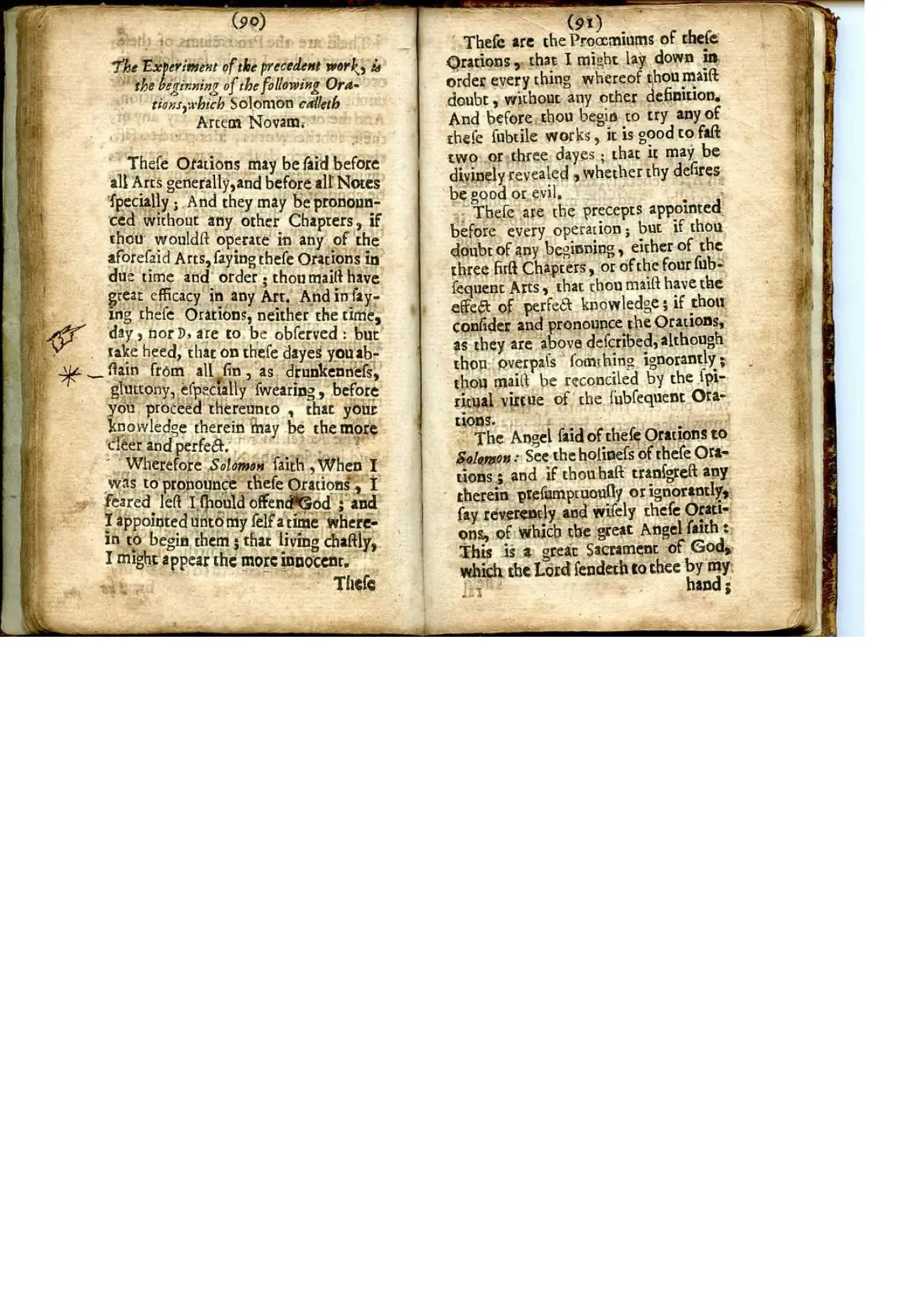
The Experiment of the precedent work, is the beginning of the following Ora- tions,which Solomon calleth Artem Novam.

These Orations may be said before all Arts generally,and before all Notes specially ; And they may be pronoun- ced without any other Chapters, if thou wouldst operate in any of the aforesaid Arts, saying these Orations in due time and order ; thou maist have great efficacy in any Art. And in say- ing these Orations, neither the time, day, nor D, are to be observed : but take heed, that on these dayes you ab- stain from all sin, as drunkenness, gluttony, especially swearing, before you proceed thereunto, that your knowledge therein may be the more cleer and perfect.

Wherefore Solomon saith, When I was to pronounce these Orations, I feared lest I should offend God ; and I appointed unto my self a time where- in to begin them ; that living chastly, I might appear the more innocent.

These

(91)

These are the Proœmiums of these Orations, that I might lay down in order every thing whereof thou maist doubt, without any other definition. And before thou begin to try any of these subtile works, it is good to fast two or three dayes ; that it may be divinely revealed, whether thy desires be good or evil.

These are the precepts appointed before every operation ; but if thou doubt of any beginning, either of the three first Chapters, or of the four sub- sequent Arts, that thou maist have the effect of perfect knowledge ; if thou consider and pronounce the Orations, as they are above described, although thou overpass somthing ignorantly ; thou maist be reconciled by the spi- ritual virtue of the subsequent Ora- tions.

The Angel said of these Orations to Solomon : See the holiness of these Ora- tions ; and if thou hast transgrest any therein presumptuously or ignorantly, say reverently and wisely these Orati- ons, of which the great Angel saith : This is a great Sacrament of God, which the Lord sendeth to thee by my hand;

Oratio prima#p101
Ars Notoria (classica) — imago facsimilaris (Oratio prima) · facsimile
Impressum — Turner 1657 · Codex illuminatus — Mellon MS 1 (Beinecke)
🔍 preme ut amplifices

TranscriptioEnglish (printed, 1657)

(92)

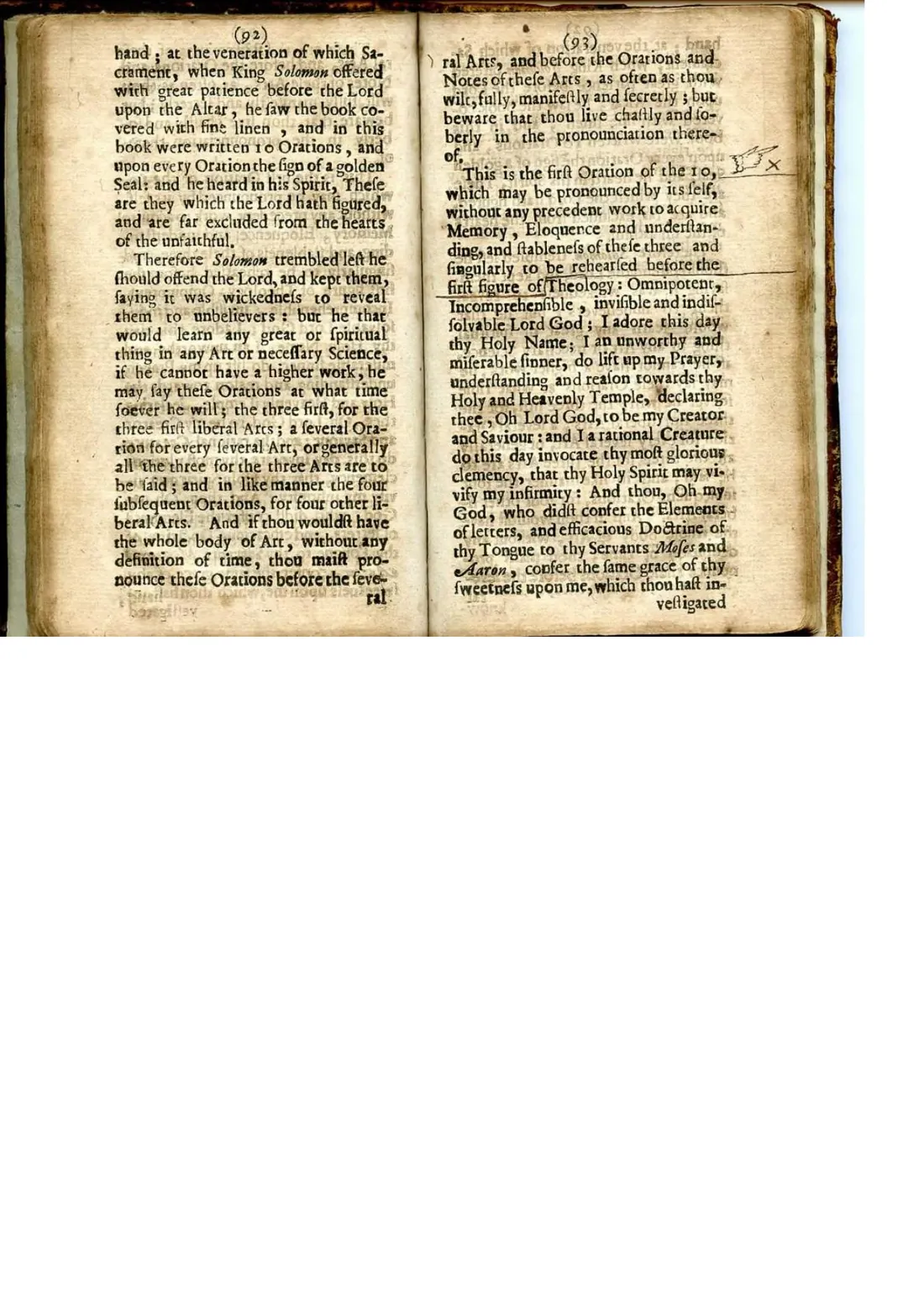
hand ; at the veneration of which Sa- crament, when King Solomon offered with great patience before the Lord upon the Altar, he saw the book co- vered with fine linen, and in this book were written 10 Orations, and upon every Oration the sign of a golden Seal: and he heard in his Spirit, These are they which the Lord hath figured, and are far excluded from the hearts of the unfaithful.

Therefore Solomon trembled lest he should offend the Lord, and kept them, saying it was wickedness to reveal them to unbelievers : but he that would learn any great or spiritual thing in any Art or necessary Science, if he cannot have a higher work, he may say these Orations at what time soever he will ; the three first, for the three first liberal Arts ; a several Ora- tion for every several Art, or generally all the three for the three Arts are to be said ; and in like manner the four subsequent Orations, for four other li- beral Arts. And if thou wouldst have the whole body of Art, without any definition of time, thou maist pro- nounce these Orations before the seve-

ral

(93)

ral Arts, and before the Orations and Notes of these Arts, as often as thou wilt, fully, manifestly and secretly ; but beware that thou live chastly and so- berly in the pronunciation there- of.

This is the first Oration of the 10, which may be pronounced by its self, without any precedent work to acquire Memory, Eloquence and understan- ding, and stableness of these three and singularly to be rehearsed before the first figure of Theology : Omnipotent, Incomprehensible, invisible and indis- solvable Lord God ; I adore this day thy Holy Name; I an unworthy and miserable sinner, do lift up my Prayer, understanding and reason towards thy Holy and Heavenly Temple, declaring thee, Oh Lord God, to be my Creator and Saviour : and I a rational Creature do this day invocate thy most glorious clemency, that thy Holy Spirit may vi- sity my infirmity : And thou, Oh my God, who didst confer the Elements of letters, and efficacious Doctrine of thy Tongue to thy Servants Moses and Aaron, confer the same grace of thy sweetness upon me, which thou hast in-

vestigated

Tertia oratio#p105
Ars Notoria (classica) — imago facsimilaris (Tertia oratio) · facsimile
Impressum — Turner 1657 · Codex illuminatus — Mellon MS 1 (Beinecke)
🔍 preme ut amplifices

TranscriptioEnglish (printed, 1657)

(96)

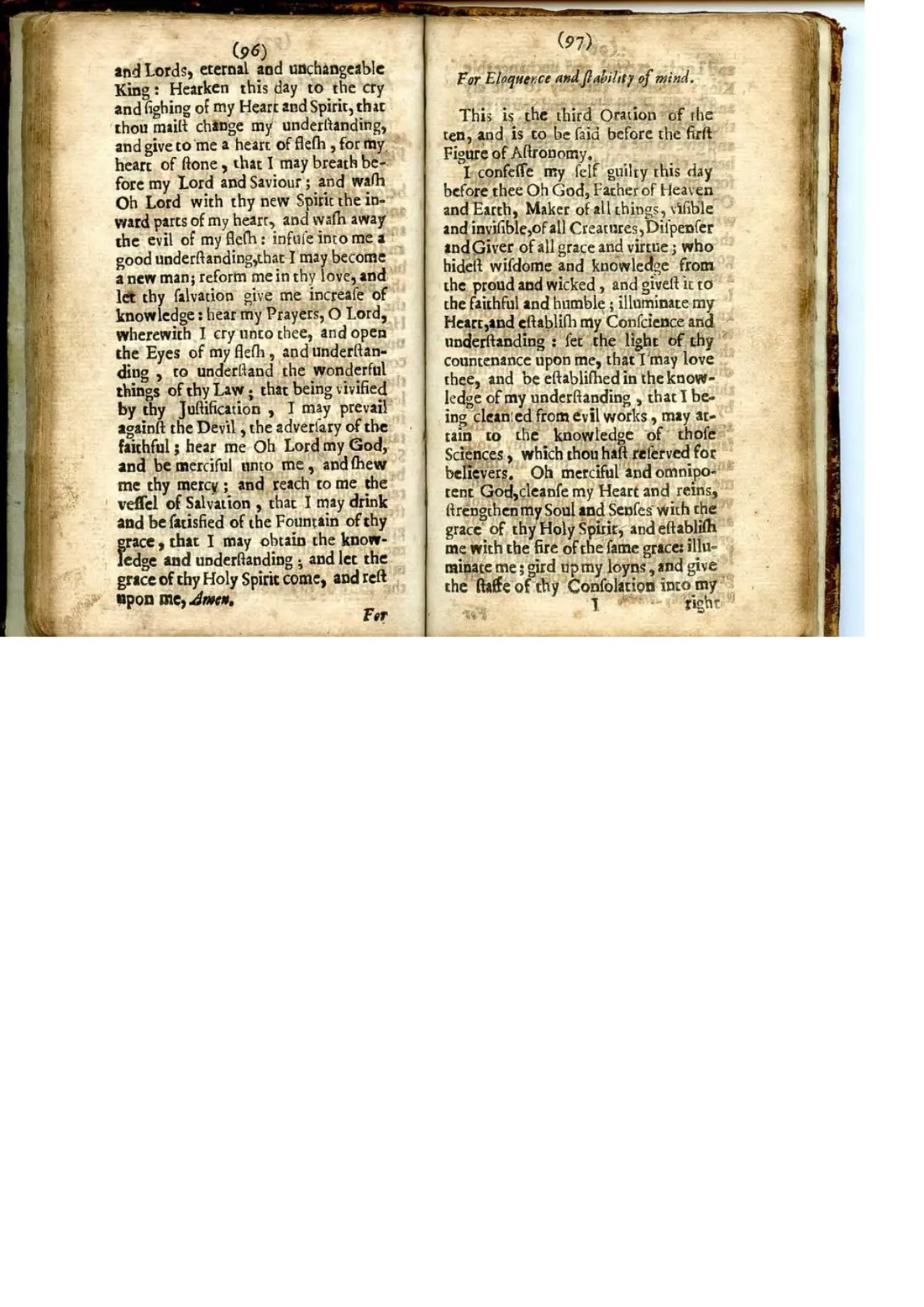
and Lords, eternal and unchangeable King : Hearken this day to the cry and sighing of my Heart and Spirit, that thou maist change my understanding, and give to me a heart of flesh, for my heart of stone, that I may breath be- fore my Lord and Saviour ; and wash Oh Lord with thy new Spirit the in- ward parts of my heart, and wash away the evil of my flesh : infuse into me a good understanding,that I may become a new man; reform me in thy love, and let thy salvation give me increase of knowledge : hear my Prayers, O Lord, wherewith I cry unto thee, and open the Eyes of my flesh, and understan- ding, to understand the wonderful things of thy Law ; that being vivified by thy Justification , I may prevail against the Devil, the adversary of the faithful ; hear me Oh Lord my God, and be merciful unto me, and shew me thy mercy ; and reach to me the vessel of Salvation, that I may drink and be satisfied of the Fountain of thy grace, that I may obtain the know- ledge and understanding ; and let the grace of thy Holy Spirit come, and rest upon me, Amen.

For

(97)

For Eloquence and stability of mind.

This is the third Oration of the ten, and is to be said before the first Figure of Astronomy. I confesse my self guilty this day before thee Oh God, Fatherof Heaven and Earth, Maker of all things, visible and invisible, of all Creatures, Dispenser and Giver of all grace and virtue ; who hidest wisdome and knowledge from the proud and wicked, and givest it to the faithful and humble ; illuminate my Heart,and establish my Conscience and understanding : let the light of thy countenance upon me, that I may love thee, and be established in the know- ledge of my understanding, that I be- ing clean'ed from evil works, may at- tain to the knowledge of those Sciences, which thou hast reserved for believers. Oh merciful and omnipo- tent God,cleanse my Heart and reins, strengthen my Soul and Senses with the grace of thy Holy Spirit, and establish me with the fire of the same grace: illu- minate me ; gird up my loyns, and give the staffe of thy Consolation into my

sight

Sapientia intellectualis#p113
Ars Notoria (classica) — imago facsimilaris (Sapientia intellectualis) · facsimile
Impressum — Turner 1657 · Codex illuminatus — Mellon MS 1 (Beinecke)
🔍 preme ut amplifices

TranscriptioEnglish (printed, 1657)

(104)

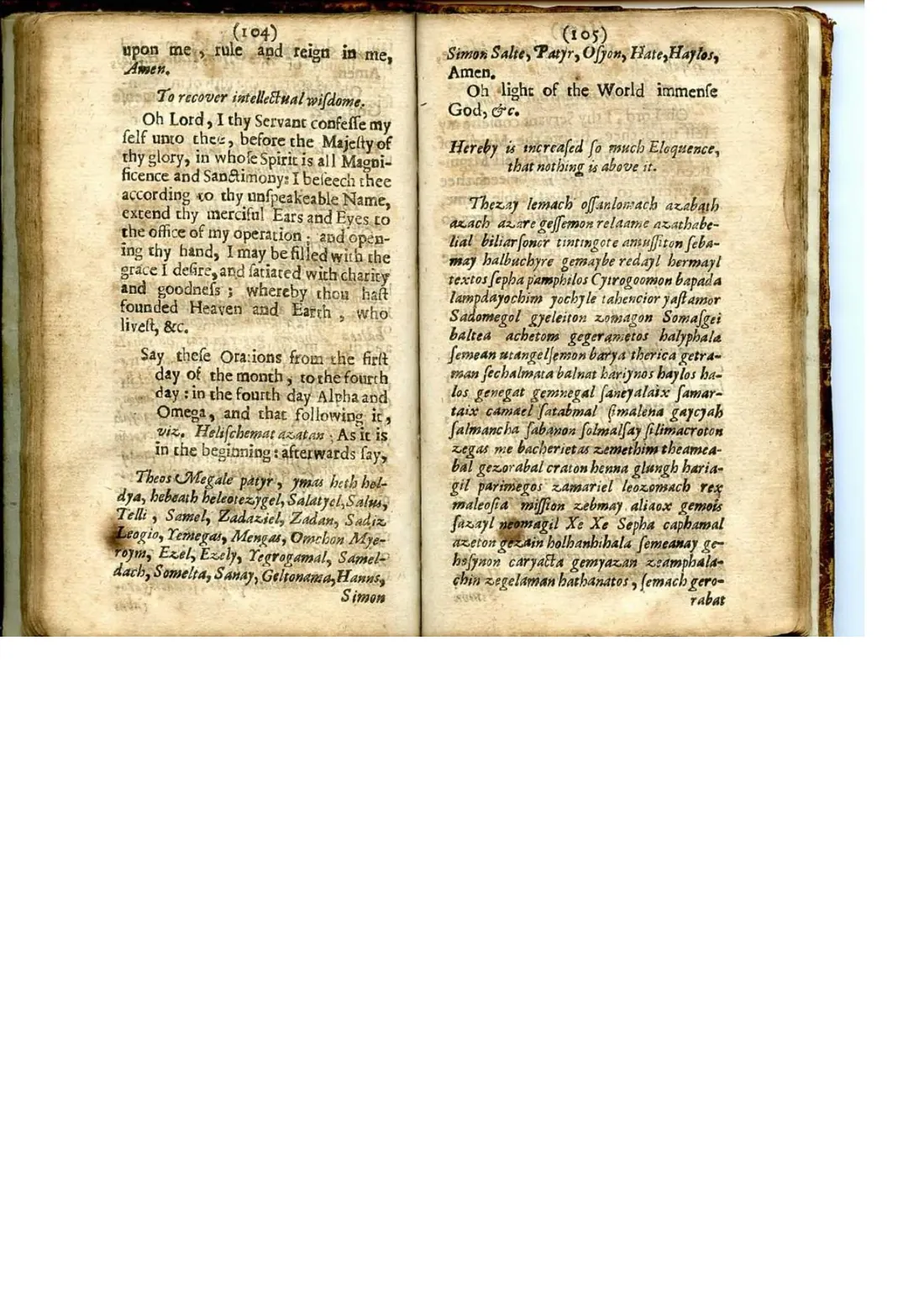
upon me , rule and reign in me, Amen.

To recover intellectual wisdom.

Oh Lord, I thy Servant confesse my self unto thee, before the Majesty of thy glory, in whose Spirit is all Magni- ficence and Sanctimony: I beseech thee according to thy unspeakable Name, extend thy merciful Ears and Eyes to the office of my operation ; and open- ing thy hand, I may be filled with the grace I desire, and satiated with charity and goodness ; whereby thou hast founded Heaven and Earth , who livest, &c.

Say these Orations from the first day of the month , to the fourth day : in the fourth day Alpha and Omega, and that following it, viz. Helischemat azatan ; As it is in the beginning : afterwards say,

Theos Megale patyr, ymas heth bel- dya, hebbath heloetezygel, Salatyel, Salus, Telli , Samel, Zadaziel, Zadan, Sadiz Leogio, Yernegas, Mengas, Omchon Mye- roym, Ezel, Ezely, Yegrogamal, Samel- dach, Somelta, Sanay, Geltonama, Harnes, Simon

(105)

Simon Salte, Payr, Ofson, Hate, Hastos, Amen. Oh light of the World immense God, &c.

Hereby is increased so much Eloquence, that nothing is above it.

Thezy lemach ossanlomach azabath azach azare gessemon relaame azathabe- lial biliarsonor tintingote amussiton seha- may halbuchyre gemaybe redayl bermayl textos sepha pamphilos Cytrogoomon bapada lampdayochim yochyle tahencior yaftamor Sadomegol gyeleiton zomagon Somasgei baltea achetom gegerametos halyphala semean utangelsemon barya therica getra- man sechalmata balnat hariynos haylos ha- los genegat gemnegal saneyalaix samar- taix camael satabmal simalena gaycyah salmancha sabanon solmassay slimacroton zegas me bacherietas zemethim theamca- bal gezorabal craton henna glungh haria- gil parimegos zamariel leoxomsach rex maleossa mission zebmay aliaox gemois sazayl neomagil Xe Xe Sepha caphamal azeton gezain holhanbihala semeanay ge- hosfmon caryacta gemyazan zeamphala- chin zegelaman hathamatos, semach gero- rabat

Benedictio loci#p119
Ars Notoria (classica) — imago facsimilaris (Benedictio loci) · facsimile
Impressum — Turner 1657 · Codex illuminatus — Mellon MS 1 (Beinecke)
🔍 preme ut amplifices

TranscriptioEnglish (printed, 1657)

(110)

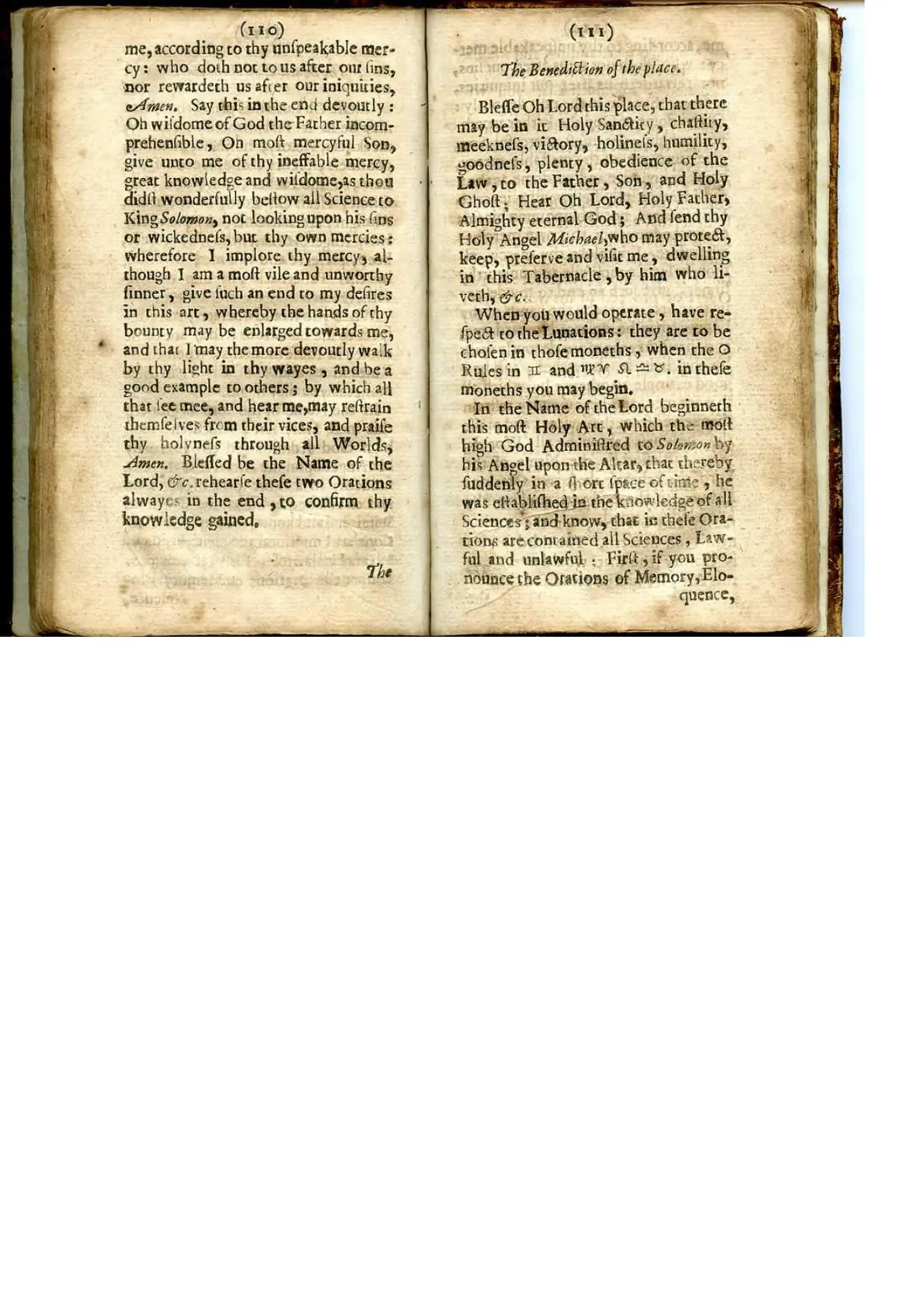
me, according to thy unspeakable mer- cy: who doth not to us after our sins, nor rewardeth us after our iniquities, Amen. Say this in the end devoutly : Oh wisdome of God the Father incom- prehensible, Oh most mercyful Son, give unto me of thy ineffable mercy, great knowledge and wisdome,as thou didst wonderfully bestow all Science to King Solomon, not looking upon his sins or wickedness, but thy own mercies : wherefore I implore thy mercy, al- though I am a most vile and unworthy sinner, give such an end to my desires in this art, whereby the hands of thy bounty may be enlarged towards me, and that I may the more devoutly walk by thy light in thy wayes, and be a good example to others ; by which all that see me, and hear me,may restrain themselves from their vices, and praise thy holyness through all Worlds, Amen. Blessed be the Name of the Lord, &c. rehearse these two Orations alwayes in the end, to confirm thy knowledge gained.

The

(111)

The Benediction of the place.

Blesse Oh Lord this place, that there may be in it Holy Sanctity, chastity, meekness, victory, holiness, humility, goodness, plenty, obedience of the Law, to the Father, Son, and Holy Ghost. Hear Oh Lord, Holy Father, Almighty eternal God : And send thy Holy Angel Michael,who may protect, keep, preserve and visit me, dwelling in this Tabernacle, by him who li- veth, &c.

When you would operate, have re- spect to the Lunations: they are to be chosen in those moneths, when the ☉ Rules in ♊ and ♍ ♈ ♌ ♎ ♉. in these moneths you may begin.

In the Name of the Lord beginneth this most Holy Art, which the most high God Administred to Solomon by his Angel upon the Altar, that thereby suddenly in a short space of time, he was established in the knowledge of all Sciences; and know, that in these Ora- tions are contained all Sciences, Law- ful and unlawful : First, if you pro- nounce the Orations of Memory, Elo- quence,

Tres species Artis#p121
Ars Notoria (classica) — imago facsimilaris (Tres species Artis) · facsimile
Impressum — Turner 1657 · Codex illuminatus — Mellon MS 1 (Beinecke)
🔍 preme ut amplifices

TranscriptioEnglish (printed, 1657)

(112)

quence and understanding, and the sta- bility thereof ; they will be mightily increased , insomuch that you will hardly keep silence ; for by a word all things were Created,and by the virtue of that word all created beings stands, and every Sacrament,and that Word is God. Therefore let the Operator be constant in his faith, and confidently believe,that he shall obtain such know- ledge and wisdome , in the pronoun- cing these Orations , for with God no- thing is impossible ; therefore let the Operator proceed in his work , with faith,hope,and a constant desire : firm- ly believing ; because we can obtain nothing but by faith ; Therefore have no doubt in this Operation , whereof there are three species , whereby the Art may be obtained.

The first species is Oration , and rea- son of a Godly mind,not by attempting a voyce of deprecation, but by rea- ding and repeating the same in the in- ward parts. The second species is fasting and praying , for the praying man God heareth. The third species is chastity ; he that would operate in this Art , let him be clean and chast by the

(113)

the space of nine dayes at least ; And before you begin , it is necessary that you know the time of the D. for in the prime of the D. it is proper to operate in this Art : and when you begin so sa- cred an Art , have a care to abstain from all mortal sins, at least while you are proceeding in this work until it be finished and compleated : and when you begin to operate, say this verse kneeling : Lift up the light of thy Countenance upon me , Oh Lord my God , and forsake not me thy servant N. that trusts in thee : then say three times Pater Noster,&c. And assert that thou will never commit wilfull perju- ry, but alwayes persevere in faith and hope. This being done,with bended knees in the place wherein thou wilt operate, say , Our help is in the Name of the Lord , who hath made Heaven and Earth : And I will enter into the Invocation of the most high, unto him who enlightneth and purifieth my Soul and Conscience, which dwelleth under the help of the most high , and con- tinueth under the protection of the God of Heaven : O Lord open and unfold the doubts of my Heart , and change

Oratio quattuor linguarum#p123
Ars Notoria (classica) — imago facsimilaris (Oratio quattuor linguarum) · facsimile
Impressum — Turner 1657 · Codex illuminatus — Mellon MS 1 (Beinecke)
🔍 preme ut amplifices

TranscriptioEnglish (printed, 1657)

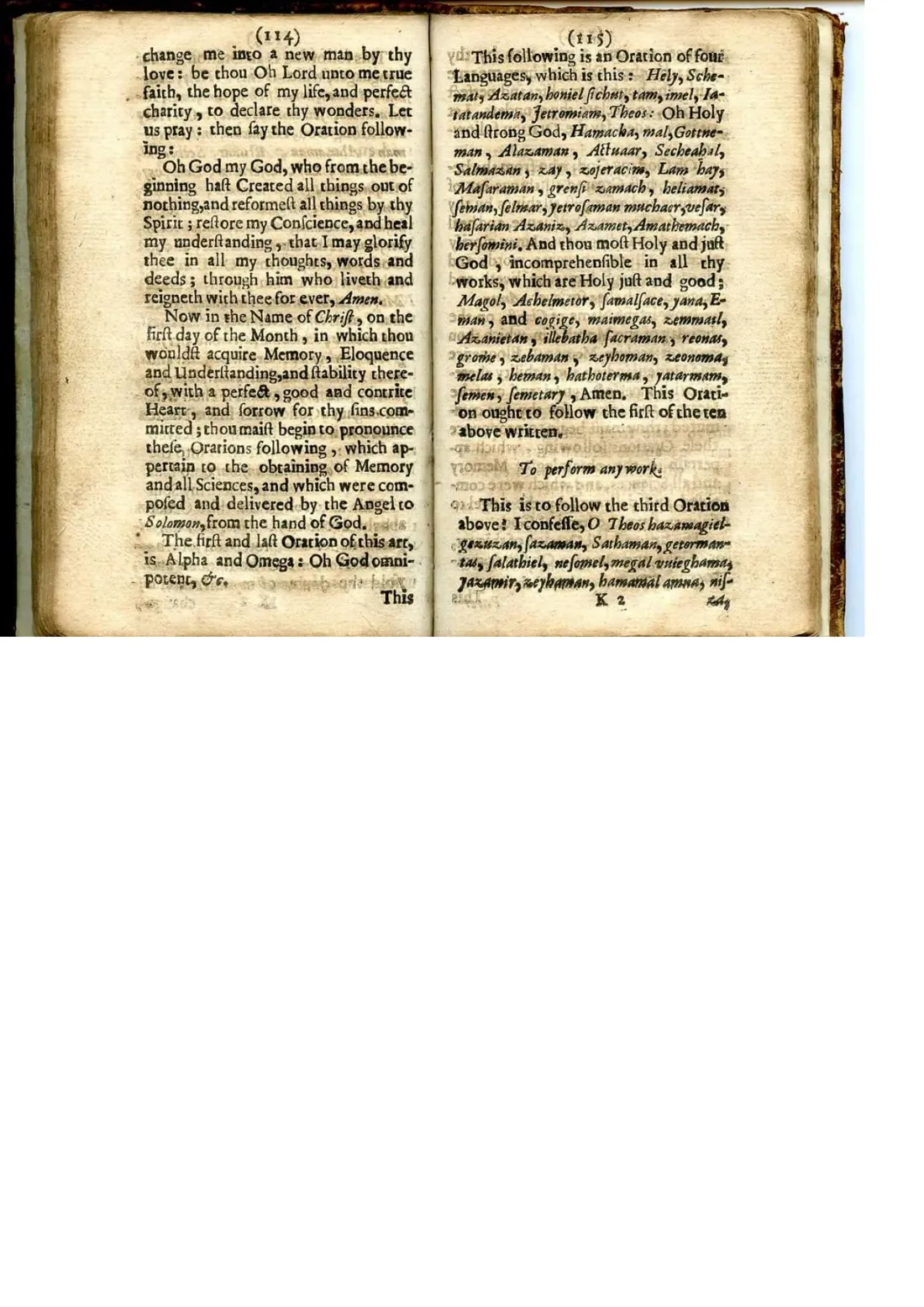
(114)

change me into a new man by thy love : be thou Oh Lord unto me true faith, the hope of my life, and perfect charity , to declare thy wonders. Let us pray : then say the Oration follow- ing :

Oh God my God, who from the be- ginning hast Created all things out of nothing,and reformest all things by thy Spirit ; restore my Conscience,and heal my understanding , that I may glorify thee in all my thoughts, words and deeds ; through him who liveth and reigneth with thee for ever, Amen.

Now in the Name of Christ, on the first day of the Month , in which thou wouldst acquire Memory , Eloquence and Understanding,and stability there- of, with a perfect , good and contrite Heart , and sorrow for thy sins com- mitted ; thou maist begin to pronounce these Orations following , which ap- pertain to the obtaining of Memory and all Sciences,and which were com- posed and delivered by the Angel to Solomon,from the hand of God.

The first and last Oration of this art, is Alpha and Omega : Oh God omni- potent, &c.

This

(115)

This following is an Oration of four Languages, which is this : Hely, Sche- mat, Azatan,honiel sichut, tam,imel, Ia- tatandema, Jetromiam, Theos: Oh Holy and strong God, Hamacha, mal, Gottne- man , Alazaman , Actuaar, Secheahal, Salmazan , zay , zojeracim, Lam hay, Masaraman , grensi zamach, heliamat, seman, selmar, yetrosaman muchaer,vesar, hasarian Azaniz, Azamet,Amathemach, hersomini. And thou most Holy and just God , incomprehensible in all thy works, which are Holy just and good ; Magol, Achelmetor, samalsace, yana, E- man , y cogige, maimegas, zemmael, Azanietan , illebatha sacraman , reonas, grome , zebaman , zeyhoman, zeonomas melas , heman , hathoterma , yatarmam, semen, semetary , Amen. This Orati- on ought to follow the first of the ten above written.

To perform any work.

This is to follow the third Oration above: I confesse, O Theos hazamagiel- gezuzan, sazaman, Sathaman, getorman- tas, salathiel, nesomel, megal vuieghama, yazamir, zeyhaman, hamamal amna, nis-

K 2

za,

Tempus et locus#p125
Ars Notoria (classica) — imago facsimilaris (Tempus et locus) · facsimile
Impressum — Turner 1657 · Codex illuminatus — Mellon MS 1 (Beinecke)
🔍 preme ut amplifices

TranscriptioEnglish (printed, 1657)

(116)

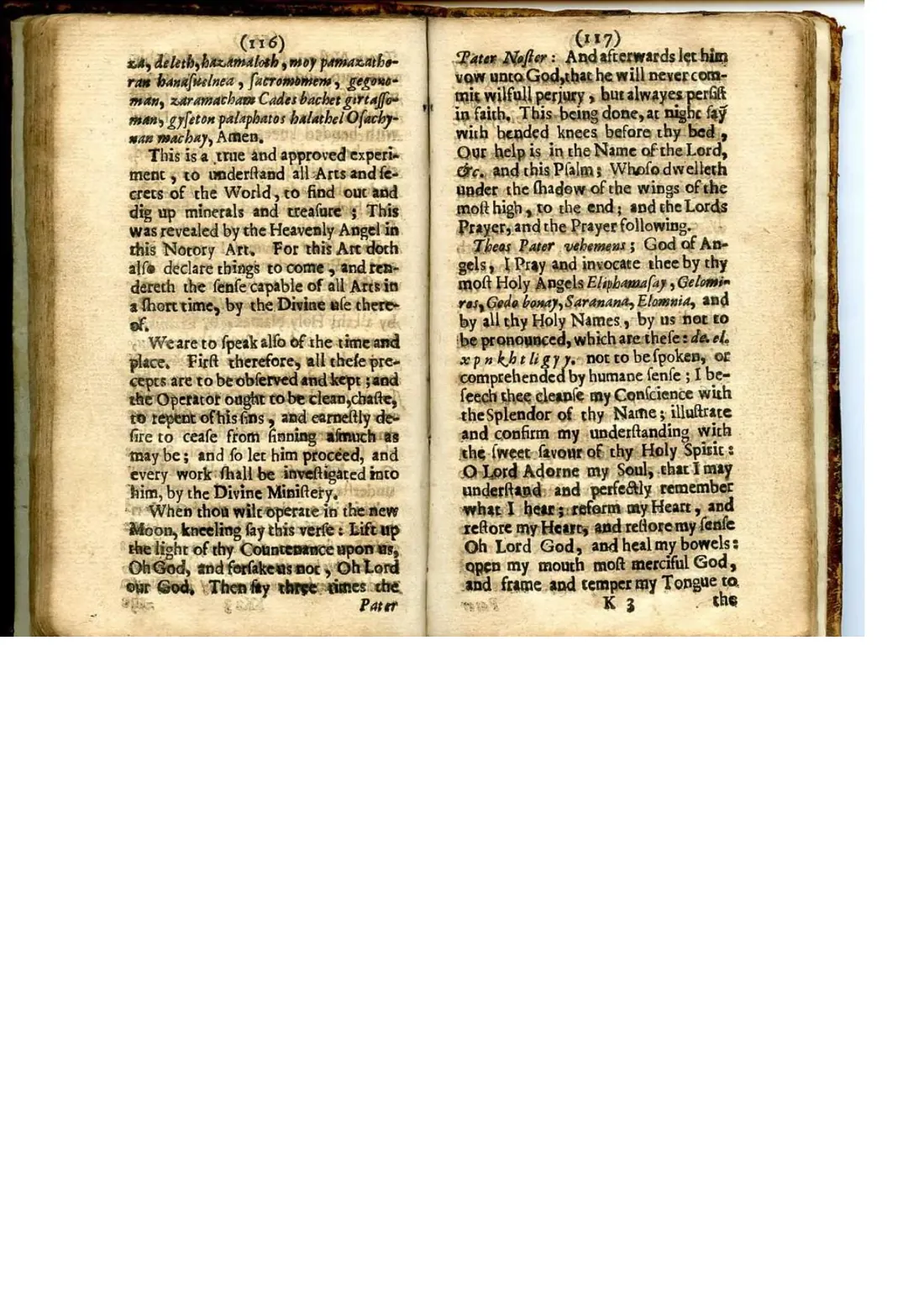
za, deleth,hazamaloth, moy pamazalbo- ran hanafuelnea, sacromomem, gegoxo- man, zaramacham Cades bachet girasso- man, gyseton palaphatos halathel Osachy- nan machay, Amen.

This is a true and approved experi- ment , to understand all Arts and se- crets of the World, to find out and dig up minerals and treasure ; This was revealed by the Heavenly Angel in this Notory Art. For this Art doth also declare things to come , and ren- dereth the sense capable of all Arts in a short time, by the Divine use there- of.

We are to speak also of the time and place. First therefore, all these pre- cepts are to be observed and kept ; and the Operator ought to be clean,chaste, to repent of his sins , and earnestly de- sire to cease from sinning asmuch as may be ; and so let him proceed, and every work shall be investigated into him, by the Divine Ministery.

When thou wilt operate in the new Moon, kneeling say this verse : Lift up the light of thy Countenance upon us, Oh God, and forsake us not , Oh Lord our God. Then say three times the

Pater

(117)

Pater Noster : And afterwards let him vow unto God,that he will never com- mit wilfull perjury , but alwayes persist in faith. This being done,at night say with bended knees before thy bed , Our help is in the Name of the Lord, &c. and this Psalm; Whoso dwelleth under the shadow of the wings of the most high , to the end ; and the Lords Prayer,and the Prayer following.

Theos Pater vehement ; God of An- gels, I Pray and invocate thee by thy most Holy Angels Eliphamasay, Gelomi- ras, Gedo bonay, Saranana, Elomnia, and by all thy Holy Names, by us not to be pronounced, which are these: de. el. x p n k h t l g y. not to be spoken, or comprehended by humane sense ; I be- seech thee cleanse my Conscience with the Splendor of thy Name ; illustrate and confirm my understanding with the sweet savour of thy Holy Spirit : O Lord Adorne my Soul, that I may understand and perfectly remember what I hear ; reform my Heart, and restore my Heart, and restore my sense Oh Lord God, and heal my bowels: open my mouth most merciful God, and frame and temper my Tongue to

K 3 the

Grimorium · grimorium.lat · CC BY 4.0 · Scheda