Liber Officiorum Spirituum

Liber Officiorum Spirituum

Folger Shakespeare Library, MS V.b.26, pp.73–84
PDF demere ↓
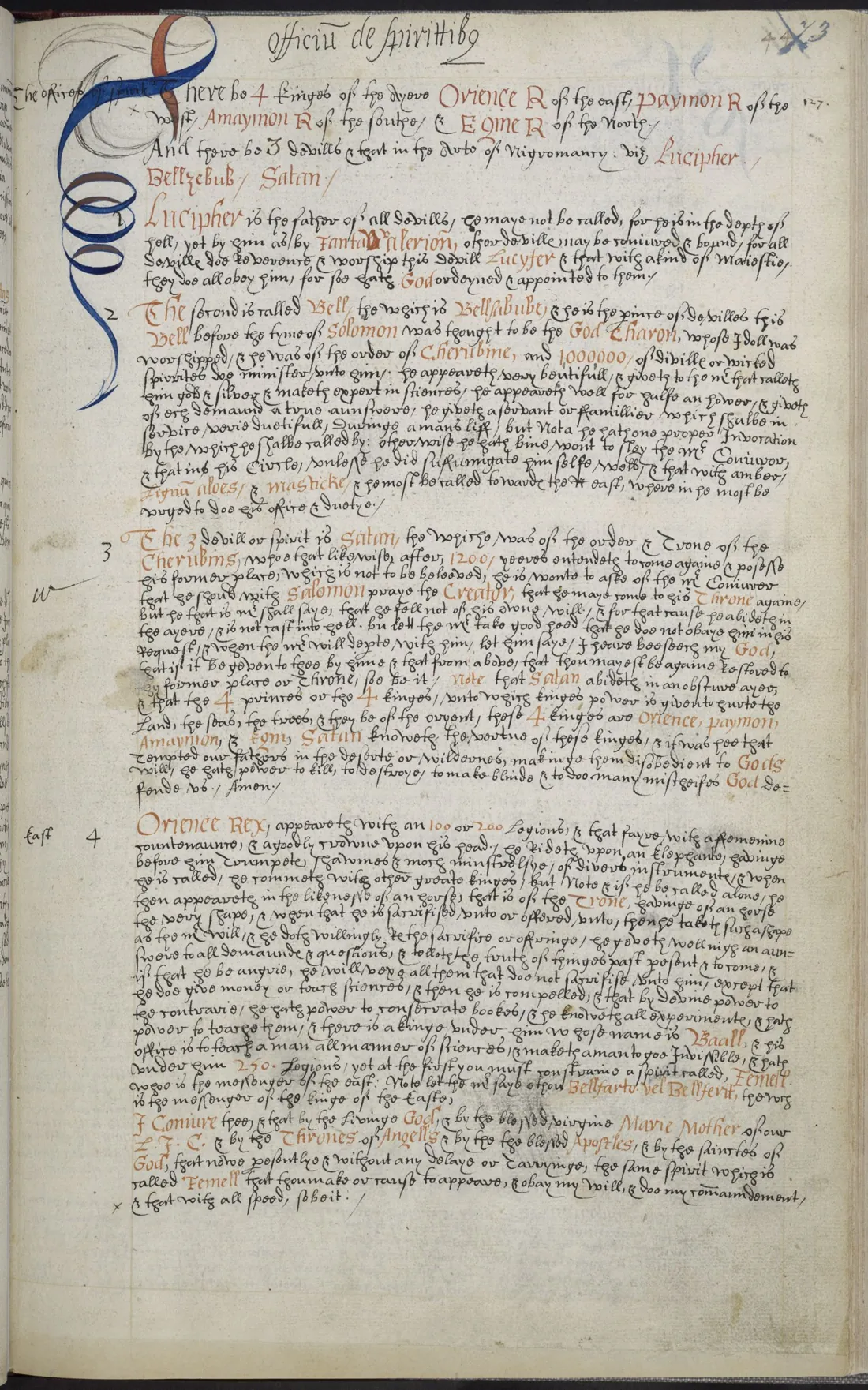
p. 73#page73
Liber Officiorum Spirituum — imago facsimilaris (p. 73) · facsimile
Folger Shakespeare Library, MS V.b.26, pp.73–84
🔍 preme ut amplifices

TranscriptioElizabethan English

[titulus, Latine:] Officiu[m] de spirittib[us].

There be 4 kynges of the dyvels: Orience R[ex] of the east, Paymon R[ex] of the west, Amaymon R[ex] of the southe, Egine R[ex] of the North. And there be 3 devills that [are] in the arte of Nigromancy: viz Lucipher, Bellzebub, Satan.

1. Lucipher is the father of all devills; he maye not be called, for he is in the depth of hell; yet by him also, by fantasticall illusion, other devils may be coniured[conjured] & bound, for all the spirits doe reverence & worship this devill Lucyfer, & that with a kind of Majestie; they doe all obey him, for [that?] God ordeyned & appointed [them] to him.

2. The second is called Bell, the which is Bellzabub, & is the prince of devilles. This Bell, before the tyme of Solomon, was thought to be the God Charon, whose Idoll was worshipped; & he was of the order of Cherubime, and 1000000 [a million] of divils or wicked spirites doe minister [to] him. & he appeareth very beutifull, & giveth to him that calleth him gold & silver, & maketh [one] appert[expert] in sciences, & he appeareth well for gulfe an[d] power[?], & giveth… a true aunswere; he giveth a servant or familier while he liveth. But Nota: he giveth no proper Invocation… [tell?] the [conjuror?] that in his Circle, unlesse he did suffumigate him selfe… with amber, ligni aloes[áloe], & mastick; & he most be called toward the East, where he most be prayd to doo his office & dutye.

3. The 3[rd] devill or spirit is Satan, the which was of the order & Trone of the Cherubims, whose[?] that likewise, after 1200 yeeres, entendeth to come againe… he speak with Solomon [&] pray the Creator that he maye come to his Conjuror; but he that is [in] his fall sayes that he fell not of his owne will… it is not cast into hell. But tell them[?] he take good heed that he doo not obays[obey] him in his request… Note that Satan abideth in an obscure ayer, & that the 4 princes or the 4 kinges — unto which kinges power is given to rule the land, the sea, the trees — & they be of the oryent; those 4 kinges are Orience, Paymon, Amaymon & Egin. Satan knowes the vertue[?] of these kinges; & it was he that tempted our fathers in the deserte or wildernes, [& made?] them disobedient to Gods will; he hath power to kill, to destroye, to make blinde, & to doo many mistgeifes[ mischiefs]. God defende us. Amen.

4. Orience Rex appeareth with an 100 or 200 legions, & that fayre, with a feminine countenaunce, & a goodly crowne upon his head; & rideth upon an Elephante; [before?] him [go?] trumpets… & more minstrelsye of divers instruments. & when [th]en appeareth in the likenes of an [ho]rse, that is of the Trone[?]… & when that so is[?] sacrifised unto, thence take [th]e sacrafice; he doeth willingly, & he[?] answere or offrings; & he doeth well nigh an aunswere[?] of all demaundes & questions, & telleth the truth of thinges past [&] present, & to come; & he doe[th] give money or [treasure?], & then… & that by devine power to consecrate bookes; & he knowe[th] all experimentes; & his office is to teach a man all manner of sciences, & maketh a man to goe Invisible; & he hath under him 250 legions. Yet at the first you must constraine a spirit called Fennell, [who] is the messenger of the east. Note that the which sayes… Bellsarto vel Bellserit, the which is the messenger of the kinge of the East.

[conjuración:] I conjure thee, & that by the kynge God, & by the blessed virgine Marie Mother of our God J[esus] C[hrist], & by the Thrones of Angells, & by the blessed Apostles, & by the spirites of God, that now presently & without any delays or taryinge, the same spirit which is called Fennell, that thou make or cause to appeare, & obay my will, & doo my commaundement, & that with all speed. So be it.
p. 74#page74
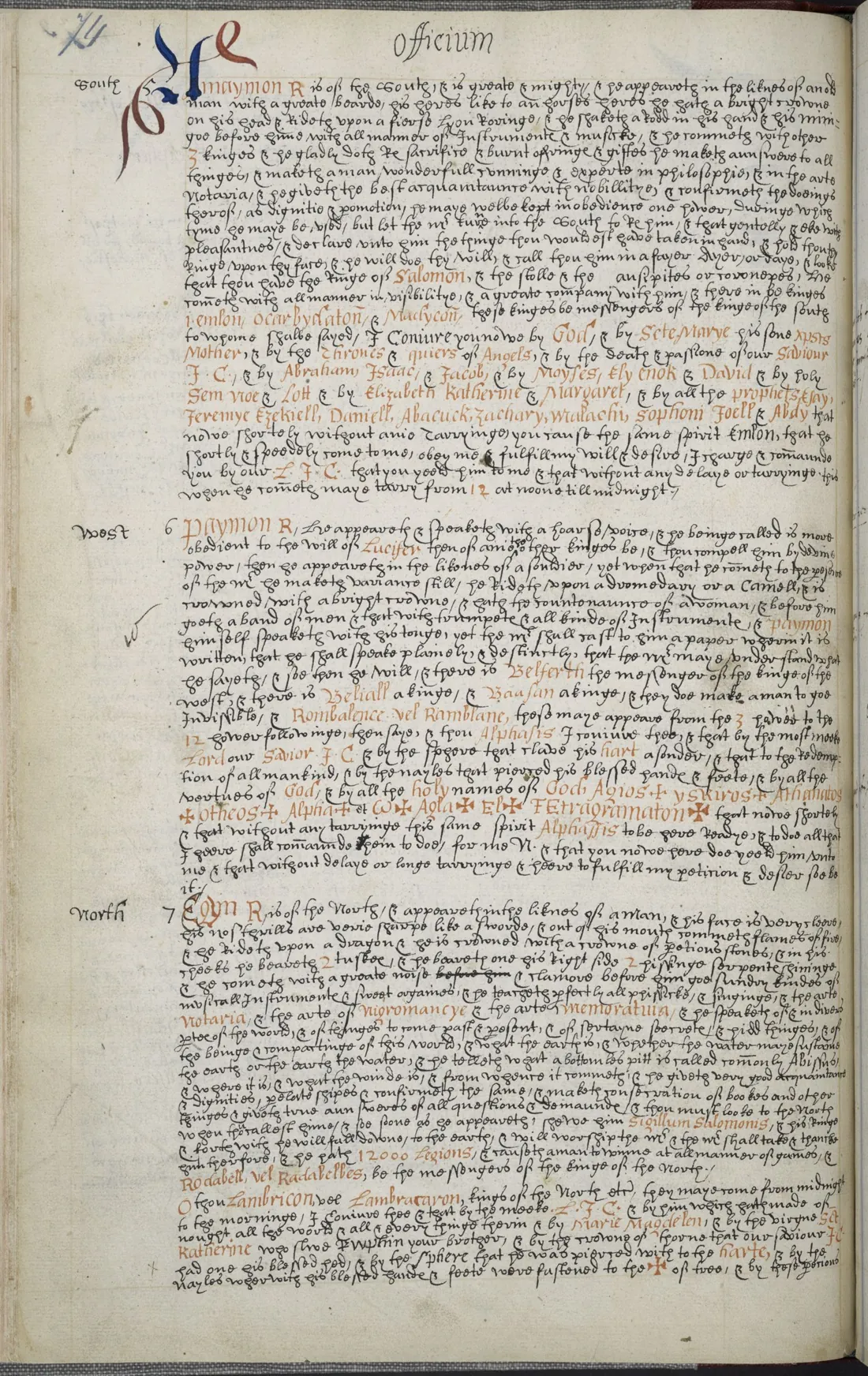
Liber Officiorum Spirituum — imago facsimilaris (p. 74) · facsimile
Folger Shakespeare Library, MS V.b.26, pp.73–84
🔍 preme ut amplifices

TranscriptioElizabethan English

[titulus:] officium.

5. Amaymon R[ex] [south] is of the south, & is greate & mighty. He appeareth in the liknes of an old man with a greate bearde, his colour like an [ho]rse[?]; & rideth upon a fierce lyon roring, & he holdeth a todd[toad] in his hand. His m[essenger]… he commeth with all manner of Instrumentes, musick. 3 kinges he gladly does sacrifice & burnt offrings, & he maketh a man wonderfull cunning & experte in philosophie, [expert] in the arte Notaria; he giveth the best acquaintaunce with nobilitie; & consumeth the doings… as dignitie & promotion he maye… but let them not turne into the south to [call] him, [except] that gentelly & [with] pleasantnes… & call thou him in a fayre dry [day] or days… he [will] tell thee the kinges of Solomon… & he come with all manner in visibility, & a greate company with him. & there is the kinges of the south [messengers]: Iemlon, Ocarbydaton, Madycon. To whom is also sayed: I Conjure you now by God, & by Ste Marye his sonn X[Christ]'s Mother, & by the Thrones & quiers of Angels, & by the deathe & passion of our Saviour J[esus] C[hrist], & by Abraham, Isaac & Jacob, & by Moyses, Ely[Elias], Enok & David, & by holy Sem, Noe[Noah], Lott, & by Elizabeth, Katherine & Margaret, & by all the prophets, [Isaiah?], Jeremye, Ezekiell, Daniell, Abacuck[Habacuc], Zachary, Malachi, Sophonye[Sofonías], [& Abdy?], that now shortly, without any taryinge, you cause the same spirit Iemlon, that he shortly & spedely come to me, obey me, & fulfill my will… I charge & commaund you by our L[ord] J.C. that you [bring] him to me — & that without any delay or taryinge, this upon he come, maye tary from 12 at noon till midnight.

6. Paymon R[ex] [west]. He appeareth & speaketh with a hars[hoarse] voice, & he beinge called is more obedient to the will of Lucifer then any other kinges be. [You must] then compell him by some power. Then he appeareth in the likenes of a soudier[soldado]; yet when that he cometh to the presence of the m[aster], he maketh variance still. He rideth upon a dromedary or a Camell, & is crowned with a bright crowne, & hath the countenaunce of a woman; & before him goeth a band of men with trumpetts, all kinds of Instrumentes. Paymon him self speaketh with his tonge; yet the m[aster] shall reache to him a paper to [write] in, [so] that he shall speake plainly & do shortly, that the m[aster] maye understand what he sayeth. Yet then he will[?]… There is Belferth, the messenger of the kinge of the west; & there is Beliall a kinge, & Baasan a kinge; & they doe make a man to goe Invisible; & Rombalence vel Ramblane, those maye appeare. From the 3 [lords]… 12 [that] follow me… then sayes: thou Alphasis, I conjure thee, & that by our Savior J.C., & by the speare that clave his hart asonder, & by the redemption of all mankind, & by the nayles that pierced his blessed hande & feete, & by all the vertues of God, & by all the holy names of God: Agios · Yskiros · Athanatos · Otheos · Alpha et ω · Agla · Ely · Tetragrammaton, that now shortly & without any tarynge the same spirit Alphasis to appeare… & that you now cause [him to] doo… without delay or long taryinge, & [th]ere to fulfill my petition. & desire so be it.

7. Egin R[ex] [north] is of the North, & appeareth in the liknes of a man, & his nostrells are very sharpe like a swords, & out of his mouth commeth flames of fire. He rideth upon a Dragon, & is crowned with a crowne of pretious stones. In his right hand he beareth 2 tuskes, & he beareth on his right side 2 hissinge serpentes shininge; & he commeth with a greate noise before him, [with] flames [of fire?], & sundry kinds of minstralcy & Instrumentes & sweet organes. & he teacheth [per]fectly all pictures & singinge, & the arte Notaria, & the arte of Nigromancye, & the arte Memoratiua[memoria]; & he speaketh of thinges past & present, of certayne secrets & privie thinges… [of how] the earth is [held up?]… & he hath 12000 legions, & he transportes a man to winne at all manner of games. & Rodabell vel Radalvelles be the messengers of the kinge of the North. O thou Zambricon vel Zambraravon, kinge of the North etc. [conjuración:] I conjure thee, & that by the [most?]… J.C., & by him were [made] of nought, & by all the wordes… & holy thinges herein, & by Marie Magdelen, & by the virgine Ste Katherine… [I conjure] thee, [thou] Zambricon, in your brother['s name], & by the [rood?]… & by his blessed [rood], & by the [nayles?]…

p. 75#page75
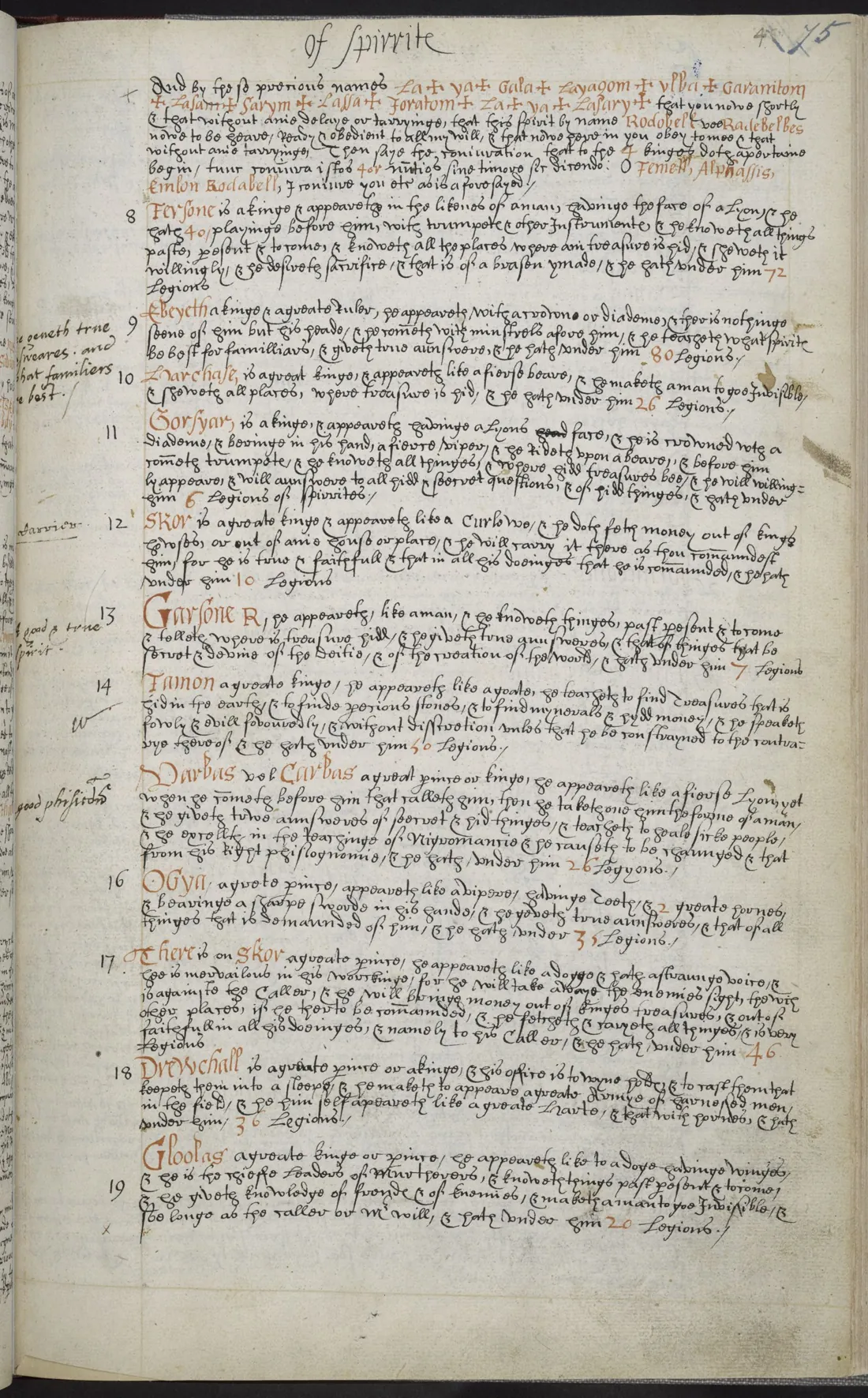
Liber Officiorum Spirituum — imago facsimilaris (p. 75) · facsimile
Folger Shakespeare Library, MS V.b.26, pp.73–84
🔍 preme ut amplifices

TranscriptioElizabethan English

(finis conjurationis Egin/Septentrionis, cum nominibus divinis:) …Za, Yat, Gala, Zayagom, Ylba, Garamiton, Zasam, Sarym, Lassa, Foratum, Za, va, Zafary — that you now shortly, & that without any delays or taryinges, that this spirit by name Rodobell vel Radebelbes [be] now ready & obedient to my will… Then sayes the conjuration [common] to the 4 kinges' [ministers]: O Feniell, Alphassis, Emlon, Rodabell, I conjure you…

8. Persone is a kinge, & appeareth in the liknes of a man, & havinge the face of a Lyon, & he [hath] 40 playinge before him with trumpetts & other Instrumentes, & he knoweth all thinges past, present & to come, & endeweth[shows] all the places where any treasure is hid, & he doeth it willingly, & he desireth sacrifice, & that is of a brazen ymade[image]; & he hath under him 72 legions.

9. Eleyctha[?] a kinge & a greate ruler; he appeareth with a crowne or diademe, & there is nothinge sene of him but his heade; he commeth with minstrels afore him, & he teacheth[?] greate [things], [gives] the best for familiars, & giveth true aunswere; & he hath under him 80 legions.

10. Marchale is a greate kinge, & appeareth like a fierce beare, & maketh a man to goe Invisible, & sheweth all places where any treasure is hid; & he hath under him 26 legions.

11. Gorsyar is a kinge, & appeareth havinge a Lyons face [with] a diademe, & havinge in his hand a fierce viper, & he is crowned; [with] a remote[?] trumpett; & he knoweth all thinges, & rideth upon a beave[bear?]; & before him he appeareth, & will aunswere to all hidd & secret questions, & of treasures… he will willingly [tell]; & [hath under] him 6 legions of spirrites.

12. Skor is a greate kinge, & appeareth like a Curlewe[cigüeña?], & he doeth fetch money out of kinges houses, or out of any house or place, & he will carry it there as he is commaunded, for he is true & faithfull, & that in all his doeings that he is commaunded; & he hath under him 10 legions.

13. Garsone R[ex] he appeareth like a man, & he knoweth thinges past, present & to come, & telleth where is treasure hid, & he doeth true aunswere, & telleth of thinges that be [done]… & of the creation of… & hath under him 7 legions.

14. Famon a greate kinge, & appeareth like a goate; he teacheth to find treasure that is hid in the earthe, & he finds pretious stones, & to find myneralls, & [red?] money, & he speaketh very [hoarse?]; & he hath under him 50 legions.

15. Darbas vel Carbas a greate prince or kinge, & he appeareth like a fierce Lyon; when he cometh, [there is a] remote[voice?] before him that calleth him; then he taketh one comly forme of a man, & he [speaketh] in the hearinge of Nigromancie, & he causeth to be reconciled[?]… from his kyn[?]; & he hath under him 26 legions.

16. Ogyn a greate prince, appeareth like a viper, & havinge a sharpe sword in his hand, & he doeth teache, & [hath] 2 greate hornes; [he answereth] thinges that is demaunded of him; & he hath under him 35 legions.

17. There[?] is on Skor a greate prince; he appeareth like a doye[paloma?], & he asswageth[?] warre; he will take awaye the enemies sight, hearinge… & [bringe] money out of kinges treasures; & is very faithfull in all his doeings, & namely to the caller; & he hath under him 46 [legions].

18. Dirdvschall is a greate prince or a kinge, & his office is to rayne[?]… keepeth [men] into a sleepe, & he maketh it to appeare… in the fields; he appeareth like a greate Harte [ciervo], & that with hornes; & [hath] men under him 36 legions.

19. Gloolas a greate kinge or prince; he appeareth like to a doye[paloma] havinge winges, & he is the [ch]iefe leader of manslears[homicidas], & knoweth thinges past, present & to come, & maketh a man to goe Invisible, & so longe as the caller or m[aster] will; & hath under him 20 legions.

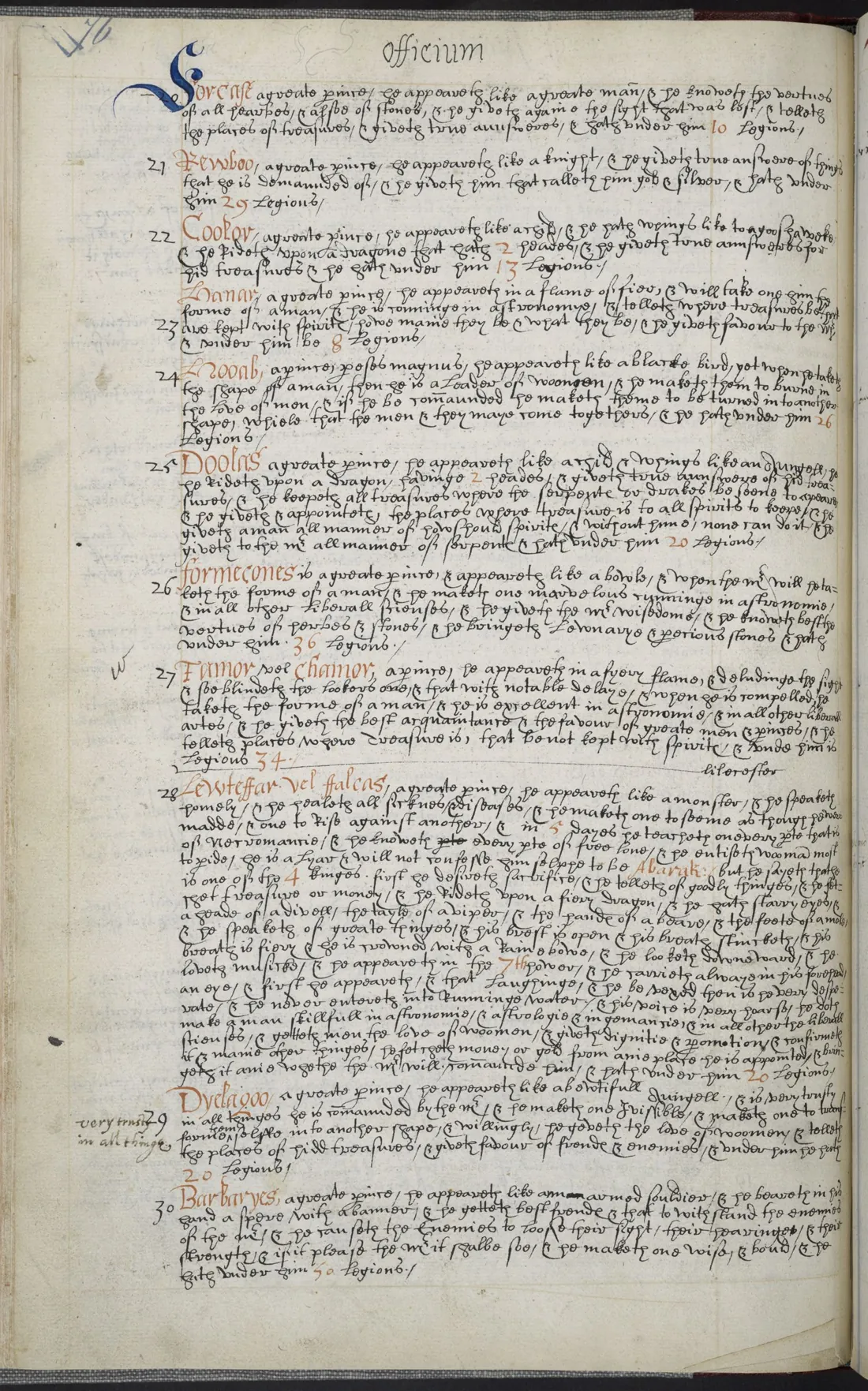
p. 76#page76
Liber Officiorum Spirituum — imago facsimilaris (p. 76) · facsimile
Folger Shakespeare Library, MS V.b.26, pp.73–84
🔍 preme ut amplifices

TranscriptioElizabethan English

[titulus:] officium.

20. Forcase[?] a greate prince; he appeareth like a greate man, & he knoweth the vertues of all herbes & also of stones, & he doeth [answer] againe of thinges that was & doth [come]; he telleth the places of treasures, & giveth true aunswere; & hath under him 10 legions.

21. Pewboo[?] a greate prince; he appeareth like a knyght, & he giveth true aunswere of thinges that is demaunded of; & he giveth him that calleth him gold & silver; & hath under him 29 legions.

22. Cookor[?] a greate prince; he appeareth like a rose[?], & he hath winges like to a goose; he rideth upon a dragon that hath 2 heades; & he giveth true aunswere for the treasures; & he hath under him 13 legions.

23. Hanar[?] a greate prince; he appeareth in a flame of fier, & will take one in the forme of a man; & he is cunninge in astronomy, & telleth where treasures be [that] are kept with spirits, [how] many they be & what they be; & he giveth favour to the m[aster]; & [hath] under him 8 legions.

24. Loonab[?] a prince; he appeareth like a blacke bird, yet when he taketh the shape of a man, then he is a leader of woemen, & he maketh them to burne in the love of men; & if he be commaunded, he maketh [them] to be turned into another shape, [so] that the men & they maye come togethers; & he hath under him 26 legions.

25. Doolas[?] a greate prince; he appeareth like a greate [thing] with winges like an [ho]rse; he rideth upon a dragon havinge 2 heades; & he giveth true aunswere of hid juells[joyas]; & he keepeth all treasures where the serpente or dragon be seene, & he appointeth the places where treasure is to all spirites to keepe; & he giveth a man all manner of [precious] stones… none can do it [but he]; & he giveth to the m[aster] all manner of serpents; & hath under him 20 legions.

26. Formecomes[?] a greate prince; he appeareth like a bore[?]; & upon the m[aster's] will he taketh the forme of a man, & he maketh one marvelous cunninge in all liberall sciences, & he giveth the m[aster] wisdome, & he knoweth both the vertues of herbes & stones, & he bringeth [forth] precious stones; & [hath] under him 36 legions.

27. Furnor vel Chamor[?] a prince; he appeareth in a fier flame, & he blindeth the lookers on, & that with notable delay; & when he is compelled, he taketh the forme of a man, & he [is] excellent in astronomie & all other liberall artes, & he giveth the best acquaintaunce & the favour of greate men; & telleth places where treasure is that be not kept with spirits; & [hath] under him 34 legions.

28. Lewsteffar vel falcas[?] a greate prince; he appeareth like a monster, & he speaketh comely; & he maketh all frendes discords, & maketh one to rise against another; & in 5 dayes he teacheth one every whit that is to doe; he is a lyar & will not confesse [truth] except he be in one of the 4 kinges[']. First he desireth sacrifice, & he telleth of goodly thinges, & [of] a greate treasure or money; & he rideth upon a fier dragon; & he hath starry eyes, & he speaketh of greate thynges; his breste is open [&] stinketh; & he beareth 2 serpents; his breath is fier; & he is crowned with a rainebowe; & he loveth minstrelsy; & he appeareth in the 7th houre; & he raungeth always in the forrest; & he maketh a man skillfull in astronomie, astrologie & geomancie, [&] in all other the liberall sciences; & telleth men the love of woomen, & giveth dignitie & promotion, & consumeth[conveyeth?] those thinges — money or gold — from any place; & [hath] under him 20 legions.

29. Dyclagoo[?] a greate prince; he appeareth like a beutifull damsell in all thinges; he is commaunded by the m[aster], & he maketh one Invisible, & maketh one to turne from one shape into another shape, & willingly he giveth the love of woomen, & telleth the places of hid treasures, & giveth favour of frende & enemies; & [hath] under him 20 legions.

30. Barbaryes[?] a greate prince; he appeareth like an armed souldier, & he beareth in his hand a speare with a banner, & he getteth best frende, & that to withstand the enemies of the m[aster]; & he causeth the enemies to loose their sight, their hearinge & their strength, & if it please the m[aster] it shalbe so; & he maketh one wise & bold; & he hath under him 50 legions.

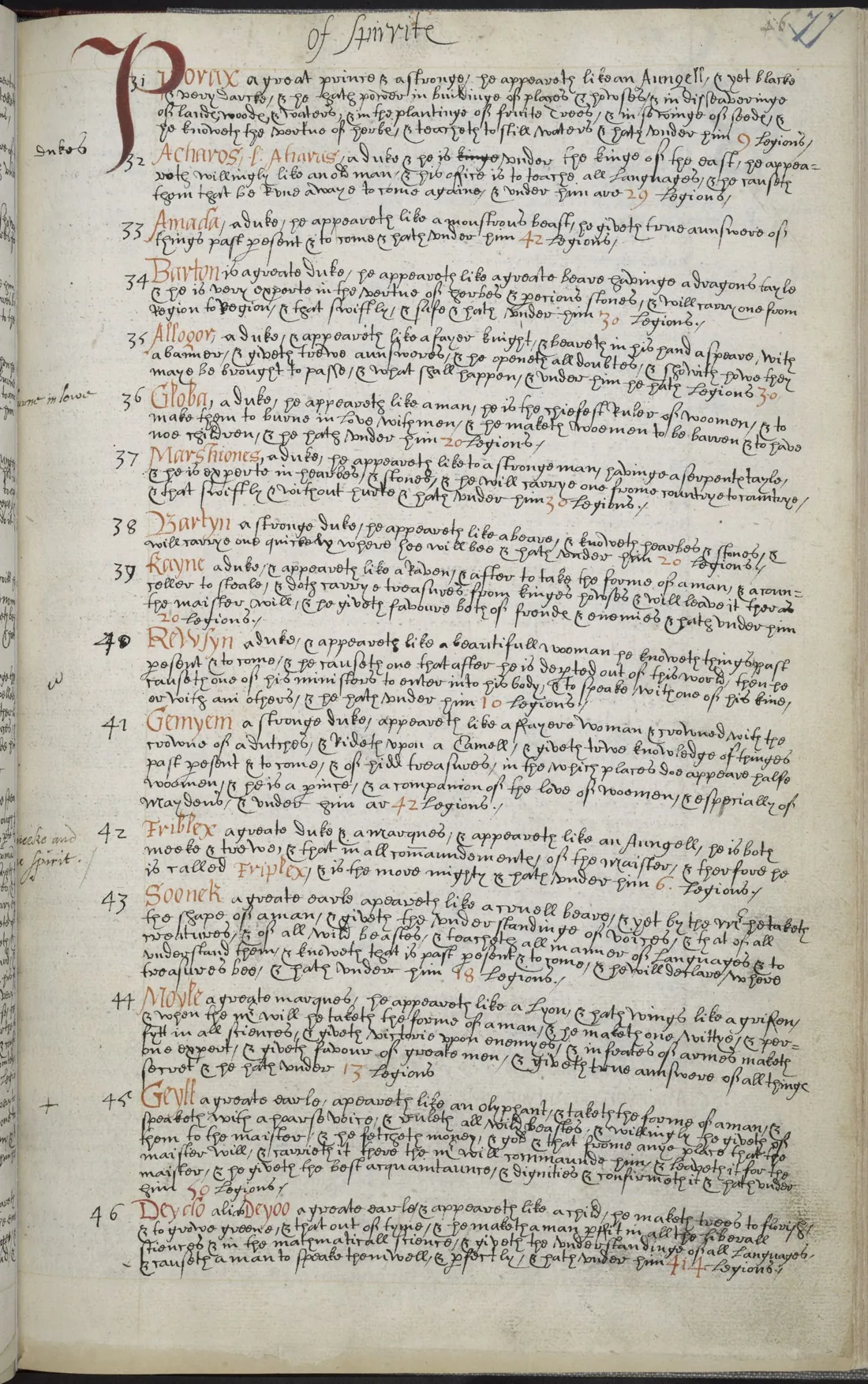
p. 77#page77
Liber Officiorum Spirituum — imago facsimilaris (p. 77) · facsimile
Folger Shakespeare Library, MS V.b.26, pp.73–84
🔍 preme ut amplifices

TranscriptioElizabethan English

31. Poryx[?] a greate prince & a stronge; he appeareth like an Aungell, & yet blacke, very [fair]; & he hath power in buildinge of places & houses, & in discoveringe of landes, woodes, & in the plantinge of fruite trees; & he knoweth the vertues of [herbes]; & teacheth to still waters; & [hath] under him 9 legions.

32. Acharos, l[ie] Aharus[?] a duke; he is kinge under the kinge of the east; he appeareth willingly like an old man, & his office is to teache all langhages, & he causeth them that be [taken] away to come againe; & under him ave[in all] 29 legions.

33. Amada[?] a duke; he appeareth like a monstruous [beast], & giveth true aunswere of thinges past, present & to come; & hath under him 42 legions.

34. Barton[?] is a greate duke; he appeareth like a greate beare, havinge a dragons tayle; & he is very experte in the vertues of herbes & precious stones; & will carry one from region to region, & that swiftlie; & also hath under him 30 legions.

35. Allogor[?] a duke; & appeareth like a fayer knyght, & beareth in his hand a speare with a banner; & giveth true aunswere; & he sheweth how they maye be brought to passe, & what shall happen; & under him he hath 30 legions.

36. Globa[?] a duke; he appeareth like a man; he is the chiefest ruler of woemen, & maketh them to burne in the love of men; & maketh woemen to be barren, & to have no children; & he hath under him 20 legions.

37. Marshiones[?] a duke; he appeareth like a stronge man, havinge a serpents tayle & stones[?]; & he is experte in herbes & stones; & he will carry one from countrye to countrye, & that swiftlie, & without hurte; & hath under him 30 legions.

38. Bartyn[?] a stronge duke; he appeareth like a boare; & knoweth herbes & stones; & will carry one quickly where soe [he] will be; & hath under him 20 legions.

39. Kayne[?] a duke; & appeareth like a raven, [in the] forme of a man; & he is a good disputer, & doth carry treasures from kinges houses, & will leade it there as the m[aster] will; & he giveth favour both of frende & enemies; & hath under him 20 legions.

40. Redysyn[?] a duke; & appeareth like a beautifull woman; he knoweth thinges past & to come, & he causeth one that, after he is departed out of his word[world], then to be revivinge[?] any others; & he ministreth to enter into his body, & to speake with one of the kinge['s]; & hath under him 10 legions.

41. Gemyem[?] a stronge duke; appeareth like a fayer woman, & crowned with the crowne of a dutches, & rideth upon a Camell, & giveth true knowledge of thinges past, present & to come, & of hid treasures — in the very places [they] doe appeare; also [procureth] woemen; & he is a prince, & a companion of the love of woemen, & especially of maydens; & under him 42 legions.

42. Friblex[?] a greate duke & a marques; & appeareth like an Aungell, meeke & true, & that in all commaundementes of the m[aster]; he is [both] called Friblex, & is the more mighty; & under him 6 legions.

43. Soonek[?] a greate earle; appeareth like a cruell beare, [in] the shape of a man; & giveth the understandinge of all wild beastes; & he understandeth them, & knoweth [thinges] past, present & to come, & of all manner of langhages [where] treasures be; & hath under him 18 legions.

44. Moyle[?] a greate marques; he appeareth like a Lyon, & hath winges like a griffen; when the m[aster] will, he taketh the forme of a man, & he maketh one witty & personable excellent; & giveth victorie upon enemies, & in feates of armes; & maketh a servt; & giveth true aunswere of all thinges; & under [him] 13 legions.

45. Gevll[?] a greate earle; appeareth like an olyphant[elefante], [then] taketh the forme of a man, speaketh with a hoarse voice, & ruleth all wild beastes, makinge them [obey] to the m[aster]; & he fetcheth money & bringeth [it from] any place that the m[aster] will, & carrieth it there [as] the m[aster] commaundeth him; & he giveth the best acquaintaunce & dignities; & hath under him 50 legions.

46. Deyclo alias Deyoo[?] a greate earle; & appeareth like a [beast], & maketh trees to florish & to grow greene, & that out of tyme; & he maketh a man perfitt in all the liberall sciences & in the mathematicall sciences; & giveth the understandinge of all langhages, & causeth a man to speake them well & perfitly; & hath under him 414[?] legions.

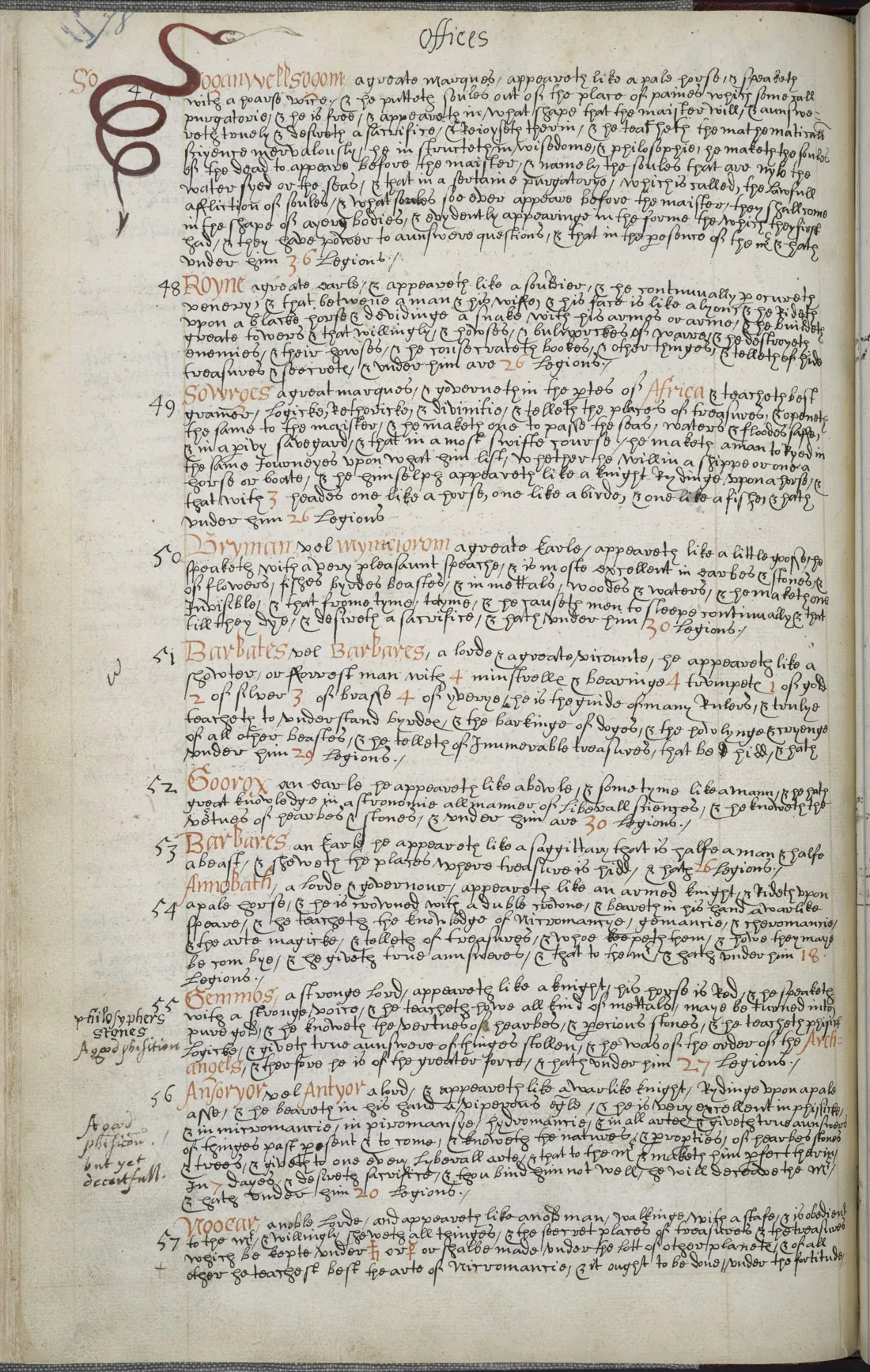
p. 78#page78
Liber Officiorum Spirituum — imago facsimilaris (p. 78) · facsimile
Folger Shakespeare Library, MS V.b.26, pp.73–84
🔍 preme ut amplifices

TranscriptioElizabethan English

47. Soganywellsogoom[?] a greate marques; appeareth like a pale [horse]; & he speaketh with a hoarse voice; & he pulleth soules out of the place of paines, which some call purgatorie; & he is free, & appeareth in what shape that the m[aster] will; & aunswereth to sacrifice… he marvelously instructeth in wisdome & philosophie; he maketh the soules of the dead to appeare before the m[aster], & namely the soules that are into the [place] which is called the dolefull affliction of soules; & what soules the m[aster] desire[th] appeare before the maister — they shall come in the shape of ayery bodies, & sodenly appearinge in [that] forme; & they take power to aunswere questions, & that in the presence of the m[aster]; & [hath] under him 36 legions.

48. Royne[?] a greate earle; & he appeareth like a soldier, & he continually worketh envy, & that betwene a man & his wife; & his face is like a lyon; he rideth upon a blacke [horse], holdinge a snake [in] his armes; & he kindleth greate [strife]; & he doth spoyle enemies & their [goods]; & he [stirreth up] warres… & telleth of hid treasures & secrets; & under him [in all] 26 legions.

49. Sowroes[?] a greate marques; & he governeth in the [parts] of Africa; & he teacheth best grammer, logicke, rethorike & divinitie; & telleth the places of treasures, & procureth the same to the m[aster]; & maketh one to pass the sea, waters & floodes safe, & that in a most swifte course; & he maketh a man to [travel]… whether within a [chamber], or on a horse or boate; & he himself appeareth like a knyght, ridinge upon a horse [with] 3 heades — one like a horse, one like a birde, & one like a [fish]; & [hath] under him 26 legions.

50. Dryman vel Wynxiorom[?] a greate earle; appeareth like a little [boy], & he speaketh with a very pleasaunt speache; he is most excellent in [the] vertues of flowers [& herbes], hid & [above ground], & in mettalls, woodes & waters; & he maketh one Invisible, & that from tyme to tyme; & he causeth men to sleepe continually, & that till they [die]; & desireth a sacrifice; & [hath] under him 30 legions.

51. Barbates vel Barbares[?] a lorde & a greate viscounte; he appeareth like a [forester] man, with 4 minstrells [bearing] 4 trompets — 1 of gold, 2 of silver, 3 of brasse, 4 of yvorye[marfil]; he is [the] guide of many [lords]; & truely teacheth to understand birdes, & the barkinge of dogges, & the lowinge of all other beastes; & he telleth of Immovable treasures that be hid; & [hath] under him 29 legions.

52. Gooryx vel Darlo[?] an earle; he appeareth like a [beast], & sometyme like a man; he hath greate knowledge in astronomie [&] all manner of liberall sciences; & he knoweth the vertues of herbes & stones; & under him [in all] 30 legions.

53. Barbares[?] an earle; he appeareth like a sagittary[centauro]; & [when] he is [also] a man, he [sheweth] the places wheare treasure is hid; & [hath] 26 legions.

54. Annobath[?] a lorde & governour; appeareth like an armed knyght, & rideth upon a pale [horse], & he is crowned with a duble diadem, & beareth in his hand [an emblem of] the arte magicke; & telleth of treasures, & he keepeth them; & giveth true aunswere; & hath under him 18 legions.

55. Gemmos[?] a stronge lorde; appeareth like a knyght, his horse is red, & he speaketh with a stronge voice; & he teacheth how all kinds of mettalls maye be turned into pure gold; & he knoweth the vertues of herbes & precious stones; & he teacheth pyromancie[?]; he giveth true aunswere of thinges stollen; & he was of the order of the Archangels[?]; & therefore he is of the greater force; & hath under him 27 legions.

56. Ansorvor vol Antyor[?] a lorde; & appeareth like a raven, [in the] liknes [of a] knyght, & rideth upon a pale asse, & he beareth in his hand a viperous [serpent]; & he is very excellent in phisicke[medicina], in nigromancie, in pyromancie, hydromancie, & in all artes; & giveth true aunswere of thinges past, present & to come; & knoweth the natures & properties of herbes, stones & trees; & bringeth one to be [expert] in liberall artes, [making] him perfitt therein in 7 dayes; & desireth sacrifice; & if you bind him not well, he will deceive the m[aster]; & [hath] under him 20 legions.

57. Nrocar[?] a noble lorde; & appeareth like an old man, walkinge with a staffe; & is obedient to the m[aster], & [sheweth] all thinges; & he [keepeth] the places of treasures & of holy [thinges], where he keepe[th] under Egyn… [he] tell[eth] of [the] planetes, & of all other; he teacheth best the arte of Nigromancie… (sigue en p.79)

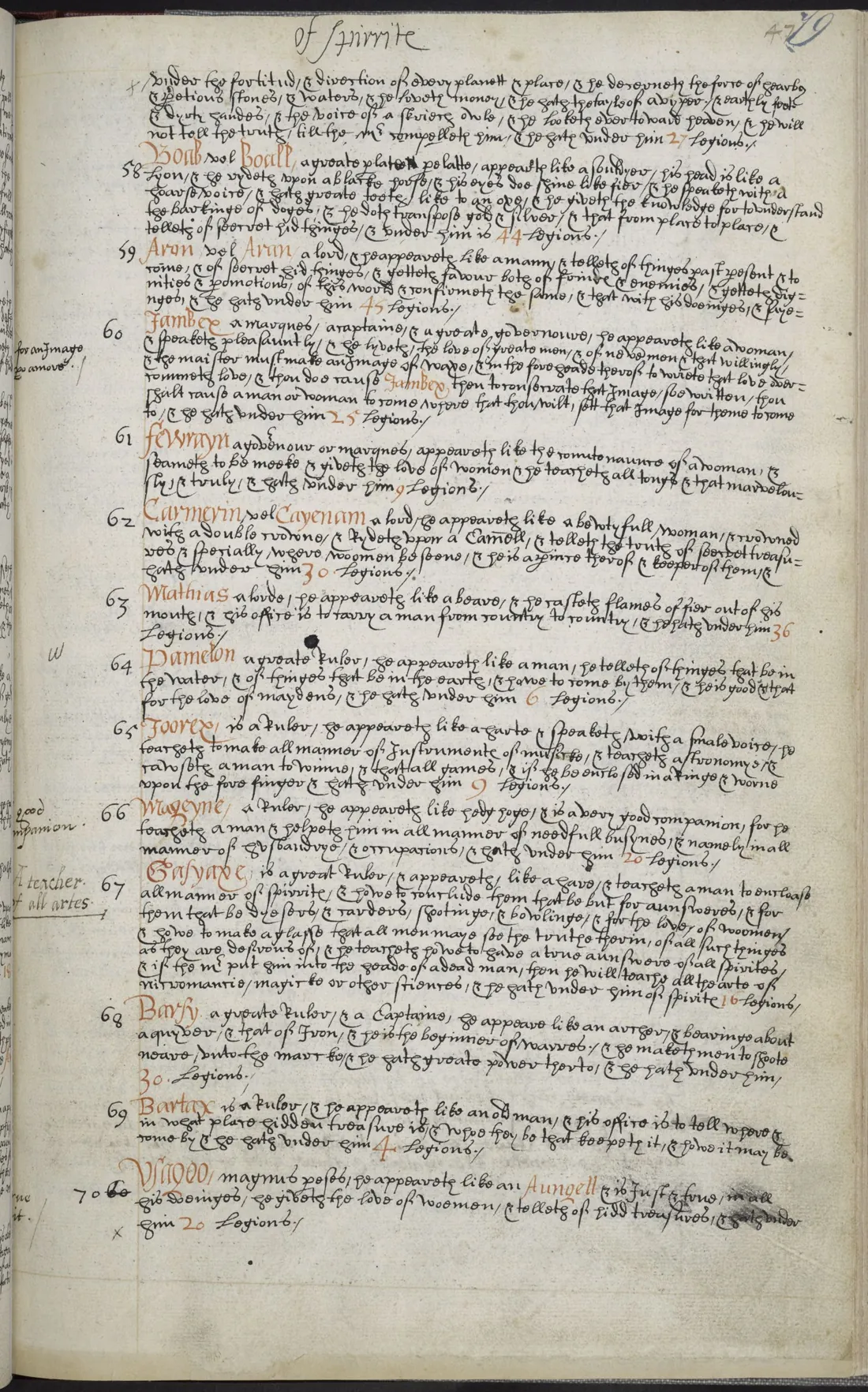
p. 79#page79
Liber Officiorum Spirituum — imago facsimilaris (p. 79) · facsimile
Folger Shakespeare Library, MS V.b.26, pp.73–84
🔍 preme ut amplifices

TranscriptioElizabethan English

[57, cont.] …vnder the fortitud[e], & diuersion[?] of euery planett & place, & he descoueroth the force of gearbes [herbes], & p[re]tious stones, & waters, & he loueth money, & he gate [hath] the tayles of a byrd, & partely foote & [duth?] handes, & the voice of a skriere [screech] owle, & he loketh about toward heauen, & he will not tell the truth, till the m[aster] compelloth him, & he hath vnder him 27 legions.

58. Boall vel Boall a greate p[re]late[?] [polatte], appeareth like a shuldyer [souldier], his heade is like a lyon, & he rydeth vpon a blacke horse, & his eyes doe shine like fier, & he speketh with a hoarse[?] voyce, & he gate greate feete like to an ope [ape], & he giueth the knowledge for to vnderstand the barkinge of dogges, & he dote [doth] transpose gold & siluer, & that from place to place, & telleth of secret hid thinges, & vnder him is 44 legions.

59. Aron vel Arin a lord, & he appeareth like a mann, & telleth of thinges past, present & to come, & of secret hid thinges, & getteth fauour bote [both] of frinde [friends?] & conomies [enemies?], & getteth dignities & p[ro]motions, of theyr word, & confirmote [confirmeth] the same, & that with his doeinges & sayenges, & he gate vnder him 45 legions.

60. Jamber a marques, a captaine, & a greate gouernour, he appeareth like a woman, & speketh pleasauntly, & he giueth the loue of greate men, & of noble men that willingly[?], & the maister must make an Image of waxe, & in the fore heades therof to write that loue [ouer?]… & thou doe cause Jamber, then to consecrate that Image, so writton, thou shalt cause a man or woman to come where that thou wilt, sett that Image for theme to come, & he gate vnder him 25 legions.

61. Fewrmyn a gouernour or marques, appeareth like the comtonaunce [countenance] of a woman, & […] mote to be mocke[?], & giueth the loue of women, & he teacheth all tonges, & that maruelou[s]ly & truly, & gate vnder him 9 legions.

62. Carmerin vel Cayenam a lord, & he appeareth like a bewtyfull woman, & a double [crowne?] [rudone?], & rydeth vpon a Camell, & telleth the truth of secret treasu[re], & specially, weare [where] woomen be sette[?], & his [acqueyntre?] therof, & kepeth of them, & gate vnder him 30 legions.

63. Mathias a lorde, he appeareth like a beare, & he casteth flames of fier out of his mouth, & his office is to tarry [carry] a man from country to country, & he gate vnder him 36 legions.

64. Pamelon a greate ruler, he appeareth like a man, he telleth of thinges that be in the water, & of thinges that be in the earth, & gaue [giue] to come by them, & his good, & that for the loue of maydens, & he gate vnder him 6 legions.

65. Foorex is a ruler, he appeareth like a garte[?], & speaketh swift[?] a smale voice, he teacheth to make all manner of Instrumente of musike, & teacheth astronomy, & teacheth a man to winne, & te[ach] at all games, & if he be enclosed in a ringe & worne vpon the fore finger, & gate vnder him 9 legions.

66. Wageyne a ruler, he appeareth like [a boy hoyo?] illegibile, & is a very good companion, for he teacheth a man & helpeth him in all manner of needfull busynes, & namely in all manner of husbandrye & occupacions, & gate vnder him 20 legions.

67. Gasyare is a greate ruler, & appeareth like a garte[?], & teacheth a man to enclose all manner of spirites, & howe to conclude[?] them that be but for aunsweres, & for them that be desed[?] & tardous[?], sportinges & bowlinges, & for the loue of woomen, & howe to make a glasse that all men maye see the truthe therin, [of woomen] as they are desirous of, & he teacheth howe to gade [guide] a true aunswere of all sure thinges, & if the m[aster] put him into the heade of a dead man, then he will teache all spirites, nigromancie, magike or other sciences, & he gate vnder him of all the arte of spirite 16 legions.

68. Barsy a greate ruler, & a Captaine, he appeare[th] like an aurger [archer?], & bearinge about [a quiuer?], & that of Iron, & he is the beginner of warres, & he maketh men to shoote neare, vnto the marke[?], & he gate greate power therto, & he gate vnder him 30 legions.

69. Bartax is a ruler, & he appeareth like an old man, & his office is to tell where & in what place hidden treasure is, & whoe they be that keepeth it, & howe it may be come by, & he gate vnder him 4 legions.

70. Vsagoo magnus potes[t] [?], he appeareth like an Aungell, & is Iust & true, in all his doeinges, & he giueth the loue of woomen, & telleth of hidd treasures, & gate vnder him 20 legions.

p. 80#page80
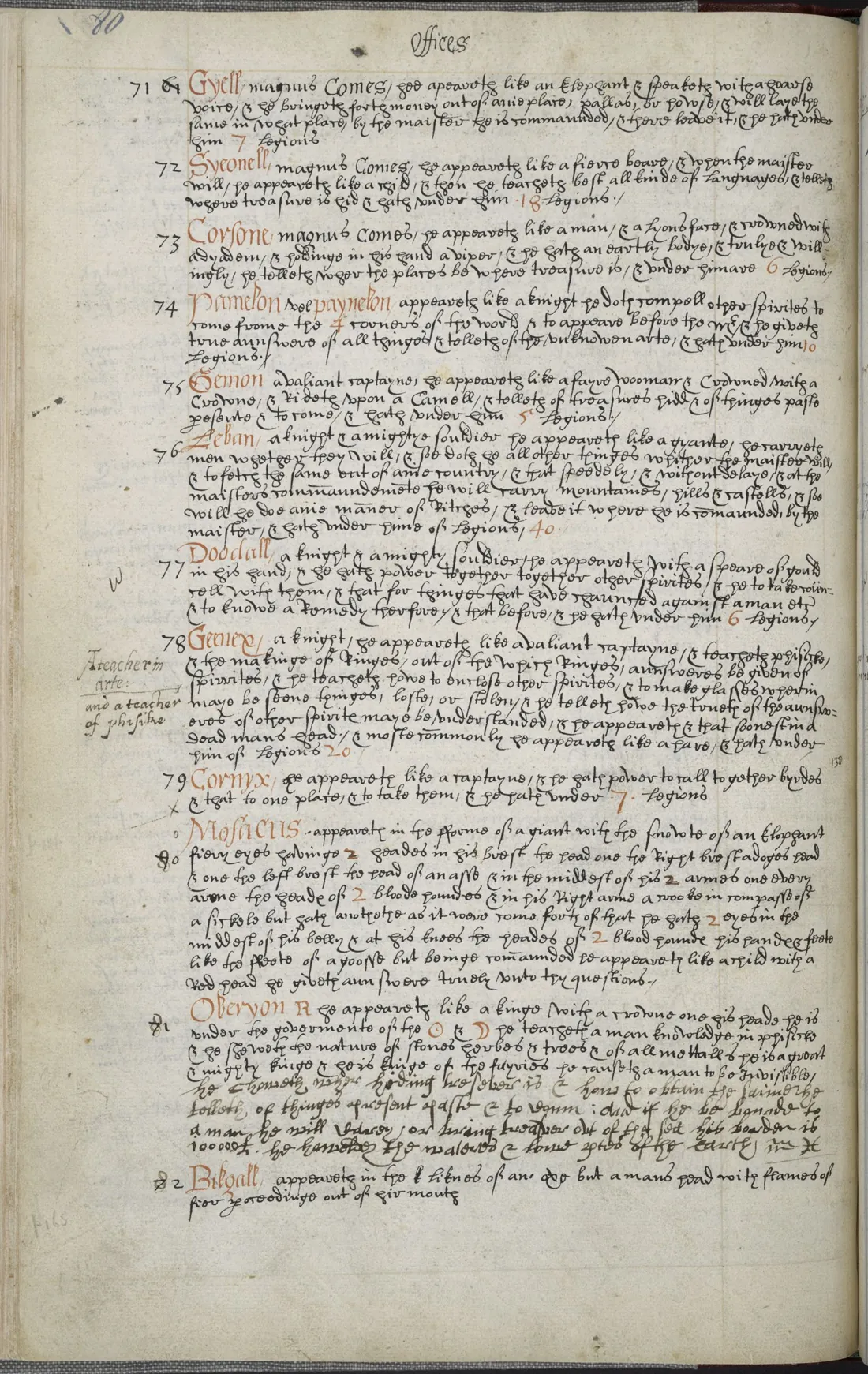
Liber Officiorum Spirituum — imago facsimilaris (p. 80) · facsimile
Folger Shakespeare Library, MS V.b.26, pp.73–84
🔍 preme ut amplifices

TranscriptioElizabethan English

71. Gyell, magnus Comes, he appeareth like an Elephant & speaketh with a graue voice, & he bringeth forth money out of anie place, pallab[le], or how, & will laye the same in what place, by the maister he is commaunded, & there leaue it, & he hath vnder him 7 legions.

72. Syconell, magnus Comes, he appeareth like a fierie beare, & vpon the maister will, he appeareth like a mayd, & then he teacheth best all kinde of Languages, & telleth wheare treasure is hid & hath vnder him 18 legions.

73. Corsone, magnus Comes, he appeareth like a man, & a lyons face, & crowned with a Dyadem, & holding in his hand a viper, & he hath an earthly bodye, & truely & willingly he telleth wheare the places be wheare treasure is, & vnder him are 6 legions.

74. Pamelon vel Paynelon, appeareth like a knight, he doth compell other spirites to come from the 4 corners of the world, & to appeare before the m[aister], & he giueth true aunswere of all things & telleth of the vnknowen arte, & hath vnder him 10 legions.

75. Semon, a valiant captayne, he appeareth like a fayre woomann & crowned with a Crowne, & rideth vpon a Camell, & telleth of treasure hid & of things paste, presente & to come, & hath vnder him 5 legions.

76. Zebun, a knight & a mightie souldier, he appeareth like a gyante, he carryeth [?] men wheather they will, & he doth he all other things whither the maister will, & to fetch the same out of anie country, & that speedely, & without delaye, & at the maisters commaundemente he will carry mountaines, hilles & castelles, & he will he doo anie manor of Ritches, & leade it wheare he is comaunded, by the maister, & hath vnder him[e] [?] of legions 40.

77. Doodcall, a knight & a mightie souldier, he appeareth with a speare of gould in his hand, & he getteth power together [to]gether other spirites, & he to take roune [?] roll with them, & that for things that gaue graunted [?] againe & a man ot[her] illegibile to knowe a Comody therefore, & that before, & he hath vnder him 6 legions.

78. Gemexe[?], a knight, he appeareth like a valiant captayne, & the makinge of kinges, out of the wighte [?] kinges, aunsweres be giuen of [?] spirites, & he teacheth howe to enclose other spirites illegibile maye be stone things, lost or stolen, & he telleth howe the truthe of the aunswere of other spirite maye be vnderstanded, & he appeareth & that soneste in a dead mans head, & moste commonly he appeareth like a faue [?], & hath vnder him of legions 20.

79. Cornyx, he appeareth like a captayne, & he getteth power to call together byrdes, & that to one place, & to take them, & he hath vnder [him] 7 legions.

80. Mosacus, appeareth in the fourme of a giant with the snoute of an Elephant, fierie eyes, hauing 2 heades in his brest, the head one the right brest a dogges head & one the left brest the head of an asse, & in the middest of his 2 armes one aboue [an]other the heade of 2 blood houndes, & in his right arme a wooke [?] in compasse of a sirkele, but hath another as it were come forth of that, he hath 2 eyes in the middest of his belly, & at his knees the heades of 2 blood hounde[s], his handes [&] feete like the feete of a goose, but beinge commaunded to appeareth like a child with a red head, he giueth aunswere truely vnto thy questions. [sin nº de legiones]

81. Oberyon R[ex], he appeareth like a kinge with a crowne on his head, he is vnder the gobermente of the ☉ & ☽, he teacheth a man knowledge in phisike, & he sheweth the nature of stones, herbes & trees, & of all mettalles, & he is a greate & mightie kinge & he is kinge of the fayries, he causeth a man to be Invisible, he sheweth wheare hidden treasure is & howe to obtaine the same, he telleth of thinges apresent & paste & to come: And if he be bounde to a man he will [discouer? vtter?] or bringe treasure out of the sea, his warden [?] is 1000000 [?], he illegibile the walles & tonn [town?] spies [?] of the earth in illegibile. [sin nº de legiones]

82. Bilgall, appeareth in the [likenes] of an[e] [ape/asse — illegibile] but a mans head with flames of fire proceedinge out of his mouth [entrada incompleta ad imum; sin nº de legiones].

p. 81#page81
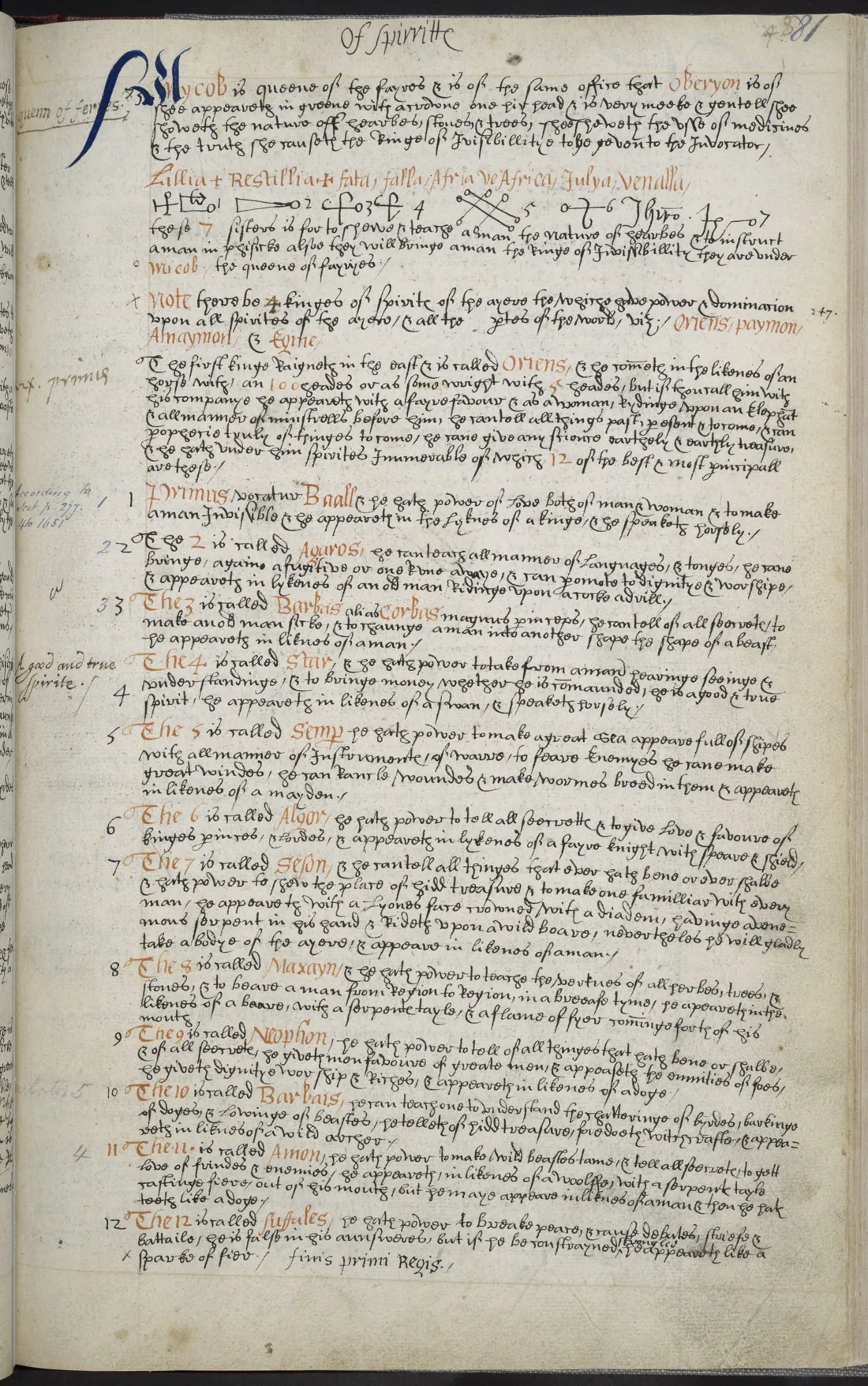
Liber Officiorum Spirituum — imago facsimilaris (p. 81) · facsimile
Folger Shakespeare Library, MS V.b.26, pp.73–84
🔍 preme ut amplifices

TranscriptioElizabethan English

[M]ycob is queene of the fayres & is of the same office that Oberyon is of she appeareth in greene w[i]th a rownde [thinge?] o[n] hir head & is very meke & gentell she sheweth the nature off herbes, stones, & trees, & sheweth the vse of medicines & the vertue[s], she causeth the ringe of Invisibillitie to be gyven to the Inuocator.

Lillia + Restillia + fata, falla, Afria ve[l] Africa, Julya, Venalla, [sigilo]·1 [sigilo]·2 [sigilo]·3 [sigilo]·4 [sigilo]·5 [sigilo]·6 Thiro·[sigilo]·7 these 7 sisters is for to sheowe & tear[c]he a man the nature off herbes & to instruct a man in phisicke, also they will bringe a man the ringe off Invisibillitie; they are under Micob the queene of fayries.

Note there be 4 kinges off spirite off the ayer the we[i]che gyue power & domination vpon all spirites of the ayer, & all the [partes?] off the woorld, viz: / ORIENS, Paymon, Amaymon, & Egine.

The first kinge Raignes[reigneth] in the East & is called ORIENS, & he cometh in the likenes of an horse w[i]th an 100 heades or ab[out] some wright[weight] w[i]th 5 heades, but if he call him w[i]th his companye he appeareth w[i]th a fayre favour & as a woman, rydinge vpon an Eloph[ant] & all manner of[f] minstrells before him; he can tell all thinges past, present & to come, & can prophecie truly of thinges to come, & he cane gyve any stronge castell & earthly treasure, & he hath vnder him spirites Immovable off weight; 12 of the best & most principall are these:

1. Primus vocatur Baall, & he hath power off love bote[both] off man & woman & to make a man Indivisible[Invisible] & he appeareth in the lyknes off a kinge, & he speaketh hoursly[hoarsely].

2. The 2 is called Agaros, he can teare[teach] all manner off Languages, & tonges, he cane bringe againe a fugitive or one that is awaye, & cane promote to dignitie & worshipe, & appeareth in lyknes off an old man Ridinge vpon a rocke advill[= crocodile?].

3. The 3 is called Barbas alias Corbus magnus princeps, he can tell off all secrete, to make an[od?] man sicke, & to re[c]haunge a man into another shape, the shape off a beast, & he appeareth in liknes off a man.

4. The 4 is called Star, & he hath power to take from a man his understandinge, & to bringe money wheither he is comaunded; he is a good & true spirit, he appeareth in liknes off a swan, & speaketh hoursly[hoarsely].

5. The 5 is called Semp, he hath power to make a great sea, & sea, appeare full off shipes w[i]th all manner off Instrumente[s] of warre, to feare[frighten] enemyes; he cane make great windes, he can[?] carve[cause] wounds & make wormes bread[breed] in them & appeareth in liknes off a mayden.

6. The 6 is called Algor, he hath power to tell all secrette, & to gyve love & favoure off kinges, princes, & lordes, & appeareth in lyknes off a fayre knight w[i]th speare & shield.

7. The 7 is called Seson, & he can tell all thinges that ever hath bene or ever shalbe, & hath power to sheowe the place off hidd treasure & to make one familliar[familiar] w[i]th ever[y] man; he appeareth w[i]th a Lyones[lioness's] face crowned w[i]th a diadem, havinge a[bout] a mons[monstrous?] serpent in his hand & Rideth vpon a wild boare; no[?]... he will gladly take a bodye off the ayer, & appeare in liknes off a man.

8. The 8 is called Maxayn, & he hath power to teache the vertues off all herbes, trees, & stones, & to beare a man from Region to Region in a breafe[brief] tyme; he appeareth in the liknes off a beare, w[i]th a serpents tayle, & a flame of fyer cominge forth off his mouth.

9. The 9 is called Neophon, he hath power to tell off all thinges that hath bene or shalbe, & off all secrete; he gyveth men favoure of greate men, & [ap]poste[declareth?] the enmities off foes, he gyveth dignitie or worship & Riches, & appeareth in liknes off a doge[dog].

10. The 10 is called Barbais, he can teare[teach] one to vnderstand the chatteringe off byrdes, barkinge off doges, & lowinge off beastes, to tell off hidd treasure, foredoote[?] w[i]th grasse[?], & appeareth in liknes of a wild [urcheon?/hedgehog?].

11. The 11 is called Amon, he hath power to make wild beastes tame, & tell all secrete, to gett love off frindes & enemies; he appeareth in liknes off a woolfe, w[i]th a serpents tayle castinge fier[fire] out off his mouth, but he maye appeare in liknes off a man & then he hath teeth like a doge.

12. The 12 is called Suffales, he hath power to breake speare, & cause doubtes, strife & battaile; he is false in his aunswers, but if he be constrayned [by his kinge?] he appeareth like a sparke of fier. — finis primi Regis. [fin del primer Rey]

p. 82#page82
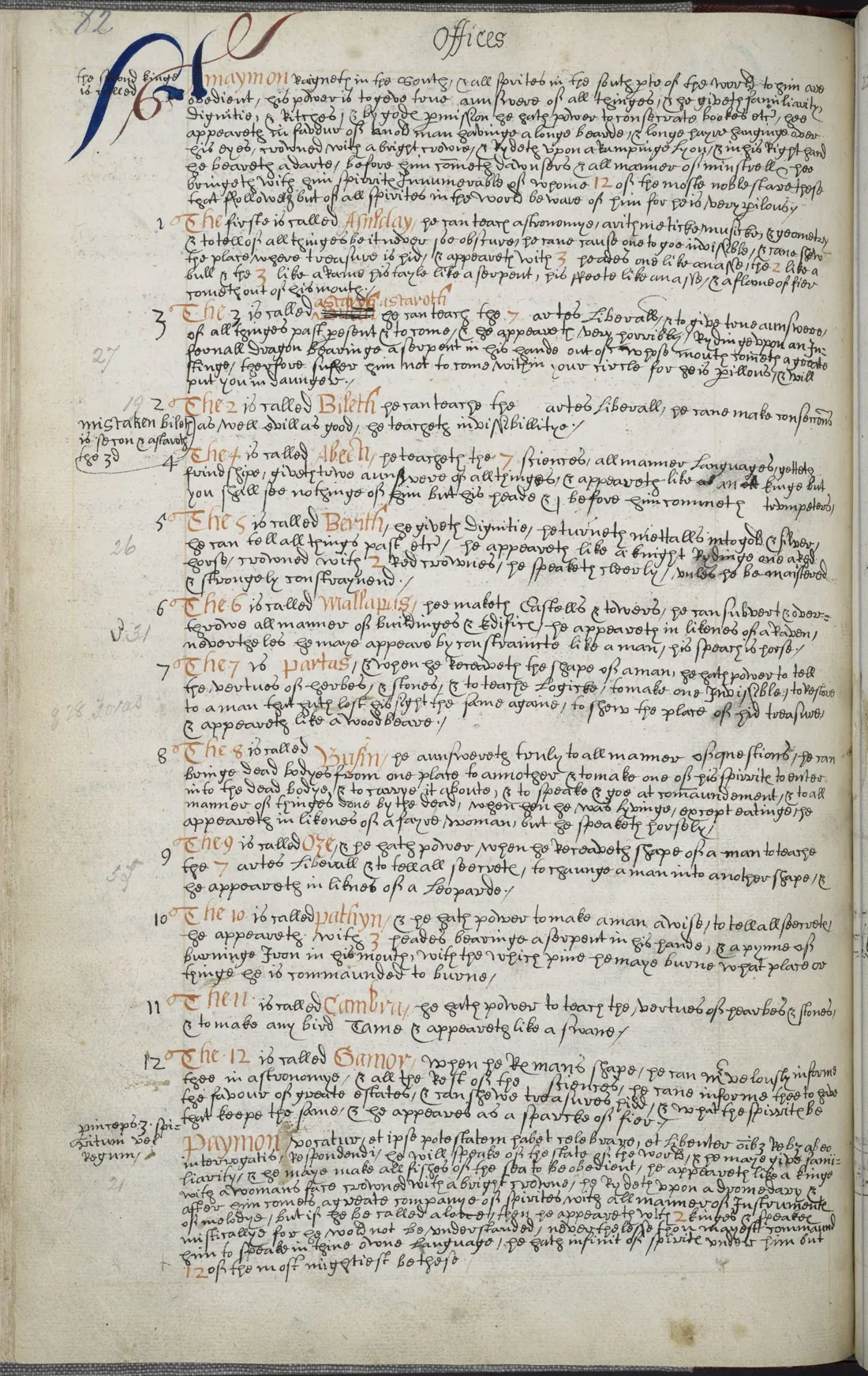
Liber Officiorum Spirituum — imago facsimilaris (p. 82) · facsimile
Folger Shakespeare Library, MS V.b.26, pp.73–84
🔍 preme ut amplifices

TranscriptioElizabethan English

[margo sinister, rubrica:] the second kinge is called [M]AYMON raignes in the easte, [and] all spirites in the easte [par]tes of the world to him are obedient; his power is to gyve true aunswere of all thinges, [and] he gyveth familiarity, dignities, [and] ritches; [and] by gods p[er]mission he gyveth power to conservate bookes [et]c, he appeareth in habit[?] of an old man havinge[?] a longe bearde [and] longe hayre hanginge over his eyes, crowned with a bright crowne, [and] rydeth vpon a lampinge[?] lyon, [and] in his right hand he beareth a darte, before him cometh dauncers [and] all manner of minstrell, he bringeth with him spirite Innumerable of whome 12 of the moste noble stande these[?] [feat?] fellowes; but of all spirites in the world beware of him for he is very perilous.

1. ¶ The firste is called Asmiday[Asmoday], he can teache astronomye, arithmatike, musike, [and] geometrie, [and] to tell of all thinges be it never so obscure, he can cause one to goo invisible, [and] can shew the place where treasure is hid, [and] appeareth with 3 heades, one like an asse[?], the 2 like a bull, [and] the 3 like a rame, his tayle like a serpent, his feete like an asse[?], [and] a flame of fyer cometh out of his mouth.

3. ¶ The 3 is called ~~[Bileth, deletum]~~ Astaroth [nomen correctum rubro supra lineam], he can teache the 7 artes liberall, [and] to gyve true aunswere of all thinges past, present [and] to come, [and] he appeareth very horrible, rydinge vpon an Infernall dragon, bearinge a serpent in his hande, out of whose mouth cometh a great stinge; therefore suffer him not to come within your circle for he is perilous [and] will put you in daunger.

2. ¶ The 2 is called Bileth, he can teache the [ ] artes liberall, he cane make consonons[?] as well evill as good, he teacheth invisibillitye. [margo sinister:] mistaken: bileth is seron [and] astaro[t]h the 3d[?]

4. ¶ The 4 is called Abech, he teacheth the 7 sciences, all manner languages, yette[?] he gyveth true aunswere of all thinges, [and] appeareth like [as] an old[?] [thinge?]; but you shall see nothinge of him but his heade, [and] before him cometh trompeters.

5. ¶ The 5 is called Berith, he gyveth dignities, he turneth mettalls into gold [and] silver, he can tell all thinges past [et]c, he appeareth like a knight[?] rydinge on a[?] [horse], crowned with 2 red crownes, he speaketh slowly, vnles he be maistered [and] strongely constrayned.

6. ¶ The 6 is called Mallapus[?], he maketh castells [and] towers, he can subvert [and] devoure[?] [destroye] all manner of buildinges [and] edifice, he appeareth in likenes of a raven; neverthelesse he maye appeare by constrainte like a man, his speach is horse[hoarse].

7. ¶ The 7 is Partas, [and] when he toucheth the shape of a man, he gath[hath] power to tell the vertues of herbes [and] stones, [and] to teache Logike, to make one Invisible, to restore to a man that hath lost his sight the same againe, to shew the place of hid[?] treasure, [and] appeareth like a woodbeare[?].

8. ¶ The 8 is called Busyn, he aunswereth truly to all manner of questions, he can bringe dead bodyes from one place to another, [and] to make one of his spirite to enter into the dead bodye, [and] to carrye it aboute, [and] to speake [and] goo at commaundement, [and] to [do] all manner of thinges done by the dead, when[as] he was lyvinge, except eatinge; he appeareth in likenes of a fayre woman, but he speaketh horsely[hoarsely].

9. ¶ The 9 is called Oze, [and] he hath power, when he toucheth shape of a man, to teache the 7 artes liberall [and] to tell all secretes, to chaunge a man into another shape, [and] he appeareth in liknes of a leoparde.

10. ¶ The 10 is called Pathyn, [and] he hath power to make a man a wise[?], to tell all secretes, he appeareth with 3 heades, bearinge a serpent in his hande, [and] a [payne?] of burninge Iron in his mouth, with the which him[?] he maye burne what place or thinge he is commaunded to burne.

11. ¶ The 11 is called Cambira, he hath power to teache[?] the vertues of herbes [and] stones, [and] to make any bird tame, [and] appeareth like a swane.

12. ¶ The 12 is called Samor, when he [taketh?] mans shape, he can marvelously informe thee in astronomye, [and] all the reste of the [ ] sciences; he can teache the favour of greate estates, [and] can shewe treasures[,] till[?]; he can informe thee to gett[?] [those?] that keepe the same, [and] he appeareth as a sparkle of fyer, [and] what[?] the spirite be[?] —

[margo sinister, Latine, 3 lineae:] illegibilepb[?] 3 spi= / ritum vel / regu[m] — (≈ «…3 spirituum vel regum») PAYMON vocatur, et ipse potestatem habet celeb[r]are[?], et libenter om[n]ib[us] reb[us] ab eo interrogatis, respondendi. — he will speake of the state of the world, [and] he maye gyve familiarity, [and] he maye make all fisshes of the sea to be obedient, he appeareth like a kinge with a womans face, crowned with a bright crowne, [and] he rydeth vpon a dromedary, [and] afore him cometh a greate company of spirites with all manner of Instrumente of melodye; but if he be called alone, then he appeareth with 2 kinges, [and] speake[th] mistically[?] for he wold not be vnderstanded, neverthelesse then one mayest[?] commaund him to speake in eche mans owne language; he hath infinit of spirite vnder him, but 12 of the most mightiest be these.

p. 83#page83
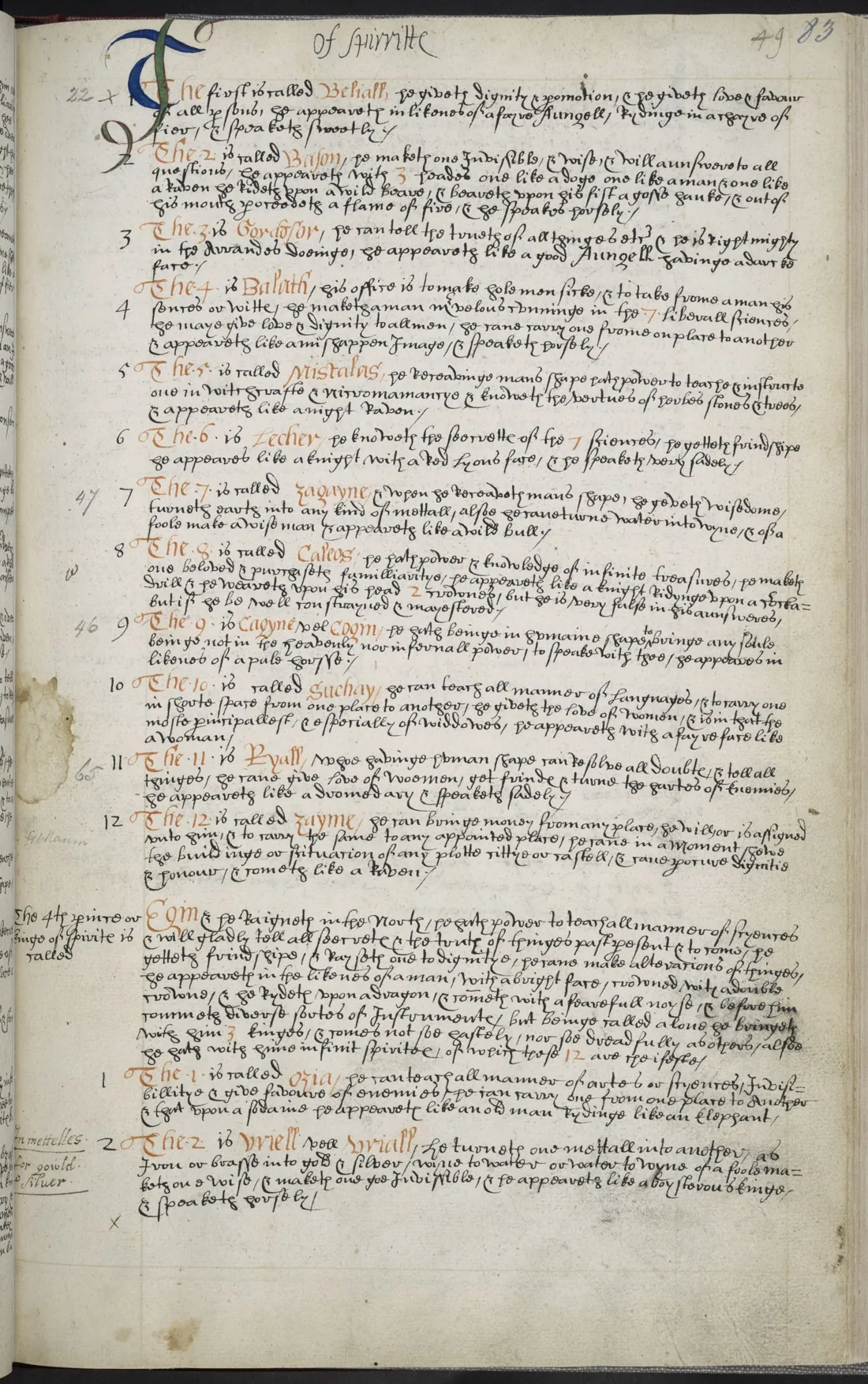
Liber Officiorum Spirituum — imago facsimilaris (p. 83) · facsimile
Folger Shakespeare Library, MS V.b.26, pp.73–84
🔍 preme ut amplifices

TranscriptioElizabethan English

of spirittes

[1.] The first is called Beliall, he giueth dignity & promotion, & he giueth loue & fauour of all the[?] […], he appeareth in likenes of a fayre Aungell, ryding in a charyet of fier, & speaketh smoothly.

2. The 2 is called Bason, he maketh one Inuisible, & wise, & will aunswer to all questions; he appeareth with 3 heades[?] one like a doge, one like a man, & one like a raben; he rideth vpon a wild beare, & beareth vpon his fist a goss hauke, & out of his mouth proceedeth a flame of fier, & he speaketh horsly.

3. The 3 is Gordonzor[?], he can tell the truthe of all thinges both[?] […], & he is right mighty in the aduaunced[?] doinges; he appeareth like a good Aungell, [gyuinge?] a[n]swer to […][?].

4. The 4 is Balaeth[?], his office is to make [golde?] men sirke [= sick], & to take from a man his senses or witte; he maketh a man m[er]uelous cunninge in the 7 liberall sciences; he may giue loue & dignity to all men; he can carry one from one place to another, & appeareth like a mishappen Image, & speaketh horsly.

5. The 5 is called Nistalas, he [receauinge?] mans shape hath power to teache & instructe one in witchcrafte & Nigromancye, & knoweth the vertues of herbes, stones & trees, & appeareth like a mighty raben.

6. The 6 is Lecher, he knoweth the secrette of the 7 sciences, he getteth friendshipe; he appeareth like a knight with a red Lyons face, & he speaketh very sadely.

7. The 7 is called Zagayne, & when he [receaueth?] mans shape he getteth wisdome; he turneth aute[?] into any kind of mettall; also he can turne water into wyne, & of a foole make a wise man; & appeareth like a wild bully [= bull].

8. The 8 is called Caleos, he hath power & knowledge of infinite treasures; he maketh one beloued & purchaseth familliaritye; he appeareth like a knight ridyng vpon a coca=drill [= crocodile][?], & he weareth vpon his head 2 [rundenes?/crownes?]; but he is very false in his aunswers, but if he be well constrayned & mayestered.

9. The 9 is Cagyne vel Cogin, he [getteth?] beinge in demaine shape [to] bringe any soule (beinge not in the [heauen?] only, nor infernall power) to speake with thee; he appeareth in likenes of a pale corse [= corpse].

10. The 10 is called Suchay[?] [o Guchay], he can teache all manner of Languages, & to carry one in shorte space from one place to another; he giueth the loue of women, & to carry one moste principallest, & especially of widdowes; he appeareth with a fayre face like a woman.

11. The 11 is Ryall, [he] giuinge [in] humane shape can resolue all doubte, & tell all thinges; he can giue loue of woomen, get frinde[s] & turne the hartes of enemies; he appeareth like a dromedary & speaketh sadly.

12. The 12 is called Zayme, he can bringe money from any place vnto him, & to carry the same to any appointed place he will, or is assigned; he can in a moment shewe the buildinges or situacion of any plotte, cittye or castell; & can [reare?/procure?] dignitie & honour, & promote like a raben.

(rubrica, margo sinister:) The 4th kinge, or kinge of[?] spirite, is called — Egin, & he raigneth in the North; he hath power to teache all manner of sciences, & will gladly tell all secrets & the truthe of thinges past & present & to come; he getteth friendshipe, & rayseth one to dignitye; he can make alterations of thinges; he appeareth in the likenes of a man, with a bright face, [reddened?] with a double crowne[?], & he rydeth vpon a dragon, & cometh with a fearefull noyse, & before him [renneth?] diuers sortes of Instrumentes; but beinge called alone he bringeth with him 3 kinges, & comes not so easely, nor so dreadfully aboute[?] hym; also he getteth with him infinit spirites, of which these 12 are the [chiefe?].

1. The 1 is called Oria, he can teache all manner of vertues or sciences, Inuisibillitye, & giue fauoure of enemies; he can carry one from one place to another, & [set?] vpon a soddaine; he appeareth like an old man rydinge like an Elephant.

2. The 2 is Vriell vel Vriall, he turneth one mettall into another, as Iron or brasse into golde & siluer, wine to water or water to wine; of a foole maketh one wise, & maketh one [Inuisible?]; & he appeareth like a boy, [sober & kinde?][?], & speaketh horsly. (nota marginal izq., subrayada:) «in mettelles — for gowld & siluer.»

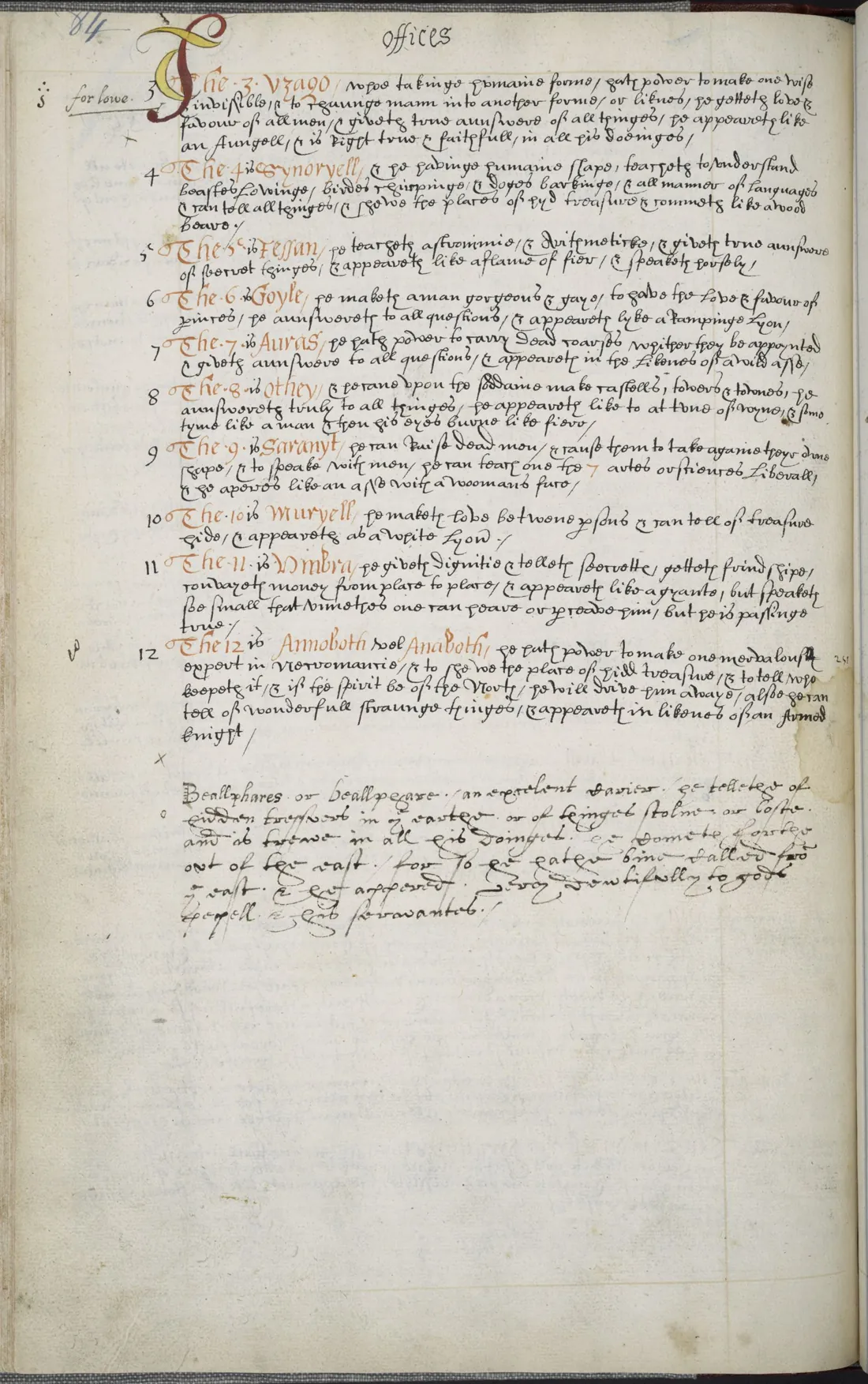
p. 84#page84
Liber Officiorum Spirituum — imago facsimilaris (p. 84) · facsimile
Folger Shakespeare Library, MS V.b.26, pp.73–84
🔍 preme ut amplifices

TranscriptioElizabethan English

3. Vzago[?] who, takinge humaine forme, hath power to make one [goe] Invisible, & to [transform] a man into another forme or liknes; he getteth love & favour of all men, & giveth true aunswere of all thinges; he appeareth like an Aungell, & is right true & faithfull in all his doeings.

4. Synovell[?] & he, havinge humaine shape, teacheth to understand beastes' lowinges, birdes' chirpinges, & dogges' barkinge, & all manner of langhages; & can tell all thinges, & sheweth the places of hid treasure; & commeth like a wood beare.

5. Fessan[?] he teacheth astronomie & arithmetike, & giveth true aunswere of secret thinges; & appeareth like a flame of fier; & speaketh [hoarsely].

6. Goyle[?] he maketh a man vertuous & gay, [&] to have the love & favour of princes; he aunswereth to all questions; & appeareth like a rampinge Lyon.

7. Auras[?] he hath power to carry dead carkes[carcasses] whither they be appointed; & giveth aunswere to all questions; & appeareth in the liknes of an old asse.

8. Othey[?] & he rideth upon the soddaine[?], [&] maketh castells, towers & townes; he aunswereth truly to all thinges; he appeareth like to a tunne[tonel] of wyne, & sometyme like a man, & then his eyes burne like fier.

9. Saranyt[?] he can raise dead men, & cause them to [rise] against their [enemies?], & to speake with men; he can teach one the 7 artes or sciences liberall; & he appeareth like an asse with a womans face.

10. Wurvell[?] he maketh [peace] to be betwene persons; & can tell of treasures hid; & appeareth as a white Lyon.

11. Nimbra[?] he giveth dignities, & telleth secrettes; getteth frende[ship]; conveyeth money from place to place; & appeareth like a giante, but speaketh so small that unneathesvix one can heare [or see] him; but he is passinge true.

12. Annoboth vel Anaboth[?] he hath power to make one marvelously experte in Nigromancie; & to shew the place of hid treasure, & to keepe it; & if the spirit be of the North, he will [serve] him always; & also he can tell of wonderfull straunge thinges; & appeareth in [the] liknes of an armed knyght.

[párrafo de cierre:] Beallphares or Beallpeare, an excellent [servitor]; he telleth of sudden treasures in the earth, or of thinges stolen or loste, & is [faithful] in all his doings; he commeth forth out of the east, for so he [was] before called; [he is] Rex of the east; & he appeareth very [obediently] to god['s people?]… himself & his servauntes.

Grimorium · grimorium.lat · CC BY 4.0 · Scheda