Liber Officiorum Spirituum

El Libro de los Oficios de los Espíritus

Folger Shakespeare Library, MS V.b.26, pp.73–84
Descargar PDF ↓
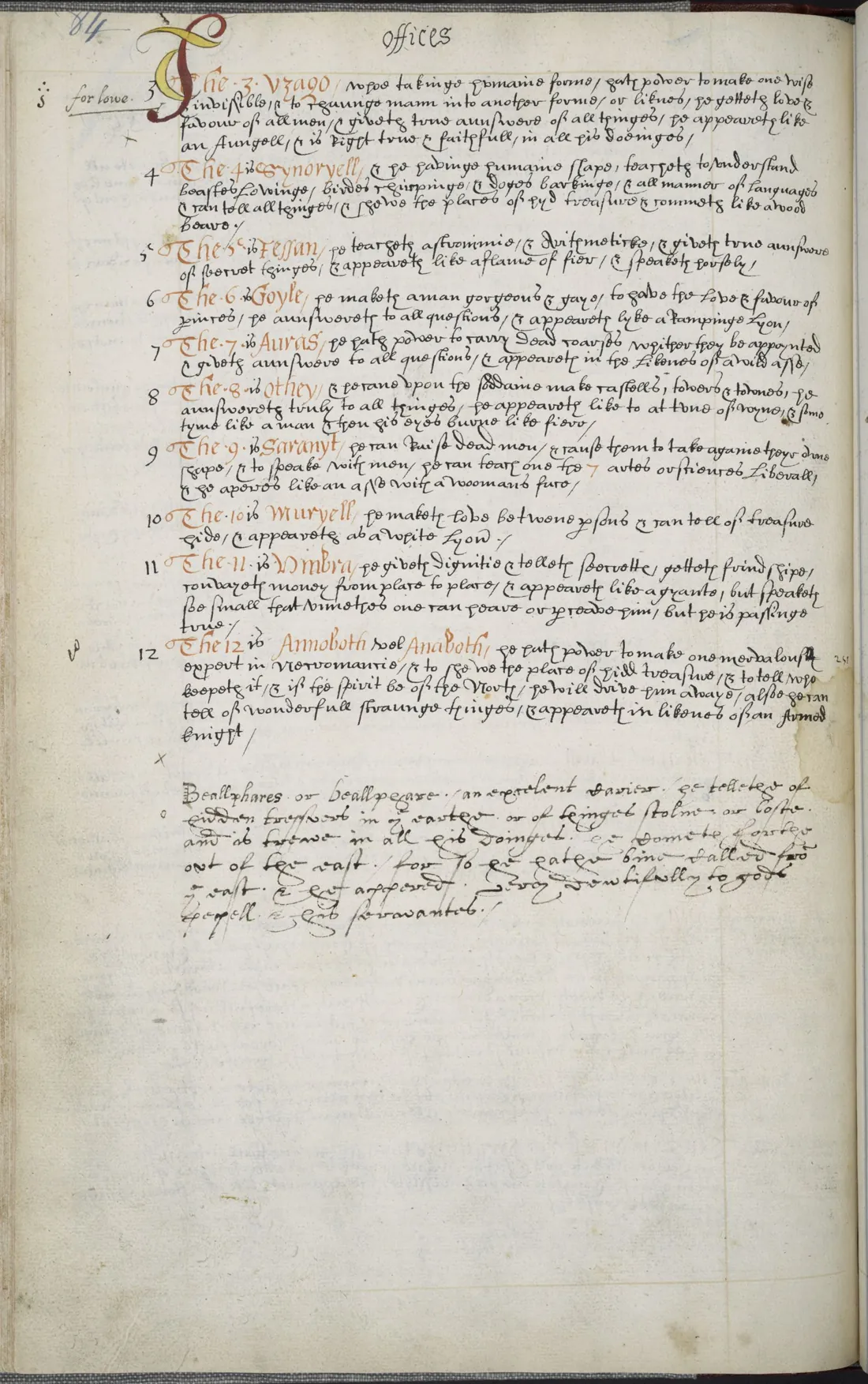
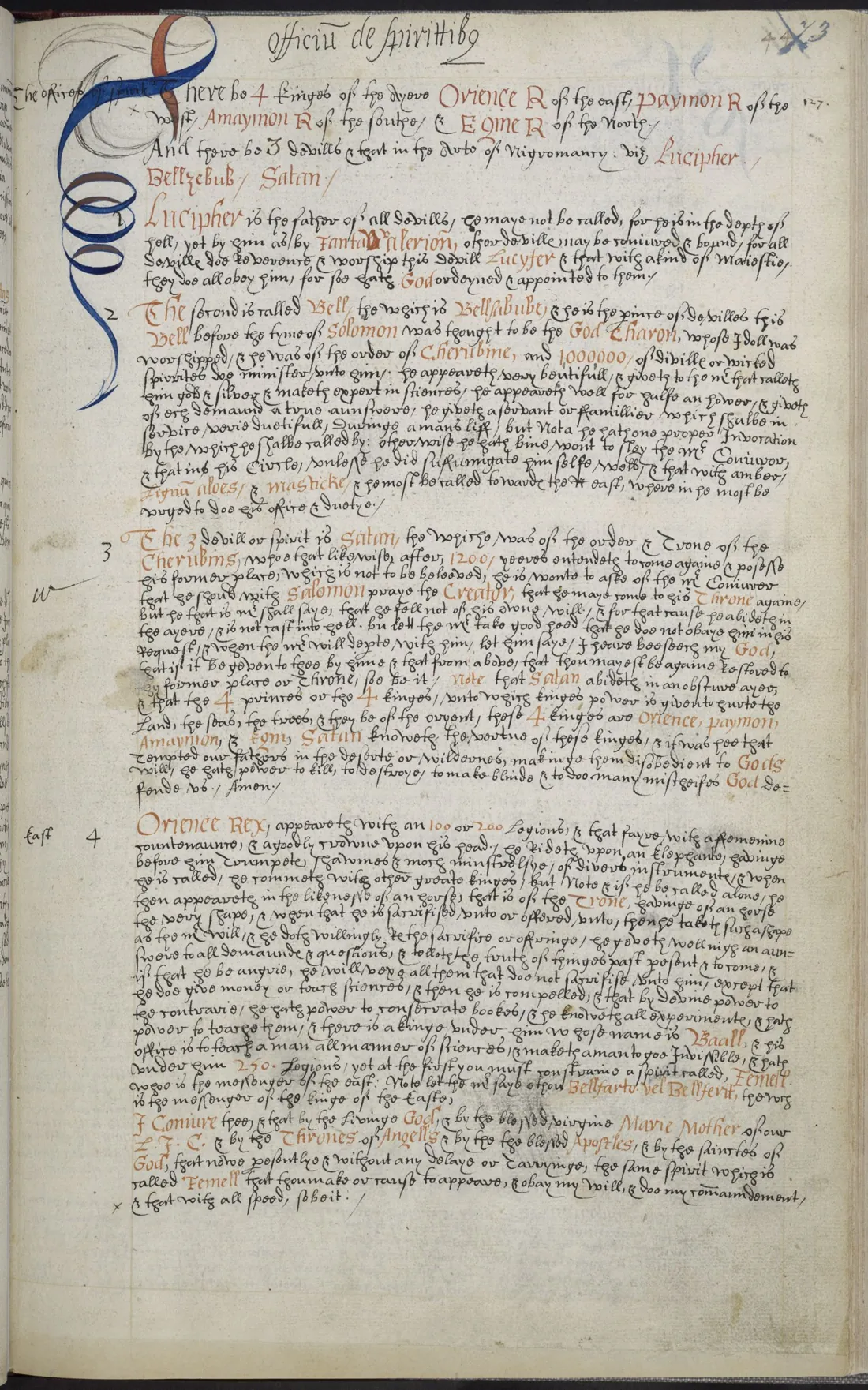
p. 73#page73
Liber Officiorum Spirituum — facsímil · p. 73 · dominio público
Folger Shakespeare Library, MS V.b.26, pp.73–84
🔍 clic para ampliar

TranscripciónInglés isabelino

[encabezado, latín:] Officiu[m] de spirittib[us].

There be 4 kynges of the dyvels: Orience R[ex] of the east, Paymon R[ex] of the west, Amaymon R[ex] of the southe, Egine R[ex] of the North. And there be 3 devills that [are] in the arte of Nigromancy: viz Lucipher, Bellzebub, Satan.

1. Lucipher is the father of all devills; he maye not be called, for he is in the depth of hell; yet by him also, by fantasticall illusion, other devils may be coniured[conjured] & bound, for all the spirits doe reverence & worship this devill Lucyfer, & that with a kind of Majestie; they doe all obey him, for [that?] God ordeyned & appointed [them] to him.

2. The second is called Bell, the which is Bellzabub, & is the prince of devilles. This Bell, before the tyme of Solomon, was thought to be the God Charon, whose Idoll was worshipped; & he was of the order of Cherubime, and 1000000 [a million] of divils or wicked spirites doe minister [to] him. & he appeareth very beutifull, & giveth to him that calleth him gold & silver, & maketh [one] appert[expert] in sciences, & he appeareth well for gulfe an[d] power[?], & giveth… a true aunswere; he giveth a servant or familier while he liveth. But Nota: he giveth no proper Invocation… [tell?] the [conjuror?] that in his Circle, unlesse he did suffumigate him selfe… with amber, ligni aloes[áloe], & mastick; & he most be called toward the East, where he most be prayd to doo his office & dutye.

3. The 3[rd] devill or spirit is Satan, the which was of the order & Trone of the Cherubims, whose[?] that likewise, after 1200 yeeres, entendeth to come againe… he speak with Solomon [&] pray the Creator that he maye come to his Conjuror; but he that is [in] his fall sayes that he fell not of his owne will… it is not cast into hell. But tell them[?] he take good heed that he doo not obays[obey] him in his request… Note that Satan abideth in an obscure ayer, & that the 4 princes or the 4 kinges — unto which kinges power is given to rule the land, the sea, the trees — & they be of the oryent; those 4 kinges are Orience, Paymon, Amaymon & Egin. Satan knowes the vertue[?] of these kinges; & it was he that tempted our fathers in the deserte or wildernes, [& made?] them disobedient to Gods will; he hath power to kill, to destroye, to make blinde, & to doo many mistgeifes[ mischiefs]. God defende us. Amen.

4. Orience Rex appeareth with an 100 or 200 legions, & that fayre, with a feminine countenaunce, & a goodly crowne upon his head; & rideth upon an Elephante; [before?] him [go?] trumpets… & more minstrelsye of divers instruments. & when [th]en appeareth in the likenes of an [ho]rse, that is of the Trone[?]… & when that so is[?] sacrifised unto, thence take [th]e sacrafice; he doeth willingly, & he[?] answere or offrings; & he doeth well nigh an aunswere[?] of all demaundes & questions, & telleth the truth of thinges past [&] present, & to come; & he doe[th] give money or [treasure?], & then… & that by devine power to consecrate bookes; & he knowe[th] all experimentes; & his office is to teach a man all manner of sciences, & maketh a man to goe Invisible; & he hath under him 250 legions. Yet at the first you must constraine a spirit called Fennell, [who] is the messenger of the east. Note that the which sayes… Bellsarto vel Bellserit, the which is the messenger of the kinge of the East.

[conjuración:] I conjure thee, & that by the kynge God, & by the blessed virgine Marie Mother of our God J[esus] C[hrist], & by the Thrones of Angells, & by the blessed Apostles, & by the spirites of God, that now presently & without any delays or taryinge, the same spirit which is called Fennell, that thou make or cause to appeare, & obay my will, & doo my commaundement, & that with all speed. So be it.

TraducciónEspañol

[encabezado:] Oficio de los espíritus.

Hay cuatro reyes de los demonios: Oriente, rey del este; Paimon, rey del oeste; Amaymon, rey del sur; Egine, rey del norte. Y hay tres demonios en el arte de la nigromancia, a saber: Lucifer, Belcebú, Satán.

1. Lucifer es el padre de todos los demonios; no puede ser llamado, pues está en lo profundo del infierno; mas por medio de él, mediante visión[?], otros demonios pueden ser conjurados y atados, porque todos los espíritus reverencian y adoran a este demonio Lucifer, y ello con una suerte de majestad; todos le obedecen, porque Dios se los asignó y sometió.

2. El segundo se llama Bell, que es Belcebú, y es el príncipe de los demonios. Este Bell, antes del tiempo de Salomón, era tenido por el dios Carón, cuyo ídolo se adoraba; y era de la orden de los Querubines, y un millón de demonios o espíritus malignos le sirven. Aparece muy hermoso, y da oro y plata a quien lo llama, y hace [al hombre] experto en las ciencias; da buena respuesta verdadera; y da un sirviente o familiar mientras [el operador] viva. Pero nota: no se le da propia invocación… a menos que [el operador] se sahúme… con ámbar, madera de áloe y almáciga; y ha de ser llamado hacia el Este, donde ha de rogársele que cumpla su oficio y deber.

3. El tercer demonio o espíritu es Satán, que fue de la orden y trono de los Querubines, el cual, igualmente, tras 1200 años, pretende volver [al trono]… Note que Satán mora en un aire oscuro, y que los cuatro príncipes o cuatro reyes —a quienes se dio poder de regir la tierra, el mar y los árboles— son del oriente; esos cuatro reyes son Oriente, Paimon, Amaymon y Egin. Y fue Satán quien tentó a nuestros padres en el desierto y los hizo desobedientes a la voluntad de Dios; tiene poder de matar, destruir, cegar y hacer muchas fechorías. Dios nos defienda. Amén.

4. Oriente Rey aparece con cien o doscientas legiones, hermoso, de semblante afeminado, con una espléndida corona sobre la cabeza; cabalga un elefante; ante él [van] trompetas y más música de diversos instrumentos… Enseña todas las ciencias liberales; revela lo pasado, presente y por venir; da dinero o tesoros; conserva libros por poder divino; conoce todos los experimentos; hace al hombre invisible; y tiene bajo sí 250 legiones. Pero primero has de constreñir a un espíritu llamado Fennell, mensajero del este.

[conjuración:] Te conjuro, y ello por el Rey Dios, y por la bendita Virgen María, Madre de nuestro Dios Jesucristo, y por los Tronos de los Ángeles, y por los benditos Apóstoles, y por los espíritus de Dios, a que ahora mismo y sin demora ni tardanza, el mismo espíritu llamado Fennell, lo hagas aparecer y obedezca mi voluntad y cumpla mi mandato, y ello con toda presteza. Así sea.
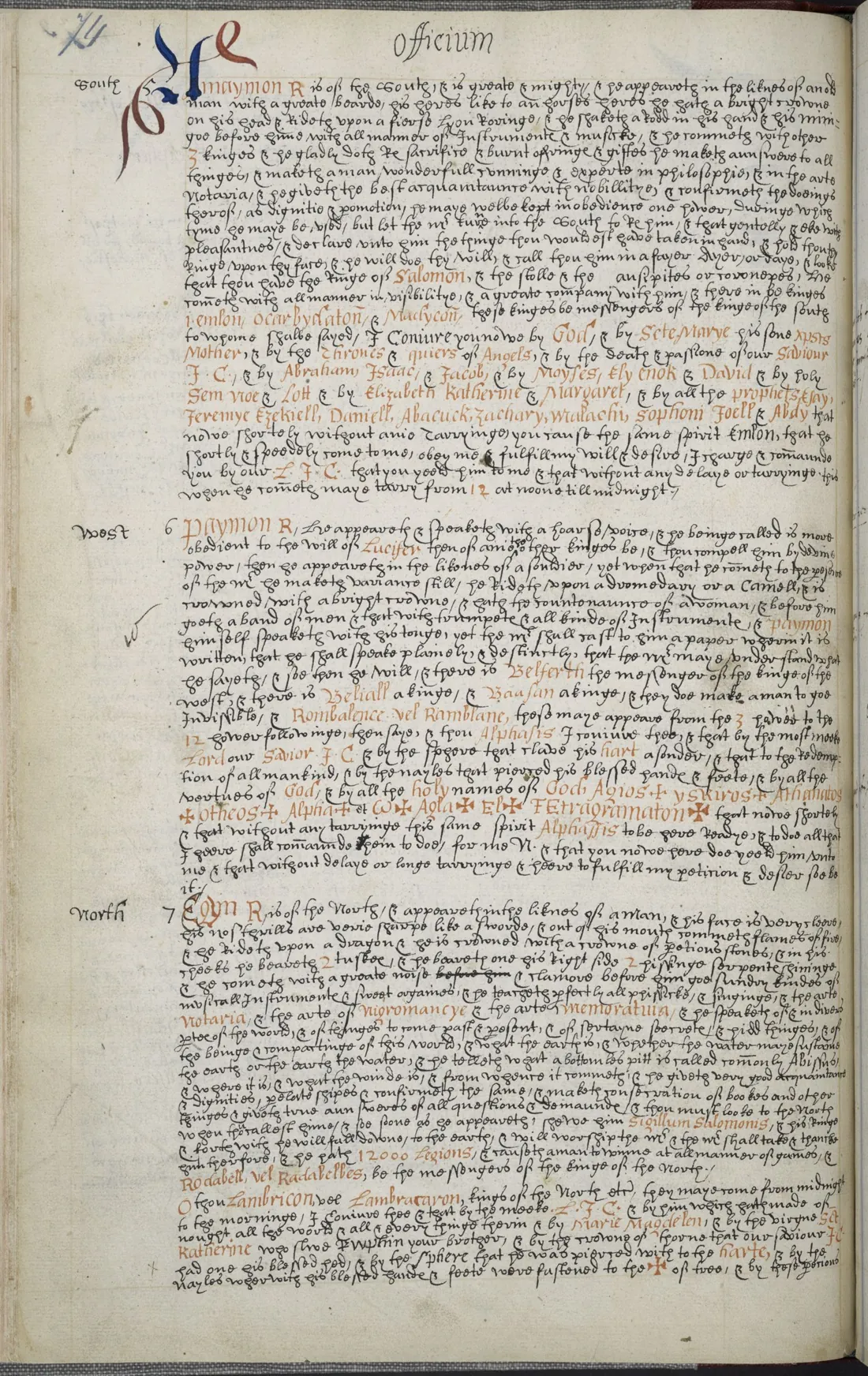
p. 74#page74
Liber Officiorum Spirituum — facsímil · p. 74 · dominio público
Folger Shakespeare Library, MS V.b.26, pp.73–84
🔍 clic para ampliar

TranscripciónInglés isabelino

[encabezado:] officium.

5. Amaymon R[ex] [south] is of the south, & is greate & mighty. He appeareth in the liknes of an old man with a greate bearde, his colour like an [ho]rse[?]; & rideth upon a fierce lyon roring, & he holdeth a todd[toad] in his hand. His m[essenger]… he commeth with all manner of Instrumentes, musick. 3 kinges he gladly does sacrifice & burnt offrings, & he maketh a man wonderfull cunning & experte in philosophie, [expert] in the arte Notaria; he giveth the best acquaintaunce with nobilitie; & consumeth the doings… as dignitie & promotion he maye… but let them not turne into the south to [call] him, [except] that gentelly & [with] pleasantnes… & call thou him in a fayre dry [day] or days… he [will] tell thee the kinges of Solomon… & he come with all manner in visibility, & a greate company with him. & there is the kinges of the south [messengers]: Iemlon, Ocarbydaton, Madycon. To whom is also sayed: I Conjure you now by God, & by Ste Marye his sonn X[Christ]'s Mother, & by the Thrones & quiers of Angels, & by the deathe & passion of our Saviour J[esus] C[hrist], & by Abraham, Isaac & Jacob, & by Moyses, Ely[Elias], Enok & David, & by holy Sem, Noe[Noah], Lott, & by Elizabeth, Katherine & Margaret, & by all the prophets, [Isaiah?], Jeremye, Ezekiell, Daniell, Abacuck[Habacuc], Zachary, Malachi, Sophonye[Sofonías], [& Abdy?], that now shortly, without any taryinge, you cause the same spirit Iemlon, that he shortly & spedely come to me, obey me, & fulfill my will… I charge & commaund you by our L[ord] J.C. that you [bring] him to me — & that without any delay or taryinge, this upon he come, maye tary from 12 at noon till midnight.

6. Paymon R[ex] [west]. He appeareth & speaketh with a hars[hoarse] voice, & he beinge called is more obedient to the will of Lucifer then any other kinges be. [You must] then compell him by some power. Then he appeareth in the likenes of a soudier[soldado]; yet when that he cometh to the presence of the m[aster], he maketh variance still. He rideth upon a dromedary or a Camell, & is crowned with a bright crowne, & hath the countenaunce of a woman; & before him goeth a band of men with trumpetts, all kinds of Instrumentes. Paymon him self speaketh with his tonge; yet the m[aster] shall reache to him a paper to [write] in, [so] that he shall speake plainly & do shortly, that the m[aster] maye understand what he sayeth. Yet then he will[?]… There is Belferth, the messenger of the kinge of the west; & there is Beliall a kinge, & Baasan a kinge; & they doe make a man to goe Invisible; & Rombalence vel Ramblane, those maye appeare. From the 3 [lords]… 12 [that] follow me… then sayes: thou Alphasis, I conjure thee, & that by our Savior J.C., & by the speare that clave his hart asonder, & by the redemption of all mankind, & by the nayles that pierced his blessed hande & feete, & by all the vertues of God, & by all the holy names of God: Agios · Yskiros · Athanatos · Otheos · Alpha et ω · Agla · Ely · Tetragrammaton, that now shortly & without any tarynge the same spirit Alphasis to appeare… & that you now cause [him to] doo… without delay or long taryinge, & [th]ere to fulfill my petition. & desire so be it.

7. Egin R[ex] [north] is of the North, & appeareth in the liknes of a man, & his nostrells are very sharpe like a swords, & out of his mouth commeth flames of fire. He rideth upon a Dragon, & is crowned with a crowne of pretious stones. In his right hand he beareth 2 tuskes, & he beareth on his right side 2 hissinge serpentes shininge; & he commeth with a greate noise before him, [with] flames [of fire?], & sundry kinds of minstralcy & Instrumentes & sweet organes. & he teacheth [per]fectly all pictures & singinge, & the arte Notaria, & the arte of Nigromancye, & the arte Memoratiua[memoria]; & he speaketh of thinges past & present, of certayne secrets & privie thinges… [of how] the earth is [held up?]… & he hath 12000 legions, & he transportes a man to winne at all manner of games. & Rodabell vel Radalvelles be the messengers of the kinge of the North. O thou Zambricon vel Zambraravon, kinge of the North etc. [conjuración:] I conjure thee, & that by the [most?]… J.C., & by him were [made] of nought, & by all the wordes… & holy thinges herein, & by Marie Magdelen, & by the virgine Ste Katherine… [I conjure] thee, [thou] Zambricon, in your brother['s name], & by the [rood?]… & by his blessed [rood], & by the [nayles?]…

TraducciónEspañol

[encabezado:] Oficio.

5. Amaymon Rey [sur] es del sur, y es grande y poderoso. Aparece en semejanza de un anciano de gran barba, de color como de caballo[?]; cabalga un feroz león rugiente y sostiene un sapo en la mano. Viene con toda clase de instrumentos, música. De buen grado se le hacen sacrificios y ofrendas quemadas; hace al hombre asombrosamente hábil y experto en filosofía y en el arte Notoria; da el mejor trato con la nobleza; concede dignidad y promoción… Pero que no se vuelvan hacia el sur para llamarlo sino con gentileza y agrado… y llámalo en un día seco y claro… Y viene con toda invisibilidad y gran compañía. Los mensajeros del rey del sur son Iemlon, Ocarbydaton, Madycon. A quien se dice: Os conjuro ahora por Dios, y por Santa María Madre de su Hijo Cristo, y por los Tronos y coros de los Ángeles, y por la muerte y pasión de nuestro Salvador Jesucristo, y por Abraham, Isaac y Jacob, y por Moisés, Elías, Enoc y David, y por los santos Sem, Noé, Lot, y por Isabel, Catalina y Margarita, y por todos los profetas —Isaías[?], Jeremías, Ezequiel, Daniel, Habacuc, Zacarías, Malaquías, Sofonías—… que ahora, sin tardanza, hagáis que el espíritu Iemlon venga pronto a mí, me obedezca y cumpla mi voluntad… Os ordeno por nuestro Señor Jesucristo que me lo traigáis — y sin demora; y una vez venga, podrá permanecer de las 12 del mediodía hasta la medianoche.

6. Paimon Rey [oeste]. Aparece y habla con voz ronca; y llamado, es más obediente a la voluntad de Lucifer que cualquier otro rey. [Hay que] constreñirlo con algún poder. Aparece en semejanza de un soldado; pero al llegar al habla con el maestro, mantiene resistencia. Cabalga un dromedario o camello, ceñido de una corona brillante, y tiene semblante de mujer; ante él va una tropa de hombres con trompetas y toda clase de instrumentos. Paimon habla con su propia lengua; mas el maestro le tenderá un papel para que escriba, de modo que hable claro y obre pronto, y el maestro entienda lo que dice. El mensajero del rey del oeste es Belferth; y hay un rey Beliall y un rey Baasan, que hacen invisible al hombre; y Rombalence vel Ramblane. [conjuración a Alphasis:] Te conjuro por nuestro Salvador Jesucristo, y por la lanza que hendió su corazón, y por la redención de todo el género humano, y por los clavos que traspasaron sus benditas manos y pies, y por todas las virtudes de Dios, y por todos los santos nombres de Dios: Agios · Yskiros · Athanatos · Otheos · Alphart et O · Aola · Eli · Tetragrámaton, que ahora y sin tardanza el espíritu Alphasis aparezca… y cumpla mi petición y deseo. Así sea.

7. Egin Rey [norte] es del Norte, y aparece en semejanza de un hombre; sus narices son muy afiladas como espadas, y de su boca salen llamas de fuego. Cabalga un dragón y está coronado con una corona de piedras preciosas. En la mano derecha lleva dos colmillos, y a su costado derecho dos serpientes; viene con gran estruendo, con llamas de fuego y diversas clases de juglaría, instrumentos y dulces órganos. Enseña perfectamente todas las figuras y dichos, y el arte Notoria, el arte de la Nigromancia y el arte de la Memoria; habla de lo pasado y presente, de ciertos secretos y cosas privadas… Tiene 12000 legiones, y hace ganar al hombre en toda clase de justas. Los mensajeros del rey del Norte son Rodabell vel Radalvelles. Oh tú Zambricon vel Zambraravon, rey del Norte… [conjuración por Jesucristo, María Magdalena, Santa Catalina virgen, y los clavos y la cruz].

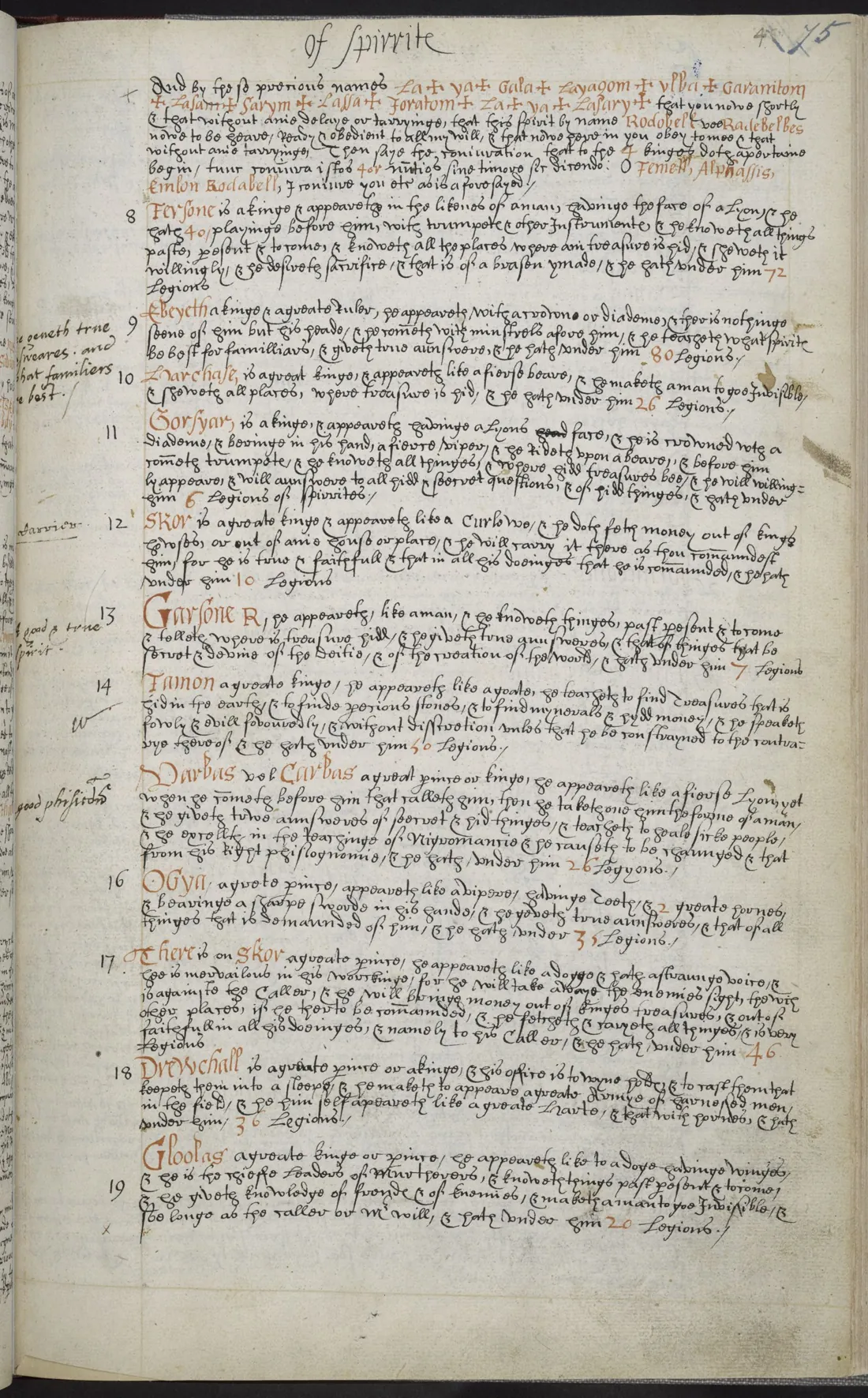
p. 75#page75
Liber Officiorum Spirituum — facsímil · p. 75 · dominio público
Folger Shakespeare Library, MS V.b.26, pp.73–84
🔍 clic para ampliar

TranscripciónInglés isabelino

(fin de la conjuración de Egin/Norte, con nombres divinos:) …Za, Yat, Gala, Zayagom, Ylba, Garamiton, Zasam, Sarym, Lassa, Foratum, Za, va, Zafary — that you now shortly, & that without any delays or taryinges, that this spirit by name Rodobell vel Radebelbes [be] now ready & obedient to my will… Then sayes the conjuration [common] to the 4 kinges' [ministers]: O Feniell, Alphassis, Emlon, Rodabell, I conjure you…

8. Persone is a kinge, & appeareth in the liknes of a man, & havinge the face of a Lyon, & he [hath] 40 playinge before him with trumpetts & other Instrumentes, & he knoweth all thinges past, present & to come, & endeweth[shows] all the places where any treasure is hid, & he doeth it willingly, & he desireth sacrifice, & that is of a brazen ymade[image]; & he hath under him 72 legions.

9. Eleyctha[?] a kinge & a greate ruler; he appeareth with a crowne or diademe, & there is nothinge sene of him but his heade; he commeth with minstrels afore him, & he teacheth[?] greate [things], [gives] the best for familiars, & giveth true aunswere; & he hath under him 80 legions.

10. Marchale is a greate kinge, & appeareth like a fierce beare, & maketh a man to goe Invisible, & sheweth all places where any treasure is hid; & he hath under him 26 legions.

11. Gorsyar is a kinge, & appeareth havinge a Lyons face [with] a diademe, & havinge in his hand a fierce viper, & he is crowned; [with] a remote[?] trumpett; & he knoweth all thinges, & rideth upon a beave[bear?]; & before him he appeareth, & will aunswere to all hidd & secret questions, & of treasures… he will willingly [tell]; & [hath under] him 6 legions of spirrites.

12. Skor is a greate kinge, & appeareth like a Curlewe[cigüeña?], & he doeth fetch money out of kinges houses, or out of any house or place, & he will carry it there as he is commaunded, for he is true & faithfull, & that in all his doeings that he is commaunded; & he hath under him 10 legions.

13. Garsone R[ex] he appeareth like a man, & he knoweth thinges past, present & to come, & telleth where is treasure hid, & he doeth true aunswere, & telleth of thinges that be [done]… & of the creation of… & hath under him 7 legions.

14. Famon a greate kinge, & appeareth like a goate; he teacheth to find treasure that is hid in the earthe, & he finds pretious stones, & to find myneralls, & [red?] money, & he speaketh very [hoarse?]; & he hath under him 50 legions.

15. Darbas vel Carbas a greate prince or kinge, & he appeareth like a fierce Lyon; when he cometh, [there is a] remote[voice?] before him that calleth him; then he taketh one comly forme of a man, & he [speaketh] in the hearinge of Nigromancie, & he causeth to be reconciled[?]… from his kyn[?]; & he hath under him 26 legions.

16. Ogyn a greate prince, appeareth like a viper, & havinge a sharpe sword in his hand, & he doeth teache, & [hath] 2 greate hornes; [he answereth] thinges that is demaunded of him; & he hath under him 35 legions.

17. There[?] is on Skor a greate prince; he appeareth like a doye[paloma?], & he asswageth[?] warre; he will take awaye the enemies sight, hearinge… & [bringe] money out of kinges treasures; & is very faithfull in all his doeings, & namely to the caller; & he hath under him 46 [legions].

18. Dirdvschall is a greate prince or a kinge, & his office is to rayne[?]… keepeth [men] into a sleepe, & he maketh it to appeare… in the fields; he appeareth like a greate Harte [ciervo], & that with hornes; & [hath] men under him 36 legions.

19. Gloolas a greate kinge or prince; he appeareth like to a doye[paloma] havinge winges, & he is the [ch]iefe leader of manslears[homicidas], & knoweth thinges past, present & to come, & maketh a man to goe Invisible, & so longe as the caller or m[aster] will; & hath under him 20 legions.

TraducciónEspañol

(fin de la conjuración de Egin/Norte, con nombres divinos Za, Yat, Gala, Zayagom, Ylba, Garamiton…:) …que ahora y sin demora el espíritu por nombre Rodobell vel Radebelbes esté presto y obediente a mi voluntad. Luego se dice la conjuración común a [los ministros de] los 4 reyes: Oh Feniell, Alphassis, Emlon, Rodabell, os conjuro…

8. Persone es un rey, y aparece en semejanza de un hombre con rostro de león; tiene 40 [músicos] tocando ante él con trompetas y otros instrumentos; conoce todo lo pasado, presente y por venir, y muestra todos los lugares donde hay tesoro escondido, y lo hace de buen grado; desea sacrificio, y ese [ha de ser] de una imagen de bronce; y tiene bajo sí 72 legiones.

9. Eleyctha[?] un rey y gran gobernante; aparece con una corona o diadema, y no se ve de él sino la cabeza; viene con juglares delante; enseña grandes [cosas], da los mejores familiares y da respuesta verdadera; y tiene bajo sí 80 legiones.

10. Marchale es un gran rey, y aparece como un feroz oso; hace al hombre invisible y muestra todos los lugares donde hay tesoro escondido; y tiene bajo sí 26 legiones.

11. Gorsyar es un rey; aparece con rostro de león y una diadema, llevando en la mano una feroz víbora, coronado; conoce todas las cosas; cabalga un oso[?]; responde a toda pregunta oculta y secreta, y sobre tesoros; y tiene bajo sí 6 legiones de espíritus.

12. Skor es un gran rey, y aparece como una cigüeña[?]; saca dinero de las casas de los reyes, o de cualquier casa o lugar, y lo lleva a donde se le ordena, pues es fiel y verdadero en todo lo que se le manda; y tiene bajo sí 10 legiones.

13. Garsone Rey aparece como un hombre; conoce lo pasado, presente y por venir, dice dónde hay tesoro escondido, da respuesta verdadera; y tiene bajo sí 7 legiones.

14. Famon un gran rey; aparece como una cabra; enseña a hallar el tesoro escondido en la tierra, encuentra piedras preciosas y minerales; habla muy [ronco?]; y tiene bajo sí 50 legiones.

15. Darbas vel Carbas un gran príncipe o rey; aparece como un feroz león; cuando viene, una [voz] lo precede que lo llama; luego toma una hermosa forma de hombre, y habla en el arte de la nigromancia; reconcilia[?]; y tiene bajo sí 26 legiones.

16. Ogyn un gran príncipe; aparece como una víbora, con una espada afilada en la mano; enseña; tiene dos grandes cuernos; responde lo que se le pregunta; y tiene bajo sí 36 legiones.

17. [Otro] Skor un gran príncipe; aparece como una paloma[?]; apacigua la guerra; quita a los enemigos la vista y el oído; trae dinero de los tesoros de los reyes; es muy fiel en todo, y en especial con quien lo llama; y tiene bajo sí 46 [legiones].

18. Dirdvschall un gran príncipe o rey; su oficio es… mantiene a los hombres en un sueño, y lo hace aparecer… en los campos; aparece como un gran ciervo con cuernos; y tiene bajo sí 36 legiones.

19. Gloolas un gran rey o príncipe; aparece como una paloma con alas; es el capitán principal de los homicidas; conoce lo pasado, presente y por venir, y hace al hombre invisible cuanto quiera quien lo llama; y tiene bajo sí 20 legiones.

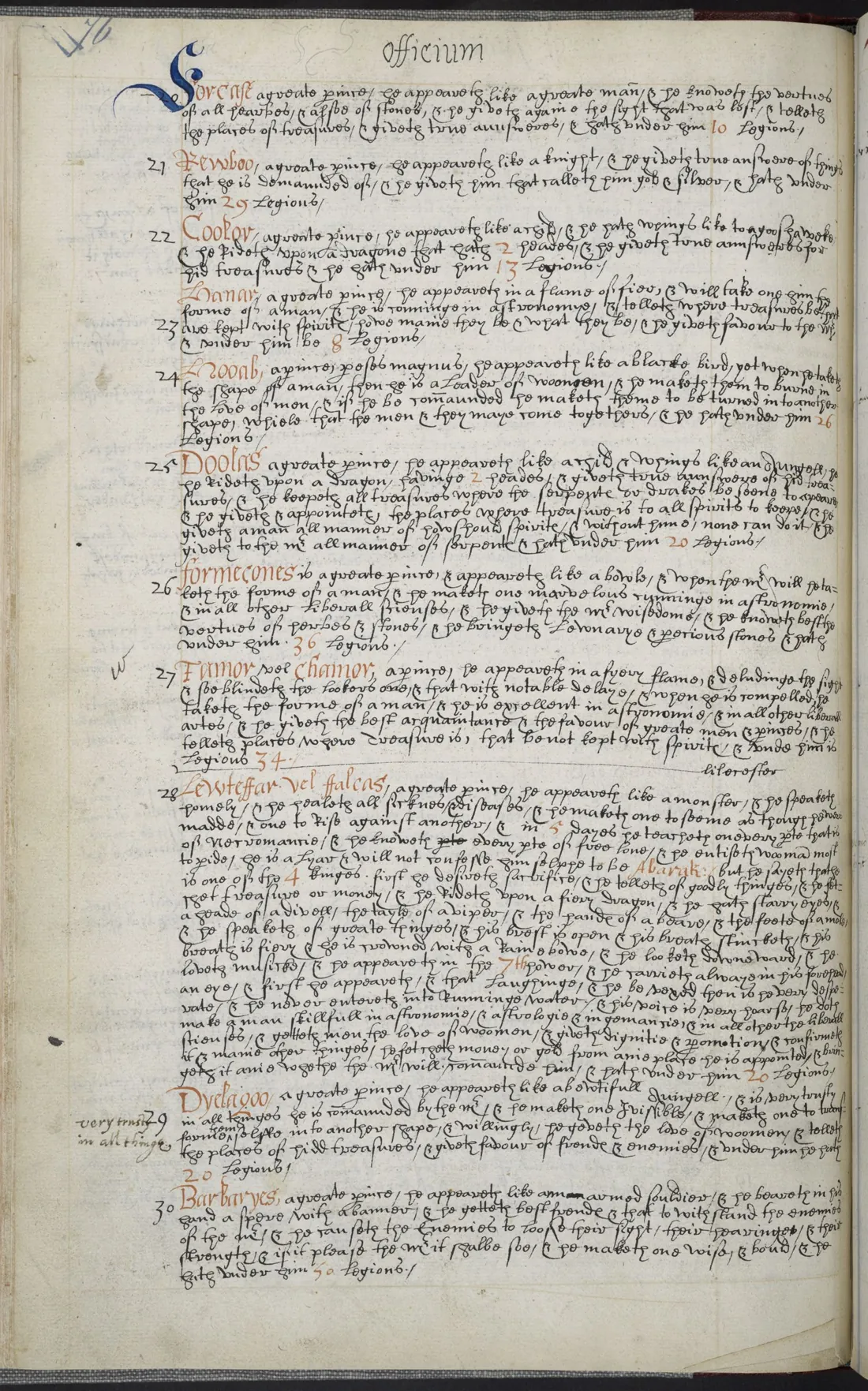
p. 76#page76
Liber Officiorum Spirituum — facsímil · p. 76 · dominio público
Folger Shakespeare Library, MS V.b.26, pp.73–84
🔍 clic para ampliar

TranscripciónInglés isabelino

[encabezado:] officium.

20. Forcase[?] a greate prince; he appeareth like a greate man, & he knoweth the vertues of all herbes & also of stones, & he doeth [answer] againe of thinges that was & doth [come]; he telleth the places of treasures, & giveth true aunswere; & hath under him 10 legions.

21. Pewboo[?] a greate prince; he appeareth like a knyght, & he giveth true aunswere of thinges that is demaunded of; & he giveth him that calleth him gold & silver; & hath under him 29 legions.

22. Cookor[?] a greate prince; he appeareth like a rose[?], & he hath winges like to a goose; he rideth upon a dragon that hath 2 heades; & he giveth true aunswere for the treasures; & he hath under him 13 legions.

23. Hanar[?] a greate prince; he appeareth in a flame of fier, & will take one in the forme of a man; & he is cunninge in astronomy, & telleth where treasures be [that] are kept with spirits, [how] many they be & what they be; & he giveth favour to the m[aster]; & [hath] under him 8 legions.

24. Loonab[?] a prince; he appeareth like a blacke bird, yet when he taketh the shape of a man, then he is a leader of woemen, & he maketh them to burne in the love of men; & if he be commaunded, he maketh [them] to be turned into another shape, [so] that the men & they maye come togethers; & he hath under him 26 legions.

25. Doolas[?] a greate prince; he appeareth like a greate [thing] with winges like an [ho]rse; he rideth upon a dragon havinge 2 heades; & he giveth true aunswere of hid juells[joyas]; & he keepeth all treasures where the serpente or dragon be seene, & he appointeth the places where treasure is to all spirites to keepe; & he giveth a man all manner of [precious] stones… none can do it [but he]; & he giveth to the m[aster] all manner of serpents; & hath under him 20 legions.

26. Formecomes[?] a greate prince; he appeareth like a bore[?]; & upon the m[aster's] will he taketh the forme of a man, & he maketh one marvelous cunninge in all liberall sciences, & he giveth the m[aster] wisdome, & he knoweth both the vertues of herbes & stones, & he bringeth [forth] precious stones; & [hath] under him 36 legions.

27. Furnor vel Chamor[?] a prince; he appeareth in a fier flame, & he blindeth the lookers on, & that with notable delay; & when he is compelled, he taketh the forme of a man, & he [is] excellent in astronomie & all other liberall artes, & he giveth the best acquaintaunce & the favour of greate men; & telleth places where treasure is that be not kept with spirits; & [hath] under him 34 legions.

28. Lewsteffar vel falcas[?] a greate prince; he appeareth like a monster, & he speaketh comely; & he maketh all frendes discords, & maketh one to rise against another; & in 5 dayes he teacheth one every whit that is to doe; he is a lyar & will not confesse [truth] except he be in one of the 4 kinges[']. First he desireth sacrifice, & he telleth of goodly thinges, & [of] a greate treasure or money; & he rideth upon a fier dragon; & he hath starry eyes, & he speaketh of greate thynges; his breste is open [&] stinketh; & he beareth 2 serpents; his breath is fier; & he is crowned with a rainebowe; & he loveth minstrelsy; & he appeareth in the 7th houre; & he raungeth always in the forrest; & he maketh a man skillfull in astronomie, astrologie & geomancie, [&] in all other the liberall sciences; & telleth men the love of woomen, & giveth dignitie & promotion, & consumeth[conveyeth?] those thinges — money or gold — from any place; & [hath] under him 20 legions.

29. Dyclagoo[?] a greate prince; he appeareth like a beutifull damsell in all thinges; he is commaunded by the m[aster], & he maketh one Invisible, & maketh one to turne from one shape into another shape, & willingly he giveth the love of woomen, & telleth the places of hid treasures, & giveth favour of frende & enemies; & [hath] under him 20 legions.

30. Barbaryes[?] a greate prince; he appeareth like an armed souldier, & he beareth in his hand a speare with a banner, & he getteth best frende, & that to withstand the enemies of the m[aster]; & he causeth the enemies to loose their sight, their hearinge & their strength, & if it please the m[aster] it shalbe so; & he maketh one wise & bold; & he hath under him 50 legions.

TraducciónEspañol

[encabezado:] Oficio.

20. Forcase[?] gran príncipe; aparece como un gran hombre; conoce las virtudes de todas las hierbas y también de las piedras; responde de lo que fue y ha de venir; dice los lugares de los tesoros y da respuesta verdadera; y tiene bajo sí 10 legiones.

21. Pewboo[?] gran príncipe; aparece como un caballero; da respuesta verdadera de lo que se le pregunta; da oro y plata a quien lo llama; y tiene bajo sí 29 legiones.

22. Cookor[?] gran príncipe; aparece como una rosa[?], con alas como de ganso; cabalga un dragón de dos cabezas; da respuesta verdadera sobre los tesoros; y tiene bajo sí 13 legiones.

23. Hanar[?] gran príncipe; aparece en una llama de fuego, y toma forma de hombre; es diestro en astronomía y dice dónde hay tesoros guardados por espíritus, cuántos son y qué son; da favor al maestro; y tiene bajo sí 8 legiones.

24. Loonab[?] príncipe; aparece como un pájaro negro; mas al tomar forma de hombre es guía de mujeres, y las hace arder en el amor de los hombres; si se le ordena, las transforma en otra figura para que el hombre y ellas puedan unirse; y tiene bajo sí 26 legiones.

25. Doolas[?] gran príncipe; aparece como algo grande con alas como de caballo; cabalga un dragón de dos cabezas; da respuesta verdadera de joyas ocultas; guarda todos los tesoros donde se ve la serpiente o el dragón, y asigna a todos los espíritus los lugares donde hay tesoro; da al hombre toda clase de piedras [preciosas]… nadie puede hacerlo [sino él]; y da al maestro toda clase de serpientes; y tiene bajo sí 20 legiones.

26. Formecomes[?] gran príncipe; aparece como un jabalí[?]; a voluntad del maestro toma forma de hombre; hace a uno maravillosamente diestro en todas las ciencias liberales; da sabiduría al maestro; conoce las virtudes de las hierbas y las piedras; y trae piedras preciosas; y tiene bajo sí 36 legiones.

27. Furnor vel Chamor[?] príncipe; aparece en una llama de fuego, y ciega a los espectadores, con notable demora; constreñido, toma forma de hombre; es excelente en astronomía y las demás artes liberales; da el mejor trato y el favor de los grandes; dice los lugares donde hay tesoro no guardado por espíritus; y tiene bajo sí 34 legiones.

28. Lewsteffar vel falcas[?] gran príncipe; aparece como un monstruo, y habla con gracia; siembra discordia entre amigos y hace que uno se alce contra otro; en 5 días enseña a uno todo cuanto haya de hacer; es mentiroso y no confiesa [la verdad] salvo estando bajo uno de los 4 reyes. Primero desea sacrificio; habla de cosas hermosas y de un gran tesoro o dinero; cabalga un dragón de fuego; tiene ojos de estrellas; habla de grandes cosas; su pecho está abierto y hiede; lleva dos serpientes; su aliento es fuego; está coronado con un arcoíris; ama la juglaría; aparece en la hora séptima; ronda siempre por el bosque; hace al hombre hábil en astronomía, astrología y geomancia y las demás ciencias liberales; enseña a los hombres el amor de las mujeres; da dignidad y promoción; y trae dinero u oro de cualquier lugar; y tiene bajo sí 20 legiones.

29. Dyclagoo[?] gran príncipe; aparece como una bella doncella en todo; es mandado por el maestro; hace a uno invisible; transforma a uno de una figura en otra; de buen grado da el amor de las mujeres; dice los lugares de los tesoros ocultos; da el favor de amigos y enemigos; y tiene bajo sí 20 legiones.

30. Barbaryes[?] gran príncipe; aparece como un soldado armado; lleva en la mano una lanza con estandarte; consigue el mejor amigo para resistir a los enemigos del maestro; hace que los enemigos pierdan la vista, el oído y la fuerza, si place al maestro; hace a uno sabio y audaz; y tiene bajo sí 50 legiones.

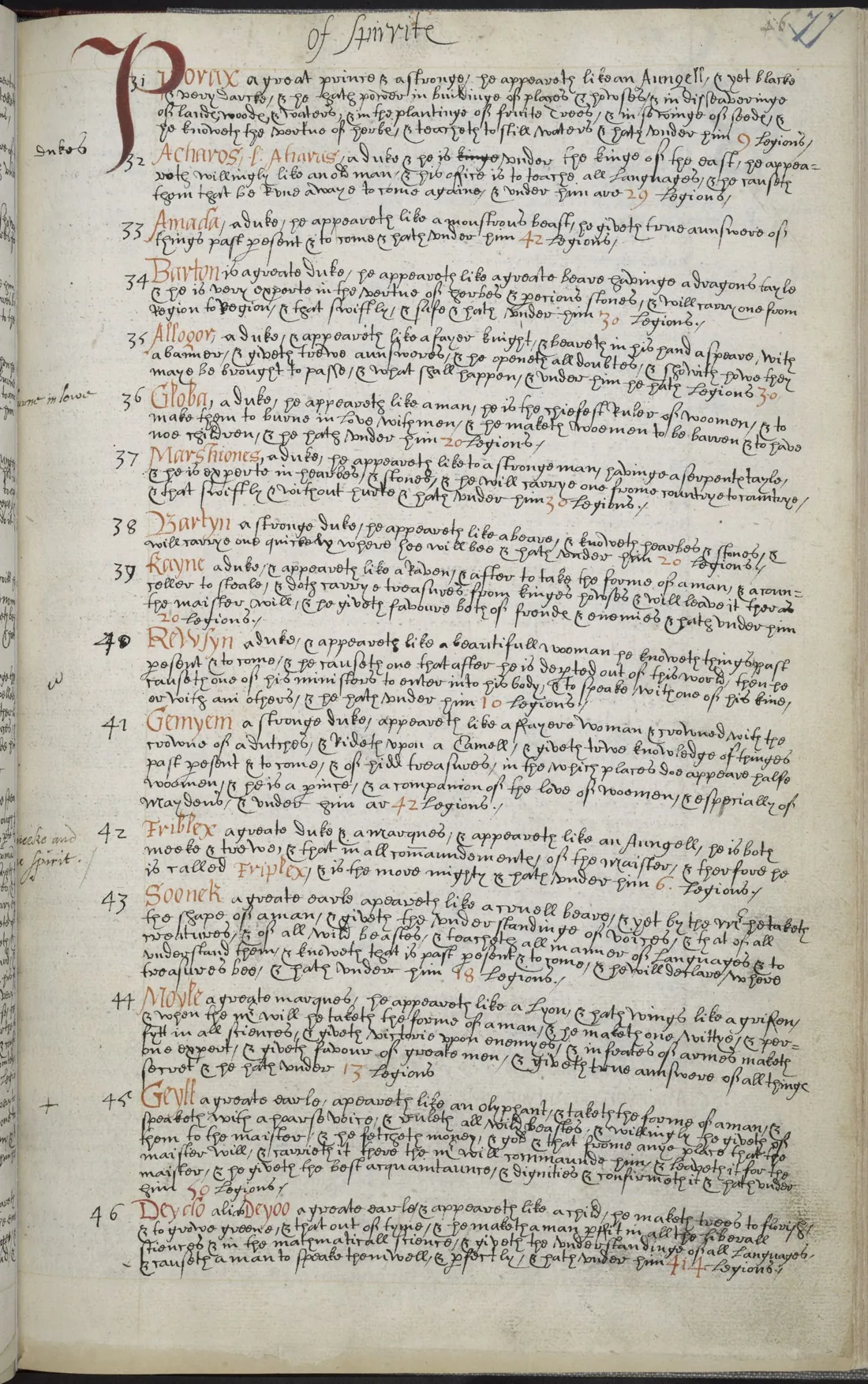
p. 77#page77
Liber Officiorum Spirituum — facsímil · p. 77 · dominio público
Folger Shakespeare Library, MS V.b.26, pp.73–84
🔍 clic para ampliar

TranscripciónInglés isabelino

31. Poryx[?] a greate prince & a stronge; he appeareth like an Aungell, & yet blacke, very [fair]; & he hath power in buildinge of places & houses, & in discoveringe of landes, woodes, & in the plantinge of fruite trees; & he knoweth the vertues of [herbes]; & teacheth to still waters; & [hath] under him 9 legions.

32. Acharos, l[ie] Aharus[?] a duke; he is kinge under the kinge of the east; he appeareth willingly like an old man, & his office is to teache all langhages, & he causeth them that be [taken] away to come againe; & under him ave[in all] 29 legions.

33. Amada[?] a duke; he appeareth like a monstruous [beast], & giveth true aunswere of thinges past, present & to come; & hath under him 42 legions.

34. Barton[?] is a greate duke; he appeareth like a greate beare, havinge a dragons tayle; & he is very experte in the vertues of herbes & precious stones; & will carry one from region to region, & that swiftlie; & also hath under him 30 legions.

35. Allogor[?] a duke; & appeareth like a fayer knyght, & beareth in his hand a speare with a banner; & giveth true aunswere; & he sheweth how they maye be brought to passe, & what shall happen; & under him he hath 30 legions.

36. Globa[?] a duke; he appeareth like a man; he is the chiefest ruler of woemen, & maketh them to burne in the love of men; & maketh woemen to be barren, & to have no children; & he hath under him 20 legions.

37. Marshiones[?] a duke; he appeareth like a stronge man, havinge a serpents tayle & stones[?]; & he is experte in herbes & stones; & he will carry one from countrye to countrye, & that swiftlie, & without hurte; & hath under him 30 legions.

38. Bartyn[?] a stronge duke; he appeareth like a boare; & knoweth herbes & stones; & will carry one quickly where soe [he] will be; & hath under him 20 legions.

39. Kayne[?] a duke; & appeareth like a raven, [in the] forme of a man; & he is a good disputer, & doth carry treasures from kinges houses, & will leade it there as the m[aster] will; & he giveth favour both of frende & enemies; & hath under him 20 legions.

40. Redysyn[?] a duke; & appeareth like a beautifull woman; he knoweth thinges past & to come, & he causeth one that, after he is departed out of his word[world], then to be revivinge[?] any others; & he ministreth to enter into his body, & to speake with one of the kinge['s]; & hath under him 10 legions.

41. Gemyem[?] a stronge duke; appeareth like a fayer woman, & crowned with the crowne of a dutches, & rideth upon a Camell, & giveth true knowledge of thinges past, present & to come, & of hid treasures — in the very places [they] doe appeare; also [procureth] woemen; & he is a prince, & a companion of the love of woemen, & especially of maydens; & under him 42 legions.

42. Friblex[?] a greate duke & a marques; & appeareth like an Aungell, meeke & true, & that in all commaundementes of the m[aster]; he is [both] called Friblex, & is the more mighty; & under him 6 legions.

43. Soonek[?] a greate earle; appeareth like a cruell beare, [in] the shape of a man; & giveth the understandinge of all wild beastes; & he understandeth them, & knoweth [thinges] past, present & to come, & of all manner of langhages [where] treasures be; & hath under him 18 legions.

44. Moyle[?] a greate marques; he appeareth like a Lyon, & hath winges like a griffen; when the m[aster] will, he taketh the forme of a man, & he maketh one witty & personable excellent; & giveth victorie upon enemies, & in feates of armes; & maketh a servt; & giveth true aunswere of all thinges; & under [him] 13 legions.

45. Gevll[?] a greate earle; appeareth like an olyphant[elefante], [then] taketh the forme of a man, speaketh with a hoarse voice, & ruleth all wild beastes, makinge them [obey] to the m[aster]; & he fetcheth money & bringeth [it from] any place that the m[aster] will, & carrieth it there [as] the m[aster] commaundeth him; & he giveth the best acquaintaunce & dignities; & hath under him 50 legions.

46. Deyclo alias Deyoo[?] a greate earle; & appeareth like a [beast], & maketh trees to florish & to grow greene, & that out of tyme; & he maketh a man perfitt in all the liberall sciences & in the mathematicall sciences; & giveth the understandinge of all langhages, & causeth a man to speake them well & perfitly; & hath under him 414[?] legions.

TraducciónEspañol

31. Poryx[?] gran príncipe fuerte; aparece como un ángel, pero negro; tiene poder en la construcción de lugares y casas, en descubrir tierras y bosques, y en plantar árboles frutales; conoce las virtudes de las [hierbas]; enseña a destilar aguas; y tiene bajo sí 9 legiones.

32. Acharos, alias Aharus[?] duque; es rey bajo el rey del este; aparece de buen grado como un anciano; su oficio es enseñar todas las lenguas, y hace volver a los que se han ido; y bajo sí, en total, 29 legiones.

33. Amada[?] duque; aparece como una bestia monstruosa; da respuesta verdadera de lo pasado, presente y por venir; y tiene bajo sí 42 legiones.

34. Barton[?] gran duque; aparece como un gran oso con cola de dragón; es muy experto en las virtudes de las hierbas y piedras preciosas; traslada a uno de región en región, y con rapidez; y tiene bajo sí 30 legiones.

35. Allogor[?] duque; aparece como un bello caballero, y lleva en la mano una lanza con estandarte; da respuesta verdadera; resuelve todas las dudas de lo que ha de suceder; y bajo sí [ciertas] legiones.

36. Globa[?] duque; aparece como un hombre; es el principal gobernante de las mujeres, y las hace arder en el amor de los hombres; y hace estériles a las mujeres, sin hijos; y tiene bajo sí 20 legiones.

37. Marshiones[?] duque; aparece como un hombre fuerte con cola de serpiente; traslada a uno de país en país, con rapidez; y tiene bajo sí 36 legiones.

38. Bartyn[?] fuerte duque; aparece como un jabalí; conoce hierbas y piedras; traslada a uno rápidamente adonde quiera; y tiene bajo sí 20 legiones.

39. Kayne[?] duque; aparece como un cuervo en forma de hombre; es buen disputador; lleva tesoros de las casas de los reyes adonde el maestro quiera; da el favor de amigos y enemigos; y tiene bajo sí 20 legiones.

40. Redysyn[?] duque; aparece como una hermosa mujer; conoce lo pasado y por venir; hace que [un alma], tras partir de este mundo, [tome cuerpo]; ministra para entrar en su cuerpo y hablar con uno de los del rey; y tiene bajo sí 10 legiones.

41. Gemyem[?] fuerte duque; aparece como una bella mujer, coronada con corona de duquesa, y cabalga un camello; da verdadero conocimiento de lo pasado, presente y por venir, y de los tesoros ocultos —aparecen en sus propios lugares—; procura mujeres; es príncipe y compañero del amor de las mujeres, en especial de las doncellas; y bajo sí 42 legiones.

42. Friblex[?] gran duque y marqués; aparece como un ángel, manso y veraz en todos los mandatos del maestro; es llamado Friblex, y es el más poderoso; y bajo sí 6 legiones.

43. Soonek[?] gran conde; aparece como un oso feroz [en] forma de hombre; da el entendimiento de todas las bestias salvajes; las entiende, y conoce lo pasado, presente y por venir, y todas las lenguas [donde] hay tesoros; y tiene bajo sí 18 legiones.

44. Moyle[?] gran marqués; aparece como un león con alas de grifo; a voluntad del maestro toma forma de hombre; hace a uno ingenioso y de excelente presencia; da victoria sobre los enemigos y en hechos de armas; da respuesta verdadera de todo; y bajo sí 13 legiones.

45. Gevll[?] gran conde; aparece como un elefante, luego toma forma de hombre, habla con voz ronca y gobierna todas las bestias salvajes, haciéndolas obedecer al maestro; saca dinero y lo trae de cualquier lugar adonde el maestro ordene; da el mejor trato y dignidades; y tiene bajo sí 50 legiones.

46. Deyclo alias Deyoo[?] gran conde; aparece como una bestia; hace florecer y verdear los árboles, aun fuera de tiempo; hace al hombre perfecto en todas las ciencias liberales y matemáticas; da el entendimiento de todas las lenguas y hace hablarlas bien y con perfección; y tiene bajo sí 414[?] legiones.

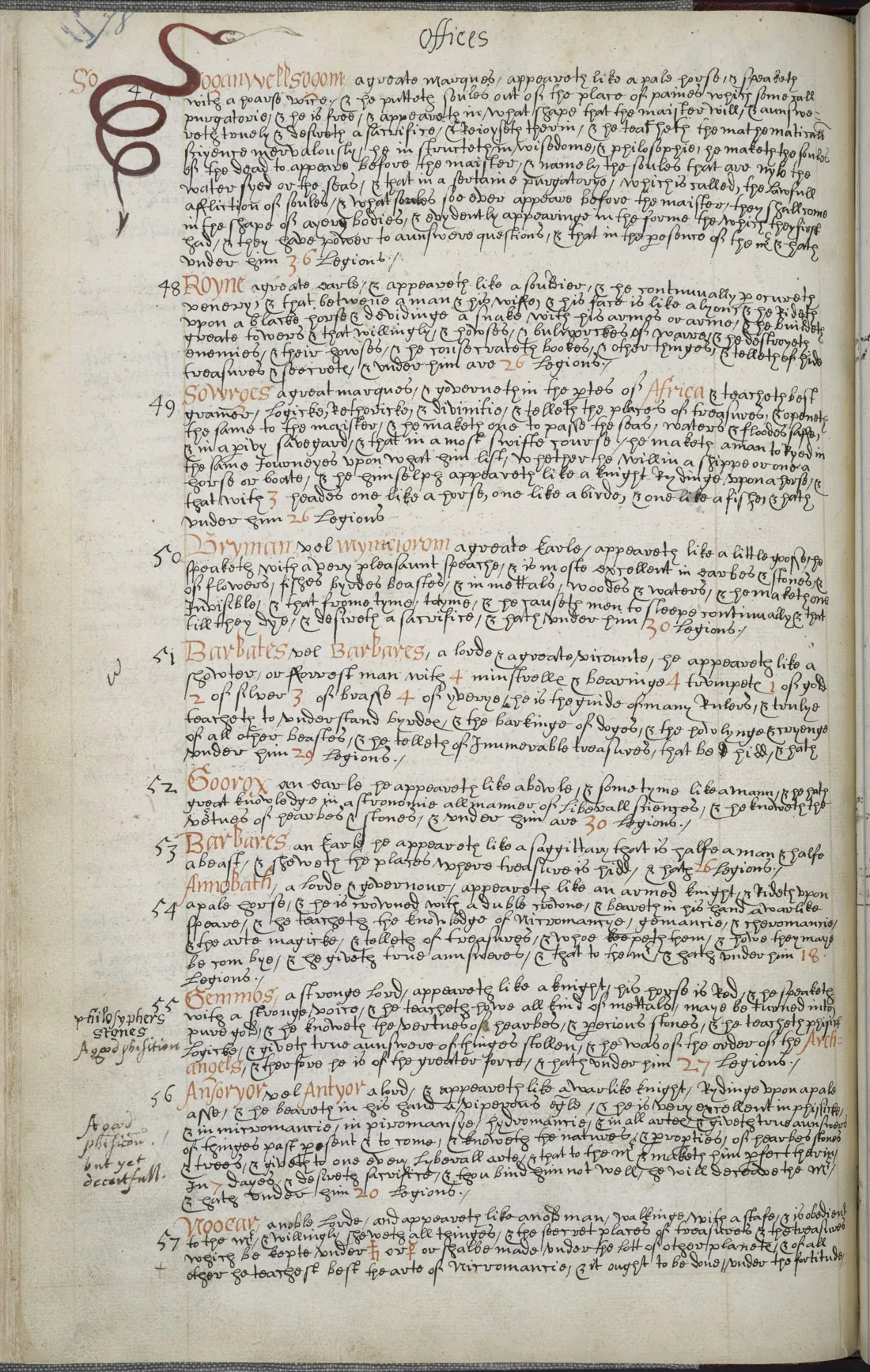
p. 78#page78
Liber Officiorum Spirituum — facsímil · p. 78 · dominio público
Folger Shakespeare Library, MS V.b.26, pp.73–84
🔍 clic para ampliar

TranscripciónInglés isabelino

47. Soganywellsogoom[?] a greate marques; appeareth like a pale [horse]; & he speaketh with a hoarse voice; & he pulleth soules out of the place of paines, which some call purgatorie; & he is free, & appeareth in what shape that the m[aster] will; & aunswereth to sacrifice… he marvelously instructeth in wisdome & philosophie; he maketh the soules of the dead to appeare before the m[aster], & namely the soules that are into the [place] which is called the dolefull affliction of soules; & what soules the m[aster] desire[th] appeare before the maister — they shall come in the shape of ayery bodies, & sodenly appearinge in [that] forme; & they take power to aunswere questions, & that in the presence of the m[aster]; & [hath] under him 36 legions.

48. Royne[?] a greate earle; & he appeareth like a soldier, & he continually worketh envy, & that betwene a man & his wife; & his face is like a lyon; he rideth upon a blacke [horse], holdinge a snake [in] his armes; & he kindleth greate [strife]; & he doth spoyle enemies & their [goods]; & he [stirreth up] warres… & telleth of hid treasures & secrets; & under him [in all] 26 legions.

49. Sowroes[?] a greate marques; & he governeth in the [parts] of Africa; & he teacheth best grammer, logicke, rethorike & divinitie; & telleth the places of treasures, & procureth the same to the m[aster]; & maketh one to pass the sea, waters & floodes safe, & that in a most swifte course; & he maketh a man to [travel]… whether within a [chamber], or on a horse or boate; & he himself appeareth like a knyght, ridinge upon a horse [with] 3 heades — one like a horse, one like a birde, & one like a [fish]; & [hath] under him 26 legions.

50. Dryman vel Wynxiorom[?] a greate earle; appeareth like a little [boy], & he speaketh with a very pleasaunt speache; he is most excellent in [the] vertues of flowers [& herbes], hid & [above ground], & in mettalls, woodes & waters; & he maketh one Invisible, & that from tyme to tyme; & he causeth men to sleepe continually, & that till they [die]; & desireth a sacrifice; & [hath] under him 30 legions.

51. Barbates vel Barbares[?] a lorde & a greate viscounte; he appeareth like a [forester] man, with 4 minstrells [bearing] 4 trompets — 1 of gold, 2 of silver, 3 of brasse, 4 of yvorye[marfil]; he is [the] guide of many [lords]; & truely teacheth to understand birdes, & the barkinge of dogges, & the lowinge of all other beastes; & he telleth of Immovable treasures that be hid; & [hath] under him 29 legions.

52. Gooryx vel Darlo[?] an earle; he appeareth like a [beast], & sometyme like a man; he hath greate knowledge in astronomie [&] all manner of liberall sciences; & he knoweth the vertues of herbes & stones; & under him [in all] 30 legions.

53. Barbares[?] an earle; he appeareth like a sagittary[centauro]; & [when] he is [also] a man, he [sheweth] the places wheare treasure is hid; & [hath] 26 legions.

54. Annobath[?] a lorde & governour; appeareth like an armed knyght, & rideth upon a pale [horse], & he is crowned with a duble diadem, & beareth in his hand [an emblem of] the arte magicke; & telleth of treasures, & he keepeth them; & giveth true aunswere; & hath under him 18 legions.

55. Gemmos[?] a stronge lorde; appeareth like a knyght, his horse is red, & he speaketh with a stronge voice; & he teacheth how all kinds of mettalls maye be turned into pure gold; & he knoweth the vertues of herbes & precious stones; & he teacheth pyromancie[?]; he giveth true aunswere of thinges stollen; & he was of the order of the Archangels[?]; & therefore he is of the greater force; & hath under him 27 legions.

56. Ansorvor vol Antyor[?] a lorde; & appeareth like a raven, [in the] liknes [of a] knyght, & rideth upon a pale asse, & he beareth in his hand a viperous [serpent]; & he is very excellent in phisicke[medicina], in nigromancie, in pyromancie, hydromancie, & in all artes; & giveth true aunswere of thinges past, present & to come; & knoweth the natures & properties of herbes, stones & trees; & bringeth one to be [expert] in liberall artes, [making] him perfitt therein in 7 dayes; & desireth sacrifice; & if you bind him not well, he will deceive the m[aster]; & [hath] under him 20 legions.

57. Nrocar[?] a noble lorde; & appeareth like an old man, walkinge with a staffe; & is obedient to the m[aster], & [sheweth] all thinges; & he [keepeth] the places of treasures & of holy [thinges], where he keepe[th] under Egyn… [he] tell[eth] of [the] planetes, & of all other; he teacheth best the arte of Nigromancie… (sigue en p.79)

TraducciónEspañol

47. Soganywellsogoom[?] gran marqués; aparece como un caballo pálido; habla con voz ronca; saca las almas del lugar de penas que algunos llaman purgatorio; es libre y aparece en la forma que el maestro quiera; instruye maravillosamente en sabiduría y filosofía; hace comparecer ante el maestro las almas de los muertos —en especial las que están en el lugar llamado «la dolorosa aflicción de las almas»—: vienen en forma de cuerpos aéreos, y responden a las preguntas en presencia del maestro; y tiene bajo sí 36 legiones.

48. Royne[?] gran conde; aparece como un soldado; obra continuamente la envidia, y ello entre marido y mujer; su rostro es de león; cabalga un caballo negro, sosteniendo una serpiente en los brazos; enciende grandes discordias; despoja a los enemigos y sus bienes; suscita guerras; dice de tesoros y secretos ocultos; y bajo sí, en total, 26 legiones.

49. Sowroes[?] gran marqués; gobierna en las partes de África; enseña óptimamente gramática, lógica, retórica y teología; dice los lugares de los tesoros y los procura al maestro; hace pasar seguro el mar, aguas y ríos, y con rapidísimo curso; traslada a un hombre… sea en una cámara, a caballo o en barco; él mismo aparece como un caballero a caballo, con tres cabezas —una de caballo, una de ave y una de pez—; y tiene bajo sí 26 legiones.

50. Dryman vel Wynxiorom[?] gran conde; aparece como un niño pequeño, y habla con voz muy agradable; es excelentísimo en las virtudes de las flores y hierbas, ocultas y visibles, y en metales, maderas y aguas; hace a uno invisible de tiempo en tiempo; hace dormir a los hombres de continuo, hasta [morir]; desea sacrificio; y tiene bajo sí 30 legiones.

51. Barbates vel Barbares[?] señor y gran vizconde; aparece como un montero, con cuatro juglares [portando] cuatro trompetas —1 de oro, 2 de plata, 3 de latón, 4 de marfil—; es guía de muchos [señores]; enseña verazmente a entender a las aves, el ladrido de los perros y el mugido de las demás bestias; dice de los tesoros inamovibles que están ocultos; y tiene bajo sí 29 legiones.

52. Gooryx vel Darlo[?] conde; aparece como una bestia, y a veces como un hombre; tiene gran conocimiento en astronomía y todas las ciencias liberales; conoce las virtudes de las hierbas y piedras; y bajo sí, en total, 30 legiones.

53. Barbares[?] conde; aparece como un sagitario[centauro]; y como hombre muestra los lugares donde hay tesoro escondido; y tiene 26 legiones.

54. Annobath[?] señor y gobernador; aparece como un caballero armado, cabalga un caballo pálido, está coronado con doble diadema y lleva en la mano [un emblema del] arte mágico; dice de los tesoros y los guarda; da respuesta verdadera; y tiene bajo sí 18 legiones.

55. Gemmos[?] fuerte señor; aparece como un caballero de caballo rojo, y habla con voz potente; enseña cómo convertir toda clase de metales en oro puro; conoce las virtudes de las hierbas y piedras preciosas; enseña piromancia[?]; da respuesta verdadera de lo robado; fue de la orden de los Archangels[?], por lo que es de mayor fuerza; y tiene bajo sí 27 legiones.

56. Ansorvor vol Antyor[?] señor; aparece como un cuervo en semejanza de caballero, cabalga un asno pálido y lleva en la mano una serpiente viperina; es excelentísimo en medicina, nigromancia, piromancia, hidromancia y todas las artes; da respuesta verdadera de lo pasado, presente y por venir; conoce las naturalezas y propiedades de hierbas, piedras y árboles; hace a uno perfecto en las artes liberales en siete días; desea sacrificio; y si no lo atas bien, engañará al maestro; y tiene bajo sí 20 legiones.

57. Nrocar[?] noble señor; aparece como un anciano que camina con un bastón; es obediente al maestro y [muestra] todas las cosas; guarda los lugares de los tesoros y de las cosas santas, donde guarda bajo Egyn; habla de los planetas y de todo lo demás; enseña óptimamente el arte de la nigromancia… (sigue en p.79)

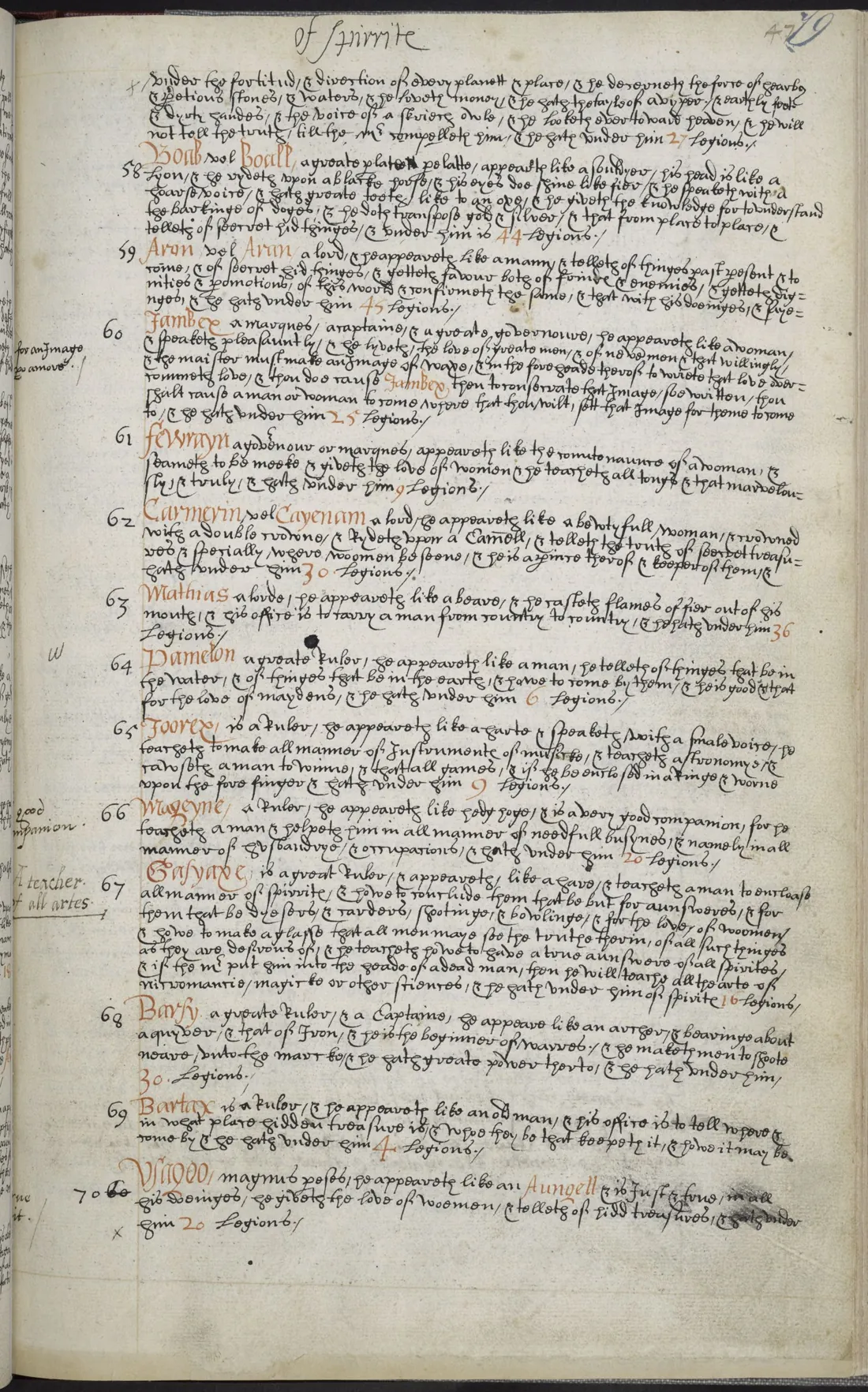
p. 79#page79
Liber Officiorum Spirituum — facsímil · p. 79 · dominio público
Folger Shakespeare Library, MS V.b.26, pp.73–84
🔍 clic para ampliar

TranscripciónInglés isabelino

[57, cont.] …vnder the fortitud[e], & diuersion[?] of euery planett & place, & he descoueroth the force of gearbes [herbes], & p[re]tious stones, & waters, & he loueth money, & he gate [hath] the tayles of a byrd, & partely foote & [duth?] handes, & the voice of a skriere [screech] owle, & he loketh about toward heauen, & he will not tell the truth, till the m[aster] compelloth him, & he hath vnder him 27 legions.

58. Boall vel Boall a greate p[re]late[?] [polatte], appeareth like a shuldyer [souldier], his heade is like a lyon, & he rydeth vpon a blacke horse, & his eyes doe shine like fier, & he speketh with a hoarse[?] voyce, & he gate greate feete like to an ope [ape], & he giueth the knowledge for to vnderstand the barkinge of dogges, & he dote [doth] transpose gold & siluer, & that from place to place, & telleth of secret hid thinges, & vnder him is 44 legions.

59. Aron vel Arin a lord, & he appeareth like a mann, & telleth of thinges past, present & to come, & of secret hid thinges, & getteth fauour bote [both] of frinde [friends?] & conomies [enemies?], & getteth dignities & p[ro]motions, of theyr word, & confirmote [confirmeth] the same, & that with his doeinges & sayenges, & he gate vnder him 45 legions.

60. Jamber a marques, a captaine, & a greate gouernour, he appeareth like a woman, & speketh pleasauntly, & he giueth the loue of greate men, & of noble men that willingly[?], & the maister must make an Image of waxe, & in the fore heades therof to write that loue [ouer?]… & thou doe cause Jamber, then to consecrate that Image, so writton, thou shalt cause a man or woman to come where that thou wilt, sett that Image for theme to come, & he gate vnder him 25 legions.

61. Fewrmyn a gouernour or marques, appeareth like the comtonaunce [countenance] of a woman, & […] mote to be mocke[?], & giueth the loue of women, & he teacheth all tonges, & that maruelou[s]ly & truly, & gate vnder him 9 legions.

62. Carmerin vel Cayenam a lord, & he appeareth like a bewtyfull woman, & a double [crowne?] [rudone?], & rydeth vpon a Camell, & telleth the truth of secret treasu[re], & specially, weare [where] woomen be sette[?], & his [acqueyntre?] therof, & kepeth of them, & gate vnder him 30 legions.

63. Mathias a lorde, he appeareth like a beare, & he casteth flames of fier out of his mouth, & his office is to tarry [carry] a man from country to country, & he gate vnder him 36 legions.

64. Pamelon a greate ruler, he appeareth like a man, he telleth of thinges that be in the water, & of thinges that be in the earth, & gaue [giue] to come by them, & his good, & that for the loue of maydens, & he gate vnder him 6 legions.

65. Foorex is a ruler, he appeareth like a garte[?], & speaketh swift[?] a smale voice, he teacheth to make all manner of Instrumente of musike, & teacheth astronomy, & teacheth a man to winne, & te[ach] at all games, & if he be enclosed in a ringe & worne vpon the fore finger, & gate vnder him 9 legions.

66. Wageyne a ruler, he appeareth like [a boy hoyo?] [ilegible], & is a very good companion, for he teacheth a man & helpeth him in all manner of needfull busynes, & namely in all manner of husbandrye & occupacions, & gate vnder him 20 legions.

67. Gasyare is a greate ruler, & appeareth like a garte[?], & teacheth a man to enclose all manner of spirites, & howe to conclude[?] them that be but for aunsweres, & for them that be desed[?] & tardous[?], sportinges & bowlinges, & for the loue of woomen, & howe to make a glasse that all men maye see the truthe therin, [of woomen] as they are desirous of, & he teacheth howe to gade [guide] a true aunswere of all sure thinges, & if the m[aster] put him into the heade of a dead man, then he will teache all spirites, nigromancie, magike or other sciences, & he gate vnder him of all the arte of spirite 16 legions.

68. Barsy a greate ruler, & a Captaine, he appeare[th] like an aurger [archer?], & bearinge about [a quiuer?], & that of Iron, & he is the beginner of warres, & he maketh men to shoote neare, vnto the marke[?], & he gate greate power therto, & he gate vnder him 30 legions.

69. Bartax is a ruler, & he appeareth like an old man, & his office is to tell where & in what place hidden treasure is, & whoe they be that keepeth it, & howe it may be come by, & he gate vnder him 4 legions.

70. Vsagoo magnus potes[t] [?], he appeareth like an Aungell, & is Iust & true, in all his doeinges, & he giueth the loue of woomen, & telleth of hidd treasures, & gate vnder him 20 legions.

TraducciónEspañol

[57, cont.] …bajo la fortaleza y la disposición[?] de cada planeta y lugar; descubre la virtud de las hierbas y de las piedras preciosas y de las aguas; ama el dinero; tiene la cola de un ave, y en parte pies y [¿…?] manos, y la voz de un búho [chotacabras/lechuza chillona]; mira alrededor hacia el cielo, y no dirá la verdad hasta que el maestro lo obligue; y tiene bajo sí 27 legiones.

58. Boall o Boall un gran prelado[?]; aparece como un soldado, su cabeza es como la de un león, y cabalga sobre un caballo negro, y sus ojos brillan como el fuego; habla con voz ronca[?]; tiene grandes pies como los de un simio, y da el conocimiento para entender el ladrido de los perros; transmuta oro y plata, y eso de un lugar a otro; y revela cosas secretas y ocultas; y bajo sí tiene 44 legiones.

59. Aron o Arin un señor; aparece como un hombre, y habla de las cosas pasadas, presentes y por venir, y de cosas secretas y ocultas; y consigue el favor tanto de amigos como de enemigos; y otorga dignidades y ascensos, según su palabra, y lo confirma, y eso con sus hechos y dichos; y tiene bajo sí 45 legiones.

60. Jamber un marqués, un capitán y un gran gobernador; aparece como una mujer, y habla agradablemente, y da el amor de los grandes hombres y de los nobles de buena voluntad[?]; y el maestro debe hacer una imagen de cera, y en la frente de ella escribir aquel amor…; y si haces que Jamber consagre esa imagen, así escrita, harás que un hombre o una mujer venga a donde tú quieras: pon esa imagen para que vengan a ella; y tiene bajo sí 25 legiones.

61. Fewrmyn un gobernador o marqués; aparece con el semblante de una mujer, y […]; da el amor de las mujeres, y enseña todas las lenguas, y eso maravillosa y verazmente; y tiene bajo sí 9 legiones.

62. Carmerin o Cayenam un señor; aparece como una hermosa mujer, con una doble [corona?], y cabalga sobre un camello; revela la verdad de los tesoros secretos, y especialmente donde las mujeres están [ocultas/dispuestas?], y [su conocimiento?] de ello, y las guarda; y tiene bajo sí 30 legiones.

63. Mathias un señor; aparece como un oso, y arroja llamas de fuego por la boca; y su oficio es transportar a un hombre de un país a otro; y tiene bajo sí 36 legiones.

64. Pamelon un gran gobernante; aparece como un hombre, y habla de las cosas que hay en el agua y de las cosas que hay en la tierra, y [da/consigue] llegar a ellas; y su bien, y eso por el amor de las doncellas; y tiene bajo sí 6 legiones.

65. Foorex es un gobernante; aparece como un [¿…?], y habla [rápido?] con voz pequeña; enseña a fabricar toda clase de instrumentos de música, y enseña astronomía, y enseña a un hombre a ganar y a [jugar?] en todos los juegos; y si se le encierra en un anillo y se lleva en el dedo índice…; y tiene bajo sí 9 legiones.

66. Wageyne un gobernante; aparece como [¿…? ilegible], y es muy buen compañero, pues enseña a un hombre y le ayuda en toda clase de asuntos necesarios, y especialmente en toda clase de labranza y oficios; y tiene bajo sí 20 legiones.

67. Gasyare es un gran gobernante; aparece como un [¿…?], y enseña a un hombre a encerrar toda clase de espíritus, y cómo [conjurar?] a los que sólo sirven para dar respuestas, y para los que están [dispuestos?] y [ociosos?], para tiros, bolos y otros pasatiempos, y para el amor de las mujeres; y enseña cómo hacer un espejo [«glasse»] en el que todos los hombres puedan ver la verdad, [de las mujeres] tal como las desean; y enseña cómo guiar una respuesta verdadera de todas las cosas seguras; y si el maestro lo mete en la cabeza de un hombre muerto, entonces enseñará todos los espíritus, la nigromancia, la magia u otras ciencias; y tiene bajo sí, de todo el arte de los espíritus, 16 legiones.

68. Barsy un gran gobernante y un capitán; aparece como un arquero[?], llevando consigo [una aljaba?], y esa de hierro; y es el iniciador de las guerras, y hace que los hombres disparen cerca del blanco[?]; y adquiere gran poder para ello; y tiene bajo sí 30 legiones.

69. Bartax un gobernante; aparece como un anciano, y su oficio es decir dónde y en qué lugar hay tesoro escondido, y quiénes son los que lo guardan, y cómo se puede conseguir; y tiene bajo sí 4 legiones.

70. Vsagoo «magnus potes[t]» [gran poder/potentado, latín, ?]; aparece como un ángel, y es justo y veraz en todos sus actos; y da el amor de las mujeres, y revela tesoros ocultos; y tiene bajo sí 20 legiones.

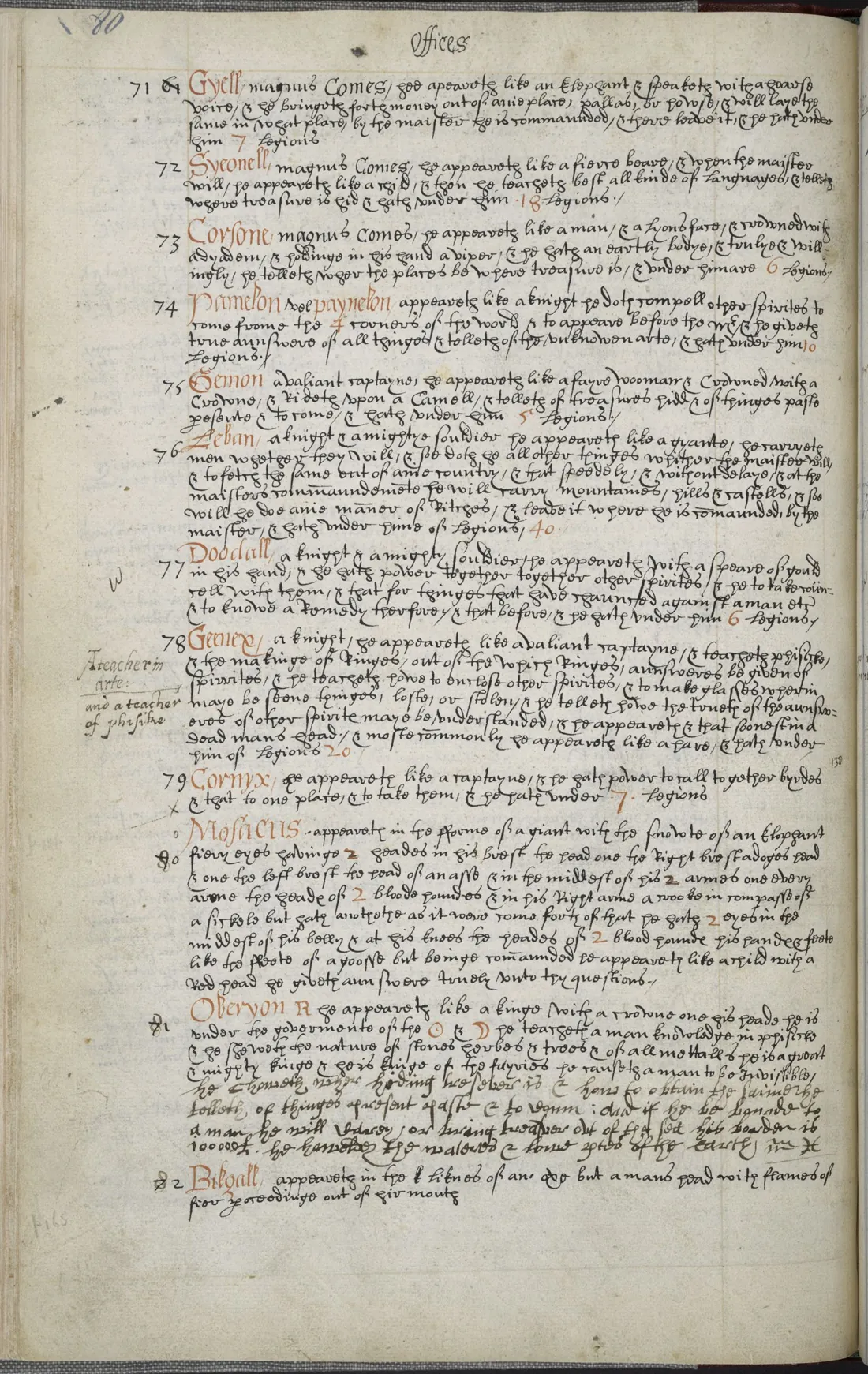
p. 80#page80
Liber Officiorum Spirituum — facsímil · p. 80 · dominio público
Folger Shakespeare Library, MS V.b.26, pp.73–84
🔍 clic para ampliar

TranscripciónInglés isabelino

71. Gyell, magnus Comes, he appeareth like an Elephant & speaketh with a graue voice, & he bringeth forth money out of anie place, pallab[le], or how, & will laye the same in what place, by the maister he is commaunded, & there leaue it, & he hath vnder him 7 legions.

72. Syconell, magnus Comes, he appeareth like a fierie beare, & vpon the maister will, he appeareth like a mayd, & then he teacheth best all kinde of Languages, & telleth wheare treasure is hid & hath vnder him 18 legions.

73. Corsone, magnus Comes, he appeareth like a man, & a lyons face, & crowned with a Dyadem, & holding in his hand a viper, & he hath an earthly bodye, & truely & willingly he telleth wheare the places be wheare treasure is, & vnder him are 6 legions.

74. Pamelon vel Paynelon, appeareth like a knight, he doth compell other spirites to come from the 4 corners of the world, & to appeare before the m[aister], & he giueth true aunswere of all things & telleth of the vnknowen arte, & hath vnder him 10 legions.

75. Semon, a valiant captayne, he appeareth like a fayre woomann & crowned with a Crowne, & rideth vpon a Camell, & telleth of treasure hid & of things paste, presente & to come, & hath vnder him 5 legions.

76. Zebun, a knight & a mightie souldier, he appeareth like a gyante, he carryeth [?] men wheather they will, & he doth he all other things whither the maister will, & to fetch the same out of anie country, & that speedely, & without delaye, & at the maisters commaundemente he will carry mountaines, hilles & castelles, & he will he doo anie manor of Ritches, & leade it wheare he is comaunded, by the maister, & hath vnder him[e] [?] of legions 40.

77. Doodcall, a knight & a mightie souldier, he appeareth with a speare of gould in his hand, & he getteth power together [to]gether other spirites, & he to take roune [?] roll with them, & that for things that gaue graunted [?] againe & a man ot[her] [ilegible] to knowe a Comody therefore, & that before, & he hath vnder him 6 legions.

78. Gemexe[?], a knight, he appeareth like a valiant captayne, & the makinge of kinges, out of the wighte [?] kinges, aunsweres be giuen of [?] spirites, & he teacheth howe to enclose other spirites [ilegible] maye be stone things, lost or stolen, & he telleth howe the truthe of the aunswere of other spirite maye be vnderstanded, & he appeareth & that soneste in a dead mans head, & moste commonly he appeareth like a faue [?], & hath vnder him of legions 20.

79. Cornyx, he appeareth like a captayne, & he getteth power to call together byrdes, & that to one place, & to take them, & he hath vnder [him] 7 legions.

80. Mosacus, appeareth in the fourme of a giant with the snoute of an Elephant, fierie eyes, hauing 2 heades in his brest, the head one the right brest a dogges head & one the left brest the head of an asse, & in the middest of his 2 armes one aboue [an]other the heade of 2 blood houndes, & in his right arme a wooke [?] in compasse of a sirkele, but hath another as it were come forth of that, he hath 2 eyes in the middest of his belly, & at his knees the heades of 2 blood hounde[s], his handes [&] feete like the feete of a goose, but beinge commaunded to appeareth like a child with a red head, he giueth aunswere truely vnto thy questions. [sin nº de legiones]

81. Oberyon R[ex], he appeareth like a kinge with a crowne on his head, he is vnder the gobermente of the ☉ & ☽, he teacheth a man knowledge in phisike, & he sheweth the nature of stones, herbes & trees, & of all mettalles, & he is a greate & mightie kinge & he is kinge of the fayries, he causeth a man to be Invisible, he sheweth wheare hidden treasure is & howe to obtaine the same, he telleth of thinges apresent & paste & to come: And if he be bounde to a man he will [discouer? vtter?] or bringe treasure out of the sea, his warden [?] is 1000000 [?], he [ilegible] the walles & tonn [town?] spies [?] of the earth in [ilegible]. [sin nº de legiones]

82. Bilgall, appeareth in the [likenes] of an[e] [ape/asse — ilegible] but a mans head with flames of fire proceedinge out of his mouth [entrada incompleta al pie; sin nº de legiones].

TraducciónEspañol

71. Gyell, gran conde; aparece como un elefante y habla con voz grave; saca dinero de cualquier lugar, palpable, o de otro modo, y lo pone en el lugar que el maestro le ordena, y allí lo deja; y tiene bajo sí 7 legiones.

72. Syconell, gran conde; aparece como un oso de fuego, y si el maestro quiere, aparece como una doncella; entonces enseña de la mejor manera toda clase de lenguas, y dice dónde hay tesoro oculto; y tiene bajo sí 18 legiones.

73. Corsone, gran conde; aparece como un hombre, con rostro de león, coronado con una diadema y sosteniendo una víbora en la mano; tiene cuerpo terrenal, y verdadera y voluntariamente dice dónde están los lugares donde hay tesoro; y bajo sí tiene 6 legiones.

74. Pamelon o Paynelon; aparece como un caballero; obliga a otros espíritus a venir desde las 4 esquinas del mundo y a comparecer ante el maestro; da respuesta verdadera de todas las cosas y enseña el arte desconocido; y tiene bajo sí 10 legiones.

75. Semon, valiente capitán; aparece como una hermosa mujer coronada con una corona, y cabalga sobre un camello; dice dónde hay tesoro oculto y de las cosas pasadas, presentes y por venir; y tiene bajo sí 5 legiones.

76. Zebun, caballero y poderoso soldado; aparece como un gigante; lleva [?] a los hombres a donde quieran, y hace todas las demás cosas adonde el maestro quiera, y las trae de cualquier país, y eso con rapidez y sin demora; y a mandato del maestro llevará montañas, colinas y castillos; y hará cualquier clase de riquezas, y las conduce adonde se le ordena, por el maestro; y tiene bajo sí 40 legiones.

77. Doodcall, caballero y poderoso soldado; aparece con una lanza de oro en la mano; reúne poder junto con otros espíritus, y ha de tomar rueda [?] con ellos, y eso por las cosas que fueron concedidas [?] de nuevo… [ilegible] enseñar a conocer una comedia [representación] con ello, y eso de antemano; y tiene bajo sí 6 legiones.

78. Gemexe[?], caballero; aparece como un valiente capitán; [trata de] la hechura de reyes, sacada de los reyes [?]; se dan respuestas por [?] espíritus, y enseña cómo encerrar a otros espíritus… [ilegible] pueden ser cosas de piedra [?], perdidas o robadas; y dice cómo puede entenderse la verdad de la respuesta de otro espíritu; y aparece, y lo más pronto en una cabeza de hombre muerto, y muy comúnmente aparece como un… [ilegible]; y tiene bajo sí 20 legiones.

79. Cornyx; aparece como un capitán; obtiene poder para reunir aves, y eso en un solo lugar, y para atraparlas; y tiene bajo sí 7 legiones.

80. Mosacus; aparece con forma de gigante con el hocico de un elefante, ojos de fuego, teniendo 2 cabezas en el pecho: la cabeza en el pecho derecho, una cabeza de perro, y en el pecho izquierdo, la cabeza de un asno; y en medio de sus 2 brazos, uno sobre otro, la cabeza de 2 sabuesos; y en su brazo derecho un… [?] en forma de un círculo, pero tiene otro como salido de aquel; tiene 2 ojos en medio del vientre, y en las rodillas las cabezas de 2 sabuesos; sus manos y pies como los pies de un ganso; pero al ser mandado, aparece como un niño de cabeza roja, y da respuesta verdadera a tus preguntas. [sin nº de legiones]

81. Oberyon, R[ey]; aparece como un rey con una corona en la cabeza; está bajo el gobierno del ☉ (Sol) y la ☽ (Luna); enseña a un hombre el conocimiento de la medicina, y muestra la naturaleza de las piedras, hierbas y árboles, y de todos los metales; es un gran y poderoso rey, y es rey de las hadas; hace invisible a un hombre; muestra dónde hay tesoro oculto y cómo obtenerlo; dice de las cosas presentes, pasadas y por venir; y si es ligado a un hombre, revelará [?] o traerá tesoro del mar; su guardián [?] es 1000000 [?]; él [ilegible] los muros y… [ilegible] de la tierra en… [ilegible]. [sin nº de legiones]

82. Bilgall; aparece en la [semejanza] de un[a]… [mono/asno — ilegible], pero con cabeza de hombre, con llamas de fuego saliendo de su boca [entrada incompleta al pie de página; sin nº de legiones].

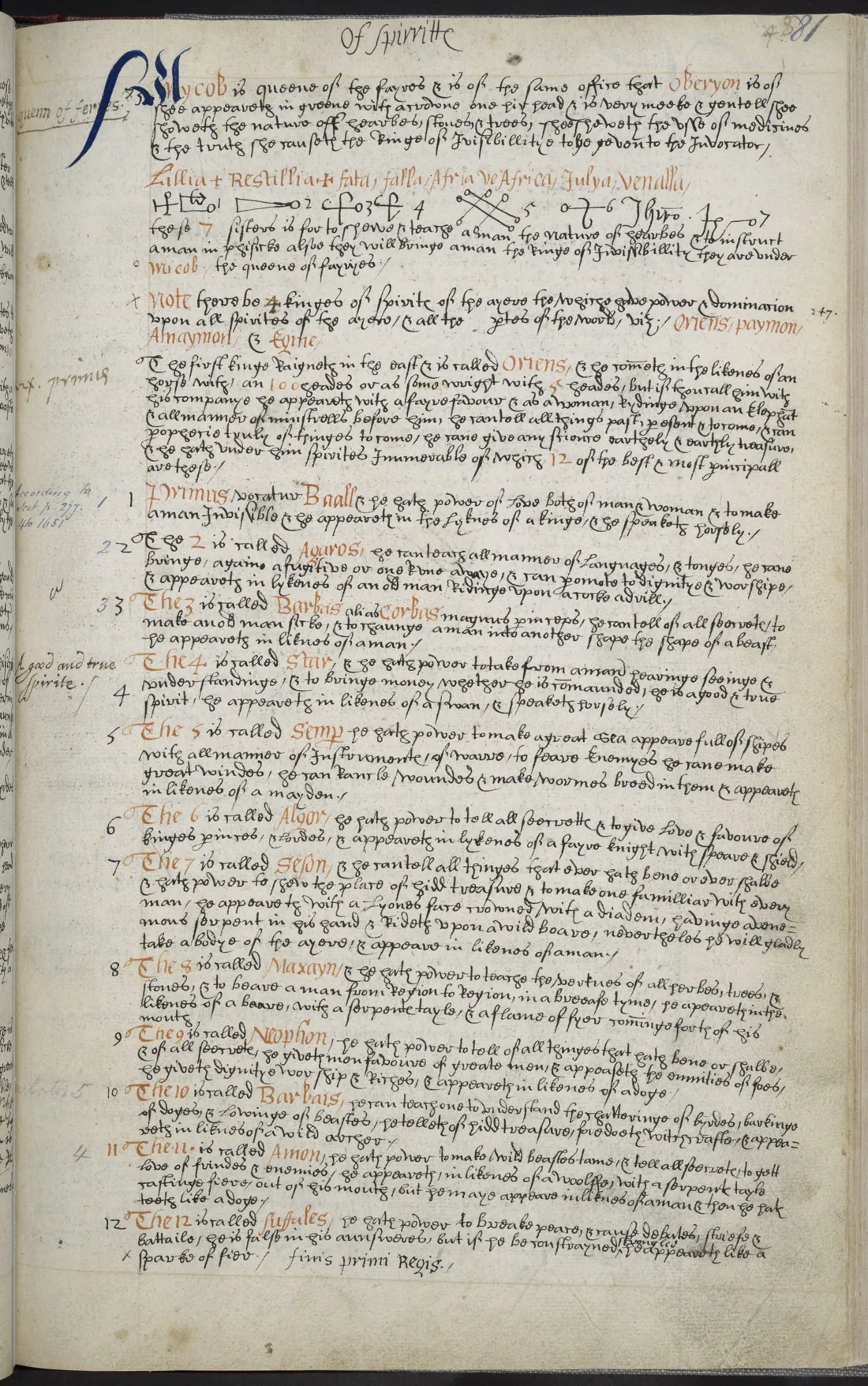
p. 81#page81
Liber Officiorum Spirituum — facsímil · p. 81 · dominio público
Folger Shakespeare Library, MS V.b.26, pp.73–84
🔍 clic para ampliar

TranscripciónInglés isabelino

[M]ycob is queene of the fayres & is of the same office that Oberyon is of she appeareth in greene w[i]th a rownde [thinge?] o[n] hir head & is very meke & gentell she sheweth the nature off herbes, stones, & trees, & sheweth the vse of medicines & the vertue[s], she causeth the ringe of Invisibillitie to be gyven to the Inuocator.

Lillia + Restillia + fata, falla, Afria ve[l] Africa, Julya, Venalla, [sigilo]·1 [sigilo]·2 [sigilo]·3 [sigilo]·4 [sigilo]·5 [sigilo]·6 Thiro·[sigilo]·7 these 7 sisters is for to sheowe & tear[c]he a man the nature off herbes & to instruct a man in phisicke, also they will bringe a man the ringe off Invisibillitie; they are under Micob the queene of fayries.

Note there be 4 kinges off spirite off the ayer the we[i]che gyue power & domination vpon all spirites of the ayer, & all the [partes?] off the woorld, viz: / ORIENS, Paymon, Amaymon, & Egine.

The first kinge Raignes[reigneth] in the East & is called ORIENS, & he cometh in the likenes of an horse w[i]th an 100 heades or ab[out] some wright[weight] w[i]th 5 heades, but if he call him w[i]th his companye he appeareth w[i]th a fayre favour & as a woman, rydinge vpon an Eloph[ant] & all manner of[f] minstrells before him; he can tell all thinges past, present & to come, & can prophecie truly of thinges to come, & he cane gyve any stronge castell & earthly treasure, & he hath vnder him spirites Immovable off weight; 12 of the best & most principall are these:

1. Primus vocatur Baall, & he hath power off love bote[both] off man & woman & to make a man Indivisible[Invisible] & he appeareth in the lyknes off a kinge, & he speaketh hoursly[hoarsely].

2. The 2 is called Agaros, he can teare[teach] all manner off Languages, & tonges, he cane bringe againe a fugitive or one that is awaye, & cane promote to dignitie & worshipe, & appeareth in lyknes off an old man Ridinge vpon a rocke advill[= crocodile?].

3. The 3 is called Barbas alias Corbus magnus princeps, he can tell off all secrete, to make an[od?] man sicke, & to re[c]haunge a man into another shape, the shape off a beast, & he appeareth in liknes off a man.

4. The 4 is called Star, & he hath power to take from a man his understandinge, & to bringe money wheither he is comaunded; he is a good & true spirit, he appeareth in liknes off a swan, & speaketh hoursly[hoarsely].

5. The 5 is called Semp, he hath power to make a great sea, & sea, appeare full off shipes w[i]th all manner off Instrumente[s] of warre, to feare[frighten] enemyes; he cane make great windes, he can[?] carve[cause] wounds & make wormes bread[breed] in them & appeareth in liknes off a mayden.

6. The 6 is called Algor, he hath power to tell all secrette, & to gyve love & favoure off kinges, princes, & lordes, & appeareth in lyknes off a fayre knight w[i]th speare & shield.

7. The 7 is called Seson, & he can tell all thinges that ever hath bene or ever shalbe, & hath power to sheowe the place off hidd treasure & to make one familliar[familiar] w[i]th ever[y] man; he appeareth w[i]th a Lyones[lioness's] face crowned w[i]th a diadem, havinge a[bout] a mons[monstrous?] serpent in his hand & Rideth vpon a wild boare; no[?]... he will gladly take a bodye off the ayer, & appeare in liknes off a man.

8. The 8 is called Maxayn, & he hath power to teache the vertues off all herbes, trees, & stones, & to beare a man from Region to Region in a breafe[brief] tyme; he appeareth in the liknes off a beare, w[i]th a serpents tayle, & a flame of fyer cominge forth off his mouth.

9. The 9 is called Neophon, he hath power to tell off all thinges that hath bene or shalbe, & off all secrete; he gyveth men favoure of greate men, & [ap]poste[declareth?] the enmities off foes, he gyveth dignitie or worship & Riches, & appeareth in liknes off a doge[dog].

10. The 10 is called Barbais, he can teare[teach] one to vnderstand the chatteringe off byrdes, barkinge off doges, & lowinge off beastes, to tell off hidd treasure, foredoote[?] w[i]th grasse[?], & appeareth in liknes of a wild [urcheon?/hedgehog?].

11. The 11 is called Amon, he hath power to make wild beastes tame, & tell all secrete, to gett love off frindes & enemies; he appeareth in liknes off a woolfe, w[i]th a serpents tayle castinge fier[fire] out off his mouth, but he maye appeare in liknes off a man & then he hath teeth like a doge.

12. The 12 is called Suffales, he hath power to breake speare, & cause doubtes, strife & battaile; he is false in his aunswers, but if he be constrayned [by his kinge?] he appeareth like a sparke of fier. — finis primi Regis. [fin del primer Rey]

TraducciónEspañol

[M]ycob es reina de las hadas y ejerce el mismo oficio que Oberyon. Aparece de verde, con [¿algo?] redondo sobre la cabeza; es muy mansa y gentil. Muestra la naturaleza de las hierbas, las piedras y los árboles, y enseña el uso de las medicinas y sus virtudes; hace que se dé al invocador el anillo de la Invisibilidad.

Lillia + Restillia + fata, falla, Afria o Africa, Julya, Venalla, [sigilo]·1 [sigilo]·2 [sigilo]·3 [sigilo]·4 [sigilo]·5 [sigilo]·6 Thiro·[sigilo]·7 Estas 7 hermanas sirven para mostrar y enseñar a un hombre la naturaleza de las hierbas y para instruirlo en la medicina; además le traerán el anillo de la Invisibilidad. Están bajo Micob, la reina de las hadas.

Nota: hay 4 reyes de los espíritus del aire, los cuales dan poder y dominio sobre todos los espíritus del aire y sobre todas las [¿partes?] del mundo, a saber: / ORIENS, Paymon, Amaymon y Egine.

El primer rey reina en el Este y se llama ORIENS; viene en semejanza de un caballo con 100 cabezas, o aproximadamente, según el caso, con 5 cabezas; pero si se le llama con su compañía aparece con hermoso semblante y como una mujer, cabalgando sobre un elefante, y con toda clase de juglares delante de él. Puede decir todas las cosas pasadas, presentes y por venir, y puede profetizar con verdad de las cosas venideras, y puede dar cualquier castillo fuerte y tesoro terrenal. Tiene bajo sí espíritus inamovibles de peso; los 12 mejores y más principales son estos:

1. El primero, llamado Baall: tiene poder sobre el amor, tanto de hombre como de mujer, y para hacer invisible a un hombre; aparece en semejanza de un rey y habla con voz ronca.

2. El 2, llamado Agaros: puede enseñar toda clase de lenguas e idiomas; puede hacer volver a un fugitivo o a quien esté ausente, y puede promover a dignidad y honra; aparece en semejanza de un anciano cabalgando sobre un rocke advill[¿= cocodrilo?].

3. El 3, llamado Barbas, alias Corbus, gran príncipe: puede revelar todo secreto, hacer enfermar a un hombre y transformar a un hombre en otra figura, la figura de una bestia; aparece en semejanza de un hombre.

4. El 4, llamado Star: tiene poder para quitarle a un hombre el entendimiento y para traer dinero adondequiera que se le mande; es un espíritu bueno y veraz; aparece en semejanza de un cisne y habla con voz ronca.

5. El 5, llamado Semp: tiene poder para hacer que un gran mar aparezca lleno de barcos con toda clase de instrumentos de guerra, para atemorizar a los enemigos; puede levantar grandes vientos, puede [¿causar?] heridas y hacer que críen gusanos en ellas; aparece en semejanza de una doncella.

6. El 6, llamado Algor: tiene poder para revelar todo secreto y para dar amor y favor de reyes, príncipes y señores; aparece en semejanza de un hermoso caballero con lanza y escudo.

7. El 7, llamado Seson: puede decir todas las cosas que jamás han sido o serán, y tiene poder para mostrar el lugar del tesoro escondido y para hacer a uno familiar de todo hombre; aparece con rostro de leona coronado con una diadema, teniendo [¿en torno?] una serpiente [¿monstruosa?] en la mano, y cabalga sobre un jabalí salvaje; [¿pero?]... tomará de buen grado un cuerpo del aire y aparecerá en semejanza de un hombre.

8. El 8, llamado Maxayn: tiene poder para enseñar las virtudes de todas las hierbas, árboles y piedras, y para llevar a un hombre de región en región en breve tiempo; aparece en semejanza de un oso, con cola de serpiente y una llama de fuego saliéndole de la boca.

9. El 9, llamado Neophon: tiene poder para decir todas las cosas que han sido o serán, y todo secreto; da a los hombres el favor de los grandes, y [¿declara?] las enemistades de los adversarios; otorga dignidad, honra y riquezas; aparece en semejanza de un perro.

10. El 10, llamado Barbais: puede enseñar a uno a entender el trinar de las aves, el ladrido de los perros y el mugido de las bestias, a revelar el tesoro escondido, y [¿adivinar?] con hierba[?]; aparece en semejanza de un [¿erizo?] salvaje.

11. El 11, llamado Amon: tiene poder para amansar a las bestias salvajes, revelar todo secreto y ganar el amor de amigos y enemigos; aparece en semejanza de un lobo, con cola de serpiente arrojando fuego por la boca, pero puede aparecer en semejanza de un hombre, y entonces tiene dientes como de perro.

12. El 12, llamado Suffales: tiene poder para quebrar lanzas y causar dudas, discordia y batalla; es falso en sus respuestas, pero si se le constriñe [¿por su rey?] aparece como una chispa de fuego. — fin del primer Rey.

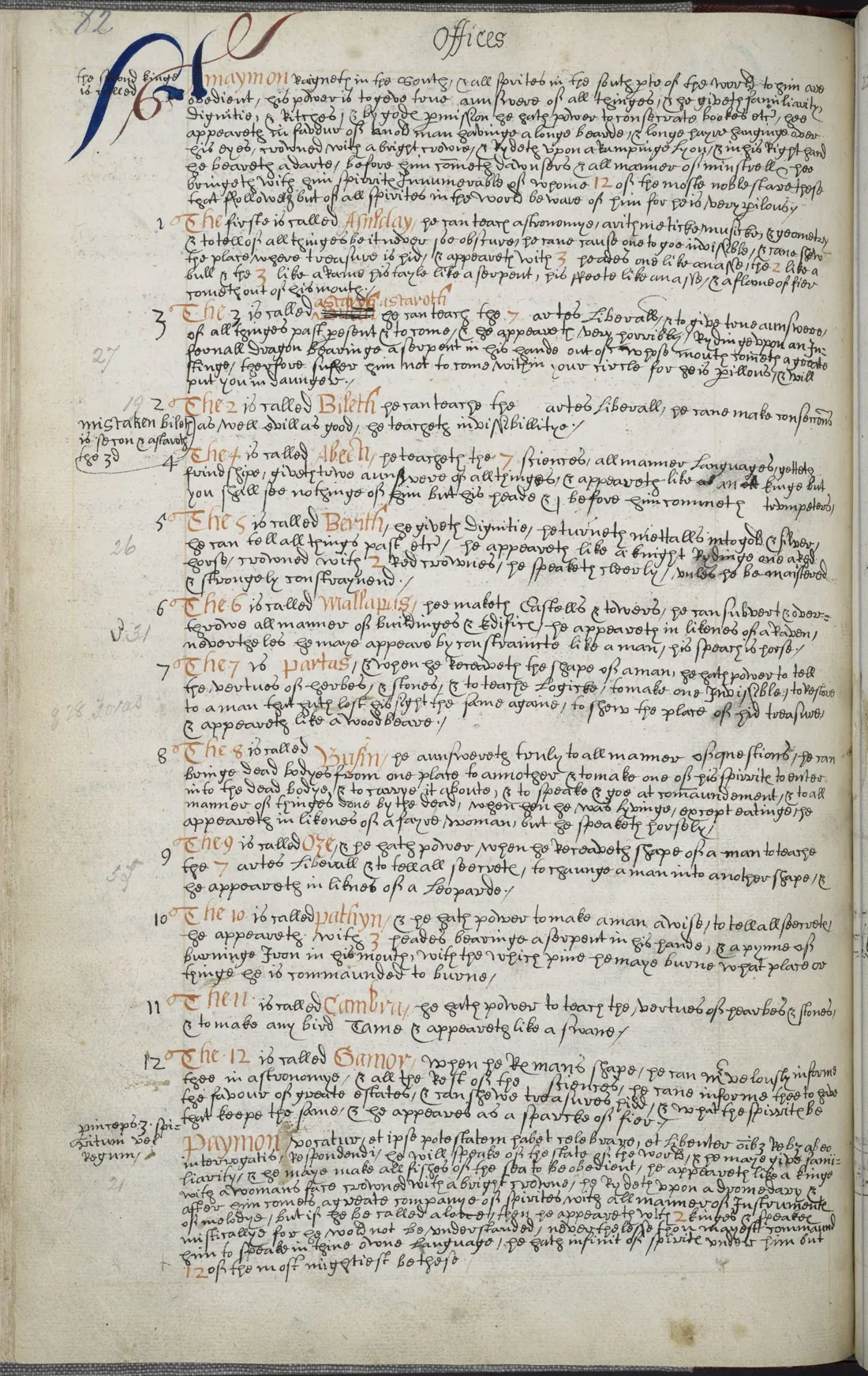
p. 82#page82
Liber Officiorum Spirituum — facsímil · p. 82 · dominio público
Folger Shakespeare Library, MS V.b.26, pp.73–84
🔍 clic para ampliar

TranscripciónInglés isabelino

[margen izq., rúbrica:] the second kinge is called [M]AYMON raignes in the easte, [and] all spirites in the easte [par]tes of the world to him are obedient; his power is to gyve true aunswere of all thinges, [and] he gyveth familiarity, dignities, [and] ritches; [and] by gods p[er]mission he gyveth power to conservate bookes [et]c, he appeareth in habit[?] of an old man havinge[?] a longe bearde [and] longe hayre hanginge over his eyes, crowned with a bright crowne, [and] rydeth vpon a lampinge[?] lyon, [and] in his right hand he beareth a darte, before him cometh dauncers [and] all manner of minstrell, he bringeth with him spirite Innumerable of whome 12 of the moste noble stande these[?] [feat?] fellowes; but of all spirites in the world beware of him for he is very perilous.

1. ¶ The firste is called Asmiday[Asmoday], he can teache astronomye, arithmatike, musike, [and] geometrie, [and] to tell of all thinges be it never so obscure, he can cause one to goo invisible, [and] can shew the place where treasure is hid, [and] appeareth with 3 heades, one like an asse[?], the 2 like a bull, [and] the 3 like a rame, his tayle like a serpent, his feete like an asse[?], [and] a flame of fyer cometh out of his mouth.

3. ¶ The 3 is called ~~[Bileth, tachado]~~ Astaroth [nombre corregido en rojo sobre la línea], he can teache the 7 artes liberall, [and] to gyve true aunswere of all thinges past, present [and] to come, [and] he appeareth very horrible, rydinge vpon an Infernall dragon, bearinge a serpent in his hande, out of whose mouth cometh a great stinge; therefore suffer him not to come within your circle for he is perilous [and] will put you in daunger.

2. ¶ The 2 is called Bileth, he can teache the [ ] artes liberall, he cane make consonons[?] as well evill as good, he teacheth invisibillitye. [margen izq.:] mistaken: bileth is seron [and] astaro[t]h the 3d[?]

4. ¶ The 4 is called Abech, he teacheth the 7 sciences, all manner languages, yette[?] he gyveth true aunswere of all thinges, [and] appeareth like [as] an old[?] [thinge?]; but you shall see nothinge of him but his heade, [and] before him cometh trompeters.

5. ¶ The 5 is called Berith, he gyveth dignities, he turneth mettalls into gold [and] silver, he can tell all thinges past [et]c, he appeareth like a knight[?] rydinge on a[?] [horse], crowned with 2 red crownes, he speaketh slowly, vnles he be maistered [and] strongely constrayned.

6. ¶ The 6 is called Mallapus[?], he maketh castells [and] towers, he can subvert [and] devoure[?] [destroye] all manner of buildinges [and] edifice, he appeareth in likenes of a raven; neverthelesse he maye appeare by constrainte like a man, his speach is horse[hoarse].

7. ¶ The 7 is Partas, [and] when he toucheth the shape of a man, he gath[hath] power to tell the vertues of herbes [and] stones, [and] to teache Logike, to make one Invisible, to restore to a man that hath lost his sight the same againe, to shew the place of hid[?] treasure, [and] appeareth like a woodbeare[?].

8. ¶ The 8 is called Busyn, he aunswereth truly to all manner of questions, he can bringe dead bodyes from one place to another, [and] to make one of his spirite to enter into the dead bodye, [and] to carrye it aboute, [and] to speake [and] goo at commaundement, [and] to [do] all manner of thinges done by the dead, when[as] he was lyvinge, except eatinge; he appeareth in likenes of a fayre woman, but he speaketh horsely[hoarsely].

9. ¶ The 9 is called Oze, [and] he hath power, when he toucheth shape of a man, to teache the 7 artes liberall [and] to tell all secretes, to chaunge a man into another shape, [and] he appeareth in liknes of a leoparde.

10. ¶ The 10 is called Pathyn, [and] he hath power to make a man a wise[?], to tell all secretes, he appeareth with 3 heades, bearinge a serpent in his hande, [and] a [payne?] of burninge Iron in his mouth, with the which him[?] he maye burne what place or thinge he is commaunded to burne.

11. ¶ The 11 is called Cambira, he hath power to teache[?] the vertues of herbes [and] stones, [and] to make any bird tame, [and] appeareth like a swane.

12. ¶ The 12 is called Samor, when he [taketh?] mans shape, he can marvelously informe thee in astronomye, [and] all the reste of the [ ] sciences; he can teache the favour of greate estates, [and] can shewe treasures[,] till[?]; he can informe thee to gett[?] [those?] that keepe the same, [and] he appeareth as a sparkle of fyer, [and] what[?] the spirite be[?] —

[margen izq., latín, 3 líneas:] [ilegible]pb[?] 3 spi= / ritum vel / regu[m] — (≈ «…3 spirituum vel regum») PAYMON vocatur, et ipse potestatem habet celeb[r]are[?], et libenter om[n]ib[us] reb[us] ab eo interrogatis, respondendi. — he will speake of the state of the world, [and] he maye gyve familiarity, [and] he maye make all fisshes of the sea to be obedient, he appeareth like a kinge with a womans face, crowned with a bright crowne, [and] he rydeth vpon a dromedary, [and] afore him cometh a greate company of spirites with all manner of Instrumente of melodye; but if he be called alone, then he appeareth with 2 kinges, [and] speake[th] mistically[?] for he wold not be vnderstanded, neverthelesse then one mayest[?] commaund him to speake in eche mans owne language; he hath infinit of spirite vnder him, but 12 of the most mightiest be these.

TraducciónEspañol

[margen izq., rúbrica:] el segundo rey se llama [M]AYMON reina en el este, y todos los espíritus de las partes orientales del mundo le son obedientes; su poder es dar respuesta verdadera de todas las cosas, y otorga familiaridad, dignidades y riquezas; y, con permiso de Dios, da poder para conservar libros, etc. Aparece con hábito[?] de un anciano de larga barba y largo cabello colgando sobre sus ojos, coronado con una corona brillante, y cabalga sobre un león fulgurante[?]; en su mano derecha lleva un dardo; ante él vienen danzantes y toda clase de juglares. Trae consigo espíritus innumerables, de los cuales 12 de los más nobles son sus [principales?] compañeros; pero de todos los espíritus del mundo, guárdate de él, porque es muy peligroso.

1. El primero se llama Asmiday [Asmodeo]; puede enseñar astronomía, aritmética, música y geometría, y a decir todas las cosas por muy ocultas que sean; puede hacer que uno se vuelva invisible y mostrar el lugar donde hay tesoro escondido. Aparece con 3 cabezas: una como de asno[?], la 2ª como de toro y la 3ª como de carnero; su cola como de serpiente, sus pies como de asno[?], y una llama de fuego sale de su boca.

3. El 3º se llama ~~[Bileth, tachado]~~ Astaroth [nombre corregido en rojo sobre la línea]; puede enseñar las 7 artes liberales y dar respuesta verdadera de todas las cosas pasadas, presentes y por venir. Aparece muy horrible, cabalgando sobre un dragón infernal, llevando una serpiente en su mano, de cuya boca sale un gran aguijón; por tanto, no le permitas entrar dentro de tu círculo, pues es peligroso y te pondrá en peligro.

2. El 2º se llama Bileth; puede enseñar las [ ] artes liberales; puede hacer consonancias[?] tanto malas como buenas; enseña la invisibilidad. [margen izq.:] equivocado: bileth es seron y astaroth el 3º[?]

4. El 4º se llama Abech; enseña las 7 ciencias, toda clase de lenguas, y da respuesta verdadera de todas las cosas; aparece como[?] un [anciano?] [cosa?]; pero no verás de él más que su cabeza, y ante él vienen trompeteros.

5. El 5º se llama Berith; otorga dignidades; convierte los metales en oro y plata; puede decir todas las cosas pasadas, etc. Aparece como un caballero[?] montado en un[?] [caballo], coronado con 2 coronas rojas; habla lentamente, a menos que sea dominado y fuertemente constreñido.

6. El 6º se llama Mallapus[?]; hace castillos y torres; puede derribar y destruir[?] toda clase de edificios y construcciones. Aparece en forma de cuervo; no obstante, por constricción puede aparecer como un hombre; su habla es ronca.

7. El 7º es Partas; y cuando toma la forma de un hombre, tiene poder para decir las virtudes de las hierbas y las piedras, y para enseñar Lógica, para hacer a uno invisible, para devolver a un hombre que ha perdido la vista la misma otra vez, para mostrar el lugar del tesoro escondido[?]; y aparece como un oso-de-bosque[?].

8. El 8º se llama Busyn; responde con verdad a toda clase de preguntas; puede traer cuerpos muertos de un lugar a otro, y hacer que uno de sus espíritus entre en el cuerpo muerto, lo lleve de un lado a otro, y hable y camine a mandato, y [haga] toda clase de cosas que hacía el muerto cuando estaba vivo, excepto comer. Aparece en forma de una hermosa mujer, pero habla roncamente.

9. El 9º se llama Oze; y tiene poder, cuando toma la forma de un hombre, para enseñar las 7 artes liberales y decir todos los secretos, para cambiar a un hombre en otra forma; y aparece en forma de leopardo.

10. El 10º se llama Pathyn; y tiene poder para hacer sabio[?] a un hombre, para decir todos los secretos. Aparece con 3 cabezas, llevando una serpiente en su mano, y un [chorro?] de hierro ardiente en su boca, con el cual puede quemar cualquier lugar o cosa que se le ordene quemar.

11. El 11º se llama Cambira; tiene poder para enseñar[?] las virtudes de las hierbas y las piedras, y para amansar cualquier ave; y aparece como un cisne.

12. El 12º se llama Samor; cuando toma[?] forma de hombre, puede informarte maravillosamente en astronomía y en todo el resto de las [ ] ciencias; puede enseñar el favor de los grandes estados, y puede mostrar tesoros[,] hasta[?]; puede informarte para conseguir[?] a [aquellos?] que guardan lo mismo; y aparece como una chispa de fuego, y [según?] sea el espíritu[?] —

[margen izq., latín, 3 líneas:] [ilegible]pb[?] 3 spi= / ritum vel / regu[m] — (≈ «…de 3 espíritus o reyes») PAYMON se le llama, y él mismo tiene poder para celebrar[?], y de buena gana responder a todas las cosas que se le preguntan. — Hablará del estado del mundo, y puede dar familiaridad, y puede hacer que todos los peces del mar le sean obedientes. Aparece como un rey con rostro de mujer, coronado con una corona brillante, y cabalga sobre un dromedario; y ante él viene una gran compañía de espíritus con toda clase de instrumentos de melodía. Pero si se le llama solo, entonces aparece con 2 reyes, y habla místicamente[?] para no ser entendido; sin embargo, entonces se le puede mandar que hable en la propia lengua de cada hombre. Tiene infinitos espíritus bajo sí, pero 12 de los más poderosos son estos.

p. 83#page83
Liber Officiorum Spirituum — facsímil · p. 83 · dominio público
Folger Shakespeare Library, MS V.b.26, pp.73–84
🔍 clic para ampliar

TranscripciónInglés isabelino

of spirittes

[1.] The first is called Beliall, he giueth dignity & promotion, & he giueth loue & fauour of all the[?] […], he appeareth in likenes of a fayre Aungell, ryding in a charyet of fier, & speaketh smoothly.

2. The 2 is called Bason, he maketh one Inuisible, & wise, & will aunswer to all questions; he appeareth with 3 heades[?] one like a doge, one like a man, & one like a raben; he rideth vpon a wild beare, & beareth vpon his fist a goss hauke, & out of his mouth proceedeth a flame of fier, & he speaketh horsly.

3. The 3 is Gordonzor[?], he can tell the truthe of all thinges both[?] […], & he is right mighty in the aduaunced[?] doinges; he appeareth like a good Aungell, [gyuinge?] a[n]swer to […][?].

4. The 4 is Balaeth[?], his office is to make [golde?] men sirke [= sick], & to take from a man his senses or witte; he maketh a man m[er]uelous cunninge in the 7 liberall sciences; he may giue loue & dignity to all men; he can carry one from one place to another, & appeareth like a mishappen Image, & speaketh horsly.

5. The 5 is called Nistalas, he [receauinge?] mans shape hath power to teache & instructe one in witchcrafte & Nigromancye, & knoweth the vertues of herbes, stones & trees, & appeareth like a mighty raben.

6. The 6 is Lecher, he knoweth the secrette of the 7 sciences, he getteth friendshipe; he appeareth like a knight with a red Lyons face, & he speaketh very sadely.

7. The 7 is called Zagayne, & when he [receaueth?] mans shape he getteth wisdome; he turneth aute[?] into any kind of mettall; also he can turne water into wyne, & of a foole make a wise man; & appeareth like a wild bully [= bull].

8. The 8 is called Caleos, he hath power & knowledge of infinite treasures; he maketh one beloued & purchaseth familliaritye; he appeareth like a knight ridyng vpon a coca=drill [= crocodile][?], & he weareth vpon his head 2 [rundenes?/crownes?]; but he is very false in his aunswers, but if he be well constrayned & mayestered.

9. The 9 is Cagyne vel Cogin, he [getteth?] beinge in demaine shape [to] bringe any soule (beinge not in the [heauen?] only, nor infernall power) to speake with thee; he appeareth in likenes of a pale corse [= corpse].

10. The 10 is called Suchay[?] [o Guchay], he can teache all manner of Languages, & to carry one in shorte space from one place to another; he giueth the loue of women, & to carry one moste principallest, & especially of widdowes; he appeareth with a fayre face like a woman.

11. The 11 is Ryall, [he] giuinge [in] humane shape can resolue all doubte, & tell all thinges; he can giue loue of woomen, get frinde[s] & turne the hartes of enemies; he appeareth like a dromedary & speaketh sadly.

12. The 12 is called Zayme, he can bringe money from any place vnto him, & to carry the same to any appointed place he will, or is assigned; he can in a moment shewe the buildinges or situacion of any plotte, cittye or castell; & can [reare?/procure?] dignitie & honour, & promote like a raben.

(rúbrica, margen izq.:) The 4th kinge, or kinge of[?] spirite, is called — Egin, & he raigneth in the North; he hath power to teache all manner of sciences, & will gladly tell all secrets & the truthe of thinges past & present & to come; he getteth friendshipe, & rayseth one to dignitye; he can make alterations of thinges; he appeareth in the likenes of a man, with a bright face, [reddened?] with a double crowne[?], & he rydeth vpon a dragon, & cometh with a fearefull noyse, & before him [renneth?] diuers sortes of Instrumentes; but beinge called alone he bringeth with him 3 kinges, & comes not so easely, nor so dreadfully aboute[?] hym; also he getteth with him infinit spirites, of which these 12 are the [chiefe?].

1. The 1 is called Oria, he can teache all manner of vertues or sciences, Inuisibillitye, & giue fauoure of enemies; he can carry one from one place to another, & [set?] vpon a soddaine; he appeareth like an old man rydinge like an Elephant.

2. The 2 is Vriell vel Vriall, he turneth one mettall into another, as Iron or brasse into golde & siluer, wine to water or water to wine; of a foole maketh one wise, & maketh one [Inuisible?]; & he appeareth like a boy, [sober & kinde?][?], & speaketh horsly. (nota marginal izq., subrayada:) «in mettelles — for gowld & siluer.»

TraducciónEspañol

de los espíritus

[1.] El primero se llama Beliall: da dignidad y ascenso, y da amor y favor de todos los[?] […]; aparece en forma de un ángel hermoso, cabalgando en un carro de fuego, y habla suavemente.

2. El 2º se llama Bason: hace a uno invisible y sabio, y responderá a todas las preguntas; aparece con 3 cabezas[?] — una como de perro, una como de hombre y una como de cuervo; cabalga sobre un oso salvaje, lleva sobre su puño un azor, y de su boca sale una llama de fuego, y habla roncamente.

3. El 3º es Gordonzor[?]: puede decir la verdad de todas las cosas ambas[?] […], y es muy poderoso en los asuntos [avanzados?]; aparece como un buen ángel, [dando?] respuesta a […][?].

4. El 4º es Balaeth[?]: su oficio es enfermar[?] a los hombres[?], y quitarle a un hombre sus sentidos o su juicio; hace a un hombre maravillosamente diestro en las 7 artes liberales; puede dar amor y dignidad a todos los hombres; puede llevar a uno de un lugar a otro; y aparece como una imagen deforme, y habla roncamente.

5. El 5º se llama Nistalas: [tomando?] forma de hombre tiene poder para enseñar e instruir a uno en brujería y nigromancia, y conoce las virtudes de las hierbas, piedras y árboles; y aparece como un poderoso cuervo.

6. El 6º es Lecher: conoce el secreto de las 7 ciencias, consigue amistad; aparece como un caballero con rostro de león rojo, y habla muy gravemente.

7. El 7º se llama Zagayne: y cuando [toma?] forma de hombre consigue sabiduría; convierte cualquier cosa[?] en cualquier clase de metal; también puede convertir el agua en vino, y de un necio hacer un hombre sabio; y aparece como un toro salvaje.

8. El 8º se llama Caleos: tiene poder y conocimiento de tesoros infinitos; hace a uno amado y procura familiaridad; aparece como un caballero cabalgando sobre un cocodrilo[?], y lleva sobre su cabeza 2 [¿coronas?]; pero es muy falso en sus respuestas, salvo si se le constriñe bien y se le domina.

9. El 9º es Cagyne vel Cogin: [obtiene?] estar en forma propia[?] [para] traer cualquier alma (que no esté solo en el [cielo?], ni en poder infernal) a hablar contigo; aparece en forma de un cadáver pálido.

10. El 10º se llama Suchay[?] [o Guchay]: puede enseñar toda clase de lenguas, y llevar a uno en breve espacio de un lugar a otro; da el amor de las mujeres, y llevar a uno sobre todo[?], y especialmente de las viudas; aparece con un rostro hermoso como de mujer.

11. El 11º es Ryall: [él] en forma humana puede resolver toda duda y decir todas las cosas; puede dar amor de mujeres, conseguir amigos y volver los corazones de los enemigos; aparece como un dromedario y habla gravemente.

12. El 12º se llama Zayme: puede traer dinero de cualquier lugar hacia sí, y llevarlo a cualquier lugar señalado, según quiera o se le asigne; puede mostrar en un momento los edificios o la situación de cualquier terreno, ciudad o castillo; y puede [levantar?/procurar?] dignidad y honor, y promover como un cuervo.

(rúbrica:) El 4º rey, o rey de[?] espíritus, se llama — Egin, y reina en el Norte; tiene poder para enseñar toda clase de ciencias, y de buen grado dirá todos los secretos y la verdad de las cosas pasadas, presentes y por venir; consigue amistad, y eleva a uno a la dignidad; puede hacer alteraciones de las cosas; aparece en forma de un hombre, con rostro brillante, [enrojecido?] con una doble corona[?], y cabalga sobre un dragón, y viene con un ruido espantoso, y delante de él [corren?] diversas suertes de instrumentos; pero llamado a solas trae consigo 3 reyes, y no viene tan fácilmente, ni tan temiblemente en torno[?] a él; también trae consigo infinitos espíritus, de los cuales estos 12 son los [principales?].

1. El 1º se llama Oria: puede enseñar toda clase de virtudes o ciencias, la invisibilidad, y dar el favor de los enemigos; puede llevar a uno de un lugar a otro, y [ponerlo?] de súbito; aparece como un anciano cabalgando como sobre un elefante.

2. El 2º es Vriell vel Vriall: convierte un metal en otro, como hierro o bronce en oro y plata, el vino en agua o el agua en vino; de un necio hace a uno sabio, y hace a uno [invisible?]; y aparece como un muchacho, [sobrio y amable?][?], y habla roncamente. (nota marginal:) «en metales — para oro y plata.»

p. 84#page84
Liber Officiorum Spirituum — facsímil · p. 84 · dominio público
Folger Shakespeare Library, MS V.b.26, pp.73–84
🔍 clic para ampliar

TranscripciónInglés isabelino

3. Vzago[?] who, takinge humaine forme, hath power to make one [goe] Invisible, & to [transform] a man into another forme or liknes; he getteth love & favour of all men, & giveth true aunswere of all thinges; he appeareth like an Aungell, & is right true & faithfull in all his doeings.

4. Synovell[?] & he, havinge humaine shape, teacheth to understand beastes' lowinges, birdes' chirpinges, & dogges' barkinge, & all manner of langhages; & can tell all thinges, & sheweth the places of hid treasure; & commeth like a wood beare.

5. Fessan[?] he teacheth astronomie & arithmetike, & giveth true aunswere of secret thinges; & appeareth like a flame of fier; & speaketh [hoarsely].

6. Goyle[?] he maketh a man vertuous & gay, [&] to have the love & favour of princes; he aunswereth to all questions; & appeareth like a rampinge Lyon.

7. Auras[?] he hath power to carry dead carkes[carcasses] whither they be appointed; & giveth aunswere to all questions; & appeareth in the liknes of an old asse.

8. Othey[?] & he rideth upon the soddaine[?], [&] maketh castells, towers & townes; he aunswereth truly to all thinges; he appeareth like to a tunne[tonel] of wyne, & sometyme like a man, & then his eyes burne like fier.

9. Saranyt[?] he can raise dead men, & cause them to [rise] against their [enemies?], & to speake with men; he can teach one the 7 artes or sciences liberall; & he appeareth like an asse with a womans face.

10. Wurvell[?] he maketh [peace] to be betwene persons; & can tell of treasures hid; & appeareth as a white Lyon.

11. Nimbra[?] he giveth dignities, & telleth secrettes; getteth frende[ship]; conveyeth money from place to place; & appeareth like a giante, but speaketh so small that unneathes[apenas] one can heare [or see] him; but he is passinge true.

12. Annoboth vel Anaboth[?] he hath power to make one marvelously experte in Nigromancie; & to shew the place of hid treasure, & to keepe it; & if the spirit be of the North, he will [serve] him always; & also he can tell of wonderfull straunge thinges; & appeareth in [the] liknes of an armed knyght.

[párrafo de cierre:] Beallphares or Beallpeare, an excellent [servitor]; he telleth of sudden treasures in the earth, or of thinges stolen or loste, & is [faithful] in all his doings; he commeth forth out of the east, for so he [was] before called; [he is] Rex of the east; & he appeareth very [obediently] to god['s people?]… himself & his servauntes.

TraducciónEspañol

3. Vzago[?] quien, tomando forma humana, tiene poder de hacer a uno invisible y de transformar a un hombre en otra forma o semejanza; consigue el amor y el favor de todos los hombres; da respuesta verdadera de todas las cosas; aparece como un ángel y es rectísimo, veraz y fiel en todo lo que hace.

4. Synovell[?] teniendo forma humana, enseña a entender los mugidos de las bestias, los trinos de las aves y el ladrido de los perros, y toda clase de lenguas; puede decirlo todo y muestra los lugares del tesoro escondido; y viene como un oso montés.

5. Fessan[?] enseña astronomía y aritmética; da respuesta verdadera de las cosas secretas; aparece como una llama de fuego; y habla [con voz ronca].

6. Goyle[?] hace al hombre virtuoso y alegre, y con el amor y favor de los príncipes; responde a todas las preguntas; y aparece como un león rampante.

7. Auras[?] tiene poder de llevar los cuerpos muertos adonde se le señale; da respuesta a todas las preguntas; y aparece en semejanza de un viejo asno.

8. Othey[?] cabalga de improviso[?]; edifica castillos, torres y ciudades; responde con verdad a todo; aparece como un tonel de vino, y a veces como un hombre, y entonces sus ojos arden como fuego.

9. Saranyt[?] puede resucitar a los muertos y hacer que se alcen contra sus [enemigos] y que hablen con los hombres; puede enseñar a uno las siete artes o ciencias liberales; y aparece como un asno con rostro de mujer.

10. Wurvell[?] hace [las paces] entre las personas; puede decir de tesoros ocultos; y aparece como un león blanco.

11. Nimbra[?] da dignidades y dice secretos; consigue amistad; traslada dinero de un lugar a otro; aparece como un gigante, pero habla tan bajo que apenas se le puede oír [o ver]; mas es sumamente veraz.

12. Annoboth vel Anaboth[?] tiene poder de hacer a uno maravillosamente experto en nigromancia, de mostrar el lugar del tesoro escondido y de guardarlo; y si el espíritu es del Norte, le servirá siempre; también puede decir de cosas maravillosas y extrañas; y aparece en semejanza de un caballero armado.

[cierre:] Beallphares o Beallpeare, un excelente [servidor]; dice de los tesoros súbitos en la tierra, o de las cosas robadas o perdidas, y es fiel en todo lo que hace; sale del este, pues así fue llamado antes; [es] Rey del este; y aparece muy [obedientemente]… él mismo y sus siervos.

Grimorium · grimorium.lat · CC BY 4.0 · Ficha