Ars Notoria

Las oraciones y notae de la sabiduría — Lemegeton, Libro 5

Manuscrito — Sloane MS 3825 (British Museum)
Descargar PDF ↓
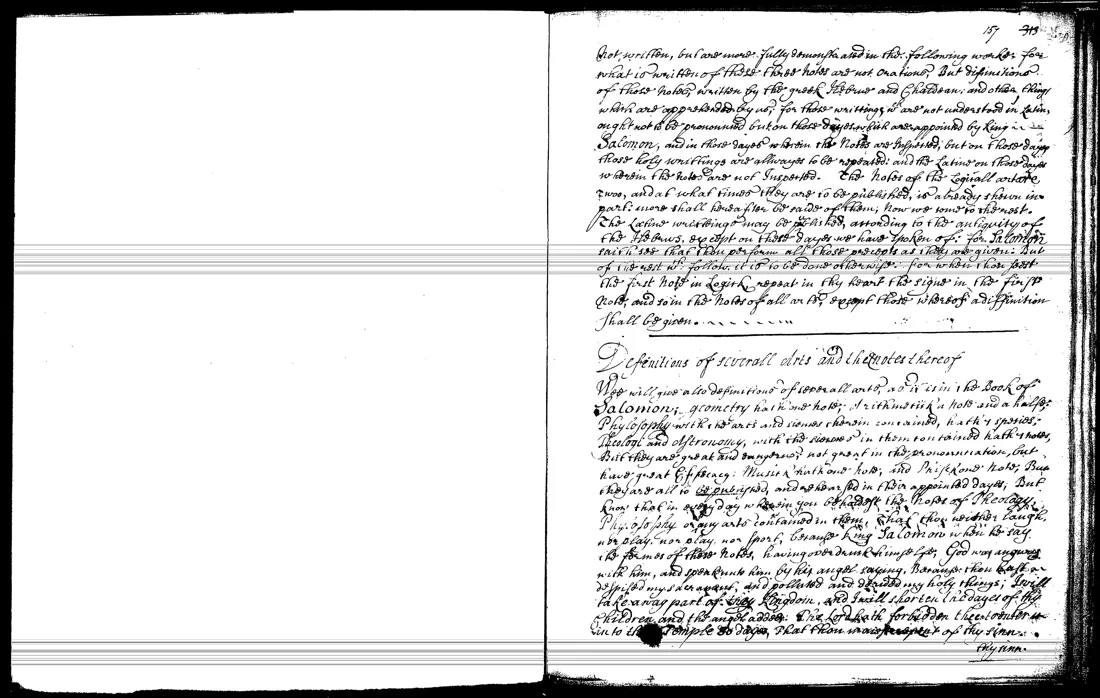
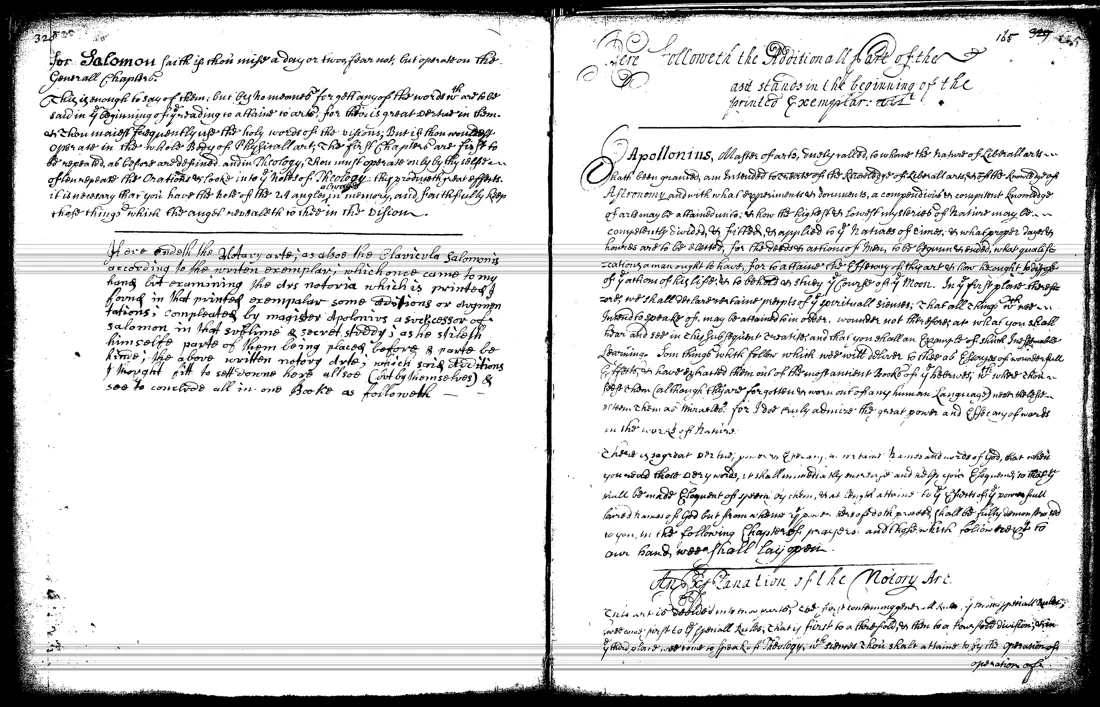
Ars Notoria — incipit#p157
Ars Notoria — facsímil · Ars Notoria — incipit · dominio público
Manuscrito — Sloane MS 3825 (British Museum)
🔍 clic para ampliar

TranscripciónInglés (s. XVII)

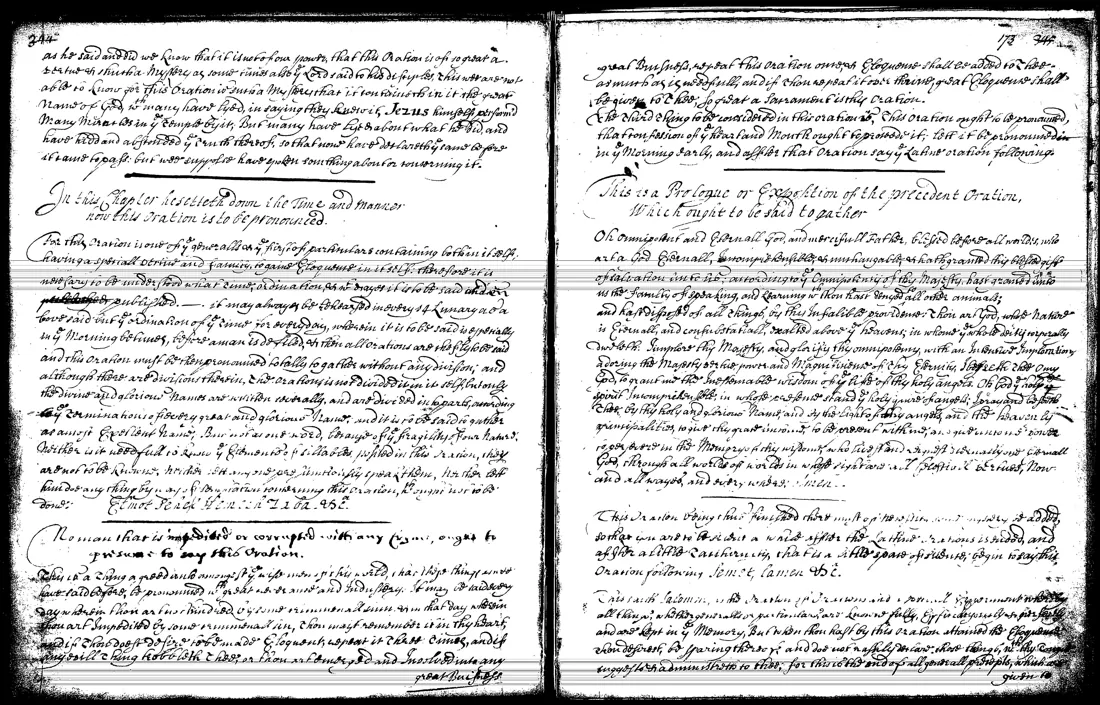
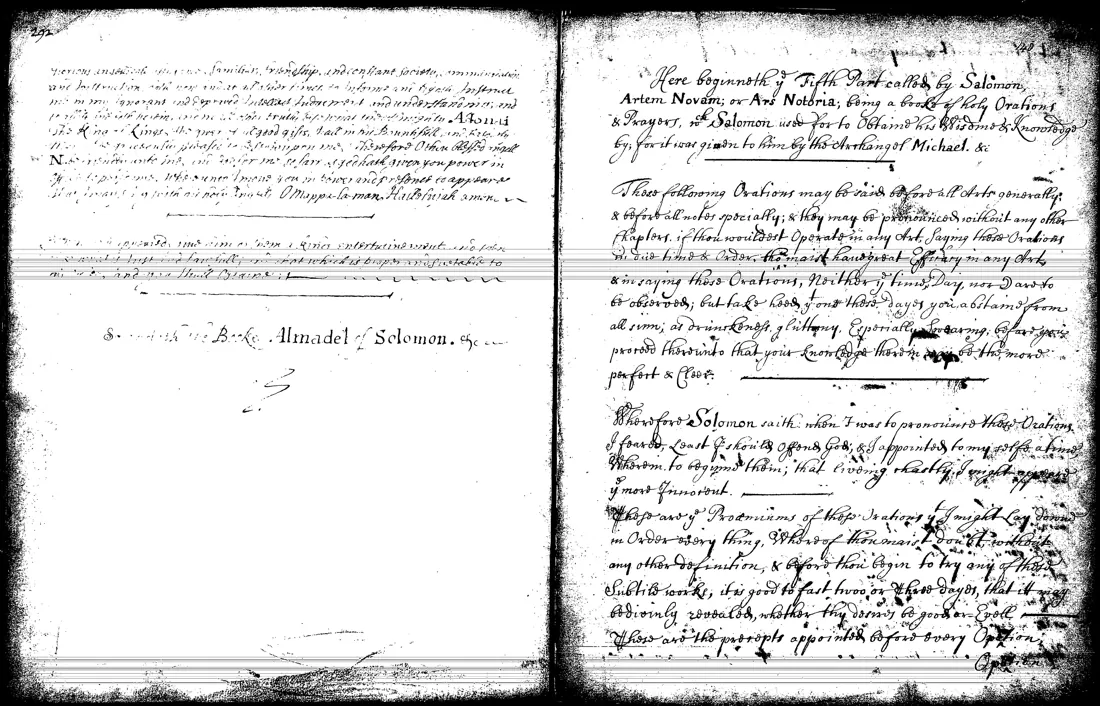
Here beginneth the Fifth Part called by Salomon Artem Novam; or Ars Notoria; being a booke of holy Orations & Prayers, which Salomon used for to Obtaine his Wisdome & Knowledge by; for it was giuen to him by the Archangel Michael. &c

These following Orations may be said before all Arts generally; & before all notes specially; & they may be pronounced without any other Chapters. if thou wouldest Operate in any Art, saying these Orations in due time & Order, thou maist haue great Effi[c]acy in any Art, & in saying these Orations, Neither the time, Day, nor Date to be observed; but take heed the[?] on those dayes you abstaine from all sinn; as drunkenesse, gluttony, Especially Swearing, before you proceed thereunto that your Knowledge therein may be the more perfect & Cleer.

Wherefore Solomon saith: when I was to pronounce these Orations I feared, Least I should offend God; & I appointed to my selfe a time therein to beginne them; that liueing chastly I might appeare the more Innocent.

These are the Proaemiums of these Orations that I might Lay downe in Order every thing, Whereof thou maist doubt, without any other definition, & before thou begin to try any of these Subtile workes, it is good to fast twoo or three dayes, that it may be diuinly revealed, whether thy desires be good or Evell

These are the precepts appointed before every Oration.

TraducciónEspañol

Aquí comienza la quinta parte llamada por Salomón Artem Novam (Arte nueva), o Ars Notoria; siendo un libro de santas oraciones y plegarias que Salomón usó para obtener su sabiduría y conocimiento; pues le fue dado por el arcángel Miguel. Etc.

Estas oraciones siguientes pueden decirse antes de todas las artes en general, y antes de todas las notas en especial; y pueden pronunciarse sin ningún otro capítulo. si quisieras operar en cualquier arte, diciendo estas oraciones en su debido tiempo y orden, podrás tener gran eficacia en cualquier arte. Y al decir estas oraciones, ni el tiempo, ni el día, ni la fecha han de observarse; pero ten cuidado de que en esos días te abstengas de todo pecado, como la embriaguez, la gula y especialmente el jurar, antes de proceder a ello, para que tu conocimiento en ello sea el más perfecto y claro.

Por lo cual dice Salomón: cuando estaba por pronunciar estas oraciones, temí, no fuera a ofender a Dios; y me señalé a mí mismo un tiempo para comenzarlas, para que, viviendo castamente, apareciera el más inocente.

Estos son los proemios de estas oraciones, para que yo pusiera en orden cada cosa, de lo cual pudieras dudar, sin ninguna otra definición; y antes de que empieces a probar cualquiera de estas obras sutiles, conviene ayunar dos o tres días, para que pueda ser revelado divinamente si tus deseos son buenos o malos.

Estos son los preceptos señalados antes de cada oración.
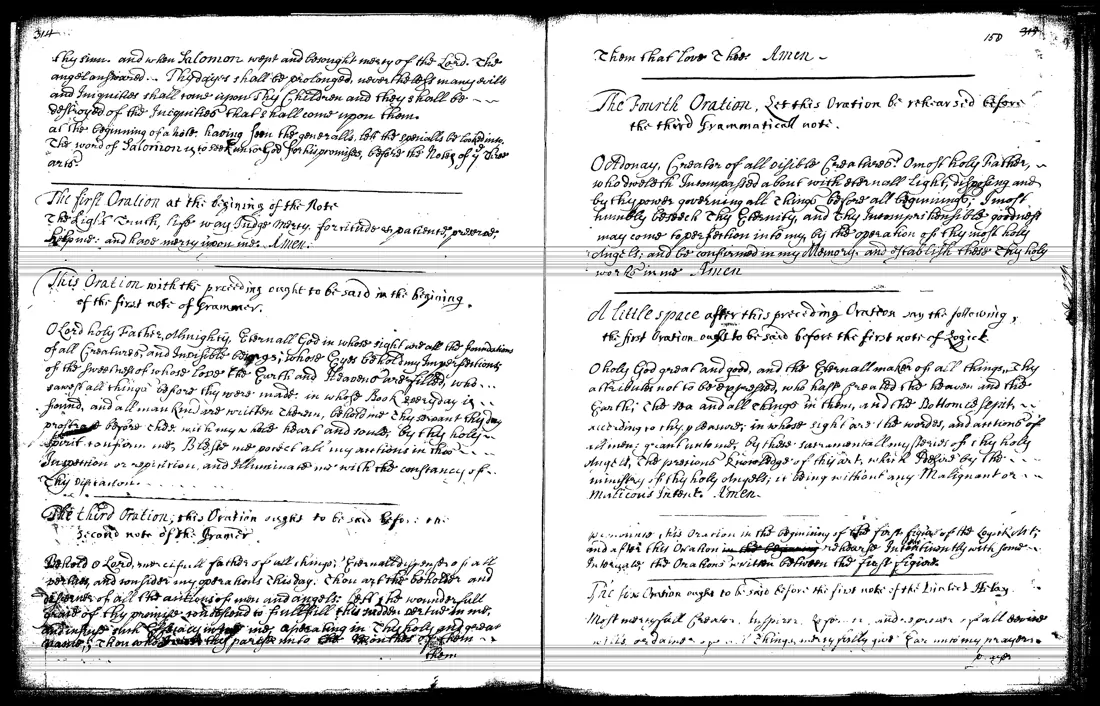
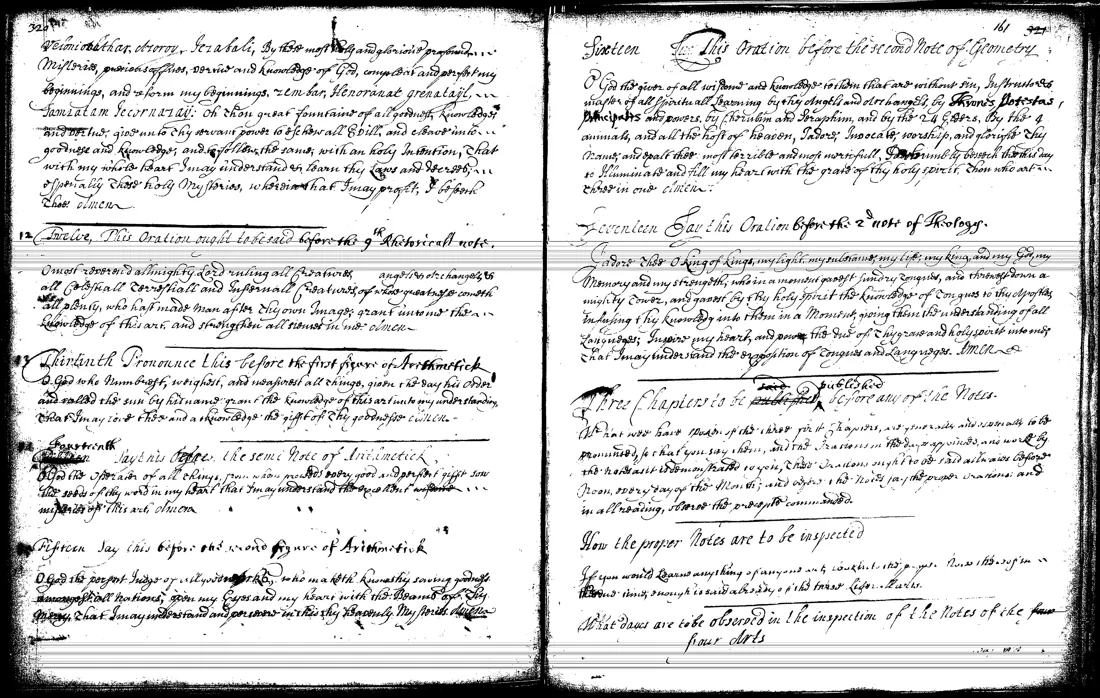
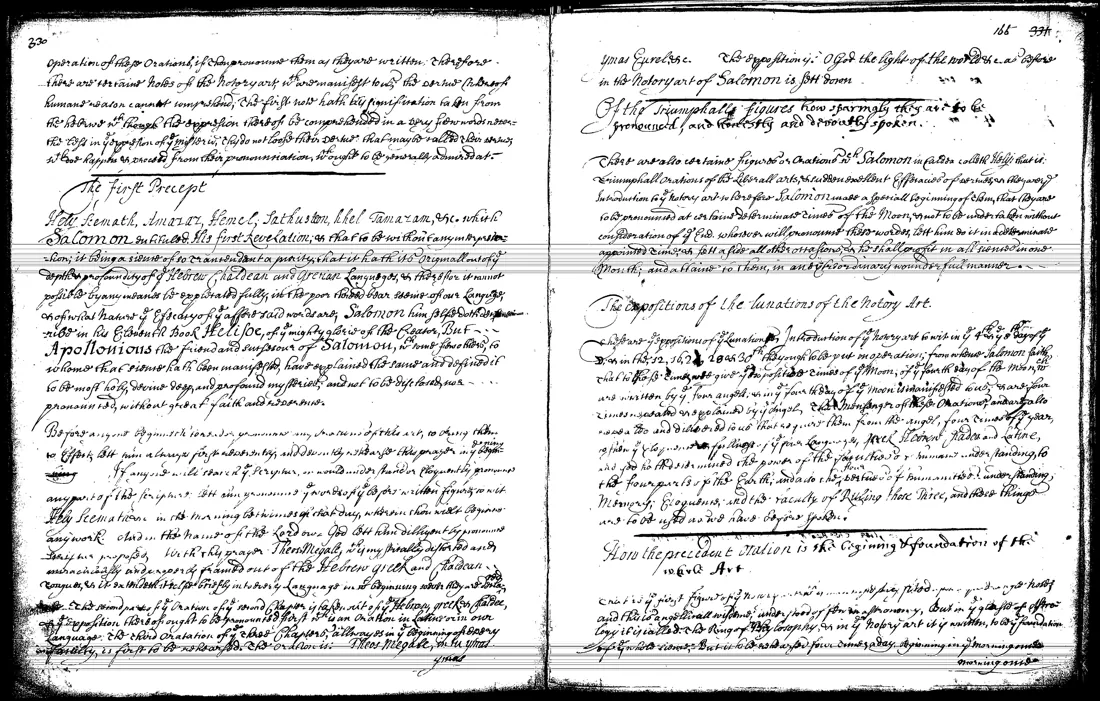
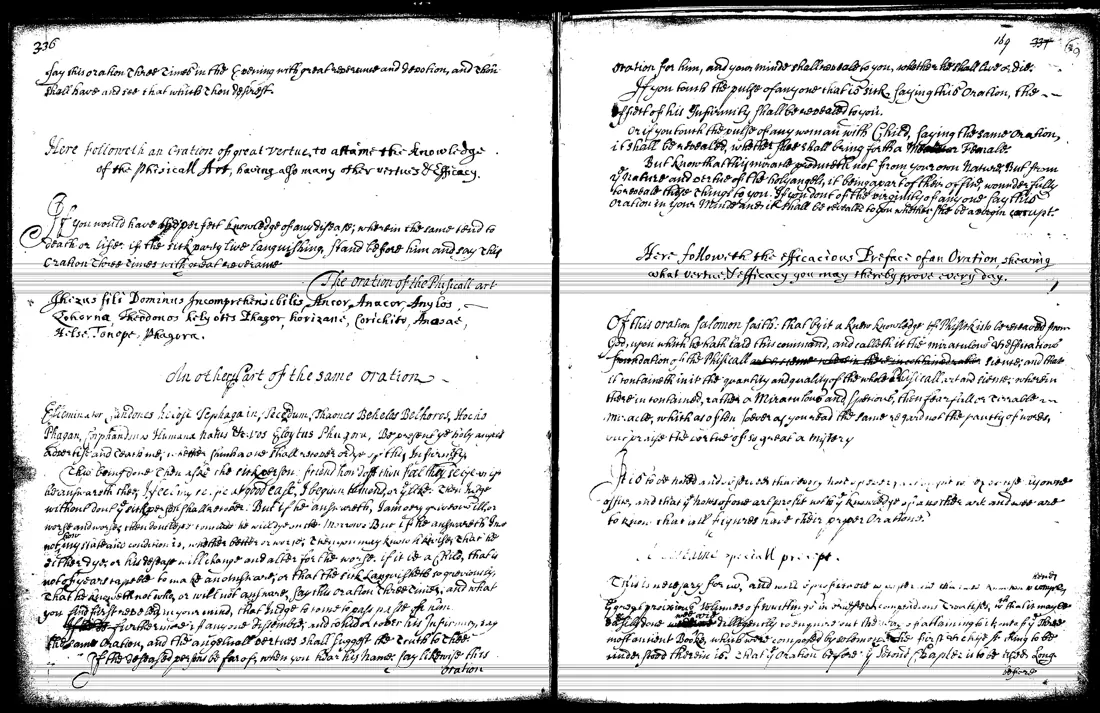
Proemio y la Primera Oración#p158
Ars Notoria — facsímil · Proemio y la Primera Oración · dominio público
Manuscrito — Sloane MS 3825 (British Museum)
🔍 clic para ampliar

TranscripciónInglés (s. XVII)

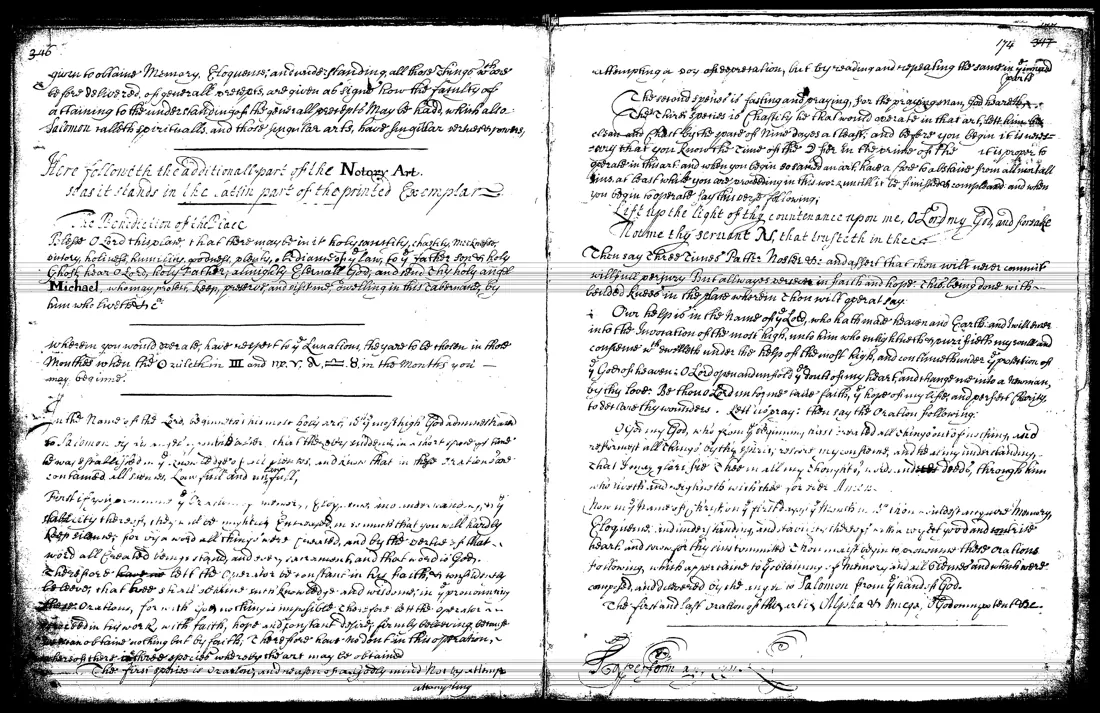
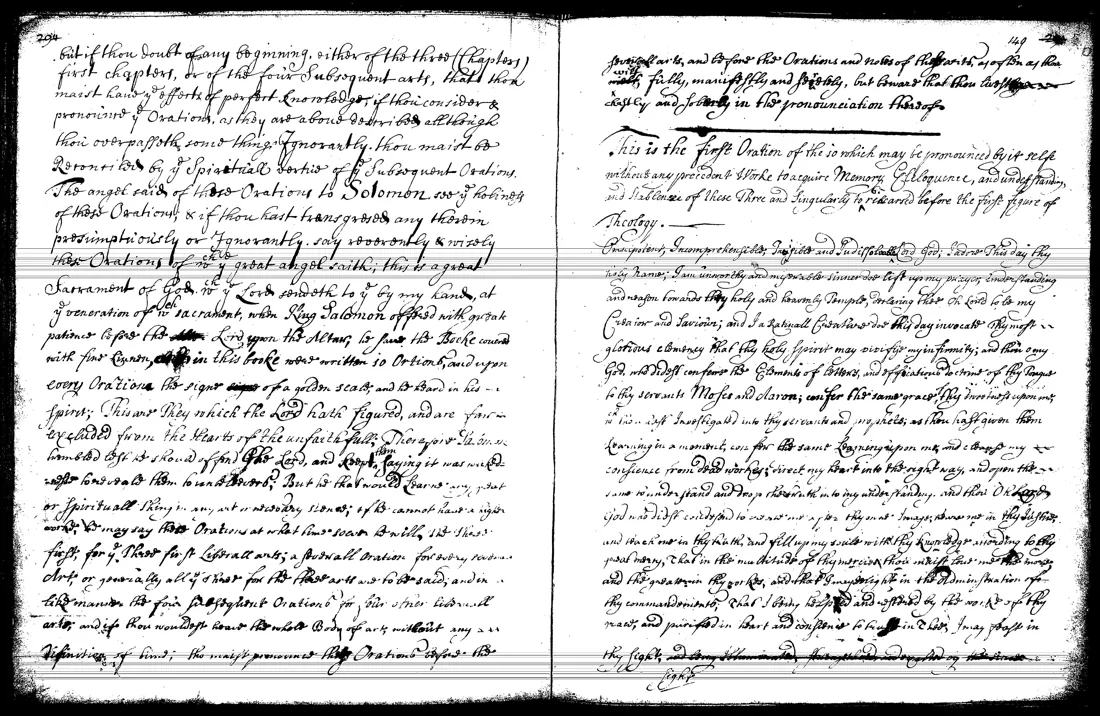
but if thou doubt of any beginning, either of the three (Chapters) first chapters, or of the four Subsequent arts, that thou maist haue y[e] Efforts[?] of perfect Knowledge; if thou consider & pronounce y[e] Orations, as they are aboue described allthough thou overpasseth some things Ignorantly. thou maist be Reconsidered by y[e] Spirituall vertue of y[e] Subsequent Orations. The angel said of these Orations to Solomon, see y[e] holines of these Orations, & if thou hast transgressed any therein presumptuously or Ignorantly. say reverently & wisely these Orations of w[ch] y[e] great angel saith; this is a great Sacrament of God. w[ch] y[e] Lord sendeth to y[e] by my hand, at y[e] veneration of w[ch] sacrament, when King Salomon offered with great patience before the [tachado] Lord upon the Altar, he saw the Booke covered with fine Linnen, [tachado] in this booke were written 10 Ortions, and upon every Oration the signe [tachado] of a golden seale; and he heard in his [-] Spirit; This are they which the Lord hath figured, and are farr excluded from the Hearts of the unfaithfull; Therefore Salomon trembled least he should offend the Lord, and kept them, saying it was wicked[?] [tachado] to reveale them to unbeleevers; But he that would Learne any great or Spirituall thing in any art is necessary sioned[?]; if he cannot haue a higher worke, he may say these Orations at what time soever he will, saith these first, for y[e] Three first Liberall arts; a severall Oration for every severall Art, or generally, all y[e] these for the three arts are to be said; and in [-] like manner the four Subsequent Orations for four other liberall arts; and if thou wouldest heare the whole Body of art, without any [-] Definition of time; thou maist pronounce these Orations before the

severall arts, and before the Orations and notes of these arts, as often as thou wilt[^ inserción] most, fully, manifestly and s[pe]edtly[?], but toward that thou liuest[?] [tachado] chastly and soberly in the pronounciation thereof.

————————

This is the first Oration of the 10 which may be pronounced by it selfe without any preccedent Worke to acquire Memory, Elloquence, and understanding, and Stableness of these Three and Singularly to re[he]arsed before the first figure of Theology. ————

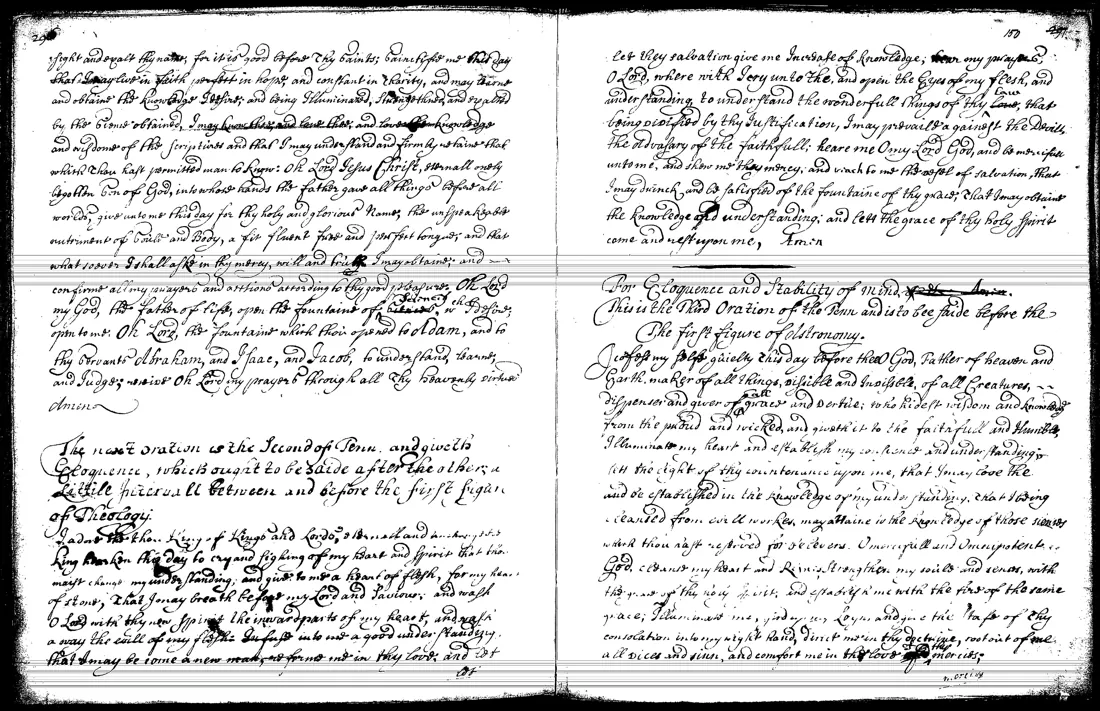
Omnipotent, Incomprehensible, Invisible and Indissoluble Lord God; I adore This day thy holy Name; I am unworthy and miserable sinner doe lift up my prayer, understanding and reason towards thy holy and heavenly Temple, declaring thee Oh Lord to be my Creaior[Creator] and Saviour; and I a Rationall Creature doe this day invocate Thy most glorious Clemency that thy holy Spirit may vivifye my infirmity; and thou o my God, who didest conferre the Elements of Letters, and officiatious[efficacious?] doctrine of thy tongue to thy servants Moses and Aaron; conferre the same grace, thy sweetness upon me; w[ch] thou hast Investigated into thy servants and prophets; as thou hast given them Learning in a moment, con[fer] for the same Learning upon me, and cleanse my conscience from dead workes; direct my heart into the right way, and open the [-] same to understand and drop the truth into my understanding. and thou Oh Lord God who didest condescend to create me after thy owne Image; heare me in thy Justice, and teach me in thy truth, and fill up my soule with thy knowledge according to thy great mercy, That in the multitude of thy mercies thou maist loue me the more and the greater in thy workes, and that I may delight in the administration of thy commandments; That I being helped and restored by the workes of thy grace, and purified in heart and conscience to trust in Thee; I may boast in thy sight, [tachado: and being Illuminated, Strengthened and re[fresh]ed by the [ilegible]] [reclamo/catchword al pie: «[?]ight»]

TraducciónEspañol

Pero si dudas de cualquier comienzo, sea de los tres primeros (capítulos) capítulos, o de las cuatro artes subsiguientes, para que puedas tener los efectos[?] del conocimiento perfecto; si consideras y pronuncias las oraciones, tal como están arriba descritas, aunque pases por alto algunas cosas ignorantemente, podrás ser reconsiderado por la virtud espiritual de las oraciones subsiguientes. El ángel dijo de estas oraciones a Salomón: mira la santidad de estas oraciones, y si has transgredido en alguna de ellas presuntuosa o ignorantemente, di reverente y sabiamente estas oraciones, de las cuales el gran ángel dice: este es un gran sacramento de Dios, que el Señor envía a ti por mi mano; en cuya veneración de dicho sacramento, cuando el rey Salomón ofrecía con gran paciencia ante el Señor sobre el altar, vio el libro cubierto de lino fino; en este libro había escritas 10 oraciones, y sobre cada oración la señal de un sello de oro; y él lo oyó en su espíritu. Estas son las que el Señor ha figurado, y están del todo excluidas de los corazones de los infieles. Por eso Salomón tembló, no fuera a ofender al Señor, y las guardó, diciendo que era impío[?] revelarlas a los incrédulos. Pero quien quisiera aprender cualquier cosa grande o espiritual en cualquier arte, es necesario sioned[?]; si no puede tener una obra mayor, puede decir estas oraciones en cualquier tiempo que quiera, diciendo estas primero, para las tres primeras artes liberales; una oración distinta para cada arte distinta, o, en general, todas estas para las tres artes han de decirse; y de igual manera las cuatro oraciones subsiguientes para las otras cuatro artes liberales; y si quisieras oír el cuerpo entero del arte, sin ninguna definición de tiempo, podrás pronunciar estas oraciones antes de las distintas artes, y antes de las oraciones y notas de estas artes, tantas veces como quieras[^ inserción], plena, manifiesta y prestamente[?], pero cuida de vivir[?] casta y sobriamente en la pronunciación de ellas.

————————

Esta es la primera oración de las 10, la cual puede pronunciarse por sí sola, sin ninguna obra precedente, para adquirir memoria, elocuencia y entendimiento, y la firmeza de estas tres; y ha de recitarse singularmente antes de la primera figura de la teología. ————

Omnipotent, Incomprehensible, Invisible and Indissoluble Lord God (Omnipotente, Incomprensible, Invisible e Indisoluble Señor Dios); este día adoro tu santo nombre; yo, indigno y miserable pecador, elevo mi oración, mi entendimiento y mi razón hacia tu santo y celestial templo, declarándote, oh Señor, ser mi Creador y Salvador; y yo, criatura racional, invoco este día tu gloriosísima clemencia, para que tu santo Espíritu vivifique mi flaqueza; y tú, oh Dios mío, que otorgaste los elementos de las letras y la eficaz[?] doctrina de tu lengua a tus siervos Moisés y Aarón, otorga esa misma gracia, tu dulzura, sobre mí; con la cual has investigado[penetrado] en tus siervos y profetas; así como les diste ciencia en un instante, confiere[da] esa misma ciencia sobre mí, y limpia mi conciencia de obras muertas; dirige mi corazón por el camino recto, y ábrelo para entender, y derrama la verdad en mi entendimiento. Y tú, oh Señor Dios, que te dignaste crearme a tu propia imagen, óyeme en tu justicia y enséñame en tu verdad, y colma mi alma con tu conocimiento según tu gran misericordia, para que en la multitud de tus misericordias me ames más, y más aún en tus obras, y para que yo me deleite en la administración de tus mandamientos; para que yo, ayudado y restaurado por las obras de tu gracia, y purificado de corazón y conciencia para confiar en ti, pueda gloriarme en tu vista, [tachado: y siendo iluminado, fortalecido y re[frescado] por el [ilegible]] [reclamo al pie: «[?]ight»]

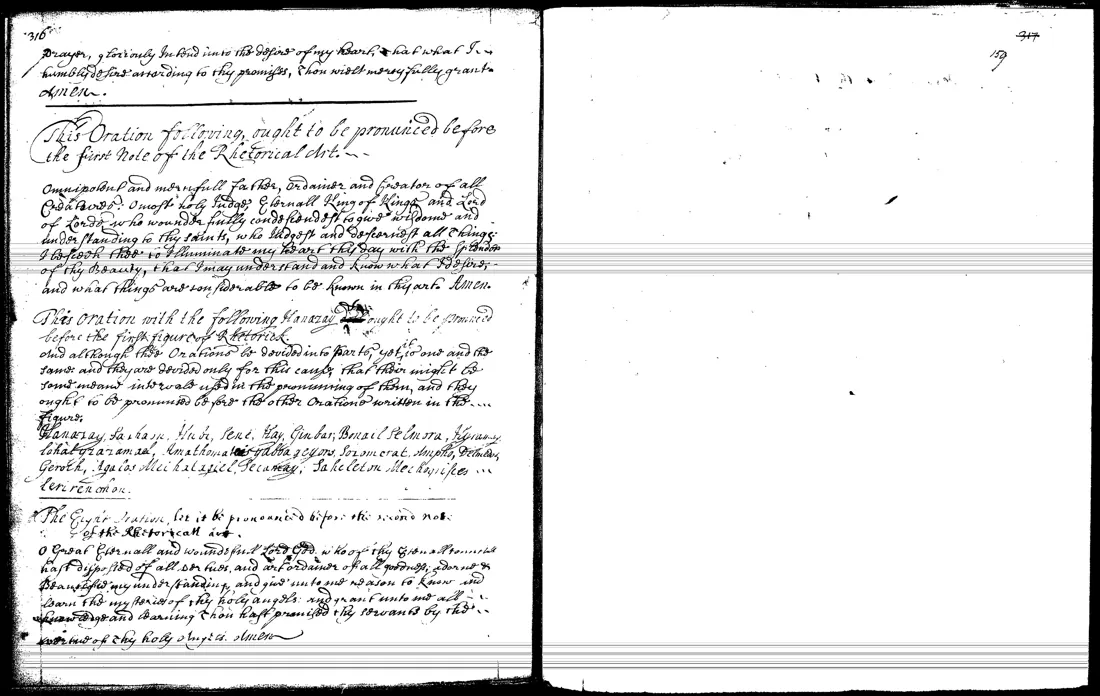
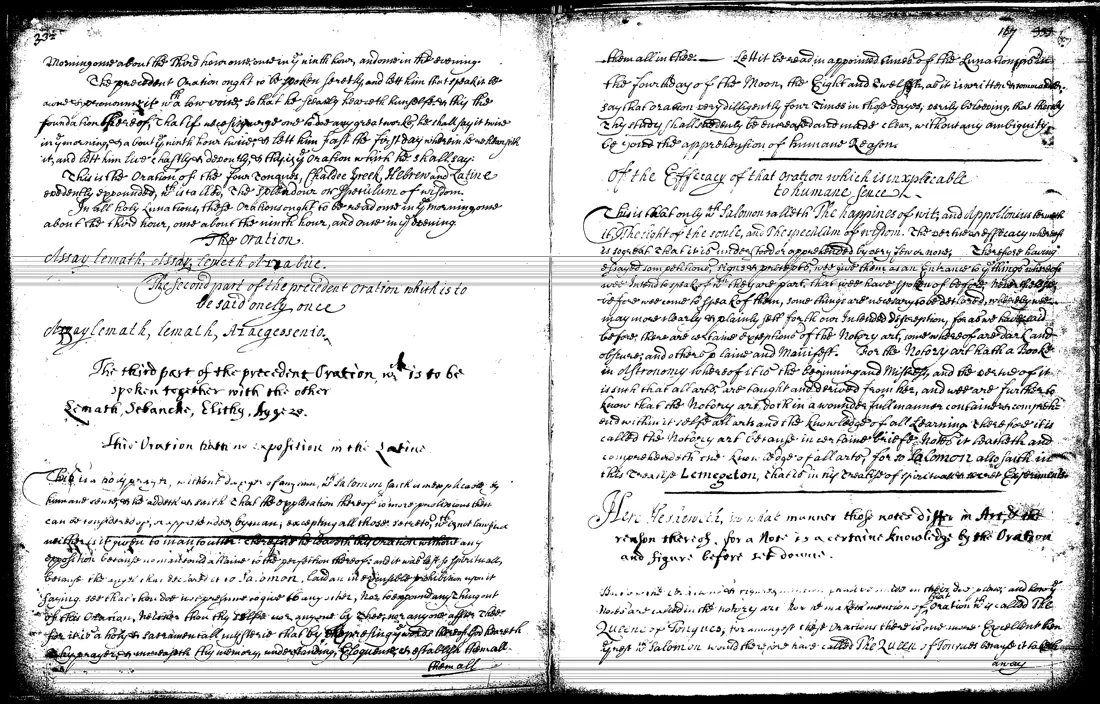
Oraciones del proemio (2ª y 3ª)#p159
Ars Notoria — facsímil · Oraciones del proemio (2ª y 3ª) · dominio público
Manuscrito — Sloane MS 3825 (British Museum)
🔍 clic para ampliar

TranscripciónInglés (s. XVII)

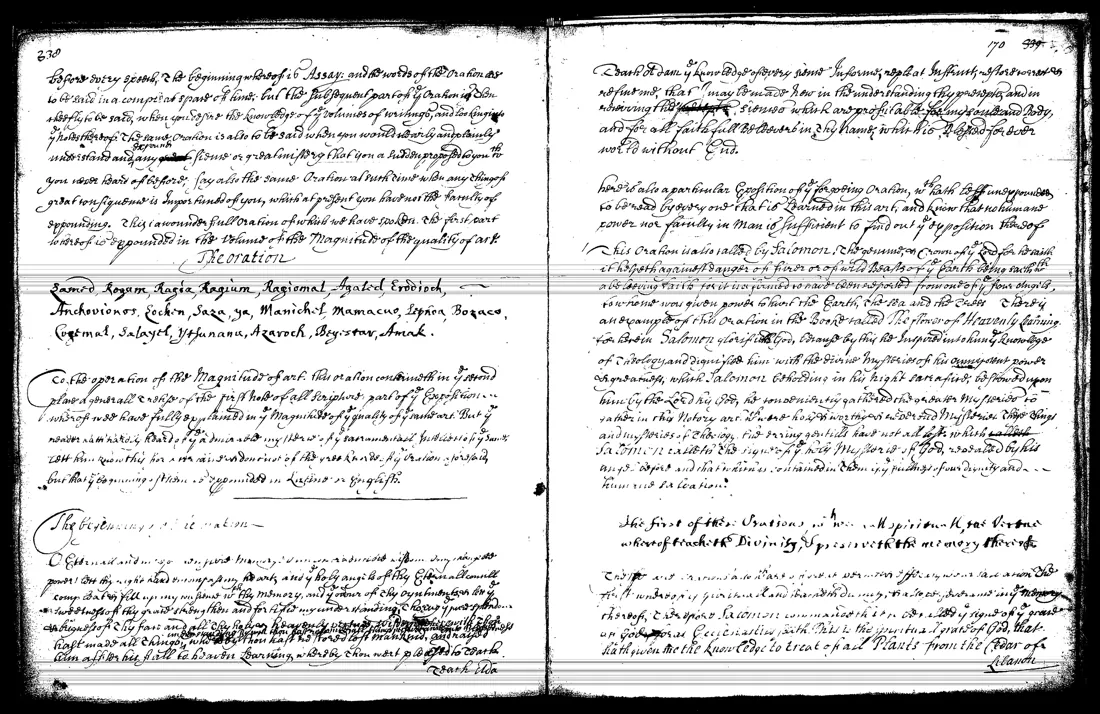
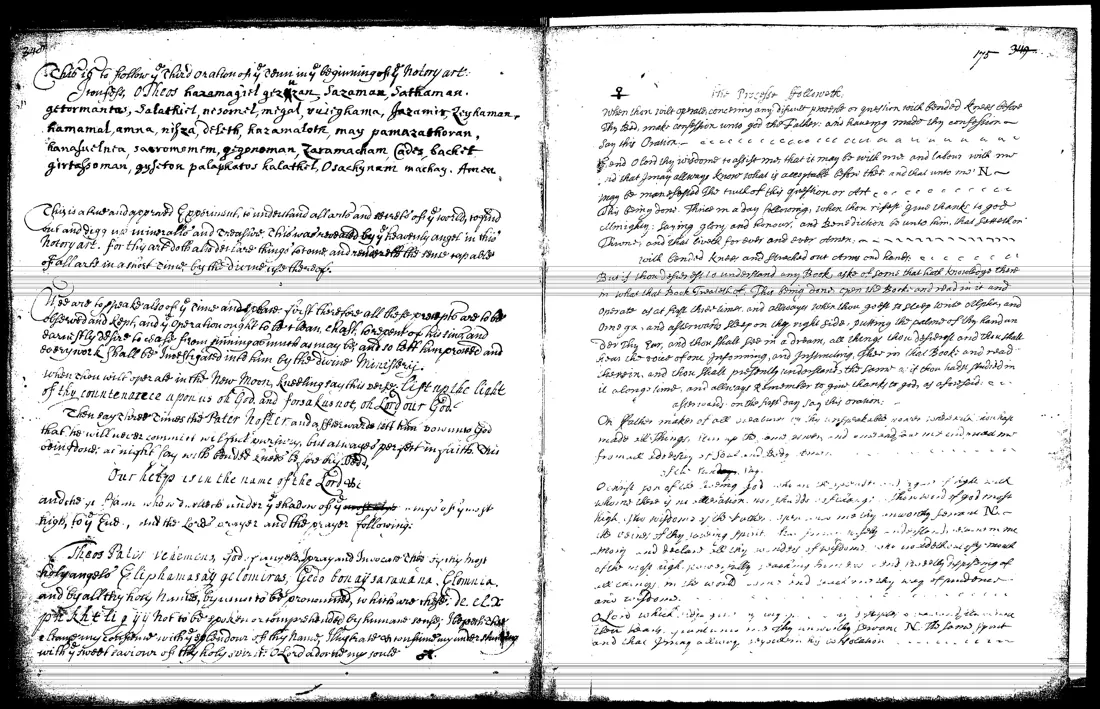
sight and exalt thy name; for it is good before Thy Saints; Sainctifie me this day that I may liue in faith perfitt in hope, and constant in Charity, and may Learne and obtaine the knowledge I desire; and being Illuminated, Strengthened, and exalted by the being obtained, I may know thee, and Loue thee; and Loue [—struck—] knowledge and wisdome of the scriptures and that I may understand and firmly obtaine that which Thou hast permitted man to know: Oh Lord Jesus Christ, Eternall onely begotten Son of God, into whose hands the father gaue all things before all worlds, giue unto me this day for thy holy and glorious Name, the unspeakable nutriment of Soule and Body, a fit fluent free and perfitt tongue; and that whatsoever I shall aske in thy mercy, will and truth I may obtaine; and confirme all my prayers and actions according to thy good pleasure. Oh Lord my God, the father of life, open the fountaine of [Sciences?] [—struck—], w[ch] I desire; open to me. Oh Lord, the fountaine which thou opened to Adam, and to thy servants Abraham, and Isaac, and Jacob, to understand, Learne, and Judge; receiue Oh Lord my prayers through all Thy heavenly virtues Amen

[rúbrica] The next oration is the Second of Penn. and giueth Eloquence, which ought to be saide after the other; a Little intervall betweene and before the first figure of Theology.

I adore thee thou King of Kings and Lords, Eternall and unchange[able] King, harken this day to cry and sighing of my heart and spirit that thou maist change my understanding, and giue to me a heart of flesh, for my heart of stone, That I may breath before my Lord and Saviour; and wash O Lord with thy new Spirit the inward parts of my heart, and wash away the euill of my flesh: Infuse into me a good understanding, that I may become a new man, reformed and firme[d?] in thy loue; and let

let they salvation giue me Increase of knowledge; [heare my prayer —struck—] O Lord, where with I cry unto thee, and open the Eyes of my flesh, and understanding, to understand the wonderfull things of thy Law [Law inserted above struck "Loue"], that being viuified by thy Justification, I may preuaild against the Devill, the Aduasary of the faithfull; heare me O my Lord God, and be mercifull unto me, and shew me thy mercy; and reach to me the [vessel?] of salvation, That I may drinch, and be satisfied of the fountaine of thy grace; That I may obtaine the knowledge and understanding; and lett the grace of thy holy Spirit come and rest upon me, Amen

[rúbrica] For Eloquence and Stability of Mind. [—struck—] This is the Third Oration of the Penn and is to bee saide before the The first figure of Astronomy.

I confess my selfe guilty this day before thee O God, Father of heaven and Earth, maker of all things, visible and Invisible, of all Creatures, dispenser and giuer of grace [all — inserted] and vertue; who hidest wisdom and knowledge from the proud and wicked, and giueth it to the faithfull and Humble, Illuminate my heart and establish my conscience and understanding; lett the light of thy countenance upon me, that I may loue thee and be established in the knowledge of my understanding, that I being cleansed from euill workes, may attaine to the knowledge of those sciences which thou hast reserued for beleivers. O mercifull and Omnipotent God, cleanse my heart and Reines, Strengthen my soule and senses, with the grace of thy holy Spirit; and establish me with the fire of the same grace; Illuminate me, gird up my Loynes, and giue the taste of thy consolation into my right hand, direct me in thy doctrine, root out of me all vices and sinn, and comfort me in thy loue [&] thy mercies;

TraducciónEspañol

… la vista y exalta tu nombre; pues es bueno ante tus santos; santifícame este día, para que viva en fe, perfecto en esperanza y constante en caridad, y pueda aprender y obtener el conocimiento que deseo; y siendo iluminado, fortalecido y exaltado por lo obtenido, pueda conocerte y amarte; y amar [—tachado—] el conocimiento y la sabiduría de las Escrituras, y que pueda entender y obtener firmemente aquello que tú has permitido conocer al hombre. Oh Señor Jesucristo, eterno y único Hijo unigénito de Dios, en cuyas manos el Padre puso todas las cosas antes de todos los mundos: dame este día, por tu santo y glorioso nombre, el inefable alimento de alma y cuerpo, una lengua apta, fluida, libre y perfecta; y que cuanto pida en tu misericordia, voluntad y verdad, pueda obtenerlo; y confirma todas mis oraciones y acciones según tu buen placer. Oh Señor mi Dios, Padre de la vida, abre la fuente de las [Ciencias?] [—tachado—], que deseo; ábremela. Oh Señor, la fuente que abriste a Adán, y a tus siervos Abraham, e Isaac, y Jacob, para entender, aprender y juzgar; recibe, oh Señor, mis oraciones a través de todas tus virtudes celestiales. Amén.

[rúbrica] La oración siguiente es la segunda "del Penn" y da elocuencia; debe decirse después de la otra, con un pequeño intervalo entre medias, y antes de la primera figura de teología.

Te adoro, tú, Rey de reyes y señores, eterno e inmutable Rey: escucha este día el clamor y el suspiro de mi corazón y mi espíritu, para que cambies mi entendimiento y me des un corazón de carne por mi corazón de piedra, para que respire ante mi Señor y Salvador; y lava, oh Señor, con tu nuevo Espíritu las partes internas de mi corazón, y lava el mal de mi carne: infunde en mí un buen entendimiento, para que llegue a ser un hombre nuevo, reformado y firme[?] en tu amor; y deja… … deja que tu salvación me dé aumento de conocimiento; [oye mi oración —tachado—] oh Señor, con la cual clamo a ti, y abre los ojos de mi carne y de mi entendimiento, para entender las cosas maravillosas de tu Ley [«Ley» insertado sobre «Amor» tachado], para que, vivificado por tu Justificación, pueda prevalecer contra el Diablo, el adversario de los fieles; óyeme, oh Señor Dios mío, y ten misericordia de mí, y muéstrame tu misericordia; y alcánzame el [vaso?] de la salvación, para que beba y sea saciado de la fuente de tu gracia; para que obtenga el conocimiento y el entendimiento; y deja que la gracia de tu santo Espíritu venga y repose sobre mí. Amén.

[rúbrica] Para la elocuencia y la estabilidad de la mente. [—tachado—] Esta es la tercera oración "del Penn" y ha de decirse antes de la primera figura de astronomía.

Me confieso culpable este día ante ti, oh Dios, Padre del cielo y de la tierra, hacedor de todas las cosas, visibles e invisibles, de todas las criaturas, dispensador y dador de [toda] gracia y virtud; que ocultas la sabiduría y el conocimiento a los soberbios y a los malvados, y los das a los fieles y humildes: ilumina mi corazón y establece mi conciencia y mi entendimiento; deja la luz de tu rostro sobre mí, para que te ame y sea establecido en el conocimiento de mi entendimiento, para que yo, limpio de las obras malas, alcance el conocimiento de aquellas ciencias que has reservado para los creyentes. Oh misericordioso y omnipotente Dios, limpia mi corazón y mis riñones, fortalece mi alma y mis sentidos con la gracia de tu santo Espíritu; y establéceme con el fuego de la misma gracia; ilumíname, ciñe mis lomos, y da el sabor de tu consolación en mi mano derecha, dirígeme en tu doctrina, arranca de mí todos los vicios y pecados, y consuélame en tu amor [y] tus misericordias;

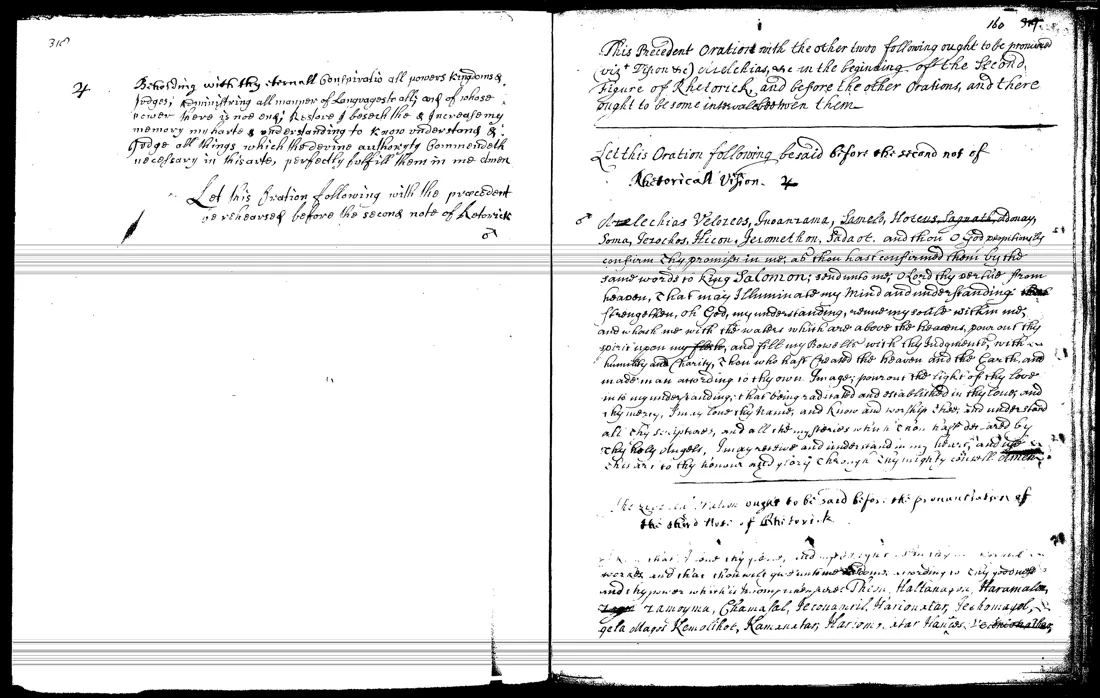
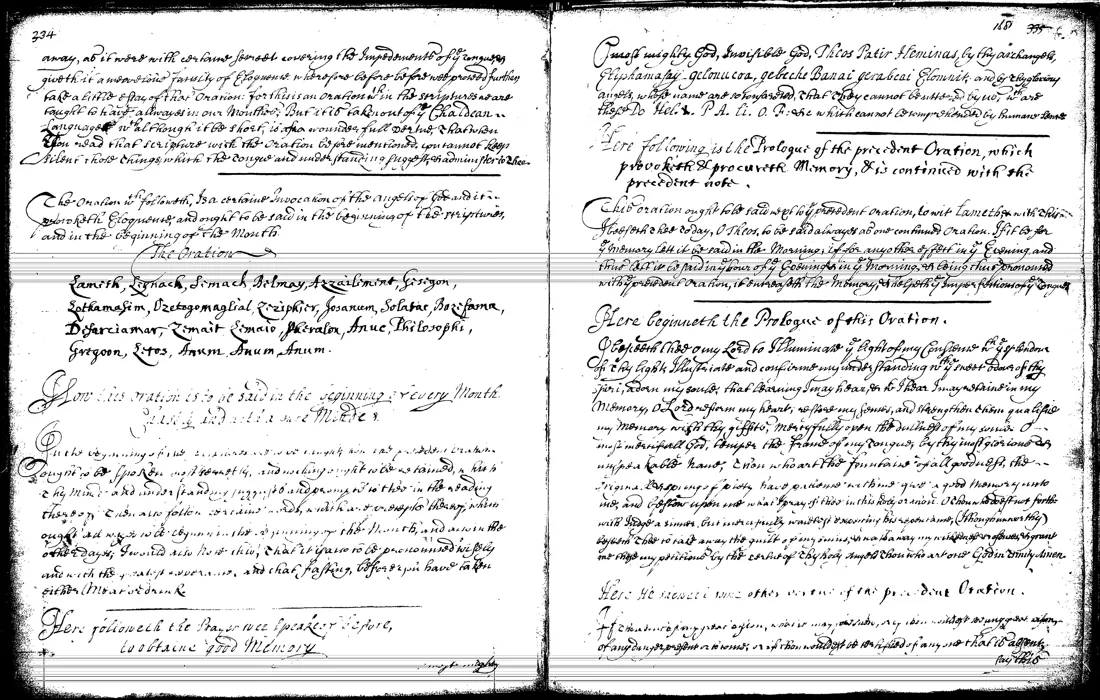
Oraciones: memoria y elocuencia#p160
Ars Notoria — lámina grabada · Oraciones: memoria y elocuencia · dominio público
Manuscrito — Sloane MS 3825 (British Museum)
🔍 clic para ampliar

TranscripciónInglés (s. XVII)

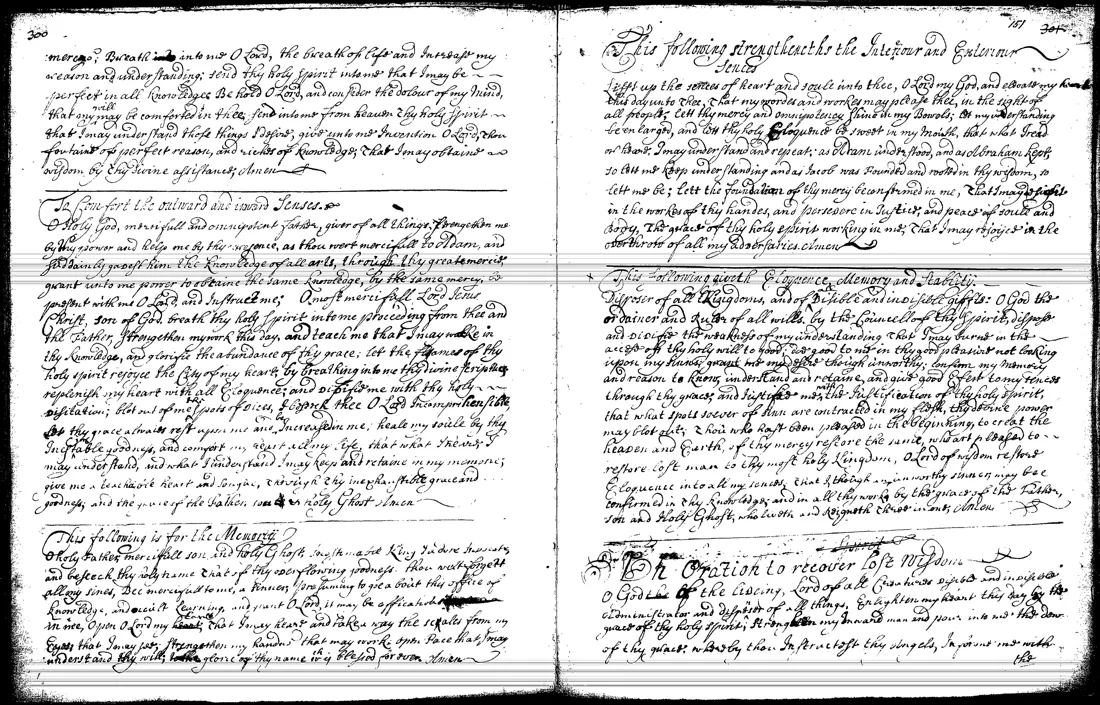
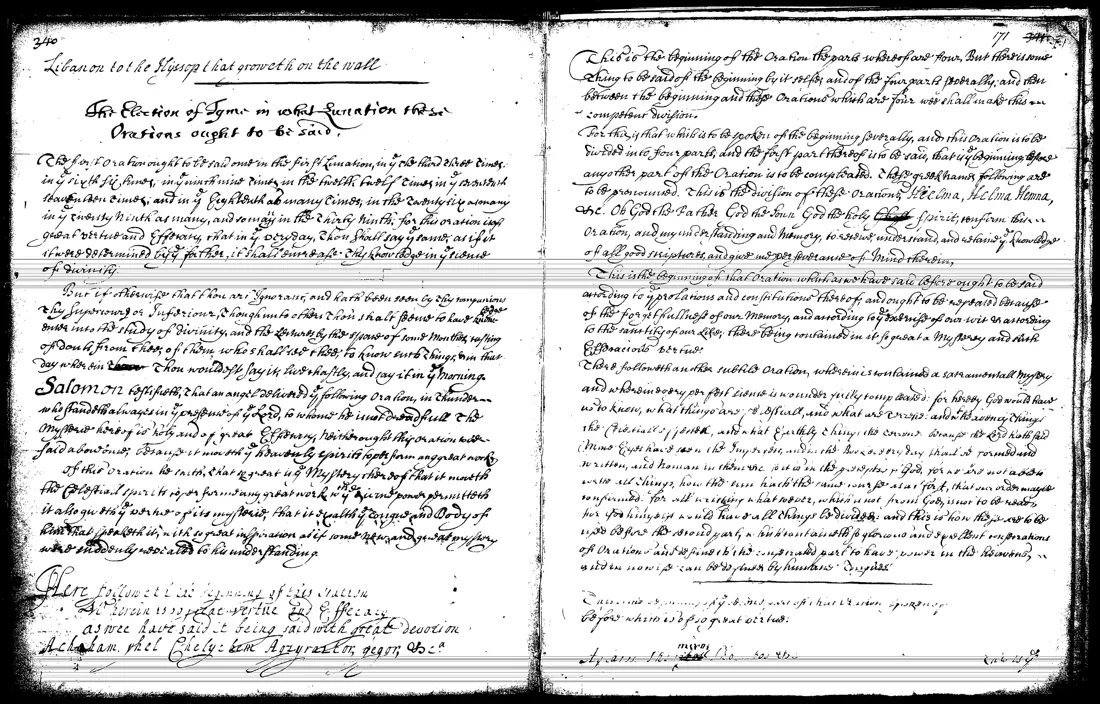
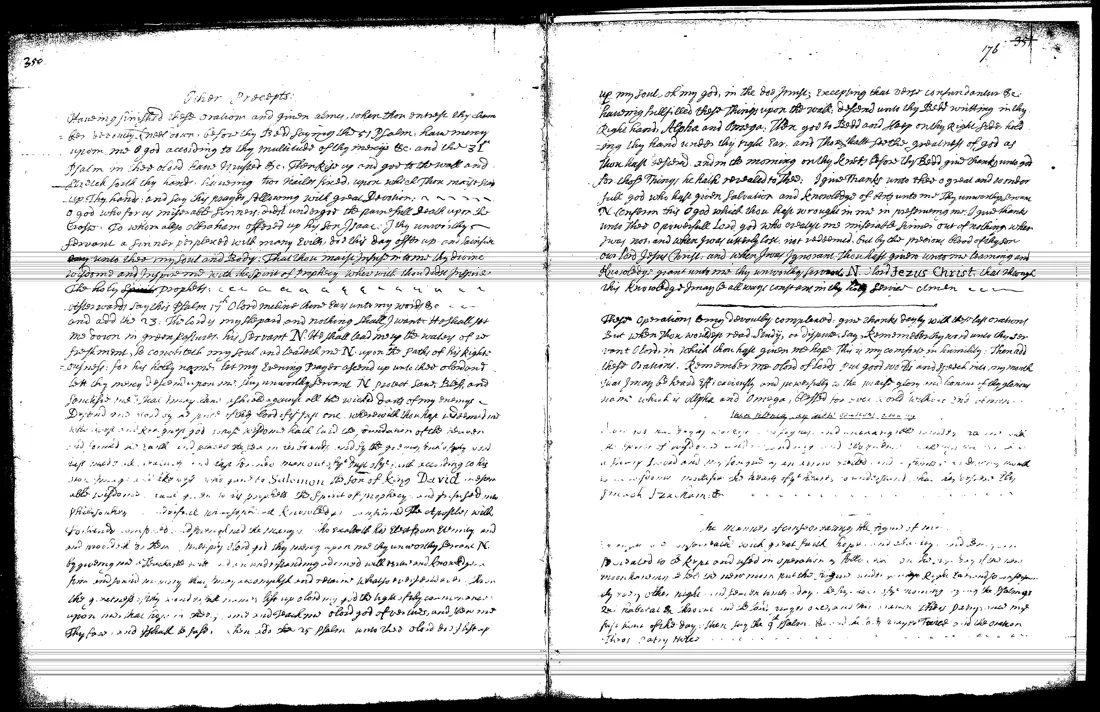
…mercye; Breath [into?] into me O Lord, the breath of life and Increase my reason and understanding; send thy holy spirit into me that I may be perfect in all knowledge; Behold O Lord, and consider the dolour of my mind, that my ^will^ may be comforted in thee; send into me from heaven thy holy spirit that I may understand those things I desire, give unto me Invention O Lord, thou fountaine of perfect reason, and riches of knowledge; That I may obtaine wisdom by thy divine assistance; Amen

To Comfort the outward and inward Senses. O Holy God, mercifull and omnipotent Father, giver of all things, Strengthen me by thy power and help me by thy presence, as thou wert mercifull to Adam, and suddainly gavest him the knowledge of all arts, through thy great mercies, grant unto me power to obtaine the same knowledge, by the same mercy, & present with me O Lord, and Instruct me; O most mercifull Lord Jesus Christ, son of God. breath thy holy spirit into me proceeding from thee and the Father, Strengthen my work this day, and teach me that I may [walke?] in thy knowledge, and glorifie the abundance of thy grace; let the flames of thy holy spirit rejoyce the City of my heart, by breathing into me thy divine scripture[s] replenish my heart with all Eloquence; and [divide?] me with thy holy visitation; blot out of me [the] spots of vices, I beseech thee O Lord Incomprehensible let thy grace alwaies rest upon me and ^be^ Increase[d] in me; heale my soule by thy Ineffable goodness, and comfort my heart all my life, that what I heard, I may understand, and what I understand I may keep and retaine in my memorie; give me a teachable heart and tongue, through thy inexhaustible grace and goodness; and the grace of the Father, son & holy Ghost Amen

This following is for the Memory. O holy Father, mercifull son, and holy Ghost, inestimable King, I adore Invocate, and beseech thy holy name that of thy overflowing goodness, thou wilt forgett all my sines, Bee mercifull to me, a sinner; presuming to goe about this office of knowledge, and occult Learning, and grant O Lord, it may be efficatious [—struck—] in mee, Open O Lord my [heart —struck—, over: eares?] That I may heare and take away the scales from my Eyes; that I may see; Strengthen my handes that [I] may work; open Pace [Face?] that I may understand thy will; to the glorie of thy name w[hi]ch is blessed for ever. Amen

This following strengtheneth the Interiour and Exteriour Senses Lift up the senses of heart and soule unto thee, O Lord my God, and eloate[?] my [heart?] this day unto thee, That my wordes and workes may please thee, in the sight of all people; lett thy mercy and omnipotency shine in my Bowels; let my understanding be enlarged, and lett thy holy Eloquence be sweet in my mouth, that what I read or heard, I may understand and repeat; as Adam understood, and as Abraham kept, so lett me keep understanding and as Iacob was Founded and rooted in thy wisdom, so lett me be; lett the foundation of thy mercy be confirmed in me, That I may [fight?] in the workes of thy handes, and persevere in Iustice, and peace of soule and body, The grace of thy holy spirit working in me, That I may rejoiced in the overthrow of all my adversaries. Amen

This following giveth Eloquence, Memory and Stablity. Disposer of all Kingdoms, and of Visible and invisible giftes: O God the ordainer and Ruler of all wills. by the Councell of thy Spirit, dispose and divide the weakness of my understanding that I may burne in the access of thy holy will to good; be good to me in thy good pleasure not looking upon my sinnes; grant me my desire though unworthy; confirm my memory and reason to know, understand and retaine, and give good Effect to my senses through thy grace; and Iustified me, ^with^ the Iustification of thy holy spirit, that what spots soever of sinn are contracted in my flesh, thy divine power may blot out; & thou who hast been pleased in the beginning, to creat the heaven and Earth, of thy mercy restore the same, who art [pleased to?] restore lost man to thy most holy Kingdom, O Lord of wisdom restore Eloquence into all my senses; that I though an unworthy sinner, may bee confirmed in thy knowledge, and in all thy works by the grace of the Father, son and Holy Ghost, who liveth and Reigneth three in one; Amen

An Oration to recover lost Wisdom O God the [—struck—] of the liveing, Lord of all Creatures visible and invisible, Administrator and disposer of all things, Enlighten my heart this day by the grace of thy holy spirit; Strengthen my Inward man and pour into me the dew of thy grace; whereby thou Instructest thy angels, Inform me with the [reclamo/catchword: «the»]

TraducciónEspañol

…misericordia; insufla [dentro] en mí, oh Señor, el aliento de la vida, y acrecienta mi razón y entendimiento; envía tu santo espíritu a mí para que yo sea perfecto en todo conocimiento; mira, oh Señor, y considera el dolor de mi mente, para que mi ^voluntad^ sea confortada en ti; envíame desde el cielo tu santo espíritu para que yo comprenda aquellas cosas que deseo; dame la invención, oh Señor, tú, fuente de razón perfecta y riquezas de conocimiento; para que yo obtenga la sabiduría por tu divina asistencia; Amén.

Para confortar los sentidos exteriores e interiores. Oh Dios Santo, misericordioso y omnipotente Padre, dador de todas las cosas, fortaléceme con tu poder y ayúdame con tu presencia, como fuiste misericordioso con Adán, y súbitamente le diste el conocimiento de todas las artes, por tus grandes misericordias; concédeme el poder de obtener ese mismo conocimiento, por la misma misericordia, y está presente conmigo, oh Señor, e instrúyeme; oh misericordiosísimo Señor Jesu- cristo, Hijo de Dios, insufla tu santo espíritu en mí, procedente de ti y del Padre; fortalece mi obra en este día, y enséñame para que yo [ande?] en tu conocimiento, y glorifique la abundancia de tu gracia; que las llamas de tu santo espíritu alegren la ciudad de mi corazón, insuflando en mí tu divina escritura; colma mi corazón de toda elocuencia; y [divídeme?] con tu santa visitación; borra de mí [las] manchas de los vicios, te suplico, oh Señor Incomprensible; que tu gracia repose siempre sobre mí y sea acrecentada en mí; sana mi alma con tu inefable bondad, y conforta mi corazón toda mi vida, para que lo que oí, lo comprenda, y lo que comprendo lo guarde y retenga en mi memoria; dame un corazón y una lengua dóciles, por tu inagotable gracia y bondad; y la gracia del Padre, del Hijo y del Espíritu Santo. Amén.

Esta que sigue es para la memoria. Oh santo Padre, misericordioso Hijo y Espíritu Santo, Rey inestimable, te adoro, invoco y suplico a tu santo nombre que, por tu desbordante bondad, perdones todos mis pecados; sé misericordioso conmigo, un pecador, que presume emprender este oficio de conocimiento y aprendizaje oculto; y concede, oh Señor, que sea eficaz [—tachado—] en mí; abre, oh Señor, mi [corazón —tachado—, encima: oídos?] para que yo oiga, y quita las escamas de mis ojos, para que yo vea; fortalece mis manos para que [yo] obre; abre [mi rostro?] para que yo comprenda tu voluntad; para gloria de tu nombre, que es bendito para siempre. Amén. Esta que sigue fortalece los sentidos interiores y exteriores. Alza los sentidos del corazón y del alma hacia ti, oh Señor mi Dios, y [eleva?] mi [corazón?] este día hacia ti, para que mis palabras y obras te agraden, a la vista de todo el pueblo; haz que tu misericordia y omnipotencia brillen en mis entrañas; que mi entendimiento sea ensanchado, y que tu santa elocuencia sea dulce en mi boca, para que lo que lea u oiga, lo comprenda y lo repita; como Adán comprendió, y como Abraham guardó, así déjame guardar el entendimiento; y como Jacob fue fundado y arraigado en tu sabiduría, así déjame ser; haz que el fundamento de tu misericordia sea confirmado en mí, para que yo [luche?] en las obras de tus manos, y persevere en la justicia, y [tenga] paz de alma y cuerpo; la gracia de tu santo espíritu obrando en mí, para que yo me regocije en el derrocamiento de todos mis adversarios. Amén.

Esta que sigue da elocuencia, memoria y estabilidad. Dispensador de todos los reinos, y de los dones visibles e invisibles: oh Dios, ordenador y Gobernante de todas las voluntades, por el consejo de tu Espíritu, dispón y divide la debilidad de mi entendimiento, para que yo arda en el acceso de tu santa voluntad hacia el bien; sé bueno conmigo según tu buena voluntad, sin mirar mis pecados; concédeme mi deseo aunque indigno; confirma mi memoria y razón para conocer, comprender y retener, y da buen efecto a mis sentidos por tu gracia; y justifícame con la justificación de tu santo espíritu, para que cualesquiera manchas de pecado contraídas en mi carne, tu divino poder las borre; y tú, que te complaciste en el principio en crear el cielo y la tierra, por tu misericordia restaura lo mismo, tú que te [complaces en?] restaurar al hombre perdido a tu santísimo Reino, oh Señor de la sabiduría, restaura la elocuencia en todos mis sentidos; para que yo, aunque pecador indigno, sea confirmado en tu conocimiento y en todas tus obras, por la gracia del Padre, del Hijo y del Espíritu Santo, que vive y reina tres en uno; Amén.

Una oración para recobrar la sabiduría perdida. Oh Dios [—tachado—] de los vivientes, Señor de todas las criaturas visibles e invisibles, Administrador y dispensador de todas las cosas, ilumina mi corazón este día por la gracia de tu santo espíritu; fortalece mi hombre interior y derrama en mí el rocío de tu gracia; por el cual instruyes a tus ángeles; infórmame con la… [reclamo al pie: «the»]

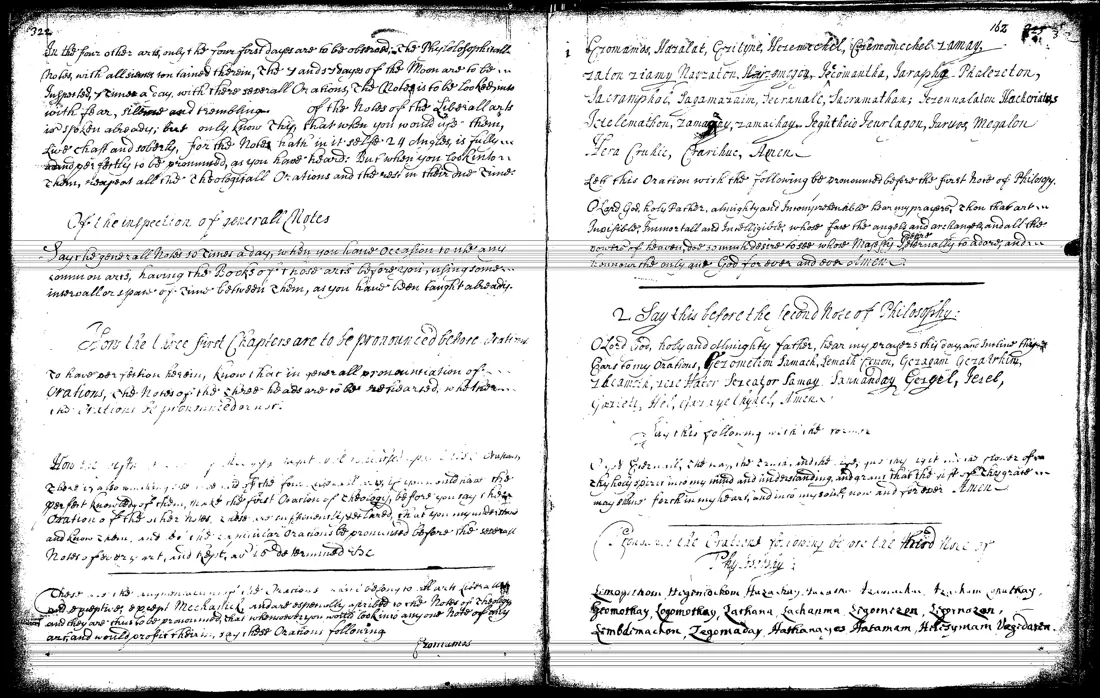
Gracia del Espíritu Santo; oración en cuatro lenguas#p161
Ars Notoria — facsímil · Gracia del Espíritu Santo; oración en cuatro lenguas · dominio público
Manuscrito — Sloane MS 3825 (British Museum)
🔍 clic para ampliar

TranscripciónInglés (s. XVII)

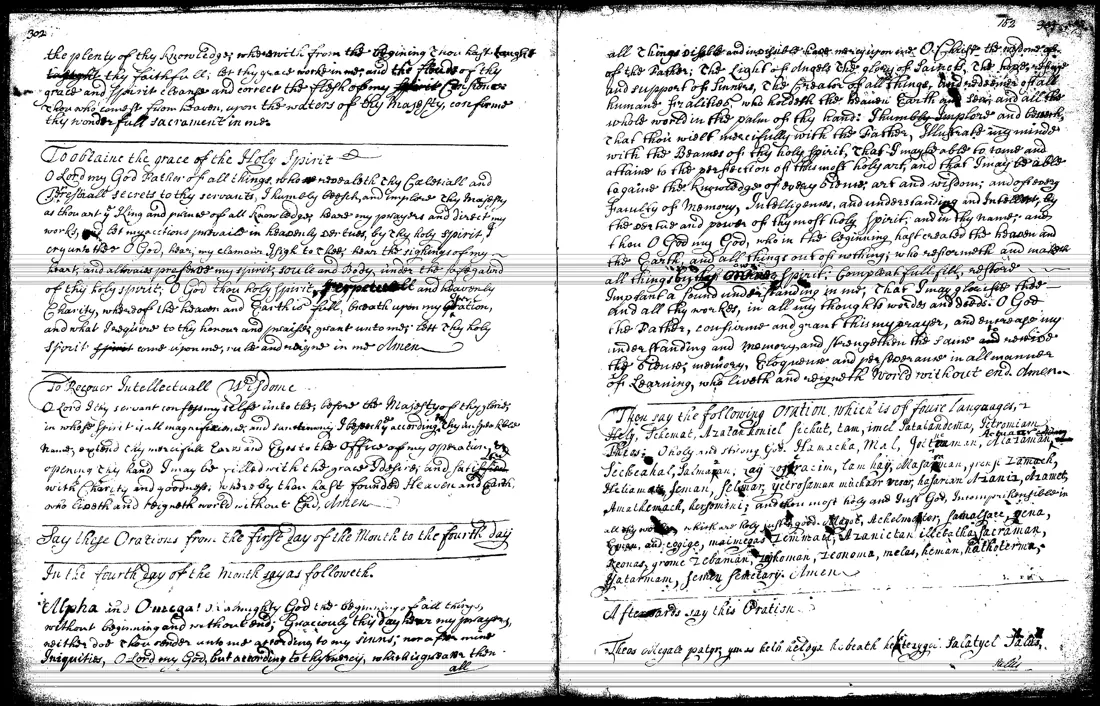
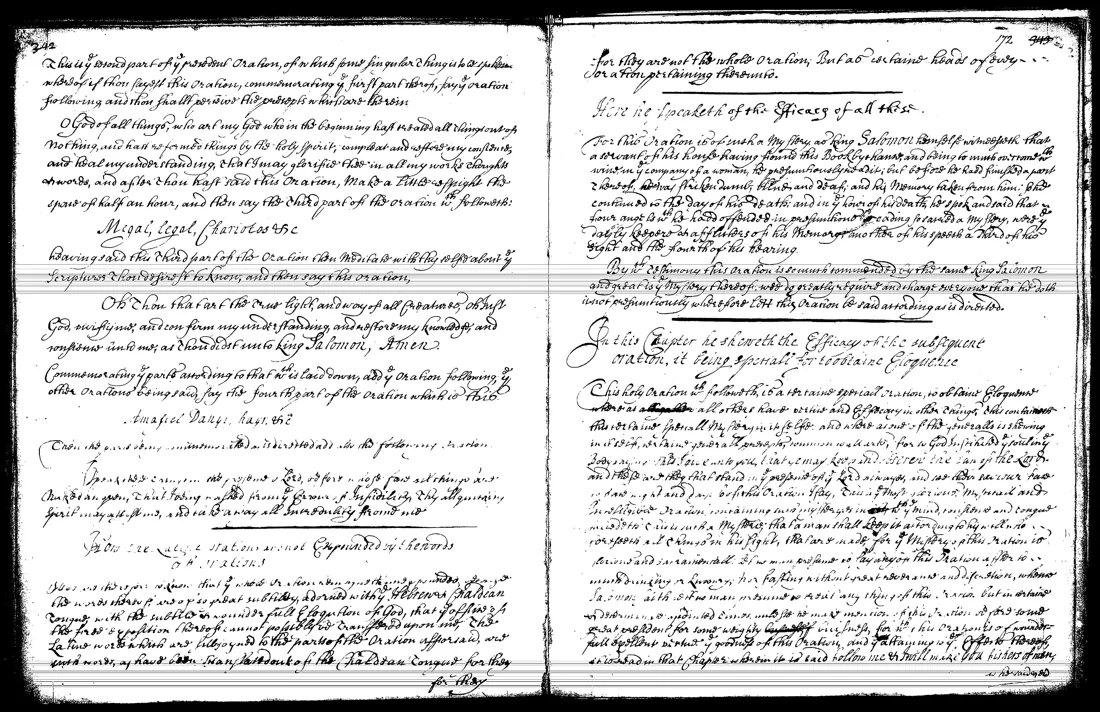
the plenty of thy Knowledge; wherewith from the beginning thou hast [taught] [~~taught~~] thy faithfull; let thy grace worke in me; and the ~~floods~~ of thy grace and spirit cleanse and correct the flesh of my ~~spirit~~ Conscience thou who comest from heaven, upon the waters of thy Majesty, confirme thy wonderfull sacrament in me.

To obtaine the grace of the Holy Spirit O Lord my God Father of all things, who revealeth thy Celestiall and Terrestiall secrets to thy servants, I humbly beseech, and implore thy Majesty as thou art y[e] King and prince of all knowledge, heare my prayers and direct my workes, [and] let my acctions prevaile in heavenly vertues, by thy holy spirit, I cry unto thee O God, heare, my clamour I sigh to thee; heare the sighinges of my heart, and allwaies preserve my spirit, soule and Body, under the safegard of thy holy spirit; O God thou holy spirit ~~perpetuall~~ and heavenly Charity, whereof the heaven and Earth is full, breath upon my Operation, [sup.: Oper.] and what I desire to thy honour and praise; grant unto me; lett thy holy Spirit ~~spirit~~ come upon me, rule and reigne in me Amen

To Recover Intellectuall Wisdome O Lord I thy servant confess my selfe unto the[e]; before the Majesty of thy glory; in whose spirit is all magnificence, and sanctimony I beseech according thy unspeakable name, extend thy mercifull Eares and Eyes to the Office of my operation, [sup.: by] opening thy hand I may be filled with the grace I desire; and satiffied with Charity and goodness; whereby thou hast founded Heaven and Earth, who liveth and reigneth world without End, Amen

Say these Orations from the first day of the Month to the fourth day

In the fourth day of the Month say as followeth.

Alpha and Omega! O Almighty God the beginning of all things, without beginning and without end; Graciously this day heare my prayers, neither doe thou render unto me according to my sinns; nor after mine Iniquities, O Lord my God, but according to thy mercy, which is greater then [reclamo: all]

all things visible and invisible have mercy upon me. O Christ the wisdome of the Father; The Light of Angels the glory of Saints, The hope, refuge and support of Sinners, The Creator of all things, and redeemer of all humane fralities, who holdeth the heaven Earth and sea, and all the whole world in the palm of thy hand: I humbly Implore and beseech, that thou wilt [m]ercifully[?] with the Father, Illustrate my minde with the Beames of thy holy spirit, That I may be able to come and attaine to the perfection of this most holy art, and that I may be able to gaine the knowledge of every liberall art and wisdom; and of every Faculty of Memory, Intelligence, and understanding and Intellect, by the vertue and power of thy most holy spirit; and in thy name; and thou O God my God, who in the beginning hast created the heaven and the Earth, and all things out of nothing; who reformeth and maketh all things by thy ~~ordinance~~ [sup.: owne] Spirit; Compleat, full-fill, restore Implant a sound understanding in me, That I may glorifie thee and all thy workes, in all my thoughts wordes and deeds. O God the Father, confirme and grant this my prayer, and increase my understanding and memory, and strengthen the same ~~and revive~~ the ~~[?]~~ memory, Eloquence and perseverance in all manner of Learning, who liveth and reigneth World without end. Amen.

Then say the following Oration, which is of foure languages, ~ Hely, Schemat, Azatan honiel sichut, tam, imel Iatabandema, Ietromiam [sup.: Actuar edon] Theos: O holy and strong God. Hamacha, Mal, Ioe[?]aman, Alazaman, [sup.: ne / or] Seckeahal, Salmaian; aiy zostracim, tam hay, Masar[m]an, grensi Zamoch, Heliamat, Ieman, Selmar, yetrosaman muchaer vesar, hasarian Azaniz, Azamet, Amathemach, hersomini; and thou most holy and Iust God, Incomprehensible in all thy workes which are holy Iust & good. Magot, Ackelmator, Iamalsace, gena, Grau, and cogige, maimegas Zemmau; Azanictan illebatha Iacraman, Reonas, grome Zebaman, ashoman, zeonoma, melas, heman, hathoterma, Yatarmam, Iemen Iemetary. Amen

Afterwards say this Oration

Theos o[the]os pater, ymas heli heldya hibeath heftezygai. Salatyel Ialas, [ilegible: continúa en la página siguiente]

TraducciónEspañol

La abundancia de tu conocimiento; con la cual desde el principio has enseñado a tus fieles; obre tu gracia en mí; y ~~los raudales~~ de tu gracia y espíritu limpien y corrijan la carne de mi ~~espíritu~~ conciencia, tú que vienes del cielo, sobre las aguas de tu Majestad, confirma tu maravilloso sacramento en mí.

Para obtener la gracia del Espíritu Santo Oh Señor Dios mío, Padre de todas las cosas, que revelas tus secretos celestiales y terrestres a tus siervos, humildemente suplico e imploro a tu Majestad, pues tú eres el Rey y príncipe de todo conocimiento, oye mis oraciones y dirige mis obras, [y] haz que mis acciones prevalezcan en las virtudes celestiales, por tu espíritu santo; yo clamo a ti, oh Dios, oye mi clamor, suspiro a ti; oye los suspiros de mi corazón, y guarda siempre mi espíritu, alma y cuerpo, bajo el amparo de tu espíritu santo; oh Dios, tú, Espíritu Santo ~~perpetuo~~ y celestial Caridad, de la cual el cielo y la tierra están llenos, alienta sobre mi operación, y lo que deseo para tu honor y alabanza, concédemelo; deja que tu santo Espíritu venga sobre mí, gobierne y reine en mí. Amén.

Para recobrar la sabiduría intelectual Oh Señor, yo, tu siervo, me confieso ante ti; ante la Majestad de tu gloria, en cuyo espíritu está toda magnificencia y santidad; suplico, según tu inefable nombre, extiende tus misericordiosos oídos y ojos a la obra de mi operación, abriendo tu mano que yo sea colmado con la gracia que deseo; y saciado con Caridad y bondad; por la cual fundaste el cielo y la tierra, que vives y reinas por los siglos sin fin. Amén.

Di estas oraciones desde el primer día del mes hasta el cuarto día.

En el cuarto día del mes di como sigue.

¡Alfa y Omega! Oh Dios Todopoderoso, principio de todas las cosas, sin principio y sin fin; graciosamente oye hoy mis oraciones; ni me trates conforme a mis pecados, ni según mis iniquidades, oh Señor Dios mío, sino según tu misericordia, que es mayor que [reclamo: todo] todas las cosas visibles e invisibles: ten misericordia de mí. Oh Cristo, sabiduría del Padre; Luz de los Ángeles, gloria de los Santos, Esperanza, refugio y sostén de los pecadores, Creador de todas las cosas y redentor de todas las flaquezas humanas, que sostienes el cielo, la tierra y el mar, y todo el mundo entero en la palma de tu mano: humildemente imploro y ruego que tú, misericordiosamente[?] con el Padre, ilumines mi mente con los rayos de tu espíritu santo, para que yo sea capaz de llegar y alcanzar la perfección de este santísimo arte, y de que yo sea capaz de ganar el conocimiento de todo arte liberal y sabiduría, y de toda facultad de memoria, inteligencia, entendimiento e intelecto, por la virtud y el poder de tu santísimo espíritu, y en tu nombre; y tú, oh Dios, Dios mío, que en el principio creaste el cielo y la tierra, y todas las cosas de la nada; que reformas y haces todas las cosas por tu ~~ordenanza~~ propio Espíritu; completa, cumple, restaura, implanta un sano entendimiento en mí, para que yo te glorifique y a todas tus obras, en todos mis pensamientos, palabras y hechos. Oh Dios Padre, confirma y concede esta oración mía, y aumenta mi entendimiento y memoria, y fortalece la misma ~~y aviva~~ la memoria, elocuencia y perseverancia en toda clase de saber, que vives y reinas por los siglos sin fin. Amén.

Di entonces la siguiente oración, que es de cuatro lenguas, ~ Hely, Schemat, Azatan honiel sichut, tam, imel Iatabandema, Ietromiam Theos: Oh Dios santo y fuerte. Hamacha, Mal, Ioe[?]aman, Alazaman, Seckeahal, Salmaian; aiy zostracim, tam hay, Masar[m]an, grensi Zamoch, Heliamat, Ieman, Selmar, yetrosaman muchaer vesar, hasarian Azaniz, Azamet, Amathemach, hersomini; y tú, Dios santísimo y Justo, Incomprensible en todas tus obras, que son santas, justas y buenas. Magot, Ackelmator, Iamalsace, gena, Grau, and cogige, maimegas Zemmau; Azanictan illebatha Iacraman, Reonas, grome Zebaman, ashoman, zeonoma, melas, heman, hathoterma, Yatarmam, Iemen Iemetary. Amén.

Después di esta oración

Theos o[the]os pater, ymas heli heldya hibeath heftezygai. Salatyel Ialas, [ilegible: continúa en la página siguiente]

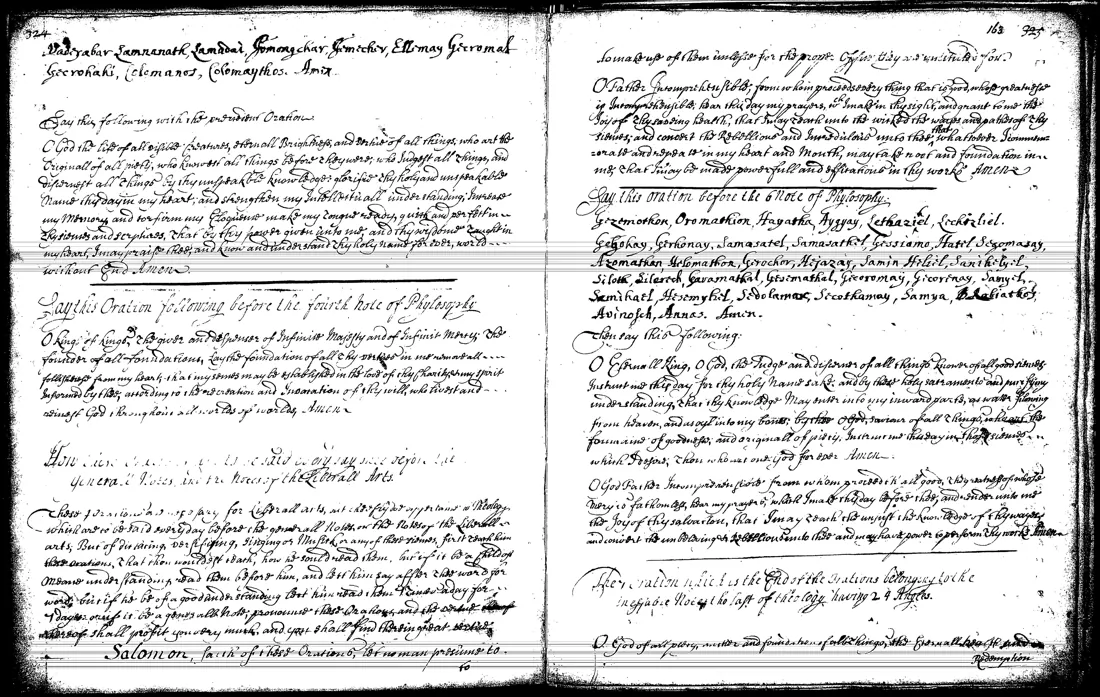
Exposición de la oración; la Tercera Parte#p162
Ars Notoria — facsímil · Exposición de la oración; la Tercera Parte · dominio público
Manuscrito — Sloane MS 3825 (British Museum)
🔍 clic para ampliar

TranscripciónInglés (s. XVII)

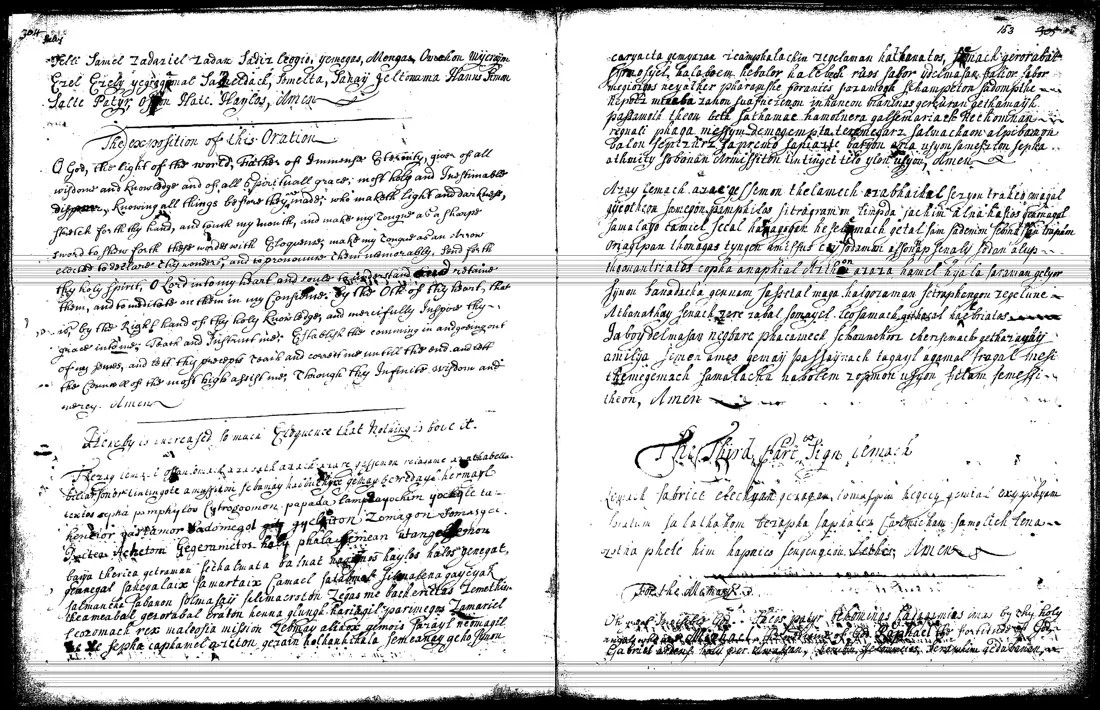
[voces magicae — fin de la oración precedente:] Felti Samel Zadariel Zadam Sadiz Leogio, yemegas, Mengas, Ourehon Wijeraym Ezel Erely yegregymal Sabeldach, Somelta, Sanay Jeltonama Hannus Simon Salte Patyr, Osson Hate. Haylos, Amen

The exposition of this Oration

O God, the light of the world, Father of Immense Eternity, giver of all wisdome and knowledge, and of all Spirituall grace; most holy and Inestimable disposer, Knowing all things before they [are] made; who maketh light and darkness, stretch forth thy hand, and touch my mouth, and make my Tongue as a sharpe sword to shew forth these wordes with Eloquence; make my Tongue as an arrow elected to declare thy wonders, and to pronounce them nameably. Send forth thy holy Spirit, O Lord, into my heart and soule, to understand [and] retaine them, and to meditate on them in my Conscience: by the Oth of thy heart, that is, by the Right hand of thy holy Knowledge, and mercifully Inspire thy grace into me; Teach and Instruct me; Establish the comming in and going out of my sences, and let thy precepts teach and correct me untill the end. and let the Counsell of the most high assist me; Through thy Infinite wisdom and mercy. Amen

Hereby is encreased so much Eloquence that nothing is boue [above] it.

[voces magicae:] Thezay lemach [ossanouch?] azize[?] azari[z]arare gessemon reiasame azathabelia biliar sondor lintingote amasitoi sebamay [haobuchyre?] gemay geredaye hermayl textos cepha pamphylos Cytrogoomon papada lampda yochim yockyle ta- henerior [gartamor?] Sadomegol [?] gyelyton Zomagon Somasgei Pattea Acketon Gegerametos [holy?] phala Semean [utangelsehon?] barja therica getraman Sechalmata balnat [nazynos?] haylos haylos genegat gennegal Saneyalaix Samartaix Camael Salademat Silmalena gayeyak salmanche Sabanon Solmasay Silmacroton Zegas me [bacheritas?] Lemethim theameabal gerorabal Eraton henna glungh harizgil parimegos Zamariel Leozomach rex maleosia mission Zebmay aliaox gemois Sarayl neomagil [le?] Sepha caphamel arieton gezain holhanhikala Semeanay geho Symon

[voces magicae — continuación:] caryacta gemyaza icamphalachin zegelaman hathanatos, Jonach gerorabal [?]osyel, halaboem hebalor halebeh raos Sabor ydelmasax [fallior?] Sabor megiorgs neyather pharamphe foranies fazamlogh Schampeton Sadompthe Repdi [mecaba?] zahon sua fnezenon inhancon maninas gerkuran gethamayh. passamoth theou beth Sathamae hamolnera galsemariack Hechomman regnali phaga miessym demogempta teremegarz Salmachaon alpibaxon balon Septzurz Japremo Sapiaste baxyon aria usyon Sameszton Sepka athoxity Sobanan Armissiton lintinget tilo ylon usyon, Amen

[voces magicae:] Azay lemach azae gessemon thelamech arabhaikal Seryon trahео[?] emagal gyeotheon Samegon pamphilos Sitragramon limpda Jachim alna hasios genmagal Samalayo Camiel Secal hazagsoen he[?]emach getal Sam Sademon Sebnyfan trapion Oriaglpan thonagas tyngen amiessus [c?y] Sodaman assonap Jenaly Sodan alup theonantriatos copha anaphial Otith[on] azaza hamel hya la Saraman gelyor Sijnon banadscha gennam Sassetal maga haigozaman Setraphangon Zegelune Athanathay Zenach zzre zabal Samayel Leosamach githacal hae Briatos Iaboy delmasan negbare phacameck Schaunehoz cherisemach getharayay amilya Simen ames gemay passaynach tagayl agamal fragat mesi themegemach Samalacha habolem zosmon usyon helam Semessi- theon, Amen

The Third Part Sign Lemach

[voces magicae:] Lemach Sabrice elechyan geragan, iomasspin heqecy gemial exgryphyam [Enatyen?] Sa lathalom Berapsha Sapiate[z] Carmicham Samolich Lena zotha phele him hapnies Sengengeon Lethes: Amen

For the Memory.

Oh great Invisible God. Theos pater [Rehominas?] [Palazmias?] imas by thy holy angels who are Michael the medicine of God, Raphael the fortitude of God, Gabriel [strength?] holy per [Anrahan?], Cherubin, [Sedaunees?], Seraphim [gedauanan?] [ilegible]

TraducciónEspañol

[voces magicae — fin de la oración precedente:] Felti Samel Zadariel Zadam Sadiz Leogio, yemegas, Mengas, Ourehon Wijeraym Ezel Erely yegregymal Sabeldach, Somelta, Sanay Jeltonama Hannus Simon Salte Patyr, Osson Hate. Haylos, Amén

La exposición de esta oración

Oh, Dios, luz del mundo, Padre de la inmensa eternidad, dador de toda sabiduría y conocimiento, y de toda gracia espiritual; santísimo e inestimable disponedor, que conoces todas las cosas antes de que sean hechas; que haces la luz y las tinieblas, extiende tu mano, y toca mi boca, y haz mi lengua como espada afilada para proferir estas palabras con elocuencia; haz mi lengua como flecha elegida para declarar tus maravillas, y para pronunciarlas [de manera nombrable]. Envía tu Espíritu Santo, oh, Señor, a mi corazón y a mi alma, para comprenderlas y retenerlas, y para meditarlas en mi conciencia; por el juramento de tu corazón, esto es, por la diestra de tu santo conocimiento, e inspira misericordiosamente tu gracia en mí; enséñame e instrúyeme; establece la entrada y la salida de mis sentidos, y que tus preceptos me enseñen y me corrijan hasta el fin; y que el consejo del Altísimo me asista; por tu infinita sabiduría y misericordia. Amén

Con esto se acrecienta tanta elocuencia que nada hay por encima de ella.

[voces magicae — se conservan verbatim:] Thezay lemach [ossanouch?] azize[?] azari[z]arare gessemon reiasame azathabelia biliar sondor lintingote amasitoi sebamay [haobuchyre?] gemay geredaye hermayl textos cepha pamphylos Cytrogoomon papada lampda yochim yockyle ta- henerior [gartamor?] Sadomegol [?] gyelyton Zomagon Somasgei Pattea Acketon Gegerametos [holy?] phala Semean [utangelsehon?] barja therica getraman Sechalmata balnat [nazynos?] haylos haylos genegat gennegal Saneyalaix Samartaix Camael Salademat Silmalena gayeyak salmanche Sabanon Solmasay Silmacroton Zegas me [bacheritas?] Lemethim theameabal gerorabal Eraton henna glungh harizgil parimegos Zamariel Leozomach rex maleosia mission Zebmay aliaox gemois Sarayl neomagil [le?] Sepha caphamel arieton gezain holhanhikala Semeanay geho Symon [voces magicae — continuación, verbatim:] caryacta gemyaza icamphalachin zegelaman hathanatos, Jonach gerorabal [?]osyel, halaboem hebalor halebeh raos Sabor ydelmasax [fallior?] Sabor megiorgs neyather pharamphe foranies fazamlogh Schampeton Sadompthe Repdi [mecaba?] zahon sua fnezenon inhancon maninas gerkuran gethamayh. passamoth theou beth Sathamae hamolnera galsemariack Hechomman regnali phaga miessym demogempta teremegarz Salmachaon alpibaxon balon Septzurz Japremo Sapiaste baxyon aria usyon Sameszton Sepka athoxity Sobanan Armissiton lintinget tilo ylon usyon, Amén

[voces magicae — verbatim:] Azay lemach azae gessemon thelamech arabhaikal Seryon trahео[?] emagal gyeotheon Samegon pamphilos Sitragramon limpda Jachim alna hasios genmagal Samalayo Camiel Secal hazagsoen he[?]emach getal Sam Sademon Sebnyfan trapion Oriaglpan thonagas tyngen amiessus [c?y] Sodaman assonap Jenaly Sodan alup theonantriatos copha anaphial Otith[on] azaza hamel hya la Saraman gelyor Sijnon banadscha gennam Sassetal maga haigozaman Setraphangon Zegelune Athanathay Zenach zzre zabal Samayel Leosamach githacal hae Briatos Iaboy delmasan negbare phacameck Schaunehoz cherisemach getharayay amilya Simen ames gemay passaynach tagayl agamal fragat mesi themegemach Samalacha habolem zosmon usyon helam Semessi- theon, Amén

La tercera parte — Sign Lemach

[voces magicae — verbatim:] Lemach Sabrice elechyan geragan, iomasspin heqecy gemial exgryphyam [Enatyen?] Sa lathalom Berapsha Sapiate[z] Carmicham Samolich Lena zotha phele him hapnies Sengengeon Lethes: Amén

Para la memoria.

Oh, gran Dios invisible. Theos pater [Rehominas?] [Palazmias?] imas por tus santos ángeles, que son Michael, la medicina de Dios, Raphael, la fortaleza de Dios, Gabriel [la fuerza?] santo per [Anrahan?], Cherubín, [Sedaunees?], Seraphim [gedauanan?] [ilegible]

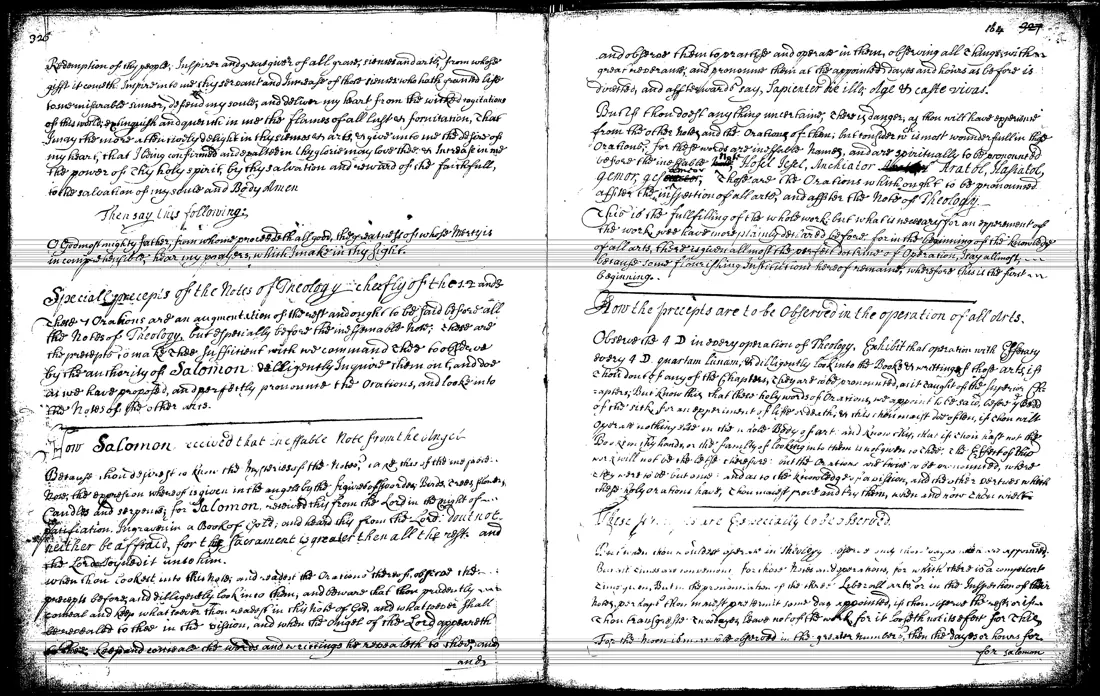
Fin de la Parte I; comienzo de la Parte II#p163
Ars Notoria — facsímil · Fin de la Parte I; comienzo de la Parte II · dominio público
Manuscrito — Sloane MS 3825 (British Museum)
🔍 clic para ampliar

TranscripciónInglés (s. XVII)

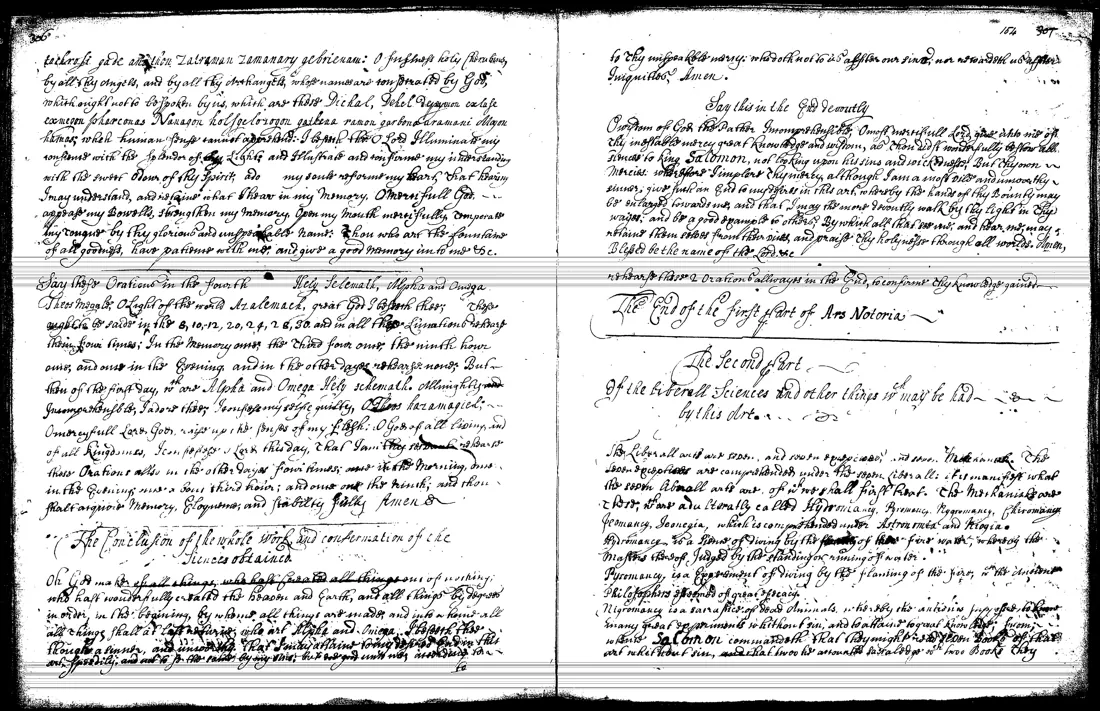
tachrosi gade anothon Zalraman Zamanary gebrienam: O highest holy Cherubins, by all thy angels, and by all thy Archangels, whose names are consecrated by God, which ought not to be spoken by us, which are these Dichal, Dehel Deramon exeluse exmegon pharconas Nanagon holloelozogon[?] gathena ramon garbona aramani Magon hamos; which human sense cannot apprehend: I beseech thee O Lord Illuminate my conscience with the splendor of thy Light; and Illustrate and confirme my understanding with the sweet Odour of thy Spirit, ado[rne] my soule reforme my heart, that hearing I may understand, and retaine what I hear in my Memory, O mercifull God, appease my Bowells, strengthen my Memory, Open my mouth mercifully, temperate my tongue by thy glorious and unspeakable name: Thou who art the fountaine of all goodness, have patience with me, and give a good Memory into me &c.

Say these Orations in the fourth [espacio] Hely Selemath, Alpha and Omega Theos megale; O Light of the world Azalemach, great God I beseech thee; These ought to be saide in the 8, 10, 12, 20, 24, 28, 30. and in all these Lunations rehearse their four times; In the Memory once; the Third four once; the ninth hour once; and once in the Evening. and in the other dayes rehearse none; But then of the first day, wch are Alpha and Omega Hely schemath. Allmighty and Incomprehensible, I adore thee; I confesse my selfe guilty, O Theos hazamagiel; O mercyfull Lord God, raise up the senses of my flesh: O God of all liuing, and of all Kingdomes, I confesse[?] O Lord this day, that I am thy servant [rehearse] these Orations also in the other dayes four times; one in the Morning, one in the Evening; one about third hour; and once one the ninth; and thou shalt acquire Memory, Eloquence; and stability fully Amen &

The Conclusion of the whole Work, and confirmation of the Sciences obtained.

Oh God maker of all things, who hast created all things out of nothing; who hast wonderfully created the heaven and Earth, and all things by degrees in order, in the beginning, by whome all things are made, and into a hand all all things shall at Last returne, who art Alpha and Omega. I beseech thee though a sinner, and unworthy, that I may attaine to my desired End in this art speedily; and not to [be?] the [saued?] by my sins; but [grant?] god unto me; according to [ilegible] [reclamo inferior: «to»]

to thy unspeakable mercy: who doth not to us [reward] after our sins, nor rewardeth us after [our] Iniquities. Amen.

Say this in the End devoutly

O wisdom of God the Father Incomprehensible; O most mercifull Lord, giue unto vs of thy inestable mercy great knowledge and wisdom, as thou didst wonderfully bestow all sciences to king Salomon, not looking upon his sins and wickednesse, But thy own Mercies: wherefore I implore thy mercy, although I am a most vile and unworthy sinner; giue such an End to my desires in this art, whereby the hands of thy Bounty may be enlarged towards me, and that I may the more devoutly walk by thy light in thy waies; and be a good example to others; By which all that see me, and hear me, may retaine themselves from their vices, and praise thy holynesse through all worlds. Amen, Blessed be the name of the Lord &c

rehearse these 2 Orations allwayes in the End, to confirme thy knowledge gained

The End of the first Part of Ars Notoria ~

The Second Part Of the liberall Sciences and other things wch may be had by this Art. ~

The Liberall arts are seven, and seven [exceptions?], and seven Mechanick. The seven [exceptions?] are comprehended under the seven liberall: it is manifest what the seven liberall arts are, of wch we shall first treat. The Mechanick are these, wch are adulterally called Hydromancy, Pyromancy, Nygromancy, Chiromancy Geomancy, Geonegia, which is comprehended under Astronomia and Riogia[?]. Hydromancy is a sciens of diuing by the [flowing?] of the [fire?] water, whereby the Masters thereof Judged by the standing or running of water. Pyromancy, is a Experiment of diuing by the flaming of the fire, wch the ancient Philosophers esteemed of great efficacy. Nigromancy is a sacrifice of dead Animals, whereby the antients supposed to haue many great experiments whithout sin, and to attaine to great knowledge; from; whence Salomon commandeth that they might read seven Books of that art whithout sin, and that twoo he accounts sacraledge wch twoo Books they [reclamo inferior: «they»]

TraducciónEspañol

tachrosi gade anothon Zalraman Zamanary gebrienam: oh altísimos y santos Querubines, por todos tus ángeles, y por todos tus Arcángeles, cuyos nombres están consagrados por Dios, los cuales no deben ser pronunciados por nosotros, que son estos: Dichal, Dehel Deramon exeluse exmegon pharconas Nanagon holloelozogon[?] gathena ramon garbona aramani Magon hamos; que el sentido humano no puede comprender: te ruego, oh Señor, ilumina mi conciencia con el esplendor de tu Luz; e ilustra y confirma mi entendimiento con el dulce olor de tu Espíritu, adorna mi alma, reforma mi corazón, para que oyendo pueda yo entender, y retener en mi memoria lo que oigo, oh Dios misericordioso, apacigua mis entrañas, fortalece mi memoria, abre mi boca misericordiosamente, templa mi lengua por tu glorioso e inefable nombre: tú que eres la fuente de todo bien, ten paciencia conmigo, y da una buena memoria dentro de mí, etc.

Di estas oraciones en el cuarto [espacio] Hely Selemath, Alpha and Omega Theos megale; oh Luz del mundo Azalemach, gran Dios yo te ruego; estas han de decirse en el 8, 10, 12, 20, 24, 28, 30. y en todas estas lunaciones repite sus cuatro veces; en la memoria una vez; la tercera cuatro una vez; la novena hora una vez; y una vez en la tarde. y en los otros días no repitas ninguna; pero entonces del primer día, las cuales son Alpha and Omega Hely schemath. Todopoderoso e incomprensible, te adoro; me confieso a mí mismo culpable, O Theos hazamagiel; oh Señor Dios misericordioso, levanta los sentidos de mi carne: oh Dios de todo lo viviente, y de todos los reinos, me confieso[?] oh Señor este día, que soy tu siervo, [repite] estas oraciones también en los otros días cuatro veces; una por la mañana, una por la tarde; una hacia la hora tercera; y una a la novena; y tú adquirirás memoria, elocuencia; y estabilidad plenamente Amén &

La conclusión de toda la obra, y confirmación de las ciencias obtenidas.

Oh Dios hacedor de todas las cosas, que has creado todas las cosas de la nada; que has creado maravillosamente el cielo y la tierra, y todas las cosas por grados en orden, en el principio, por quien todas las cosas son hechas, y en una mano todas las cosas al fin volverán, tú que eres Alpha and Omega. Te ruego, aunque pecador e indigno, que pueda yo alcanzar mi fin deseado en este arte prontamente; y no [ser?] [ilegible] por mis pecados; sino [concédeme?] Dios a mí; conforme a [ilegible] [reclamo inferior: «to»] según tu inefable misericordia: que no [nos paga] conforme a nuestros pecados, ni nos recompensa según [nuestras] iniquidades. Amén.

Di esto al final devotamente

Oh sabiduría de Dios Padre incomprensible; oh Señor misericordiosísimo, danos de tu inestimable misericordia gran conocimiento y sabiduría, así como maravillosamente otorgaste todas las ciencias al rey Salomón, no mirando sus pecados y maldad, sino tus propias misericordias: por lo cual imploro tu misericordia, aunque soy un pecador vilísimo e indigno; da tal fin a mis deseos en este arte, por el cual las manos de tu generosidad puedan ser extendidas hacia mí, y que yo pueda caminar más devotamente por tu luz en tus caminos; y ser buen ejemplo para otros; por lo cual todos los que me vean, y me oigan, puedan apartarse de sus vicios, y alabar tu santidad por todos los mundos. Amén, Bendito sea el nombre del Señor, etc.

repite estas 2 oraciones siempre al final, para confirmar el conocimiento adquirido

Fin de la primera parte del Ars Notoria ~

La segunda parte De las ciencias liberales y otras cosas que pueden obtenerse por este arte. ~

Las artes liberales son siete, y siete [excepciones?], y siete mecánicas. Las siete [excepciones?] están comprendidas bajo las siete liberales: es manifiesto cuáles son las siete artes liberales, de las cuales trataremos primero. Las mecánicas son estas, que son adulteradamente llamadas hidromancia, piromancia, nigromancia, quiromancia, geomancia, Geonegia, la cual está comprendida bajo la astronomía y [Riogia?]. La hidromancia es una ciencia de adivinar por el [fluir?] del [fuego?] agua, por el cual los maestros de ella juzgaban por el estar quieta o correr del agua. La piromancia es un experimento de adivinar por el llamear del fuego, la cual los antiguos filósofos estimaban de gran eficacia. La nigromancia es un sacrificio de animales muertos, por el cual los antiguos suponían tener muchos grandes experimentos sin pecado, y alcanzar gran conocimiento; de donde Salomón manda que puedan leerse siete libros de ese arte sin pecado, y que dos los cuenta [como] sacrilegio, cuyos dos libros ellos [reclamo inferior: «they»]

Por qué la Gramática tiene tres notas#p164
Ars Notoria — facsímil · Por qué la Gramática tiene tres notas · dominio público
Manuscrito — Sloane MS 3825 (British Museum)
🔍 clic para ampliar

TranscripciónInglés (s. XVII)

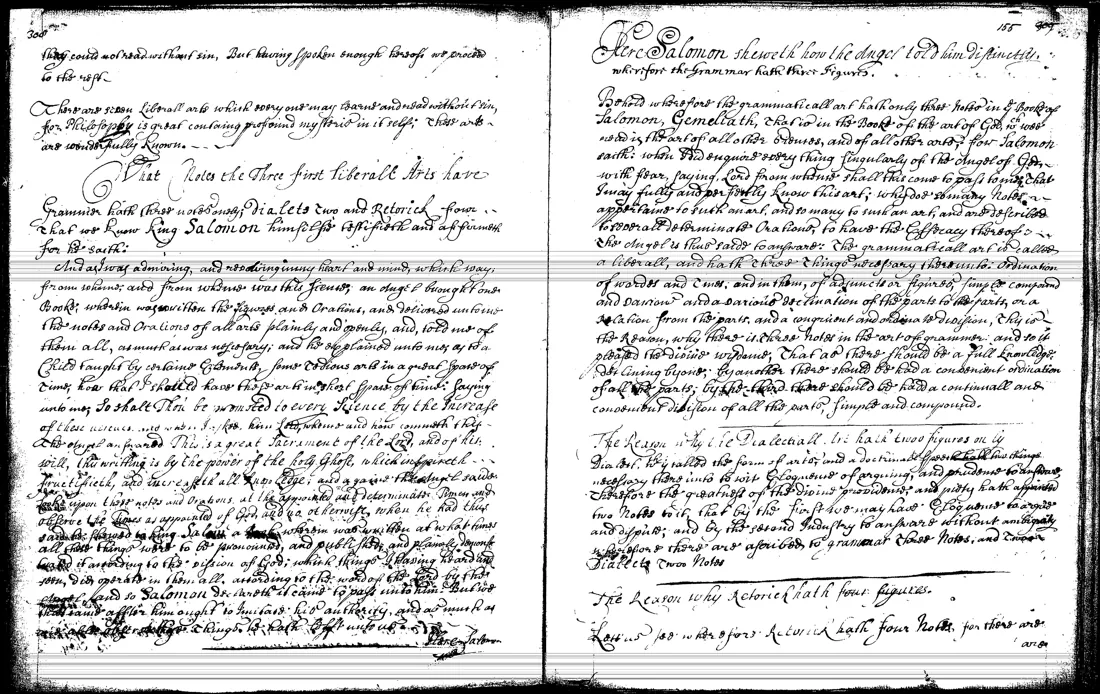
they could not read without sin, But having spoken enough hereof we proceed to the rest.

There are seven Liberall arts which every one may learne and read without sin, for Philosophy is great containing profound mysteries in it self; these arts are wonderfully Knowne.

What Notes the Three first Liberall Arts have.

Grammer hath three notes onely; dialets two and Retorick foure. That we know King Salomon himselfe testifieth and affirmeth for he saith:

And as I was admiring, and resolving in my heart and mind, which way; from whence; and from whence[?] was this Science; an Angel brought one Booke; wherein was written the figures and Orations, and delivered unto me the notes and Orations of all arts plainly and openly, and, told me of them all, as much as was necessary; and he explained unto me; as to a Child taught by certaine Elements, some tedious arts in a great space of time; how that I should have these arts in short space of time: saying unto me; So shalt Thou be promised[?] to every Science by the Increase of these sciences. And when I asked him Lord, whence and how commeth this? The Angel answered This is a great Sacrement of the Lord, and of his will, this writting is by the power of the holy Ghost, which inspireth[,] fructifieth, and increaseth all Knowledge; and againe the Angel saide looke upon these notes and Orations, at the appointed and determinate Times and observe the Times as appointed of God, and no otherwise, when he had thus said he shewed to King Salom[on] a Booke wherein was written at what times all these things were to be pronounced, and published; and plainely demonst- [r]ated it according to the vission [vision] of God; which things I having heard and seen, did operate in them all, according to the words of the Lord by the Angel; and so Salomon declareth it came to pass unto him. But we that came after him ought to Imitate his authority, and as much as we are able observe those things he hath left unto us. [reclamo/catchword:] Here Salom[on]

Here Salomon sheweth how the Angel told him distinctly, wherefore the Grammar hath three Figures.

Behold wherefore the grammaticall art hath only three notes in ye Booke of Salomon, Gemeliath, that is in the Booke of the art of God, w[hi]ch was [reed?] is the art of all other sciences, and of all other arts; for Salomon saith: when I did enquire every thing singularly of the Angel of God, with feare, saying, Lord from whence shall this come to pass to me, that I may fully and perfectly know this art; why doe so many notes appertaine to such an art, and so many to such an art, and are described to severall determinate Orations, to have the Efficacy thereof & the Angel is thus saide to answare: The grammaticall art is called a liberall, and hath three things necessary thereunto: Ordination of wordes and Times: and in them, of adiuncts or figures, simple compound and various; and a various declination of the parts to the parts, or a relation from the parts, and a congruent and ordinate division, This is the Reason, why there is three notes in the art of grammer: and so it pleased the divine wisdome, That as there should be a full Knowledge: declining by one; by another there should be had a convenient ordination of all the parts; by the third there should be had a continuall and convenient division of all the parts, simple and compound.

The Reason why the Dialectiall Art hath twoo figures or ij [two] Dialects, w[hi]ch is called the forme of arts, and a doctrinall speech hath two things necessary thereinto to wit Eloquence of arguing, and prudence to answar; Therefore the greatnesse of the divine providence, and piety hath appointed two notes to it, that by the first twoo may haue Eloquence to argue and dispute; and by the second Industry to answare without ambiguity wherefore there are ascribed to grammar three notes, and twoo Dialects twoo notes.

The Reason why Retorick hath four figures.

Let us see wherefore Retorick hath four notes, for there are [reclamo/catchword:] are

TraducciónEspañol

no podían leer sin pecado. Pero habiendo hablado suficiente de esto, procedemos a lo demás.

Hay siete artes liberales que cualquiera puede aprender y leer sin pecado, pues la filosofía es grande, conteniendo en sí misma profundos misterios; estas artes son maravillosamente conocidas.

Qué notas tienen las tres primeras artes liberales.

La gramática tiene tres notas solamente; la dialéctica dos y la retórica cuatro. Eso lo sabemos porque el propio rey Salomón lo testifica y afirma, pues dice:

Y mientras yo me maravillaba, y resolvía en mi corazón y mi mente de qué modo, de dónde y de dónde[?] procedía esta ciencia, un ángel trajo un libro, en el cual estaban escritas las figuras y las oraciones, y me entregó las notas y oraciones de todas las artes clara y abiertamente, y me habló de todas ellas, tanto cuanto era necesario; y me explicó, como a un niño enseñado por ciertos elementos, algunas artes tediosas en un gran espacio de tiempo; de modo que yo tendría estas artes en un corto espacio de tiempo, diciéndome: Así serás prometido[?] a toda ciencia por el aumento de estas ciencias. Y cuando le pregunté: Señor, ¿de dónde y cómo viene esto? El ángel respondió: Este es un gran sacramento del Señor, y de su voluntad; esta escritura es por el poder del Espíritu Santo, que inspira, fructifica y aumenta todo conocimiento. Y de nuevo dijo el ángel: mira estas notas y oraciones en los tiempos señalados y determinados, y observa los tiempos según los señala Dios, y no de otro modo. Cuando hubo dicho esto, mostró al rey Salom[ón] un libro en el que estaba escrito en qué tiempos habían de pronunciarse y publicarse todas estas cosas; y las demostró claramente según la visión de Dios; las cuales cosas yo, habiéndolas oído y visto, obré en todas ellas conforme a las palabras del Señor por el ángel; y así Salomón declara que le sucedió. Pero nosotros, que vinimos después de él, debemos imitar su autoridad, y en cuanto podamos observar aquellas cosas que él nos ha dejado. [reclamo:] Here Salom[on] Aquí muestra Salomón cómo el ángel le dijo distintamente por qué la gramática tiene tres figuras.

He aquí por qué el arte gramatical tiene solo tres notas en el libro de Salomón, Gemeliath, esto es, en el libro del arte de Dios, que era[?] [reed?] es el arte de todas las demás ciencias, y de todas las demás artes; pues Salomón dice: cuando yo indagaba cada cosa en particular al ángel de Dios, con temor, diciendo: Señor, ¿de dónde me vendrá esto, para que plena y perfectamente conozca este arte; por qué tantas notas competen a tal arte, y tantas a tal arte, y están descritas en varias oraciones determinadas, para tener su eficacia? Y el ángel se dice que respondió así: El arte gramatical se llama liberal, y tiene tres cosas necesarias para él: la ordenación de las palabras y de los tiempos; y en ellos, de los adjuntos o figuras, simples, compuestos y varios; y una diversa declinación de las partes con las partes, o una relación desde las partes, y una división congruente y ordenada. Esta es la razón por la que hay tres notas en el arte de la gramática; y así plugo a la sabiduría divina que, así como debía haber un pleno conocimiento declinando por una, por otra hubiese una conveniente ordenación de todas las partes, y por la tercera hubiese una continua y conveniente división de todas las partes, simples y compuestas.

La razón por la que el arte dialéctico tiene dos figuras, o ij [dos] dialécticas, que se llama la forma de las artes, y un discurso doctrinal tiene dos cosas necesarias para él, a saber: la elocuencia de argumentar y la prudencia de responder; por tanto, la grandeza de la providencia divina y la piedad le han señalado dos notas, para que por la primera se tenga elocuencia para argumentar y disputar, y por la segunda industria para responder sin ambigüedad; por lo cual se atribuyen a la gramática tres notas, y a la dialéctica dos notas.

La razón por la que la retórica tiene cuatro figuras.

Veamos por qué la retórica tiene cuatro notas, pues hay [reclamo:] are

Tiempos y horas para las notas#p165
Ars Notoria — facsímil · Tiempos y horas para las notas · dominio público
Manuscrito — Sloane MS 3825 (British Museum)
🔍 clic para ampliar

TranscripciónInglés (s. XVII)

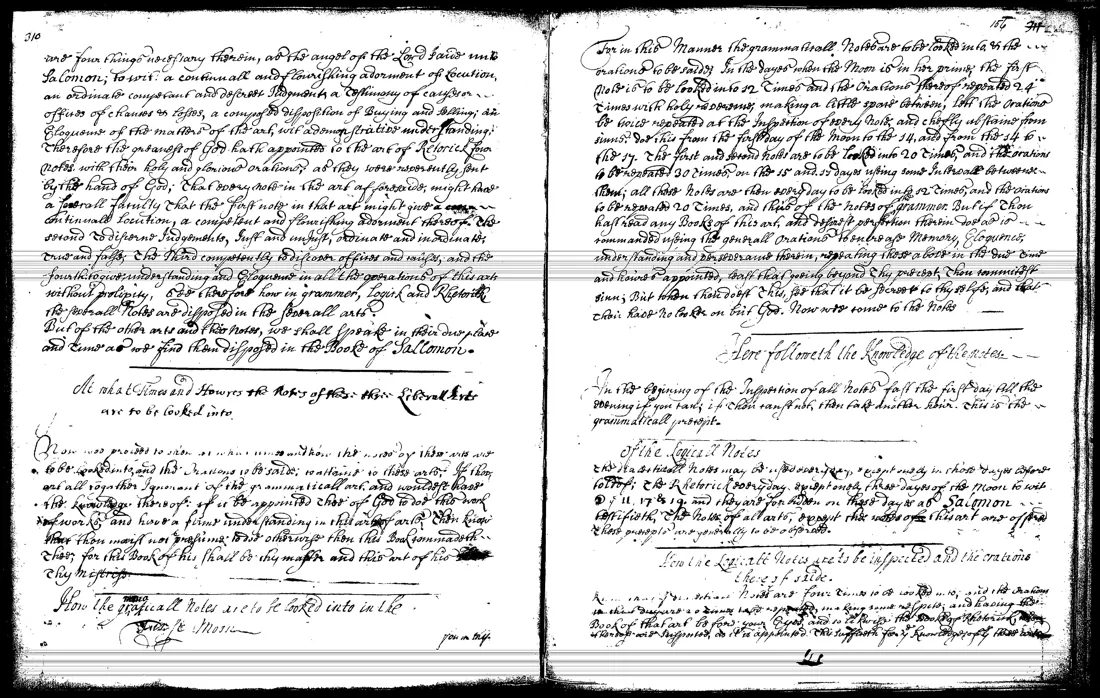
and four things necessary therein, as the angel of the Lord saide unto Salomon; to wit: a continuall and flourishing adornment of Locution, an ordinate competant and descreet Judgment, a testimony of causes or offices of chances & losses, a composed disposition of Buying and selling; an Eloquence of the matters of the art, wit[h] a demonstratiue understanding; Therefore the greatness of God hath appointed to the art of Retorick four notes. with their holy and glorious orations; as they were reuerently sent by the hand of God; That every note in the art aforesaide, might haue a severall faculty That the first note in that art might giue a co[n]- continuall Locution, a competent and flourishing adornment thereof. The second to disserne Judgements, Just and unjust, ordinate and inordinate; true and false, The Third competently to discover offices and causes; and the fourth: to giue understanding and Eloquence in all the operations of this art; without prolixity, & see therefore how in grammer, Logick and Rhetorick the severall Notes are disposed in the severall arts. But of the other arts and their notes, we shall speake in their due place and time as we find them disposed in the Booke of Sallomon.

_[encabezado]_ At what Times and Howres the Notes of these three Liberall Arts are to be looked into

Now wee proceed to shew at what times and how the notes of these arts are to be looked into, and the Orations to be saide; [coattaineing?] to those arts; If thou art all together Ignorant of the grammaticall art. and wouldest haue the knowledge thereof: if it be appointed thee of God to doe this work of workes, and haue a firme understanding in this art of arts, then know that thou maist not presume to doe otherwise then this Book commandeth thee; for this Book of his shall be thy master and this art of his thy mistriss.

_[encabezado]_ How the gra[m]maticall Notes are to be looked into in the [First Moone?] _[reclamo:]_ for in this

For in this Manner the grammaticall Notes are to be looked into. & the orations to be saide; In the dayes when the Moon is in her prime, the first Note is to be looked into 12 times and the Orations therof repeated 24 times with holy [reuerence?]; making a little space between, Lest the Orations be twice repeated at the Inspection of every note, and cheifly abstaine from sinns: doe this from the first day of the Moon to the 14, and from the 14 to the 17. The first and second notes are to be looked into 20 times, and the orations to be repeated 30 times; on the 15 and 17 dayes using some Interval between them; all these notes are then every day to be looked into 12 times, and the orations to be repeated 20 Times, and this of the notes of grammer. But if Thou hast read any Books of this art, and desirest perfection therein doe as is commanded using the generall orations to encrease Memory, Eloquence, understanding and perseuerance therein, repeating those aboue in the due time and howres appointed, least that going beyond thy precept, thou commitest sinn; But when thou doest This, see that it be secret to thy selfe, and that their haue no looker on but God. Now wee come to the notes

_[encabezado]_ Here followeth the Knowledge of the notes

In the begining of the Inspection of all notes fast the first day All the eevning if you can; if thou canst not, then fast another hour. This is the grammaticall precept.

_[encabezado]_ Of the Logicall Notes The dialecticall Notes may be used every [day?], except onely in those dayes before tould of; The Rhetorick every day. except onely those dayes of the Moon to wit ☽ 11, 17 & 19. and they are forbidden on these dayes as Salomon testifieth. The notes of all arts, except the notes of this art and of these those precepts are generally to be observed.

_[encabezado]_ How the Logicall Notes are to be inspected and the orations thereof saide. [Remember?] that if [dialecticall?] Notes are Four times to be looked into; and the Orations [thereof?] to be repeated 2 times, making some respite; and having the Book of that art before your Eyes, and so likewise the Book of Rhetorick when [it is?] said [inspected?], as it is appointed. This suffiseth for [the] Knowledge of [these arts?] _[reclamo/foliación:]_ 311

TraducciónEspañol

…y cuatro cosas [son] necesarias en ello, como el ángel del Señor dijo a Salomón; a saber: un continuo y florido adorno de la locución, un ordenado, competente y discreto juicio, un testimonio de las causas u oficios de los azares y las pérdidas, una compuesta disposición del comprar y el vender; una elocuencia de las materias del arte, con un entendimiento demostrativo. Por eso la grandeza de Dios ha asignado al arte de la retórica cuatro notas, con sus santas y gloriosas oraciones, tal como fueron reverentemente enviadas por la mano de Dios; para que cada nota en el arte antedicho tuviera una facultad distinta: que la primera nota en aquel arte diera una continua locución, un competente y florido adorno de ella. La segunda, para discernir los juicios, lo justo y lo injusto, lo ordinario y lo desordenado, lo verdadero y lo falso. La tercera, para descubrir competentemente los oficios y las causas; y la cuarta, para dar entendimiento y elocuencia en todas las operaciones de este arte, sin prolijidad. Y ved, pues, cómo en la gramática, la lógica y la retórica las diversas notas están dispuestas en las diversas artes. Pero de las otras artes y sus notas hablaremos en su debido lugar y tiempo, según las hallemos dispuestas en el Libro de Salomón.

_[encabezado]_ En qué tiempos y horas han de inspeccionarse las notas de estas tres artes liberales

Ahora procedemos a mostrar en qué tiempos y cómo han de inspeccionarse las notas de estas artes, y las oraciones que han de decirse, [pertenecientes?] a esas artes. Si eres del todo ignorante del arte gramatical y quisieras tener el conocimiento de él; si te es asignado por Dios hacer esta obra de las obras y tener un firme entendimiento en este arte de las artes, entonces sabe que no debes presumir de hacer de otra manera que como este Libro te lo manda; pues este Libro suyo será tu maestro, y este arte suyo, tu maestra.

_[encabezado]_ Cómo han de inspeccionarse las notas gramaticales en la [¿Primera Luna?] _[reclamo:]_ for in this Pues de esta manera han de inspeccionarse las notas gramaticales, y las oraciones que han de decirse: en los días en que la Luna está en su prime (creciente), la primera nota ha de inspeccionarse 12 veces y las oraciones de ella repetirse 24 veces con santa [¿reverencia?]; haciendo un pequeño espacio entre [ellas], no sea que las oraciones se repitan dos veces en la inspección de cada nota; y sobre todo abstente de pecados. Haz esto desde el primer día de la Luna hasta el 14, y desde el 14 hasta el 17. La primera y la segunda notas han de inspeccionarse 20 veces, y las oraciones repetirse 30 veces; en los días 15 y 17 usando algún intervalo entre ellas; todas estas notas han de inspeccionarse entonces cada día 12 veces, y las oraciones repetirse 20 veces; y esto en cuanto a las notas de la gramática. Pero si has leído algún Libro de este arte y deseas la perfección en él, haz como se manda, usando las oraciones generales para acrecentar la memoria, la elocuencia, el entendimiento y la perseverancia en ello, repitiendo las de arriba en el debido tiempo y horas señaladas, no sea que, yendo más allá de tu precepto, cometas pecado. Pero cuando hagas esto, cuida que sea en secreto para ti mismo, y que nadie tenga por espectador sino a Dios. Ahora venimos a las notas.

_[encabezado]_ Aquí sigue el conocimiento de las notas

Al comienzo de la inspección de todas las notas, ayuna el primer día toda la tarde si puedes; si no puedes, entonces ayuna otra hora. Este es el precepto gramatical.

_[encabezado]_ De las notas lógicas Las notas dialécticas pueden usarse cada [¿día?], excepto solamente en aquellos días antes mencionados; la retórica, cada día, excepto solamente aquellos días de la Luna, a saber: ☽ 11, 17 y 19; y están prohibidos en estos días, como Salomón atestigua. Las notas de todas las artes —excepto las notas de este arte y de estos [preceptos]— aquellos preceptos han de observarse en general.

_[encabezado]_ Cómo han de inspeccionarse las notas lógicas y decirse sus oraciones [¿Recuerda?] que las notas [¿dialécticas?] han de inspeccionarse cuatro veces, y las oraciones [de ellas] repetirse 2 veces, haciendo alguna pausa; y teniendo el Libro de aquel arte ante tus ojos, y así también el Libro de la retórica cuando [¿se?] dice [¿e inspecciona?], como está señalado. Esto basta para el conocimiento de [¿estas artes?]. _[reclamo/foliación:]_ 311

Meses y lunaciones de las notas#p166
Ars Notoria — facsímil · Meses y lunaciones de las notas · dominio público
Manuscrito — Sloane MS 3825 (British Museum)
🔍 clic para ampliar

TranscripciónInglés (s. XVII)

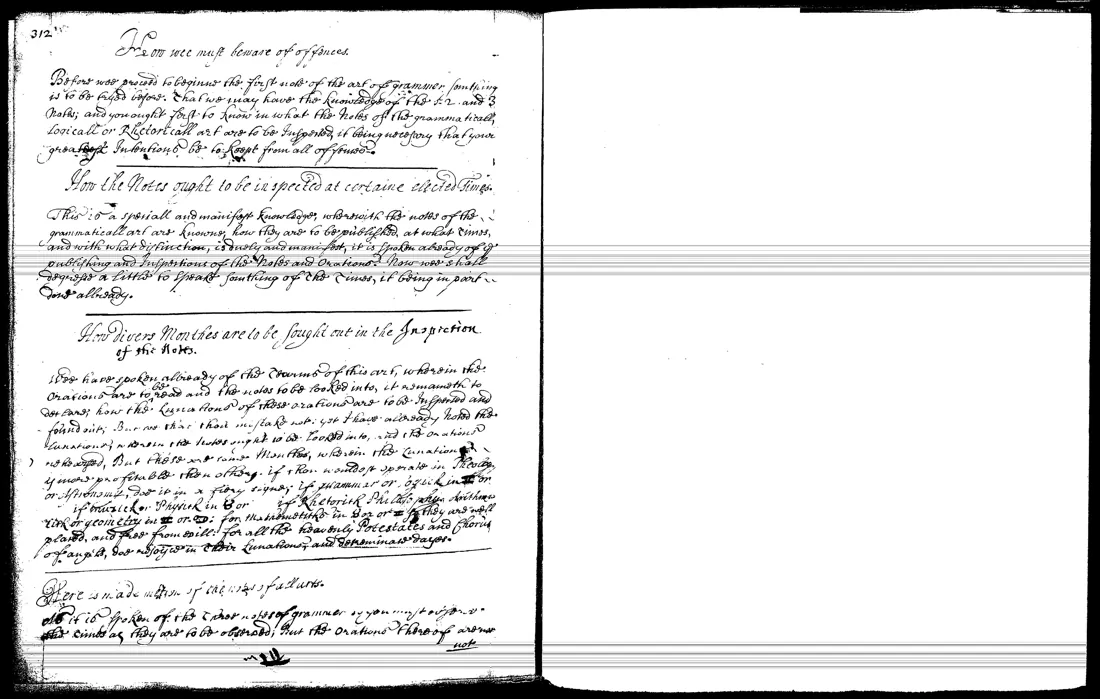
_How wee must beware of offences._

Before wee proceed to beginne the first note of the art of grammer somthing is to be tryed before. That we may have the knowledge of the 1. 2. and 3 notes; and you ought first to know in what the notes of the grammaticall, Logicall or Rhetoricall art are to be Inspected, it being necessary that your greate[st] [tachado] Intentions be to keept from all offences.

_How the Notes ought to be inspected at certaine elected Times._

This is a speciall and manifest knowledge, wherewith the notes of the grammaticall art are knowne, how they are to be published, at what times, and with what distinction, is duely and manifest, it is spoken already of ye publishing and Insportions[?] of the notes and Orations. Now wee shall degresse a little to speake somthing of the times, it being in part done allready.

_How divers Monthes are to be sought out in the Inspiction_ _of the Notes._

Wee have spoken allready of the Cour[s]es[?] of this art, wherein the Orations are to [be] read and the notes to be Looked into, it remaineth to declare; how the Lunations of those orations are to be Inspected and found out; But [see?] that thou mistake not: yet I have allready noted the Lunations, wherein the notes ought to be Looked into, and the orations rehearsed, But those are [certaine?] Monthes, wherein the Lunation is more profitable then other; if thou wouldest operate in Theology, or Astronomy, doe it in a fiery signe; if grammar or Logick in [♊?] or [signo ilegible] if musick or Physick in [♉?] or [espacio en blanco] if Rhetorick Philosophy Arithme- tick or geometry in [♊?] or [♋?]: for mathematicke in [♌?] or [♊?] if they are well pleased, and free from evill: for all the heavenly Potestates and Chorus of Angells, doe rejoyce in their Lunations, and determinate dayes.

_Here is made mention of the notes of all arts._

As it is spoken of the three notes of grammer so you must observe the times as they are to be observed; But the Orations thereof are [not] _(reclamo al pie: «not»)_

[en blanco]

TraducciónEspañol

_Cómo debemos guardarnos de las ofensas._

Antes de que procedamos a comenzar la primera nota del arte de la gramática, algo ha de probarse antes: que podamos tener el conocimiento de las notas 1.ª, 2.ª y 3.ª; y debes primero saber en qué han de ser inspeccionadas las notas del arte gramatical, lógico o retórico, siendo necesario que tu mayor propósito sea guardarte de todas las ofensas.

_Cómo deben ser inspeccionadas las notas en ciertos tiempos elegidos._

Este es un conocimiento especial y manifiesto, con el cual se conocen las notas del arte gramatical: cómo han de ser publicadas, en qué tiempos y con qué distinción, es cosa debida y manifiesta; ya se ha hablado de la publicación e inspección[?] de las notas y oraciones. Ahora nos desviaremos un poco para decir algo de los tiempos, estando ya hecho en parte.

_Cómo deben buscarse los diversos meses en la inspección de las notas._

Ya hemos hablado de los cursos[?] de este arte, en el cual las oraciones han de leerse y las notas han de examinarse; resta declarar cómo han de inspeccionarse y hallarse las lunaciones de esas oraciones; pero mira[?] no te equivoques: ya he señalado las lunaciones en que las notas deben examinarse y las oraciones recitarse; pero hay ciertos[?] meses en los que la lunación es más provechosa que otra. Si quisieras operar en teología o astronomía, hazlo en un signo de fuego; si en gramática o lógica, en [♊?] o [signo ilegible]; si en música o medicina, en [♉?] o [espacio en blanco]; si en retórica, filosofía, aritmética o geometría, en [♊?] o [♋?]; para las matemáticas, en [♌?] o [♊?] si están bien dispuestos y libres de mal; pues todas las celestiales Potestades y el Coro de los Ángeles se regocijan en sus lunaciones y días determinados.

_Aquí se hace mención de las notas de todas las artes._

Así como se ha hablado de las tres notas de la gramática, así debes observar los tiempos en que han de observarse; pero las oraciones de ello no [son / se hacen]… _(reclamo al pie: «not»)_ [en blanco]

Cuándo pronunciar los santos escritos#p167
Ars Notoria — facsímil · Cuándo pronunciar los santos escritos · dominio público
Manuscrito — Sloane MS 3825 (British Museum)
🔍 clic para ampliar

TranscripciónInglés (s. XVII)

[en blanco]

[...] not written, but are more fully demonstrated in the following workes: for what is written of those three notes are not Orations, But diffinitions of those notes; written by the greek Hebrew and Chaldean; and other things which are apprehended by us; for those writtings, w[ch] are not understood in Latin, ought not to be pronounced but on those dayes which are appointed by King Salomon, and in those dayes wherein the Notes are Inspected, but on those dayes those holy writtings are allwayes to be repeated: and the Latine on those dayes wherein the notes are not Inspected. The notes of the Logicall arte are, twoo, and at what times they are to be published, is already showen in part: more shall herafter be saide of them; now we come to the rest. The Latine writtings may be published, according to the antiquity of the Hebrews, except on those dayes we have spoken of: for Salomon saith see that thou performe all those precepts as they are given: But of the rest w[ch]: follow. it is to be done otherwise: for when thou seest the first note in Logick, repeat in thy heart the signe in the first note, and so in the notes of all artes, except those whereof a diffinition shall be given. ~~~~~~~~

Definitions of severall arts and the notes thereof

Wee will give also definitions of severall arts, as it is in the Book of Salomon; geometry hath one note; Arithmetick a note and a halfe; Phylosophy with the arts and siences therein contained, hath 4 species; Theologi and Astronomy, with the siences in them contained hath 4 notes, But they are great and dangerous; not great in the pronounciation, but have great Effecacy: Musick hath one note; and Phisick one note; But they are all to be published, and rehearsed in their appointed dayes; But know that in every day wherein you behouldest the notes of Theology, Phylosophy or any arts contained in them, That thou neither laugh, nor play, nor play, nor sport, because King Salomon when he say[?] the formes of those notes, having over drunk himselfe; God was angry with him, and speak unto him by his angel saying, Because thou hast despised my sacrament, and polluted and derided my holy things; I will take away part of they Kingdom, and I will shorten the dayes of thy children and the angel added: The Lord hath forbidden thee to enter u- in to the [borrón] Temple 30 dayes, That thou maist repent of thy sinn.

[reclamo/catchword, esquina inferior derecha:] thy sinn.

TraducciónEspañol

[en blanco] [...] no están escritas, sino que se demuestran más plenamente en las obras siguientes; pues lo que está escrito de esas tres notas no son oraciones, sino definiciones de esas notas, escritas por el griego, el hebreo y el caldeo, y otras cosas que son comprendidas por nosotros; pues aquellos escritos que no se entienden en latín no deben pronunciarse sino en aquellos días que fueron señalados por el rey Salomón, y en aquellos días en que las notas son inspeccionadas; pero en aquellos días esos santos escritos han de repetirse siempre, y los latinos en aquellos días en que las notas no son inspeccionadas. Las notas del arte de la lógica son dos, y en qué tiempos han de publicarse ya se ha mostrado en parte; más se dirá de ellas en adelante; ahora venimos al resto.

Los escritos latinos pueden publicarse, conforme a la antigüedad de los hebreos, salvo en aquellos días de que hemos hablado; pues Salomón dice: procura cumplir todos esos preceptos tal como te son dados; pero en cuanto al resto que sigue, ha de hacerse de otro modo: pues cuando veas la primera nota en lógica, repite en tu corazón el signo de la primera nota, y así en las notas de todas las artes, salvo aquellas de las que se dé una definición. ~~~~~~~~

Definiciones de las diversas artes y de sus notas

Daremos también las definiciones de las diversas artes, tal como está en el Libro de Salomón: la geometría tiene una nota; la aritmética, una nota y media; la filosofía, con las artes y ciencias en ella contenidas, tiene 4 especies; la teología y la astronomía, con las ciencias en ellas contenidas, tienen 4 notas, pero son grandes y peligrosas —no grandes en la pronunciación, sino que tienen gran eficacia—; la música tiene una nota, y la física una nota. Pero todas han de publicarse y recitarse en sus días señalados. Mas sabe que en todo día en que contemplares las notas de la teología, la filosofía o cualquiera de las artes contenidas en ellas, ni rías, ni juegues, ni juegues, ni te diviertas; porque el rey Salomón, cuando vio[?] las formas de esas notas, habiendo bebido en exceso, Dios se airó con él, y le habló por su ángel diciendo: Porque has despreciado mi sacramento, y contaminado y escarnecido mis cosas santas, quitaré parte de tu reino, y acortaré los días de tus hijos; y el ángel añadió: El Señor te ha prohibido entrar en el [borrón] Templo durante 30 días, para que te arrepientas de tu pecado.

Las notas de Gramática y Lógica#p168
Ars Notoria — facsímil · Las notas de Gramática y Lógica · dominio público
Manuscrito — Sloane MS 3825 (British Museum)
🔍 clic para ampliar

TranscripciónInglés (s. XVII)

thy sinn. and when Salomon wept and besought mercy of the Lord. The angel answered ... Thy dayes shall be prolonged, neverthelesse many evills and Iniquities shall come upon Thy Children and they shall be ~~ destroyed of the Iniquities that shall come upon them. at the beginning of a note. having seen the generalls, lett the specialls be looked into. The word of Salomon is to seek unto God for his promises, before the Notes of ye three arts.

The first Oration at the beginning of the Note The Light truth, life way Iudge mercy. fortitude & patience, [preserue?], helpme: and have mercy upon me. AMEN.

This Oration with the preceding ought to be said in the beginning of the first note of Grammer.

O Lord holy Father, Almighty, Eternall God in whose sight are all the foundations of all Creatures, and Invisible things; whose Eyes behold my Imperfections; of the sweetnesse of whose love the Earth and Heavens are filled, who ... sawest all things before they were made: in whose Book everyday is .. found, and all mankind are written therein, behold me Thy servant Thy day prostrate before thee. with my whole heart and soule, by thy holy ~ Spirit conforme me, Blesse me perfect all my actions in thee ~ Inspiration or aspiration, and Illuminate me with the constancy of ~ Thy Dispisation.

The third Oration; this Oration ought to be said before the second note of the Grammer.

Behold o Lord, mercifull father of all things; Eternall dispenser of all vertues, and consider my operations thisday. Thou art the beholder and discerner of all the actions of men and angels: lett the wonderfull deed of thy promise condescend to fullfill this sudden vertue in me, and infuse such Efficacy into me. appearing in Thy holy and greate name; Thou who [tachado, ilegible] the[s] [parise?] into [tachado: the] Monthes of [them?] ~~ [reclamo al pie:] them

Them that love thee. Amen ~

The Fourth Oration, Let this Oration be rehearsed before the third Grammaticall note.

O Adonay, Creator of all visible Creatures? O most holy Father, ~ who dwelleth Incompassed about with eternall Light, disposing and by thy power governing all things before all beginnings; I most humbly beseech Thy Eternity, and thy Incomprehensible goodnesse may come to perfection into me, by the operation of thy most holy Angels; and be confirmed in my Memory. and stablish those thy holy workes in me. Amen

A little space after this preceding Oration say the following, the first Oration ought to be said before the first note of Logick.

O holy God great and good, and the Eternall maker of all things, Thy attributes not to be oppressed, who hast created the heaven and the Earth; the sea and all things in them, and the Bottomlesse [sepit?] (= pit), ~ according to thy pleasure; in whose sight are the wordes, and actions of all men: grant unto me, by these sacramentall mysteries of thy holy Angels, the previous knowledge of thisart, which [desired?] by the ~ ministery of thy holy Angels; it being without any Malignant or ~ Malicious Intent. Amen

pronounce, this Oration in the beginning of the first figure of the Logick Art; and after this Oration in [tachado: the beginning] rehearse Intentiuely with some ~ Intervals, the Orations written between the first figures.

The five Oration ought to be said before the first note of the [Liberall Astronomy?].

Most mercyfull Creator. Inspirer, [reformer?], and disposer of all [divine?] wills, ordainer of [all?] things, mercyfully give Eare unto my prayers. [reclamo al pie:] p. [?]

TraducciónEspañol

tu pecado. Y cuando Salomón lloró y suplicó misericordia del Señor, el ángel respondió... Tus días serán prolongados; no obstante, muchos males e iniquidades vendrán sobre tus hijos, y ellos serán ~~ destruidos por las iniquidades que caerán sobre ellos. Al comienzo de una nota: habiendo visto las cosas generales, examínense las particulares. La palabra de Salomón es buscar a Dios por sus promesas, antes de las notas de las tres artes. La primera oración al comienzo de la nota. La Luz, la verdad, la vida, el camino, Juez, misericordia, fortaleza y paciencia, [preserua?], ayúdame: y ten misericordia de mí. Amén. Esta oración, junto con la precedente, ha de decirse al comienzo de la primera nota de gramática. Oh Señor, Padre santo, Todopoderoso, Dios Eterno en cuya vista están todos los fundamentos de todas las criaturas, y las cosas invisibles; cuyos ojos contemplan mis imperfecciones; de la dulzura de cuyo amor la tierra y los cielos están llenos, tú que ... viste todas las cosas antes de que fueran hechas; en cuyo libro cada día está .. escrito, y toda la humanidad está escrita en él, contémplame a mí, tu siervo, este día tuyo, postrado ante ti, con todo mi corazón y mi alma; por tu santo ~ Espíritu confórmame, bendíceme, perfecciona todas mis acciones en ti ~ por inspiración o aspiración, e ilumíname con la constancia de ~ tu dispensación. La tercera oración; esta oración ha de decirse antes de la segunda nota de la gramática. Mira, oh Señor, padre misericordioso de todas las cosas; eterno dispensador de todas las virtudes, y considera mis operaciones en este día. Tú eres el contemplador y discernidor de todas las acciones de los hombres y los ángeles: haz que el maravilloso hecho de tu promesa condescienda a cumplir esta súbita virtud en mí, e infunde tal eficacia en mí, apareciendo en tu santo y grande nombre; Tú que [tachado, ilegible] el[/los] [parise?] en [tachado: los] meses de [ellos?] ~~ [reclamo al pie:] them (ellos) los que te aman. Amén ~ La cuarta oración. Que esta oración se recite antes de la tercera nota gramatical. Oh Adonay, Creador de todas las criaturas visibles. Oh Padre santísimo, ~ que moras rodeado de luz eterna, disponiendo y gobernando por tu poder todas las cosas antes de todo principio; muy humildemente suplico a tu eternidad, y a tu incomprensible bondad, que venga a perfección en mí, por la operación de tus más santos ángeles; y sea confirmada en mi memoria; y establece estas tus santas obras en mí. Amén. Un pequeño intervalo después de esta oración precedente, di la siguiente: la primera oración ha de decirse antes de la primera nota de lógica. Oh santo Dios, grande y bueno, y eterno hacedor de todas las cosas, cuyos atributos no han de ser oprimidos, que has creado el cielo y la tierra, el mar y todas las cosas en ellos, y el [pozo/abismo] sin fondo, ~ según tu voluntad; en cuya vista están las palabras y acciones de todos los hombres: concédeme, por estos misterios sacramentales de tus santos ángeles, el conocimiento previo de este arte, el cual [deseado?] por el ~ ministerio de tus santos ángeles; siendo ello sin ningún propósito maligno o ~ malicioso. Amén. Pronuncia esta oración al comienzo de la primera figura del arte de la lógica; y después de esta oración [tachado: al comienzo] recita atentamente, con algunos ~ intervalos, las oraciones escritas entre las primeras figuras. La quinta oración ha de decirse antes de la primera nota de la [¿Astronomía liberal?]. Misericordiosísimo Creador, inspirador, [reformador?], y disponedor de todas las [divinas?] voluntades, ordenador de [todas?] las cosas, misericordiosamente presta oído a mis oraciones. [reclamo al pie:] p. [?]
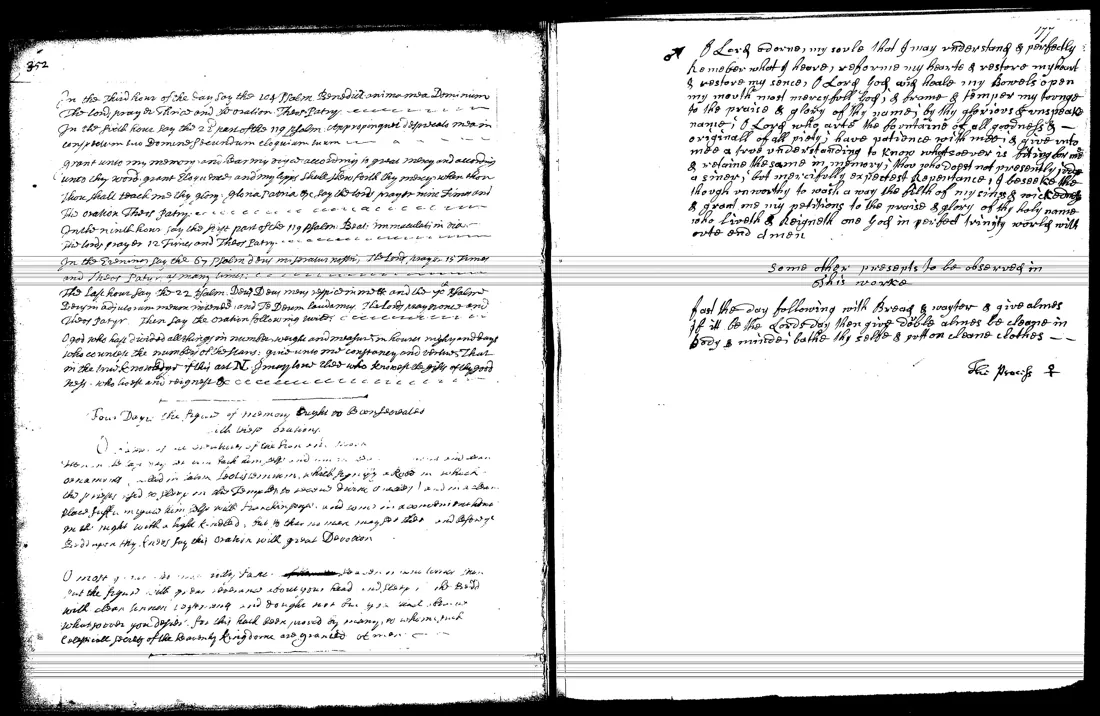
Notas de Retórica (voces de Hanazay)#p169
Ars Notoria — facsímil · Notas de Retórica (voces de Hanazay) · dominio público
Manuscrito — Sloane MS 3825 (British Museum)
🔍 clic para ampliar

TranscripciónInglés (s. XVII)

[...] prayer, gloriously Intend into the desire of my heart, that what I humbly desire according to thy promises, thou wildt mercyfully grant. Amen.

______________________________

This Oration following, ought to be pronounced before the first Note of the Rhetorical Art. —

Omnipotent and mercifull Father, ordainer and Creator of all Creatures: O most holy Iudge, Eternall King of Kings and Lord of Lords: who wounderfully condescendest to giue wisdome and understanding to thy saints, who Iudgest and descerndst all things: I beseech thee to Illuminate my heart this day with the Splendor of thy Beauty, that I may understand and know what I desire, and what things are considerable to be known in thy art. Amen.

This Oration with the following Hanazay [ought] to be pronounced before the first figure of Rhetorick. And although these Orations be devided into parts, yet it is one and the same: and they are devided only for this cause, that their might be some meane interval used in the pronouncing of them, and they ought to be pronounced before the other Orations written in the .... figure: Hanazay, Sazhas[n?], Hubi, Sene, Hay, Ginbar; Bonail Selmora, Kyram[ay?] lohat Grazamael, Amathoma[t]is yabba geyors, Sozomcrat. Ampho, Delmedos, Geroth, Agalos Meihatagiel[?] Secamay; Saheleton Meehoyifses [?] lerircncmon.

______________________________

The Eight Oration, let it be pronounced before the second Note of the Rhetoricall art. O Great Eternall and wounderfull Lord God, who of thy Eternall bounty hast disposed of all vertues, and art ordainer of all goodness; adorne & Beautifie my understanding, and giue unto me reason to know and learn the mysteries of thy holy angels: and grant unto me all knowledge and learning thou hast promised thy servants by the vertue of thy holy Angells. Amen.

[en blanco]

TraducciónEspañol

[...] oración, dirige gloriosamente hacia el deseo de mi corazón, que lo que humildemente deseo según tus promesas, tú misericordiosamente lo concedas. Amén.

______________________________

Esta oración siguiente debe pronunciarse antes de la primera nota del Arte de la Retórica. —

Omnipotente y misericordioso Padre, ordenador y Creador de todas las criaturas: oh santísimo Juez, Eterno Rey de Reyes y Señor de Señores: que maravillosamente te dignas dar sabiduría y entendimiento a tus santos, que juzgas y discierne todas las cosas: te suplico que ilumines mi corazón este día con el esplendor de tu belleza, para que yo comprenda y conozca lo que deseo, y qué cosas son dignas de conocerse en tu arte. Amén.

Esta oración, junto con la que sigue —Hanazay—, [debe] pronunciarse antes de la primera figura de la Retórica. Y aunque estas oraciones estén divididas en partes, es una y la misma: y se dividen solo por esta causa, para que haya algún intervalo mesurado en el pronunciarlas; y deben pronunciarse antes de las demás oraciones escritas en la .... figura: Hanazay, Sazhas[n?], Hubi, Sene, Hay, Ginbar; Bonail Selmora, Kyram[ay?] lohat Grazamael, Amathoma[t]is yabba geyors, Sozomcrat. Ampho, Delmedos, Geroth, Agalos Meihatagiel[?] Secamay; Saheleton Meehoyifses [?] lerircncmon.

______________________________

La octava oración, pronúnciese antes de la segunda nota del Arte de la Retórica. Oh gran, eterno y maravilloso Señor Dios, que por tu eterna bondad has dispuesto de todas las virtudes, y eres ordenador de toda bondad; adorna y hermosea mi entendimiento, y dame razón para conocer y aprender los misterios de tus santos ángeles: y concédeme todo el conocimiento y saber que has prometido a tus siervos por la virtud de tus santos ángeles. Amén. [en blanco]

Notas de Retórica (2ª y 3ª)#p170
Ars Notoria — facsímil · Notas de Retórica (2ª y 3ª) · dominio público
Manuscrito — Sloane MS 3825 (British Museum)
🔍 clic para ampliar

TranscripciónInglés (s. XVII)

[♃] Beholding with thy eternall Conspiratio all powers kingdoms & Judges, Administring all manner of Languages to all; and of whose power there is not one; Restore I beseech the[e] & Increase my memory my harte & vnderstanding to know vnderstand & Judge all things which the devine authoryty Commendeth necessary in this arte, perfectly fulfill them in me amen

Let this Oration following with the precedent be rehearsed before the second note of Rhetorick [♂]

This Precedent Oration with the other twoo following ought to be pronounc[ed] (viz + Vision &c) Azelechias, &c in the beginning of the Second Figure of Rhetorick, and before the other Orations, and there ought to be some interval betwen them

――――――――――

Let this Oration following be said before the second not[e] of Rhetoricall Vision. [♃]

[♂] A[z]elechias Velozeos, Guanzama, Sameb, Hoteus, Sagnath, Adonay, Soma, Gezochos, Elicon, Geromethon, Sadaot. and thou O God propitiously confirm Thy promise in me, as thou hast confirmed them by the same words to King Salomon; send unto me, O Lord thy vertue from heaven, that may Illuminate my Mind and understanding; [tunc?] strengthen, oh God, my understanding, renew my soule within me, and wash me with the waters which are above the heavens, pour out thy spirit upon my fleshe, and fill my Bowells with thy Judgements, with humility and Charity, thou who hast Created the heaven and the Earth, and made man according to thy own Image; pour out the light of thy loue into my understanding, that being radiated and established in thy loue, and thy mercy, I may loue thy Name, and know and worship thee, and understand all thy scriptures, and all the mysteries which thou hast declared by thy holy Angels, I may receiue and understand in my hearte, and utter this arte to thy honour and glory through thy mighty counsell Amen

――――――――――

The severall Oration ought to be said before the pronunciation of the third Note of Rhetorick.

[ilegible] that I [send?] thy [grace?], and [perfect?] [ilegible] workes, and that thou wilt giue vnto me [wisdome] according to thy goodness and thy power which is incomprehensible: Theon, Haltanagon, Haramalon, [Zaza?] Zamoyma, Chamasal, Ieconanriil, Harionatar, Iechomagol, gela Magos Kemolihot, Kamanatar, Hariome[n]atar Hanaes. Ve[c?] [ilegible, tachado]

TraducciónEspañol

[♃] Contemplando con tu eterna Conspiratio todos los poderes, reinos y jueces, administrando toda clase de lenguas a todos; y de cuyo poder no hay ninguno [exento]; restaura, te lo suplico, y aumenta mi memoria, mi corazón y mi entendimiento, para conocer, comprender y juzgar todas las cosas que la divina autoridad manda necesarias en este arte; cúmplelas perfectamente en mí, amén.

Que esta oración siguiente, con la precedente, se recite antes de la segunda nota de la retórica. [♂] Esta oración precedente, junto con las otras dos siguientes, debe pronunciarse (a saber, + Vision etc.) Azelechias, etc., al comienzo de la segunda figura de la retórica, y antes de las otras oraciones; y debe haber algún intervalo entre ellas.

――――――――――

Que esta oración siguiente se diga antes de la segunda nota de la visión retórica. [♃]

[♂] Azelechias, Velozeos, Guanzama, Sameb, Hoteus, Sagnath, Adonay, Soma, Gezochos, Elicon, Geromethon, Sadaot. Y tú, oh Dios, confirma propiciamente tu promesa en mí, así como las confirmaste con las mismas palabras al rey Salomón; envíame, oh Señor, tu virtud desde el cielo, para que ilumine mi mente y mi entendimiento; [tunc?] fortalece, oh Dios, mi entendimiento, renueva mi alma dentro de mí, y lávame con las aguas que están por encima de los cielos; derrama tu espíritu sobre mi carne, y llena mis entrañas con tus juicios, con humildad y caridad; tú que has creado el cielo y la tierra, e hiciste al hombre según tu propia imagen; derrama la luz de tu amor en mi entendimiento, para que, radiado y establecido en tu amor y tu misericordia, ame yo tu nombre, y te conozca y te adore, y comprenda todas tus escrituras, y todos los misterios que has declarado por tus santos ángeles; que yo los reciba y comprenda en mi corazón, y profiera este arte para tu honra y gloria, por medio de tu poderoso consejo. Amén.

――――――――――

La otra oración debe decirse antes de la pronunciación de la tercera nota de la retórica.

[ilegible] que yo [envíe?] tu [gracia?], y [perfecciones?] [ilegible] obras, y que me des sabiduría conforme a tu bondad y a tu poder, que es incomprensible: Theon, Haltanagon, Haramalon, [Zaza?] Zamoyma, Chamasal, Ieconanriil, Harionatar, Iechomagol, gela Magos Kemolihot, Kamanatar, Hariome[n]atar Hanaes. Ve[c?] [ilegible, tachado]

Notas de Retórica a Teología (12–17)#p171
Ars Notoria — facsímil · Notas de Retórica a Teología (12–17) · dominio público
Manuscrito — Sloane MS 3825 (British Museum)
🔍 clic para ampliar

TranscripciónInglés (s. XVII)

Veromiobathar, otoroy, Jezabali, By thes most holy and glorious presence [...] Mistress, [precious?] [officus?], vertue and knowledge of God, compleat and perfect my beginnings, and reform my beginnings, zem bar, Henoranat grenatajl, [...] Samzatam Jecornazajl: Oh thou great fountaine of all goodness, knowledge; and vertue, giue unto thy servant power to eshew all Evill, and cleaue unto goodnesse and knowledge, and to follow the same, with an holy Intention, that with my whole heart I may understand & learn thy Laws and decrees, [...] espetially those holy Mysteries, wherein that I may profit, I beseek Thee: amen.

Twelve. This Oration ought to be said before the 9<sup>th</sup> Rhetoricall note.

O most reverend allmighty Lord ruling all Creatures, angells & archangells, & all Coelestiall Terrestiall and Infernall Creatures, of whose greatnesse cometh all plenty, who hast made man after thy own Image; grant unto me the knowledge of this art, and strengthen all sences in me. amen

Thirtinth. Pronounce this before the first figure of Arithmetick

O God who Numbrest, weighest, and measurest all things, giuen the day his Order and called the sun by his name: grant the knowledge of this art unto my understanding, that I may loue thee and a[c]knowledge the gift of Thy goodnesse. amen

Fourtienth. Say this before the same Note of Arithmetick

O God the operator of all things, from whom proceeds every good and perfect gift: sow the seeds of thy word in my heart that I may understand the excellent wisdom [...] misteries of this art. amen

Fifteen. Say this before the second figure of Arithmetick

O God the perfect Judge of all good[nesse] workes, who maketh known thy saving goodness amongst all nations, open my Eyes and my heart with the Beams of Thy mercy, That I may understand and persever in this thy heavenly Mysteries. amen

Sixteen [Say?] This Oration before the second Note of Geometry

O God the giver of all wisdom and knowledge to them that are without sin, Instructor & master of all spirituall Learning by thy Angells and Archangells, by Thrones Potestas Principates and powers, by Cherubim and Seraphim, and by the 24 Elders, By the 4 animals, and all the host of heaven, I adore, Invocate, worship, and glorifie Thy Name; and [dealt?] thee most terrible and most mercifull, I [humbly] beseech thee this day to Illuminate and fill my heart with the grace of thy holy spirit, Thou who art [...] Three in one. amen

Seventeen. Say this Oration before the 2<sup>d</sup> note of Theology.

I adore thee O King of Kings, my light, my substance, my life, my king, and my God, my Memory and my strength; who in a moment gauest sundry Tongues, and throwest down a mighty Tower, and gauest by thy holy spirit the knowledge of Tongues to thy Apostles, Infusing thy knowledge into them in a Moment; giving them the understanding of all Languages; Inspire my heart, and power the dew of Thy grace and holy spirit into me; that I may understand the disposition of Tongues and Languages. AMEN

Three Chapters to be ~~said~~ published before any of the Notes.

What wee haue spoken of the three first Chapters, are generally and essentially to be pronounced, so that you say them, and the Orations in the dayes appointed, and worke by the notes as it is demonstrated to you, These Orations ought to be said allwaies before noon, every day of the Month; and after the Notes say the proper orations: and in all reading, obserue the precepts commanded.

How the proper Notes are to be inspected

If you would Learne anything of any one art, Looke into the proper Notes thereof in [...] [second?] time, enough is said allready of the three Liberall [Artes?].

What dayes are to be observed in the inspection of the Notes of the ~~four~~ four Arts

TraducciónEspañol

Veromiobathar, otoroy, Jezabali, por esta santísima y gloriosa presencia [...] maestra [Señora], [precious?] [officus?], virtud y conocimiento de Dios, completa y perfecciona mis comienzos, y reforma mis comienzos, zem bar, Henoranat grenatajl, [...] Samzatam Jecornazajl: Oh tú, gran fuente de toda bondad, conocimiento y virtud, da a tu siervo poder para rehuir todo mal, y para adherirse a la bondad y al conocimiento, y para seguir lo mismo, con una santa intención, de modo que con todo mi corazón pueda entender y aprender tus leyes y decretos, especialmente esos santos misterios, en los cuales pueda yo aprovechar; te lo suplico. amén.

Doce. Esta oración ha de decirse antes de la 9ª nota de retórica.

Oh muy reverendo y todopoderoso Señor que riges todas las criaturas, ángeles y arcángeles, y todas las criaturas celestiales, terrestres e infernales, de cuya grandeza procede toda abundancia, que hiciste al hombre a tu propia imagen; concédeme el conocimiento de este arte, y fortalece todos los sentidos en mí. amén

Decimotercera. Pronuncia esto antes de la primera figura de la aritmética

Oh Dios que numeras, pesas y mides todas las cosas, que diste al día su orden y llamaste al sol por su nombre: concede el conocimiento de este arte a mi entendimiento, para que te ame y reconozca el don de tu bondad. amén

Decimocuarta. Di esto antes de la misma nota de aritmética

Oh Dios, obrador de todas las cosas, de quien procede todo bien y todo don perfecto: siembra las semillas de tu palabra en mi corazón, para que yo entienda la excelente sabiduría [...] los misterios de este arte. amén

Quince. Di esto antes de la segunda figura de la aritmética

Oh Dios, Juez perfecto de todas las obras buenas [de bondad], que das a conocer tu bondad salvadora entre todas las naciones, abre mis ojos y mi corazón con los rayos de tu misericordia, para que yo entienda y persevere en estos tus celestiales misterios. amén Dieciséis. [¿Di?] Esta oración antes de la segunda nota de geometría

Oh Dios, dador de toda sabiduría y conocimiento a los que están sin pecado, instructor y maestro de todo saber espiritual por tus ángeles y arcángeles, por Thrones Potestas Principates y potestades, por querubines y serafines, y por los 24 ancianos, por los 4 animales, y por toda la hueste del cielo, yo adoro, invoco, venero y glorifico tu nombre; y [¿te trato/te llamo?] más terrible y más misericordioso, humildemente te suplico este día que ilumines y llenes mi corazón con la gracia de tu santo espíritu, tú que eres [...] tres en uno. amén

Diecisiete. Di esta oración antes de la 2ª nota de teología.

Te adoro, oh Rey de Reyes, mi luz, mi sustancia, mi vida, mi rey y mi Dios, mi memoria y mi fortaleza; que en un momento diste diversas lenguas, y derribaste una poderosa torre, y diste por tu santo espíritu el conocimiento de las lenguas a tus apóstoles, infundiendo tu conocimiento en ellos en un momento; dándoles el entendimiento de todas las lenguas; inspira mi corazón, e infunde el rocío de tu gracia y santo espíritu en mí; para que yo entienda la disposición de las lenguas e idiomas. amén

Tres capítulos que han de ~~decirse~~ publicarse antes de cualquiera de las notas.

Lo que hemos dicho de los tres primeros capítulos ha de pronunciarse general y esencialmente, de modo que los digas, junto con las oraciones en los días señalados, y obres por las notas como se te ha demostrado. Estas oraciones han de decirse siempre antes del mediodía, cada día del mes; y después de las notas di las oraciones propias; y en toda lectura observa los preceptos ordenados.

Cómo han de inspeccionarse las notas propias

Si quieres aprender algo de cualquier arte, mira en las notas propias de él en [...] [¿segundo?] tiempo; ya se ha dicho bastante de las tres [¿Artes?] liberales.

Qué días han de observarse en la inspección de las notas de las ~~cuatro~~ cuatro artes

Preceptos; las notas de Filosofía#p172
Ars Notoria — facsímil · Preceptos; las notas de Filosofía · dominio público
Manuscrito — Sloane MS 3825 (British Museum)
🔍 clic para ampliar

TranscripciónInglés (s. XVII)

In the four other arts, only the four first dayes are to be observed; the Phylolosophicall notes, with all sciences contained therein, the 4 and 5 dayes of the Moon are to be Inspected, 5 times a day, with there severall Orations, the Note is to be Looked into with fear, silence and trembling. Of the notes of the Liberall arts is spoken already; but only know this, that when you would use them, liue chast and soberly, for the Note hath in it selfe 24 Angles, is fully and perfectly to be pronunced, as you have heard: But when you look into them, repeat all the Theologicall Orations and the rest in their due time:

#### Of the inspection of severall Notes Say the generall notes 10 times a day, when you have Occasion to use any common arts, having the Books of those arts before you, using some intervall or space of time between them, as you have been taught already.

#### How the three first Chapters are to be pronounced before Orations To have perfection herein, know that in generall pronunciation of Orations, the notes of the three heads are to be considered, whether the Orations be pronounced or not.

#### How the eyght [Orations aforesaid?] [ilegible] [to be?] recited [upon?] these [Notes?] That is also nothing else [but?] [the?] [notes?] of the four [severall?] [arts?], if you would haue the perfect knowledge of them, then the first Oration of Theology, before you say the Oration of the other notes, these are sufficiently declared, that you may understand and know them, and so the particular Orations be pronounced before the severall Notes of every art, and kept, as it is determined &c

These are the augmentations of the Orations which belong to all arts liberall and exceptive, except Mechanick, and are especially ascribed to the Notes of Theology, and they are thus to be pronounced, that whensoever you would look into any one note of any art, and would profit therein, say these Orations following

[reclamo al pie:] Cromumos

[voces magicae — continúa la oración «aumentativa»:] Cromumos, Hazalat, Ezityne, Hezemechel, Gnemomechel Zamay, zaton ziamy Nazzaton, Haizemogou, Iecomantha, Iaraphy Phalezeton, Sacraniphaé, Sagamazaim, Iecranale, Sacramathan; Iezennalaton Hackeriatos Ictelemathon, zama[gay?], zamachay, Iegutheio Ieurlagon, Iaruos, Megalon Iera Crukie, Crarihue, Amen.

Let this Oration with the following be pronounced before the first note of Philosopy. O Lord God, holy Father, almighty and Incomprehensible hear my prayers, thou that art Invisible, Immortall and Intelligible, whose face the angels and archangels, and all the powers of heaven, doe so much desire to see whose Majesty I eternally to adore, and honnour the only and God for ever and ever Amen.

#### 2. Say this before the second note of Philosophy: O Lord God, holy and almighty father, hear my prayers this day, and Incline thy Ears to my Orations, Gezomelion Samach, Semath Iemon, Gezagam Gezatrku[m?], Iheamech, iese Hator Sezeator Samay, Sannanday Gergel, Iesel, Gaziell, Hel, Garaye Chydel, Amen.

Say this following with the former. O God Eternall, the way, the truth, and the life, put thy [ilegible] in[to] the flower of [ilegible] thy holy spirit into my mind and understanding, and grant that the gift of thy grace may shine forth in my heart, and into my soul, now and for ever. Amen.

#### 3. Continue the Orations following before the third note of Physiology[?]: Lemogethon, Hegenochom Huzaruy, [ilegible], [ilegible], [ilegible], onuthay, Geomothay, Logomothay, Iathana, Sachauma, Sigornezon, Sigornozon, Sembdemachon, Iegomaday, Hathanayos Hatamam, Hilisymam Vegidazen.

TraducciónEspañol

En las otras cuatro artes solo han de observarse los cuatro primeros días; las notas filosóficas, con todas las ciencias contenidas en ellas, han de inspeccionarse los días 4 y 5 de la Luna, cinco veces al día, con sus varias oraciones; la nota ha de mirarse con temor, silencio y temblor. De las notas de las artes liberales ya se ha hablado; pero solo sabe esto: que cuando quisieras usarlas, vive casto y sobrio, pues la nota tiene en sí misma 24 ángulos, ha de pronunciarse plena y perfectamente, como has oído; pero cuando mires en ellas, repite todas las oraciones teológicas y las demás en su debido tiempo.

#### De la inspección de las varias notas Di las notas generales diez veces al día, cuando tengas ocasión de usar cualquier arte común, teniendo delante los libros de esas artes, usando algún intervalo o espacio de tiempo entre ellas, como ya se te ha enseñado.

#### Cómo han de pronunciarse los tres primeros capítulos antes de las oraciones Para tener perfección en esto, sabe que, en la pronunciación general de las oraciones, han de considerarse las notas de las tres cabezas, tanto si las oraciones se pronuncian como si no.

#### Cómo han de recitarse las ocho [oraciones antedichas?] [ilegible] sobre estas [notas?] Eso no es tampoco otra cosa [sino?] [las?] [notas?] de las cuatro [varias?] [artes?]; si quisieras tener el conocimiento perfecto de ellas, entonces [di] la primera oración de teología antes de decir la oración de las otras notas; estas están suficientemente declaradas, para que puedas entenderlas y conocerlas, y así las oraciones particulares se pronuncien ante las varias notas de cada arte, y se guarden, como está determinado. Etc.

Estas son las aumentaciones de las oraciones que pertenecen a todas las artes liberales y exceptivas, salvo la mecánica, y están especialmente atribuidas a las notas de teología, y han de pronunciarse así: que cuandoquiera que quisieras mirar en cualquier nota de cualquier arte, y quisieras aprovechar en ella, di estas oraciones siguientes:

[reclamo al pie:] Cromumos [voces magicae — continúa la oración «aumentativa»; se conservan verbatim:] Cromumos, Hazalat, Ezityne, Hezemechel, Gnemomechel Zamay, zaton ziamy Nazzaton, Haizemogou, Iecomantha, Iaraphy Phalezeton, Sacraniphaé, Sagamazaim, Iecranale, Sacramathan; Iezennalaton Hackeriatos Ictelemathon, zama[gay?], zamachay, Iegutheio Ieurlagon, Iaruos, Megalon Iera Crukie, Crarihue, Amen.

Que esta oración, con la siguiente, se pronuncie antes de la primera nota de filosofía. Oh Señor Dios, santo Padre, todopoderoso e incomprensible, oye mis plegarias; tú que eres invisible, inmortal e inteligible, cuyo rostro los ángeles y arcángeles, y todas las potestades del cielo, tanto desean ver; cuya majestad [he de] adorar eternamente, y honrar como el único Dios, por los siglos de los siglos. Amén.

#### 2. Di esto antes de la segunda nota de filosofía: Oh Señor Dios, santo y todopoderoso Padre, oye mis plegarias este día, e inclina tus oídos a mis oraciones, Gezomelion Samach, Semath Iemon, Gezagam Gezatrku[m?], Iheamech, iese Hator Sezeator Samay, Sannanday Gergel, Iesel, Gaziell, Hel, Garaye Chydel, Amén.

Di lo siguiente con lo anterior. Oh Dios eterno, el camino, la verdad y la vida, pon tu [ilegible] en la flor de [ilegible] tu santo espíritu en mi mente y entendimiento, y concede que el don de tu gracia resplandezca en mi corazón, y en mi alma, ahora y por siempre. Amén.

#### 3. Continúa las oraciones siguientes antes de la tercera nota de Physiology[?]: Lemogethon, Hegenochom Huzaruy, [ilegible], [ilegible], [ilegible], onuthay, Geomothay, Logomothay, Iathana, Sachauma, Sigornezon, Sigornozon, Sembdemachon, Iegomaday, Hathanayos Hatamam, Hilisymam Vegidazen.

Notas de Filosofía (4ª y 6ª)#p173
Ars Notoria — facsímil · Notas de Filosofía (4ª y 6ª) · dominio público
Manuscrito — Sloane MS 3825 (British Museum)
🔍 clic para ampliar

TranscripciónInglés (s. XVII)

Vadyabar Zamnanath, Zamdai, Homongchar, Zimechor, Ellmay Geromal Geerohaki, Colemanos, Colomaythos. Amen

Say this following with the precedent Oration.

O God the life of all visible creatures, eternall Brightness, and vertue of all things: who art the Originall of all pietie; who knowest all things before they were; who Judgest all things, and discernest all things by thy unspeakable knowledge: glorifie thy holy and unspeakable Name this day in my heart; and strengthen my Intellectuall understanding; Increase my Memory and Confirm my Eloquence, make my Tongue ready, quick and perfect in Physiques and scriptures, That by thy power given unto me, and thy wisdome taught in my heart, I may praise thee, and know and understand thy holy Name for ever, world without End Amen.

Say this Oration following before the fourth Note of Phylosophy

O king of kings, the giver and dispenser of Infinite Majesty and of Infinit Mercy; the founder of all foundations, Lay the foundation of all thy vertues in me, remove all follishness from my heart, that my sences may be established in the love of thy Charity, & my spirit Informed by thee, according to the recreation and Insaration of thy will, who livest and reignest God throughout all worlds of worlds, Amen

How these Orations [ought?] to be said every day once before the generall Notes, and the Notes of the Liberall Arts.

These Orations are necessary for Liberall arts, [not] there[to] fully doe appertaine to Theology which are to be said every day before the generall Notes, on the Notes of the Liberall arts; But of dictating, versifying, singing or Musick, or any of these sciences, first teach him these Orations, that thou wouldest teach, how he sould read them, but if it be a Child of meane understanding, read them before him, and lett him say after thee word for word: but if he be of a good understanding lett him read them himselfe a day for [4?] dayes: or if it be a generall Note, pronounce these Orations, and the vertue thereof shall profit you very much; and you shall find therein great vertue

Salomon, saith of these Orations, let no man presume to [reclamo: to]

to make use of them unlesse for the proper Offices they are instituted for.

O Father Incomprehensible; from whom proceeds every thing that is good, whose greatnesse is Incomprehensible: hear this day my prayers, w[ch] I make in thy sight, and grant to me the Joy of thy saveing health, that I may teach unto the wicked the wayes and pathes of thy sinnes; and convert the Rebellious and Increadulous unto thee, [that] whatsoever I commem= =orate and repeate in my heart and Mouth, may take root and foundation in me, that I may be made powerfull and effituous in thy workes, Amen

Say this oration before the 6 Note of Phylosophy.

Gezemothon, Oromathion, Hayatha, Ayggay, Sethaziel, Lochezliel. Gehohay, Gerhonay, Samasatel, Samasathel, Gessiamo, Hatel, Segomasay, Azomathan, Helomathon, Gerochor, Hejazay, Samin Heliel, Sanihely.l, Siloth, Silesech, Gavamathal, Gesemathal, Geeoromay, Gicorenay, Samyel, Semihael, Hesemyhel, Sedolamax, Secothamay, Samya, [B]alabiathos, Avinosch, Annas. Amen.

Then say this following:

O Eternall King, O God, the Judge and discerner of all things, knower of all good sences; Instruct me this day for thy holy Name sake, and by these holy sacraments and pure things[?] understanding, that thy knowledge May enter into my inward parts, as water flowing from heaven, and as oyl into my bones; by thee O God, saviour of all things, who art the fountaine of goodnesse, and originall of pietie; Instruct me this day in those sences which I desire; Thou who art one God for ever Amen.

O God Father Incomprehensible, from whom proceedeth all good, the greatnesse of whose Mercy is fathomlesse, hear my prayers, which I make this day before thee, and render unto me the Joy of thy salvation, that I may teach the unjust the knowledge of thy wayes; and convert the unbeleiving & Rebellious unto thee, and may have power to performe thy workes, Amen

The oration which is the End of the Orations belonging to the ineffable Note, the last of theology, having 24 Angles.

O God of all pietie, [mother?] and foundation of all things, the Eternall health and [reclamo: Redemption]

TraducciónEspañol

Vadyabar Zamnanath, Zamdai, Homongchar, Zimechor, Ellmay Geromal Geerohaki, Colemanos, Colomaythos. Amén

Di lo siguiente junto con la oración precedente.

Oh Dios, vida de todas las criaturas visibles, brillo eterno y virtud de todas las cosas: tú que eres el origen de toda piedad; que conoces todas las cosas antes de que fueran; que juzgas todas las cosas y disciernes todas las cosas por tu inefable conocimiento: glorifica tu santo e inefable Nombre este día en mi corazón; y fortalece mi entendimiento intelectual; aumenta mi memoria y confirma mi elocuencia, haz mi lengua pronta, veloz y perfecta en las físicas y las escrituras, para que, por tu poder dado a mí, y tu sabiduría enseñada en mi corazón, pueda alabarte, y conocer y entender tu santo Nombre para siempre, por los siglos, sin fin. Amén.

Di la siguiente oración antes de la cuarta Nota de la Filosofía

Oh rey de reyes, dador y dispensador de majestad infinita y de infinita misericordia; fundador de todos los fundamentos, pon el fundamento de todas tus virtudes en mí, quita toda necedad de mi corazón, para que mis sentidos queden establecidos en el amor de tu caridad, y mi espíritu informado por ti, conforme a la recreación e Insaración de tu voluntad, tú que vives y reinas como Dios por todos los siglos de los siglos, Amén

Cómo deben decirse estas oraciones cada día, una vez, antes de las Notas generales y de las Notas de las Artes Liberales.

Estas oraciones son necesarias para las artes liberales, [no] enteramente pertenecen a la Teología, y han de decirse cada día antes de las Notas generales, sobre las Notas de las artes liberales; pero en el dictado, la versificación, el canto o la música, o cualquiera de estas ciencias, enseña primero a aquel a quien quisieras enseñar estas oraciones, cómo debe leerlas; pero si es un niño de entendimiento escaso, léeselas delante de él, y hazle decir tras de ti palabra por palabra: mas si es de buen entendimiento, que las lea él mismo un día durante [4?] días: o si es una Nota general, pronuncia estas oraciones, y la virtud de ellas te aprovechará muchísimo; y hallarás en ellas gran virtud

Salomón dice de estas oraciones: que ningún hombre presuma de [reclamo: to] hacer uso de ellas sino para los oficios propios para los que fueron instituidas.

Oh Padre Incomprensible; de quien procede todo lo que es bueno, cuya grandeza es incomprensible: escucha este día mis oraciones, que hago ante tu vista, y concédeme el gozo de tu salud salvadora, para que pueda enseñar a los malvados los caminos y sendas de tus [pecados]; y convertir a los rebeldes e incrédulos hacia ti, [para que] todo cuanto conmemore y repita en mi corazón y mi boca, arraigue y se fundamente en mí, para que sea hecho poderoso y eficaz en tus obras, Amén

Di esta oración antes de la 6.ª Nota de la Filosofía.

Gezemothon, Oromathion, Hayatha, Ayggay, Sethaziel, Lochezliel. Gehohay, Gerhonay, Samasatel, Samasathel, Gessiamo, Hatel, Segomasay, Azomathan, Helomathon, Gerochor, Hejazay, Samin Heliel, Sanihely.l, Siloth, Silesech, Gavamathal, Gesemathal, Geeoromay, Gicorenay, Samyel, Semihael, Hesemyhel, Sedolamax, Secothamay, Samya, [B]alabiathos, Avinosch, Annas. Amén.

Luego di lo siguiente:

Oh Rey Eterno, oh Dios, juez y discernidor de todas las cosas, conocedor de todos los buenos sentidos; instrúyeme este día por amor de tu santo Nombre, y por estos santos sacramentos y puras cosas[?] de entendimiento, que tu conocimiento pueda entrar en mis partes interiores, como el agua que fluye del cielo, y como el aceite en mis huesos; por ti, oh Dios, salvador de todas las cosas, que eres la fuente de la bondad y origen de la piedad; instrúyeme este día en aquellos sentidos que deseo; tú que eres un solo Dios para siempre, Amén.

Oh Dios Padre Incomprensible, de quien procede todo bien, la grandeza de cuya misericordia es insondable, escucha mis oraciones, que hago este día ante ti, y devuélveme el gozo de tu salvación, para que pueda enseñar a los injustos el conocimiento de tus caminos; y convertir a los incrédulos y rebeldes hacia ti, y tener poder para cumplir tus obras, Amén

La oración que es el fin de las oraciones pertenecientes a la Nota inefable, la última de la teología, que tiene 24 ángulos.

Oh Dios de toda piedad, [madre/hacedor?] y fundamento de todas las cosas, la salud eterna y [reclamo: Redemption]

Notas de Teología; la Nota inefable#p174
Ars Notoria — facsímil · Notas de Teología; la Nota inefable · dominio público
Manuscrito — Sloane MS 3825 (British Museum)
🔍 clic para ampliar

TranscripciónInglés (s. XVII)

Redemption of thy people; Inspirer and great giuer of all grace, siences and arts, from whose gifft it cometh: Inspire into me thy seruant and Increase of those siences: who hath granted life to me miserable sinner, defend my soule; and deliuer my heart from the wicked cogitations of this world; extinguish and quench in me the flames of all lust & fornitation, that I may the more attentiuely delight in thy siences & arts, & giue unto me the desire of my heart, that I being confirmed and exalted in thy glorie may loue thee, & Increase in me the power of thy holy spirit, by thy salvation and reward of the faithfull, to the salvation of my soule and Body Amen

Then say this following:

O God most mighty father, from whome proceedeth all good, the greatnesse of whose Mercy is incomprehensible, hear my prayers, which I make in thy sight.

Speciall precepts of the Notes of Theology cheefly of these 1.2. and these 4 Orations are an augmentation of the rest and ought to be said before all the Notes of Theology; but especially before the ineffable now; & these are the precepts to make these sufficient with no command these to observe by the authority of Salomon: dilligently Inquire them out, and doe as we haue proposed, and perfectly pronounce the Orations, and looke into the Notes of the other arts.

─────────

How Salomon receiued that ineffable Note from the Angel

Because thou desirest to know the Mysteries of the Notes; take these of the more special Now; the oppression [operation?] whereof is given in the angels [angles?] by the figures of swordes, Birds, trees, flowers, Candles and serpents; for Salomon receiued this from the Lord in the night of [ilegible] purification. Ingrauen in a Booke of Gold; and heard this from the Lord: doubt not. neither be affraid, for the Sacrament is greater then all the rest. and the Lord obeyed [betrayed?] it unto him.

when thou lookest into this note; and readest the Orations thereof, observe the precepts before; and dilligently look into them; and beware that thou prudently conceal and keep whatsoever thou readest in this note of God, and whatsoever shall be revealed to thee in the vision, and when the Angel of the Lord appeareth [to?] thee, keep and conceal the words and writings he reuealeth to thee; and [reclamo:] and

and observe them to practise and operate in them, observing all things with great reverence; and pronounce them at the appointed dayes and hours as before is directed, and afterwards say, Sapienter [vie?] illo; olge & caste vivas.

But if thou doost any thing uncertaine, there is danger, as thou will haue experience from the other notes, and the Orations of them; but consider w[hi]ch is most wonderfull in these Orations; for these words are ineffable names, and are spiritually to be pronounced before the ineffable [superíndice: Note] ^amcor[?] [tachado] Hosel Iesel, Anchiator [tachado] Aratol, Hasiatol, gemor, gesemor, [tachado] These are the Orations which ought to be pronounced affter the inspection of all arts, and affter the Note of Theology.

This is the fullfilling of the whole work: but what is necessary for an experement of the work, wee haue more plainly declared before, for in the beginning of the knowledge of all arts, there is giuen allmost the perfect doctrine of Operation, I say allmost, [ilegible] because some flourishing Institutions here of remaine, wherefore this is the first in beginning.

─────────

How the precepts are to be Observed in the operation of all arts.

Observe the 4 D in every operation of Theology. Exhibit that operation with Efficacy every 4 D. quartam Lunam, & dilligently look into the Books & writings of those arts, if thou doubt of any of the Chapters, they are to be pronounced, as it taught of the Superior Ch[apters]; [ch]apters; But know this, that these holy words of Orations, we appoint to be said, before ye Body of the sixt, for an experiment of life or death; & this thou maist doe often, if thou will operate nothing else in this whole Body of art. and know this, that if thou hast not the Bookes in thy hands, or the faculty of looking into them is not giuen to thee; the Effect of this work will not be the lesse therefore: but the Orations are twise to be pronounced, where they were to be but once: and as to the knowledge of a vision, and the other vertues which these holy orations haue, thou maist proue and try them, when and how thou wilt.

These p[recept]s are Especially to be observed.

But when thou wouldest operate in Theology, observe only those dayes wch are appointed; But all times are convenient for those notes and operations, for which there is a competent time giuen; But in the pronounciation of the three Liberall arts, or in the Inspection of their notes, perhaps thou maist not permit some day appointed, if thou observe the rest; or if thou transgresse two dayes, leave not of the worke for it looseth not its effect for this. For the moon is more to be observed in the greater numbers, then the dayes or hours for [reclamo:] for salomon

TraducciónEspañol

Redención de tu pueblo; inspirador y gran dador de toda gracia, ciencias y artes, de quien procede el don: inspira en mí, tu siervo, y aumento de esas ciencias, tú que has concedido vida a mí, mísero pecador; defiende mi alma y libra mi corazón de las malvadas cavilaciones de este mundo; extingue y apaga en mí las llamas de toda lujuria y fornicación, para que yo me deleite más atentamente en tus ciencias y artes, y dame el deseo de mi corazón, para que yo, confirmado y exaltado en tu gloria, te ame y aumente en mí el poder de tu santo espíritu, por tu salvación y recompensa de los fieles, para la salvación de mi alma y mi cuerpo. Amén.

Luego di lo siguiente:

Oh Dios, padre todopoderoso, de quien procede todo bien, cuya grandeza de misericordia es incomprensible, oye mis oraciones, que hago ante tu vista.

Preceptos especiales de las Notas de Teología principalmente de estas 1, 2 y estas 4 oraciones, que son un aumento del resto y deben decirse antes de todas las Notas de Teología; pero especialmente antes de la inefable ahora; y estos son los preceptos para hacer estas suficientes, sin más mandato que observar estas por la autoridad de Salomón: indágalos diligentemente y haz como hemos propuesto, y pronuncia perfectamente las oraciones, y mira dentro de las Notas de las otras artes.

─────────

Cómo Salomón recibió aquella Nota inefable del Ángel

Porque deseas conocer los misterios de las Notas, toma estas de las más especiales Ahora; la opresión [¿operación?] de las cuales se da en los ángeles [¿ángulos?] por las figuras de espadas, aves, árboles, flores, velas y serpientes; pues Salomón recibió esto del Señor en la noche de [ilegible] la purificación. Grabado en un Libro de Oro; y oyó esto del Señor: no dudes, ni temas, pues el sacramento es mayor que todo lo demás. Y el Señor se lo obedeció [¿traicionó?].

Cuando mires dentro de esta nota y leas sus oraciones, observa los preceptos anteriores; y mira diligentemente dentro de ellos; y ten cuidado de que prudentemente ocultes y guardes cuanto leas en esta nota de Dios, y cuanto se te revele en la visión; y cuando el Ángel del Señor se aparezca [a?] ti, guarda y oculta las palabras y escritos que él te revele; y [reclamo:] y y obsérvalas para practicar y operar en ellas, observando todas las cosas con gran reverencia; y pronúncialas en los días y horas señalados como antes se ha indicado; y después di: Sapienter [vie?] illo; olge & caste vivas.

Pero si haces algo con incertidumbre, hay peligro, como tendrás experiencia por las otras notas y las oraciones de ellas; pero considera lo que es más maravilloso en estas oraciones; pues estas palabras son nombres inefables, y han de pronunciarse espiritualmente ante el inefable [superíndice: Note] ^amcor[?] [tachado] Hosel Iesel, Anchiator [tachado] Aratol, Hasiatol, gemor, gesemor, [tachado] Estas son las oraciones que deben pronunciarse después de la inspección de todas las artes, y después de la Nota de Teología.

Este es el cumplimiento de toda la obra; pero lo que es necesario para un experimento de la obra, lo hemos declarado más claramente antes, pues en el comienzo del conocimiento de todas las artes se da casi la doctrina perfecta de la operación —digo casi, [ilegible] porque quedan aquí algunas florecientes instituciones—, por lo cual este es el primer comienzo.

─────────

Cómo se han de observar los preceptos en la operación de todas las artes.

Observa el 4.º D en toda operación de Teología. Ejecuta esa operación con eficacia cada 4.º D, quartam Lunam, y mira diligentemente dentro de los libros y escritos de esas artes; si dudas de cualquiera de los capítulos, han de pronunciarse, tal como se enseña en los capítulos superiores; pero sabe esto, que estas santas palabras de las oraciones las señalamos para que se digan antes del cuerpo del sexto, para un experimento de vida o muerte; y esto puedes hacerlo a menudo, si no quieres operar nada más en todo este cuerpo del arte. Y sabe esto: que si no tienes los libros en tus manos, o no se te concede la facultad de mirar dentro de ellos, el efecto de esta obra no será menor por ello; sino que las oraciones han de pronunciarse dos veces, donde debían ser sólo una: y en cuanto al conocimiento de una visión, y las demás virtudes que tienen estas santas oraciones, puedes probarlas y ensayarlas cuándo y cómo quieras.

Estos preceptos han de observarse especialmente.

Pero cuando quieras operar en Teología, observa sólo aquellos días que están señalados; pero todos los tiempos son convenientes para aquellas notas y operaciones para las cuales hay tiempo suficiente; mas en la pronunciación de las tres artes liberales, o en la inspección de sus notas, quizá no puedas guardar algún día señalado, si observas el resto; o si transgredes dos días, no dejes la obra, pues no pierde su efecto por esto. Pues la luna ha de observarse más en los números mayores que los días u horas para [reclamo:] for salomon

Colofón; la parte añadida (Apolonio)#p175
Ars Notoria — facsímil · Colofón; la parte añadida (Apolonio) · dominio público
Manuscrito — Sloane MS 3825 (British Museum)
🔍 clic para ampliar

TranscripciónInglés (s. XVII)

for Salomon saith if thou miss a day or twoo, fear not, but operate on the Generall Chapters. This is enough to say of them; but by no meanes forgett any of the words wch are to be said in ye beginning of ye reading to attaine to arts; for there is great vertue in them. & thou maiest fequently use the holy words of the visions; But if thou wouldst operate in the whole Body of Phisicall art; The first Chapters are first to be repeated, as before are defined. and in Theology, thou must operate only by thy selfe & often repeate the Orations & looke into ye notes of Theology: this produceth great effects. it is necessary that you have the hold of the 24 angles in memory, and faithfully keep _always_ those things which the angel revealeth to thee in the vision.

———

Here endeth the Notary arts; as also the Clavicula Salomonis according to the written exemplar; which once came to my hand but examining the ars notoria which is printed & found in that printed exemplar some additions or augmen- tations; compleated by magister Apolonius a successor of salomon in that sublime & secret studdy; as he stileth himselfe parte of them being placed before 8 parts be- hind; the above written notory arts; which said Additions I thought fitt to sett donne here allso (out by themselves) & soe to conclude all in one Booke as followeth ———

Here Followeth the Additionall Part of the [l]ast stands in the beginning of the printed Exemplar: viz.

Apollonius, Master of arts, duely called, to whome the nature of Liberall arts hath been granted, am Intended to treate of the knowledge of Liberall arts, & of the knowledge of Astronomy and with what Experiments & documents, a compendious & competent knowledge of arts may be attained unto; & how the highest & lowest mysteries of nature may be competently divided, & fitted, & applied to ye Natures of times, & what proper dayes & howres are to be alotted, for the deeds & actions of Men, to be begunn & ended, what qualifi- =cations a man ought to have, for to attaine the Efficacy of this art & how he ought to dispose of ye actions of his life. & to behold & study ye Course of ye Moon. In ye first place therf- =ore, we shall declare certaine precepts of ye spirituall sciences; that all things wch we Intend to speake of, may be attained to in order. wounder not therefore, at what you shall hear and see in this subsequent treatise, and that you shall an Example of such Inestimable Learning. Som things which follow which wee will deliver to thee as Essayes of wounderfull Effects, & have exhausted them out of the most antient Books of ye hebrews; wth when thou seest them (although they are forgotten & worn out of any human Language) neverthelesse esteem them as Miracles: for I doe truly admire the great power and Efficany of words in the works of Nature.

There is so great vertue, power & Efficacy, in certaine names and words of God, that when you read those very words, it shall immediatly overturne and adde [to?] your Eloquence, so that ye shall be made Eloquent of speech by them, & at length attaine to ye Effects of ye power full sacred names of God but from whence ye power thereof doth proceed, shall be fully demonstrated to you, in the following Chapters of prayers: and those wch follow next to our hand, wee shall laij open.

An Explanation of the Notory Art

This art is devided into two parts; the first containing generall Rules, ye second speciall Rules; wee come first to ye speciall Rules; that is fiirst to a threefold, & then to a fourefold division; & in ye third place, wee come to speake of Theology, wth sciences thou shalt attaine to by the operation of [reclamo al pie:] operation of

TraducciónEspañol

pues Salomón dice: si pierdes un día o dos, no temas, sino opera sobre los capítulos generales. Esto basta decir de ellos; pero de ningún modo olvides ninguna de las palabras que han de decirse al comienzo de la lectura para alcanzar las artes; pues hay gran virtud en ellas. Y podrás usar frecuentemente las santas palabras de las visiones; pero si quisieras operar en todo el cuerpo del arte física, los primeros capítulos han de repetirse primero, como antes se ha definido. Y en teología, debes operar solo por ti mismo, y repetir a menudo las oraciones y mirar en las notas de la teología: esto produce grandes efectos. Es necesario que tengas retenidos en la memoria los 24 ángulos, y que guardes fielmente _siempre_ aquellas cosas que el ángel te revela en la visión.

———

Aquí termina el arte notoria, así como también la Clavicula Salomonis, según el ejemplar manuscrito que en otro tiempo llegó a mis manos; pero examinando el ars notoria que está impreso, hallé en aquel ejemplar impreso algunas adiciones o ampliaciones, completadas por magister Apolonio, un sucesor de Salomón en aquel sublime y secreto estudio; según él mismo se declara, parte de ellas están colocadas antes y 8 partes detrás; el arte notoria arriba escrita, cuyas dichas adiciones juzgué oportuno poner aquí también (aparte, por sí mismas), y así concluir todo en un solo libro, como sigue ——— Aquí sigue la parte adicional de la [obra] que en último lugar está al comienzo del ejemplar impreso, a saber (viz.):

Apolonio, maestro de artes, debidamente llamado, a quien ha sido concedida la naturaleza de las artes liberales, tengo el propósito de tratar del conocimiento de las artes liberales, y del conocimiento de la astronomía; y con qué experimentos y documentos puede alcanzarse un conocimiento compendioso y competente de las artes; y cómo los más altos y los más bajos misterios de la naturaleza pueden ser competentemente divididos, ajustados y aplicados a las naturalezas de los tiempos; y qué días y horas propios han de asignarse para que las obras y acciones de los hombres se comiencen y se terminen; qué cualificaciones debe tener un hombre para alcanzar la eficacia de este arte, y cómo debe disponer de las acciones de su vida; y contemplar y estudiar el curso de la Luna. En primer lugar, por tanto, declararemos ciertos preceptos de las ciencias espirituales, para que todas las cosas de las que pensamos hablar puedan alcanzarse en orden. No te asombres, pues, de lo que oigas y veas en este tratado siguiente, y de que [tengas] un ejemplo de tan inestimable saber. Algunas cosas que siguen, que te entregaremos como ensayos de efectos maravillosos, las hemos extraído de los más antiguos libros de los hebreos; y cuando las veas (aunque estén olvidadas y desgastadas de toda lengua humana), estímalas no obstante como milagros: pues yo de veras admiro el gran poder y eficacia de las palabras en las obras de la naturaleza.

Hay tan gran virtud, poder y eficacia en ciertos nombres y palabras de Dios, que cuando lees esas mismas palabras, ha de [acrecentar?] y añadir [a?] tu elocuencia, de modo que serás hecho elocuente de palabra por ellas, y al fin alcanzarás los efectos de los poderosos y sagrados nombres de Dios; pero de dónde procede el poder de ellos, te será plenamente demostrado en los capítulos siguientes de plegarias; y aquellas que vienen a nuestra mano en seguida, las expondremos.

Una explicación del arte notoria

Este arte se divide en dos partes: la primera contiene reglas generales, la segunda reglas especiales; venimos primero a las reglas especiales, esto es, primero a una división triple, y luego a una división cuádruple; y en tercer lugar venimos a hablar de la teología, cuyas ciencias alcanzarás por la operación de [reclamo al pie:] operación de

El Primer Precepto y las lunaciones#p176
Ars Notoria — facsímil · El Primer Precepto y las lunaciones · dominio público
Manuscrito — Sloane MS 3825 (British Museum)
🔍 clic para ampliar

TranscripciónInglés (s. XVII)

operation of these Orations, if [thou] pronounce them as they are written. Therefore there are certaine holds of the notory art, w[ch] are manifest to us; the vertue therof humane reason cannot comprehend; The first now hath his signification taken from the hebrew w[th] though the exposition therof be comprehended in a very few words, neuer= the lesse in [ye] expression of [ye] misteries, they do not loose their vertue: that may be called their vertue; w[ch] doe happen & proceed from their pronounsiation, w[ch] ought to be generally admired at.—

The first Precept

Hely Semath, Amazaz, Hemel, Sathusteon, Ahel Tamazam, &c. which Salomon intituled, His first Revelation; & that to be without any interpreta= -tion; it being a signe of so transcendant a piety, that it hath its Originall out of [ye] depth & profundity of [ye] Hebrew Chaldean and Grecian Languages, & therefore it cannot possible by any meanes be explicated fully, in the poor threed bear seeme of our Language, & of what nature [ye] Efficacy of [ye] afore said words are, Salomon him selfe doth des- -ribe in his Eleventh Book Helisoe, of [ye] mighty glorie of the Creator, But Apollonious the friend and successour of Salomon, w[ch] some fewe others, to whome that science hath been manifested, have explained the same and defined it to be most holy, divine deep, and profound mysteries; and not to be disclosed, nor pronounced, without great faith and reverence.

Before any one beginneth to reade [ye] misteries [any reasons?] of this art, to bring them to Effect, Lett him alwayes first reverently, and dewly rehearse this prayer in [ye] begin[n]= -ning

If any one will search [ye] Scripture, or would understand or Eloquently pronounce any part of the scripture: Lett him pronounce [ye] words of [ye] before written figure to wit Hely Semathon in the morning betimes of that day, wherein thou wilt beginne any work. And in the name of the Lord our God Lett him diligently pronounce ~~[Scripture?]~~ proposed, With thy prayer Theos Megale, w[ch] is mystically distorted and miraculously and expertly framed out of the Hebrew greek and Chaldean tongues, & it extendeth itself briefly into every Language in [ye] beginning [words they are said?]. The second parte of [ye] Oration of [ye] second Chapter is taken out of [ye] Hebrew, greek, & Chaldee, & [ye] exposition therof ought to be pronounced first w[ch] is an Oration in Latine or in our Language. The third Oration of [ye] these Chapters, allwayes in [ye] beginning of every [faculty?], is first to be rehearsed. The Oration is: Theos Megale, in tu ymas

[reclamo al pie: ymas]

ymas Eyrel &c. The exposition ij: O God the light of the world &c. as before in the Notory art of Salomon is sett down.

Of the Triumphall figures how sparingly they are to be pronounced, and honestly and devoutly spoken.

There are also certaine figures or Orations w[ch] Salomon in Caldea calleth Holy; that is Triumphall orations of the Liberall arts, & sudden excellent Effcaceis of vertues, & they are [ye] Introduction to [ye] notory art. wherefore Salomon made a speciall beginning of them, that they are to be pronounced at certaine determinate times of the Moon, & not to be undertaken without consideration of [ye] End. whosoever will pronounce these wordes, Lett him do it in a [de]terminate appointed times, & sett aside all other occasions, & he shall profit in all sciences in one Month; and attaine to them, in an extraordinary wonderfull manner.

The expositions of the lunations of the Notory Art.

These are [ye] expositions of [ye] Lunation. Introduction of [ye] notory art to wit in [ye] 4th & 8th day of [ye] [☽], & in the, 12, 16, 2[4?], 28 & 30th though to be yet in moderation; from whence Salomon saith that to those s[ai]d times we[?] give [ye] expositions times of [ye] Moon; of [ye] fourth day of the Moon, w[ch] are written by [ye] four angels, & in [ye] fourth day of [ye] moon is manifested to us, & are four times repeated & explained by [ye] Angel, the Messenger of these Orations, and are also [given?] to us and [delivered?] to us that acquire them from the Angel, four times of [ye] year, of them [ye] Eloquence & fullness of [ye] four Languages, greek Hebrew Chaldee and Latine, and God ha[th] determined the power of the faculties or humane understanding, to the four parts of the Earth; and also the foure vertues of humanities & understanding, Memory, Eloquence, and the faculty of Ruling those Three, and these things are to be used as we have before spoken.

How the precedent oration is the beginning & foundation of the whole Art.

This is [ye] first figure of [ye] notory art [ilegible] expressed piety [ilegible] and this is angelicall wisdome, understood of [some?] in astronomy, But in [ye] state of Astro- logy it is called: The Ring of Philosophy, & in [ye] notory art it is written, to be [ye] foundation of [ye] whole science. But it to be rehearsed foure times a day, beginning in [ye] morning [ons?]

[reclamo al pie: morning ons[?]]

TraducciónEspañol

...operación de estas oraciones, si las pronuncias tal como están escritas. Por lo tanto hay ciertos fundamentos del arte notoria, que nos son manifiestos; cuya virtud la razón humana no puede comprender. La primera ahora tiene su significación tomada del hebreo, aunque la exposición de ella se comprenda en muy pocas palabras; no obstante, en la expresión de los misterios, no pierden su virtud: la que puede llamarse su virtud, la cual sucede y procede de su pronunciación, que ha de ser admirada por todos.—

El primer precepto

Hely Semath, Amazaz, Hemel, Sathusteon, Ahel Tamazam, etc., que Salomón tituló su primera revelación; y ello ha de ser sin ninguna interpretación, siendo signo de una piedad tan trascendente que tiene su origen en la profundidad y hondura de las lenguas hebrea, caldea y griega; y por eso no puede de ningún modo ser explicada plenamente en la pobre y raída apariencia de nuestra lengua. Y de qué naturaleza es la eficacia de las antedichas palabras, el propio Salomón lo describe en su undécimo libro Helisoe, sobre la poderosa gloria del Creador. Pero Apolonio, el amigo y sucesor de Salomón, a quien —con algunos pocos otros a quienes esa ciencia ha sido manifestada— han explicado lo mismo y lo han definido como misterios santísimos, divinos, profundos y hondos, que no han de ser divulgados ni pronunciados sin gran fe y reverencia.

Antes de que alguno empiece a leer los misterios [¿las razones?] de este arte, para llevarlos a efecto, que siempre primero, reverente y debidamente, recite esta oración al comienzo.

Si alguno quisiera escudriñar la Escritura, o entender o pronunciar elocuentemente cualquier parte de la escritura, que pronuncie las palabras de la figura antes escrita, a saber, Hely Semathon, por la mañana temprano de aquel día en que quieras comenzar cualquier obra. Y en el nombre del Señor nuestro Dios, que diligentemente pronuncie ~~[¿Scripture?]~~ lo propuesto, con tu oración Theos Megale, la cual está místicamente distorsionada y milagrosa y hábilmente compuesta a partir de las lenguas hebrea, griega y caldea, y se extiende brevemente a toda lengua en el comienzo [¿las palabras que se dicen?]. La segunda parte de la oración del segundo capítulo está tomada del hebreo, griego y caldeo, y su exposición ha de pronunciarse primero, que es una oración en latín o en nuestra lengua. La tercera oración de estos capítulos, siempre al comienzo de cada [¿facultad?], ha de recitarse primero. La oración es: Theos Megale, in tu ymas

[reclamo al pie: ymas] ymas Eyrel etc. La exposición ij: Oh Dios, luz del mundo, etc., como antes, en el arte notoria de Salomón queda establecido.

De las figuras triunfales: cuán parcamente han de ser pronunciadas, y honesta y devotamente habladas.

Hay también ciertas figuras u oraciones que Salomón, en Caldea, llama santas; esto es, las oraciones triunfales de las artes liberales, y las súbitas y excelentes eficacias de las virtudes; y son la introducción al arte notoria. Por lo cual Salomón hizo un comienzo especial de ellas, de modo que han de pronunciarse en ciertos tiempos determinados de la luna, y no han de emprenderse sin consideración del fin. Quienquiera que pronuncie estas palabras, que lo haga en tiempos determinados y señalados, y deje de lado toda otra ocupación, y aprovechará en todas las ciencias en un mes, y las alcanzará de un modo extraordinario y maravilloso.

Las exposiciones de las lunaciones del arte notoria.

Estas son las exposiciones de la lunación. La introducción del arte notoria, a saber, en los días 4º y 8º de la [☽], y en el 12, 16, 2[4?], 28 y 30º, aunque con moderación; de donde Salomón dice que a esos dichos tiempos damos las exposiciones de los tiempos de la luna; del cuarto día de la luna, las cuales están escritas por los cuatro ángeles, y en el cuarto día de la luna se nos manifiesta, y son cuatro veces repetidas y explicadas por el ángel, el mensajero de estas oraciones; y son también [¿dadas?] y [¿entregadas?] a nosotros que las obtenemos del ángel, cuatro veces al año, de ellas la elocuencia y plenitud de las cuatro lenguas: griego, hebreo, caldeo y latín; y Dios ha determinado el poder de las facultades o el entendimiento humano a las cuatro partes de la tierra; y también las cuatro virtudes de las humanidades y del entendimiento: memoria, elocuencia, y la facultad de regir esas tres, y estas cosas han de usarse como antes hemos dicho.

Cómo la oración precedente es el comienzo y fundamento de todo el arte.

Esta es la primera figura del arte notoria [ilegible] expresada piedad [ilegible]; y esta es la sabiduría angélica, entendida por [¿algunos?] en la astronomía; pero en el estado de la astrología se llama: el anillo de la filosofía; y en el arte notoria está escrito que es el fundamento de toda la ciencia. Pero ha de recitarse cuatro veces al día, comenzando por la mañana [¿ons?].

[reclamo al pie: morning ons[?]]

La oración de las cuatro lenguas#p177
Ars Notoria — facsímil · La oración de las cuatro lenguas · dominio público
Manuscrito — Sloane MS 3825 (British Museum)
🔍 clic para ampliar

TranscripciónInglés (s. XVII)

[continúa de la página anterior] Morning one about the Third hour: one in ye ninth hour, and one in the euening.

The precedent Oration ought to be spoken secretly, and lett him that speak it to a[?]word[?] & pronounce it wth a low voice; so that he scarsely heareth himselfe: & thus the foundation thereof, that if necessity urged one to doe any great worke, he shall say it twise in ye morning, & about ye ninth hour twise; & lett him fast the first day wherein he rehearseth it, and lett him liue chastly & devoutly, & say ye Oration which he shall say:

This is the Oration of the four tongues, Chaldee, Greek, Hebrew and Latine soddenly expounded, wch is called, The splendour or Speculum of wisdom.

In all holy Lunations, these Orations ought to be read one in ye morning, one about the third hour, one about the ninth hour, and one in ye euening.

_The Oration._

Assay lemath, Assay, temeth ol[?]·[ilegible]·abie.

The second part of the precedent Oration which is to be said onely once

Assaylemath, lemath, Azacgessenio.

The third part of the precedent Oration, wch is to be spoken together with the other

Lemath, Sebanche, Elithy, Aygezo.

This Oration hath no exposition in the Latine.

This is a holy prayer, without danger of any sinn, wch Salomon saith is inexplicable by humane sence; & he addeth & saith that the exposition thereof is more prolixious then can be considered of, or apprehended by man; excepting all those secreto, [O th?] it is not lawfull neither is it giuen to man to utter: therefore he readeth this Oration without any exposition because no man could attaine to the perfection thereof: and it was left so spirituall, because the [angell?] that declared it to Salomon, laid an ostensible prohibition upon it, saying, see that thou doe not [presume?] require to any other, nor to expound any thing out of this Oration, neither thou thy selfe nor anyone by thee, nor anyone after thee: for it is a holy & sacramentall misterie that by the professing ye words thereof God heareth thy prayer, & increaseth thy memory, understanding, Eloquence, & establish them all

[reclamo:] them all

them all in thee. —— Lett it be read in appointed times of the Lunation, [pro?][ilegible] the fourth day of the Moon, the Eight and twelfth, as it is written & commanded, say that oration very dilligently four times in those dayes; verily beleeving, that thereby thy study shall suddenly be increased and made cleare, without any ambiguity; be yond the apprehension of humane Reason.

_Of the Effecacy of that oration which is inexplicable to humane sence._

This is that only wch Salomon calleth The happines of wit; and Appollonius termeth it, The sight of the soule, and The speculum of wisdom. The vertue & Efficacy whereof is so great that it is understood or apprehended by very few or none; Therefore hauing essayed som petitions, signes & pr[e]cepts, wee giue them as an Entrance to ye things whereof wee Intend to speak of wth the 3d part, that wee have spoken of before, howsoever [before?] wee come to speak of them, some things are necessary to be declared, whereby wee may more cleary & plainly sett forth our Intended Description, for as wee have said before; there are certaine descriptions of the Notory art, some whereof are dark and obscure; and others plaine and Manifest. For the Notory art hath a Booke in Astronomy whereof it is the beginning and Mistress, and the vertue of it issueth that all arts are taught and derived from her, and wee are further to know that the Notory art doth in a wonder full manner containe & comprehend within it selfe all arts and the knowledge of all Learning; therefore it is called the Notory art because in certaine briefe notes it teacheth and comprehendeth the knowledge of all arts, for so Salomon also saith in this treatise Lemegeton, that is in his treatise of spirituall & secret Experiments.

Here sheweth in what manner these notes differ in Art, & the reason thereof, for a Note is a certaine knowledge by the Oration and figure before sett downe.

Because these Orations & signes & [precepts?] [ilegible] placed [here?] in their due places; and how ye Notes are called in the Notory art, nor it maketh mension of that Oration wch is called The Queene of Tongues; for amongst those Orations there is one more Excellent then the rest wch Salomon would therefore have called The Queen of Tongues because it taketh

[reclamo:] away

TraducciónEspañol

[continúa de la página anterior] una por la mañana hacia la hora tercera, una en la hora novena, y una en la tarde.

La oración precedente ha de decirse en secreto, y quien la pronuncie ha de [a?...] y pronunciarla en voz baja, de modo que apenas se oiga a sí mismo; y tal es el fundamento de ello: que si la necesidad impulsara a uno a hacer alguna gran obra, la dirá dos veces por la mañana, y hacia la hora novena dos veces; y que ayune el primer día en que la recite, y que viva casta y devotamente, y diga la oración que ha de decir:

Esta es la oración de las cuatro lenguas —caldeo, griego, hebreo y latín— súbitamente expuesta, la cual se llama el esplendor o Speculum de la sabiduría.

En todas las santas lunaciones, estas oraciones han de leerse: una por la mañana, una hacia la hora tercera, una hacia la hora novena, y una en la tarde.

_La oración._

Assay lemath, Assay, temeth ol[?]·[ilegible]·abie.

La segunda parte de la oración precedente, que ha de decirse una sola vez

Assaylemath, lemath, Azacgessenio.

La tercera parte de la oración precedente, que ha de pronunciarse junto con la otra

Lemath, Sebanche, Elithy, Aygezo.

Esta oración no tiene exposición en el latín.

Esta es una santa plegaria, sin peligro de pecado alguno, la cual dice Salomón que es inexplicable para el sentido humano; y añade y dice que la exposición de ella es más prolija de lo que el hombre puede considerar o aprehender; exceptuando todos aquellos secretos, [¿oh?] no es lícito ni le es dado al hombre proferirlos: por eso lee esta oración sin exposición alguna, porque ningún hombre podría alcanzar la perfección de ella; y se dejó tan espiritual porque el [¿ángel?] que la declaró a Salomón puso sobre ella una prohibición manifiesta, diciendo: mira que no [¿pretendas?] pedirla a ningún otro, ni expongas cosa alguna de esta oración, ni tú mismo, ni nadie por medio de ti, ni nadie después de ti; porque es un santo y sacramental misterio, que al profesar sus palabras Dios oye tu plegaria, y acrecienta tu memoria, entendimiento, elocuencia, y las establece todas

[reclamo:] todas ellas todas ellas en ti. —— Léase en los tiempos señalados de la lunación, [¿pro?][ilegible] el cuarto día de la Luna, el octavo y el duodécimo, como está escrito y mandado; di esa oración muy diligentemente cuatro veces en esos días, creyendo verdaderamente que con ello tu estudio será súbitamente acrecentado y hecho claro, sin ambigüedad alguna, más allá de la aprehensión de la razón humana.

_De la eficacia de aquella oración que es inexplicable para el sentido humano._

Esta es aquella que solo Salomón llama la felicidad del ingenio; y Apolonio la denomina la vista del alma, y el Speculum de la sabiduría. Cuya virtud y eficacia es tan grande que es entendida o aprehendida por muy pocos o por ninguno. Por lo tanto, habiendo ensayado algunas peticiones, signos y preceptos, los damos como una entrada a las cosas de las que pretendemos hablar en la tercera parte, de las que hemos hablado antes; sin embargo, [¿antes?] de que lleguemos a hablar de ellas, algunas cosas es necesario declarar, con lo cual podamos exponer más clara y llanamente nuestra descripción pretendida; pues, como hemos dicho antes, hay ciertas descripciones del arte notoria, algunas de las cuales son oscuras y confusas, y otras claras y manifiestas. Pues el arte notoria tiene un libro en la Astronomía, de la cual es el principio y la Maestra, y su virtud se sigue de que todas las artes son enseñadas y derivadas de ella; y hemos de saber además que el arte notoria contiene y comprende dentro de sí, de un modo maravilloso, todas las artes y el conocimiento de todo saber. Por eso se llama arte notoria, porque en ciertas breves notas enseña y comprende el conocimiento de todas las artes; pues así lo dice también Salomón en este tratado Lemegeton, esto es, en su tratado de experimentos espirituales y secretos.

Aquí se muestra de qué manera estas notas difieren en el arte, y la razón de ello: pues una nota es un conocimiento cierto por la oración y la figura antes expuestas.

Porque estas oraciones y signos y [¿preceptos?] [ilegible] puestos [¿aquí?] en sus debidos lugares; y de cómo las notas se llaman en el arte notoria, ni hace mención de aquella oración que se llama la Reina de las Lenguas; pues entre esas oraciones hay una más excelente que las demás, a la cual Salomón por eso quiso llamar la Reina de las Lenguas, porque quita

[reclamo:] quita [away]

Oración para la buena memoria#p178
Ars Notoria — lámina grabada · Oración para la buena memoria · dominio público
Manuscrito — Sloane MS 3825 (British Museum)
🔍 clic para ampliar

TranscripciónInglés (s. XVII)

away, as it were with certaine sweet[?] couering the Impedements of ye tongue, giueth it a meruailious faculty of Eloquence. wherefore before wee proceed further, take a little essay of that Oration: for this is an oration w[hi]ch in the scriptures wee are taught to haue allwayes in our Mouthes; But it is taken out of ye Chaldean Language, w[hi]ch although it be short, is a[l]soe wounderfull vertue, & that when thou read that scripture with the Oration before mentioned, you cannot keep silent those things, which the tongue and understanding suggest, & administer to thee.

The Oration w[hi]ch followeth, Is a certaine Invocation of the angells of God and it prouoketh Eloquence, and ought to be said in the beginning of the scriptures, and in the beginning of the Month.

_The Oration_

Lamith, Lignach, Simach, Belmay, Azzailement, Gisigon, Sothamasim, Ozetogomaglial, Zeziphier, Josanum, Solatac, Bozisama[?], Defarciamar, Zimait Simaio Sheualon[?], Anuc, Philosophi, Gregoon, Letos, Anum, Anum, Anum.

_How this oration is to be said in the beginning of every Month_ _fasting[?], and with a [pure?] Minde &c_

In the beginning of the[?] scriptures[?] wee[?] ought[?] to[?] say[?] the precedent oration. ought to be spoken most seuerely[?], and nothing ought to be retained, w[hi]ch thy minde and understanding suggest and prompt to thee in the reading thereof; & du also follow certaine wordes, w[i]th are[?] vertue[?] of[?] thereof; which ought [as?] wee[?] to be begun in the beginning of the Month, and as in the other dayes; I would also haue this, that it is[?] alsoe to be pronounced wisely and with the greatest reuerence, and that fasting, before you haue taken either Meat or drinke.

_Here followeth the Prayer wee speake of before,_ _to obtaine good Memory_

O most mighty God, Invisible God, Theos Patir Heminas, by thy archangels, Eliphamasay, gelonucoa, gebeche Banai gerabcai Elomnit; and by thy glorious angels, whose names are so consecrated, that they cannot be uttered by us; w[hi]ch are these Do Hel [figura: signos abreviados] P. A. Li. O. F: &c which cannot be comprehended by humane sense.

_Here following is the Prologue of the precedent Oration, which_ _prouoketh & procureth Memory, & is continued with the_ _precedent note._

This oration ought to be said w[i]th ye precedent oration, to wit Lameth[?], &c with this. I beseech thee to day, O Theos, to be said alwayes as one continued Oration. If it be for ye memory lett it be said in the Morning; if for any other effect in ye Evening, and thus lett it be said in ye hour of ye Evening & in ye Morning, & being thus pronounced with ye precedent oration, it encreaseth the Memory, & helpeth ye Imperfections of ye tongue.

_Here beginneth the Prologue of this Oration._

I beseech thee O my Lord to Illuminate ye light of my Conscience w[i]th ye splendour of thy light, Illustriate and confirme my understanding w[i]th ye sweet odour of thy spirit, adorn my soule, that hearing I may hear, & so ye[that?] I hear I may retaine in my Memory, O Lord reform my heart; restore my senses, and strengthen them qualifie my Memory with thy giftes, mercyfully open the dullness of my soule. O most mercifull God, temper the frame of my tongue, by thy most glorious & unspeakable name, & thou who art the fountaine of all goodness, the Originall spring of piety, haue patience w[i]th me, giue a good memory unto me, and bestow upon me what I pray of thee in this holy oration. O thou who dost not forth- with Judge a sinner, but mercifully waitest & expecting his repentance, (though unworthy) beseech thee to take away the guilt of my sinns, & wash away my wickedness & offences, & grant me these my petitions by the vertue of thy holy Angels thou who art one God in trinity. Amen.

_Here he reciteth some other vertue of the precedent Oration._

If thou desirest[?] to enioy[?] any great office[?], w[hi]ch is[?] may[?] [ilegible], or[?] if[?] thou wouldest[?] enioy[?] [ilegible] of any danger present or to come; or if thou wouldest be certified[?] of any [note?] that is absent, say this

TraducciónEspañol

lejos[?], como si con cierto dulce[?] velo cubriera los impedimentos de la lengua, le da una maravillosa facultad de elocuencia. Por lo cual, antes de proceder más adelante, tomemos un pequeño ensayo de aquella oración: pues esta es una oración que en las Escrituras se nos enseña a tener siempre en nuestras bocas; pero está tomada de la lengua caldea, la cual, aunque sea breve, es también de maravillosa virtud; y así, cuando leas aquella escritura junto con la oración antes mencionada, no podrás guardar silencio sobre aquellas cosas que la lengua y el entendimiento sugieren y te administran.

La oración que sigue es cierta invocación de los ángeles de Dios, y provoca la elocuencia, y debe decirse al comienzo de las escrituras y al comienzo del mes.

_La oración_

Lamith, Lignach, Simach, Belmay, Azzailement, Gisigon, Sothamasim, Ozetogomaglial, Zeziphier, Josanum, Solatac, Bozisama[?], Defarciamar, Zimait Simaio Sheualon[?], Anuc, Philosophi, Gregoon, Letos, Anum, Anum, Anum.

_Cómo ha de decirse esta oración al comienzo de cada mes,_ _en ayunas[?] y con mente [pura?] etc._

Al comienzo de las[?] escrituras[?] debemos[?] decir[?] la oración precedente, [la cual] ha de pronunciarse muy severamente[?], y nada ha de retenerse de lo que tu mente y tu entendimiento te sugieren e inspiran en la lectura de ella; y sigue también ciertas palabras que son[?] virtud[?] de ella; las cuales deben[?] comenzarse al comienzo del mes, y así también en los demás días; querría también [advertir] esto: que ha[?] de pronunciarse sabiamente y con la mayor reverencia, y eso en ayunas, antes de que hayas tomado alimento o bebida alguna.

_Aquí sigue la plegaria de la que hablamos antes,_ _para obtener buena memoria_ Oh Dios poderosísimo, Dios invisible, Theos Patir Heminas, por tus arcángeles, Eliphamasay, gelonucoa, gebeche Banai gerabcai Elomnit; y por tus gloriosos ángeles, cuyos nombres están tan consagrados que no pueden ser pronunciados por nosotros, los cuales son estos: Do Hel [figura: signos abreviados] P. A. Li. O. F: etc., que no pueden ser comprendidos por el sentido humano.

_Aquí sigue el prólogo de la oración precedente, que_ _provoca y procura la memoria, y se continúa con la_ _nota precedente._

Esta oración debe decirse junto con la oración precedente, a saber Lameth[?], etc., con esta: «Te suplico hoy, oh Theos», [y ha] de decirse siempre como una sola oración continuada. Si es para la memoria, dígase por la mañana; si para cualquier otro efecto, por la tarde; y así dígase a la hora de la tarde y por la mañana; y pronunciada de este modo junto con la oración precedente, aumenta la memoria y remedia las imperfecciones de la lengua.

_Aquí comienza el prólogo de esta oración._

Te suplico, oh Señor mío, que ilumines la luz de mi conciencia con el esplendor de tu luz, ilustra y confirma mi entendimiento con el dulce olor de tu espíritu, adorna mi alma, para que oyendo pueda oír, y así lo que[?] oigo pueda retenerlo en mi memoria. Oh Señor, reforma mi corazón, restaura mis sentidos y fortalécelos, cualifica mi memoria con tus dones, abre misericordiosamente la torpeza de mi alma. Oh Dios misericordiosísimo, templa la estructura de mi lengua, por tu gloriosísimo e inefable nombre; y tú que eres la fuente de toda bondad, el manantial original de la piedad, ten paciencia conmigo, da una buena memoria a mí, y otórgame lo que te pido en esta santa oración. Oh tú que no juzgas al pecador de inmediato, sino que esperas misericordiosamente aguardando su arrepentimiento, (aunque indigno) te suplico que quites la culpa de mis pecados, y laves mi maldad y mis ofensas, y me concedas estas mis peticiones por la virtud de tus santos ángeles, tú que eres un solo Dios en Trinidad. Amén.
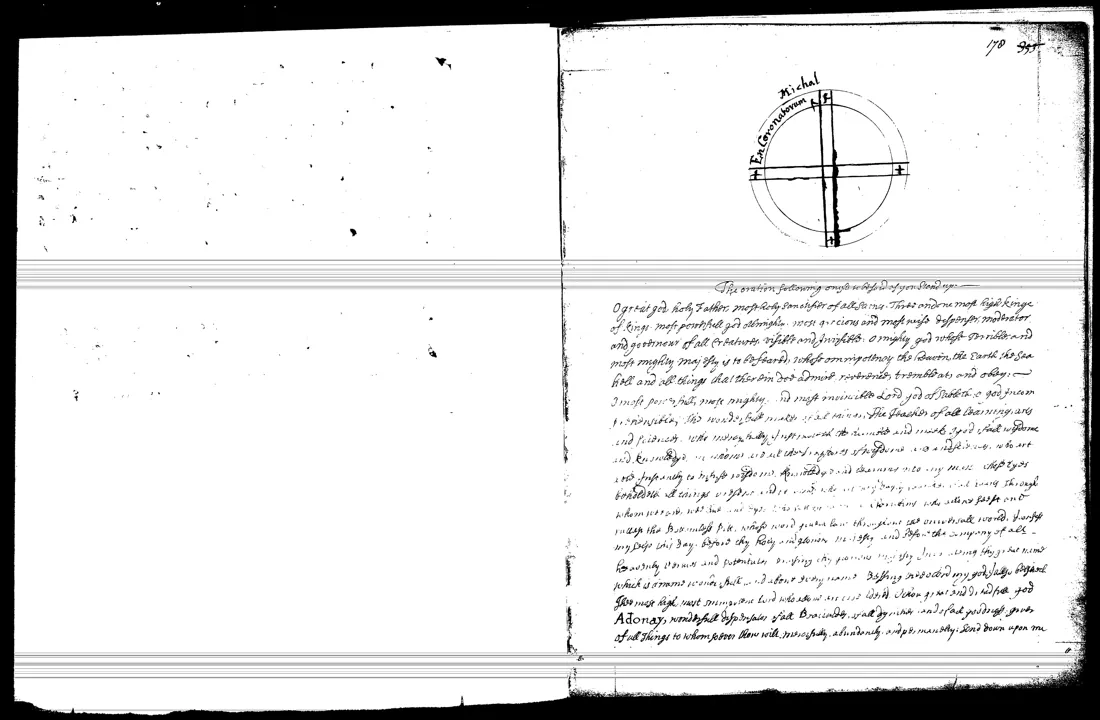
_Aquí recita otra virtud de la oración precedente._

Si deseas[?] gozar[?] de algún gran cargo[?], que[?] pueda[?] [ilegible], o[?] si[?] quisieras[?] gozar[?] [ilegible] de algún peligro presente o por venir; o si quisieras estar cierto[?] de alguna [cosa? nota?] que está ausente, di esto:

El Arte Físico (medicina)#p179
Ars Notoria — facsímil · El Arte Físico (medicina) · dominio público
Manuscrito — Sloane MS 3825 (British Museum)
🔍 clic para ampliar

TranscripciónInglés (s. XVII)

say this oration three times in the Evening with great reverence and devotion, and thou shall have and see that which thou desirest.

Here followeth an oration of great vertue, to attaine the knowledge of the Phisicall Art, having also many other vertues & Efficacy.

If you would have the[?] perfect knowledge of any disease; wherein the same tend to death or life: if the sick party live languishing, stand before him and say this oration three times with great reverence

_<div align="right">The oration of the Phisicall art</div>_

Ihezus fili Dominus Incomprehensibilis Ancor, Anacor, Anylos, Zohorna, Theodonos hely otes Ihagor, horizane, Corichito, Anasae, Helse, Tonope, Phagora.

_An other Part of the same oration_

Elleminator Candones helosi Tephagain, Secedum, Thaones Behelas Belhoros, Hocho Phagan, Emphandimus Humana natus &c: vos Eloytus Phugora, Be present ye holy angels advertise and teach me, whether such a one shall recover or dye of this Infirmity,

This being done then aske the sick person: friend how dost thou feel thy selfe or if he answereth thee, I feeling my selfe at good ease, I begin to mend, or ye like: then Iudge without doubt ye sick person shall recover. But if he answereth, I am very sick or ill, or worse and worse, then doubtless toward he will dye on the Morrow: But if he answereth I know not [how] my state and condition is, whether better or worse; thereupon may know likewise, that he either dye, or his disease will change and alter for the worse. if it be a Child, that is not of years capable to make an answere; or that the sick Languisheth so grievously, that he knoweth not who, or will not answere, say this oration three times, and what you find first setled in your mind, that Iudge to come to pass or fall on him. [Albeit] furthermore if any one dissemble, and would sober his Infirmity, say the same Oration, and the angelicall vertues shall suggest the truth to thee. If the deseased person be far of, when you hear his name: say likewise this _<div align="right">oration</div>_

oration for him, and your minde shall reveale to you, whether he shall live or die.

If you touch the pulse of any one that is sick, saying this Oration, the effect of his Infirmity shall be revealed to you.

Or if you touch the pulse of any woman with Child, saying the same Oration, it shall be revealed, whether shee shall bring forth a [tachado: Male?] Female:

But know that this miracle produceth not from your own Nature, But from ye Nature and vertue of the holy angels, it being a part of their office, wonderfully to reveale these things to you. If you dout of the virginity of any one say this oration in your Minde and it shall be revealed to you whether shee be a virgin [or?] corrupt.

Here followeth the efficacious Preface of an Oration, shewing what vertue & efficacy you may thereby prove every day.

Of this oration Salomon saith: That by it a New knowledge of Phisick is to be received from God, upon which he hath laid this command, and calleth it the miraculous & efficatious foundation of the Phisicall art [tachado: at some [ilegible] in the [ilegible] in contained rather] siences; and that it containeth in it the quantity and quality of the whole Phisicall art and siences; wherein therein contained, rather a Miraculous and glorious, then fearfull or terrable in miracle, which as often soever as you read the same regard not the paucity of words, but praise the vertue of so great a mistery

It is to be noted and is decreed that every note operateth [ilegible] it is put to, or serve[?]; if it do[?] office, and that ye notes of one art profit not to ye knowledge of another art and [we?] are to know that all figures have their proper Orations.

_A[?] certaine speciall precept._

This is necessary for us, and well experienced to expres[?] [ilegible] these into Number to compyle[?] [in?] great preixious [precious?] Volumes of writings, in most [large?] compendious Treatises, wth that it may be easily done [tachado: wee ovt / ilegible] diligently to enquire out the way of attaining it out of ye three most ancient Books, which were composed by solomon: The first which he first the King to be understood therein is: that ye oration before ye Second Chapter is to be used. Long _<div align="right">before</div>_

TraducciónEspañol

di esta oración tres veces al atardecer con gran reverencia y devoción, y entonces tendrás y verás aquello que deseas.

Aquí sigue una oración de gran virtud, para alcanzar el conocimiento del arte físico (medicina), teniendo también muchas otras virtudes y eficacia.

Si quisieras tener el[?] perfecto conocimiento de cualquier enfermedad, cuando la misma tienda a la muerte o a la vida: si el enfermo vive languideciendo, ponte de pie ante él y di esta oración tres veces con gran reverencia.

_<div align="right">La oración del arte físico</div>_

Ihezus fili Dominus Incomprehensibilis Ancor, Anacor, Anylos, Zohorna, Theodonos hely otes Ihagor, horizane, Corichito, Anasae, Helse, Tonope, Phagora.

_Otra parte de la misma oración_

Elleminator Candones helosi Tephagain, Secedum, Thaones Behelas Belhoros, Hocho Phagan, Emphandimus Humana natus &c: vos Eloytus Phugora, estad presentes, oh santos ángeles, advertidme y enseñadme si tal persona sanará o morirá de esta enfermedad,

Hecho esto, pregunta entonces al enfermo: amigo, ¿cómo te sientes? Y si te responde: sintiéndome a gusto, empiezo a mejorar, o algo semejante: juzga entonces sin duda que el enfermo sanará. Pero si responde: estoy muy enfermo o mal, o cada vez peor, entonces sin duda morirá al día siguiente. Pero si responde: no sé cuál es mi estado y condición, si mejor o peor; de ahí podrás conocer igualmente que o bien morirá, o su enfermedad cambiará y se alterará para peor. Si es un niño que no tiene edad capaz de responder, o si el enfermo languidece tan gravemente que no sabe quién es, o no quiere responder, di esta oración tres veces, y lo que primero se asiente en tu mente, juzga que ha de sucederle o recaer sobre él. [Albeit] además, si alguien disimula y quisiera atenuar su enfermedad, di la misma oración, y las virtudes angélicas te sugerirán la verdad. Si la persona enferma está lejos, cuando oigas su nombre di igualmente esta _<div align="right">oración</div>_ oración por él, y tu mente te revelará si vivirá o morirá.

Si tocas el pulso de alguien que está enfermo, diciendo esta oración, el efecto de su enfermedad te será revelado.

O si tocas el pulso de cualquier mujer encinta, diciendo la misma oración, te será revelado si dará a luz un [tachado: varón?] o hembra:

Pero sabe que este milagro no procede de tu propia naturaleza, sino de la naturaleza y virtud de los santos ángeles, siendo parte de su oficio revelarte maravillosamente estas cosas. Si dudas de la virginidad de alguien, di esta oración en tu mente y te será revelado si es virgen o [está] corrupta.

Aquí sigue el eficaz preludio de una oración, mostrando qué virtud y eficacia podrás con ella probar cada día.

De esta oración dice Salomón: que por ella ha de recibirse de Dios un nuevo conocimiento de la física, sobre el cual él ha puesto este mandato, y la llama el milagroso y eficaz fundamento del arte físico [tachado: en algún... en la... contenido más bien] ciencias; y que contiene en sí la cantidad y cualidad de todo el arte físico y las ciencias; en lo cual allí contenido, más bien un milagro maravilloso y glorioso que espantoso o terrible, el cual, cuantas más veces lo leas, no repares en la escasez de palabras, sino alaba la virtud de tan gran misterio.

Ha de notarse y está decretado que cada nota obra [ilegible] aquello a que se destina, o para lo que sirve, si cumple[?] su oficio; y que las notas de un arte no aprovechan al conocimiento de otro arte, y hemos[?] de saber que todas las figuras tienen sus propias oraciones.

_Un[?] cierto precepto especial._

Esto es necesario para nosotros, y bien experimentado, para expresar[?] [ilegible] estas cosas en número, para compilar[?] [en?] grandes preciosos volúmenes de escritura, en muy [amplios?] compendiosos tratados; lo cual, para que pueda hacerse fácilmente [tachado: debemos / ilegible], hemos de indagar diligentemente el modo de alcanzarlo a partir de los tres libros antiquísimos que compuso Salomón: el primero, que él, el rey, [dispuso] que fuera entendido en ellos, es: que la oración anterior al segundo capítulo ha de usarse. Largo _<div align="right">antes</div>_

«The Oration»; la oración «O Eternall»#p180
Ars Notoria — facsímil · «The Oration»; la oración «O Eternall» · dominio público
Manuscrito — Sloane MS 3825 (British Museum)
🔍 clic para ampliar

TranscripciónInglés (s. XVII)

before every speech, the beginning wherof is Assay: and the words of the Oration are to be said in a compleat space of time; but the subsequent part of ye Oration is then cheefly to be said, when you desire the knowledge of ye volumes of writings, and looking into ye holes therof. The same Oration is also to be said when you would clearly and plainly understand and [expound] any [tachado] question or great mistery that you a sudden proposed to you w[hi]ch you never heard of before; say also the same Oration at such time when any thing of great consiquence is Importuned of you, which at present you have not the faculty of expounding. This is a wounderfull Oration of which we have spoken. The first part wherof is expounded in the volume of the Magnitude of the quality of art.

&nbsp;&nbsp;&nbsp;&nbsp;&nbsp;&nbsp;&nbsp;&nbsp;The Oration

Samet, Rozum, Ragia, Ragium, Ragiomal, Agalec, Erodioch, Anchovionos, Cochen, Saza, ya, Manichel, Mamacuo, Lepnon, Bozaco, Cogimal, Salayel, Ytsunanu, Azaroch, Begistar, Amak.

Co the operation of the Magnitude of art. this oration conteineth in ye second place a generall redresse of the first [hoh?] of all Scripture: part of ye Exposition wherof wee have fully explained in ye Magnitude of ye quality of ye said art. But ye reader hath hardly heard of ye admirable mysterie of ye sacramentall Jurisdiction of ye said, Lett him know this, for we raise wisdome out of the greeknesse of ye Oration aforesaid, but that ye beginnings therof is expounded in Lattine or English.

&nbsp;&nbsp;The beginning of the Oration

O Eternall and mercy[full ...] [ilegible] pure memory [ilegible] wisdome [in?] my heart [ilegible] power. Lett thy right hand encompas my heart, and ye holy angels of thy Eternall counsell comp[asse me] about, fill up my confidence with thy memory, and ye odour of thy oyntments, & let ye sweetnesse of thy grace strengthen and fortifie my understanding: [Chorus?] ye pure splendo[ur] & brightnesse of thy face and all thy holy heavenly vertues, wisdome [wherwith thou] [interlineado: ilegible] hast made all things, wherby thou hast [restored?] lost mankind, and raised him after his fall to heaven learning, wherby thou wert pleased to teach &nbsp;&nbsp;&nbsp;&nbsp;&nbsp;&nbsp;&nbsp;&nbsp;&nbsp;&nbsp;&nbsp;&nbsp;&nbsp;&nbsp;&nbsp;&nbsp;&nbsp;&nbsp;[reclamo: w[hi]ch Ada[m]]

teach Adam ye knowledge of everie signe: Informe, reple[nish?] [at?] Instru[c]t, restore corre[c]t & refine me, that I may be made new in the understanding thy precepts, and in receiving thy [tachado] sciences which are profitable for my soule and Body, and for all faithfull beleevers in thy Name, which is Blessed for ever world without End.

heere is also a particular Exposition of ye foregoing Oration, w[hi]ch hath left unexpounded to be read by every one that is Learned in this art; and know that no humane power nor faculty in Man is sufficient to find out ye exposition therof

This Oration is also called by Salomon The genume [genuine?], or Crown of ye Lord for he saith it helpeth against danger of fire or of wild Beasts of ye earth being said w[i]th a beleeving faith for it is affirmed to have beene reported from one of ye foure angels, to whome was given power to hurt the Earth, the sea and the trees. Thirdly an example of this oration in the Booke called The flower of Heavenly Learning. for herein Salomon glorifieth God, & cause by this he Inspired into him ye knowledge of Theology, and dignified him with the divine Mysteries of his omnipotent power & greatnesse, which Salomon beholding in his hight care afird [?], bestowed upon him by the Lord his God, he conveniently gathered the greater Mysteries to gather in this Notory art w[hi]ch were holy & worthy & wonderfull Mysteries. These things and mysteries of Theology, the daring gentills have not all lost. which [tachado] Salomon calleth the signes of ye holy Mysteries of God, revealed by his Angel before: and that which is contained in them is ye fullnesse of our dignity and humane salvation.

&nbsp;&nbsp;The first of these Orations is w[hi]ch [ilegible] All spirituall, ye Virtue wherof teacheth Divinity, & preserveth the memory therof

These are Orations also th[at ilegible] divine [vertues? ilegible] our salvation. The first wherof [is] spirituall and teacheth divinity, & also expoundeth in ye memory therof, & thereupon Salomon commandeth it to be called ye signes of ye grace of God, for as Ecclesiastes saith. This is the spirituall grace of God, that hath given me the knowledge to treat of all Plants from the Cedar of &nbsp;&nbsp;&nbsp;&nbsp;&nbsp;&nbsp;&nbsp;&nbsp;&nbsp;&nbsp;&nbsp;&nbsp;&nbsp;&nbsp;&nbsp;&nbsp;&nbsp;&nbsp;[reclamo: Lebanon]

TraducciónEspañol

antes de cada discurso, cuyo comienzo es Assay: y las palabras de la oración han de decirse en un espacio de tiempo completo; pero la parte subsiguiente de la oración ha de decirse principalmente cuando deseas el conocimiento de los volúmenes de escritos, y al escudriñar sus huecos. La misma oración ha de decirse también cuando quisieras entender clara y llanamente y [exponer] cualquier cuestión o gran misterio que de súbito se te proponga, del cual nunca hayas oído antes; di también la misma oración en el momento en que cualquier cosa de gran consecuencia te sea importunada, de la cual al presente no tengas la facultad de exponer. Esta es una oración maravillosa de la que hemos hablado. Su primera parte se expone en el volumen de la magnitud de la cualidad del arte.

&nbsp;&nbsp;&nbsp;&nbsp;&nbsp;&nbsp;&nbsp;&nbsp;La oración

Samet, Rozum, Ragia, Ragium, Ragiomal, Agalec, Erodioch, Anchovionos, Cochen, Saza, ya, Manichel, Mamacuo, Lepnon, Bozaco, Cogimal, Salayel, Ytsunanu, Azaroch, Begistar, Amak.

[Co] la operación de la magnitud del arte. Esta oración contiene, en segundo lugar, una reparación general del primer [hoh?] de toda la Escritura: parte de la exposición de ello la hemos explicado plenamente en la magnitud de la cualidad de dicho arte. Pero el lector apenas ha oído del admirable misterio de la jurisdicción sacramental de lo dicho; sépalo él, pues levantamos sabiduría de la [greeknesse] de la oración antes dicha, mas su comienzo se expone en latín o en inglés.

&nbsp;&nbsp;El comienzo de la oración

Oh Eterno y misericordioso [...] [ilegible] pura memoria [ilegible] sabiduría [en?] mi corazón [ilegible] poder. Que tu diestra circunde mi corazón, y los santos ángeles de tu Eterno consejo me rodeen [en derredor], colma mi confianza con tu memoria, y el olor de tus ungüentos, y que la dulzura de tu gracia fortalezca y fortifique mi entendimiento: [Chorus?] el puro esplendor y brillo de tu rostro y todas tus santas virtudes celestiales, sabiduría [con la cual tú] [interlineado: ilegible] hiciste todas las cosas, por la cual [restauraste?] a la humanidad perdida, y la levantaste tras su caída al saber del cielo, por el cual te dignaste enseñar &nbsp;&nbsp;&nbsp;&nbsp;&nbsp;&nbsp;&nbsp;&nbsp;&nbsp;&nbsp;&nbsp;&nbsp;&nbsp;&nbsp;&nbsp;&nbsp;&nbsp;&nbsp;[reclamo: w[hi]ch Ada[m] = «which Adam»] enseñar a Adán el conocimiento de cada signo: infórmame, [reple[nish]?/llena], instruye, restaura, corrige y refíname, para que sea hecho nuevo en el entendimiento de tus preceptos, y en recibir tus [tachado] ciencias que son provechosas para mi alma y mi cuerpo, y para todos los fieles creyentes en tu Nombre, que es Bendito por siempre, mundo sin fin.

Aquí hay también una exposición particular de la oración precedente, que se ha dejado sin exponer para que la lea cada uno que esté instruido en este arte; y sabe que ningún poder ni facultad humana en el hombre es suficiente para hallar la exposición de ello.

Esta oración es también llamada por Salomón The genume [¿la genuina?], o Corona del Señor, pues dice que socorre contra el peligro del fuego o de las bestias salvajes de la tierra, dicha con fe creyente; pues se afirma que fue reportada por uno de los cuatro ángeles, a quien fue dado poder para dañar la Tierra, el mar y los árboles. En tercer lugar, un ejemplo de esta oración en el libro llamado The flower of Heavenly Learning (La flor del saber celestial). Pues en ella Salomón glorifica a Dios, y por causa de esto Él le inspiró el conocimiento de la teología, y lo dignificó con los divinos misterios de su omnipotente poder y grandeza, los cuales, contemplándolos Salomón en su [hight?] care afird [?], le fueron otorgados por el Señor su Dios; convenientemente reunió los mayores misterios para juntarlos en este arte Notoria, los cuales eran santos y dignos y maravillosos misterios. Estas cosas y misterios de la teología, los osados gentiles no los han perdido del todo. A los cuales [tachado] Salomón llama los signos de los santos misterios de Dios, revelados por su Ángel antes; y lo que en ellos se contiene es la plenitud de nuestra dignidad y de la salvación humana.

&nbsp;&nbsp;La primera de estas oraciones es la que [ilegible] toda espiritual, cuya virtud enseña divinidad, y preserva la memoria de ello.

Estas son oraciones también [que ilegible] divinas [virtudes? ilegible] nuestra salvación. La primera de ellas [es] espiritual y enseña divinidad, y también se expone en la memoria de ello; y por tanto Salomón manda que se llame los signos de la gracia de Dios, pues como dice el Eclesiastés. Esta es la gracia espiritual de Dios, que me ha dado el conocimiento para tratar de todas las plantas desde el cedro del &nbsp;&nbsp;&nbsp;&nbsp;&nbsp;&nbsp;&nbsp;&nbsp;&nbsp;&nbsp;&nbsp;&nbsp;&nbsp;&nbsp;&nbsp;&nbsp;&nbsp;&nbsp;[reclamo: Lebanon = «Líbano»]

Elección del tiempo; la Primera Oración#p181
Ars Notoria — lámina grabada · Elección del tiempo; la Primera Oración · dominio público
Manuscrito — Sloane MS 3825 (British Museum)
🔍 clic para ampliar

TranscripciónInglés (s. XVII)

Libanon to the Hyssop that groweth on the wall

The Election of Tyme in what Lunation these Orations ought to be said.

The first Oration ought to be said onse in the first Lunation, in y[e] the third three times. in y[e] sixth six times; in y[e] ninth nine times; in the twelfth twelfe times; in y[e] seavententh seaventeen times; and in y[e] Eighteenth as many times; in the twenty six as many in y[e] twenty Ninth as many, and so may in the thirty Ninth; for this oration is [of] great vertue and Effecacy, that in y[e] veryday, thou shall say y[e] same, as if it if were determined by y[e] father, it shall enorease thy knowledge in y[e] sience of divinity.

But if otherwise that thou art Ignorant, and hath been seen by thy companions thy Superiours or Inferiours, though unto others thou shalt seeme to have knowl- edge into the study of divinity, and the Lectures by the space of some Months, tasting of doubt from thee; of them who shall see thee; to know such things; & in that day wherein [ilegible, tachado] Thou wouldest say it, liue chastly, and say it in y[e] morning.

Salomon testifieth, that an angel delivered y[e] following Oration, in thunder— who standeth alwayes in y[e] presence of y[e] Lord, to whome he is not dreadfull. The Mysterie hereof is holy and of great Effecacy, neither ought this oration to be said aboue once; because it moueth y[e] heavenly spirits to performe any great worke.

Of this oration he saith, that so great is y[e] Mystery thereof that it moueth the Celestiall spirits to performe any great worke, w[hi]ch y[e] divine power permitteth it also giueth y[e] vertue of its mysterie, that it healeth y[e] tongue and Body of him that speaketh it, with so great inspiration as if some new and great mystery were suddenly reuealed to his understanding.

Here followeth the beginning of this oration wherein is so great vertue and Effecacy as wee have said it being said with great devotion Achaham. yhel Chelyckem[?] Agzyraltor[?], gegor, &c[a]

This is the beginning of the Oration the parts whereof are four, But there is some thing to be said of the beginning by it selfe; and of the four parts seuerally; and then between the beginning and these Orations which are four wee shall make this a competent division.

For this is that which is to be spoken of the beginning seuerally, and this Oration is to be divided into four parts; and the first part thereof is to be said, that is y[e] beginning, before any other part of the Oration is to be compleated. These greek names following are to be pronounced. This is the division of these Orations, Helema, Helma Hemna, &c. Oh God the Father God the Sonn God the holy ~~Ghost~~ Spirit, confirm this Oration, and my understanding and Memory, to receiue, understand, and retaine y[e] knowledge of all good scriptures, and giue me perseueranee of Mind therein,

This is the beginning of that Oration which as wee have said before ought to be said according to y[e] prolations and constitutions thereof; and ought to be repeated because of the forgetfullnesse of our Memory, and according to y[e] dexteritie of our wit & according to the sanctitie of our Life; there being contained in it so great a Mystery and such Efficacious vertue.

There followeth another subtile Oration, wherein is contained a sacramentall Mystery and wherein euery perfect Signe is wonderfully compleated: for hereby God would haue us to know, what things are Difficill, and what are easie: and what heauenly things the Celestialls professe, and what Earthly things the earone[?]. Because the Lord hath said Mine Eyes haue seen the Imperfect, and in thy Booke are they, day thou[?] are formed and written, and no man in the meane[?]. So it is in the presence of God, for wee are not able with all things, how the sun hath the same course as at first, that our order may be confirmed. for all writting whatsoeuer, which is not from God, is not to be read; for God himselfe would haue all things be diuided: and this is how these are to be used before the second part, which containeth so glorious and excellent conspirations[?] of Orations and we finde th[at] the compleated part to haue power in the heauens, and in nowise can be done just by humane Emprise[?].

This is the beginning of y[e] [Names?] of that Oration spoken of before which is of so great vertue:

Ayaim[?] Sh[ilegible] [figura: glosa griega interlineal «μιχος[?]» sobre palabra tachada] Bo[ilegible]tos the [ilegible] Enchy[?]

TraducciónEspañol

Líbano al hisopo que crece en el muro

La elección del tiempo, en qué lunación deben decirse estas oraciones.

La primera oración debe decirse una vez en la primera lunación; en la tercera, tres veces; en la sexta, seis veces; en la novena, nueve veces; en la duodécima, doce veces; en la decimoséptima, diecisiete veces; y en la decimoctava, otras tantas; en la vigésimo sexta, otras tantas; en la vigésimo novena, otras tantas; y así puede en la trigésimo novena; pues esta oración es de tan gran virtud y eficacia que, en el día mismo, dirás lo mismo, como si hubiera sido determinado por el padre, y aumentará tu conocimiento en la ciencia de la divinidad.

Pero si por el contrario eres ignorante, y has sido visto por tus compañeros, tus superiores o inferiores —aunque ante otros parecerás tener conocimiento en el estudio de la divinidad, y las lecturas por espacio de algunos meses, dudando de ti, de aquellos que te verán, para conocer tales cosas—; y en aquel día en que [ilegible] quisieras decirla, vive castamente, y dila por la mañana.

Salomón atestigua que un ángel entregó la oración siguiente, en trueno —el cual está siempre en la presencia del Señor, ante quien no es terrible. El misterio de ella es santo y de gran eficacia; ni debe decirse esta oración más de una vez, porque mueve a los espíritus celestiales a realizar cualquier gran obra.

De esta oración dice él que tan grande es su misterio que mueve a los espíritus celestiales a realizar cualquier gran obra, lo cual permite el poder divino; da también la virtud de su misterio, de modo que sana la lengua y el cuerpo de quien la pronuncia, con tan gran inspiración como si algún nuevo y gran misterio fuese súbitamente revelado a su entendimiento.

Aquí sigue el comienzo de esta oración, en la que hay tan gran virtud y eficacia, como hemos dicho, siendo dicha con gran devoción: Achaham. yhel Chelyckem[?] Agzyraltor[?], gegor, &c[a] Este es el comienzo de la oración, cuyas partes son cuatro; pero hay algo que decir del comienzo por sí mismo, y de las cuatro partes por separado; y luego, entre el comienzo y estas oraciones, que son cuatro, haremos una división conveniente.

Pues esto es lo que ha de decirse del comienzo por separado, y esta oración ha de dividirse en cuatro partes; y la primera parte de ella ha de decirse, esto es, el comienzo, antes de que ninguna otra parte de la oración sea completada. Estos nombres griegos siguientes han de pronunciarse. Esta es la división de estas oraciones: Helema, Helma Hemna, etc. Oh Dios Padre, Dios Hijo, Dios ~~Espíritu~~ Espíritu Santo, confirma esta oración, y mi entendimiento y memoria, para recibir, entender y retener el conocimiento de todas las buenas escrituras, y dame perseverancia de mente en ello.

Este es el comienzo de aquella oración que, como hemos dicho antes, debe decirse según las prolaciones y constituciones de ella; y debe repetirse a causa del olvido de nuestra memoria, y según la destreza de nuestro ingenio, y según la santidad de nuestra vida; conteniéndose en ella tan gran misterio y tan eficaz virtud.

Sigue después otra oración sutil, en la que se contiene un misterio sacramental, y en la que toda señal perfecta se completa maravillosamente: pues por ello quiso Dios que supiéramos qué cosas son difíciles y cuáles fáciles; y qué cosas celestiales profesan los celestiales, y qué cosas terrenales la tierra[?]. Porque el Señor ha dicho: Mis ojos han visto lo imperfecto, y en tu Libro están, el día en que fueron formados y escritos, y ningún hombre entre tanto[?]. Así es en la presencia de Dios, pues no somos capaces con todas las cosas, cómo el sol sigue el mismo curso que al principio, para que nuestro orden sea confirmado. Pues todo escrito, cualquiera que sea, que no proceda de Dios, no ha de leerse; porque Dios mismo quiere que todas las cosas sean divididas: y así es como estas han de usarse antes de la segunda parte, la cual contiene tan gloriosas y excelentes conspiraciones[?] de oraciones; y hallamos que la parte completada tiene poder en los cielos, y de ningún modo puede lograrse solo por empresa[?] humana.

Este es el comienzo de los [Nombres?] de aquella oración de la que se habló antes, la cual es de tan gran virtud:

Ayaim[?] Sh[ilegible] [figura: glosa griega interlineal «μιχος[?]» sobre palabra tachada] Bo[ilegible]tos the [ilegible] Enchy[?]

Eficacia y peligro de las oraciones#p182
Ars Notoria — facsímil · Eficacia y peligro de las oraciones · dominio público
Manuscrito — Sloane MS 3825 (British Museum)
🔍 clic para ampliar

TranscripciónInglés (s. XVII)

This is y{e} second part of y{e} precedent Oration, of w{ch} some singular thing is to be spoken whereof if thou saydst this Oration, commemorating y{e} first part therof, say y{e} oration following, and thou shallt perceive the precepts w{ch} are therein

O God of all things, who art my God who in the beginning hast created all things out of Nothing, and hast reformed things by the holy spirit, compleat and restore my conscience, and heal my understanding, that I may glorifie thee in all my works thoughts & words, and after thou hast said this Oration, Make a Little respight the space of half an hour, and then say the third part of the oration w{ch} followeth:

Megal, legal, Chariotos &c

having said this third part of the Oration then Meditate with thy selfe about y{e} Scriptures thou desirest to know, and then say this oration,

Oh Thou that art the true light, and way of all Creatures, oh Just God, viuifiyme, and confirm my understanding, and restore my knowledge, and conscience unto me; as thou didst unto king Salomon, Amen.

Commemorating y{e} parts according to that w{ch} is laid down, add y{e} Oration following, y{e} other Orations being said, say the fourth part of the oration which is this.

Amasiel Danys. hayr. &c

Then these praiers being commemorated as is directed add also the following oration.

[Speake?] these [ilegible] the [prytene?] O Lord, [before?] whose face all things are Naked and open, That being washed from y{e} Crimes of Infidility, Thy allquickning Spirit may [assist?] me, and take away all Incredulity from me

How some [certaine?] Orations are not Expounded by y{e} words of y{e} Orations.

[Here?] wee therefore [woulde?] know that y{e} whole Oration aforesaid may not be expounded, [because?] the words thereof, are of so great subtilty, adorned with y{e} Hebrew & Chaldean Tongue, with the subtile & wonderfull Elocution of God, that y{e} offring of the [free?] exposition therof cannot possibly be transferred upon me, The Latine words which are subjoyned to the parts of the Oration aforesaid, are such words, as have been Translated out of the Chaldean tongue for they

for they are not the whole Oration; But as certaine heads of every Oration pertaining thereunto.

Here he Speaketh of the Efficacy of all these.

For this Oration is of such a Mystery, as king Salomon himselfe witnesseth that a servant of his house having found this Booke by chance, and being to much overcome [with] wine, in y{e} company of a woman, he presumptiously read it; but before he had finished a part thereof, he was strikeon dumb, blind, and deaf; and his Memory taken from him: & he continued to the day of his death; and in y{e} hour of his death, he spok and said that foure angels w{ch} he had offended in presumptions reading so sacred a Mystery, were y{e} dayly keepers as afflicters of his Memory; another of his speech a Third of his sight and the fourth of his hearing.

By w{ch} testimony this oration is so much commended by the same king Salomon and great is y{e} Mystery thereof. w{ch} we do greatly require and charge every one that he doth is not presumptiously wherefore Lett this Oration be said according as is directed.

In this Chapter he sheweth the Efficacy of the subsequent oration, it being especiall for to obtaine Eloquence

This holy Oration w{ch} followeth, is a certaine speciall oration, to obtaine Eloquence whereas a~~ll togeather~~ all others have vertue and Efficacy in other things, this containeth this certaine speciall Mystery in it selfe: and whereas one of the generalls is shewing in it selfe, certaine generall precepts, common to all arts, for so God instituteth y{e} soul in y{e} Body, saying, This I give unto you, that ye may keep & observe the Law of the Lord. and these are they that stand in y{e} presence of y{e} Lord alwayes, and see their saviour face to [face both?] night and day. Of this Oration I say, This is y{e} most glorious, Mysticall and Investigious Oration, containing such mysteries in it w{ch} y{e} mind, conscience and tongue proceedeth: This is such a Mysterie, that a man shall keep it according to his will, who foresetteth all things in his sight, that are & made, for y{e} Mystery of this Oration is glorious and sacramentall. Let no man presume to say any of this Oration after too much drinking or Luxury, nor fasting without great reverence and discretion, whereof Salomon saith: Let no man presume to read any thing of this Oration but in certaine & determinate appointed times, unlesse he make mention of this Oration or [first?] some great accident for some weighty [~~businesse~~?] & businesse, for w{ch} this Oration is of wonder- full excellent vertue & goodnesse of this Oration, and y{e} attaining to y{e} Effects thereof,

TraducciónEspañol

Esta es la segunda parte de la oración precedente, de la cual algo singular ha de decirse; por lo cual, si dijeres esta oración, conmemorando su primera parte, di la oración siguiente, y percibirás los preceptos que hay en ella.

Oh Dios de todas las cosas, que eres mi Dios, que en el principio creaste todas las cosas de la nada, y has reformado las cosas por el Espíritu Santo, completa y restaura mi conciencia, y sana mi entendimiento, para que yo te glorifique en todas mis obras, pensamientos y palabras; y después de haber dicho esta oración, haz una pequeña pausa por espacio de media hora, y di entonces la tercera parte de la oración, que es la que sigue:

Megal, legal, Chariotos &c

Habiendo dicho esta tercera parte de la oración, medita entonces contigo mismo acerca de las Escrituras que deseas conocer, y di luego esta oración:

Oh tú que eres la verdadera luz y el camino de todas las criaturas, oh Dios Justo, vivifícame, y confirma mi entendimiento, y restaura mi conocimiento y mi conciencia en mí, como lo hiciste con el rey Salomón, Amén.

Conmemorando las partes conforme a lo que se ha expuesto, añade la oración siguiente; y dichas las demás oraciones, di la cuarta parte de la oración, que es esta:

Amasiel Danys. hayr. &c

Entonces, conmemoradas estas plegarias como está indicado, añade también la oración siguiente.

[¿Di?] estas [ilegible] el [prytene?] Oh Señor, [ante] cuya faz todas las cosas están desnudas y abiertas, para que, lavado de los crímenes de la infidelidad, tu Espíritu que todo lo vivifica me [¿asista?], y aparte de mí toda incredulidad. Cómo algunas oraciones no se explican por las palabras de las oraciones. [¿Por esto?] queremos, pues, [dar a] saber que la oración antedicha en su totalidad no puede exponerse, [porque?] las palabras de ella son de tan gran sutileza, adornadas con la lengua hebrea y caldea, con la sutil y admirable elocución de Dios, que el ofrecimiento de la [¿libre?] exposición de ella no puede en modo alguno transferirse a mí. Las palabras latinas que van unidas a las partes de la oración antedicha son tales palabras como han sido traducidas de la lengua caldea, pues ellas pues ellas no son la oración entera, sino como ciertos encabezamientos de cada oración que a ella pertenece. Aquí habla de la eficacia de todas estas. Pues esta oración es de tal misterio, según el mismo rey Salomón atestigua, que un criado de su casa, habiendo hallado este libro por azar, y estando demasiado dominado por el vino, en compañía de una mujer, lo leyó presuntuosamente; pero antes de haber terminado una parte de él, quedó herido mudo, ciego y sordo, y le fue quitada la memoria; y así continuó hasta el día de su muerte; y en la hora de su muerte habló y dijo que cuatro ángeles, a quienes había ofendido al leer presuntuosamente tan sagrado misterio, eran los guardianes diarios como afligidores de su memoria; otro de su habla, un tercero de su vista, y el cuarto de su oído.

Por cuyo testimonio esta oración es tan recomendada por el mismo rey Salomón, y grande es el misterio de ella; por lo cual encarecidamente requerimos y encargamos a todo el que lo haga que no sea presuntuosamente; por tanto, séase dicha esta oración según está indicado. En este capítulo muestra la eficacia de la oración siguiente, siendo especial para obtener elocuencia. Esta santa oración que sigue es una cierta oración especial para obtener elocuencia; mientras que ~~todas juntas~~ todas las demás tienen virtud y eficacia en otras cosas, esta contiene este cierto misterio especial en sí misma; y mientras que una de las generales muestra en sí misma ciertos preceptos generales, comunes a todas las artes, pues así instituye Dios el alma en el cuerpo, diciendo: Esto os doy a vosotros, para que guardéis y observéis la Ley del Señor; y estos son los que están en la presencia del Señor siempre, y ven a su salvador cara a [¿cara, tanto?] de noche como de día. De esta oración digo que es la más gloriosa, mística e [«Investigious»] oración, que contiene tales misterios en sí que la mente, la conciencia y la lengua [de ella] proceden: es tal misterio, que un hombre la guardará conforme a su voluntad, quien pone de antemano todas las cosas ante su vista, las que son y las que están hechas; pues el misterio de esta oración es glorioso y sacramental. Que ningún hombre presuma decir nada de esta oración tras demasiada bebida o lujuria, ni ayunando sin gran reverencia y discreción; de lo cual dice Salomón: Que ningún hombre presuma leer cosa alguna de esta oración sino en ciertos y determinados tiempos señalados, a no ser que haga mención de esta oración, o [¿primero?] algún gran suceso, por algún grave [asunto?] y negocio, pues esta oración es de admirable y excelente virtud y bondad, y el alcanzar a los efectos de ella,

Cómo pronunciar; «Oh Dios Omnipotente»#p183
Ars Notoria — facsímil · Cómo pronunciar; «Oh Dios Omnipotente» · dominio público
Manuscrito — Sloane MS 3825 (British Museum)
🔍 clic para ampliar

TranscripciónInglés (s. XVII)

as he said and did wt know that it is not of our powr, that this Oration is of so great a vertue & suth a Mystery as some times also ye Lord said to his disciples, this wee are not able to know for this Oration is such a Mystery that it containeth in it the great Name of God, wth many haue Lyed, in saying they knew it, JEZUS himselfe perform'd Many Miracles in ye Temple by it; But many haue Lyed about what he did, and haue hidd and absconded ye truth thereof, so that now haue declareth ye same to see it came to pass: but wee suppose haue spoken somthing about or concerning it.

_(rúbrica / encabezado)_ In this Chapter he setteth down the Time and manner how this oration is to be pronounced.

For this oration is one of ye generalls & ye first of particulars containing both in it selfe, hauing a speciall vertue and famuly [faculty?], to gaine Eloquence in it selfe: therefore it is necessary to be understood what time, ordination, & wt dayes it is to be said and in ~~published~~ published. —. it may always be rehearsed in every 4t Lunary as a boue said but ye ordination of ye time for euery day, wherein it is to be said is especially in ye Morning betimes, before a man is defiled, & then all Orations are the first to be said and this oration must be then pronounced totally togather without any diuision; and although there are diuisions therein, the oration is not diuided in it selfe, but only the diuine and glorious Names are written seuerally, and are diuided into parts, according [to] ye terminations of euery great and glorious Name. and it is to be said togather as most Excellent Names, But not as one word, becausse of ye fragility of our nature. Neither is it needfull to know ye Elements of syllables, posited in this oration, they are not to be knowne, neither lett any one pray illutiously [?] speak them, nor then let him doe any thing by way of interpretation concerning this oration, it ought not to be done. Et mot Perick[?] Vercin[?] Iuba[?] .&c.

_(rúbrica / encabezado)_ No man that is impedited or corrupted with any [crime], ought to presume to say this Oration.

This is a thing agreed unto amongst ye wise men of this world, that those things wee doe haue said before, to pronounced wth great vertue and Industry. It may be said euery day wherein thou art hindred of some criminall sinn. & in that day wherein thou art Impedited by some criminall sin, thou mayst remember it in thy heart, and if thou doest desire to be made Eloquent, repeat it three times, and if any euill thing troubleth thee, or thou art submerged and Insolued [Involved?] into any

great Business, repeat this oration once, & Eloquence shall be added to thee as much as is needfull; and if thou repeat it ouer thrice, great Eloquence shall be giuen to thee; So great a Sacrament is this oration. The Third thing to be considered in this oration is, This oration ought to be pronounced, that Confession of ye heart and Mouth ought to precede it; lett it be pronounced in ye Morning early, and affter that oration say ye Latine oration following.

_(rúbrica / encabezado)_ This is a Prologue or Exposition of the precedent Oration, Which ought to be said togather

Oh Omnipotent and Eternall God, and mercifull Father, blessed before all worlds, wch art a God Eternall, Incomprehensible, & unchangable, & hath granted this blessed gift of saluation unto us; according to ye Omnipotency of thy Majesty, hast granted unto us the Family of speaking, and Learning wth thou hast denyed all other animals; and hast disposed of all things, by this Infalible prouidence: Thou art God, whose Nature is Eternall, and consubstatiall, exalted aboue ye heauens; in whome ye whole deity corporally dwelleth. Implore thy Majesty, and glorify thy omnipotency, with an Interiour Imploration, adoring the Majesty & the power and Magnificence of thy Eternity, I beseech thee O my God, to grant me the Inestimable wisdom of ye life of thy holy angels. Oh God ye holy [&] spirit Incomprehensible, in whose presence stand ye holy quire[s] of angels; I pray and beseech thee, by thy holy and glorious Name, and by the light of thy angels, and the heauenly principalities, to giue thy great increase, to be present with me, and giue unto me ye power to persevere in the Memory of thy wisdome, who liuest and reignest eternally one Eternall God, through all worlds of worlds in whose sight are all celestiall vertues, Now and allwayes, and euery where. Amen. —

This Oration being thus finished there must (& neuertheless a certaine mystery) is added, so that you are to be silent a while affter the Latine orations is ended, and affter a little Taciturnity, that is a little space of silence, begin to say this Oration following Semet, Camen &c. This saith Salomon, is the Oration of orations, and a speciall & generall [oration] whereby all things, whether generalls or particulars, are known fully, & effectually & perfectly and are kept in ye Memory, But when thou hast by this oration attained the Eloquence thou desirest, be sparing thereof; and doe not rashly declare those things, wch thy [tongue] suggests & administreth to thee; for this is the end of all generall precepts, which are _(reclamo al pie:)_ giuen

TraducciónEspañol

como él dijo e hizo, sabemos que no está en nuestro poder, pues esta oración es de tan gran virtud y tal misterio como algunas veces también el Señor dijo a sus discípulos, esto no somos capaces de saberlo; pues esta oración es un misterio tal que contiene en sí el gran Nombre de Dios, con el cual muchos han mentido diciendo que lo conocían. JEZUS mismo obró muchos milagros en el templo mediante él; pero muchos han mentido acerca de lo que él hizo, y han ocultado y escondido la verdad de ello, de modo que ahora ha declarado lo mismo para ver [cómo] llegó a suceder; mas suponemos haber dicho algo acerca o concerniente a ello.

_(rúbrica / encabezado)_ En este capítulo expone el tiempo y la manera en que esta oración ha de pronunciarse.

Pues esta oración es una de las generales y la primera de las particulares, conteniendo ambas en sí, teniendo una virtud especial y facultad [famuly?], para ganar elocuencia en sí misma; por tanto es necesario entender en qué tiempo, ordenación y en qué días ha de decirse y en ~~publicado~~ publicado. —. Puede siempre recitarse en cada 4.ª lunar, como se dijo antes, pero la ordenación del tiempo para cada día, en que ha de decirse, es especialmente por la mañana temprano, antes de que un hombre se contamine, y entonces todas las oraciones son las primeras en decirse; y esta oración debe entonces pronunciarse enteramente, junta, sin ninguna división; y aunque hay divisiones en ella, la oración no está dividida en sí misma, sino que solo los divinos y gloriosos nombres están escritos por separado, y se dividen en partes, según [las] terminaciones de cada gran y glorioso Nombre. Y ha de decirse junta, como los más excelentes nombres, pero no como una sola palabra, a causa de la fragilidad de nuestra naturaleza. Tampoco es necesario conocer los elementos de las sílabas puestas en esta oración; ellas no han de ser conocidas, ni permita nadie pronunciarlas [illutiously?], ni haga entonces nada por vía de interpretación acerca de esta oración; no debe hacerse. Et mot Perick[?] Vercin[?] Iuba[?] .&c.

_(rúbrica / encabezado)_ Ningún hombre que esté impedido o corrompido por algún [crimen] debe presumir de decir esta oración.
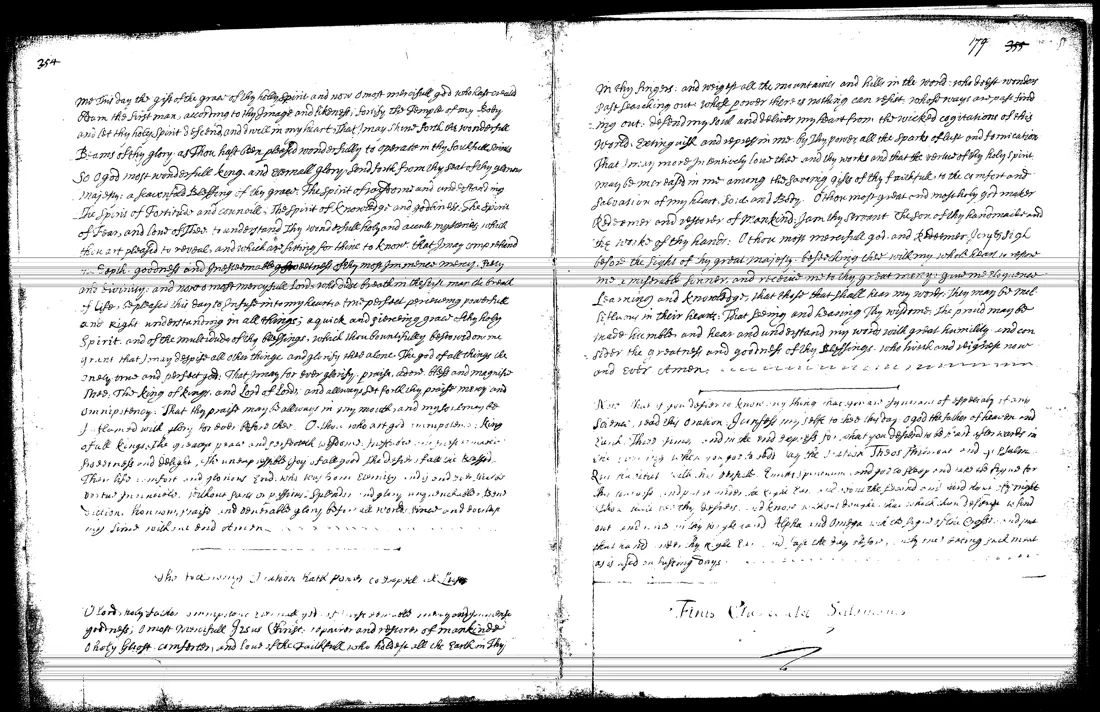
Esto es cosa convenida entre los hombres sabios de este mundo, que aquellas cosas que hemos dicho antes se pronuncien con gran virtud e industria. Puede decirse cada día en que no estés impedido por algún pecado criminal; y en aquel día en que estés impedido por algún pecado criminal, puedes recordarla en tu corazón, y si deseas ser hecho elocuente, repítela tres veces; y si alguna cosa mala te perturba, o estás sumergido e involucrado [Insolued] en algún gran negocio, repite esta oración una vez, y elocuencia te será añadida tanto cuanto sea menester; y si la repites tres veces, gran elocuencia te será dada; tan gran sacramento es esta oración. Lo tercero a considerar en esta oración es: esta oración debe pronunciarse [de modo] que la confesión del corazón y de la boca deba precederla; que se pronuncie por la mañana temprano, y después de esa oración di la oración latina siguiente.

_(rúbrica / encabezado)_ Este es un prólogo o exposición de la oración precedente, el cual ha de decirse junto [con ella].

Oh Omnipotente y Eterno Dios, y misericordioso Padre, bendito antes de todos los mundos, que eres Dios Eterno, Incomprensible e inmutable, y has concedido este bendito don de la salvación a nosotros; según la Omnipotencia de tu Majestad, has concedido a nosotros la familia del habla y del aprender, que has negado a todos los demás animales; y has dispuesto de todas las cosas por esta infalible providencia: tú eres Dios, cuya naturaleza es eterna y consustancial, exaltada sobre los cielos; en quien toda la deidad habita corporalmente. Imploro tu Majestad, y glorifico tu omnipotencia, con una imploración interior, adorando la Majestad y el poder y la magnificencia de tu Eternidad; te suplico, oh Dios mío, que me concedas la inestimable sabiduría de la vida de tus santos ángeles. Oh Dios [y] santo espíritu Incomprensible, en cuya presencia están los santos coros de ángeles; te ruego y suplico, por tu santo y glorioso Nombre, y por la luz de tus ángeles, y las celestiales principalidades, que des tu gran incremento, para estar presente conmigo, y me des el poder de perseverar en la memoria de tu sabiduría, tú que vives y reinas eternamente, un solo Eterno Dios, por todos los mundos de mundos, en cuya vista están todas las virtudes celestiales, ahora y siempre, y en todo lugar. Amén. —

Terminada así esta oración, hay que añadir (y no obstante un cierto misterio) [algo más], de modo que has de guardar silencio un rato después de que las oraciones latinas hayan acabado, y tras una pequeña taciturnidad, esto es un pequeño espacio de silencio, comienza a decir esta oración siguiente Semet, Camen &c. Esta, dice Salomón, es la oración de las oraciones, y una [oración] especial y general por la cual todas las cosas, ya generales ya particulares, se conocen plena, eficaz y perfectamente, y se guardan en la memoria. Pero cuando por esta oración hayas alcanzado la elocuencia que deseas, sé parco con ella; y no declares temerariamente aquellas cosas que tu [lengua] te sugiera y administre; pues este es el fin de todos los preceptos generales, que son _(reclamo al pie:)_ dados

Bendición del Lugar; el Proceso#p184
Ars Notoria — facsímil · Bendición del Lugar; el Proceso · dominio público
Manuscrito — Sloane MS 3825 (British Museum)
🔍 clic para ampliar

TranscripciónInglés (s. XVII)

given to obtaine Memory, Eloquence; and understanding, all those things w[hi]ch were to fore delivered, of generall precepts, are given ab signe how the faculty of attaining to the understanding of the generall precepts May be had, which also Salomon calleth spiritualls. and those singular arts, have singular vertues & powers,

Here followeth the additionall part of the Notory Art. soe as it stands in the Latin part of the printed Exemplar

The Benediction of the Place Bless O Lord this place, that there may be in it holy sanctity, chastity, meeknesse, victory, holines, humility, goodnes, plenty, obediance of y[e] Law, to y[e] father son & holy Ghost, hear O Lord, holy Father; almighty Eternall God; and send thy holy angell Michael, who may protect, keep, preserve, and visit me, dwelling in this tabernacle, by him who liveth &c[a].

wherein you would operate, have respect to y[e] Lunations, the yeare to be chosen in those Monthes when the [☉ Sol] ruleth in [♊] and [♍], [♈], [♌], [♎], [♉], in the Monthes you may beginne.

In the Name of the Lord, beginneth his most holy art, w[hi]ch y[e] most high God administred to Salomon by his angell, assured [him?] that they [very?] suddenly, in a short space yet[?] time [he?] was established in y[e] knowledge of all sciences, and knew that in these orations are contained all sciences, Lawfull and unlawfull,

First if you pronounce y[e] Orations of Memory, Eloquence, and understanding, & y[e] stability thereof, they will be mightily Encreased, in so much that you will hardly keep silence; for by a word all things were created, and by the vertue of that word all created beings stand, and every sacrament, and that word is God. Therefore ~~have wee~~ lett the Operator be constant in his faith, & confidently beleeve, that hee shall obtaine such knowledge and wisdome, in y[e] pronouncing [these?] Orations, for with God nothing is impossible. therefore lett the operator [proceed?] [proceed?] in his worke, with faith, hope and constant desire; firmly beleeving becaus we can obtaine nothing but by faith; therefore have no doubt in this operation, whereof there is three species whereby the art may be obtained The first species is oration, and reason of a godly mind Not by attempt- [reclamo al pie: attempting]

attempting a day of desperation, but by reading and repeating the same in y[e] time [y[e] parts?] The second species is fasting and praying, for the praying man, God heareth. The third species is Chastity he that would operate in that art, lett him be clean and Chast by the space of Nine dayes at least; and before you begin it is neces- sary that you know the time of the [☽ Luna] for in the prime of the [___] it is proper to operate in this art. and when you begin so sacred an art, have a care to abstaine from all mortall sins. at least while you are proceeding in this worke, untill it be finished & compleated. and when you begin to operate say this word following, Lift up the light of thy countenance upon me, O Lord my God, and forsake Not me thy servant N, that trusteth in thee. Then say three times Pater Noster &c: and assert that thou wilt never commit willfull perjury But allwayes persevere in faith and hope. this being done with bended knees in the place wherein thou wilt operate say. Our help is in the name of y[e] Lord, who hath made heaven and Earth: and will enter into the Invocation of the most high. unto him who enlighteneth & purifieth my soule and conscience w[hi]ch dwelleth under the helpe of the most high, and continueth under y[e] protection of y[e] God of heaven: O Lord open and unfold y[e] doubt of my heart, and change me into a new man, by thy love: Be thou O Lord unto me a stedfast[?] faith, y[e] hope of my life, and perfect Charity, to declare thy wounders. Lett us pray: then say the Oration following: O God my God, who from y[e] beginning hast created all things out of nothing, and reformest all things by thy spirit; restore my conscience, and heale my understanding, that I may glorifie Thee in all my thoughts, words and deeds, through him who liveth and reigneth with thee for ever Amen. Now in y[e] Name of y[e] Trinity, on y[e] first day of y[e] Month in [Deo?] thou wouldst acquire Memory, Eloquence, and understanding, and stedfastnes thereof, with a[n] upright good and contrite heart, and even for thy sins committed thou maist begin to pronounce these Orations following, which appertaine to y[e] obtaining of Memory, and all others and which were composed, and delivered by the angell to Salomon from y[e] hands of God. The first and last oration of this arte is Alpha & Omega, [Helo?] Dominus [potendat?] &c. [reclamo al pie, muy florido: To perform a[n]... ­— ilegible]

TraducciónEspañol

dado para obtener memoria, elocuencia y entendimiento, todas aquellas cosas que fueron antes entregadas, de los preceptos generales, se dan como señal de cómo puede haber la facultad de alcanzar el entendimiento de los preceptos generales; a lo cual también Salomón llama «espirituales». Y esas artes singulares tienen singulares virtudes y poderes.

Aquí sigue la parte adicional del Arte Notoria, tal como está en la parte latina del ejemplar impreso.

La bendición del lugar Bendice, oh Señor, este lugar, para que haya en él santa santidad, castidad, mansedumbre, victoria, santidad, humildad, bondad, abundancia, obediencia de la Ley; al Padre, al Hijo y al Espíritu Santo; escucha, oh Señor, santo Padre, Dios Eterno todopoderoso; y envía a tu santo ángel Michael, que me proteja, guarde, preserve y visite, morando en este tabernáculo, por aquel que vive, etc.

[en el mes] en que quisieras operar, ten respeto a las lunaciones; el año ha de escogerse en aquellos meses cuando el [☉ Sol] rige en [♊], y [♍], [♈], [♌], [♎], [♉]; en esos meses puedes comenzar.

En el nombre del Señor comienza su muy santo arte, el cual el Dios altísimo administró a Salomón por medio de su ángel; le aseguró [a él?] que [muy?] repentinamente, en un breve espacio de[?] tiempo, [él?] quedó establecido en el conocimiento de todas las ciencias; y supo que en estas oraciones están contenidas todas las ciencias, lícitas e ilícitas.

Primero, si pronuncias las oraciones de memoria, elocuencia y entendimiento, y la estabilidad de ello, serán poderosamente acrecentados, hasta tal punto que apenas podrás guardar silencio; pues por una palabra todas las cosas fueron creadas, y por la virtud de esa palabra se sostienen todos los seres creados, y todo sacramento; y esa palabra es Dios. Por tanto, ~~tenemos que~~ que el operador sea constante en su fe, y confiadamente crea que él obtendrá tal conocimiento y sabiduría al pronunciar [estas?] Oraciones; pues para Dios nada es imposible. Por tanto, que el operador [prosiga?] [prosiga?] en su obra, con fe, esperanza y deseo constante; creyendo firmemente, porque nada podemos obtener sino por la fe; por tanto, no tengas duda en esta operación, de la cual hay tres especies por las que el arte puede obtenerse. La primera especie es la oración, y la razón de una mente piadosa, no por intent[ar] [reclamo: attempting] intentar un día de desesperación, sino leyendo y repitiendo lo mismo en su tiempo [¿sus partes?]. La segunda especie es ayunar y orar, pues al hombre que ora, Dios lo escucha. La tercera especie es la castidad: el que quisiera operar en ese arte, que sea limpio y casto por el espacio de nueve días al menos; y antes de que comiences, es necesa- rio que sepas el tiempo de la [☽ Luna], pues en el prime[r cuarto?] de la [___] es propio operar en este arte. Y cuando comiences arte tan sagrado, ten cuidado de abstenerte de todos los pecados mortales, al menos mientras estés procediendo en esta obra, hasta que sea acabada y completada. Y cuando comiences a operar, di esta palabra siguiente: Alza sobre mí la luz de tu rostro, oh Señor mi Dios, y no abandones a mí, tu siervo N, que confía en ti. Luego di tres veces el Pater Noster, etc.; y afirma que nunca cometerás perjurio voluntario, sino que siempre perseverarás en la fe y la esperanza. Hecho esto, con las rodillas dobladas en el lugar donde quisieras operar, di: Nuestro auxilio está en el nombre del Señor, que hizo el cielo y la tierra; y entrará en la invocación del Altísimo, hacia aquel que ilumina y purifica mi alma y conciencia, que mora bajo el amparo del Altísimo, y permanece bajo la protección de el Dios del cielo: oh Señor, abre y despliega la duda de mi corazón, y múdame en un hombre nuevo, por tu amor: sé tú, oh Señor, para mí una fe firme, la esperanza de mi vida y perfecta caridad, para declarar tus maravillas. Oremos; luego di la Oración siguiente: Oh Dios, Dios mío, que desde el principio creaste todas las cosas de la nada, y reformas todas las cosas por tu espíritu; restaura mi conciencia, y sana mi entendimiento, para que te glorifique en todos mis pensamientos, palabras y obras, por medio de aquel que vive y reina contigo por siempre. Amén. Ahora, en el nombre de la Trinidad, el primer día del mes, en [Deo?], quisieras adquirir memoria, elocuencia y entendimiento, y firmeza de ello, con un corazón recto, bueno y contrito; y aun por tus pecados cometidos puedes comenzar a pronunciar estas oraciones siguientes, que pertenecen a la obtención de la memoria, y todas las demás, y que fueron compuestas y entregadas por el ángel a Salomón de las manos de Dios. La primera y última oración de este arte es Alpha & Omega, [Helo?] Dominus [potendat?] &c. [reclamo al pie, muy florido: To perform a[n]... — ilegible]

Experimento de minerales; el Proceso#p185
Ars Notoria — lámina grabada · Experimento de minerales; el Proceso · dominio público
Manuscrito — Sloane MS 3825 (British Museum)
🔍 clic para ampliar

TranscripciónInglés (s. XVII)

This is to follow y{e} Third oration of y{e} [com̄?] in y{e} begining of y{e} notory art:

Ihonseh, O Theos hazamagiel gezuzan, Sazaman, Sathaman, getormantas, Salathiel, nesomel, migal, vuisghama, Jazamir, Zeyhaman, hamamal, amna, nisza, deleth, hazamaloth, may pamazathovan, hanasuelnia, sacromomem, gegonoman, Zaramacham, Cades, backet, girtassoman, gysiton palaphatos halathel, Osachynam machay. Amen

This is a true and approued Experiment, to understand all arts and secrets of y{e} world, to find out and digg up mineralls and treasure. This was reuealed by y{e} heauenly angel in this notory art. for this art doth also declare things to come, and rendereth the same capable of all arts in a short time, by the diuine use thereof.

Wee are to speake also of y{e} time and place. first therefore all these precepts are to be obserued and kept, and y{e} Operation ought to be Clean, chast, [conuent?] of his sins, and earnestly desire to cease from sinning as much as may be, and so let him proceed and soe every worke shall be Investigated into him by the diuine Ministry.

When thou wilt operate in the New Moon, kneeling say this verse. Lift up the light of thy countenance upon us oh God, and forsake us not, oh Lord our God. Then say three times the Pater noster and afterwards tell him downe unto God that he will noe more committ wilfull periury, but always perfect in faith. This being done: at night say with bended knees before thy Bed,

Our helpe is in the name of the Lord &c

and the y{e} Psalm who dwelleth under y{e} shadow of y{e} [~~— — —~~] [wings?] of y{e} most high, to y{e} End., and the Lords prayer and the prayer following:

Theos Pater vehemens, God of angels, I pray and Invocate thee y{e} by thy most holy angels Eliphamasay gelomiras, Gedo bonay saranana, Elomnia, and by all thy holy names, by names to be pronounced, which are these: de. el. X ph. kh. t. li. g. yy. not to be spoken or comprehended by humane sense, I beseech thee enlarge my conscience with y{e} splendour of thy name, Illustrate & confirme my understanding with y{e} sweet sauiour of thy holy spirit: O Lord adorne my soule &c [figura: signo]

[figura: pequeña cruz rematada por un lazo/anillo] The Processe followeth:

When thou wilt operate concerning any dificult precepts or question, with bended knees before thy Bed, make confession unto god the Father: and haueing made thy confession say this Oration.— [c c c c c c c c c c c relleno] [Se]nd O Lord thy wisdome to assist me, that it may be with me, and labour with me, [an]d that I may allways know what is acceptable before thee: and that unto me N. may be manefested the truth of this question or Art [relleno] This being done: Thrice in a day following, when thou risest give thanks to god Almighty: saying glory and honour, and Benediction be unto him, that setteth on Throne; and that liueth for euer and euer amen. [relleno]

with bended knees and stretched out Arms and hands. [relleno]

But if thou desirest to understand any Book, aske of some that hath knowledge there in what that Book Treateth of. This being done open the Booke and read in it, and operate as at first three times. and allwayes when thou goest to sleep write Alpha, and Omega, and afterwards sleep on thy right side, putting the palme of thy hand un der thy Ear, and thou shalt see in a dream, all things thou desirest and thou shalt hear the voice of one Informing, and Instructing thee in that Booke and read therein. and thou shalt presently understand the same as it thou hadst studied in it a longe time, and allways remember to giue thanks to god, as aforesaid. [relleno]

afterwards on the first day say this oration:— O Father maker of all creatures by thy unspeakable [worde?] [wherewith?] thou hast made all things, [lift?] up th{e} [word?] power, and [understand?] our [word?] and [word?] me from all [aduersity?] of Soul and Body. amen. [relleno]

[Sixt?] [Sunday?] say. [ilegible] O Christ son of the liueing god [who art the splendour? and Image? of light? with?] whome there is no alteration. nor shadow of Changing. thou word of god most high. the wisdome of the Father. open [unto?] me thy unworthy seruant N. the [gift?] of thy sauing spirit. [that I may?] [perfectly?] understand, [retaine in?] me[mory] mory, and declare all thy wordes of wisdome. [giue me thereof by?] mouth of the most high [power?], [virtually?] [teaching? him?] and truely disposing of all [things?] in the [world?] [ilegible] and [teach me?] thy way of prudence and wisdome. [relleno] O Lord which [ilegible] giue [ilegible] my way [ilegible] [prosper?] [ilegible] thou heart, [ilegible] me thy unworthy seruant N. the same spirit and that I may allways [proceed? in thy consolation?] [relleno]

TraducciónEspañol

Esto sigue a la tercera oración del [com̄?] al comienzo del arte notoria:

Ihonseh, O Theos hazamagiel gezuzan, Sazaman, Sathaman, getormantas, Salathiel, nesomel, migal, vuisghama, Jazamir, Zeyhaman, hamamal, amna, nisza, deleth, hazamaloth, may pamazathovan, hanasuelnia, sacromomem, gegonoman, Zaramacham, Cades, backet, girtassoman, gysiton palaphatos halathel, Osachynam machay. Amén

Este es un experimento verdadero y probado, para entender todas las artes y secretos del mundo, para descubrir y desenterrar minerales y tesoros. Esto fue revelado por el ángel celestial en esta arte notoria; pues esta arte también declara las cosas por venir, y hace al mismo [operador] capaz de todas las artes en poco tiempo, por el uso divino de ella.

Hemos de hablar también del tiempo y del lugar. Por tanto, primero, todos estos preceptos han de observarse y guardarse, y la operación debe ser limpia, casta, [arrepentido?] de sus pecados, y ha de desear ardientemente cesar de pecar cuanto sea posible; y así proceda, y de este modo toda obra le será investigada [infundida] por el ministerio divino.

Cuando quieras operar en la luna nueva, arrodillado di este versículo: Alza sobre nosotros la luz de tu rostro, oh Dios, y no nos desampares, oh Señor nuestro Dios. Después di tres veces el Pater noster, y luego prométele delante de Dios que no cometerá más perjurio voluntario, sino que siempre [estará] perfecto en la fe. Hecho esto, de noche di, con las rodillas dobladas ante tu lecho:

Nuestro auxilio está en el nombre del Señor, etc.

y el Salmo «El que mora bajo la sombra de las [alas?] del Altísimo», hasta el fin; y la oración del Señor, y la oración siguiente:

Theos Pater vehemens, Dios de los ángeles, te ruego e invoco por tus muy santos ángeles Eliphamasay gelomiras, Gedo bonay saranana, Elomnia, y por todos tus santos nombres, por nombres que no han de pronunciarse, que son estos: de. el. X ph. kh. t. li. g. yy., que no han de ser dichos ni comprendidos por el sentido humano; te suplico que ensanches mi conciencia con el esplendor de tu nombre, ilustres y confirmes mi entendimiento con el dulce sabor de tu santo espíritu: oh Señor, adorna mi alma, etc. [figura: signo] [figura: pequeña cruz rematada por un lazo/anillo] Sigue el proceso:

Cuando quieras operar acerca de cualquier precepto o cuestión difícil, con las rodillas dobladas ante tu lecho, haz confesión a Dios Padre; y hecha tu confesión, di esta oración: [Envía?], oh Señor, tu sabiduría para asistirme, para que esté conmigo y trabaje conmigo, y para que yo siempre conozca lo que es aceptable ante ti, y para que me sea manifestada a mí, N., la verdad de esta cuestión o arte. Hecho esto, tres veces al día siguiente, cuando te levantes, da gracias a Dios Todopoderoso diciendo: gloria y honor y bendición sean para aquel que se sienta en el trono, y que vive por los siglos de los siglos, amén.

Con las rodillas dobladas y los brazos y manos extendidos.

Pero si deseas entender algún libro, pregunta a alguno que tenga conocimiento en él de qué trata ese libro. Hecho esto, abre el libro y lee en él, y opera como al principio tres veces; y siempre, cuando vayas a dormir, escribe Alfa y Omega, y después duerme sobre tu costado derecho, poniendo la palma de tu mano bajo tu oreja, y verás en sueños todas las cosas que deseas, y oirás la voz de alguien que te informa e instruye en aquel libro, y lee en él; y al punto entenderás lo mismo como si lo hubieras estudiado largo tiempo; y acuérdate siempre de dar gracias a Dios, como se ha dicho.

Después, en el primer día di esta oración: Oh Padre, hacedor de todas las criaturas, por tu inefable [palabra?] [con la cual?] hiciste todas las cosas, [alza?] tu [poder?], y [entiende?] nuestro [ilegible] y [ilegible] me dé toda [adversidad?] de alma y cuerpo. Amén.

[¿El sexto?] [¿domingo?] di: [ilegible] Oh Cristo, Hijo del Dios viviente, [que eres el esplendor? e imagen? de la luz? con?] quien no hay mudanza ni sombra de variación, tú Verbo de Dios altísimo, la sabiduría del Padre: abre [a?] mí, tu indigno siervo N., el [don?] de tu espíritu salvador, [para que yo?] [perfectamente?] entienda, [retenga en la?] memoria y declare todas tus palabras de sabiduría; [dame de ello por?] boca del altísimo [poder?], [virtualmente?] [enseñando?] y disponiendo verdaderamente de todas [las cosas?] en el [mundo?] [ilegible], y [enséñame?] tu camino de prudencia y sabiduría. Oh Señor, que [ilegible] dame [ilegible] mi camino [ilegible] [prospera?] [ilegible] tu corazón, [ilegible] me, tu indigno siervo N., el mismo espíritu, y que yo siempre [proceda? en tu consolación?].

Preceptos; consagrar la figura#p186
Ars Notoria — facsímil · Preceptos; consagrar la figura · dominio público
Manuscrito — Sloane MS 3825 (British Museum)
🔍 clic para ampliar

TranscripciónInglés (s. XVII)

Other Precepts. Haueing finished these Orations and giuen almes, when thou entrest thy Cham- =ber deuoutly Kneel down, before thy Bedd saying the 51 Psalm. haue mercy upon me O god acceording to thy multitude of thy mercys &c. and the 31[st] Psalm in thee o lord haue I trusted &c. Then [rise?] up and goe to the wall and stretck forth thy hands. haueing two nailes fixed, upon which Thou maist stay up Thy hands: and say this prayer following with great Deuotion: ~~~ O god who for us miserable sinners: didst undergoe the painefull Death upon the Crosse: To whom also Abraham offered up his Son Isaac: I thy unwortthy seruant a sinner perplexed with many Evills, doe this day offer up and sacrifice [my?] unto thee my Soul and Body: That thou maist Infuse into me thy diuine wisdome and Inspire me with the spirit of prophecy, wherwith thou didst Inspire The holy [Spirit — tachado] prophets: [rasgos de pluma / flourishes] Afterwards say this Psalm 17[th] O lord incline thine Ear unto my words &c ~~ and add the 23: The Lord is my Shepard and nothing shall I want: He shall [set?] me down in greene pastures his Seruant N. He shall lead me by the waters of [re]- freshment, & conuerteth my Soul and leadeth me N. upon the paths of his Right- =eousnesse: for his holly [names?] let my Evening Prayer ascend up unto thee o lord and Lett thy mercy descend upon me. thy unworthy seruant N protect. Saue, Blesse, and Sanctifie me: that being as a shield against all the wicked darts of my enemys ~ Defend me and [ilegible] as [prince?] of the Lord of [hosts?] one. wherewith thou hast redeemed me [ilegible] and Keep [grant?] god whose wisdome hath laid the foundation of the heauen and formed the earth and placed the [sea?] in its bounds. and [by?] the goeing [back?] of thy [word?] [ilegible] the [raineing?] and cast forth the men out of thy dust of the earth according to his [ilegible] likewise who gaue to Salomon the Son of King David inspea[k]- able wisdome. [came?] [ilegible] to his prophets the Spirit of prophecy. and professed[?] new Philosophers [ilegible] deuinest [word?] and Knowledge, [ilegible] The Apostles with [ilegible] and [ouercame?] the enemys. who exalteth his Elect from Eternity and [ilegible] to them. Multiply o lord god thy mercy upon me thy unworthy seruant N. by giueing me a [teachable?] wit, [and?] an understanding adorned with vertue and Knowledge: firme and sound memory that they may accomplish and retaine whatsoeuer [I studie?]. then [ilegible] my [words?] in the [word?]: lift up o lord my god the light of thy countenance upon me that I might see [word?], and [end?] teach me o lord god of vertues, and shew me Thy face: and I shall be safe. Then doe [say?] the 25 Psalm unto thee o lord doe I lift up

up my Soul, oh my god, in thee doe [I trust?]; excepting that vere confundantur &c haueing fullfilled these Things upon the wall: descend unto thy Bedd writting in thy Right hand, Alpha and Omega: Then goe to Bedd and sleep on thy Right side hold- =ing thy hand under thy right Ear. and thou shalt see the greatnesse of god as thou hast desired. and in the morning on thy Knees before thy Bedd giue thanks unto god for those Things he hath reuealed to Thee: I giue Thanks unto thee o great and wonder- full god who hast giuen Salvation and Knowledge of Arts unto me Thy unworthy seruant N. Confirm this O god which thou hast wrought in me in preseruing me. I giue thanks unto thee O powerfull Lord god who createst me miserable sinner out of nothing when I was not, and when I was utterly lost: not redeemed, but by the pretious blood of thy Son our Lord Jesus Christ: and when I was Ignorant thou hast giuen unto me learning and Knowledge grant unto me thy unworthy seruant N. o lord Jesus Christ: that through thy Knowledge I may be allwayes constant in thy holy seruice Amen ~~~

———————————————

These Operations being deuoutly compleated: giue thanks dayly with these last orations But when thou wouldst read Studie, or dispute, say. Remember thy word unto thy ser- uant O lord. in which thou hast giuen me hope. This is my comforte in humility: Then add these Orations. Remember me o lord of lords: put good words and speech into my mouth that I may be heard Efficaciously and powerfully to the praise glory and honour of thy glorious name which is Alpha and Omega, Blessed for euer world without end amen ~~ [Then silently say these orations &c — línea subrayada/tachada, casi ilegible]

[ilegible: 3 líneas muy desvaídas] ... the Spirit of wisdome understanding and [word?] ... a [fiery?] sword and my tongue as an arrow [word?] ... [word?] in euery mouth [word?] wisdome mollifie the hearts of thy [seruants?] considered [ilegible] the [Ismach?] Izacharim &c ~~~

The manner of consecrating the figure of [Art?]

[ilegible] ... with great faith hope and charity, and Deuo[tion?] [it must be sealed?] to be kept and used in operation as followeth: on the first day of the new moon knowing to be the new moon put the figure under thy Right Eare and so wearing- =ly euery other night and [some?] twise a day: [say?] in the morning saying the Psalmes 2ui Habitat[?] [Qui Habitat] &c [throwne?] and to be said onze[?] ouer, and this [manner?] these prayers must [first?] time of the day: then say the 9[th] Psalm &c and [word?] his oration [twise?] and the oration Then [certain?] notes[?] [ilegible] ~~~

TraducciónEspañol

Otros preceptos. Habiendo terminado estas oraciones y dado limosnas, cuando entres en tu cámara arrodíllate devotamente, ante tu cama diciendo el salmo 51: «Ten misericordia de mí, oh Dios, conforme a la multitud de tus misericordias, etc.», y el salmo 31[o]: «En ti, Señor, he confiado, etc.». Luego [levántate?] y ve a la pared y extiende tus manos, teniendo clavados dos clavos, sobre los cuales podrás sostener tus manos en alto; y di esta oración siguiente con gran devoción: Oh Dios, que por nosotros míseros pecadores sufriste la dolorosa muerte en la cruz, a quien también Abraham ofreció a su hijo Isaac: yo, tu indigno siervo, un pecador atribulado por muchos males, ofrezco y sacrifico hoy a ti mi alma y mi cuerpo, para que infundas en mí tu divina sabiduría y me inspires con el espíritu de profecía con que inspiraste a los santos profetas: [rasgos de pluma] Después di este salmo 17[o]: «Señor, inclina tu oído a mis palabras, etc.», y añade el 23: «El Señor es mi pastor y nada me faltará. Él hará [recostarme?] en verdes pastos a su siervo N. Él me conducirá junto a las aguas de refrigerio, y convierte mi alma y guía a N. por las sendas de su justicia; por su santo [nombre?]. Suba mi oración vespertina hasta ti, oh Señor, y descienda tu misericordia sobre mí, tu indigno siervo N.: protege, salva, bendice y santifícame, para que, siendo como un escudo contra todos los malvados dardos de mis enemigos, me defiendas» — y [ilegible] como [príncipe?] del Señor de los [ejércitos?], uno, con el cual me has redimido [ilegible]; y guarda [concede?], oh Dios, cuya sabiduría puso el fundamento del cielo y formó la tierra y colocó el [mar?] en sus límites, y por el [retroceso?] de tu [palabra?] [ilegible] [la lluvia?] y sacó a los hombres del polvo de la tierra según su [palabra?]; [ilegible] asimismo, que dio a Salomón, hijo del rey David, sabiduría inefable; [dio?] [ilegible] a sus profetas el espíritu de profecía, y profesó nuevos filósofos [ilegible] divinísima [palabra?] y conocimiento, [ilegible]; los apóstoles con [ilegible] y [venció?] a los enemigos; que exalta a sus elegidos desde la eternidad y [ilegible] a ellos. Multiplica, oh Señor Dios, tu misericordia sobre mí, tu indigno siervo N., dándome un ingenio [dócil?] y un entendimiento adornado de virtud y conocimiento, memoria firme y sólida, para que puedan cumplir y retener cuanto [estudie?]. Entonces [ilegible] mis [palabras?] en el [ilegible]: levanta, oh Señor Dios mío, la luz de tu rostro sobre mí, para que yo pueda ver [ilegible], y [al fin?] enséñame, oh Señor Dios de las virtudes, y muéstrame tu rostro, y estaré a salvo. Luego di el salmo 25: «A ti, oh Señor, levanto... ...mi alma; oh Dios mío, en ti confío»; salvo aquel versículo vere confundantur, etc. Habiendo cumplido estas cosas junto a la pared, dirígete a tu cama escribiendo en tu mano derecha «Alpha and Omega». Luego vete a la cama y duerme sobre tu lado derecho, teniendo tu mano bajo tu oreja derecha, y verás la grandeza de Dios como has deseado. Y por la mañana, de rodillas ante tu cama, da gracias a Dios por aquellas cosas que te ha revelado: «Te doy gracias, oh grande y maravilloso Dios, que has dado salvación y conocimiento de las artes a mí, tu indigno siervo N.: confirma esto, oh Dios, que has obrado en mí al preservarme. Te doy gracias, oh poderoso Señor Dios, que me creaste, mísero pecador, de la nada cuando yo no existía; y cuando estaba enteramente perdido, no redimido, sino por la preciosa sangre de tu Hijo nuestro Señor Jesucristo; y cuando era ignorante me diste instrucción y conocimiento; concede a mí, tu indigno siervo N., oh Señor Jesucristo, que por tu conocimiento sea yo siempre constante en tu santo servicio. Amén.»

———————————————

Estando estas operaciones devotamente terminadas, da gracias diariamente con estas últimas oraciones. Pero cuando quieras leer, estudiar o disputar, di: «Acuérdate de tu palabra dada a tu siervo, oh Señor, en la cual me has dado esperanza; este es mi consuelo en mi humildad»; luego añade estas oraciones: «Acuérdate de mí, oh Señor de señores; pon buenas palabras y discurso en mi boca, para que sea oído eficaz y poderosamente, para alabanza, gloria y honor de tu glorioso nombre, que es Alpha and Omega, bendito por siempre, por los siglos de los siglos. Amén.» [Luego di en silencio estas oraciones, etc. — línea subrayada, casi ilegible]

[ilegible: tres líneas muy desvaídas] ... el espíritu de sabiduría, entendimiento y [palabra?] ... una espada [ardiente?] y mi lengua como una flecha [palabra?] ... [palabra?] en toda boca; [palabra?] sabiduría, ablanda los corazones de tus [siervos?], considerado [ilegible]. [Ismach?] Izacharim &c [se conservan verbatim].

El modo de consagrar la figura de [¿Arte?]

[ilegible] ... con gran fe, esperanza y caridad, y devo[ción?]; [ha de ser sellada?] para guardarse y usarse en la operación como sigue: en el primer día de la luna nueva, sabiendo que es luna nueva, pon la figura bajo tu oreja derecha, y llevándola así cada dos noches, y [alguna?] dos veces al día; [di?] por la mañana, diciendo los salmos Qui Habitat, etc., [ilegible], y ha de decirse [once?] veces; y de esta [manera?] estas oraciones han de [decirse en la primera?] hora del día; luego di el salmo 9[o], etc., y [ilegible] su oración [dos veces?] y la oración. Luego [ciertas?] notas[?] [ilegible].

Salmos por horas; oración del entendimiento#p187
Ars Notoria — lámina grabada · Salmos por horas; oración del entendimiento · dominio público
Manuscrito — Sloane MS 3825 (British Museum)
🔍 clic para ampliar

TranscripciónInglés (s. XVII)

In the third hour of the day say the 104 Psalm. Benedic anima mea Dominum the Lord, prayer Thrice and to oration Theos Patyr. ————— In the sixth houre say the 2d part of the 119 Psalm. Appropinquet deprecatio mea in conspectu tuo Domine, secundum eloquium tuum ——— a ——— grant vnto my memory and beare my cry &c according to great mercy and according vnto thy word, grant Eloquence: and my lipps shall shew forth thy mercy when thou thou shall teach me thy glory: Gloria Patria &c Say the Lords prayer nine Times and the oration Theos Patyr. ————— On the ninth hour say the first part of the 119 Psalm: Beati immaculati in via. the Lords prayer 12 Times and Theos Patyr. ————— In the Evening say the 67 Psalm Deus misereatur nostri, the Lords prayer 15 Times and Theos Patyr. as many times: ————— The last hour say the 22 Psalm. Deus Deus meus respice in me &c and the [70th?] Psalme Deus in adjutorium meum intende, and Te Deum laudamus. the Lords prayer once and Theos Patyr. Then say the oration following wch: —————

O God who hast divided all things in number, weight and measure, in houres, night and dayes, who countest the number of the starrs: giue vnto me constancy and vertue, That in the true knowledge of this art N. I may love thee who knowest the gifts of thy good- nesse. who liuest and reignest &c —————

——— Foure Dayes the figure of memory Brought to Confederates [wi]th these Orations.

[figura: un círculo dibujado — «O»] [ilegible] of the [structure?] of the Sun and [Moon?] [ilegible] lay it [vpon?] [her/here?] back [side?] [selfe?] and [ilegible] ornaments [ilegible] in [manner?] [Ecclesiasticall?], which signify a Cross in which the priests [vsed?] to [pray?] on the Temple, to [warrant?] Divine [charity?] and in a clean place [suffumigate?] him selfe with [franckincense?] and come in a convenient houre in the night with a light kindled, [that?] to thee no man may [see thee?] and before ye Godd vpon thy knees say this oration with great Devotion

O most [ilegible] [ilegible] [ilegible] Fame [tachado] [ilegible] [put?] the figure with p[ow]der [ilegible] about your head and sleep, [in?] the Bedd with clean linnen [ilegible] and [doubt?] not but you shall [have?] Answer whatsoever you desire: for this hath been proved by many, to whome such Celestiall secrets of the heavenly Kingdome are granted &c men —————

[manecilla/flecha marginal →] O Lord adorne, my soule that I may vnderstand & perfectly remember what I heard, & reforme my hearte & restore my [heart?] & restore my sence, O Lord God [wilt?] heale my Bowels open my mouth most mercyfull God, & frame & temper my tounge to the praise & glory of thy name, by thy glorious & vnspeak[able] name; O Lord who arte the fountaine of all goodnesse & — originall of all piety, have patience with mee, & give vnto mee a true vnderstanding to know whatsoever is fitting for me & retaine the same in memory, thou who dopst not presently judge a sinner, but mercifully expectest Repentance, I beseeke the[e] though vnworthy to wash a way the filth of my sinns & wicked[nesse] & grant me my petitions to the praise & glory of thy holy name who liueth & Reignith one God in perfect trinity world with oute end Amen

Some other precepts to be observed in this worke

Fast the day following with Bread & wayter & give almes If itt be the Lords day then give doble almes be cleane in body & minde, bathe thy selfe & putt on cleane clothes —————

The Proces[s] [reclamo/catchword al pie]

TraducciónEspañol

En la tercera hora del día di el Salmo 104. Benedic anima mea Dominum («Bendice, alma mía, al Señor»), la oración del Señor [padrenuestro] tres veces, y luego la oración Theos Patyr. ————— En la sexta hora di la 2ª parte del Salmo 119. Appropinquet deprecatio mea in conspectu tuo Domine, secundum eloquium tuum ——— a ——— concede a mi memoria y escucha mi clamor, etc., conforme a tu gran misericordia y conforme a tu palabra; concede elocuencia, y mis labios mostrarán tu misericordia cuando me enseñes tu gloria: Gloria Patria, etc. Di el padrenuestro nueve veces y la oración Theos Patyr. ————— En la novena hora di la primera parte del Salmo 119: Beati immaculati in via («Bienaventurados los inmaculados en el camino»). El padrenuestro 12 veces y Theos Patyr. ————— Por la tarde di el Salmo 67 Deus misereatur nostri («Dios tenga misericordia de nosotros»), el padrenuestro 15 veces y Theos Patyr otras tantas veces. ————— En la última hora di el Salmo 22. Deus Deus meus respice in me («Dios mío, Dios mío, mírame»), etc., y el Salmo [¿70?] Deus in adjutorium meum intende («Dios, ven en mi auxilio»), y el Te Deum laudamus. El padrenuestro una vez y Theos Patyr. Luego di la oración siguiente, wch [la cual]: —————

Oh Dios que has dividido todas las cosas en número, peso y medida, en horas, noche y días, que cuentas el número de las estrellas: dame constancia y virtud, para que, en el verdadero conocimiento de este arte N., yo te ame a ti que conoces los dones de tu bondad. Que vives y reinas, etc. —————

——— Cuatro días. La figura de la memoria, llevada a los Confederados con estas oraciones.

[figura: un círculo dibujado — «O»] [ilegible] de la [¿estructura?] del Sol y [¿la Luna?] [ilegible] pon[la] [¿sobre?] [¿su?] espalda [¿lado?] [¿sí mismo?] y [ilegible] ornamentos [ilegible] al modo [¿eclesiástico?], que significan una Cruz en la cual los sacerdotes [¿solían?] [¿orar?] en el Templo, para [¿garantizar?] la [¿caridad?] divina; y en un lugar limpio sahúmate a ti mismo con [¿incienso?] y ven a una hora conveniente en la noche, con una luz encendida, [¿de modo que?] nadie pueda [¿verte?]; y ante ese [figura/Dios] de rodillas di esta oración con gran devoción

Oh, muy [ilegible] [ilegible] [ilegible] Fame [tachado] [ilegible] [¿pon?] la figura con p[ol]vo [ilegible] alrededor de tu cabeza y duerme, [¿en?] la cama con lino limpio [ilegible], y no dudes de que tendrás respuesta a cualquier cosa que desees: pues esto ha sido probado por muchos, a quienes tales secretos celestiales del reino de los cielos les son concedidos, etc. ————— [manecilla/flecha marginal →] Oh Señor, adorna mi alma para que pueda entender y recordar perfectamente lo que oí, y reforma mi corazón y restaura mi [¿corazón?] y restaura mi sentido; oh Señor Dios, [¿sana?] mis entrañas, abre mi boca, Dios misericordísimo, y forma y templa mi lengua para la alabanza y gloria de tu nombre, por tu glorioso e inefable nombre; oh Señor que eres la fuente de toda bondad y — origen de toda piedad, ten paciencia conmigo y dame un verdadero entendimiento para conocer cuanto sea conveniente para mí y retener lo mismo en la memoria; tú que no juzgas de inmediato al pecador, sino que misericordiosamente esperas su arrepentimiento, te ruego, aunque indigno, que laves la inmundicia de mis pecados y maldad[es], y concede mis peticiones para la alabanza y gloria de tu santo nombre, que vives y reinas, un solo Dios en perfecta Trinidad, por los siglos sin fin. Amén.

Algunos otros preceptos que han de observarse en esta obra

Ayuna el día siguiente con pan y agua, y da limosna. Si es el día del Señor [domingo], da doble limosna; sé limpio de cuerpo y de mente; báñate y ponte ropa limpia. —————

The Proces[s] [reclamo que anuncia la página siguiente]

La nota del círculo y la cruz (Michael)#p188
Ars Notoria — lámina grabada · La nota del círculo y la cruz (Michael) · dominio público
Manuscrito — Sloane MS 3825 (British Museum)
🔍 clic para ampliar

TranscripciónInglés (s. XVII)

[en blanco — solo motas de tinta; sin texto]

[figura: círculo doble con una cruz de brazos iguales inscrita; en los cuatro extremos de la cruz, pequeñas cruces/daga (✝). Rotulado por fuera del anillo, en el arco superior izquierdo (letras ascendentes): En Coronatorum; y por encima del círculo, arriba: Michal]

The oration following ought to be said if you Stand up:— O great god holy Father, most holy Sanctifier of all Saints. Three and one most high kinge of kings. most powrfull god allmighty. most gracious and most wise dispenser, moderator and goodenour [governour?] of all Creatures, visible and Invisible: O mighty god whose Terrible, and most mighty majesty is to be feared, whose omnipotency the heaven, the Earth the Sea Hell and all things that therein doe admire, reverence, tremble at, and obey:— O most powrfull, most mighty, and most invincible Lord god of Sabboth: o god Incom- prehensible, the [wonder?] that maketh of all things, The Teacher of all Learning, arts and Sciences. who mercyfully instructeth the humble and meeke [of?] god[?] [fall?] wisdome and Knowledge, in whom[e] [are?] all the treasures of wisdome and Sciences, who art [told?] [instantly?] to infuse wisdome, Knowledge, and learning into my mind. those Eyes beholdeth all things visible and Invisible, who at [any?] day[?] [remaines?] and [ruleth?] through whom we are, [reddime?] and [Eyes?] [ilegible] [dominions?] who [rulest?] [ilegible] and rullest the Bottomless Pitt, whose word gouerneth throughout the universall world. I confess my selfe this day. before thy Holy and glorious majesty. and before the company of all — heavenly vertues and potentates. [praising?] thy [glorious?] majesty [ilegible] [amongst?] thy great name which is a name wonderfull [ilegible] and about every name. Blessing [indeed?] o Lord my god. I also beseech Thee most high, most [sinngulare?] Lord who [liuest?] in [eternall?] [world?]. [Iehou?] great and I [ilegible] god Adonay, wonderfull dispensator of all [Braverdes?], of all dignities and of all goodness. giver of all things to whom soever thou wilt: mercyfully, abundantly, and [permanently?]: Send down upon me

TraducciónEspañol

[en blanco] [figura: círculo doble con una cruz de brazos iguales; en las cuatro puntas de la cruz, cruces pequeñas (✝). Rótulos —conservados verbatim por ser nombres/voces sagradas—: En Coronatorum (en el arco superior izquierdo) y Michal (Miguel, sobre el círculo)] La oración siguiente ha de decirse estando en pie:— Oh gran Dios, santo Padre, santísimo Santificador de todos los santos. Trino y uno, altísimo rey de reyes; poderosísimo Dios todopoderoso; graciosísimo y sapientísimo dispensador, moderador y gobernador de todas las criaturas, visibles e invisibles: Oh Dios poderoso, cuya terrible y poderosísima majestad ha de ser temida, cuya omnipotencia el cielo, la tierra, el mar, el infierno y todas las cosas que en ellos hay admiran, reverencian, ante quien tiemblan y obedecen:— Oh poderosísimo, poderosísimo e invencibilísimo Señor Dios de Sabboth: oh Dios incom- prensible, la [maravilla?] que hace todas las cosas, el Maestro de toda la ciencia, las artes y los saberes; que misericordiosamente instruye a los humildes y mansos [de?] Dios[?] [en toda?] sabiduría y conocimiento, en quien [están?] todos los tesoros de la sabiduría y las ciencias, tú que [eres?] [al instante?] a infundir sabiduría, conocimiento y saber en mi mente. Esos ojos contemplan todas las cosas visibles e invisibles, tú que en [cualquier?] día[?] [permaneces?] y [rige?], por quien somos, [reddime?] y [ojos?] [ilegible] [dominios?] que [riges?] [ilegible] y gobiernas el pozo sin fondo, cuya palabra gobierna por todo el mundo universal. Me confieso este día, ante tu santa y gloriosa majestad, y ante la compañía de todas — las celestiales virtudes y potestades, [alabando?] tu [gloriosa?] majestad [ilegible] [entre?] tu gran nombre, que es un nombre maravilloso [ilegible] y sobre todo nombre. Bendito [en verdad?] oh Señor mi Dios. También te suplico, a ti, altísimo, singularísimo Señor que [vives?] en [el eterno?] [mundo?]. Iehou[ah], grande, y yo [ilegible] Dios Adonay, maravilloso dispensador de toda [Braverdes?], de toda dignidad y de toda bondad; dador de todas las cosas a quienquiera que tú quieras: misericordiosa, abundante y [permanentemente?]: envía sobre mí

Oraciones finales; «Finis Clavicula Salomonis»#p189
Ars Notoria — facsímil · Oraciones finales; «Finis Clavicula Salomonis» · dominio público
Manuscrito — Sloane MS 3825 (British Museum)
🔍 clic para ampliar

TranscripciónInglés (s. XVII)

me this day the gift of the grace of thy holy Spirit and now O most mercifull god who hast created Adam the first man, according to thy Image and likeness; fortify the Temple of my Body and let thy holy Spirit descend, and dwell in my heart; that I may shine forth the wonderfull Beames of thy glory, as Thou hast been pleased wonderfully to operate in thy faithfull Servants So O god most wonderfull king, and eternall glory, send forth from thy seat of thy glorious majesty; a seaven fold Blessing of thy grace: The Spirit of wisdome and understanding The Spirit of Fortitude and councell; The Spirit of Knowledge and godliness. The Spirit of Fear, and love of Thee: to understand Thy wonderfull holy and occult mysteries; which thou art pleased to reveal, and which are fitting for thine to know: that I may comprehend

the [depth?] goodness and greatness [~~goodness~~ tachado] of thy most Immense mercy. Beauty and divinity: and now O most mercyfull Lord who didst breath in the first man the breath of Life, Be pleased this day to Infuse into my heart a true perfect perceiving powerfull and Right understanding in all things; a quick and piercing grace of thy holy Spirit. and of the multitude of thy blessings, which thou Bountifully bestowed on me grant that I may despise all other things and glorify thee alone. The god of all things the onely true and perfect god: That I may for ever glorify, praise, adore, bless and magnify Thee. The king of kings, and Lord of Lords, and allways set forth thy praise mercy and Omnipotency: That thy praise may be allways in my mouth, and my soul may be

Inflamed with glory for God, before thee. O thou who art god omnipotent: King of all kings. The [giver of?] peace and [perfect?] wisdome. [ilegible] [sweetnesse?] and Delight, The unexpressible Joy of all good the desires [shall?] be blessed Their life comfort and glorious god: who was from Eternity and is and art Creator vertue immoueable. without parts or passions: Splendor and glory unquenchable, Bene diction. honnour, praise and adoreable glory before all worlds, Amend and destroy my Sinnes without End Amen ———

[rúbrica centrada] The following Oration hath power, to dispell all Evell[s?]

O Lord, holy father, omnipotent eternall god, of [whose?] speedy and [most?] mercifull [presence?] goodness; O most mercifull Jesus Christ, repairer and restorer of mankinde O holy Ghost comforter, and love of the Faithfull who holdest all the Earth in Thy

In thy fingers: and weigh up all the mountaines and hills in the world: who doest wonders past searching out: whose power there is nothing can resist: whose ways are past find -ing out. defend my Soul and deliver my heart from the wicked cogitations of this World. Extinguish and repress in me by Thy power, all the Sparks of lust and fornication That I may more Intensively love thee and thy works and that the vertue of thy holy Spirit may be increased in me among the saveing gifts of thy faithfull. to the comfort and Salvation of my heart, Soul and Body. O thou most great and most holy god maker Redeemer and restorer of Mankind: I am thy Servant the Son of thy handmaid and the worke of thy hands: O thou most mercifull god. and Redeemer Cry & Sigh before the sight of thy great majesty, beseeching thee with my whole heart to [repose?] me a miserable Sinner. and receive me to thy great mercy: give me Eloquence Learning and knowledge, that those that shall hear my words: they may be Mel- lifluous in their hearts: That seeing and hearing Thy wisdome. the proud may be made humble and hear and understand my words with great humility. and con- sider the greatnesse and goodnesse of thy Blessings. who livest and reignest now and Ever Amen: ————

[rúbrica final] Now that if you desire to know any thing that you are Ignorant of, especially of any Science, read this Oration: I confesse my selfe to thee this day: O god the father of heaven and Earth. Three times. and in the end express for, what you desire to be [Read?] afterwards in the [evening?] when you goe to bed. say the Antiem [Theos Patronout?] and ye Psalme Qui habitat with the Versicle. Emitte Spiritum. and goe to Sleep and take the [Signe?] for thy [answer?]. and put it under thy right [eare?]. and [ilegible] and lyed downe thy night- [gowne?] untill [worthy?] desires. and know without doubt: that which thou desirest to find out. and end it in thy right hand: Alpha and Omega with the Signe of the Cross. and put that hand under thy Right [eare?]. and lay the day before, only [ilegible] eating such meat as is used on fasting days. ————

Finis Clavicula Salomonis

TraducciónEspañol

…me [da] este día el don de la gracia de tu Espíritu Santo; y ahora, oh Dios misericordiosísimo que creaste a Adán, el primer hombre, según tu imagen y semejanza; fortalece el templo de mi cuerpo y haz que descienda tu Espíritu Santo y more en mi corazón, para que yo haga brillar los maravillosos rayos de tu gloria, como te ha placido obrar maravillosamente en tus fieles siervos.

Así pues, oh Dios rey maravillosísimo y gloria eterna, envía desde el trono de tu gloriosa majestad una séptuple bendición de tu gracia: el Espíritu de sabiduría y entendimiento, el Espíritu de fortaleza y consejo, el Espíritu de conocimiento y piedad, el Espíritu de temor y amor de ti: para entender tus maravillosos, santos y ocultos misterios, que te place revelar y que conviene que los tuyos conozcan; para que yo comprenda la [profundidad?], bondad y grandeza de tu inmensísima misericordia. Belleza y divinidad: y ahora, oh Señor misericordiosísimo que insuflaste en el primer hombre el aliento de vida, ten a bien este día infundir en mi corazón un verdadero, perfecto, penetrante, poderoso y recto entendimiento en todas las cosas; una gracia viva y penetrante de tu santo Espíritu, y de la multitud de tus bendiciones, que generosamente derramaste sobre mí. Concede que yo desprecie todas las demás cosas y a ti solo te glorifique. Oh Dios de todas las cosas, el único verdadero y perfecto Dios: que yo por siempre glorifique, alabe, adore, bendiga y magnifique a ti. El rey de reyes y Señor de señores; y que siempre proclame tu alabanza, misericordia y omnipotencia: que tu alabanza esté siempre en mi boca, y mi alma esté inflamada de gloria por Dios, ante ti.

Oh tú que eres Dios omnipotente, Rey de todos los reyes, [dador de?] paz y [perfecta?] sabiduría, [ilegible], [dulzura?] y deleite, el gozo inefable de todo bien; [que?] los deseos sean bendecidos. Vida, consuelo y glorioso Dios de ellos: que fuiste desde la eternidad, y eres, y eres Creador; virtud inmóvil, sin partes ni pasiones: esplendor y gloria inextinguibles, bendición, honor, alabanza y gloria adorable ante todos los mundos. Enmienda y destruye mis pecados sin fin. Amén. ———

[rúbrica centrada] La siguiente oración tiene poder para disipar todo mal.

Oh Señor, padre santo, Dios omnipotente y eterno, de [cuya?] pronta y [muy?] misericordiosa [presencia?] [y] bondad; oh misericordiosísimo Jesucristo, reparador y restaurador del género humano; oh Espíritu Santo consolador y amor de los fieles, que sostienes toda la tierra en tus… …dedos: y sopesas todos los montes y colinas del mundo; que haces maravillas insondables; a cuyo poder nada puede resistir; cuyos caminos son inescrutables. Defiende mi alma y libra mi corazón de las malvadas cavilaciones de este mundo. Extingue y reprime en mí, por tu poder, todas las chispas de la lujuria y la fornicación, para que yo te ame más intensamente a ti y a tus obras, y para que la virtud de tu santo Espíritu se acreciente en mí entre los dones salvíficos de tus fieles, para consuelo y salvación de mi corazón, alma y cuerpo. Oh tú, grandísimo y santísimo Dios, hacedor, Redentor y restaurador del género humano: yo soy tu siervo, el hijo de tu sierva y la obra de tus manos. Oh tú, Dios misericordiosísimo y Redentor: clamo y suspiro ante la vista de tu gran majestad, suplicándote con todo mi corazón que [me acojas?], a mí, mísero pecador, y me recibas en tu gran misericordia. Dame elocuencia, saber y conocimiento, para que quienes oigan mis palabras las hallen melifluas en sus corazones; para que, viendo y oyendo tu sabiduría, los soberbios sean hechos humildes, y oigan y entiendan mis palabras con gran humildad, y consideren la grandeza y bondad de tus bendiciones. Tú que vives y reinas ahora y por siempre. Amén. ————

[rúbrica final] Ahora bien, si deseas conocer alguna cosa que ignoras, especialmente de cualquier ciencia, lee esta oración: «Me confieso a ti este día, oh Dios, padre del cielo y de la tierra». Tres veces. Y al final expresa aquello que deseas que se te [revele?] después, por la [tarde?], cuando vayas a acostarte. Di la antífona [Theos Patronout?] y el Salmo Qui habitat con el Versículo Emitte Spiritum; y ve a dormir y toma la [Señal?] por [respuesta?]. Y ponla bajo tu [oído?] derecho, y [ilegible], y acuéstate con tu ropón de noche hasta [alcanzar los?] deseos [dignos?]. Y sabe sin duda que aquello que deseas hallar, remátalo en tu mano derecha [con] Alpha and Omega con la Señal de la Cruz; y pon esa mano bajo tu [oído?] derecho. Y el día anterior [ilegible], comiendo solo tal alimento como se usa en los días de ayuno. ————

Finis Clavicula Salomonis (Fin de la Clavícula de Salomón)

Grimorium · grimorium.lat · CC BY 4.0 · Ficha